Drive Team Excellence with Vector Database for AI Systems Corporate Training

Empower your teams with expert-led on-site, off-site, and virtual Vector Database for AI Systems Training through Edstellar, a premier corporate training provider for organizations globally. Designed to meet your specific training needs, this group training program ensures your team is primed to drive your business goals. Help your employees build lasting capabilities that translate into real performance gains.

Vector databases have become the foundational data layer of modern AI systems, enabling fast and accurate retrieval of high-dimensional embeddings for applications ranging from semantic search and recommendation engines to retrieval-augmented generation and multi-modal AI. This training covers vector embedding fundamentals, similarity search algorithms, platform selection, RAG integration, performance optimization, security, and production operations, equipping teams with the complete skill set needed to build and manage vector database infrastructure for enterprise AI.

Edstellar's Vector Database for AI Systems Instructor-led course offers virtual/onsite training options so teams can learn in the format that best suits their operational needs. The curriculum combines core theory with hands-on labs across major vector database platforms, enabling ML engineers, AI engineers, and data engineers to design, deploy, and optimize production-grade vector database systems that power reliable and scalable AI applications.

Get Customized Expert-led Training for Your Teams
Customized Training Delivery
Scale Your Training: Small to Large Teams
In-person Onsite, Live Virtual or Hybrid Training Modes
Plan from 2000+ Industry-ready Training Programs
Experience Hands-On Learning from Industry Experts
Delivery Capability Across 100+ Countries & 10+ Languages
""""

Key Skills Employees Gain from Instructor-led Vector Database for AI Systems Training

Vector Database for AI Systems skills corporate training will enable teams to effectively apply their learnings at work.

  • Vector Embedding and Indexing
  • Similarity Search Implementation
  • Vector Database Platform Selection
  • RAG Pipeline Integration
  • Vector DB Performance Optimization
  • Multi-Modal Vector Search
  • Production Vector DB Deployment

Key Learning Outcomes of Vector Database for AI Systems Training Workshop

Upon completing Edstellar’s Vector Database for AI Systems workshop, employees will gain valuable, job-relevant insights and develop the confidence to apply their learning effectively in the professional environment.

  • Master vector embedding fundamentals and high-dimensional indexing strategies for building performant AI search and retrieval systems.
  • Gain hands-on proficiency with leading vector database platforms including Pinecone, Weaviate, Milvus, Qdrant, and pgvector.
  • Develop and deploy RAG pipelines that integrate vector databases with large language models for accurate generative AI applications.
  • Learn similarity search algorithms including HNSW, IVF, and Product Quantization and apply them to real-world retrieval challenges.
  • Build multi-modal and hybrid search architectures combining dense and sparse vector techniques for richer AI query results.
  • Apply production best practices for performance tuning, security, governance, and operational management of vector database systems.

Key Benefits of the Vector Database for AI Systems Group Training

Attending our Vector Database for AI Systems group training classes provides your team with a powerful opportunity to build skills, boost confidence, and develop a deeper understanding of the concepts that matter most. The collaborative learning environment fosters knowledge sharing and enables employees to translate insights into actionable work outcomes.

  • Instructor-led training covering vector database fundamentals through to production deployment for AI-powered applications.
  • Hands-on practice with leading vector database platforms including Pinecone, Weaviate, Milvus, Qdrant, and pgvector.
  • Deep coverage of vector embedding models and high-dimensional representation techniques for diverse AI use cases.
  • Learn similarity search algorithms including ANN, HNSW, IVF, and Product Quantization for scalable retrieval.
  • RAG architecture integration training for building accurate and context-aware generative AI applications.
  • Multi-modal and hybrid vector search techniques combining dense and sparse retrieval for richer AI systems.
  • Performance optimization strategies covering indexing, caching, sharding, and query tuning at production scale.
  • Security, governance, and access control best practices for enterprise vector database deployments.
  • Flexible virtual and onsite delivery formats designed for ML engineers, data engineers, and AI teams.
  • Certificate of completion validating expertise in vector database design and AI systems integration.

Topics and Outline of Vector Database for AI Systems Training

Our virtual and on-premise Vector Database for AI Systems training curriculum is structured into focused modules developed by industry experts. This training for organizations provides an interactive learning experience that addresses the evolving demands of the workplace, making it both relevant and practical.

  1. What Are Vector Databases
    • How vector databases differ from relational and document databases in structure and query patterns
    • The role of vector databases in modern AI systems including search, recommendation, and generation
    • Overview of the vector database ecosystem and key platform categories available for enterprise use
    • Business use cases driving vector database adoption across industries and AI application domains
  2. Vector Embeddings Explained
    • What embeddings are and how neural networks transform raw data into high-dimensional vector representations
    • Embedding spaces and how semantic proximity is encoded as geometric closeness in vector dimensions
    • Types of embeddings: text, image, audio, code, and multi-modal embeddings for different AI applications
    • How embedding quality directly affects downstream AI application accuracy and retrieval performance
  3. Similarity and Distance Metrics
    • Cosine similarity, dot product, and Euclidean distance and when to apply each for vector comparisons
    • Understanding the effect of vector normalization on similarity score computation and ranking
    • Choosing the right distance metric based on embedding model type and task-specific requirements
    • Impact of dimensionality on distance metric behavior and the curse of dimensionality in retrieval
  4. Vector Database Architecture Overview
    • Core components of a vector database: index, storage layer, query engine, and API interface
    • How vector databases handle ingestion, indexing, and retrieval at scale for production workloads
    • Distributed vector database architecture for horizontal scaling across nodes and data partitions
    • Consistency, availability, and durability trade-offs in vector database design for AI systems
  5. The AI Application Stack with Vector Databases
    • Where vector databases sit within the broader AI and ML application architecture and data stack
    • Integration points between vector databases, embedding models, LLMs, and application APIs
    • How vector databases complement traditional databases in hybrid AI application architectures
    • Key design decisions when introducing a vector database into an existing AI system infrastructure
  6. Vector Database Use Case Patterns
    • Semantic search pattern: replacing keyword search with embedding-based retrieval for better relevance
    • Recommendation system pattern: user and item embeddings for personalized content discovery at scale
    • RAG pattern: retrieving relevant context from a vector store to ground LLM response generation
    • Anomaly detection pattern: using embedding distance to identify outliers in production data streams
  1. Text Embedding Models
    • Sentence transformer models: SBERT, E5, BGE, and OpenAI embeddings for semantic text representation
    • Comparing embedding model performance using MTEB benchmarks for retrieval and similarity tasks
    • Choosing between open-source and API-based embedding models based on cost and privacy requirements
    • Domain-specific fine-tuning of embedding models to improve retrieval accuracy on specialized corpora
  2. Image and Multi-Modal Embedding Models
    • Vision transformer models producing image embeddings for visual similarity search applications
    • CLIP and multi-modal models generating shared embedding spaces for text and image alignment
    • Multi-modal embedding strategies for product search, content moderation, and media retrieval systems
    • Handling embedding dimensionality differences across modalities in a unified vector database schema
  3. Code and Structured Data Embeddings
    • Code embedding models for semantic code search, deduplication, and AI pair-programming tools
    • Embedding tabular and structured data for hybrid AI applications combining structured and unstructured search
    • Graph embeddings and knowledge graph integration with vector databases for relational AI tasks
    • Time-series and sequential data embedding approaches for predictive AI and anomaly detection systems
  4. Embedding Generation Pipelines
    • Building batch embedding pipelines for large document corpora using GPU-accelerated inference jobs
    • Real-time embedding generation pipelines for low-latency AI applications requiring fresh vector updates
    • Chunking strategies for long documents: fixed-size, sentence-based, and semantic chunking approaches
    • Metadata enrichment during embedding generation for enabling filtered vector search in production
  5. Managing Embedding Versions
    • Challenges of embedding model version changes and the impact on stored vector compatibility
    • Re-embedding strategies for updating a vector database when switching to a new embedding model
    • Dual-model serving approaches for running old and new embedding models simultaneously during migration
    • Versioning metadata to track which embedding model generated each vector in the production database
  6. Embedding Quality Evaluation
    • Intrinsic evaluation of embedding quality using clustering coherence and nearest-neighbor consistency
    • Extrinsic evaluation of embedding quality by measuring end-to-end retrieval precision and recall
    • Designing test query sets and ground-truth relevance labels for embedding model selection benchmarks
    • Monitoring embedding quality drift in production to detect model degradation and trigger re-embedding
  1. Exact vs Approximate Nearest Neighbor Search
    • Brute-force exact search: when it is appropriate and its computational limitations at scale
    • Approximate nearest neighbor (ANN) search and the accuracy-speed trade-off for production use
    • Recall vs latency trade-off curves and how to tune ANN parameters for specific application SLAs
    • Benchmarking exact vs ANN search quality on real datasets using ann-benchmarks methodology
  2. HNSW Indexing
    • HNSW graph structure: hierarchical layers, entry points, and neighbor selection during construction
    • Key HNSW parameters: M, ef_construction, and ef_search and their effect on quality and speed
    • HNSW memory consumption patterns and strategies for managing large-scale index memory footprints
    • Incremental HNSW updates: inserting and deleting vectors without full index reconstruction overhead
  3. IVF and Flat Indexing
    • Inverted File (IVF) index structure using k-means clustering for partitioned approximate search
    • Tuning nlist and nprobe parameters to balance recall quality against query throughput in IVF
    • IVF-Flat vs IVF-PQ: choosing between full vector storage and compressed representations
    • GPU-accelerated IVF indexing with FAISS for high-throughput similarity search at billion-scale
  4. Product Quantization and Compression
    • Product Quantization (PQ): decomposing vectors into subspaces for compact and fast index compression
    • Scalar quantization and binary quantization as lightweight alternatives to full-precision vector storage
    • Quantization quality-compression trade-offs and selecting quantization settings for target recall
    • Re-ranking with original vectors after PQ retrieval to recover precision in production search systems
  5. Hybrid and Filtered Search
    • Metadata filtering in vector search: pre-filtering, post-filtering, and in-index filtering strategies
    • Hybrid search combining dense vector retrieval with sparse BM25 keyword search for richer results
    • Reciprocal Rank Fusion (RRF) for merging dense and sparse retrieval result sets effectively
    • Performance implications of filtered vector search and index design strategies for high-selectivity filters
  6. Index Benchmarking and Selection
    • Systematic index benchmarking methodology comparing HNSW, IVF, and PQ on target datasets
    • Dataset characteristics influencing index choice: dimensionality, corpus size, and update frequency
    • Index build time vs query latency trade-offs for production vector database deployment decisions
    • Tooling for index performance profiling and continuous benchmarking in production environments
  1. Pinecone
    • Pinecone managed service architecture: pods, serverless namespaces, and index configuration options
    • Ingesting vectors with metadata using the Pinecone Python SDK and REST API for production pipelines
    • Namespace-based multi-tenancy in Pinecone for isolating vector data across products and customers
    • Pinecone query filtering, hybrid search support, and performance tuning for production workloads
  2. Weaviate
    • Weaviate schema design: classes, properties, and vectorizer module configuration for AI applications
    • GraphQL and REST APIs in Weaviate for vector search, BM25 hybrid search, and aggregate queries
    • Weaviate multi-tenancy architecture for managing isolated vector collections across enterprise clients
    • Weaviate module ecosystem: text2vec, img2vec, and generative modules for end-to-end AI pipelines
  3. Milvus
    • Milvus architecture: coordinator nodes, query nodes, data nodes, and index nodes at production scale
    • Collection design in Milvus: schema definition, partitioning, and index configuration for large corpora
    • Milvus bulk insert and streaming insert strategies for efficient large-scale vector ingestion pipelines
    • Milvus performance tuning: segment management, compaction policies, and cache configuration options
  4. Qdrant
    • Qdrant collection and segment architecture for managing high-dimensional vector data at scale
    • Qdrant payload-based filtering with HNSW indexing for fast metadata-filtered similarity search queries
    • Qdrant snapshot and backup operations for disaster recovery in production vector database environments
    • Qdrant distributed deployment with sharding and replication for high availability at enterprise scale
  5. pgvector and PostgreSQL Integration
    • pgvector extension setup: enabling vector storage and similarity search within existing PostgreSQL databases
    • HNSW and IVFFlat index creation in pgvector for accelerating vector search query performance
    • Hybrid queries in PostgreSQL combining pgvector similarity search with standard SQL filter predicates
    • pgvector scalability limits and when to migrate from pgvector to a dedicated vector database platform
  6. Platform Selection and Evaluation
    • Decision framework for selecting a vector database based on scale, cost, latency, and operational needs
    • Managed cloud vs self-hosted vector database trade-offs for enterprise security and cost governance
    • Evaluating platform maturity, community support, and ecosystem integrations for long-term selection
    • Migration strategies for moving vector data between platforms with minimal downtime and data loss
  1. RAG Fundamentals
    • What RAG is and why grounding LLM responses in retrieved context improves accuracy and reduces hallucination
    • Core RAG pipeline components: document ingestion, embedding, vector retrieval, prompt construction, and generation
    • Naive RAG vs advanced RAG architectures and when to apply more sophisticated retrieval strategies
    • RAG evaluation metrics: context relevance, answer faithfulness, and answer relevance for pipeline quality
  2. Document Ingestion and Chunking for RAG
    • Document loading strategies for PDFs, web pages, databases, and structured data in RAG systems
    • Chunking strategies: fixed-size, sentence, semantic, and recursive chunking and their trade-offs
    • Chunk overlap, size tuning, and metadata attachment for optimal RAG retrieval precision
    • Parent-child chunking strategies for balancing retrieval granularity and context completeness
  3. Retrieval Strategies for RAG
    • Dense retrieval with vector search as the primary retrieval mechanism in standard RAG pipelines
    • Hybrid retrieval combining dense vector search and BM25 sparse retrieval for improved coverage
    • Query expansion, HyDE, and multi-query retrieval for improving recall on complex user questions
    • Re-ranking retrieved chunks using cross-encoder models to maximize relevance before LLM generation
  4. Advanced RAG Architectures
    • Self-RAG: LLM-guided adaptive retrieval for determining when to retrieve and how to use context
    • Corrective RAG (CRAG): adding knowledge correction steps to handle low-relevance retrieval results
    • Agentic RAG patterns using LLM tool calling to iteratively retrieve and reason over multiple sources
    • GraphRAG: combining knowledge graph retrieval with vector search for richer multi-hop reasoning
  5. RAG Pipeline Implementation
    • Building RAG pipelines with LangChain and LlamaIndex integrating vector databases and LLM APIs
    • Prompt template design for grounded generation: injecting retrieved context effectively into LLM prompts
    • Citation and source attribution in RAG systems for transparency and factual verification
    • Streaming RAG responses for improving user experience in real-time generative AI applications
  6. RAG Evaluation and Optimization
    • RAGAS framework for automated end-to-end RAG pipeline quality evaluation without human labels
    • Isolating retrieval vs generation failures to identify which RAG component to optimize first
    • Index tuning strategies for improving retrieval recall and reducing irrelevant chunk retrieval
    • Continuous RAG quality monitoring in production to detect degradation and trigger pipeline updates
  1. Multi-Modal Search Concepts
    • What multi-modal search is and how it enables querying across text, image, audio, and video data
    • Shared embedding space models that align different modalities for unified cross-modal retrieval
    • Multi-modal RAG: retrieving image and text context jointly to support vision-language AI generation
    • Key applications of multi-modal vector search in e-commerce, media, healthcare, and content platforms
  2. CLIP and Vision-Language Models
    • CLIP architecture: contrastive pre-training for learning aligned text and image embedding spaces
    • Generating CLIP embeddings for images and text queries for cross-modal product and media search
    • Fine-tuning CLIP on domain-specific datasets to improve retrieval accuracy for specialized applications
    • Alternatives to CLIP: SigLIP, ImageBind, and domain-specific multi-modal embedding models
  3. Vector Database Support for Multi-Modal Data
    • Storing and indexing multi-modal embeddings in Weaviate using img2vec and multi2vec-clip modules
    • Multi-vector collection design for co-locating text and image embeddings with shared metadata fields
    • Cross-modal query routing strategies in vector databases for handling diverse query modality inputs
    • Namespace and collection strategies for organizing multi-modal vector data at enterprise scale
  4. Hybrid Search Architecture
    • Dense and sparse vector combination strategies for hybrid search in production AI applications
    • BM25 sparse retrieval integration within Weaviate, Qdrant, and other hybrid-capable vector platforms
    • Weight tuning between dense and sparse components for optimizing hybrid retrieval quality metrics
    • Late interaction models like ColBERT for richer token-level matching in hybrid retrieval systems
  5. Result Fusion and Re-Ranking
    • Reciprocal Rank Fusion for combining dense and sparse retrieval result lists without score normalization
    • Cross-encoder re-ranking of merged candidate sets for precision improvement in hybrid search pipelines
    • Diversity-aware re-ranking for surfacing varied and non-redundant results in recommendation systems
    • Multi-objective ranking combining relevance, recency, popularity, and personalization signals effectively
  6. Use Case Implementations
    • Building a visual product search system using multi-modal embeddings and a vector database backend
    • Multi-modal content moderation pipeline using embedding similarity to detect policy-violating media
    • Hybrid enterprise document search combining semantic and keyword retrieval for knowledge management
    • Video scene retrieval using frame-level embeddings and temporal aggregation for media AI systems
  1. Performance Profiling and Benchmarking
    • Key vector database performance metrics: QPS, p50/p95/p99 query latency, recall, and index build time
    • Designing realistic benchmarks using production-representative datasets and query distributions
    • Load testing vector databases to identify throughput ceilings before production traffic peaks occur
    • Continuous performance benchmarking to detect regressions after index or configuration changes
  2. Indexing Strategy Optimization
    • Selecting optimal HNSW M and ef parameters through systematic recall-vs-latency grid search experiments
    • Segment and shard tuning in Milvus and Qdrant for balancing query parallelism and memory usage
    • Index warm-up strategies to eliminate cold-start latency spikes after index loading in production
    • Incremental vs batch indexing trade-offs and their effect on query consistency during data updates
  3. Caching and Query Optimization
    • Semantic caching for vector search: caching results for similar query vectors to reduce latency
    • Application-layer caching patterns for frequent embedding lookups and hot vector query results
    • Query batching strategies for improving GPU and CPU utilization during high-throughput retrieval
    • Filter cardinality optimization: designing metadata schemas to minimize filtered search overhead
  4. Sharding and Replication
    • Horizontal sharding strategies for distributing large vector collections across multiple database nodes
    • Replication factor configuration for read throughput scaling and fault tolerance in production
    • Consistent hashing and partition strategies for minimizing cross-shard query fan-out overhead
    • Rebalancing shards after cluster scaling events without disrupting production query availability
  5. Embedding Dimensionality Reduction
    • Matryoshka Representation Learning (MRL) for flexible embedding truncation without quality loss
    • PCA and UMAP dimensionality reduction applied to embeddings for visualization and index compression
    • Trade-offs of reducing embedding dimensions on index size, query speed, and retrieval quality
    • Adaptive embedding dimensions for tiered storage strategies balancing cost and accuracy requirements
  6. Resource and Cost Optimization
    • Memory-mapped index strategies for serving large vector indexes from disk at reduced memory cost
    • Tiered storage architecture: hot memory tier for frequent queries and cold disk tier for archived vectors
    • Right-sizing vector database compute instances based on QPS requirements and index memory footprint
    • Cost attribution and chargeback models for shared vector database infrastructure across teams
  1. Vector Database Security Fundamentals
    • Security threat model for vector databases: data exfiltration, model inversion, and poisoning attacks
    • Embedding inversion risks and techniques for protecting sensitive data stored as vector embeddings
    • Encryption at rest and in transit requirements for vector databases handling sensitive enterprise data
    • Network security controls: VPC isolation, private endpoints, and firewall rules for vector databases
  2. Authentication and Authorization
    • API key management and rotation policies for securing vector database access in production environments
    • Role-based access control (RBAC) for restricting collection-level operations by user and service role
    • OAuth 2.0 and service account integration for authenticating AI applications to vector database APIs
    • Namespace and collection-level permission models in Weaviate, Milvus, and Qdrant platforms
  3. Data Privacy in Vector Databases
    • GDPR and data subject rights for vectors derived from personal data: deletion and correction challenges
    • Right-to-erasure implementation: cascading deletion of source records and corresponding vector embeddings
    • Data residency and sovereignty controls for vector databases deployed in multi-region cloud environments
    • Differential privacy techniques for adding noise to embeddings to reduce personal data leakage risk
  4. Audit Logging and Compliance
    • Audit log configuration for capturing all query, insert, delete, and schema change operations
    • Log retention policies and secure log export for compliance with SOC 2, ISO 27001, and GDPR
    • Anomaly detection on access logs to identify unusual query patterns and potential exfiltration attempts
    • Evidence collection and audit trail documentation for regulatory review of vector database operations
  5. Multi-Tenant Data Isolation
    • Namespace and collection-based isolation patterns for securely serving multiple tenants from one cluster
    • Per-tenant API key scoping to prevent cross-tenant data access in shared vector database deployments
    • Physical vs logical isolation trade-offs for multi-tenant vector database deployments in enterprise
    • Testing multi-tenant isolation controls to verify data boundaries are enforced under concurrent load
  6. Governance and Data Lineage
    • Tracking vector data lineage from source document through chunking, embedding, and indexing stages
    • Data catalog integration for registering vector collections with enterprise metadata and governance systems
    • Schema governance policies for enforcing consistent metadata standards across vector collections
    • AI governance frameworks applied to vector database operations for responsible enterprise AI deployment
  1. SDK and API Integration Patterns
    • Comparing Python SDK clients for Pinecone, Weaviate, Milvus, and Qdrant for application integration
    • REST and gRPC API patterns for high-throughput vector upsert and query operations in AI pipelines
    • Async and batch API usage patterns for efficient high-volume embedding ingestion workflows
    • Error handling, retry logic, and circuit breakers for resilient vector database API integrations
  2. LangChain and LlamaIndex Integration
    • Connecting LangChain VectorStore abstractions to Pinecone, Weaviate, Milvus, and Qdrant backends
    • LlamaIndex storage context configuration for persisting node embeddings to vector database collections
    • Building end-to-end RAG pipelines with LangChain using vector store retrievers and LLM chains
    • Switching vector database backends in LangChain and LlamaIndex without refactoring pipeline logic
  3. Data Pipeline Integration
    • Apache Kafka integration for streaming document events through embedding and vector upsert pipelines
    • Airflow DAGs orchestrating batch embedding jobs and vector database refresh workflows end-to-end
    • Change data capture (CDC) patterns for keeping vector indexes synchronized with source database updates
    • Idempotent upsert patterns for preventing duplicate vectors during pipeline retry and reprocessing
  4. Embedding Service Integration
    • Building an internal embedding microservice with caching for centralizing embedding generation at scale
    • Integrating OpenAI, Cohere, and Google Vertex AI embedding APIs into production vector ingestion pipelines
    • Self-hosted embedding inference with vLLM or TEI for cost control and data privacy in embedding generation
    • Rate limiting and cost tracking for external embedding API calls in high-volume production pipelines
  5. Application-Level Integration Patterns
    • Sidecar pattern for embedding generation co-located with application pods in Kubernetes deployments
    • Federated search patterns querying multiple vector collections and merging results at the application layer
    • Session context management for conversational AI applications using vector databases for memory storage
    • A/B testing retrieval strategies at the application layer without changes to the vector database schema
  6. Observability and Monitoring Integration
    • OpenTelemetry instrumentation for tracing vector database queries through end-to-end AI application flows
    • Prometheus metrics export for vector database latency, error rates, and index size monitoring dashboards
    • Distributed trace correlation linking embedding generation, vector retrieval, and LLM generation spans
    • Alerting on vector database SLA breaches integrated with incident response and on-call tooling
  1. Production Deployment Architecture
    • High-availability vector database cluster design with replication and automatic failover for production
    • Kubernetes deployment of self-hosted Milvus and Qdrant with persistent volume and resource configuration
    • Blue-green deployment for vector database index updates to enable zero-downtime schema and index migrations
    • Canary rollout strategies for gradually introducing new embedding models into production retrieval systems
  2. Infrastructure as Code for Vector Databases
    • Terraform modules for provisioning managed vector database services on AWS, Azure, and Google Cloud
    • Helm charts for deploying and configuring self-hosted vector database clusters in Kubernetes environments
    • GitOps workflows for managing vector database configuration changes with automated drift detection
    • Environment promotion pipelines from development through staging to production for vector infrastructure
  3. Backup, Recovery, and Data Durability
    • Snapshot and backup strategies for vector database collections and index files at regular intervals
    • Point-in-time recovery design for restoring vector databases after data corruption or accidental deletion
    • Cross-region replication for disaster recovery and geographic redundancy in production vector systems
    • Recovery time objective (RTO) and recovery point objective (RPO) planning for vector database operations
  4. Operational Monitoring and Alerting
    • Production monitoring dashboards covering vector database query latency, index size, and storage growth
    • Alert rules for detecting query latency spikes, storage capacity thresholds, and replication lag events
    • Capacity planning models for predicting storage and compute needs as vector corpora grow over time
    • On-call runbooks for diagnosing and resolving common vector database production incident scenarios
  5. Index Lifecycle Management
    • Planned index rebuild workflows for migrating to new embedding models with minimal production disruption
    • Incremental re-embedding pipelines for large corpora when switching embedding model versions in production
    • Archiving stale vectors and managing collection lifecycle to control storage costs over time
    • Version tagging for vector collections to track which embedding model and index configuration was used
  6. Continuous Improvement and Scaling
    • Retrieval quality monitoring in production using user feedback signals and automated evaluation pipelines
    • Scaling vector database capacity horizontally as AI application data volumes and query loads grow
    • A/B testing retrieval configurations in production to identify and deploy quality-improving optimizations
    • Building a vector database center of excellence for sharing best practices across AI engineering teams

Who Can Take the Vector Database for AI Systems Training Course

The Vector Database for AI Systems training program can also be taken by professionals at various levels in the organization.

  • ML Engineers
  • AI Engineers
  • Data Engineers
  • Software Engineers
  • Data Scientists
  • AI Architects

Prerequisites for Vector Database for AI Systems Training

Professionals should have working knowledge of Python, foundational machine learning concepts, and familiarity with cloud or database systems to take the Vector Database for AI Systems training course.

Request a Quote for your Corporate Training Requirements

Valid number

Delivering Training for Organizations across 100 Countries and 10+ Languages

Corporate Group Training Delivery Modes
for Vector Database for AI Systems Training

At Edstellar, we understand the importance of impactful and engaging training for employees. As a leading Vector Database for AI Systems training provider, we ensure the training is more interactive by offering Face-to-Face onsite/in-house or virtual/online sessions for companies. This approach has proven to be effective, outcome-oriented, and produces a well-rounded training experience for your teams.

Virtual Vector Database for AI Systems Training

Edstellar's Vector Database for AI Systems virtual/online training sessions bring expert-led, high-quality training to your teams anywhere, ensuring consistency and seamless integration into their schedules.

With global reach, your employees can get trained from various locations
The consistent training quality ensures uniform learning outcomes
Participants can attend training in their own space without the need for traveling
Organizations can scale learning by accommodating large groups of participants
Interactive tools can be used to enhance learning engagement
On-site Vector Database for AI Systems Training

Edstellar's Vector Database for AI Systems inhouse face to face instructor-led training delivers immersive and insightful learning experiences right in the comfort of your office.

Higher engagement and better learning experience through face-to-face interaction
Workplace environment can be tailored to learning requirements
Team collaboration and knowledge sharing improves training effectiveness
Demonstration of processes for hands-on learning and better understanding
Participants can get their doubts clarified and gain valuable insights through direct interaction
Off-site Vector Database for AI Systems Training

Edstellar's Vector Database for AI Systems offsite face-to-face instructor-led group training offer a unique opportunity for teams to immerse themselves in focused and dynamic learning environments away from their usual workplace distractions.

Distraction-free environment improves learning engagement
Team bonding can be improved through activities
Dedicated schedule for training away from office set up can improve learning effectiveness
Boosts employee morale and reflects organization's commitment to employee development

Explore Our Customized Pricing Package
for
Vector Database for AI Systems Corporate Training

Looking for pricing details for onsite, offsite, or virtual instructor-led Vector Database for AI Systems training? Get a customized proposal tailored to your team’s specific needs.

Request a Group Training Quote
""
How Many Team Members Need Training?
Please select an option or fill in the custom field.
"'

Is Your Corporate Training Requirement Only for Vector Database for AI Systems?

Please select at least one course.
""
Add the List of Training Workshops
search icon

      Please select the course

      No. of Courses selected: 0

      Clear

      Upload a CSV

      Send us your Training Requirements in 3 Easy steps

      1. 1
      2. 2
        Add the required training workshops
      3. 3
        Upload to get a quick quote or email it to contact@edstellar.com

      ""

      Looking for a Complete Package?

      Looking for a one-time pricing option for all your annual training requirements?

      View Corporate Training Packages
      ""
      Select the Option that Best Describes Your Corporate Training Requirement

      Please select an option or choose from the recurring options.
      ""
      Verify and Submit Your Request

      Review Your Corporate Training Selection Summary

      Training Program: Vector Database for AI Systems Training

      1. No of Team Members

      2. Selected Training Preference

      3. Selected Recurring Sessions

      1

      Review your Requirements

      Training Workshops Selected :


        Excel
        File has been
        successfully uploaded.
        Fill the form to submit
 your details
        Submit Your Professional Contact Information
        Valid number
        We've received your enquiry. Our team will be in touch soon.
        Oops! Something went wrong while submitting the form.
        Starter
        120 licences

        Tailor-Made Trainee Licenses with Our Exclusive Training Packages!

        View Package

        64 hours of group training (includes VILT/In-person On-site)

        Tailored for SMBs

        Growth
        320 licences

        Tailor-Made Trainee Licenses with Our Exclusive Training Packages!

        View Package

        160 hours of group training (includes VILT/In-person On-site)

        Ideal for growing SMBs

        Enterprise
        800 licences

        Tailor-Made Trainee Licenses with Our Exclusive Training Packages!

        View Package

        400 hours of group training (includes VILT/In-person On-site)

        Designed for large corporations

        Custom
        Unlimited licenses

        Tailor-Made Trainee Licenses with Our Exclusive Training Packages!

        View Package

        Unlimited duration

        Designed for large corporations

        Edstellar: Your Go-to Vector Database for AI Systems Training Company

        Experienced Trainers

        Our trainers bring years of industry expertise to ensure the training is practical and impactful.

        Quality Training

        With a strong track record of delivering training worldwide, Edstellar maintains its reputation for its quality and training engagement.

        Industry-Relevant Curriculum

        Our course is designed by experts and is tailored to meet the demands of the current industry.

        Customizable Training

        Our course can be customized to meet the unique needs and goals of your organization.

        Comprehensive Support

        We provide pre and post training support to your organization to ensure a complete learning experience.

        Multilingual Training Capabilities

        We offer training in multiple languages to cater to diverse and global teams.

        Testimonials

        What Our Clients Say

        We pride ourselves on delivering exceptional training solutions. Here's what our clients have to say about their experiences with Edstellar.

        "Edstellar's virtual Vector Database for AI Systems training gave our ML engineering team the foundation to deploy production RAG pipelines in weeks instead of months. Our semantic search accuracy improved by 42% and query latency dropped by over 55% after applying the indexing and optimization techniques from the program."

        Priya Nair

        Head of ML Engineering,

        A Global AI Product Company

        "The onsite Vector Database for AI Systems training by Edstellar aligned our AI engineers and data engineers around a common architecture for our enterprise RAG system. The hands-on platform labs across Pinecone and Milvus were directly applicable to our production stack and helped us cut our RAG system build time by nearly 40%."

        Arjun Mehta

        VP of AI Engineering,

        A Global Technology Enterprise

        "We ran an intensive off-site Vector Database for AI Systems program with Edstellar for 18 AI architects and senior engineers. The security, governance, and production operations modules directly shaped our enterprise vector database standards. We launched a shared vector infrastructure serving 9 AI products with 30% lower infrastructure cost."

        Kavya Reddy

        Director of AI Infrastructure,

        A Global Financial Services Group

        "Edstellar's IT & Technical training programs have been instrumental in strengthening our engineering teams and building future-ready capabilities. The hands-on approach, practical cloud scenarios, and expert guidance helped our teams improve technical depth, problem-solving skills, and execution across multiple projects. We're excited to extend more of these impactful programs to other business units."

        Aditi Rao

        L&D Head,

        A Global Technology Company

        Get Your Team Members Recognized with Edstellar’s Course Certificate

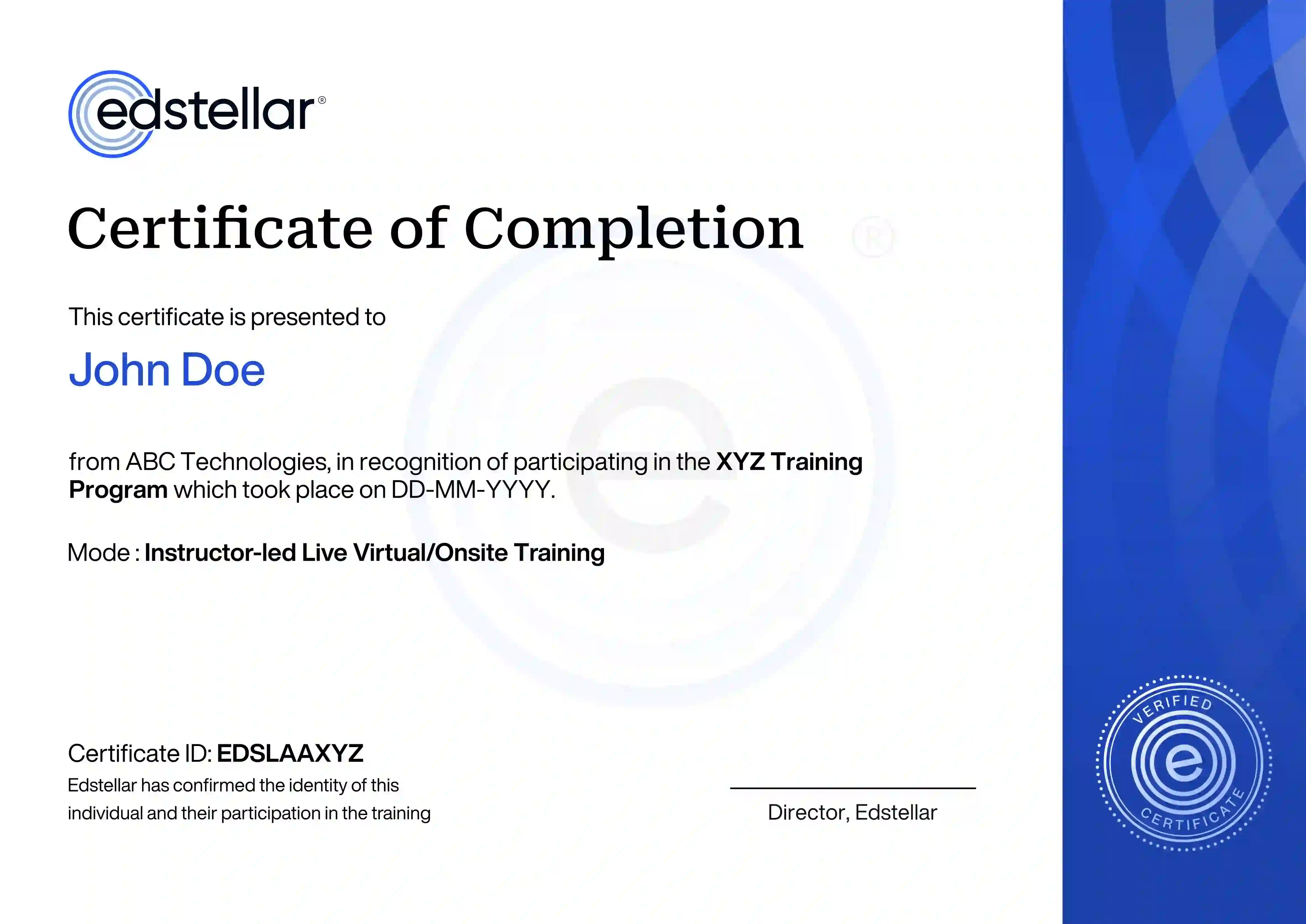
        Upon successful completion of the training course offered by Edstellar, employees receive a course completion certificate, symbolizing their dedication to ongoing learning and professional development.

        This certificate validates the employee's acquired skills and is a powerful motivator, inspiring them to enhance their expertise further and contribute effectively to organizational success.

        Certificate of Excellence

        Other Related Corporate Training Courses