Drive Team Excellence with Multi-Modal Vector Search Corporate Training

Empower your teams with expert-led on-site, off-site, and virtual Multi-Modal Vector Search Training through Edstellar, a premier corporate training provider for organizations globally. Designed to meet your specific training needs, this group training program ensures your team is primed to drive your business goals. Help your employees build lasting capabilities that translate into real performance gains.

Multi-Modal Vector Search is a transformative approach that enables AI-powered systems to retrieve semantically relevant results across different data modalities including text, images, audio, and video. As organizations adopt generative AI and recommendation systems, the ability to search and retrieve across heterogeneous data types has become a critical engineering capability. This training provides participants with the theoretical foundations and practical skills required to architect, build, and deploy production-grade multi-modal vector search systems.

Edstellar's Multi-Modal Vector Search Instructor-led course offers virtual/onsite training options designed for technology teams seeking advanced expertise in embedding models, vector databases, and cross-modal retrieval. Participants will gain hands-on experience working with leading vector database platforms, state-of-the-art embedding architectures, and ANN indexing strategies. The course culminates in building complete multi-modal RAG pipelines and deploying optimized search infrastructure at scale, equipping teams with immediately applicable skills to accelerate AI-driven product development.

Get Customized Expert-led Training for Your Teams
Customized Training Delivery
Scale Your Training: Small to Large Teams
In-person Onsite, Live Virtual or Hybrid Training Modes
Plan from 2000+ Industry-ready Training Programs
Experience Hands-On Learning from Industry Experts
Delivery Capability Across 100+ Countries & 10+ Languages
""""

Key Skills Employees Gain from Instructor-led Multi-Modal Vector Search Training

Multi-Modal Vector Search skills corporate training will enable teams to effectively apply their learnings at work.

  • Multi-modal embedding generation for text, image, and audio data
  • Vector database configuration and management using Pinecone, Weaviate, and Qdrant
  • Approximate Nearest Neighbor (ANN) algorithm implementation and indexing
  • Cross-modal retrieval and multi-modal fusion strategy design
  • Building and deploying multi-modal RAG pipelines
  • Scaling and optimizing vector search infrastructure for production
  • Evaluating and fine-tuning multi-modal search models for accuracy

Key Learning Outcomes of Multi-Modal Vector Search Training Workshop

Upon completing Edstellar’s Multi-Modal Vector Search workshop, employees will gain valuable, job-relevant insights and develop the confidence to apply their learning effectively in the professional environment.

  • Design and implement multi-modal embedding pipelines for text, image, and audio data sources
  • Configure and query vector databases including Pinecone, Weaviate, and Qdrant for production use cases
  • Apply ANN indexing algorithms such as HNSW and IVF to optimize search speed and accuracy
  • Build end-to-end multi-modal RAG pipelines that integrate LLMs with vector search backends
  • Evaluate and fine-tune multi-modal retrieval models to meet accuracy and latency requirements
  • Deploy and scale vector search infrastructure to handle enterprise-grade workloads reliably

Key Benefits of the Multi-Modal Vector Search Group Training

Attending our Multi-Modal Vector Search group training classes provides your team with a powerful opportunity to build skills, boost confidence, and develop a deeper understanding of the concepts that matter most. The collaborative learning environment fosters knowledge sharing and enables employees to translate insights into actionable work outcomes.

  • Expert-led instructor training with hands-on multi-modal vector search exercises and real-world case studies
  • Covers text, image, audio, and video embedding generation using state-of-the-art models
  • Practical sessions on configuring and querying Pinecone, Weaviate, and Qdrant vector databases
  • In-depth training on ANN algorithms including HNSW, IVF, and FAISS indexing strategies
  • Guidance on designing cross-modal retrieval and multi-modal fusion architectures
  • Hands-on multi-modal RAG pipeline construction integrating LLMs with vector search backends
  • Scalability and performance optimization techniques for production vector search deployments
  • Model evaluation, fine-tuning, and monitoring strategies for sustained search quality
  • Available as onsite or virtual instructor-led training tailored to organizational needs
  • Customizable curriculum aligned with industry-specific multi-modal AI use cases

Topics and Outline of Multi-Modal Vector Search Training

Our virtual and on-premise Multi-Modal Vector Search training curriculum is structured into focused modules developed by industry experts. This training for organizations provides an interactive learning experience that addresses the evolving demands of the workplace, making it both relevant and practical.

  1. Introduction to Vector Representations and Semantic Search
    • Difference between keyword search and vector-based semantic search
    • How dense vector embeddings capture semantic meaning
    • Overview of embedding spaces and similarity metrics
    • Real-world use cases for vector search in enterprise AI
  2. Embedding Model Architectures
    • Transformer-based models for generating text embeddings
    • Contrastive learning and its role in embedding quality
    • Sentence transformers and bi-encoder vs cross-encoder models
    • Choosing the right embedding model for specific tasks
  3. Similarity Metrics and Distance Functions
    • Cosine similarity, dot product, and Euclidean distance explained
    • When to use each metric for retrieval tasks
    • Impact of normalization on similarity calculations
    • Benchmarking similarity functions for accuracy and speed
  4. Vector Indexing Fundamentals
    • Flat indexing and brute-force search methods
    • Introduction to approximate nearest neighbor (ANN) indexing
    • Trade-offs between recall, precision, and query latency
    • Overview of popular indexing libraries and frameworks
  5. Multi-Modal Search Concepts
    • Defining multi-modality in the context of AI search systems
    • Challenges of aligning embeddings across different data types
    • Shared embedding spaces and cross-modal alignment techniques
    • Industry examples of deployed multi-modal search systems
  6. Setting Up the Development Environment
    • Installing Python dependencies and embedding libraries
    • Configuring GPU environments for embedding generation
    • Connecting to vector database instances locally and in the cloud
    • Running a simple end-to-end vector search demonstration
  1. Text Preprocessing for Embedding Pipelines
    • Tokenization strategies for different embedding models
    • Handling long documents with chunking and sliding windows
    • Cleaning and normalizing text data for consistent embeddings
    • Managing multilingual text in embedding pipelines
  2. State-of-the-Art Text Embedding Models
    • OpenAI, Cohere, and open-source embedding model comparison
    • Using Hugging Face sentence-transformers for text embeddings
    • Fine-tuning pre-trained models on domain-specific corpora
    • Evaluating text embedding quality with MTEB benchmarks
  3. Building a Semantic Search Engine
    • Encoding a document corpus into vector representations
    • Storing embeddings in a vector database for retrieval
    • Query encoding and nearest neighbor search execution
    • Post-processing and ranking retrieved results
  4. Hybrid Search with Dense and Sparse Vectors
    • Combining BM25 keyword search with dense vector retrieval
    • Reciprocal rank fusion for hybrid result merging
    • SPLADE and learned sparse representations overview
    • Tuning hybrid search weights for optimal performance
  5. Reranking and Result Refinement
    • Cross-encoder reranking to improve precision of top results
    • Diversity-aware reranking to reduce redundancy
    • Contextual filtering with metadata during retrieval
    • Latency vs accuracy trade-offs in reranking pipelines
  6. Evaluating Semantic Search Quality
    • Recall@K, MRR, and NDCG metrics for search evaluation
    • Building evaluation datasets and relevance judgment sets
    • A/B testing semantic search system improvements
    • Continuous evaluation pipelines for production systems
  1. Fundamentals of Image Embedding Generation
    • CNN vs Vision Transformer (ViT) architectures for image encoding
    • Using pre-trained models such as CLIP, ResNet, and DINO
    • Extracting feature vectors from intermediate model layers
    • Image preprocessing pipelines for consistent embedding quality
  2. CLIP and Contrastive Vision-Language Models
    • How CLIP aligns image and text in a shared embedding space
    • Zero-shot image classification using CLIP embeddings
    • Fine-tuning CLIP on domain-specific image-text pairs
    • Evaluating CLIP performance on retrieval benchmarks
  3. Building a Visual Search System
    • Encoding image datasets and storing in a vector database
    • Image query encoding and similarity search implementation
    • Handling image metadata and enabling filtered visual search
    • Serving visual search results via REST APIs
  4. Cross-Modal Image-Text Search
    • Text-to-image retrieval using shared embedding spaces
    • Image-to-text retrieval and caption-based search
    • Aligning heterogeneous embeddings for cross-modal queries
    • Handling embedding space drift in deployed systems
  5. Image Data Augmentation for Robust Embeddings
    • Augmentation strategies to improve embedding generalization
    • Handling image quality variations and low-resolution inputs
    • Synthetic data generation to supplement training sets
    • Impact of augmentation on downstream retrieval accuracy
  6. Scaling Visual Search Infrastructure
    • Batch processing large image corpora for embedding generation
    • Distributed storage and retrieval for image vector datasets
    • Caching strategies for frequently queried image embeddings
    • Monitoring visual search latency and throughput in production
  1. Audio Feature Extraction and Representation
    • Mel spectrograms, MFCCs, and raw waveform representations
    • Pre-trained audio models including Wav2Vec 2.0 and Whisper
    • Extracting fixed-length embeddings from variable-duration audio
    • Use cases for audio vector search in enterprise environments
  2. Speech and Music Embedding Models
    • Speaker verification and identification using embedding similarity
    • Music similarity search with audio fingerprinting and embeddings
    • Multilingual speech embedding alignment techniques
    • Benchmarking audio embedding models on retrieval tasks
  3. Video Understanding and Frame-Level Embeddings
    • Extracting per-frame visual embeddings from video streams
    • Temporal aggregation strategies for video-level representations
    • Using models like VideoMAE and CLIP-based video encoders
    • Handling long-form video content in embedding pipelines
  4. Joint Audio-Visual Embedding Models
    • Training models that align audio and visual representations
    • Audio-visual correspondence and contrastive learning objectives
    • Applications in video retrieval and multimedia recommendation
    • Evaluating joint audio-visual embedding quality
  5. Building Audio and Video Search Pipelines
    • Ingesting audio and video files and extracting embeddings at scale
    • Storing and indexing audio-visual embeddings in vector databases
    • Enabling text-to-video and audio-to-audio search queries
    • Optimizing pipeline throughput for media-heavy workloads
  6. Handling Multi-Modal Media Metadata
    • Attaching structured metadata to audio and video embeddings
    • Enabling hybrid metadata and vector-based filtering
    • Managing versioning of embeddings as models are updated
    • Best practices for data governance in media embedding pipelines
  1. Foundations of Multi-Modal Fusion
    • Early, late, and hybrid fusion approaches for multi-modal data
    • Choosing a fusion strategy based on task requirements
    • Dimensionality alignment for combining heterogeneous embeddings
    • Challenges of modality imbalance in fusion pipelines
  2. Shared Embedding Space Architectures
    • Training projection layers to map modalities into a common space
    • Contrastive objectives for cross-modal alignment
    • Zero-shot transfer across modalities using shared spaces
    • Evaluating cross-modal alignment quality with retrieval metrics
  3. Cross-Modal Query Strategies
    • Text-to-image, image-to-audio, and audio-to-text query patterns
    • Handling asymmetric query-document pairs in retrieval
    • Combining multiple query modalities for richer retrieval
    • Fallback strategies when a query modality is unavailable
  4. Attention-Based Fusion Mechanisms
    • Cross-attention layers for modality interaction modeling
    • Transformer-based multi-modal encoders and their architectures
    • Training attention-based fusion models from scratch and fine-tuning
    • Computational cost analysis of attention fusion vs simple concatenation
  5. Retrieval Augmented Generation with Multi-Modal Context
    • Feeding retrieved multi-modal context into generative LLM pipelines
    • Structuring multi-modal prompts for consistent LLM outputs
    • Managing context window limits with multi-modal retrieved content
    • Use cases for multi-modal RAG in knowledge management systems
  6. Evaluating Cross-Modal Retrieval Performance
    • Cross-modal retrieval benchmarks including MSCOCO and Flickr30K
    • Precision, recall, and rank-based metrics for cross-modal tasks
    • Human evaluation protocols for multi-modal retrieval quality
    • Iterative improvement cycles based on evaluation feedback
  1. Overview of Vector Database Landscape
    • Comparing Pinecone, Weaviate, Qdrant, Milvus, and pgvector
    • Managed vs self-hosted vector database deployment options
    • Selection criteria based on scale, latency, and cost requirements
    • Integration compatibility with existing ML and data infrastructure
  2. Pinecone Configuration and Operations
    • Creating and managing Pinecone indexes for different embedding types
    • Upsert, query, and delete operations using the Pinecone Python client
    • Namespaces and metadata filtering for multi-tenant search
    • Monitoring Pinecone index performance and usage metrics
  3. Weaviate Schema Design and Querying
    • Designing object schemas with vector and property fields in Weaviate
    • GraphQL and REST query interfaces for vector and hybrid search
    • Weaviate modules for automated vectorization of text and images
    • Configuring HNSW indexing parameters in Weaviate for performance
  4. Qdrant Collections and Payload Filtering
    • Creating Qdrant collections with named vector support for multi-modality
    • Using payload fields for metadata storage and filtered search
    • Batch upsert and streaming ingestion into Qdrant collections
    • Qdrant cluster deployment and horizontal scaling configuration
  5. Multi-Vector Storage for Multi-Modal Search
    • Storing multiple embedding vectors per document in a single record
    • Querying across named vector fields for cross-modal retrieval
    • Managing embedding updates when models are retrained or replaced
    • Schema migration strategies for evolving multi-modal data models
  6. Security, Access Control, and Data Governance
    • API key management and role-based access for vector database endpoints
    • Encrypting embeddings at rest and in transit
    • Audit logging for vector database operations in regulated environments
    • Data retention policies and GDPR compliance for stored embeddings
  1. Why Exact Search Does Not Scale
    • Computational complexity of brute-force nearest neighbor search
    • The curse of dimensionality in high-dimensional vector spaces
    • Trade-offs between recall and query latency in large-scale search
    • When approximate search is acceptable for production use cases
  2. HNSW: Hierarchical Navigable Small World Graphs
    • HNSW graph construction and layer-based navigation explained
    • Tuning ef_construction and M parameters for index quality
    • HNSW query-time parameters and their effect on recall vs speed
    • Memory footprint of HNSW indexes and optimization strategies
  3. IVF: Inverted File Index with Product Quantization
    • Clustering-based IVF partitioning with k-means centroids
    • Product quantization for compressed vector storage and fast search
    • nprobe tuning for controlling recall at query time
    • Combining IVF with HNSW for hybrid indexing strategies
  4. FAISS Library Deep Dive
    • Installing and configuring FAISS for CPU and GPU environments
    • Building flat, IVF, and HNSW indexes with the FAISS Python API
    • GPU-accelerated search with FAISS for high-throughput workloads
    • Serializing and loading FAISS indexes for production deployment
  5. ScaNN and Other Modern ANN Libraries
    • Overview of Google ScaNN and its anisotropic quantization approach
    • Benchmarking ANN libraries using the ann-benchmarks framework
    • Annoy and NGT for tree-based approximate nearest neighbor search
    • Selecting the right ANN library for specific hardware and scale
  6. Dynamic Indexing and Real-Time Updates
    • Challenges of inserting new vectors into existing ANN indexes
    • Segment-based indexing for supporting real-time upserts
    • Index rebuild schedules and online vs offline index update strategies
    • Handling deleted vectors and tombstoning in ANN indexes
  1. Introduction to Retrieval Augmented Generation
    • RAG architecture overview and how retrieval enhances LLM outputs
    • Naive RAG vs advanced RAG pipeline design patterns
    • Multi-modal extensions to standard text-only RAG systems
    • Use cases for multi-modal RAG in enterprise knowledge systems
  2. Document Ingestion and Multi-Modal Chunking
    • Extracting text, images, and tables from PDFs and documents
    • Chunking strategies that preserve semantic coherence across modalities
    • Generating embeddings for each modality during document ingestion
    • Metadata tagging and lineage tracking for ingested documents
  3. Multi-Modal Retrieval and Context Assembly
    • Executing parallel retrieval queries across text and image indexes
    • Merging and ranking results from multiple modality retrievers
    • Assembling multi-modal context packages for LLM consumption
    • Handling context window limits with selective multi-modal inclusion
  4. LLM Integration with Multi-Modal Context
    • Passing retrieved images and text to vision-language LLM APIs
    • Prompt engineering for multi-modal context and grounded generation
    • Streaming responses with citations linked to retrieved sources
    • Handling LLM hallucinations through retrieval grounding strategies
  5. Orchestration with LangChain and LlamaIndex
    • Building multi-modal RAG chains using LangChain retriever abstractions
    • LlamaIndex multi-modal index and query engine configuration
    • Custom retriever implementations for cross-modal search pipelines
    • Integrating LangSmith for tracing and debugging RAG pipelines
  6. Testing and Validating RAG Pipeline Quality
    • Automated evaluation with RAGAS metrics for retrieval and generation
    • Context relevance, faithfulness, and answer correctness scoring
    • Human-in-the-loop evaluation workflows for multi-modal RAG
    • Iterative pipeline improvements based on evaluation findings
  1. Performance Bottlenecks in Vector Search Systems
    • Identifying latency sources in embedding generation pipelines
    • Query throughput limits in vector database deployments
    • Network and I/O bottlenecks in distributed search architectures
    • Profiling tools for vector search performance analysis
  2. Embedding Caching and Precomputation Strategies
    • Caching frequently requested embeddings to reduce model inference costs
    • Precomputing embeddings at ingestion time vs query time trade-offs
    • Using Redis and Memcached for embedding cache storage
    • Cache invalidation strategies when embedding models are updated
  3. Horizontal Scaling of Vector Databases
    • Sharding vector indexes across multiple nodes for scale-out
    • Replication strategies for high availability in vector search clusters
    • Load balancing query traffic across vector database replicas
    • Kubernetes deployment patterns for cloud-native vector databases
  4. Quantization and Compression for Storage Efficiency
    • Scalar quantization to reduce embedding storage footprint
    • Product quantization trade-offs in accuracy vs storage savings
    • Binary and 1-bit quantization for extreme compression scenarios
    • Matryoshka representation learning for flexible embedding dimensionality
  5. Asynchronous and Streaming Ingestion Pipelines
    • Kafka-based streaming pipelines for real-time embedding ingestion
    • Async batch processing workers for high-throughput document indexing
    • Backpressure handling and dead-letter queues in ingestion pipelines
    • Idempotent ingestion design to prevent duplicate vector records
  6. Cost Optimization for Vector Search at Scale
    • Estimating infrastructure costs for embedding generation and storage
    • Tiered storage strategies using hot and cold vector indexes
    • Selecting cost-effective cloud instance types for GPU embedding workloads
    • FinOps practices for managing vector search infrastructure spending
  1. Comprehensive Retrieval Evaluation Frameworks
    • Building multi-modal evaluation datasets with annotated relevance labels
    • Offline evaluation metrics: Recall@K, MRR, MAP, and NDCG
    • Online evaluation through A/B testing and user engagement signals
    • Automating evaluation pipelines with continuous integration workflows
  2. Fine-Tuning Embedding Models for Domain Adaptation
    • Collecting domain-specific training pairs for contrastive fine-tuning
    • Fine-tuning with triplet loss, contrastive loss, and in-batch negatives
    • Parameter-efficient fine-tuning using LoRA for embedding models
    • Preventing catastrophic forgetting during domain-specific fine-tuning
  3. Model Versioning and Embedding Migration
    • Managing multiple embedding model versions in a production system
    • Re-indexing strategies when upgrading to a new embedding model
    • Blue-green deployment for zero-downtime embedding model updates
    • Tracking model lineage and embedding provenance for auditing
  4. Monitoring and Observability for Vector Search
    • Key metrics to monitor: query latency, recall drift, and throughput
    • Embedding distribution monitoring to detect data and model drift
    • Alerting on retrieval quality degradation using automated checks
    • Integrating vector search observability with Grafana and Prometheus
  5. CI/CD Pipelines for Multi-Modal Search Systems
    • Automating embedding pipeline testing with unit and integration tests
    • Containerizing embedding services with Docker for reproducible deployments
    • GitOps workflows for managing vector database schema and index changes
    • Canary deployments for gradual rollout of new embedding models
  6. Capstone: End-to-End Multi-Modal Search System Deployment
    • Designing a production-ready multi-modal search architecture
    • Building the full pipeline from data ingestion to query serving
    • Conducting load testing and tuning the system for production SLAs
    • Presenting deployment decisions and performance results to stakeholders

Who Can Take the Multi-Modal Vector Search Training Course

The Multi-Modal Vector Search training program can also be taken by professionals at various levels in the organization.

  • Machine Learning Engineers
  • AI and Data Scientists
  • Backend and Platform Engineers
  • Search and Recommendation System Developers
  • MLOps and AI Infrastructure Engineers
  • Technical Architects and Solution Designers

Prerequisites for Multi-Modal Vector Search Training

Professionals should have experience with machine learning, Python, and basic knowledge of embeddings to take the Multi-Modal Vector Search training course.

Request a Quote for your Corporate Training Requirements

Valid number

Delivering Training for Organizations across 100 Countries and 10+ Languages

Corporate Group Training Delivery Modes
for Multi-Modal Vector Search Training

At Edstellar, we understand the importance of impactful and engaging training for employees. As a leading Multi-Modal Vector Search training provider, we ensure the training is more interactive by offering Face-to-Face onsite/in-house or virtual/online sessions for companies. This approach has proven to be effective, outcome-oriented, and produces a well-rounded training experience for your teams.

Virtual Multi-Modal Vector Search Training

Edstellar's Multi-Modal Vector Search virtual/online training sessions bring expert-led, high-quality training to your teams anywhere, ensuring consistency and seamless integration into their schedules.

With global reach, your employees can get trained from various locations
The consistent training quality ensures uniform learning outcomes
Participants can attend training in their own space without the need for traveling
Organizations can scale learning by accommodating large groups of participants
Interactive tools can be used to enhance learning engagement
On-site Multi-Modal Vector Search Training

Edstellar's Multi-Modal Vector Search inhouse face to face instructor-led training delivers immersive and insightful learning experiences right in the comfort of your office.

Higher engagement and better learning experience through face-to-face interaction
Workplace environment can be tailored to learning requirements
Team collaboration and knowledge sharing improves training effectiveness
Demonstration of processes for hands-on learning and better understanding
Participants can get their doubts clarified and gain valuable insights through direct interaction
Off-site Multi-Modal Vector Search Training

Edstellar's Multi-Modal Vector Search offsite face-to-face instructor-led group training offer a unique opportunity for teams to immerse themselves in focused and dynamic learning environments away from their usual workplace distractions.

Distraction-free environment improves learning engagement
Team bonding can be improved through activities
Dedicated schedule for training away from office set up can improve learning effectiveness
Boosts employee morale and reflects organization's commitment to employee development

Explore Our Customized Pricing Package
for
Multi-Modal Vector Search Corporate Training

Looking for pricing details for onsite, offsite, or virtual instructor-led Multi-Modal Vector Search training? Get a customized proposal tailored to your team’s specific needs.

Request a Group Training Quote
""
How Many Team Members Need Training?
Please select an option or fill in the custom field.
"'

Is Your Corporate Training Requirement Only for Multi-Modal Vector Search?

Please select at least one course.
""
Add the List of Training Workshops
search icon

      Please select the course

      No. of Courses selected: 0

      Clear

      Upload a CSV

      Send us your Training Requirements in 3 Easy steps

      1. 1
      2. 2
        Add the required training workshops
      3. 3
        Upload to get a quick quote or email it to contact@edstellar.com

      ""

      Looking for a Complete Package?

      Looking for a one-time pricing option for all your annual training requirements?

      View Corporate Training Packages
      ""
      Select the Option that Best Describes Your Corporate Training Requirement

      Please select an option or choose from the recurring options.
      ""
      Verify and Submit Your Request

      Review Your Corporate Training Selection Summary

      Training Program: Multi-Modal Vector Search Training

      1. No of Team Members

      2. Selected Training Preference

      3. Selected Recurring Sessions

      1

      Review your Requirements

      Training Workshops Selected :


        Excel
        File has been
        successfully uploaded.
        Fill the form to submit
 your details
        Submit Your Professional Contact Information
        Valid number
        We've received your enquiry. Our team will be in touch soon.
        Oops! Something went wrong while submitting the form.
        Starter
        120 licences

        Tailor-Made Trainee Licenses with Our Exclusive Training Packages!

        View Package

        64 hours of group training (includes VILT/In-person On-site)

        Tailored for SMBs

        Growth
        320 licences

        Tailor-Made Trainee Licenses with Our Exclusive Training Packages!

        View Package

        160 hours of group training (includes VILT/In-person On-site)

        Ideal for growing SMBs

        Enterprise
        800 licences

        Tailor-Made Trainee Licenses with Our Exclusive Training Packages!

        View Package

        400 hours of group training (includes VILT/In-person On-site)

        Designed for large corporations

        Custom
        Unlimited licenses

        Tailor-Made Trainee Licenses with Our Exclusive Training Packages!

        View Package

        Unlimited duration

        Designed for large corporations

        Edstellar: Your Go-to Multi-Modal Vector Search Training Company

        Experienced Trainers

        Our trainers bring years of industry expertise to ensure the training is practical and impactful.

        Quality Training

        With a strong track record of delivering training worldwide, Edstellar maintains its reputation for its quality and training engagement.

        Industry-Relevant Curriculum

        Our course is designed by experts and is tailored to meet the demands of the current industry.

        Customizable Training

        Our course can be customized to meet the unique needs and goals of your organization.

        Comprehensive Support

        We provide pre and post training support to your organization to ensure a complete learning experience.

        Multilingual Training Capabilities

        We offer training in multiple languages to cater to diverse and global teams.

        Testimonials

        What Our Clients Say

        We pride ourselves on delivering exceptional training solutions. Here's what our clients have to say about their experiences with Edstellar.

        "Edstellar's virtual Multi-Modal Vector Search training delivered outstanding results for our AI engineering team. Within weeks of completing the program, our engineers successfully deployed a cross-modal retrieval system that reduced product search latency by 35% and improved relevance scores by 28%. The instructor's ability to break down complex embedding concepts into practical exercises made all the difference."

        Rohan Mehta

        VP of Engineering,

        A Global AI Solutions Company

        "The onsite Multi-Modal Vector Search training by Edstellar exceeded our expectations. Our data science team gained hands-on experience with Pinecone and Weaviate, and we went from prototype to production with our image-text search system in under 6 weeks. The measurable impact on our recommendation engine accuracy was immediately visible, with a 40% improvement in user engagement metrics post-deployment."

        Priya Nair

        Head of Data Science,

        A Leading E-Commerce Enterprise

        "We sent our ML platform team to Edstellar's intensive Multi-Modal Vector Search bootcamp and the outcomes were transformative. The deep focus on ANN algorithms, RAG pipeline construction, and production deployment gave our engineers the confidence to architect a scalable multi-modal search system from scratch. We observed a 50% reduction in embedding pipeline processing time after applying the optimization techniques covered in training."

        Samuel Okafor

        Director of ML Infrastructure,

        A Global Media Technology Firm

        "Edstellar's IT & Technical training programs have been instrumental in strengthening our engineering teams and building future-ready capabilities. The hands-on approach, practical cloud scenarios, and expert guidance helped our teams improve technical depth, problem-solving skills, and execution across multiple projects. We're excited to extend more of these impactful programs to other business units."

        Aditi Rao

        L&D Head,

        A Global Technology Company

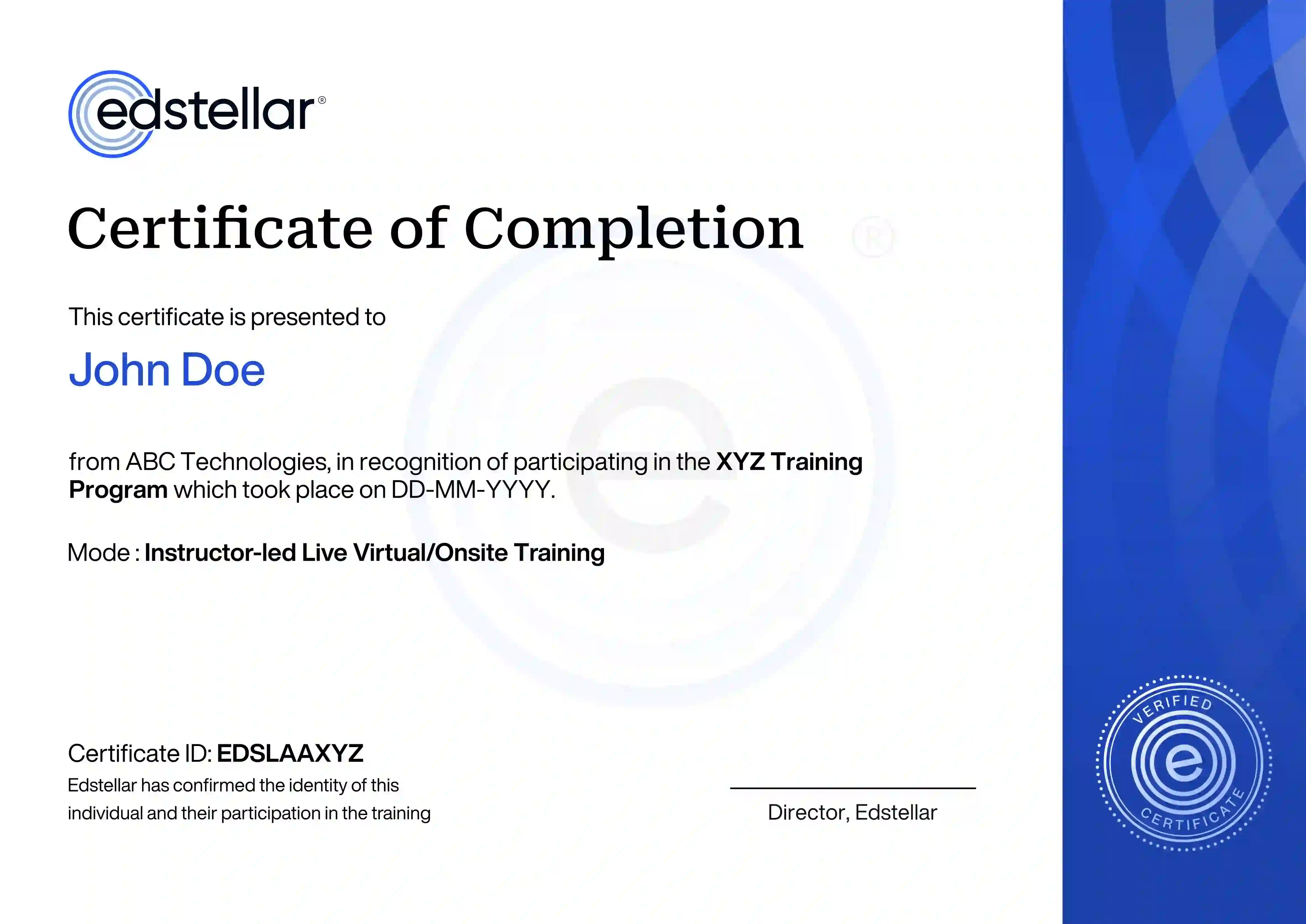
        Get Your Team Members Recognized with Edstellar’s Course Certificate

        Upon successful completion of the training course offered by Edstellar, employees receive a course completion certificate, symbolizing their dedication to ongoing learning and professional development.

        This certificate validates the employee's acquired skills and is a powerful motivator, inspiring them to enhance their expertise further and contribute effectively to organizational success.

        Certificate of Excellence

        Other Related Corporate Training Courses