Drive Team Excellence with LangChain Application Development Corporate Training

Empower your teams with expert-led on-site, off-site, and virtual LangChain Application Development Training through Edstellar, a premier corporate training provider for organizations globally. Designed to meet your specific training needs, this group training program ensures your team is primed to drive your business goals. Help your employees build lasting capabilities that translate into real performance gains.

LangChain is a leading open-source framework for building LLM-powered applications, enabling developers to compose chains of prompts, models, memory, agents, and tools into coherent, production-ready workflows. It simplifies the development of RAG systems, autonomous agents, chatbots, and data-augmented AI applications by providing modular components and seamless integrations with vector databases, external APIs, and cloud platforms. This training covers LangChain fundamentals through to advanced topics including LCEL, agent design, vector DB integration, evaluation, and scalable production deployment.

Edstellar's LangChain Application Development Instructor-led course offers virtual/onsite training options to meet professionals' diverse needs. This flexibility ensures that professionals and teams can engage in learning experiences that best suit their logistical and learning preferences. What sets the Edstellar course apart is its emphasis on practical experience, with hands-on projects and real-world scenarios that bring LangChain concepts to life. Edstellar equips professionals with the skills and confidence to design, build, and deploy LangChain applications effectively in their AI development projects.

Get Customized Expert-led Training for Your Teams
Customized Training Delivery
Scale Your Training: Small to Large Teams
In-person Onsite, Live Virtual or Hybrid Training Modes
Plan from 2000+ Industry-ready Training Programs
Experience Hands-On Learning from Industry Experts
Delivery Capability Across 100+ Countries & 10+ Languages
""""

Key Skills Employees Gain from Instructor-led LangChain Application Development Training

LangChain Application Development skills corporate training will enable teams to effectively apply their learnings at work.

  • LangChain Chain and Prompt Design
  • RAG Pipeline Development
  • LangChain Agent and Tool Integration
  • Memory Management in LLM Applications
  • LCEL Advanced Chain Construction
  • Vector Database Integration with LangChain
  • LangChain Production Deployment

Key Learning Outcomes of LangChain Application Development Training Workshop

Upon completing Edstellar’s LangChain Application Development workshop, employees will gain valuable, job-relevant insights and develop the confidence to apply their learning effectively in the professional environment.

  • Master LangChain core components including chains, prompts, models, and output parsers to build modular and production-grade LLM application architectures.
  • Gain expertise in building RAG pipelines with LangChain by integrating document loaders, vector stores, embeddings, and retrieval chains for accurate, knowledge-grounded responses.
  • Develop proficiency in designing and deploying LangChain agents with custom tool integration to enable autonomous, multi-step reasoning and task execution workflows.
  • Learn memory and state management strategies in LangChain, applying conversation buffers, entity memory, and summary memory to support contextual multi-turn LLM applications.
  • Build advanced chain pipelines using LangChain Expression Language (LCEL), leveraging streaming, parallelism, and fallback mechanisms for robust production deployments.
  • Apply testing, evaluation, and production deployment best practices for LangChain applications using LangSmith, tracing, containerization, and cloud scaling strategies.

Key Benefits of the LangChain Application Development Group Training

Attending our LangChain Application Development group training classes provides your team with a powerful opportunity to build skills, boost confidence, and develop a deeper understanding of the concepts that matter most. The collaborative learning environment fosters knowledge sharing and enables employees to translate insights into actionable work outcomes.

  • Understand LangChain architecture by learning how chains, models, prompts, and output parsers integrate to build modular, production-ready LLM applications.
  • Design and implement LangChain prompt templates and output parsers to structure LLM interactions and extract structured data from model responses.
  • Build end-to-end RAG pipelines using LangChain document loaders, text splitters, embedding models, vector stores, and retrieval chains for knowledge-grounded AI.
  • Develop LangChain agents with custom tools, enabling autonomous task execution, API calls, and multi-step reasoning workflows powered by LLMs.
  • Implement memory and state management in LangChain applications using conversation buffers, summary memory, and entity memory for contextual multi-turn interactions.
  • Master LangChain Expression Language (LCEL) to compose advanced, declarative chain pipelines with streaming, parallelism, and fallback support.
  • Integrate vector databases including Pinecone, Chroma, and Weaviate with LangChain to enable efficient semantic search and document retrieval at scale.
  • Connect LangChain applications to external APIs and services using tool-calling patterns, enabling real-time data access and task automation.
  • Test, evaluate, and debug LangChain applications using LangSmith, automated evaluation pipelines, and tracing tools to ensure reliability and accuracy.
  • Deploy and scale LangChain applications in production using containerization, cloud platforms, API gateways, and monitoring best practices.

Topics and Outline of LangChain Application Development Training

Our virtual and on-premise LangChain Application Development training curriculum is structured into focused modules developed by industry experts. This training for organizations provides an interactive learning experience that addresses the evolving demands of the workplace, making it both relevant and practical.

  1. Overview of Large Language Models
    • Transformer architecture and attention mechanisms
    • LLM capabilities, limitations, and use cases
    • Prompt-response interaction fundamentals
    • Token-based processing and context windows
  2. LangChain Framework Fundamentals
    • LangChain architecture and design philosophy
    • Core abstractions and component overview
    • LangChain vs other LLM frameworks
    • Installation, setup, and environment configuration
  3. LLM Application Architecture Patterns
    • Monolithic vs modular LLM application design
    • Chain-based orchestration patterns
    • Agent and tool-based architectures
    • RAG vs fine-tuning architectural trade-offs
  4. LangChain Model Integrations
    • Connecting OpenAI, Anthropic, and open-source models
    • LLM and chat model interfaces in LangChain
    • Model configuration and parameter tuning
    • Switching and comparing models programmatically
  5. Development Environment and Tooling
    • LangChain CLI and project scaffolding
    • API key management and environment variables
    • Dependency management and versioning
    • LangSmith setup for tracing and monitoring
  6. Ethical and Responsible LLM Development
    • Bias, fairness, and hallucination risks
    • Data privacy considerations in LLM apps
    • Content filtering and moderation strategies
    • Responsible AI principles for production systems
  1. Prompt Templates and Management
    • PromptTemplate and ChatPromptTemplate design
    • Dynamic variable injection and formatting
    • Few-shot prompt templates with examples
    • Partial prompt templates and reusability
  2. LangChain Model Wrappers
    • LLM vs ChatModel interfaces
    • Synchronous and asynchronous model calls
    • Streaming model responses
    • Batch inference and token usage tracking
  3. Output Parsers
    • String, JSON, and Pydantic output parsers
    • Structured output extraction from LLMs
    • Auto-fixing and retry output parsers
    • Custom output parser implementation
  4. Chain Types and Composition
    • LLMChain and SimpleSequentialChain patterns
    • SequentialChain for multi-step workflows
    • RouterChain for conditional branching
    • TransformChain for data preprocessing
  5. Document Loaders and Text Splitters
    • Loading PDF, HTML, CSV, and web content
    • RecursiveCharacterTextSplitter strategies
    • Semantic and token-based splitting
    • Metadata preservation during loading
  6. Callbacks and Event Handling
    • LangChain callback system architecture
    • Custom callback handler implementation
    • Streaming callbacks for real-time output
    • Logging and debugging with callbacks
  1. RAG Architecture and Data Flow
    • Indexing and retrieval pipeline overview
    • Document ingestion and preprocessing stages
    • Query-time retrieval and generation flow
    • RAG vs fine-tuning decision criteria
  2. Embedding Models in LangChain
    • OpenAI and HuggingFace embedding integrations
    • Generating and storing document embeddings
    • Embedding model selection and benchmarking
    • Batch embedding and caching strategies
  3. Vector Store Integration
    • Chroma, Pinecone, and FAISS setup in LangChain
    • Indexing and upserting document vectors
    • Similarity search and metadata filtering
    • Persistent vs in-memory vector stores
  4. Retrieval Chains and RetrievalQA
    • RetrievalQA chain configuration
    • ConversationalRetrievalChain for chat-based RAG
    • Custom retriever implementation
    • Multi-query retrieval for improved recall
  5. Advanced Retrieval Techniques
    • Hybrid search combining dense and sparse retrieval
    • Contextual compression and document reranking
    • Parent-child document retrieval strategies
    • Self-querying retriever with metadata filters
  6. RAG Pipeline Optimization
    • Chunking strategy impact on retrieval quality
    • Retrieval parameter tuning (top-k, thresholds)
    • Reducing hallucinations with grounding prompts
    • End-to-end RAG pipeline performance profiling
  1. Agent Fundamentals in LangChain
    • Agent architecture and reasoning loops
    • ReAct (Reason and Act) agent pattern
    • Agent types: zero-shot, structured, conversational
    • Agent executor configuration and limits
  2. Built-in Tools and Tool Kits
    • LangChain built-in tools overview (search, calculator)
    • Tool kits for SQL, CSV, and Python REPL
    • Web search and API tool integration
    • Tool selection and routing logic
  3. Custom Tool Development
    • Defining custom tools with @tool decorator
    • Tool input schema with Pydantic validation
    • Async tool implementation for concurrent execution
    • Tool error handling and retry mechanisms
  4. Multi-Agent Systems
    • Designing multi-agent collaboration workflows
    • Agent supervisor and subagent patterns
    • LangGraph for stateful multi-agent orchestration
    • Inter-agent communication and task delegation
  5. Tool Calling with LLMs
    • OpenAI function calling integration
    • Structured tool call parsing and execution
    • Parallel tool calling in agent workflows
    • Tool call result injection back to LLM
  6. Agent Evaluation and Safety
    • Evaluating agent task completion accuracy
    • Limiting agent scope with guardrails
    • Logging and tracing agent decision steps
    • Handling infinite loops and runaway agents
  1. Memory Fundamentals in LangChain
    • Why memory matters in multi-turn LLM applications
    • Memory types and selection criteria
    • Memory integration with chains and agents
    • Memory persistence and session management
  2. Conversation Buffer Memory
    • ConversationBufferMemory configuration
    • ConversationBufferWindowMemory for context control
    • Managing token limits with windowed memory
    • Injecting conversation history into prompts
  3. Summary and Entity Memory
    • ConversationSummaryMemory for long conversations
    • ConversationSummaryBufferMemory hybrid approach
    • Entity memory for named entity tracking
    • Knowledge graph memory for structured recall
  4. Vector Store-Backed Memory
    • VectorStoreRetrieverMemory architecture
    • Semantic memory retrieval from conversation history
    • Storing and querying long-term memories
    • Combining vector memory with other memory types
  5. Stateful Application Design
    • Session-based state management patterns
    • User-specific memory stores and isolation
    • Persistent memory with databases (Redis, SQLite)
    • Memory lifecycle management and cleanup
  6. Memory Optimization Strategies
    • Balancing memory depth vs token cost
    • Compressing memory with summarization LLMs
    • Selective memory retention policies
    • Evaluating memory impact on response quality
  1. LCEL Fundamentals
    • LCEL syntax and pipe operator composition
    • Runnable interface and protocol overview
    • Building simple chains with LCEL
    • LCEL vs legacy chain patterns
  2. Advanced LCEL Composition
    • RunnableParallel for concurrent chain execution
    • RunnablePassthrough for input forwarding
    • RunnableLambda for custom transformation steps
    • RunnableBranch for conditional chain routing
  3. Streaming and Async with LCEL
    • Streaming output tokens with LCEL chains
    • Async invoke and astream methods
    • Batch processing with LCEL pipelines
    • Event streaming for UI and API integration
  4. Fallbacks and Error Handling
    • Configuring fallback chains for resilience
    • Model fallback for API rate limit handling
    • Retry logic with exponential backoff
    • Error propagation and graceful degradation
  5. Configurable Chains and Runtime Overrides
    • ConfigurableField for dynamic parameter injection
    • Runtime configuration with config_schema
    • Swapping models and prompts at runtime
    • Chain versioning and A/B testing support
  6. LCEL in Production Architectures
    • Composing complex multi-step LCEL pipelines
    • Integrating LCEL chains with FastAPI and LangServe
    • Observability and tracing for LCEL chains
    • Performance benchmarking of LCEL vs imperative chains
  1. Vector Database Fundamentals for LangChain
    • Vector store abstraction in LangChain
    • Supported vector database integrations overview
    • Choosing the right vector store for your use case
    • Vector indexing algorithms (HNSW, IVF) explained
  2. Chroma Integration
    • Chroma local and persistent setup with LangChain
    • Creating and managing Chroma collections
    • Adding, updating, and deleting documents
    • Similarity search and metadata filtering in Chroma
  3. Pinecone Integration
    • Pinecone index creation and namespace management
    • Upsetting and querying vectors via LangChain
    • Hybrid search with Pinecone sparse-dense index
    • Scaling Pinecone for high-throughput production workloads
  4. Weaviate and FAISS Integration
    • Weaviate schema design and LangChain connector
    • FAISS for local high-performance vector search
    • Persisting and loading FAISS indexes
    • Weaviate hybrid search and generative module
  5. Advanced Vector Store Operations
    • Multi-vector retriever for parent-child document indexing
    • Time-weighted vector retrieval for recency scoring
    • Ensemble retriever combining multiple vector stores
    • Maximal marginal relevance (MMR) search
  6. Vector Store Performance and Maintenance
    • Index refresh and incremental update strategies
    • Monitoring query latency and throughput
    • Cost optimization for managed vector databases
    • Data backup, migration, and versioning
  1. REST API Integration with LangChain
    • Wrapping REST APIs as LangChain tools
    • Authentication handling (API keys, OAuth tokens)
    • Request/response parsing and error handling
    • Rate limiting and retry strategies for external APIs
  2. OpenAI Function Calling in LangChain
    • Defining functions and schemas for tool calling
    • Binding tools to LangChain chat models
    • Parsing and executing tool call results
    • Multi-tool orchestration in a single LLM call
  3. Database and SQL Tool Integration
    • SQLDatabaseChain for natural language to SQL
    • Connecting to PostgreSQL, MySQL, and SQLite
    • Query validation and SQL injection prevention
    • Combining SQL results with LLM-generated responses
  4. Third-Party Service Integrations
    • Google Search, SerpAPI, and Bing tool integration
    • Wolfram Alpha and calculator tool usage
    • Email, Slack, and notification tool integration
    • Custom SaaS platform connectors
  5. File and Data Source Integrations
    • Reading from S3, GCS, and Azure Blob storage
    • Processing Excel, CSV, and JSON data files
    • Web scraping and URL content loading
    • LangChain document transformers for data enrichment
  6. Streaming and Async API Patterns
    • Async API calls within LangChain chains
    • Streaming API responses to end users
    • Concurrent API tool execution with asyncio
    • Timeout and cancellation handling for API tools
  1. LangSmith for Tracing and Observability
    • LangSmith setup and project configuration
    • Tracing chain and agent execution steps
    • Visualizing input/output at each chain node
    • Latency and token usage analysis with LangSmith
  2. Unit and Integration Testing
    • Unit testing LangChain components with pytest
    • Mocking LLM calls for deterministic tests
    • Integration testing RAG and agent pipelines
    • Test dataset creation and management
  3. LLM Application Evaluation Frameworks
    • LangChain evaluation chain types (QA, context, criteria)
    • Using LLMs as judges for automated evaluation
    • Faithfulness, relevancy, and correctness metrics
    • RAGAS framework integration for RAG evaluation
  4. Debugging Common LangChain Issues
    • Diagnosing prompt formatting and injection errors
    • Debugging output parser failures and mismatches
    • Tracing agent loop failures and tool call errors
    • Memory and context window overflow debugging
  5. Regression Testing and CI/CD Integration
    • Building automated regression test suites
    • Integrating LangChain tests into GitHub Actions
    • Dataset versioning for reproducible evaluation
    • Alerting on evaluation metric degradation
  6. Performance Profiling and Optimization
    • Identifying latency bottlenecks in chains and agents
    • Token cost analysis and reduction strategies
    • Caching LLM responses with LangChain cache layer
    • Parallel chain execution for throughput improvement
  1. LangServe for API Deployment
    • LangServe architecture and FastAPI integration
    • Exposing LangChain chains as REST endpoints
    • LangServe playground for interactive testing
    • Authentication and rate limiting for LangServe APIs
  2. Containerization and Orchestration
    • Dockerizing LangChain applications
    • Kubernetes deployment manifests for LLM services
    • Horizontal pod autoscaling for variable load
    • Container resource limits for LLM workloads
  3. Cloud Deployment Strategies
    • Deploying to AWS (ECS, Lambda, SageMaker)
    • Azure Container Apps and Azure OpenAI integration
    • Google Cloud Run for serverless LangChain apps
    • Multi-cloud and hybrid deployment patterns
  4. Scalability and High Availability
    • Load balancing LangChain API instances
    • Connection pooling for vector database access
    • Queue-based processing for long-running chains
    • Circuit breaker patterns for LLM API resilience
  5. Production Monitoring and Alerting
    • Metrics collection with Prometheus and Grafana
    • Distributed tracing with OpenTelemetry
    • Log aggregation and structured logging practices
    • Alerting on latency, error rates, and cost thresholds
  6. Security and Compliance in Production
    • Secrets management for API keys and credentials
    • Data encryption in transit and at rest
    • Input sanitization and prompt injection prevention
    • Audit logging for compliance and governance

Who Can Take the LangChain Application Development Training Course

The LangChain Application Development training program can also be taken by professionals at various levels in the organization.

  • AI/ML Engineers
  • Backend Developers
  • Data Scientists
  • LLM Application Architects
  • Software Engineers (AI/LLM)
  • Technical Product Managers (AI)

Prerequisites for LangChain Application Development Training

Professionals should have a working knowledge of Python programming, familiarity with REST APIs, and a basic understanding of machine learning concepts and large language models to take the LangChain Application Development training course.

Request a Quote for your Corporate Training Requirements

Valid number

Delivering Training for Organizations across 100 Countries and 10+ Languages

Corporate Group Training Delivery Modes
for LangChain Application Development Training

At Edstellar, we understand the importance of impactful and engaging training for employees. As a leading LangChain Application Development training provider, we ensure the training is more interactive by offering Face-to-Face onsite/in-house or virtual/online sessions for companies. This approach has proven to be effective, outcome-oriented, and produces a well-rounded training experience for your teams.

Virtual LangChain Application Development Training

Edstellar's LangChain Application Development virtual/online training sessions bring expert-led, high-quality training to your teams anywhere, ensuring consistency and seamless integration into their schedules.

With global reach, your employees can get trained from various locations
The consistent training quality ensures uniform learning outcomes
Participants can attend training in their own space without the need for traveling
Organizations can scale learning by accommodating large groups of participants
Interactive tools can be used to enhance learning engagement
On-site LangChain Application Development Training

Edstellar's LangChain Application Development inhouse face to face instructor-led training delivers immersive and insightful learning experiences right in the comfort of your office.

Higher engagement and better learning experience through face-to-face interaction
Workplace environment can be tailored to learning requirements
Team collaboration and knowledge sharing improves training effectiveness
Demonstration of processes for hands-on learning and better understanding
Participants can get their doubts clarified and gain valuable insights through direct interaction
Off-site LangChain Application Development Training

Edstellar's LangChain Application Development offsite face-to-face instructor-led group training offer a unique opportunity for teams to immerse themselves in focused and dynamic learning environments away from their usual workplace distractions.

Distraction-free environment improves learning engagement
Team bonding can be improved through activities
Dedicated schedule for training away from office set up can improve learning effectiveness
Boosts employee morale and reflects organization's commitment to employee development

Explore Our Customized Pricing Package
for
LangChain Application Development Corporate Training

Looking for pricing details for onsite, offsite, or virtual instructor-led LangChain Application Development training? Get a customized proposal tailored to your team’s specific needs.

Request a Group Training Quote
""
How Many Team Members Need Training?
Please select an option or fill in the custom field.
"'

Is Your Corporate Training Requirement Only for LangChain Application Development?

Please select at least one course.
""
Add the List of Training Workshops
search icon

      Please select the course

      No. of Courses selected: 0

      Clear

      Upload a CSV

      Send us your Training Requirements in 3 Easy steps

      1. 1
      2. 2
        Add the required training workshops
      3. 3
        Upload to get a quick quote or email it to contact@edstellar.com

      ""

      Looking for a Complete Package?

      Looking for a one-time pricing option for all your annual training requirements?

      View Corporate Training Packages
      ""
      Select the Option that Best Describes Your Corporate Training Requirement

      Please select an option or choose from the recurring options.
      ""
      Verify and Submit Your Request

      Review Your Corporate Training Selection Summary

      Training Program: LangChain Application Development Training

      1. No of Team Members

      2. Selected Training Preference

      3. Selected Recurring Sessions

      1

      Review your Requirements

      Training Workshops Selected :


        Excel
        File has been
        successfully uploaded.
        Fill the form to submit
 your details
        Submit Your Professional Contact Information
        Valid number
        We've received your enquiry. Our team will be in touch soon.
        Oops! Something went wrong while submitting the form.
        Starter
        120 licences

        Tailor-Made Trainee Licenses with Our Exclusive Training Packages!

        View Package

        64 hours of group training (includes VILT/In-person On-site)

        Tailored for SMBs

        Growth
        320 licences

        Tailor-Made Trainee Licenses with Our Exclusive Training Packages!

        View Package

        160 hours of group training (includes VILT/In-person On-site)

        Ideal for growing SMBs

        Enterprise
        800 licences

        Tailor-Made Trainee Licenses with Our Exclusive Training Packages!

        View Package

        400 hours of group training (includes VILT/In-person On-site)

        Designed for large corporations

        Custom
        Unlimited licenses

        Tailor-Made Trainee Licenses with Our Exclusive Training Packages!

        View Package

        Unlimited duration

        Designed for large corporations

        Edstellar: Your Go-to LangChain Application Development Training Company

        Experienced Trainers

        Our trainers bring years of industry expertise to ensure the training is practical and impactful.

        Quality Training

        With a strong track record of delivering training worldwide, Edstellar maintains its reputation for its quality and training engagement.

        Industry-Relevant Curriculum

        Our course is designed by experts and is tailored to meet the demands of the current industry.

        Customizable Training

        Our course can be customized to meet the unique needs and goals of your organization.

        Comprehensive Support

        We provide pre and post training support to your organization to ensure a complete learning experience.

        Multilingual Training Capabilities

        We offer training in multiple languages to cater to diverse and global teams.

        Testimonials

        What Our Clients Say

        We pride ourselves on delivering exceptional training solutions. Here's what our clients have to say about their experiences with Edstellar.

        "Edstellar's virtual LangChain training transformed how our team builds LLM applications. Within four weeks, our AI engineers reduced average LLM application build time by 45% and improved RAG pipeline retrieval accuracy by 38%. The hands-on approach to LCEL, agent design, and vector DB integration gave our team the confidence to ship production-quality LangChain applications from day one."

        Rohan Mehta

        Head of AI Engineering,

        A Global SaaS Technology Company

        "The onsite LangChain training from Edstellar was a turning point for our engineering team. In just five days, our team of twelve backend and ML engineers went from LangChain beginners to successfully shipping our first production LangChain application, an AI-powered document assistant that cut document processing time by 60%. The expert trainers kept the sessions practical and immediately applicable."

        Priya Nair

        VP of Engineering,

        A Leading Enterprise Software Company

        "Edstellar's off-site LangChain intensive gave our team the deep skills needed to move fast. After the three-day program, our engineers deployed four LLM-powered product features using LangChain agents and RAG pipelines, cutting our average AI feature development cycle by 50%. The coverage of LCEL, memory management, and production deployment was exactly what we needed to scale."

        Sarah Lim

        Chief AI Officer,

        A Fast-Growing AI Product Company

        "Edstellar's IT & Technical training programs have been instrumental in strengthening our engineering teams and building future-ready capabilities. The hands-on approach, practical cloud scenarios, and expert guidance helped our teams improve technical depth, problem-solving skills, and execution across multiple projects. We're excited to extend more of these impactful programs to other business units."

        Aditi Rao

        L&D Head,

        A Global Technology Company

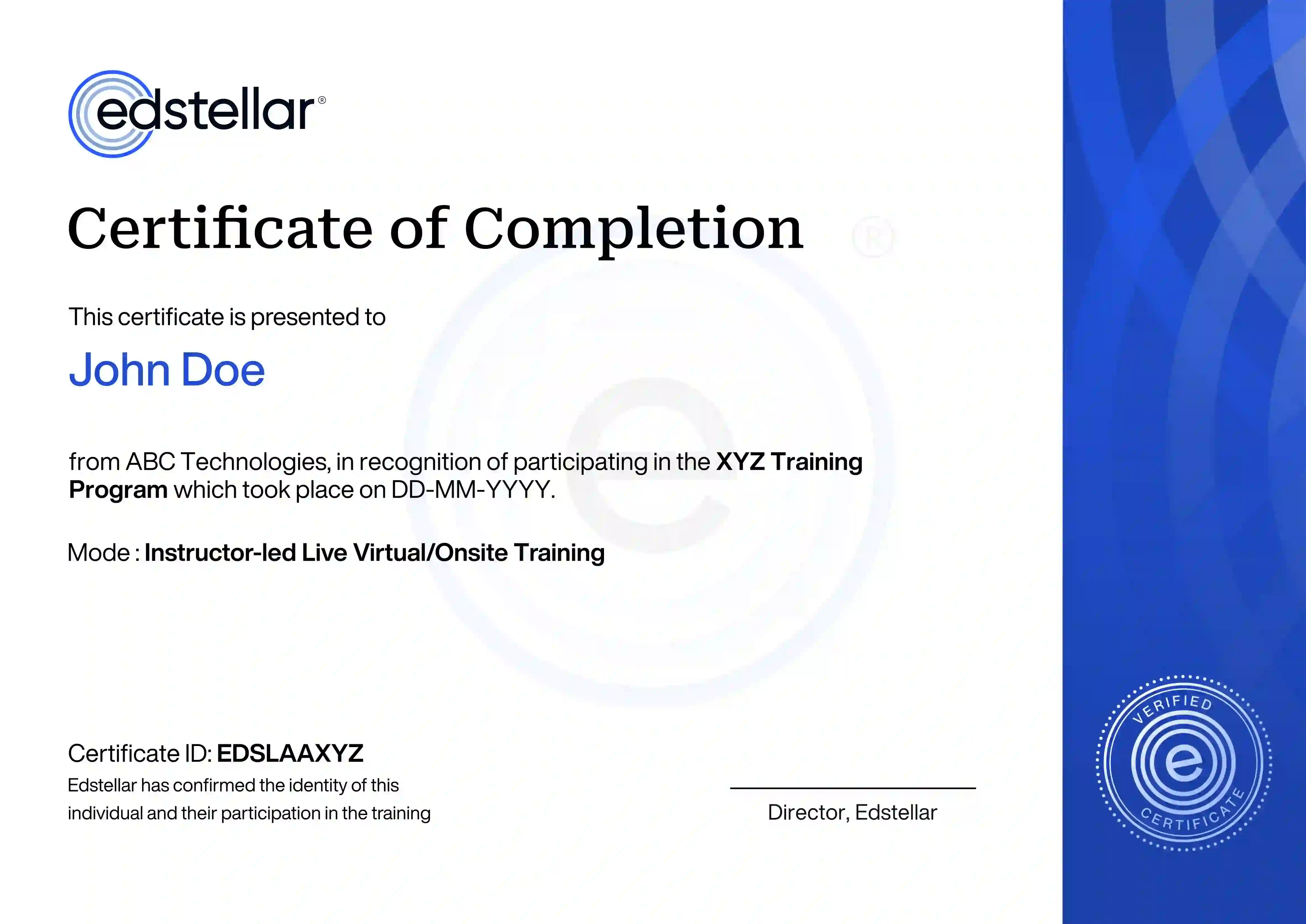
        Get Your Team Members Recognized with Edstellar’s Course Certificate

        Upon successful completion of the training course offered by Edstellar, employees receive a course completion certificate, symbolizing their dedication to ongoing learning and professional development.

        This certificate validates the employee's acquired skills and is a powerful motivator, inspiring them to enhance their expertise further and contribute effectively to organizational success.

        Certificate of Excellence

        Other Related Corporate Training Courses