MLOps for LLMs Corporate Training Program
This training equips teams with practical skills to build, deploy, monitor, and manage large language models in production using MLOps pipelines, CI/CD, experiment tracking, and modern LLM tooling.
(Virtual / On-site / Off-site)
Available Languages
English, Español, 普通话, Deutsch, العربية, Português, हिंदी, Français, 日本語 and Italiano
Drive Team Excellence with MLOps for LLMs Corporate Training
Empower your teams with expert-led on-site, off-site, and virtual MLOps for LLMs Training through Edstellar, a premier corporate training provider for organizations globally. Designed to meet your specific training needs, this group training program ensures your team is primed to drive your business goals. Help your employees build lasting capabilities that translate into real performance gains.
MLOps for large language models bridges the gap between AI research and scalable production systems. This training covers the complete LLM operations lifecycle - from data versioning and experiment tracking to CI/CD pipelines, model registries, serving infrastructure, and production monitoring. Teams learn to apply proven DevOps and software engineering principles to the unique operational challenges of managing LLMs at enterprise scale.
Edstellar's MLOps for LLMs Instructor-led course offers virtual/onsite training options so participants can learn in the format that fits their schedule and team structure. The curriculum combines MLOps theory with hands-on labs using industry-standard tooling, enabling ML engineers and data scientists to build robust, repeatable, and production-ready LLM systems.

Key Skills Employees Gain from Instructor-led MLOps for LLMs Training
MLOps for LLMs skills corporate training will enable teams to effectively apply their learnings at work.
- LLM Pipeline Orchestration
- Experiment Tracking and Versioning
- CI/CD for LLM Systems
- Model Monitoring and Observability
- LLM Deployment and Serving
- Infrastructure Automation for AI
- Fine-Tuning Pipeline Management
Key Learning Outcomes of MLOps for LLMs Training Workshop
Upon completing Edstellar’s MLOps for LLMs workshop, employees will gain valuable, job-relevant insights and develop the confidence to apply their learning effectively in the professional environment.
- Master end-to-end LLM pipeline design and orchestration using MLOps frameworks and tools for scalable production deployments.
- Gain proficiency in experiment tracking, model versioning, and reproducible LLM development workflows using MLflow and registry tools.
- Develop CI/CD pipelines for automated LLM training, evaluation, and production deployment with testing and validation gates.
- Learn model monitoring and observability practices to detect LLM performance degradation and drift at production scale.
- Build infrastructure automation skills for provisioning and scaling LLM training and serving environments efficiently.
- Apply fine-tuning and deployment strategies to manage and update LLMs effectively in enterprise production systems.
Key Benefits of the MLOps for LLMs Group Training
Attending our MLOps for LLMs group training classes provides your team with a powerful opportunity to build skills, boost confidence, and develop a deeper understanding of the concepts that matter most. The collaborative learning environment fosters knowledge sharing and enables employees to translate insights into actionable work outcomes.
- Instructor-led training covering the full MLOps lifecycle for large language models in production environments.
- Hands-on exercises building LLM pipelines using MLflow, Kubeflow, and Airflow orchestration tools.
- Learn model versioning, experiment tracking, and reproducible workflows for LLM development projects.
- Covers CI/CD pipeline design for automated LLM training, evaluation, and production deployment.
- Model monitoring and observability training for detecting drift and LLM performance degradation.
- Infrastructure as Code practices for provisioning and scaling GPU clusters and LLM serving stacks.
- Fine-tuning pipeline management covering data versioning, training jobs, and model evaluation workflows.
- Deployment strategies including blue-green, canary, and shadow deployments for LLM production systems.
- Flexible virtual and onsite delivery options suited to ML engineering and AI platform teams.
- Certificate of completion recognizing proficiency in MLOps practices for large language models.
Topics and Outline of MLOps for LLMs Training
Our virtual and on-premise MLOps for LLMs training curriculum is structured into focused modules developed by industry experts. This training for organizations provides an interactive learning experience that addresses the evolving demands of the workplace, making it both relevant and practical.
-
MLOps Fundamentals and the LLM Lifecycle
- Core MLOps principles applied to large language model development and production operations
- The LLM lifecycle: data preparation, pre-training, fine-tuning, deployment, and monitoring stages
- How LLM operations differ from traditional ML pipelines and standard software DevOps practices
- Key challenges in scaling LLMs from research prototypes to enterprise production environments
-
MLOps Maturity Model for LLM Systems
- Stages of MLOps maturity from manual workflows to fully automated LLM operations pipelines
- Assessing current LLM operational maturity across tooling, automation, and organizational culture
- Key capability gaps that hold organizations back from advancing their LLM MLOps maturity level
- Building a prioritized roadmap to advance LLM operations maturity across engineering teams
-
LLM Tooling Ecosystem Overview
- Experiment tracking tools: MLflow, Weights and Biases, and Neptune for LLM project tracking
- Pipeline orchestration platforms: Kubeflow, Airflow, Prefect, and ZenML for LLM workflows
- Model serving frameworks: vLLM, TGI, Triton, and Ray Serve for production LLM deployments
- Cloud platforms and managed LLM services supporting training and inference at scale
-
Data Pipelines for LLM Development
- Designing scalable data ingestion pipelines for LLM pre-training and fine-tuning datasets
- Data quality checks, deduplication, and preprocessing automation for LLM training workflows
- Streaming data pipelines for continuous model updates and online learning in production
- Connecting data pipelines to training orchestration systems for end-to-end LLM automation
-
Roles and Responsibilities in LLM MLOps
- Key roles in LLM MLOps: ML engineer, AI platform engineer, and LLMOps practitioner
- Cross-functional team structure connecting research, engineering, and production operations
- Collaboration patterns between model teams, platform teams, and product stakeholders
- Defining ownership and accountability across the LLM development and deployment lifecycle
-
MLOps Governance and Compliance for LLMs
- Audit trails and lineage tracking for training data, experiments, and LLM model versions
- Compliance requirements for LLM deployments in regulated industries and enterprise environments
- Responsible AI governance practices integrated into LLM MLOps engineering workflows
- Documentation standards supporting internal audit and regulatory review for LLM systems
-
Training Data Management Fundamentals
- Types of training data for LLMs: pre-training corpora, instruction tuning sets, and RLHF data
- Data storage architecture for large-scale LLM training datasets and document collections
- Metadata management for tracking dataset provenance, versions, and quality metrics
- Data governance and licensing considerations for LLM pre-training and fine-tuning datasets
-
Data Version Control for LLM Projects
- DVC (Data Version Control) concepts and Git integration for LLM dataset tracking workflows
- Tagging and versioning training datasets alongside model code for reproducible experiments
- Managing dataset snapshots and rollback capabilities for debugging training data issues
- Linking dataset versions to experiment runs for complete training data lineage documentation
-
Data Quality and Preprocessing Pipelines
- Automated quality checks for detecting corrupt, duplicate, and low-quality LLM training samples
- Text normalization, deduplication, and filtering pipelines for LLM pre-training corpora
- Instruction tuning dataset construction: formatting, quality filtering, and diversity assurance
- RLHF data pipelines: human preference collection, annotation quality, and dataset curation
-
Feature Stores and Embedding Management
- Role of feature stores in LLM workflows for managing structured metadata and input features
- Embedding management: storing, versioning, and retrieving embeddings for production RAG systems
- Integration of embedding stores with vector databases for LLM pipeline data management
- Caching embedding computations to reduce cost and latency in production LLM applications
-
Data Pipeline Orchestration for LLM Training
- Designing DAG pipelines for multi-stage LLM data preparation and validation workflows
- Airflow and Prefect for scheduling LLM data preprocessing pipelines with dependency management
- Failure recovery and retry logic in LLM data pipeline orchestration for reliability
- Monitoring data pipeline performance and detecting drift in streaming training data feeds
-
Dataset Registry and Team Collaboration
- Centralized dataset registry for discovering and sharing LLM training data across teams
- Dataset cards and documentation standards for transparent LLM data management practices
- Access controls, audit logging, and security practices for sensitive LLM training datasets
- Collaborative dataset curation workflows integrating domain experts and ML engineering teams
-
Experiment Tracking Fundamentals
- What to track in LLM experiments: hyperparameters, metrics, artifacts, and environment details
- MLflow experiment tracking setup and configuration for LLM training and fine-tuning runs
- Organizing experiments with tags, groups, and project structures for team-wide visibility
- Comparing experiment runs and identifying optimal configurations from LLM training histories
-
Weights and Biases for LLM Experiments
- W&B setup, project organization, and logging integration for LLM training workflow tracking
- Real-time metric visualization and loss curve analysis during LLM fine-tuning runs
- Hyperparameter sweep configuration using W&B Sweeps for automated LLM optimization runs
- Artifact logging for datasets, model checkpoints, and evaluation outputs within W&B projects
-
Hyperparameter Optimization for LLMs
- Hyperparameter search strategies: grid, random, and Bayesian optimization for LLM fine-tuning
- Key LLM hyperparameters: learning rate, batch size, warmup steps, and sequence length
- Early stopping and pruning techniques to reduce wasted GPU compute in optimization runs
- Automated hyperparameter optimization using Optuna, Ray Tune, and W&B Sweeps tools
-
Model Registry Management
- Model registry concepts: versioning, staging environments, and production promotion workflows
- MLflow Model Registry for managing LLM versions, lifecycle stages, and associated metadata
- Lineage tracking linking model versions to datasets, experiments, and source code commits
- Approval workflows for promoting LLM versions from staging to production environments
-
Reproducibility in LLM Experiments
- Sources of non-reproducibility in LLM training: randomness, hardware, and dependency versions
- Environment reproducibility using Docker, conda, and pip lock files for training run isolation
- Seed management and deterministic configurations for producing reproducible LLM training results
- Full experiment reproducibility checklists for LLM fine-tuning and evaluation run documentation
-
Collaborative Experiment Management
- Shared experiment workspaces enabling cross-team collaboration on LLM development projects
- Experiment documentation practices for communicating research findings to product stakeholders
- Knowledge management for LLM experiments: capturing insights, failure modes, and lessons learned
- Integrating experiment tracking tools with project management platforms for sprint-aligned reporting
-
Fine-Tuning Approaches and Trade-Offs
- Full fine-tuning vs parameter-efficient fine-tuning (PEFT): use cases, cost, and quality trade-offs
- LoRA and QLoRA: low-rank adaptation methods for cost-effective LLM fine-tuning workflows
- Instruction tuning, RLHF, and DPO: alignment techniques and their specific pipeline requirements
- Selecting fine-tuning strategy based on task requirements, data volume, and compute constraints
-
Training Data Preparation for Fine-Tuning
- Formatting training data for instruction tuning: prompt-response pair construction standards
- Dataset size and quality trade-offs for achieving effective LLM fine-tuning outcomes
- Train, validation, and test split strategies for managing fine-tuning datasets reliably
- Synthetic data generation techniques for augmenting LLM fine-tuning dataset size and diversity
-
Fine-Tuning Infrastructure Setup
- GPU instance selection and configuration for single-node and multi-node LLM fine-tuning runs
- Distributed training setup using DeepSpeed ZeRO and FSDP for large model fine-tuning jobs
- Memory optimization techniques: gradient checkpointing, mixed precision training, and CPU offloading
- Container-based training environments for reproducible and portable LLM fine-tuning pipelines
-
Fine-Tuning Job Orchestration
- Packaging fine-tuning jobs as reusable pipeline components in Kubeflow and SageMaker Pipelines
- Job scheduling, queue management, and priority assignment for competing fine-tuning workloads
- Checkpoint saving strategies and job resumption logic for long-running fine-tuning experiments
- Parallelizing fine-tuning experiments across multiple GPU nodes for faster research iteration
-
Evaluation During Fine-Tuning
- Automated evaluation metrics for LLM fine-tuning: BLEU, ROUGE, and task-specific quality scores
- Human evaluation integration for subjective quality assessment of fine-tuned LLM outputs
- Evaluation-driven early stopping based on measured downstream task performance improvements
- Regression testing against baseline models to confirm fine-tuning delivers measurable quality gains
-
Post Fine-Tuning Model Management
- Saving, versioning, and registering fine-tuned LLM weights in the centralized model registry
- Merging LoRA adapters with base model weights to produce deployment-ready model artifacts
- Model documentation standards for fine-tuned LLMs: capabilities, limitations, and intended use
- Deprecation and archival workflows for retiring outdated fine-tuned models from production
-
CI/CD Fundamentals for LLM Development
- How CI/CD principles from software engineering apply to modern LLM development workflows
- Key stages in an LLM CI/CD pipeline: code, data, training, evaluation, and deployment
- Differences between traditional software CI/CD and ML model CI/CD pipeline requirements
- Toolchain overview: GitHub Actions, GitLab CI, Jenkins, and cloud-native CI/CD for LLMs
-
Continuous Integration for LLM Code and Data
- Automated unit and integration tests for LLM pipeline code and data processing functions
- Data validation gates in CI pipelines to catch schema and quality issues before training runs
- Code quality checks, linting, and security scanning for LLM application source repositories
- Pull request automation for LLM projects with test coverage and quality enforcement gates
-
Automated Model Training Pipelines
- Triggering automated LLM fine-tuning from code or dataset changes detected in CI pipelines
- Parameterized training pipeline templates for launching consistent and repeatable training runs
- Cost controls in automated training pipelines to prevent runaway GPU compute expenditure
- Artifact management for model checkpoints and evaluation outputs from automated training runs
-
Continuous Evaluation and Testing
- Automated LLM evaluation suites running against every new model version in the CI pipeline
- Benchmarking against golden datasets to detect quality regressions before production deployment
- A/B testing and shadow evaluation frameworks for systematically comparing LLM model versions
- Threshold-based deployment gates blocking underperforming LLM versions from reaching production
-
Continuous Deployment for LLMs
- Blue-green deployment for LLMs: switching production traffic with zero-downtime model updates
- Canary deployment strategies for gradually rolling out new LLM versions to user traffic
- Shadow deployment for testing new LLM versions against live traffic without user impact
- Automated rollback for reverting failed LLM deployments quickly and reliably in production
-
LLMOps Pipeline Automation
- End-to-end LLMOps pipeline design from data ingestion through to production deployment
- Event-driven pipeline triggers for automated retraining on detected data drift or quality signals
- GitOps principles applied to LLM infrastructure and model deployment automation workflows
- Monitoring CI/CD pipeline health and tracking deployment frequency for LLM production systems
-
LLM Serving Architecture Fundamentals
- LLM serving components: inference servers, API gateways, load balancers, and caching layers
- Serving framework comparison: vLLM, TGI, Triton, Ray Serve, and BentoML for LLM workloads
- Latency, throughput, and cost trade-offs in designing LLM serving infrastructure at scale
- Scaling LLM inference endpoints horizontally and vertically for varying production traffic loads
-
Containerization and Kubernetes for LLM Serving
- Building Docker containers for LLM serving applications with proper GPU dependency management
- Kubernetes deployment manifests for LLM inference pods with GPU resource requests and limits
- Helm charts for managing and versioning LLM serving infrastructure across deployment environments
- Kubernetes auto-scaling configurations for LLM inference pods based on request queue depth signals
-
vLLM and Continuous Batching
- vLLM architecture: paged attention mechanism, KV cache management, and continuous batching
- Deploying vLLM inference servers for open-source LLMs with optimal throughput configurations
- Configuring tensor parallelism in vLLM for serving large models across multiple GPUs efficiently
- Benchmarking vLLM deployments to validate throughput and latency against production SLA targets
-
API Gateway and Request Routing for LLMs
- Designing LLM API gateways with rate limiting, authentication, and multi-model request routing
- Semantic caching at the API gateway layer for eliminating redundant LLM inference computations
- Observability instrumentation at the gateway for request tracing and cost attribution per team
- Multi-model serving architectures for routing requests to the most appropriate LLM endpoint
-
Model Optimization for Serving
- INT8 and INT4 quantization for reducing LLM inference compute and memory serving requirements
- GGUF and GPTQ quantization formats for efficient CPU and GPU LLM inference deployments
- Speculative decoding for accelerating output token generation speed in production LLM serving
- Model distillation for deploying smaller, more efficient LLMs with acceptable quality trade-offs
-
Multi-Environment Deployment Management
- Environment promotion strategy across development, staging, and production for LLM systems
- Infrastructure as Code with Terraform for consistent LLM serving environment provisioning
- Configuration management for LLM serving across environments using environment variables
- Disaster recovery and failover planning for high-availability production LLM serving systems
-
LLM Monitoring Fundamentals
- Why LLM monitoring differs from traditional ML model monitoring and software observability
- Key LLM production metrics: latency percentiles, throughput, error rates, and cost per request
- Types of LLM production failures: hallucination, factual errors, safety violations, and timeouts
- Monitoring architecture for LLM systems: instrumentation strategy, collection, and alerting layers
-
Output Quality Monitoring
- Automated LLM output quality monitoring using LLM-as-a-judge evaluation in production
- Detecting hallucinations and factual inconsistencies in LLM responses at production traffic scale
- Tracking user feedback and satisfaction ratings as quality proxies for continuous LLM monitoring
- Anomaly detection for sudden drops in LLM response coherence or quality metric thresholds
-
Data and Concept Drift Detection
- Input distribution shift detection for identifying changes in LLM prompt patterns over time
- Semantic drift monitoring using embedding similarity for detecting topic distribution changes
- Concept drift in downstream task performance signaling the need for LLM retraining
- Statistical drift detection methods applied to LLM input feature and output response monitoring
-
LLM Observability Tooling
- OpenTelemetry integration for distributed tracing of LLM request and response processing flows
- LLM-specific observability platforms: LangSmith, Arize AI, and WhyLabs for production monitoring
- Structured logging for LLM requests including prompt, response, latency, and token usage data
- Building LLM observability dashboards covering request traces, quality metrics, and cost trends
-
Alerting and Incident Response for LLMs
- Designing alert rules for LLM serving degradation, unexpected cost spikes, and quality drops
- On-call runbooks for diagnosing and resolving common LLM production incident scenarios
- Post-incident review processes for LLM failures with root cause analysis documentation
- Escalation workflows connecting LLM monitoring alerts to engineering and product response teams
-
Continuous Feedback and Retraining Triggers
- Human-in-the-loop feedback pipelines for collecting LLM correction data from production users
- Automated retraining triggers based on drift thresholds or measured quality metric breaches
- Feedback data curation pipelines for preparing LLM correction datasets for targeted fine-tuning
- Closing the MLOps loop: connecting production monitoring insights to data prep and retraining
-
GPU Infrastructure for LLM Workloads
- GPU types for LLM training and inference: NVIDIA H100, A100, and L40 instance configurations
- Single-node vs multi-node GPU cluster architectures for cost-effective LLM training workloads
- GPU interconnects: NVLink and InfiniBand bandwidth requirements for distributed LLM training
- Cloud GPU instance selection and right-sizing strategies for LLM training and serving operations
-
Distributed Training Infrastructure
- Data parallelism, model parallelism, and tensor parallelism strategies for large LLM training
- DeepSpeed ZeRO optimization stages for efficient memory utilization across GPU training clusters
- FSDP (Fully Sharded Data Parallel) configuration for scaling LLM training memory efficiency
- Fault tolerance and checkpoint recovery strategies for multi-node LLM training job interruptions
-
Kubernetes for LLM Infrastructure Management
- Kubernetes cluster architecture for orchestrating LLM training and production inference workloads
- GPU resource requests, limits, and node affinity rules for LLM pod scheduling and isolation
- Priority classes for managing competing LLM training and inference workload scheduling policies
- KEDA event-driven auto-scaling for LLM inference pods responding to queue depth metrics
-
Infrastructure as Code for LLM Systems
- Terraform modules for provisioning cloud GPU instances and LLM serving infrastructure resources
- Kubernetes manifests and Helm charts for consistent LLM deployments across all environments
- GitOps workflows using ArgoCD or Flux for automated and auditable LLM infrastructure management
- Infrastructure testing and validation procedures for LLM environments before production promotion
-
Storage and Networking for LLM Workloads
- High-performance storage solutions for LLM training datasets and model checkpoint management
- Distributed file systems: Lustre, GPFS, and cloud-native storage options for LLM training clusters
- Network bandwidth requirements and optimization techniques for multi-node LLM training jobs
- Object storage lifecycle management for LLM artifacts, training datasets, and model checkpoints
-
Cost Optimization for LLM Infrastructure
- Spot instance strategies for reducing LLM training costs with automated interruption handling
- Reserved capacity planning for production LLM serving to optimize long-term infrastructure spend
- Autoscaling policies for LLM inference to dynamically balance cost efficiency and availability
- Resource tagging and cost allocation for tracking LLM infrastructure spend by team and project
-
LLM Evaluation Fundamentals
- Types of LLM evaluation: intrinsic metrics, benchmark tasks, automated scoring, and human eval
- Evaluation dimensions: factual accuracy, coherence, relevance, safety, and helpfulness assessment
- Standard LLM benchmarks: MMLU, HumanEval, TruthfulQA, and MT-Bench usage and interpretation
- Designing evaluation suites tailored to specific LLM deployment use cases and requirements
-
Automated Evaluation Metrics
- Reference-based metrics: BLEU, ROUGE, and METEOR and their limitations for LLM assessment
- Embedding-based similarity metrics: BERTScore and sentence similarity for semantic evaluation
- LLM-as-a-judge evaluation using frontier models for automated quality scoring at scale
- Building custom evaluation metrics aligned to specific business quality requirements for LLMs
-
Safety and Alignment Evaluation
- Red-teaming LLMs for safety: adversarial prompt testing and jailbreak vulnerability detection
- Bias and fairness evaluation in LLM outputs across demographic and linguistic population groups
- Toxicity detection and harmful content evaluation in LLM response datasets and production logs
- Alignment evaluation: measuring instruction-following accuracy and helpfulness in fine-tuned LLMs
-
RAG and Tool-Augmented LLM Evaluation
- Evaluating RAG systems: context relevance, answer faithfulness, and answer relevance metrics
- RAGAS framework for automated RAG pipeline evaluation using reference-free assessment metrics
- Tool-use evaluation for LLM agents: tool selection accuracy and end-to-end task completion rates
- End-to-end pipeline evaluation from retrieval quality through to the final generated LLM response
-
Human Evaluation Workflows
- Designing human evaluation guidelines and quality rubrics for consistent LLM quality assessment
- Crowd-sourcing human evaluation using annotation platforms with built-in quality control measures
- Side-by-side comparison evaluation for ranking competing LLM versions against each other
- Analyzing evaluation data for statistical significance and measuring inter-annotator agreement
-
Evaluation Integration in CI/CD Pipelines
- Integrating automated evaluation suites into LLM CI/CD pipelines as mandatory quality gates
- Regression testing frameworks for detecting LLM performance drops between model versions
- Evaluation result dashboards for tracking LLM quality trends across continuous release cycles
- Threshold policies and approval workflows for LLM evaluation gates governing production deployments
-
LLM Platform Architecture Design
- Core components of an internal LLM platform: API gateway, model registry, and serving layer
- Monolithic vs microservices architecture trade-offs for LLM platform scalability and maintenance
- Multi-tenant LLM platform design for serving multiple product teams and use cases safely
- Reference architectures for enterprise LLM platforms deployed on AWS, Azure, and Google Cloud
-
Developer Experience and Self-Service Tooling
- Internal developer portal for self-service LLM platform access, documentation, and onboarding
- SDK and API design principles for simplifying LLM model integration across product teams
- Centralized prompt management tools for versioning and sharing prompts across the organization
- LLM playground and sandbox environments for rapid developer prototyping and experimentation
-
Security and Access Control for LLM Platforms
- Authentication and authorization for LLM platform APIs using OAuth 2.0 and API key management
- Role-based access control for LLM model versions, prompt libraries, and training datasets
- Data privacy controls for preventing sensitive data exposure in LLM prompts and generated outputs
- Audit logging for all LLM platform operations to support compliance and governance requirements
-
Platform Reliability Engineering
- Defining SLOs and SLAs for LLM platform availability, latency, and response quality commitments
- Reliability engineering practices: redundancy, failover, and circuit breakers for LLM serving
- Capacity planning for LLM platforms to reliably meet peak demand without over-provisioning
- Incident management process for LLM platform outages and production performance degradation events
-
Scaling LLM Operations Across the Organization
- Center of Excellence model for LLM platform governance and cross-team engineering collaboration
- Onboarding programs for product teams building new AI features on the shared LLM platform
- Feedback loops between platform teams and product teams for continuous platform improvement
- Measuring LLM platform success: adoption metrics, reliability KPIs, and developer satisfaction scores
-
Future Directions in LLM MLOps
- Agentic AI workflows and their evolving implications for LLM pipeline orchestration and monitoring
- Multimodal LLMs and the adaptation of MLOps practices for vision-language production models
- Emerging open-source LLM tooling and frameworks shaping the future of enterprise LLMOps
- Building adaptive LLM platforms that evolve with rapidly advancing foundation model capabilities
Who Can Take the MLOps for LLMs Training Course
The MLOps for LLMs training program can also be taken by professionals at various levels in the organization.
- ML Engineers
- Data Scientists
- AI Platform Engineers
- DevOps Engineers
- Data Engineers
- AI Product Managers
Prerequisites for MLOps for LLMs Training
Professionals should have working knowledge of Python, machine learning fundamentals, and familiarity with cloud platforms to take the MLOps for LLMs training course.
Corporate Group Training Delivery Modes
for MLOps for LLMs Training
At Edstellar, we understand the importance of impactful and engaging training for employees. As a leading MLOps for LLMs training provider, we ensure the training is more interactive by offering Face-to-Face onsite/in-house or virtual/online sessions for companies. This approach has proven to be effective, outcome-oriented, and produces a well-rounded training experience for your teams.


.webp)
Edstellar's MLOps for LLMs virtual/online training sessions bring expert-led, high-quality training to your teams anywhere, ensuring consistency and seamless integration into their schedules.
.webp)
Edstellar's MLOps for LLMs inhouse face to face instructor-led training delivers immersive and insightful learning experiences right in the comfort of your office.
.webp)
Edstellar's MLOps for LLMs offsite face-to-face instructor-led group training offer a unique opportunity for teams to immerse themselves in focused and dynamic learning environments away from their usual workplace distractions.
Explore Our Customized Pricing Package
for
MLOps for LLMs Corporate Training
Looking for pricing details for onsite, offsite, or virtual instructor-led MLOps for LLMs training? Get a customized proposal tailored to your team’s specific needs.
64 hours of group training (includes VILT/In-person On-site)
Tailored for SMBs
Tailor-Made Trainee Licenses with Our Exclusive Training Packages!
160 hours of group training (includes VILT/In-person On-site)
Ideal for growing SMBs
Tailor-Made Trainee Licenses with Our Exclusive Training Packages!
400 hours of group training (includes VILT/In-person On-site)
Designed for large corporations
Tailor-Made Trainee Licenses with Our Exclusive Training Packages!
Unlimited duration
Designed for large corporations
Edstellar: Your Go-to MLOps for LLMs Training Company
Experienced Trainers
Our trainers bring years of industry expertise to ensure the training is practical and impactful.
Quality Training
With a strong track record of delivering training worldwide, Edstellar maintains its reputation for its quality and training engagement.
Industry-Relevant Curriculum
Our course is designed by experts and is tailored to meet the demands of the current industry.
Customizable Training
Our course can be customized to meet the unique needs and goals of your organization.
Comprehensive Support
We provide pre and post training support to your organization to ensure a complete learning experience.
Multilingual Training Capabilities
We offer training in multiple languages to cater to diverse and global teams.
What Our Clients Say
We pride ourselves on delivering exceptional training solutions. Here's what our clients have to say about their experiences with Edstellar.
"Edstellar's virtual MLOps for LLMs training transformed how our ML engineering team manages model lifecycles. Within 8 weeks we deployed a fully automated fine-tuning pipeline that reduced manual deployment effort by 60% and cut our LLM model update cycle from 3 weeks to 4 days."
Nisha Pillai
Head of ML Platform Engineering,
A Global AI Software Company
"The onsite MLOps for LLMs program by Edstellar aligned our ML, DevOps, and data engineering teams completely. The CI/CD pipeline modules were immediately actionable - we implemented automated LLM evaluation gates and reduced production incidents by 47% within 2 months of completing the training."
Rohit Khanna
VP of AI Engineering,
A Global Technology Enterprise
"We hosted an intensive off-site MLOps for LLMs program with Edstellar for 20 senior ML engineers and AI architects. The model monitoring and platform design modules directly shaped our internal AI platform roadmap. We launched a shared LLM serving platform that improved inference cost efficiency by 38% across 12 product teams."
Anjali Mehra
Director of AI Infrastructure,
A Global Financial Services Group
"Edstellar's IT & Technical training programs have been instrumental in strengthening our engineering teams and building future-ready capabilities. The hands-on approach, practical cloud scenarios, and expert guidance helped our teams improve technical depth, problem-solving skills, and execution across multiple projects. We're excited to extend more of these impactful programs to other business units."
Aditi Rao
L&D Head,
A Global Technology Company
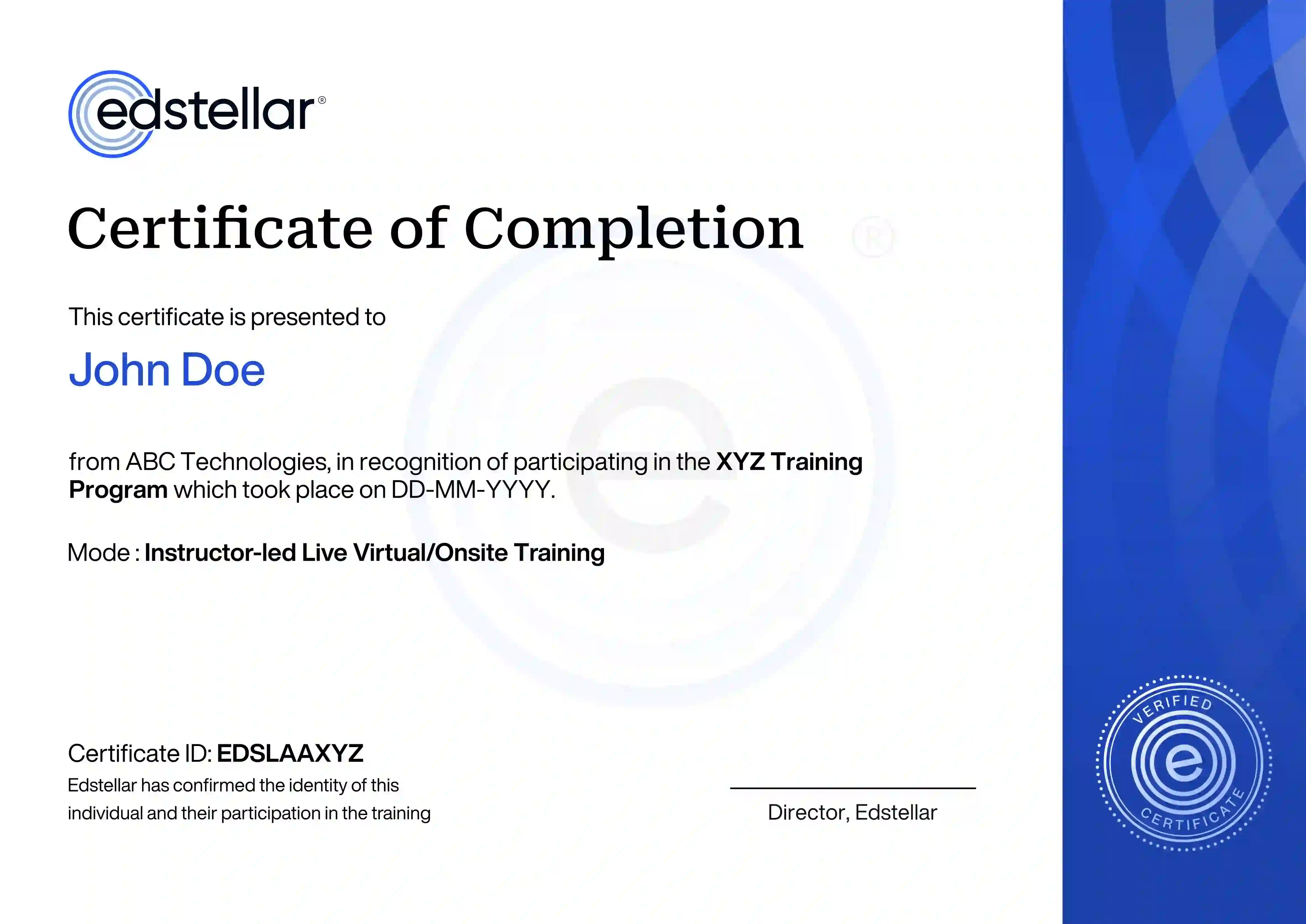
Get Your Team Members Recognized with Edstellar’s Course Certificate
Upon successful completion of the training course offered by Edstellar, employees receive a course completion certificate, symbolizing their dedication to ongoing learning and professional development.
This certificate validates the employee's acquired skills and is a powerful motivator, inspiring them to enhance their expertise further and contribute effectively to organizational success.


Other Related Corporate Training Courses
Edstellar is a one-stop instructor-led corporate training and coaching solution that addresses organizational upskilling and talent transformation needs globally.
Marketing Excellence
Operational Excellence
Finance Excellence
HR Excellence
IT Excellence
Customer Service
Leadership Excellence
Quality Management
Software
How it WorksFAQ'sCorporate Training
CatalogStellar AI
Skill MatrixHRMS Integration
Who we ServeCEO RetreatsPricingTraining DeliveryPartner with Edstellar
CareersContact us