Corporate Introduction to Salesforce Training Course
Edstellar’s Introduction to Salesforce instructor-led training course equips teams with the skills to manage customer data, sales operations, and marketing campaigns. Employees will learn to optimize their sales, service, and business processes using Salesforce. Upskill your team to integrate Salesforce with external systems using web services.
(Virtual / On-site / Off-site)
Available Languages
English, Español, 普通话, Deutsch, العربية, Português, हिंदी, Français, 日本語 and Italiano
Drive Team Excellence with Introduction to Salesforce Corporate Training
Empower your teams with expert-led on-site, off-site, and virtual Introduction to Salesforce Training through Edstellar, a premier corporate training provider for organizations globally. Designed to meet your specific training needs, this group training program ensures your team is primed to drive your business goals. Help your employees build lasting capabilities that translate into real performance gains.
Salesforce is a cloud-based CRM platform that allows employees to centralize data management, automate workflows, and gain valuable insights. Salesforce empowers teams by reducing manual tasks and boosting operational efficiency. The Introduction to Salesforce training enables employees to manage customer interactions and personalize communications.
Edstellar's virtual/onsite Introduction to Salesforce training course offers customization and seamlessly integrates cutting-edge methodologies. Our trainers are renowned for their expertise in Salesforce instructor-led training courses and have vast experience solving the complexities of CRM optimization, workflow automation, and data analytics within the Salesforce ecosystem.

Key Skills Employees Gain from instructor-led Introduction to Salesforce Training
VMware Cloud Foundation - Management and Operations skills corporate training will enable teams to effectively apply their learnings at work.
- Cloud ManagementCloud Management is the process of overseeing cloud computing resources and services. This skill is important for IT professionals to ensure efficient resource utilization, security, and cost-effectiveness in cloud environments.
- Infrastructure DeploymentInfrastructure Deployment is the process of setting up and configuring IT systems and resources. this skill is important for roles like DevOps engineers and system administrators, ensuring efficient, reliable, and scalable environments.
- Resource ProvisioningResource Provisioning is the process of allocating and managing resources such as hardware, software, and services. this skill is important for IT roles to ensure efficient operations and optimal resource utilization.
- Automation TechniquesAutomation Techniques involve using technology to perform tasks with minimal human intervention. This skill is important for roles in engineering, IT, and manufacturing, enhancing efficiency and reducing errors.
- Troubleshooting SkillsTroubleshooting Skills involve diagnosing and resolving issues efficiently. This skill is important for IT professionals, engineers, and customer support roles to ensure smooth operations.
- Performance OptimizationPerformance Optimization is the process of enhancing system efficiency and effectiveness. This skill is important for roles in IT, engineering, and data analysis to ensure peak productivity.
Key Learning Outcomes of Introduction to Salesforce Training Workshop for Employees
Upon completing Edstellar’s Introduction to Salesforce workshop, employees will gain valuable, job-relevant insights and develop the confidence to apply their learning effectively in the professional environment.
- Apply Salesforce CRM features to optimize sales and service processes
- Create and customize quote templates for efficient quoting processes
- Design and implement automation rules and workflows using Salesforce
- Configure security settings to ensure data integrity and compliance
- Develop reports and dashboards to analyze data and track performance metrics
Key Benefits of the Introduction to Salesforce Group Training
Attending our Introduction to Salesforce group training classes provides your team with a powerful opportunity to build skills, boost confidence, and develop a deeper understanding of the concepts that matter most. The collaborative learning environment fosters knowledge sharing and enables employees to translate insights into actionable work outcomes.
- Equips the team with the techniques to maximize Salesforce CRM functionality
- Empowers employees with the skills to automate business processes effectively
- Develops required skills in teams for advanced data analysis and reporting
- Instills ideas in teams for optimizing customer relationship management strategies
- Provides employees with insights into leveraging Salesforce for improved sales and service operations
Topics and Outline of Introduction to Salesforce Training
Our virtual and on-premise Introduction to Salesforce training curriculum is structured into focused modules developed by industry experts. This training for organizations provides an interactive learning experience that addresses the evolving demands of the workplace, making it both relevant and practical.
- Understanding Introduction to Salesforce architecture
- Cloud concepts
- Salesforce components
- Data storage and security
- Navigating Salesforce user interface
- Salesforce terminology
- Standard navigation elements
- List views and record details
- Managing user profiles and permissions
- User profiles and permission sets
- Field-level security and object-level security
- Creating and customizing quote templates
- Building quote layouts
- Adding and formatting quote line items
- Including product information and pricing
- Configuring quote calculation fields
- Setting up formulas for discounts, taxes, and totals
- Customizing quote calculations based on business rules
- Integrating quotes with sales processes
- Associating quotes with opportunities
- Triggering quote generation based on sales stages
- Using quotes for proposal generation and closing deals
- Managing leads, opportunities, and accounts
- Creating and qualifying leads
- Converting leads to opportunities
- Managing account details and relationships
- Implementing sales processes and workflows
- Configuring sales stages and pipelines
- Automating tasks based on sales process progression
- Using workflow rules and approval processes
- Tracking sales performance with reports and dashboards
- Building reports on sales activities and metrics
- Creating dashboards for visualizing key performance indicators (KPIs)
- Analyzing sales trends and identifying opportunities
- Handling cases and service requests
- Creating and managing cases for customer issues
- Setting up service entitlements and escalation rules
- Resolving customer cases and tracking resolutions
- Automating service processes with workflows
- Automating case assignments and notifications
- Triggering actions based on case status changes
- Streamlining service processes for efficiency
- Analyzing service metrics with reports and dashboards
- Reporting on service resolution times and customer satisfaction
- Creating dashboards to track service team performance
- Identifying areas for improvement in customer service
- Creating custom objects and fields
- Defining custom object structures
- Adding different field types
- Setting field-level security and validation rules
- Defining relationships between objects
- Understanding object relationships
- Configuring relationships for data linking and referencing
- Optimizing data model for efficiency
- Designing efficient data structures
- Minimizing data redundancy and improving data quality
- Balancing flexibility and performance with data model design
- Configuring role-based security settings
- Assigning user roles with specific permissions
- Controlling data access based on user roles
- Implementing data sharing rules
- Defining data sharing rules for specific user groups or territories
- Ensuring appropriate data visibility for different users
- Balancing data access needs with security considerations
- Securing data access with profiles and permission sets
- Leveraging permission sets for granular access control
- Combining profiles and permission sets for user authorization
- Customizing user interface with buttons and links
- Creating custom buttons and links for quick actions
- Linking to internal or external resources from Salesforce
- Automating tasks with custom actions
- Building custom actions for automating repetitive tasks
- Triggering actions from buttons, links, or workflows
- Enhancing user productivity with quick actions
- Utilizing quick actions for frequently used tasks
- Creating quick actions for data creation, update, or deletion
- Streamlining user workflows and saving time
- Establishing parent-child relationships between objects
- Defining master and detail objects in a relationship
- Understanding data hierarchy and inheritance
- Utilizing master-detail relationships for data organization
- Utilizing roll-up summary fields for data aggregation
- Creating roll-up summary fields to aggregate data from child objects
- Calculating totals, averages, or other metrics on related records
- Creating custom reports and dashboards
- Building reports with filters, groupings, and sorting options
- Designing dashboards with charts, graphs, and key metrics
- Scheduling and automating report delivery
- Setting up automatic report generation and distribution
- Delivering reports to users via email or sharing them in dashboards
- Ensuring timely access to critical data insights
- Collaborating with colleagues using Chatter
- Utilizing Chatter feeds for real-time communication and updates
- Sharing posts, files, and links with colleagues
- Mentioning users and groups for targeted communication
- Creating Chatter groups and feeds
- Establishing public or private groups for specific topics or teams
- Creating dedicated feeds for project collaboration or announcements
- Leveraging Chatter for team communication and knowledge sharing
- Discussing customer issues, opportunities, and account details
- Sharing best practices, tips, and internal knowledge
- Improving team communication and knowledge management
- Accessing Salesforce from mobile devices
- Utilizing the Salesforce mobile app for on-the-go access
- Managing leads, opportunities, and accounts from a mobile device
- Staying connected and productive even when away from the desk
- Optimizing user experience for mobile
- Understanding the limitations and functionalities of the mobile app
- Designing workflows and layouts optimized for mobile use
- Ensuring a seamless user experience across devices
- Leveraging mobile features for on-the-go productivity
- Utilizing offline capabilities for data access without internet connectivity
- Capturing leads, updating records, and completing tasks from the mobile app
- Exploring Salesforce app marketplace
- Discovering pre-built apps for extending Salesforce functionality
- Finding industry-specific solutions and productivity tools
- Evaluating apps based on features, reviews, and pricing
- Installing and managing third-party apps
- Installing apps from the AppExchange into your Salesforce org
- Configuring and customizing app settings based on your needs
- Extending Salesforce functionality with appexchange apps
- Integrating external tools and services with Salesforce
- Automating workflows and processes with specialized apps
- Automating business processes with workflow rules
- Defining criteria for triggering workflows based on record changes
- Automating tasks such as field updates, email notifications, and record assignments
- Defining criteria for workflow triggers
- Configuring workflow rules with specific conditions and filters
- Ensuring workflows trigger only when necessary
- Maintaining data integrity and avoiding unintended automation
- Updating records and sending notifications with workflow actions
- Performing automatic actions on records when a workflow triggers
- Sending email notifications to users or groups based on workflow criteria
- Implementing business logic with formulas and validation rules
- Creating formulas to calculate fields, manipulate data, and automate calculations
- Setting validation rules to enforce data quality and consistency
- Ensuring data accuracy and adherence to business rules
- Automating processes with process builder
- Building complex automation processes with point-and-click tools
- Utilizing decision points and loops for conditional automation
- Enhancing workflow functionality with process builder
- Integrating salesforce with external systems using Flow
- Creating powerful automation with Salesforce Flow
- Connecting Salesforce with external systems and APIs
- Transitioning to Salesforce lightning experience
- Understanding the benefits and features of the Lightning experience
- Migrating from Salesforce Classic to Lightning
- Customizing the user interface for a modern experience
- Customizing lightning pages and components
- Building custom Lightning pages with drag-and-drop functionality
- Utilizing pre-built components to create dynamic layouts
- Tailoring the user experience to meet specific needs
- Enhancing user productivity with lightning features
- Leveraging features like Kanban boards and inline editing
- Boosting user productivity and streamlining workflows
- Customizing user interface with page layouts
- Controlling the fields and sections displayed on record detail pages
- Designing user-friendly layouts for different record types
- Optimizing the user interface for efficient data entry and viewing
- Optimizing user experience with record types
- Creating record types to categorize and manage different data types
- Enforcing specific field layouts and validation rules for each record type
- Implementing custom themes and branding
- Customizing the look and feel of your Salesforce org with themes
- Matching your company branding and creating a consistent user experience
- Deploying changes between Salesforce environments
- Understanding Salesforce environments
- Packaging and deploying customizations between environments
- Tracking and managing changes with change sets
- Utilizing change sets to track and manage configuration changes
- Identifying and reviewing changes before deployment
- Ensuring a smooth and controlled deployment process
- Ensuring deployment success and minimizing risks
- Implementing best practices for successful deployments
- Testing changes thoroughly before deploying to production
- Managing Salesforce application life cycle
- Understanding the stages of the Salesforce application life cycle (SDLC)
- Implementing development, testing, and deployment processes
- Implementing sandbox environments for development and testing
- Utilizing sandboxes for development, testing, and training purposes
- Isolating development activities from the production environment
- Ensuring data security and integrity
- Deploying changes with version control and release management
- Using version control tools to track changes and manage code versions
- Implementing a release management process for controlled deployments
- Integrating Salesforce with external systems using Apis
- Understanding Salesforce APIs for data exchange
- Consuming and exposing web services in Salesforce
- Connecting to external applications and systems
- Automating data synchronization and processes with integration tools
- Utilizing Salesforce integration tools like Data Loader and MuleSoft
- Automating data import, export, and synchronization
Who Can Take the Introduction to Salesforce Training Course
The Introduction to Salesforce training program can also be taken by professionals at various levels in the organization.
- Salesforce Administrators
- CRM Specialists
- Sales Representatives
- IT Support Technicians
- Application Developers
- Business Analysts
- Marketing Specialists
- Customer Service Representatives
- Data Analysts
- Cloud Engineers
- Technical Support Engineers
- Managers
Prerequisites for Introduction to Salesforce Training
Employees with a basic understanding of CRM can take up the Introduction to Salesforce training course.
Corporate Group Training Delivery Modes
for Introduction to Salesforce Training
At Edstellar, we understand the importance of impactful and engaging training for employees. As a leading Introduction to Salesforce training provider, we ensure the training is more interactive by offering Face-to-Face onsite/in-house or virtual/online sessions for companies. This approach has proven to be effective, outcome-oriented, and produces a well-rounded training experience for your teams.
.webp)
Edstellar's Introduction to Salesforce virtual/online training sessions bring expert-led, high-quality training to your teams anywhere, ensuring consistency and seamless integration into their schedules.
.webp)
Edstellar's Introduction to Salesforce inhouse training delivers immersive and insightful learning experiences right in the comfort of your office.
.webp)
Edstellar's Introduction to Salesforce offsite group training offer a unique opportunity for teams to immerse themselves in focused and dynamic learning environments away from their usual workplace distractions.
Explore Our Customized Pricing Package
for
Introduction to Salesforce Corporate Training
Looking for pricing details for onsite, offsite, or virtual instructor-led Introduction to Salesforce training? Get a customized proposal tailored to your team’s specific needs.
64 hours of group training (includes VILT/In-person On-site)
Tailored for SMBs
Tailor-Made Trainee Licenses with Our Exclusive Training Packages!
160 hours of group training (includes VILT/In-person On-site)
Ideal for growing SMBs
Tailor-Made Trainee Licenses with Our Exclusive Training Packages!
400 hours of group training (includes VILT/In-person On-site)
Designed for large corporations
Tailor-Made Trainee Licenses with Our Exclusive Training Packages!
Unlimited duration
Designed for large corporations
Edstellar: Your Go-to Introduction to Salesforce Training Company
Experienced Trainers
Our trainers bring years of industry expertise to ensure the training is practical and impactful.
Quality Training
With a strong track record of delivering training worldwide, Edstellar maintains its reputation for its quality and training engagement.
Industry-Relevant Curriculum
Our course is designed by experts and is tailored to meet the demands of the current industry.
Customizable Training
Our course can be customized to meet the unique needs and goals of your organization.
Comprehensive Support
We provide pre and post training support to your organization to ensure a complete learning experience.
Multilingual Training Capabilities
We offer training in multiple languages to cater to diverse and global teams.
What Our Clients Say
We pride ourselves on delivering exceptional training solutions. Here's what our clients have to say about their experiences with Edstellar.
"The Introduction to Salesforce training provided me with comprehensive capabilities that elevated my expertise. As a Marketing Operations Coordinator, I needed to understand advanced methodologies deeply, and this course delivered hands-on exercises gave me hands-on experience with industry best practices. My ability to architect solutions and solve complex problems has improved substantially. Highly recommend for anyone serious about this field.”
Duane Bradley
Marketing Operations Coordinator,
Cloud CRM Solutions Provider
"The Introduction to Salesforce training enhanced my ability to architect and implement sophisticated professional expertise strategies. Understanding strategic frameworks through intensive expert-led workshops exercises proved invaluable for enterprise initiatives. We delivered a high-visibility enterprise project two months ahead of schedule. The detailed exploration of practical simulations provided methodologies I leverage in every engagement.”
Sun Xin
CRM Administrator,
CRM Platform Implementation Partner
"As a Operations Analyst overseeing operational excellence initiatives, the Introduction to Salesforce training significantly elevated our team's capabilities. The course expertly covered industry best practices, operational effectiveness. We completed our comprehensive digital transformation initiative significantly ahead of schedule. Our department has achieved remarkable improvements, demonstrating this course's lasting organizational impact.”
Tarek Amir
Operations Analyst,
Customer Success Platform Company
“Edstellar’s IT & Technical training programs have been instrumental in strengthening our engineering teams and building future-ready capabilities. The hands-on approach, practical cloud scenarios, and expert guidance helped our teams improve technical depth, problem-solving skills, and execution across multiple projects. We’re excited to extend more of these impactful programs to other business units.”
Aditi Rao
L&D Head,
A Global Technology Company
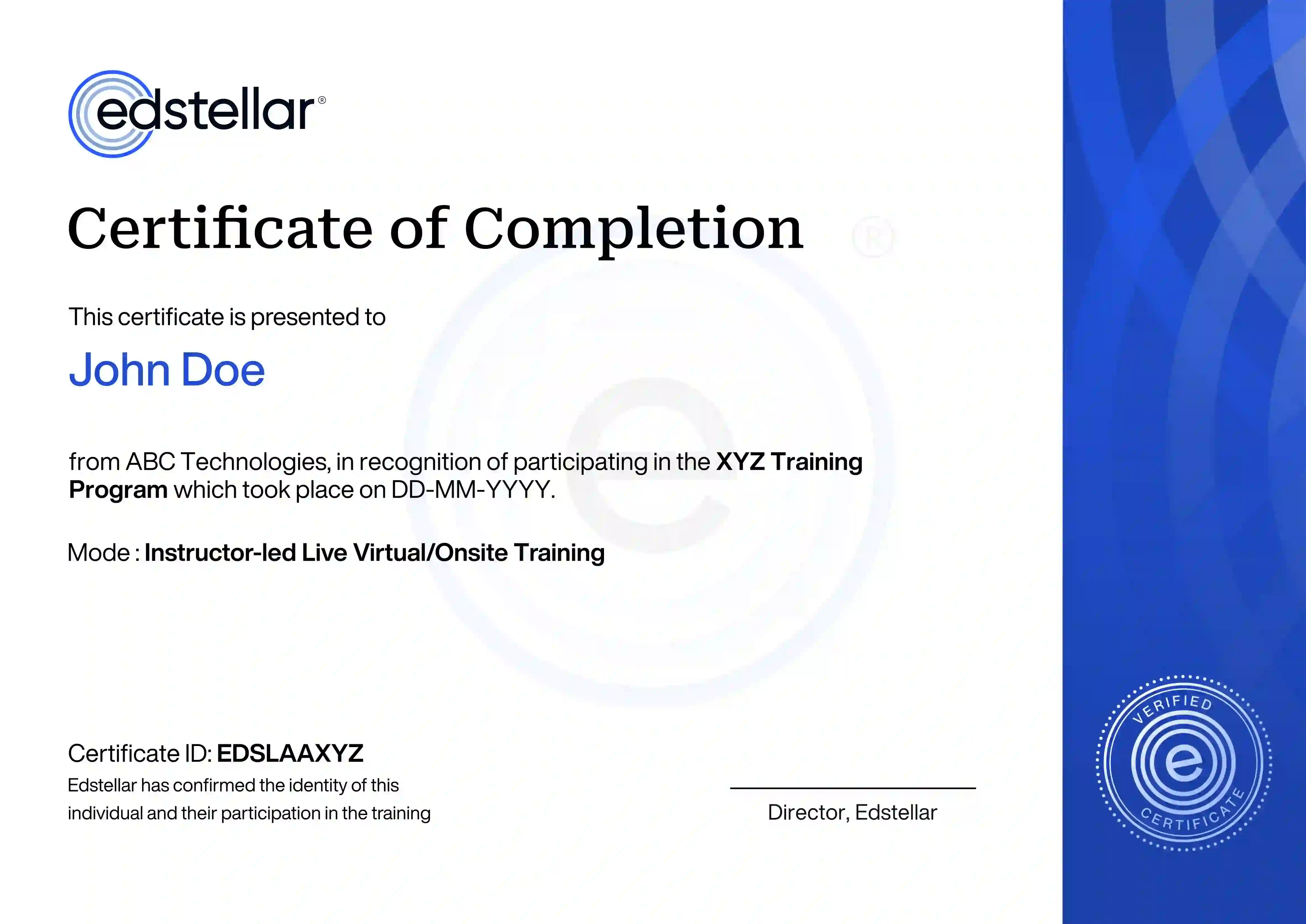
Get Your Team Members Recognized with Edstellar’s Course Certificate
Upon successful completion of the training course offered by Edstellar, employees receive a course completion certificate, symbolizing their dedication to ongoing learning and professional development.
This certificate validates the employee's acquired skills and is a powerful motivator, inspiring them to enhance their expertise further and contribute effectively to organizational success.


We have Expert Trainers to Meet Your Introduction to Salesforce Training Needs
The instructor-led training is conducted by certified trainers with extensive expertise in the field. Participants will benefit from the instructor's vast knowledge, gaining valuable insights and practical skills essential for success in Access practices.
Other Related Corporate Training Courses
Explore More Courses
Edstellar is a one-stop instructor-led corporate training and coaching solution that addresses organizational upskilling and talent transformation needs globally. Edstellar offers 2000+ tailored programs across disciplines that include Technical, Behavioral, Management, Compliance, Leadership and Social Impact.
FAQs
BlogSitemap