
.NET Architecture Training
Learn to build .NET apps your team can change fast and safely.
A hands-on program for engineering leaders whose .NET teams lose weeks to small changes, broken releases and apps stuck on old versions.
.NET Architecture Training is an instructor-led program from Edstellar that teaches your team how to write, test and maintain well-structured apps on Microsoft's .NET, formerly .NET Core, with every lab built on the team's own scenarios.
- Onsite
- Virtual
- Hybrid
 Expert trainers
Need more than one program?Get a group quote
Where Application Structure Breaks Down, and What Your Team Learns in This Program
.NET Architecture Training teaches .NET teams how to structure apps so they stay easy to change. Without a shared structure, small changes take weeks and new features break old ones. Apps get stuck on versions that no longer get security fixes. The training builds one design approach for developers, tech leads and architects.
- Nov 2026
Support ended for .NET 8 and .NET 9. .NET 10 LTS is supported to November 2028.
Source: Microsoft 2026 - 90%
Of software professionals now use AI, and AI makes a team's strengths and weaknesses bigger.
Source: Google DORA 2025 - 46%
Of developers distrust the accuracy of AI tools, so AI-written code needs a firm review.
Source: Stack Overflow 2025 - 27.8%
Of developers use C#, one of the most used languages in enterprise software.
Source: Stack Overflow 2025
Sources: Microsoft, .NET and .NET Core support policy 2026 (end of support for .NET 8 and .NET 9; .NET 10 LTS to November 2028). Google, DORA State of AI-assisted Software Development 2025 (90% AI adoption). Stack Overflow, Developer Survey 2025 (46% distrust AI accuracy; 27.8% use C#).
Close the Application Structure Gaps in Your Teams With Edstellar's .NET Architecture Training
Tell Edstellar where changes slow down or break, and the instructor builds the labs on code like yours.
Map our gapsPractise the Application Design Decisions Your .NET Teams Face
Explore sample exercises from .NET Architecture Training. Participants practise real choices, compare ways to solve them and get feedback from the instructor.
Choose a practice scenario
Each exercise can fit your industry and the roles in your .NET teams.
Instructor-led scenario lab
Learn to Apply SOLID and Dependency Injection
What participants do
Pick where to start untangling a sample order class.
Pair refactoring exerciseMarketing needs a loyalty discount by Friday, but the pricing logic lives in five places. Can we add it without breaking checkout?
Select a choice to see the question to practise.
Question to practise · Write tests around the current behavior firstWhich tests prove the old discounts still work after the change?
Question to practise · Move the pricing rules behind one interfaceWhat should the interface hide, and who calls it?
Question to practise · Inject the rules through the .NET containerWhich service lifetime fits a rule set that never changes at runtime?
What participants take away
Note one class in your own code that needs the same treatment.
Individual reflectionRefactor plan
Your notes stay on this page only. Nothing is saved or sent.
Participants pull tangled logic behind clear interfaces and change it safely under tests.
Instructor-led scenario lab
Learn to Choose the Right Design Pattern
What participants do
Choose a pattern for the growing shipping rules.
Small-group design exerciseWe add a new shipping option every quarter, and the method is now 400 lines long. The AI assistant suggests a factory. Is that right?
Select a choice to see the question to practise.
Question to practise · Use the Strategy patternWhat does each shipping rule need to know, and what stays shared?
Question to practise · Accept the suggested factoryWhich problem does a factory solve here, and which does it leave?
Question to practise · Keep it simple with a lookup tableWhen is a plain table enough, and when does it stop working?
What participants take away
Add one of your own design problems to the selection guide.
Individual reflectionPattern selection guide
Your notes stay on this page only. Nothing is saved or sent.
Participants pick a pattern by the problem it solves and weigh what it costs.
Instructor-led scenario lab
Learn to Structure Apps With Clean Architecture and Modules
What participants do
Draw the module boundaries for a sample sales app.
Team design exerciseBilling reads the orders tables directly, so every orders release breaks the invoice reports. How do we stop this?
Select a choice to see the question to practise.
Question to practise · Give each module its own data and contractWhat does billing really need from orders, and how should it ask?
Question to practise · Publish events between modulesWhich events would billing listen to, and what if one is late?
Question to practise · Split billing into its own service nowWhat would you gain, and what new problems would you take on?
What participants take away
Sketch the modules your own app could split into.
Individual reflectionModule map
Your notes stay on this page only. Nothing is saved or sent.
Participants split an app into modules with clear boundaries that talk through events.
Instructor-led scenario lab
Learn to Modernize Legacy .NET Apps Step by Step
What participants do
Plan the first steps to move a sample portal to .NET 10.
Pair assessment exerciseThe portal runs on .NET 8 and its support has ended. The upgrade estimate is six months because everything depends on everything.
Select a choice to see the question to practise.
Question to practise · Run an upgrade assessment firstWhat does the assessment tell you that the estimate did not?
Question to practise · Add seams around the riskiest partsWhere would a boundary let you move code in smaller pieces?
Question to practise · Move the whole app in one releaseWhat must be true for a single big move to be safe?
What participants take away
List the first module your team would move, and why.
Individual reflectionMigration plan
Your notes stay on this page only. Nothing is saved or sent.
Participants assess a legacy app and plan a piece-by-piece move to .NET 10.
Instructor-led scenario lab
Learn to Guard the Design With Architecture Tests
What participants do
Decide how to catch AI-written code that breaks the layers.
Hands-on review exerciseThe assistant added a feature that calls the database from a controller. It compiles and the tests pass. Should we merge it?
Select a choice to see the question to practise.
Question to practise · Write an architecture test for the layer ruleWhich rule would have failed this change in the build?
Question to practise · Add the rule to the assistant’s instructionsHow do you tell the assistant your architecture, and is that enough?
Question to practise · Review it with a checklistWhat else on the checklist would this change fail?
What participants take away
Write one rule your team would add to the build.
Individual reflectionAI change review checklist
Your notes stay on this page only. Nothing is saved or sent.
Participants turn design rules into tests and review AI-written code with one checklist.
- LearnNew concepts in context
- PracticeApply to realistic scenarios
- CompareDiscuss different approaches
- ReflectCapture key takeaways
Build the Labs Around Scenarios From Your Business
Tell Edstellar the design decisions your .NET teams are facing this year. Edstellar adapts the scenarios to your industry, teams and tools. So participants rehearse cases they will meet back at work.
Customize the practice scenarios.NET Architecture Training for Employees: Program Overview
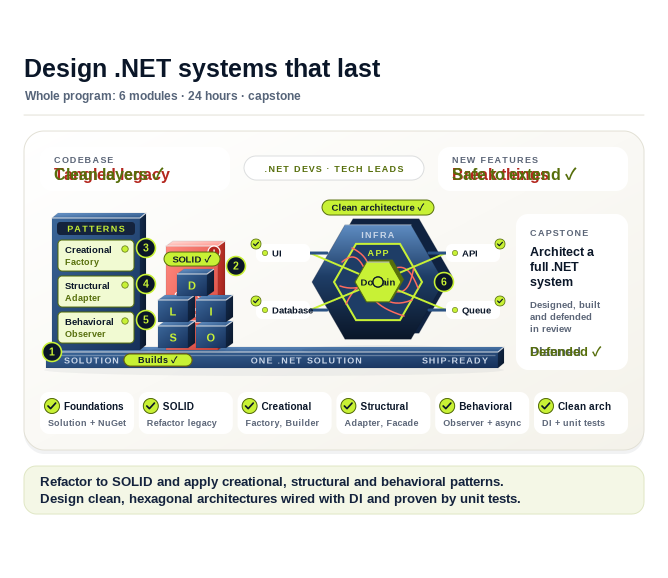
.NET Architecture Training is Edstellar's instructor-led training on designing, testing and maintaining .NET software. Developers, tech leads and architects learn to write clean C# with SOLID and the right patterns. They structure apps with Clean Architecture, modernize them and add AI features. Then they guard the design with architecture tests. Every lab runs on .NET 10.
This instructor-led .NET Architecture Training turns clean code, app structure, upgrades and design checks into practice on the work your team already has.
Edstellar starts with a needs analysis of your .NET versions, your stack, your standards and the design problems that slow your teams down.
An instructor then takes each skill through labs on sample code that mirrors your services:
- Refactor a legacy order class to SOLID, with dependency injection and tests.
- Restructure a layered app into a modular monolith with clean boundaries.
- Plan a move to .NET 10 and add an AI feature behind a port.
- Write architecture tests and review AI-written code with one checklist.
Participants get feedback on every lab. They finish with a capstone: they design, build and defend a .NET system in an instructor review.
- 01 · Write
Learn to Write Clean C# With SOLID and the Right Patterns
Participants refactor an old class under tests and build a guide for picking patterns. The instructor reviews each choice.
- 02 · Structure
Learn to Structure Apps With Clean Architecture
Teams restructure a layered ASP.NET Core app into modules with clear boundaries. The instructor checks every dependency against the rules.
- 03 · Modernize
Learn to Modernize Apps and Add AI Features
Participants assess a legacy app and plan its move to .NET 10. Then they add an AI feature behind a port and switch the model.
- 04 · Guard
Learn to Guard the Design With Architecture Tests
Participants turn design rules into architecture tests. Then they check AI-written changes with a checklist, and the instructor gives feedback.

Enterprise Training Solutions Customized for Your Company
One partner for instructor-led corporate training, delivered the way your teams work.
Request a Training Quote- Customized Training Delivery
- Scale Your Training: Small to Large Teams
- In-person Onsite, Live Virtual or Hybrid Training Modes
- Plan from 2000+ Industry-ready Training Programs
- Hands-On Labs on Live Infrastructure, Led by Industry Experts
What Your Team Can Do After the Training
Turn the Training Into Easy-to-Change .NET Apps With Edstellar
Edstellar maps the skills to your goals, such as faster changes and fewer broken releases. Then it tracks progress after the program and shows the results.
Plan your learning outcomes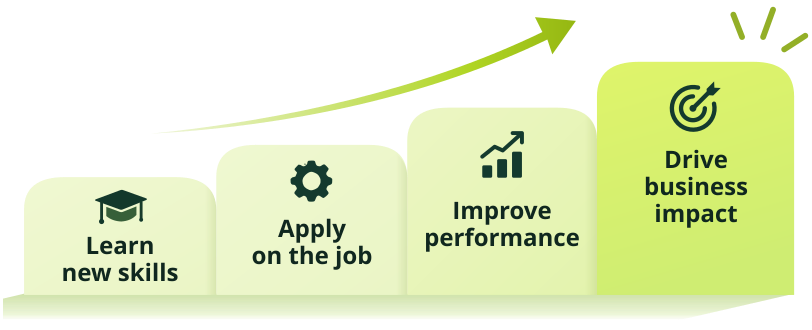
.NET Architecture Training Program Outline
~34 hours across 9 modules, about 70% hands-on practice. Edstellar customizes the duration, module mix and schedule to your scope.
~34 h approx total9 modules8 labs + capstone~70% practice
01Introduction to architecture decisions in modern .NET~3 hours · Lab: Map a sample .NET 10 solution to C4 diagrams and write its first architecture decision record
- Quality goals that drive design: maintainability and testability in ISO/IEC 25010
- Attribute-Driven Design: from quality goals to design choices
- Reading a solution at four levels with the C4 model
- Recording decisions and trade-offs in an ADR
- .NET 10 LTS and C# 14: what the program builds on and why
LabMap a sample .NET 10 solution to C4 diagrams and write its first architecture decision record
Learn ~1.25 h · Practice ~1.75 h
- .NET SDK
- Visual Studio
- Visual Studio Code with C# Dev Kit
- Mermaid
- diagrams.net
- ISO/IEC 25010 product quality model
- Attribute-Driven Design (ADD)
- C4 model
- Architecture decision record (ADR)
- C4 container and component diagrams
02How to apply SOLID principles and dependency injection in C#~4 hours · Lab: Refactor a legacy order-processing class to SOLID, wire it through dependency injection and cover it with unit tests
- The five SOLID principles in everyday C#
- Dependency injection and service lifetimes in the built-in .NET container
- Spotting code smells that signal tight coupling
- Red, green, refactor: changing structure safely under tests
LabRefactor a legacy order-processing class to SOLID, wire it through dependency injection and cover it with unit tests
Learn ~1.25 h · Practice ~2.75 h
- .NET SDK
- Visual Studio
- JetBrains Rider
- xUnit.net
- SonarQube Server
- SOLID principles
- Red, green, refactor
In your team's weekA bug fix in the invoice code keeps breaking other screens.
- The invoice class builds its own database connection and calls the payment gateway itself.
- Nobody can test it alone, so every fix needs a full regression run.
- Unrelated screens break in production after small releases.
- Write tests that lock in the current behavior.
- Move the logic behind an interface (red, green, refactor).
- Inject it through the .NET container with the right lifetime.
- Make the fix and run the tests again.
Produces: a refactored, tested class
03How to choose the right design pattern~4 hours · Lab: Build a pattern selection guide and apply it to three design problems, including one AI-suggested solution
- Patterns as shared design vocabulary, chosen by the problem
- Creational patterns in .NET: Factory Method, Builder and when DI replaces them
- Structural patterns: Adapter, Decorator and Facade at boundaries
- Behavioral patterns: Strategy, Observer and Mediator for changing rules and events
- What each pattern costs, and reviewing patterns an AI assistant suggests
LabBuild a pattern selection guide and apply it to three design problems, including one AI-suggested solution
Learn ~1.25 h · Practice ~2.75 h
- Visual Studio
- xUnit.net
- GitHub Copilot
- GoF design patterns
- Pattern selection guide
In your team's weekA pull request adds a new discount type with another if-else chain.
- Each new rule adds one more branch to the same long method.
- Patterns are picked by habit or because an AI assistant suggests them.
- The design gets harder to read with every release.
- Name the design problem in one line.
- Check the pattern selection guide for candidates.
- Weigh what each pattern costs, then choose.
- Record the choice and why in the pull request.
Produces: a pattern selection guide
04Structuring applications with Clean Architecture and modular monoliths~5 hours · Lab: Restructure a layered ASP.NET Core app into a modular monolith with Clean Architecture boundaries and events between modules
- Layered (N-tier) vs Clean, Onion and Hexagonal architecture
- Ports and adapters: keeping EF Core and other infrastructure behind interfaces
- Repository and unit of work, and when not to use them
- Bounded contexts as modules with their own data and contracts
- Events between modules with a message broker
LabRestructure a layered ASP.NET Core app into a modular monolith with Clean Architecture boundaries and events between modules
Learn ~1.5 h · Practice ~3.5 h
- ASP.NET Core
- Entity Framework Core
- RabbitMQ
- Docker
- xUnit.net
- Clean Architecture (Onion, Hexagonal, Ports and Adapters)
- Domain-driven design (bounded contexts)
- C4 container and component diagrams
In your team's weekTwo teams keep editing the same project and break each other’s code.
- Orders and billing share one project and read each other’s tables.
- Every release from one team breaks the other team’s reports.
- Onboarding takes months because every team structures code differently.
- Draw the bounded contexts as modules.
- Give each module its own data and contract.
- Connect modules through events, not shared tables.
- Check the structure with C4 component diagrams.
Produces: a modular solution template and component diagrams
05Making cloud-native design decisions~3 hours · Lab: Run a design review on splitting one module into its own service, compose it with Aspire and record the decision
- When to stay a modular monolith and when to split out a service
- Synchronous calls vs event-driven communication
- Weighing trade-offs with the Azure Well-Architected pillars
- Composing a multi-service .NET app locally with Aspire
LabRun a design review on splitting one module into its own service, compose it with Aspire and record the decision
Learn ~1 h · Practice ~2 h
- Aspire
- Docker
- ASP.NET Core
- Azure Well-Architected Framework
- Design review with recorded decisions
- Architecture decision record (ADR)
In your team's weekA manager asks to move reporting into a separate service for scale.
- Teams start building a new service before anyone reviews the design.
- The review rejects it after a sprint because it shares a database.
- Weeks of work are lost and teams and architects argue.
- List the options: stay a module or split into a service.
- Weigh them against the Azure Well-Architected pillars.
- Review the design with peers before building.
- Record the decision in an ADR.
Produces: a reviewed architecture decision record (ADR)
06Learning to modernize legacy .NET apps step by step~3 hours · Lab: Assess a .NET Framework and .NET 8 sample app with .NET Upgrade Assistant and plan a strangler-style move to .NET 10
- .NET 8 and .NET 9 end of support (November 2026) and the move to .NET 10 LTS
- Assessing an app with .NET Upgrade Assistant
- Finding seams and adding boundaries before moving code
- The Strangler Fig approach: replacing a legacy app piece by piece
LabAssess a .NET Framework and .NET 8 sample app with .NET Upgrade Assistant and plan a strangler-style move to .NET 10
Learn ~1 h · Practice ~2 h
- .NET SDK
- Visual Studio
- Incremental modernization (Strangler Fig)
- .NET upgrade path (assess, choose a path, upgrade, validate)
- .NET upgrade assessment
In your team's weekSecurity flags an app on an unsupported .NET version.
- The portal still runs on .NET 8, and an admin app runs on .NET Framework.
- Everything depends on everything, so the upgrade estimate is huge.
- Leadership will not fund a big-bang rewrite, so the risk stays open.
- Assess the app with .NET Upgrade Assistant.
- Choose the upgrade path and find the seams.
- Move one module at a time behind a stable boundary (Strangler Fig).
- Test each move before the next one.
Produces: an upgrade assessment and migration plan
07Architecting AI-enabled .NET apps~4 hours · Lab: Add an AI assistant feature behind a port with Microsoft.Extensions.AI, ground it with retrieval (RAG) and switch the model provider without touching business code
- Where AI fits in the architecture: AI calls behind a port
- One abstraction for models with Microsoft.Extensions.AI (IChatClient)
- Retrieval-augmented generation (RAG): embeddings and grounding on the app's own data
- Agents and workflows with Microsoft Agent Framework, and moving from Semantic Kernel
- Testing and swapping AI providers, hosted or local
LabAdd an AI assistant feature behind a port with Microsoft.Extensions.AI, ground it with retrieval (RAG) and switch the model provider without touching business code
Learn ~1.25 h · Practice ~2.75 h
- Microsoft.Extensions.AI
- Microsoft Agent Framework
- Azure OpenAI
- Ollama
- ASP.NET Core
- Clean Architecture (Onion, Hexagonal, Ports and Adapters)
- Architecture decision record (ADR)
In your team's weekThe business asks for a chat assistant in the support app.
- The team calls one model’s SDK straight from the controllers.
- The model, prompts and data access leak into business code.
- Switching model provider means rewriting every call site.
- Put the AI call behind a port in the core.
- Use Microsoft.Extensions.AI for the model client.
- Ground answers on the app’s own data with RAG.
- Record the choice in an ADR and test a provider switch.
Produces: an AI feature behind a port, with its ADR
08AI-assisted development with architectural guardrails~3 hours · Lab: Write architecture tests for the lab solution, let an AI assistant add a feature, then review it with the checklist
- What AI coding assistants do well and where they break structure
- Telling the assistant the architecture rules
- Architecture tests as fitness functions with ArchUnitNET or NetArchTest
- A review checklist for AI-generated changes
LabWrite architecture tests for the lab solution, let an AI assistant add a feature, then review it with the checklist
Learn ~1 h · Practice ~2 h
- GitHub Copilot
- Claude Code
- ArchUnitNET
- NetArchTest
- GitHub
- Architecture fitness functions
- Architecture test suite
- AI-generated code review checklist
In your team's weekAI-written pull requests are growing in size and number.
- Generated code calls the database from the UI layer and repeats existing services.
- It compiles and the tests pass, so it slips through review.
- Review time grows and the structure erodes with every merge.
- Write the layer rules as architecture tests.
- Run them in every build as fitness functions.
- Tell the assistant the rules in its instructions.
- Review each AI-written change with the checklist.
Produces: an architecture test suite and a review checklist
09Capstone project: design, build and defend a .NET system~5 hours · Lab: Design a .NET system from a business brief, build a vertical slice with tests and architecture tests, and defend the design in an instructor review
- From business brief to quality goals and design choices
- C4 diagrams and ADRs for the main decisions
- Building a vertical slice with unit and architecture tests
- Design review: defending trade-offs to the instructor and peers
LabDesign a .NET system from a business brief, build a vertical slice with tests and architecture tests, and defend the design in an instructor review
Learn ~0.5 h · Practice ~4.5 h
- Visual Studio
- GitHub
- Mermaid
- xUnit.net
- ArchUnitNET
- Attribute-Driven Design (ADD)
- C4 model
- Design review with recorded decisions
- Architecture decision record (ADR)
Get a .NET Architecture Training Outline Tailored to Your .NET Stack
Share your .NET versions, stack and design problems, and Edstellar adapts the modules, labs and hours to your teams.
Get a tailored outlineThe Tools and Techniques Your Team Learns to Put Into Practice in the Labs
Explore the tools and techniques participants learn, practise in guided labs and carry into their own design work.
Explore a framework
Design principles and patterns · Modules 2 and 3
Architecture and guardrails · Modules 4 and 8
Learning tool
Framework overviews and practice tools used during training.
Framework snapshotModule 02
SOLID Principles
Learn to write C# classes that are easy to change and test.
Select a part of the framework to see what it covers.
SOLID Principles
Framework viewSelect a part of the framework to see what it covers.
One reason to change per class, so a fix stays in one place.
Add new behavior with new code, not edits to working code.
A subtype must work wherever its base type works, or callers break.
Small interfaces so classes do not depend on methods they never use.
Business code depends on interfaces, and the .NET container supplies the parts.
Sample exerciseA fictional retailer needs a new discount rule in a 900-line order class.
Untangle the order classSample
Select a step to see what participants do in it.
Write tests around what the class does today.
List each job the class does and split them.
Put the pricing rules behind an interface and inject it.
Participants refactor a legacy order class to SOLID and wire it through dependency injection.
Participants spot tight coupling and fix it under tests.
Framework snapshotModule 03
GoF Design Patterns
Learn to choose a pattern by the problem it solves.
Select a part of the framework to see what it covers.
GoF Design Patterns
Framework viewSelect a part of the framework to see what it covers.
Control how objects are made, and see when DI already does the job.
Wrap and connect parts at the boundaries without changing them.
Swap rules and handle events without long if-else chains.
Name the problem in one line before naming a pattern.
Every pattern adds classes and indirection, so weigh it.
Check patterns an AI assistant suggests against the real problem.
Sample exerciseA fictional logistics team adds a shipping option every quarter to a 400-line method.
Pick the patternSample
Select a step to see what participants do in it.
Rules vary, and new ones keep coming.
Strategy, a factory, or a plain lookup table.
Choose one and write down why it fits.
Participants build a pattern selection guide and apply it to three design problems.
Participants pick patterns on purpose and say what each one costs.
Framework snapshotModule 04
Clean Architecture
Learn to keep business rules at the center, with infrastructure at the edges.
Select a part of the framework to see what it covers.
Clean Architecture
Framework viewSelect a part of the framework to see what it covers.
The rules of the business, with no framework code inside.
What the core needs from the outside world, defined by the core.
Entity Framework Core, web APIs and messaging that plug into the ports.
Outer code depends on the core, never the other way round.
Business rules run in unit tests without a database.
Sample exerciseA fictional insurer has claims rules mixed into controllers and data code.
Move rules to the coreSample
Select a step to see what participants do in it.
Mark the business logic in the controllers.
Write the interfaces the rules need.
Move data and web code behind those ports.
Layer map
Select a field to see how participants use it.
The rules that belong in the center.
The interfaces the core defines.
The infrastructure behind each port.
Any dependency that points outward.
A practice aid for the training, not a finished policy or certification.
Participants restructure a layered ASP.NET Core app with ports and adapters.
Participants keep the core free of database and web code.
Framework snapshotModule 04
Domain-Driven Design (Bounded Contexts)
Learn to split a large app into modules that each own their model.
Select a part of the framework to see what it covers.
Domain-Driven Design (Bounded Contexts)
Framework viewSelect a part of the framework to see what it covers.
Start from what the business does, not from tables.
Each area keeps its own words and rules.
Calls and events between contexts, never shared tables.
A bounded context can live as a module inside one app.
Split a context out only when it needs to scale or deploy alone.
Sample exerciseIn a fictional sales app, billing reads the orders tables directly.
Draw the boundariesSample
Select a step to see what participants do in it.
Orders, billing, catalog and customers.
What each area may call or hear.
Give each module its own tables.
Participants draw bounded contexts and turn them into modules with their own data.
Participants set module boundaries that stop teams breaking each other.
Framework snapshotModule 08
Architecture Fitness Functions
Learn to turn design rules into tests that run in every build.
Select a part of the framework to see what it covers.
Architecture Fitness Functions
Framework viewSelect a part of the framework to see what it covers.
For example, controllers never call repositories.
Use ArchUnitNET or NetArchTest to assert the rule.
The build fails when a change breaks the rule.
AI-written changes face the same tests as human ones.
Reviewers check what tests cannot: fit, duplication, security.
Sample exerciseA fictional bank team finds an AI-written feature that calls the database from a controller.
Guard the layersSample
Select a step to see what participants do in it.
Controllers must not reference data code.
See the AI-written change fail.
Apply the checklist to what tests cannot see.
Architecture test suite
Select a field to see how participants use it.
The design rule in one line.
The test that asserts it.
The projects it covers.
Who keeps it up to date.
A practice aid for the training, not a finished policy or certification.
Participants write architecture tests, let an AI assistant add a feature and review it.
Participants keep the structure intact as AI writes more code.
Framework snapshotModule 01
Architecture Decision Record (ADR)
Learn to record each design choice and its trade-offs.
Select a part of the framework to see what it covers.
Architecture Decision Record (ADR)
Framework viewSelect a part of the framework to see what it covers.
The problem and the forces behind it.
Two or three real choices.
The choice in one clear sentence.
The trade-offs the team accepts.
So everyone knows if it still holds.
Sample exerciseA fictional team wants to move reporting into its own service.
Write the ADRSample
Select a step to see what participants do in it.
Why reporting is slow today.
Keep it as a module or split it out.
Record the choice and its costs.
ADR template
Select a field to see how participants use it.
The problem in two or three lines.
The choices you weighed.
The one you chose.
What you gain and give up.
A practice aid for the training, not a finished policy or certification.
Participants write ADRs for their lab designs and defend them in the capstone review.
Participants make decisions others can follow and question later.
Tailor the Labs to Your Own Standards and Templates
Share the coding standards, solution templates and review rules your organization already uses. Edstellar builds them into the labs, so participants learn to apply them alongside SOLID, Clean Architecture and architecture tests.
Add your frameworks to the trainingThe Tools Your Team Works in Hands-On
These are the .NET tools the labs use to build, test and guard each design. Edstellar swaps in your own tools and versions where they differ.
Your team's design workflow
Design · Build · Test · Review
Modules 1 to 9: the IDEs, app parts, AI tools and tests your team works in during the labs.Modules 1 to 9: the editors and SDK every lab runs in.Modules 4 and 5: the parts of the app the structure is applied to.Modules 3, 7 and 8: AI in the app and in the way the team writes code.Modules 2, 8 and 9: the tests, diagrams and pull requests that guard the design.
Frameworks, tools and logos are shown for teaching purposes; Edstellar is not affiliated with their publishers, and the tool mix is tailored to each client.
Where the Training Fits Your Team
Edstellar tailors .NET Architecture Training to each participant's part in designing and changing .NET applications. See how the examples, labs and talks change for each level of design responsibility.
Select a Level of Design Responsibility
Step height reflects design responsibility scope. Every level gets role-relevant practice.
.NET Developers
Learn to write C# that is easy to change and test, and fits the agreed design.
Learn to Write Clean, Testable C#
The daily design habits that keep a .NET codebase easy to change.
Participants learn the five principles in everyday C# and the built-in .NET container.
Select another topic icon to compare.Participants learn Strategy, Decorator, Factory and others, chosen by the problem and its cost.
Select another topic icon to compare.Participants learn changing structure safely under unit tests.
Select another topic icon to compare.Practice Answering a Tech Lead Who Needs a Change This Sprint
A fictional tech lead asks for a new discount rule that must not break checkout. Participants plan the change.
Tech lead · sampleMarketing wants a new loyalty discount by Friday. Can you add it without touching checkout again?
Your practice responseI'll move the discount rules behind one interface, add the loyalty rule as a new Strategy, and cover it with tests before I open the pull request.
- Find the seam
- Add the rule as a Strategy
- Test and open the PR
- Gate review
Build the Coding Section of the Architecture Playbook
They write down the design habits they will use each week.
Participants practise drafting where each kind of code goes and what it may depend on.
Select another heading to compare.Participants practise drafting the team's common problems and the patterns that fit.
Select another heading to compare.Participants practise drafting the steps before changing shared code.
Select another heading to compare.Participants use SOLID and dependency injection. They pick patterns by the problem and keep new code in its layer.
Tech Leads and Senior Engineers
Learn to set module boundaries, review designs early and keep AI-written code inside the rules.
Learn to Set Boundaries and Guard Them
The structure and review habits that stop code from drifting.
Participants learn ports and adapters, bounded contexts as modules, events between them.
Select another topic icon to compare.Participants learn layer and dependency rules that fail the build.
Select another topic icon to compare.Participants learn a checklist for structure, duplication, dependencies and tests.
Select another topic icon to compare.Practice Sorting Design Changes by Size and Risk
Participants place three fictional changes on a grid. Then they decide how much review each one needs.
Build the Review Section of the Architecture Playbook
They write the rules and checks the team will use on each change.
Participants practise drafting the modules, what each owns and how they talk.
Select another heading to compare.Participants practise drafting the rules the build enforces.
Select another heading to compare.Participants practise drafting what reviewers check on every AI-written pull request.
Select another heading to compare.Participants set module boundaries and record their decisions. They check each change with architecture tests and a checklist.
Architects and Engineering Heads
Learn to weigh design choices against business goals, and plan upgrades and AI features with care.
Learn to Make and Defend Architecture Decisions
The ways to decide that link design to cost, risk and speed of change.
Participants learn turning business goals into design choices.
Select another topic icon to compare.Participants learn .NET Upgrade Assistant, seams and the Strangler Fig approach.
Select another topic icon to compare.Participants learn Microsoft.Extensions.AI and Microsoft Agent Framework behind ports.
Select another topic icon to compare.Practice Choosing a Modernization Option
Participants compare three fictional options for an old app. Then they rehearse what they would recommend.
Build the Decision Section of the Architecture Playbook
They write how the company will make and record design decisions.
Participants practise drafting the goals every design is checked against.
Select another heading to compare.Participants practise drafting how decisions and trade-offs are recorded.
Select another heading to compare.Participants practise drafting the order modules move to .NET 10.
Select another heading to compare.Participants compare design options and plan a step-by-step move to .NET 10. They also put AI features behind clear boundaries.
Mixed Engineering, QA and Platform Teams
Learn to work from one architecture so code, tests and templates follow the same rules.
Learn One Shared Architecture Approach
One shared way to talk about structure, for every role.
Participants learn one way to draw and record a design.
Select another topic icon to compare.Participants learn dependency injection and boundaries that make tests stable.
Select another topic icon to compare.Participants learn a reference structure platform teams publish and product teams reuse.
Select another topic icon to compare.Practice Handling One Design Failure Across Three Roles
One fictional incident is worked from three perspectives.
One fictional scenarioAt a fictional insurer, a new claims feature reads another module's database tables directly, and a release breaks the billing reports.
Developer perspectiveWhy did I reach into another module's data, and what should I have called instead?
QA engineer perspectiveWhy did our tests miss it, and which test do we add?
Platform engineer perspectiveWhich architecture rule or template change stops a repeat?
Build the Shared Section of the Architecture Playbook
They write the rules each role follows.
Participants practise drafting the folders and projects every new app starts from.
Select another heading to compare.Participants practise drafting what every design must allow tests to do.
Select another heading to compare.Participants practise drafting who reviews what, and when.
Select another heading to compare.Everyone agrees one structure, tests it in the build and reviews designs together.
- Shared foundations.One design method (decide, record, test, review) and vocabulary for every role
- Role-relevant practice.Labs matched to each level of design responsibility
- Individual contributions to the team's architecture playbook.A personal learning output from training
Discuss Your Training Cohort With Edstellar
Tell Edstellar which roles and levels will attend, and get a cohort plan with labs matched to each one.
Discuss your cohort's training needsWho This .NET Architecture Training Program Is For
This program is for .NET engineering teams, from developers and QA engineers to tech leads, platform teams and solution architects. It is often commissioned by CTOs, heads of engineering and L&D leaders who need code that changes faster, a safe path to .NET 10 and guardrails for AI-written code. Edstellar adapts the labs to your stack, .NET versions and standards. Participants need working C#, object-oriented basics, unit tests and Git; no prior architecture experience is needed.
Financial Services and Insurance Teams
Learn to keep core banking, payment and policy apps easy to change and safe to modernize.
Tasks They Learn to Handle
- Separating business rules from data and web layers
- Planning a piece-by-piece move off unsupported .NET versions
- Recording design decisions for audit and review
Sample Cases Practised in the Labs
- A rate-change rule touches eight files in the policy appCoupling
- The payments API still runs on .NET 8Modernization
- Auditors ask why a service shares a databaseDecision records
Fictional training examples
Modules With Most Emphasis
- Module 04 · Structuring applications with Clean Architecture and modular monoliths
- Module 06 · Learning to modernize legacy .NET apps step by step
Healthcare Teams
Learn to build patient and claims apps whose rules can be tested on their own and changed with confidence.
Tasks They Learn to Handle
- Putting clinical and billing rules behind testable interfaces
- Keeping AI features behind a boundary with no patient data in prompts
- Reviewing designs before a release
Sample Cases Practised in the Labs
- A claims rule cannot be tested without a live databaseTestability
- A chat assistant needs grounding on policy documentsAI architecture
- A new module breaks the billing reportBoundaries
Fictional training examples
Modules With Most Emphasis
- Module 02 · How to apply SOLID principles and dependency injection in C#
- Module 07 · Architecting AI-enabled .NET apps
Retail and E-Commerce Teams
Learn to change pricing, checkout and catalog features quickly without breaking the store.
Tasks They Learn to Handle
- Adding business rules as new code instead of edits
- Deciding when to split a busy module into a service
- Keeping AI-written changes inside the structure
Sample Cases Practised in the Labs
- Marketing wants a new discount every monthPattern choice
- Checkout slows during sales eventsCloud-native decision
- AI-written pull requests double in sizeGuardrails
Fictional training examples
Modules With Most Emphasis
- Module 03 · How to choose the right design pattern
- Module 05 · Making cloud-native design decisions
Government and Public Sector Teams
Learn to modernize long-lived .NET Framework systems step by step while services stay live.
Tasks They Learn to Handle
- Assessing legacy apps for an upgrade
- Adding seams before moving code
- Agreeing one reference structure across suppliers and teams
Sample Cases Practised in the Labs
- A citizen portal runs on .NET FrameworkModernization
- Two contractors structure apps differentlyStandards
- A rewrite plan stalls for budgetIncremental plan
Fictional training examples
Modules With Most Emphasis
- Module 06 · Learning to modernize legacy .NET apps step by step
- Module 01 · Introduction to architecture decisions in modern .NET
Backend Engineering Teams
Learn to ship .NET services that stay easy to change and test.
Tasks They Learn to Handle
- Applying SOLID and dependency injection
- Choosing patterns by the problem
- Keeping modules behind clear boundaries
Sample Cases Practised in the Labs
- A one-line change needs a full regression runCoupling
- Every service handles errors differentlyConsistency
- A shared helper class grows to 3,000 linesRefactoring
Fictional training examples
Modules With Most Emphasis
- Module 02 · How to apply SOLID principles and dependency injection in C#
- Module 04 · Structuring applications with Clean Architecture and modular monoliths
Application Modernization Teams
Learn to move legacy .NET apps to .NET 10 piece by piece, without a big-bang rewrite.
Tasks They Learn to Handle
- Running an upgrade assessment
- Finding seams and adding boundaries
- Planning a strangler-style migration
Sample Cases Practised in the Labs
- An app on .NET 8 lost support this monthEnd of support
- A .NET Framework app depends on System.Web everywhereSeams
- Leadership asks for a quarterly migration planRoadmap
Fictional training examples
Modules With Most Emphasis
- Module 06 · Learning to modernize legacy .NET apps step by step
- Module 04 · Structuring applications with Clean Architecture and modular monoliths
Platform Engineering Teams
Learn to publish solution templates and architecture rules that product teams follow.
Tasks They Learn to Handle
- Building a reference solution template
- Writing architecture tests for the build
- Composing multi-service apps with Aspire
Sample Cases Practised in the Labs
- Each team invents its own folder layoutTemplates
- Layer rules are written down but never checkedArchitecture tests
- Teams ask whether to split into servicesDesign review
Fictional training examples
Modules With Most Emphasis
- Module 08 · AI-assisted development with architectural guardrails
- Module 05 · Making cloud-native design decisions
Quality Engineering Teams
Learn to make testability part of design and catch structural breaks automatically.
Tasks They Learn to Handle
- Reviewing designs for testability
- Adding architecture tests to the pipeline
- Writing tests that survive refactoring
Sample Cases Practised in the Labs
- Tests break whenever the database changesTestable design
- A design reaches QA that cannot be testedEarly review
- AI-written tests pass but miss edge casesAI review
Fictional training examples
Modules With Most Emphasis
- Module 02 · How to apply SOLID principles and dependency injection in C#
- Module 08 · AI-assisted development with architectural guardrails
How Skills Grow Through .NET Architecture Training: From Working C# With No Shared Design Approach to a Shared, Tested .NET Architecture the Team Can Defend
Where participants typically start and finish on each skill. A short assessment sets each participant's starting point, and the capstone shows the progress made.
Applying SOLID and dependency injection in C#
FoundationDevelopingProficientAdvancedTypical starting level: DevelopingLevel reached by the end: ProficientChoosing and reviewing design patterns
FoundationDevelopingProficientAdvancedTypical starting level: FoundationLevel reached by the end: ProficientStructuring apps with Clean Architecture and modules
FoundationDevelopingProficientAdvancedTypical starting level: FoundationLevel reached by the end: ProficientMaking cloud-native design decisions
FoundationDevelopingProficientAdvancedTypical starting level: FoundationLevel reached by the end: DevelopingPlanning an incremental .NET modernization
FoundationDevelopingProficientAdvancedTypical starting level: FoundationLevel reached by the end: ProficientArchitecting AI-enabled .NET apps
FoundationDevelopingProficientAdvancedTypical starting level: FoundationLevel reached by the end: DevelopingGuarding structure with architecture tests and reviews
FoundationDevelopingProficientAdvancedTypical starting level: FoundationLevel reached by the end: Proficient
| Skill | FoundationDevelopingProficientAdvanced | Typical starting level | Level reached by the end |
|---|---|---|---|
| Applying SOLID and dependency injection in C# | Developing | Proficient | |
| Choosing and reviewing design patterns | Foundation | Proficient | |
| Structuring apps with Clean Architecture and modules | Foundation | Proficient | |
| Making cloud-native design decisions | Foundation | Developing | |
| Planning an incremental .NET modernization | Foundation | Proficient | |
| Architecting AI-enabled .NET apps | Foundation | Developing | |
| Guarding structure with architecture tests and reviews | Foundation | Proficient |
Typical startLevel reached
Plan the Training for Your Sector and Teams
Edstellar adapts the cases, labs and module mix to your industry, departments and roles.
Plan for our sector.NET Architecture in the Real World
Three public examples show the decisions this program teaches at work in large .NET systems. They are not affiliated with Edstellar.
A few servers for a very busy site
Stack Overflow
Stack Overflow shared its 2016 setup in public. About 66 million pages a day were served by nine main web servers running ASP.NET MVC on .NET.
Source: nickcraver.com
Moving a large estate off .NET Framework
Microsoft Teams
The Microsoft Teams infrastructure team moved its services from .NET Framework to modern .NET. It compared both side by side and reported an average 29% saving on Azure compute cost.
Source: devblogs.microsoft.com
Composing a services-based .NET app
Microsoft eShop reference application (vendor material)
Microsoft’s open-source eShop app is a sample online store built from several .NET services. It is put together with Aspire. It is vendor material, shown because it is public and widely studied.
Source: github.com/dotnet
How Edstellar Delivers the Training: Methodology, Modes and Customization
Edstellar runs .NET Architecture Training as instructor-led training for your teams: onsite, live virtual or hybrid, customized to your .NET stack and standards, and delivered in six clear stages from training needs analysis to skill assessment.
Onsite Training
Instructor-led · at your offices
Your team in one room, with labs run on your sample code, solution templates and coding standards.
Live Virtual Training
Instructor-led · remote
Real-time sessions with breakout labs and instructor feedback for teams across locations.
Hybrid Training
Instructor-led · onsite and remote
Onsite and virtual participants learn together in one cohort, with the same labs.
Customized to Your .NET Stack
Edstellar tailors cases, labs and the module mix to your sector, your .NET versions, tools and review process and your internal policies, in 10+ languages.
Find the Right Delivery Format for Your Teams
Tell Edstellar where your teams sit and how they work, and get a delivery recommendation with a draft schedule.
Get a delivery recommendationLearn From Instructors Who Connect .NET Architecture With Everyday Code Reviews
Practitioners From .NET architecture, backend engineering and modernization
Edstellar matches an instructor to your cohort's roles, industry and .NET versions and stack. Each brings hands-on experience in .NET architecture, backend engineering and modernization and in facilitating corporate training, and you review their profile before booking.

Sessions Run Like Real Design Reviews
The instructor explains each principle or pattern with a real example, then coaches your team through refactoring, module design and architecture test labs on fictional cases like your own. Every debrief adds a reviewed decision record or a tested rule to the team playbook.
Match an Instructor to Your Training Cohort
Discuss instructor fit for your cohortTell Edstellar your sector and .NET versions and stack and get a matched instructor proposal, with a profile shared before booking.
Why Edstellar as Your .NET Architecture Training Provider
Edstellar is a capability-building partner for organizations building .NET software that stays easy to change. Edstellar shapes every .NET Architecture Training program around your industry and .NET stack, matches a practitioner instructor to your cohort and delivers onsite, live virtual or hybrid, so your teams leave with hands-on skills and a reviewed architecture pack from the capstone.
- Tailored. Every program is shaped around your .NET architecture workflows, tools, and team roles before delivery.
- Expert trainers. Practitioners with deep .NET architecture expertise lead every session, coaching your team through hands-on labs.
- Measurable outcomes. We track capability from baseline check to capstone, so your .NET architecture skill lift stays visible.
- Global scale. Deliver one shared .NET architecture standard across sites and batches, in onsite, virtual or hybrid formats.
Expert trainers
Years delivering
Organizations trained
Certified
- ISO 9001 certified
- ISO 27001 certified
- North America
- Latin America
- Europe
- Middle East
- Africa
- India
- Southeast Asia
- East Asia
- Australia and New Zealand
Trusted by teams at
















Edstellar Products That Extend Your Training
Alongside its instructor-led programs, Edstellar offers seven products that find skill gaps, run learning, assess leaders and keep teams improving after the training ends.
- 01Diagnose needsTNA/TNI EngineTraining needs analysisCapability OSCapability analytics
- 02Run the learningSpectra LMSLearning managementSpicaEnglish assessmentComing soon
- 03Assess and give feedbackZenithLeadership assessmentOrbit360-degree feedback
- 04Coach and alignPolarisTeam effectivenessMeridianVirtual coaching
.NET Architecture Training FAQs
Fit and relevance
What kind of training is .NET Architecture Training?
It is technical training in software development and testing: how to design, structure and change .NET applications so they stay easy to maintain. Teams practise on sample code in hands-on labs led by an instructor. It suits .NET developers, tech leads, QA and platform engineers and architects, and Edstellar runs it onsite, virtually or in a hybrid format.
Who should attend, and what do they need to know first?
The program suits .NET developers, senior engineers, tech leads, QA and platform engineers and solution architects. It also works as .NET architect training for senior developers who are moving into design roles. Participants need working C#, object-oriented basics, unit tests and Git. No prior architecture experience is needed.
Our developers already write good code. Why do they need architecture training?
Good code in one class does not stop slow changes, broken releases or teams building apps in different ways. Those problems come from structure: boundaries, dependencies and decisions nobody wrote down. This training gives the whole team one shared approach, so changes stay small, tests stay stable and new joiners learn the codebase faster.
Why pay for instructor-led training when Microsoft's architecture guides are free?
The guides explain the ideas well, but they do not apply them to your code. In this program an instructor runs labs on sample code that mirrors your services, reviews every design and helps the team agree one approach. Teams leave with templates, tests and decision records they keep using.
Outcomes and impact
How do we measure the impact of the training?
Edstellar runs a pre- and post-training assessment and shares a post-training report. For business results, agree a baseline with the sponsor first, such as the time to make a typical change, review rework or escaped defects. Results depend on how teams apply the methods, so no fixed improvement is promised.
How does the program help with AI coding assistants?
AI assistants write code fast, but they do not know your architecture rules. Teams learn to tell the assistant those rules. They check the rules in every build with architecture tests. They review AI-written pull requests with one checklist. Teams practise this with GitHub Copilot and Claude Code on the lab code.
What is covered and how it is taught
Does the program include .NET design patterns training?
Yes. Module 2 is SOLID principles training in C#, with dependency injection. Module 3 is .NET design patterns training, built on a selection guide. It covers Factory Method, Strategy, Decorator, Adapter, Mediator and more. Participants learn when a pattern helps, what it costs and how to review one an AI assistant suggests.
Which .NET version does the training use?
The labs run on .NET 10, the current long-term support release, with C# 14. Support for .NET 8 and .NET 9 ended in November 2026, so one module shows how to assess and move .NET 8 and .NET Framework apps step by step. Edstellar can align the labs with the versions your teams run.
How much of the program is hands-on?
About 70% of the roughly 34 hours is practice. Every module has a lab. Teams refactor code under tests, build a modular solution and plan a modernization. They add an AI feature behind a port and write architecture tests. In the capstone, the team designs, builds and defends a system in a review.
Delivery and logistics
How long does the training take?
The program runs approximately 34 hours across nine modules, and about 70% is hands-on. Edstellar runs onsite .NET architecture training at your office, virtual sessions on Microsoft Teams or hybrid training that mixes both. Sessions fit around your sprints and release dates, and the needs analysis sets the final hours.
Can you train .NET teams across countries and time zones?
Yes. Edstellar plans cohorts by location and time zone, with one coordinator for every cohort. Materials are in English by default, and local-language versions can be prepared on demand. Every cohort follows the same outline and templates, so all teams end up with one shared architecture approach.
What do we need to set up before the first session?
Each participant needs a laptop with Visual Studio, VS Code or Rider and the agreed .NET SDK, plus access to nuget.org or your internal package feed. For virtual sessions, a conferencing tool with breakout rooms. Edstellar shares a setup checklist so your IT team can check everything before day one.
Can we start with a pilot team before a wider rollout?
Yes. Many teams start with one pilot cohort built around a real design problem and agreed goals. Look at the test results and what the tech leads say. Then adjust the starting level, lab depth and schedule before more teams join the program.
Assessment and certification
Do participants get a certificate after .NET architecture training?
Yes. Participants who finish the labs and the capstone get an Edstellar training completion certificate. It shows the training they completed. It is not a certification exam. Edstellar is not affiliated with Microsoft or any certification body. So the certificate does not replace a vendor certification, and the program does not prepare for one.
How is each participant's progress checked?
Progress is checked through a pre- and post-training assessment, the work produced in each lab and the capstone design review. The instructor reviews the decision records, diagrams and tests each participant builds, and the post-training report shows where people need more practice.
Pricing and how to engage
How much does the training cost for a team?
The price depends on the number of participants and cohorts, the format, the level of customization and any travel. Edstellar sends a tailored proposal with an itemized quote after a short scoping call, so you can compare it with other options on the same scope.
How do we request a proposal from Edstellar?
Send your team size, locations, .NET versions and design problems through the quote form. Edstellar signs an NDA first, runs a short needs analysis and builds the labs on sample code like yours. The proposal covers the outline, a trainer profile you approve before contracting, the schedule and the terms.
What support do teams get after the training?
Teams keep the templates they built: decision records, C4 diagrams, the pattern selection guide, architecture tests and the review checklist. Edstellar can also add coaching, review sessions or a train-the-trainer program. These are paid extras, with goals and timing agreed up front.
Still Have Questions About .NET Architecture Training for Your Team?
Have a question about scope, schedules, assessments or pricing for your cohort? An Edstellar training specialist replies within one business day.
Ask a training specialistWhere This Training Fits in Your Team's Learning Path.
Teams first get fluent in C# and the .NET runtime. .NET architecture training then gives them one shared way to structure apps, from SOLID and patterns to modules, AI features and guardrails. Next, they carry that design into APIs and services. Then they use it to move older .NET apps onto current versions.

LEARN THE LANGUAGE
C# & .NET Engineering Training
Build fluency in C# and the .NET runtime. Patterns only make sense once the language is second nature.

DESIGN IT WELL
.NET Architecture & Design Patterns Training
Apply SOLID, clean architecture and proven design patterns so .NET code stays easy to change.

SPLIT INTO SERVICES
API & Microservices Architecture Training
Carry the same design discipline into APIs and independently deployable services.

GO FURTHER
.NET Modernization (.NET 8+ Migration) Training
Use the architecture skills to move legacy .NET Framework applications onto .NET 8 and beyond.
More related courses
Software Architecture & System Design Training
Architecture Modernization with Domain-Driven Design Training
Clean Code & Software Craftsmanship (with AI Code Review) Training
Also from Edstellar
Talent assessments
Psychometric, behavioral, leadership and 360-degree assessment.
→Training needs analysis
Needs analysis, gap identification, and a training roadmap.
→L&D consulting
Learning strategy, content, technology and ROI measurement.
→OD consulting
Org design, succession planning and cultural change.
→Managed training services
Training outsourcing, vendor management, logistics and administration.
→Coaching solutions
Executive and manager coaching that keeps skills in use.
Start an RFP shaped to your needs.
Answer three quick questions about team size, scope, and how often you need the program run, then send the request from the last step. Everything you choose travels with it, so you only fill this in once.
How many team members need training?
.NET Architecture & Design Patterns Training Packages & Pricing
Where L&D holds an annual budget, license packages price the whole year at once instead of raising a purchase order per workshop. Hours and licenses are pooled across teams, programs and locations, so unused capacity is not stranded in one department.
Starter
120
trainee licenses64 hours of group training
Tailored for SMBs
Growth
320
trainee licenses160 hours of group training
Ideal for growing SMBs
Enterprise
800
trainee licenses400 hours of group training
Designed for large corporations
Custom
Unlimited
trainee licensesDuration set by the rollout
Multi-region and multi-year
Training Packages & Pricing
Choose the training format that works for your team. Pricing is customized based on your requirements, cohort size, and delivery needs.
Request a .NET Architecture Training Quote for Your Team
Tell us your team size, roles and preferred delivery mode. An Edstellar training specialist replies within one business day with a tailored plan covering scope, schedule and pricing.