Drive Team Excellence with C++ for Embedded Systems Corporate Training

C++ for Embedded Systems, refers to the application of the C++ programming language in the development of software for embedded systems. Knowledge in C++ programming language in the context of real-time and embedded systems enables teams to develop efficient and reliable software solutions for a wide range of embedded devices. Professionals need training in C++ for Embedded Systems to build cutting-edge embedded solutions, ensuring optimized resource usage, and enhanced system reliability.

Edstellar's virtual/onsite C++ for Embedded Systems training course provides customization and integrates cutting-edge methodologies. Our trainers are renowned for their expertise in C++ for Embedded Systems instructor-led training course and have extensive experience in addressing the complexities of the C++ language, particularly in memory management, real-time processing, and system optimization.

Get Customized Expert-led Training for Your Teams
Customized Training Delivery
Scale Your Training: Small to Large Teams
In-person Onsite, Live Virtual or Hybrid Training Modes
Plan from 2000+ Industry-ready Training Programs
Experience Hands-On Learning from Industry Experts
Delivery Capability Across 100+ Countries & 10+ Languages
""""

Skills Your Employees Will Gain

These are the core, hands-on capabilities your team builds during the program.

  • OOP Principles
    Oop Principles (Object-Oriented Programming) involve encapsulation, inheritance, and polymorphism. This skill is important for software developers to create modular, maintainable, and scalable code.
  • Memory Management
    Memory Management is the process of efficiently allocating, using, and freeing memory in computing. This skill is important for software developers to optimize performance and prevent leaks.
  • Real-time OS
    Real-Time OS (RTOS) is an operating system designed for real-time applications, ensuring timely task execution. This skill is important for roles in embedded systems, robotics, and automation, where precise timing and reliability are crucial for performance and safety.
  • Interoperable Code
    Interoperable Code refers to software that can work seamlessly across different systems and platforms. This skill is important for developers and engineers to ensure compatibility, enhance collaboration, and streamline processes in diverse tech environments.
  • Modeling Techniques
    Modeling Techniques involve creating abstract representations of systems or processes to analyze and predict behavior. This skill is important for data analysts and engineers, as it aids in decision-making and optimizing solutions.
  • Error Handling
    Error Handling is the process of anticipating, detecting, and resolving errors in software or systems. This skill is important for developers and IT professionals to ensure reliability, enhance user experience, and maintain system integrity.

What Your Team Will Achieve After This Training

  • Apply object-oriented programming principles to embedded systems development
  • Implement efficient memory management techniques in embedded applications
  • Utilize real-time operating systems for deterministic behavior
  • Integrate C and C++ code seamlessly for interoperability
  • Model embedded systems using object-oriented modeling techniques
  • Demonstrate proficiency in error-handling strategies for embedded environments
  • Employ virtual functions and inheritance for code reuse and extensibility

Topics & Program Outline

The curriculum is organized into focused modules built by industry experts and delivered virtually or on-premise. Interactive sessions reflect the evolving demands of the workplace, keeping the learning both relevant and practical.

  1. Evolution of C++
    • Early C++ 
    • Standardization of C++
    • Key features introduced in different C++ versions 
  2. Significance of C++ in modern embedded systems
    • Advantages of C++ for embedded development
    • Examples of domains where C++ is dominant in embedded systems
  1. Types of embedded systems
    • Real-time vs. non-real-time systems
    • Resource-constrained vs. high-performance systems
    • Harvard architecture vs. Von Neumann architecture
  2. The role of software in embedded devices
    • Device drivers and hardware interaction
    • Application logic and control algorithms
    • Operating systems 
  3. Challenges in developing software for embedded systems
    • Memory constraints
    • Performance requirements
    • Real-time deadlines
    • Power consumption limitations
  1. Evolution from C to C++
    • Object-oriented programming concepts introduced in C++
    • Operator overloading, function overloading
    • Standard Template Library (STL)
  2. Key concepts of object-oriented programming in C++
    • Classes and objects: Encapsulation, data abstraction
    • Inheritance: Code reusability, polymorphism
    • Polymorphism: Function overloading, operator overloading, virtual functions
    • Abstraction: Interfaces, abstract classes
  1. Compilers for C++ embedded development
    • Selection criteria for embedded compilers 
    • Popular compilers for embedded C++
  2. Debuggers for embedded systems:
    • Debugging challenges in embedded systems
    • JTAG debugging
    • Non-intrusive debugging techniques
  3. IDEs for C++ embedded development:
    • Features beneficial for embedded development 
    • Popular IDEs for embedded C++ 
  4. Cross-compilation for different architectures:
    • Concept of cross-compilation
    • Toolchain setup for cross-compilation
    • Challenges and considerations in cross-compilation
  1. Access specifiers
    • Public, private, protected access
    • Access control and encapsulation
  2. Static members and methods in classes
    • When to use static members and methods
    • Examples of static usage in embedded systems
  1. Multiple inheritance
    • Design considerations for using multiple inheritance
    • Virtual inheritance to resolve ambiguity
  2. Interfaces
    • Pure virtual functions and abstract classes
    • Interface design principles in embedded C++
  3. Composition vs. inheritance
    • When to favor composition over inheritance
    • Achieving code reusability through composition
  1. Understanding the virtual table and virtual table pointer
    • Mechanics of virtual function calls
    • Overhead associated with virtual functions
  2. Virtual destructors and their importance
    • Destructor behavior in inheritance hierarchies
    • The need for virtual destructors
  1. Templates for function and class polymorphism
    • Generic programming with templates
    • Writing template functions and classes
  2. Advanced template features
    • Variadic templates for handling variable number of arguments
    • Template metaprogramming for compile-time computations
  3. Pitfalls and limitations of templates in embedded systems
    • Code size implications of templates
    • Compile-time complexity issues
  1. Custom error handling frameworks for embedded C++
    • Designing error-handling mechanisms for embedded systems
    • Exception handling vs. error codes
  2. Strategies for using noexcept and ensuring exception safety
    • The noexcept specifier
    • Exception safety considerations in embedded C++
  3. Balancing performance and robustness in error handling:
    • Techniques for efficient error handling
    • Trade-offs between robustness and performance
  1. When to use and not to use inline functions for embedded systems
    • Benefits of inline functions
    • Drawbacks of inline functions 
  2. The impact of inline on code size and speed
    • Trade-offs between performance and code size
    • Techniques for judicious use of inline
  1. Sequence of operations in embedded system startup
    • Power-on Reset (POR) initialization
    • Clock configuration
    • Memory initialization
    • Stack setup
    • Calling main() function
  2. Customizing linker scripts for hardware initialization
    • The role of linker scripts
    • Specifying memory regions and initialization routines
  3. Bootloader design and its role in embedded systems:
    • Functionality of a bootloader
    • Updating firmware using a bootloader
  1. Techniques for reducing the footprint of standard libraries in embedded applications
    • Subsetting the standard library
    • Customizing library implementations
  2. Exploring Boost and other third-party C++ libraries for embedded development
    • Popular embedded C++ libraries 
    • Selecting libraries considering size and functionality
  3. Safe and effective use of the STL in constrained environments
    • STL container and algorithm choices for embedded systems
    • Memory management considerations with the STL
  1. Garbage collection algorithms suitable for embedded systems
    • Limitations of traditional garbage collection
    • Alternative memory management techniques 
  2. Overloading new and delete operators for custom memory management
    • Custom allocation and deallocation routines
    • Memory leak prevention strategies
  3. Understanding and preventing memory fragmentation
    • Causes and consequences of memory fragmentation
    • Techniques for memory management to avoid fragmentation
  1. Comparison of popular RTOSs for embedded C++ development
    • Features and characteristics of different RTOSes
    • Selection criteria for an RTOS based on project requirements
  2. Design patterns for multitasking and inter-task communication
    • Common task synchronization mechanisms 
    • Message passing for communication between tasks
  3. Real-time constraints and meeting deadlines in RTOS-based systems
    • Scheduling algorithms for real-time tasks
    • Techniques for ensuring timely task execution
  1. Techniques for safe and efficient calling of C functions from C++
    • Name mangling and linkage considerations
    • Data type marshaling between C and C++
  2. Managing external dependencies and third-party libraries in mixed-language projects
    • Versioning and compatibility issues
    • Building systems for mixed-language projects
  3. Encapsulating C code in C++ classes for improved type safety and readability
    • C++ wrappers for C functions and data structures
    • Benefits of encapsulation for maintainability
  1. Detailed examples of UML diagrams for embedded systems
    • Class diagrams: Representing system classes and relationships
    • Sequence diagrams: Capturing message flow between objects
    • State diagrams: Modeling object behavior and state transitions
  2. Tools for generating code from UML models
    • Model-Driven Development (MDD) for embedded systems
    • Advantages and limitations of code generation from UML
  3. Case studies of UML in real-world embedded systems development
    • Practical examples of how UML is used in embedded system design

Who Should Attend?

This program suits professionals at many levels across the organization, including:

  • Embedded Systems Developers
  • Software Engineers
  • C++ Developers
  • IT Managers
  • Firmware Engineers
  • Systems Programmers
  • Hardware Engineers
  • Software Architects
  • Firmware Developers
  • Application Developers
  • IT Consultants
  • Systems Analysts

What are the Prerequisites?

Professionals with a basic understanding of C++ language can take up the C++ for Embedded Systems training course.

Request a Quote for your Corporate Training Requirements

Valid number

Delivering Training for Organizations across 100 Countries and 10+ Languages

Choose the Format That Fits Your Team

We design training your teams actually engage with, and deliver it the way that suits you best. Through a vetted global trainer network, Edstellar runs sessions in 10+ languages with consistent quality anywhere.

Virtual C++ for Embedded Systems Training

Virtual / online: expert-led live sessions delivered anywhere, with consistency and easy scheduling.

We deliver anywhere worldwide
Standardized content for consistent outcomes
Join from own workspace, no travel
We scale to large groups across sites
Interactive tools keep remote learners engaged
On-site C++ for Embedded Systems Training

On-site (in-house): immersive, instructor-led learning at your office.

Our trainers run face-to-face at your office
We tailor setup/content to your workplace and tools
Group exercises drive collaboration
Live demos +  hands-on practice
Direct trainer access to clarify doubts
Off-site C++ for Embedded Systems Training

Off-site: focused, instructor-led group learning away from everyday workplace distractions.

We host your teams at a venue of your preferred choice
Built-in group activities for bonding
Full uninterrupted schedule for focus/retention
Boosts morale and signals commitment

Get a Proposal Shaped to Your Needs

Need pricing for onsite, offsite, or virtual delivery? Get a proposal tailored to your team's needs.

Request a Group Training Quote
""
How Many Team Members Need Training?
Please select an option or fill in the custom field.
"'

Is Your Corporate Training Requirement Only for C++ for Embedded Systems?

Please select at least one course.
""
Add the List of Training Workshops
search icon

      Please select the course

      No. of Courses selected: 0

      Clear

      Upload a CSV

      Send us your Training Requirements in 3 Easy steps

      1. 1
      2. 2
        Add the required training workshops
      3. 3
        Upload to get a quick quote or email it to contact@edstellar.com

      ""

      Looking for a Complete Package?

      Looking for a one-time pricing option for all your annual training requirements?

      View Corporate Training Packages
      ""
      Select the Option that Best Describes Your Corporate Training Requirement

      Please select an option or choose from the recurring options.
      ""
      Verify and Submit Your Request

      Review Your Corporate Training Selection Summary

      Training Program: C++ for Embedded Systems Training

      1. No of Team Members

      2. Selected Training Preference

      3. Selected Recurring Sessions

      1

      Review your Requirements

      Training Workshops Selected :


        Excel
        File has been
        successfully uploaded.
        Fill the form to submit
 your details
        Submit Your Professional Contact Information
        Valid number
        We've received your enquiry. Our team will be in touch soon.
        Oops! Something went wrong while submitting the form.
        Starter
        120 licences

        Tailor-Made Trainee Licenses with Our Exclusive Training Packages!

        View Package

        64 hours of group training (includes VILT/In-person On-site)

        Tailored for SMBs

        Growth
        320 licences

        Tailor-Made Trainee Licenses with Our Exclusive Training Packages!

        View Package

        160 hours of group training (includes VILT/In-person On-site)

        Ideal for growing SMBs

        Enterprise
        800 licences

        Tailor-Made Trainee Licenses with Our Exclusive Training Packages!

        View Package

        400 hours of group training (includes VILT/In-person On-site)

        Designed for large corporations

        Custom
        Unlimited licenses

        Tailor-Made Trainee Licenses with Our Exclusive Training Packages!

        View Package

        Unlimited duration

        Designed for large corporations

        What Sets Edstellar Apart

        Experienced Trainers

        Our trainers are drawn from a vetted global network and bring years of industry expertise, keeping every session practical and impactful.

        Proven Quality

        With a strong global track record, Edstellar is known for quality and engaging delivery.

        Industry-Relevant Curriculum

        Our programs are built by experts to match the demands of today's industry.

        Fully Customizable

        Every program can be tailored to your organization's goals.

        Comprehensive Support

        We provide pre- and post-session support for a complete learning experience.

        Global Multi-Location & Multilingual Training Delivery

        We deliver in multiple languages to support diverse global teams.

        Hear from Organizations We've Trained

        "The C++ for Embedded Systems training exceeded my expectations in every way. As a Senior Software Engineer, I gained comprehensive knowledge of industry best practices that transformed my approach to practical and immediately applicable. The knowledge gained has been immediately applicable to mission-critical projects and initiatives. The instructor's expertise in real-world case studies made complex concepts crystal clear and actionable.”

        Donna Dixon

        Senior Software Engineer,

        Technology Consulting Services Company

        "This C++ for Embedded Systems course equipped me with comprehensive advanced methodologies expertise that I've seamlessly integrated into our organizational practice. The hands-on modules covering hands-on exercises and practical I now confidently design solutions that consistently deliver measurable business results. We've reduced implementation timelines by 45% on comparable projects, validating the immediate impact of this training program.”

        He Xian

        Senior Software Engineer,

        IT Services and Solutions Provider

        "As a Senior Software Engineer leading strategic implementation operations, the C++ for Embedded Systems training provided our team with essential strategic frameworks expertise at scale. The comprehensive modules on across our complete operational footprint. Our stakeholder satisfaction and NPS scores reached unprecedented all-time highs. This course has proven invaluable for driving our organizational transformation and sustained excellence.”

        Krishnan David

        Senior Software Engineer,

        Enterprise Software Development Firm

        “Edstellar’s IT & Technical training programs have been instrumental in strengthening our engineering teams and building future-ready capabilities. The hands-on approach, practical cloud scenarios, and expert guidance helped our teams improve technical depth, problem-solving skills, and execution across multiple projects. We’re excited to extend more of these impactful programs to other business units.”

        Aditi Rao

        L&D Head,

        A Global Technology Company

        Recognition That Motivates Your Team

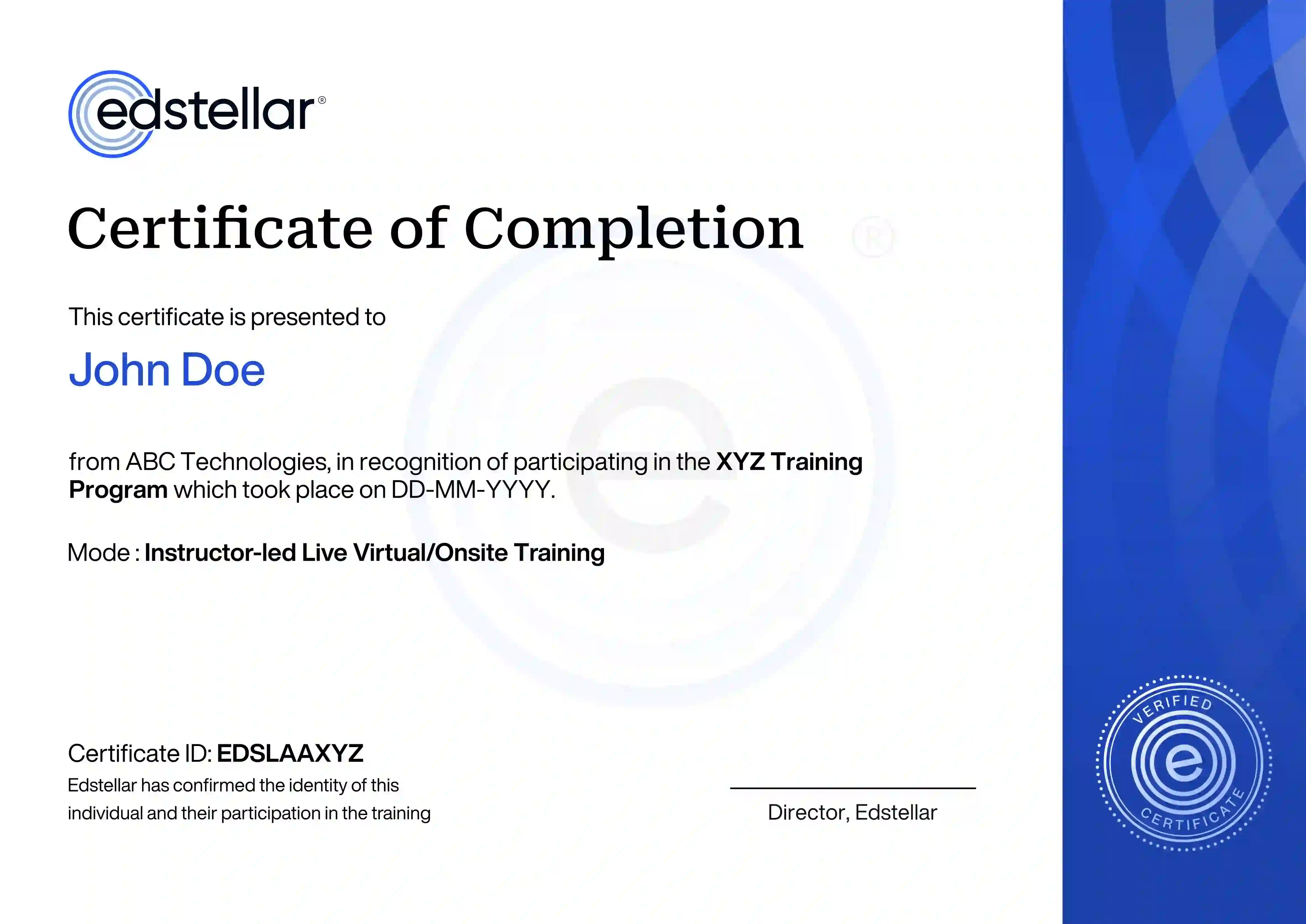
        Upon successful completion of the training course offered by Edstellar, employees receive a course completion certificate, symbolizing their dedication to ongoing learning and professional development.

        This certificate validates the employee's acquired skills and is a powerful motivator, inspiring them to enhance their expertise further and contribute effectively to organizational success.

        Recognition That Motivates Your Team
        Other Related Corporate Training Courses