15 Accountability Activities, Games & Exercises for Employees in 2026
A comprehensive guide to accountability games for teams, evaluated by an L&D leader with 24+ years of experience building high performance, results driven teams across operations and training functions.
15 Accountability Activities, Games & Exercises for Employees in 2026
Content
Table of Content
Quick Overview
Structured accountability activities turn ownership from a soft virtue into a measurable operating practice for every team.
Peer-to-peer accountability exercises reduce management overhead and replace policing with self-correcting team culture.
Ownership activities for teams pair commitments with visible trackers, weekly cadence, and shared artifacts.
Personal accountability games strengthen individual follow-through before scaling to cross-functional and leadership cohorts.
Accountability training and responsibility training compound when delivered as workshops, sprints, and recurring check-ins rather than one-off events.
Performance culture and trust building outcomes are measurable through cycle time, error rate, and engagement-survey shifts post-program.
Ask any business owner, and you will find that implementing structured accountability activities among employees is one of the most effective ways to drive performance, build a high-trust team culture, and raise employee engagement. Despite significant investments in training employees across various skills, organizations often struggle to build a culture of accountability without consistent accountability activities embedded into team routines.
According to FranklinCovey research, while 72% of senior HR executives agree that leadership accountability is a critical business issue, only 31% say they are satisfied with the current level of accountability within their organizations. The World Economic Forum ranks self-efficacy and dependability among the top skills employers will prioritize through 2030, making structured accountability activities a measurable workforce investment rather than a soft cultural ambition.
Without structured team accountability exercises and recurring workplace accountability activities, organizations struggle with poor decision-making, a lack of ownership among employees, and hindered collaboration, all of which impede organizational growth. A clear-eyed read on where these gaps live across roles starts with a structured skill gap diagnostic, which converts vague concerns about "low ownership" into specific behaviors L&D can address.
With accountability in place, two things happen: it holds people answerable for their actions, decisions, and outcomes, and it strengthens collaboration and trust within teams. At its core, developing accountability requires employees to understand the interdependence of their roles and how their contributions impact the overall outcome, which is why aligning accountability activities with employee training best practices matters as much as the activities themselves.
Author Insight
"Accountability is built through culture, not compliance. The exercises that shift behavior help teams define what accountability looks like in their context, practice ownership in safe environments, and celebrate follow through rather than just outcomes. When accountability becomes a team habit, everything improves.
"
Subbaiah M U
✓ 24+ years of building accountable, high performing teams across operations and training functions, where ownership and follow through were essential to daily success.
Why Accountability Matters in 2026
Organizations in 2026 navigate a hyper-accelerated landscape defined by distributed hybrid work, complex cross-functional alignment, and rapid technology integration. In this environment, execution bottlenecks rarely stem from a lack of technical training. Instead, they occur when team members work in silos, assume someone else is managing critical dependencies, and fail to take ownership of end outcomes.
Workplace accountability functions as the operational engine that translates strategic plans into actual business results. When organizations implement structured accountability activities for teams, they establish a culture where commitments are visible, progress is measurable, and peer-to-peer expectations are clearly defined.This shift reduces management overhead, eliminates redundant follow-ups, and empowers individual contributors to self-correct and meet performance expectations proactively.
The business impact of establishing an ownership culture is significant. Companies that cultivate strong responsibility training and team accountability activities consistently outperform competitors across key performance indicators, achieving faster project cycles, higher employee engagement, and reduced voluntary turnover.By embedding accountability activities into their regular development programs, HR and L&D leaders build teams that treat commitments not as soft virtues, but as concrete, measurable results that drive long-term business success.
Meanwhile, organizations that neglect these capabilities find themselves trapped in cycles of poor judgments, resource misallocation, and missed market opportunities, ultimately relegating them to reactive crisis management rather than strategic leadership. Gallup research ties low workplace ownership directly to the "$8.9 trillion in lost annual productivity created by employee disengagement," underscoring why accountability activities and training have shifted from a culture initiative to an L&D priority.
"With the right support, any leader can step up, embrace accountability and transform their organization into a place where everyone succeeds."
Vince Molinaro
Founder & CEO, Leadership Contract Inc. · Canada
✔ Leadership advisor and author specializing in accountability, executive effectiveness, organizational culture, and leadership transformation.
Key Accountability Activities and Exercises to Align Your Team
Explore our curated selection of the best 15 accountability activities, games, and workplace exercises for employees below. Each activity is built to strengthen team culture and ownership culture, with a guided interactive demo, materials, learning outcomes, and expert facilitator tips.
👤 Age 18+👥 6+ Players⏱ 30-45 min
1. Trust Box Exercise
Team members anonymously submit challenges or feedback into a designated box, then openly discuss the concerns as a group. The setup creates a safe space for raising issues while fostering collective problem-solving.
TrustOpennessDialogue
1 Interactive Guided Demo
1
2
3
4
5
6
7
Step 1 of 7
👆
📦
📦🔒🗝️
📝📦🖊️📋📦
🖊️
📋✨🎯🤝
✨✨
📋✅🌟💡
💡
🤝📌📋✨
✨✨
✨📦📝🖊️📋
🏆
🎉🌟✨🎊💫
Welcome to Trust Box Exercise
Share concerns safely and solve problems together.
👆 Click anywhere to continue
2 Activity Details
📦
Team members anonymously submit challenges or feedback into a designated box, then openly discuss the concerns as a group. The setup creates a safe space for raising issues while fostering collective problem-solving.
Players
👥 6+ Players
Recommended
Time
⏱ 30-45 min
Activity + debrief
Format
Team Game
Facilitated
Skill
Trust
Primary outcome
What You'll Need
Prepare these items before the activity begins so the session runs smoothly.
📦
Trust Box
Required for activity
📝
Paper Slips
Required for activity
🖊️
Pens
Required for activity
📋
Action Log
Required for activity
Step-by-Step Walkthrough
1
Set Up the Box
Place a sealed box and blank slips in the room and explain confidentiality rules.
5 min
2
Anonymous Submissions
Each member writes a workplace challenge or concern and drops it in the box.
5 min
3
Group Discussion
Facilitator reads each slip aloud and the team discusses it without identifying authors.
5 min
4
Solution Mapping
Group brainstorms solutions for each concern and assigns owners for follow-up.
5 min
5
Commit to Action
Document agreed actions and schedule a review to track progress.
5 min
Ground Rules
✓ Do
Explain the goal and constraints before starting.
Give every participant a clear role or opportunity to contribute.
Keep the timer visible and the rules consistent.
Encourage teams to explain their reasoning.
Close with a structured debrief.
✕ Don't
Do not let one person dominate the activity.
Do not change the rules midway unless it is a planned variation.
Do not skip reflection after the activity.
Do not make the activity personal or uncomfortable.
Do not focus only on winning; focus on learning.
What Your Team Will Learn
These outcomes should be reinforced during the debrief.
🧠
Outcome
Trust
Participants practice this capability through the activity and reinforce it through discussion.
🛠️
Outcome
Openness
Participants practice this capability through the activity and reinforce it through discussion.
🤝
Outcome
Dialogue
Participants practice this capability through the activity and reinforce it through discussion.
⏱
Outcome
Empathy
Participants practice this capability through the activity and reinforce it through discussion.
💡
Outcome
Ownership
Participants practice this capability through the activity and reinforce it through discussion.
📊
Outcome
Collaboration
Participants practice this capability through the activity and reinforce it through discussion.
Ways to Mix It Up
🔁
Repeat Round
Run a second round after debrief to test improved thinking.
🤐
Silent Mode
Add a short no-speaking phase to test non-verbal coordination.
💰
Budget Mode
Assign costs or limits to resources to force prioritization.
🌐
Virtual Edition
Adapt the activity using breakout rooms and shared documents.
🏆
Scored Challenge
Award points for creativity, teamwork, and quality of reasoning.
Debrief Questions
Use these prompts to convert the activity into workplace learning.
What did your team do first during Trust Box Exercise?
Which assumption turned out to be wrong?
How did communication affect the result?
Where did the team lose time or clarity?
What workplace situation feels similar to this activity?
What would you change if you ran the activity again?
3 Tips for Facilitators
⏱
Time Box Clearly
Use a visible timer so participants feel the constraint and pace their decisions.
🧑🏫
Facilitate, Don't Solve
Guide with questions instead of giving answers.
📌
Capture Observations
Note communication patterns, decision points, and bottlenecks.
💬
Debrief Deeply
Reserve enough time to connect the activity to workplace behavior.
4 Real-World Applications
🎯
Quarterly Planning
Translate annual goals into focused, time-bound milestones.
📈
Performance Reviews
Anchor 1:1s to specific, measurable outcomes.
🤝
Team Alignment
Make individual work visible so the team can support each other.
🚀
Career Development
Turn reflection into structured, repeatable growth plans.
👤 Age 18+👥 Pairs⏱ 45-60 min
2. Peer Reviews
Members assess each other's recent work using structured forms covering communication, quality, timeliness, and collaboration. One-on-one conversations follow, focusing on constructive criticism and improvement goals.
FeedbackQualityGrowth
1 Interactive Guided Demo
1
2
3
4
5
6
7
Step 1 of 7
👆
📝
👥📝✅
🖊️📝💻📅📝
💻
📋✨🎯🤝
✨✨
📅✅🌟💡
💡
🤝📌📋✨
✨✨
📋📝🖊️💻📅
🏆
🎉🌟✨🎊💫
Welcome to Peer Reviews
Exchange structured feedback and set growth goals.
👆 Click anywhere to continue
2 Activity Details
📝
Members assess each other's recent work using structured forms covering communication, quality, timeliness, and collaboration. One-on-one conversations follow, focusing on constructive criticism and improvement goals.
Players
👥 Pairs
Recommended
Time
⏱ 45-60 min
Activity + debrief
Format
Team Game
Facilitated
Skill
Feedback
Primary outcome
What You'll Need
Prepare these items before the activity begins so the session runs smoothly.
📝
Review Forms
Required for activity
🖊️
Pens
Required for activity
💻
Shared Drive
Required for activity
📅
Calendar
Required for activity
Step-by-Step Walkthrough
1
Share the Form
Distribute a structured form covering quality, communication, timeliness, and collaboration.
5 min
2
Complete Reviews
Each reviewer fills the form with specific examples from recent work.
5 min
3
Pair Discussions
Partners meet to walk through feedback face to face and clarify points.
5 min
4
Set Goals
Each person sets two improvement goals based on the feedback received.
5 min
5
Follow Up
Revisit goals in thirty days to confirm progress and adjust focus.
5 min
Ground Rules
✓ Do
Explain the goal and constraints before starting.
Give every participant a clear role or opportunity to contribute.
Keep the timer visible and the rules consistent.
Encourage teams to explain their reasoning.
Close with a structured debrief.
✕ Don't
Do not let one person dominate the activity.
Do not change the rules midway unless it is a planned variation.
Do not skip reflection after the activity.
Do not make the activity personal or uncomfortable.
Do not focus only on winning; focus on learning.
What Your Team Will Learn
These outcomes should be reinforced during the debrief.
🧠
Outcome
Feedback
Participants practice this capability through the activity and reinforce it through discussion.
🛠️
Outcome
Quality
Participants practice this capability through the activity and reinforce it through discussion.
🤝
Outcome
Growth
Participants practice this capability through the activity and reinforce it through discussion.
⏱
Outcome
Trust
Participants practice this capability through the activity and reinforce it through discussion.
💡
Outcome
Accountability
Participants practice this capability through the activity and reinforce it through discussion.
📊
Outcome
Communication
Participants practice this capability through the activity and reinforce it through discussion.
Ways to Mix It Up
🔁
Repeat Round
Run a second round after debrief to test improved thinking.
🤐
Silent Mode
Add a short no-speaking phase to test non-verbal coordination.
💰
Budget Mode
Assign costs or limits to resources to force prioritization.
🌐
Virtual Edition
Adapt the activity using breakout rooms and shared documents.
🏆
Scored Challenge
Award points for creativity, teamwork, and quality of reasoning.
Debrief Questions
Use these prompts to convert the activity into workplace learning.
What did your team do first during Peer Reviews?
Which assumption turned out to be wrong?
How did communication affect the result?
Where did the team lose time or clarity?
What workplace situation feels similar to this activity?
What would you change if you ran the activity again?
3 Tips for Facilitators
⏱
Time Box Clearly
Use a visible timer so participants feel the constraint and pace their decisions.
🧑🏫
Facilitate, Don't Solve
Guide with questions instead of giving answers.
📌
Capture Observations
Note communication patterns, decision points, and bottlenecks.
💬
Debrief Deeply
Reserve enough time to connect the activity to workplace behavior.
4 Real-World Applications
🎯
Quarterly Planning
Translate annual goals into focused, time-bound milestones.
📈
Performance Reviews
Anchor 1:1s to specific, measurable outcomes.
🤝
Team Alignment
Make individual work visible so the team can support each other.
🚀
Career Development
Turn reflection into structured, repeatable growth plans.
👤 Age 18+👥 5-12 Players⏱ 30-40 min
3. The Accountability Game
Team members anonymously write down recent project mistakes and the group collectively discusses solutions and lessons. The exercise emphasizes learning rather than fault, promoting constructive dialogue.
LearningReflectionImprovement
1 Interactive Guided Demo
1
2
3
4
5
6
7
Step 1 of 7
👆
🎯
🎲💡🎯
📇🖊️📋📝🖊️
🖊️
📋✨🎯🤝
✨✨
📋✅🌟💡
📝
🎯🤝📌💡
✨✨
💡📇🖊️📋📝
🏆
🎉🌟✨🎊💫
Welcome to The Accountability Game
Turn recent mistakes into shared team lessons.
👆 Click anywhere to continue
2 Activity Details
🎯
Team members anonymously write down recent project mistakes and the group collectively discusses solutions and lessons. The exercise emphasizes learning rather than fault, promoting constructive dialogue.
Players
👥 5-12 Players
Recommended
Time
⏱ 30-40 min
Activity + debrief
Format
Team Game
Facilitated
Skill
Learning
Primary outcome
What You'll Need
Prepare these items before the activity begins so the session runs smoothly.
📇
Index Cards
Required for activity
🖊️
Pens
Required for activity
📋
Flip Chart
Required for activity
📝
Lessons Log
Required for activity
Step-by-Step Walkthrough
1
Frame Safe Space
Open by emphasizing the no-blame intent and the focus on shared learning.
5 min
2
Write Mistakes
Each person anonymously writes one recent mistake on a card and submits it.
5 min
3
Group Reflection
Facilitator reads cards aloud and the team discusses contributing factors.
5 min
4
Generate Lessons
Capture practical lessons and patterns the team can apply going forward.
5 min
5
Commit to Changes
Agree on specific process changes and assign owners to drive them.
5 min
Ground Rules
✓ Do
Explain the goal and constraints before starting.
Give every participant a clear role or opportunity to contribute.
Keep the timer visible and the rules consistent.
Encourage teams to explain their reasoning.
Close with a structured debrief.
✕ Don't
Do not let one person dominate the activity.
Do not change the rules midway unless it is a planned variation.
Do not skip reflection after the activity.
Do not make the activity personal or uncomfortable.
Do not focus only on winning; focus on learning.
What Your Team Will Learn
These outcomes should be reinforced during the debrief.
🧠
Outcome
Learning
Participants practice this capability through the activity and reinforce it through discussion.
🛠️
Outcome
Reflection
Participants practice this capability through the activity and reinforce it through discussion.
🤝
Outcome
Improvement
Participants practice this capability through the activity and reinforce it through discussion.
⏱
Outcome
Honesty
Participants practice this capability through the activity and reinforce it through discussion.
💡
Outcome
Trust
Participants practice this capability through the activity and reinforce it through discussion.
📊
Outcome
Growth
Participants practice this capability through the activity and reinforce it through discussion.
Ways to Mix It Up
🔁
Repeat Round
Run a second round after debrief to test improved thinking.
🤐
Silent Mode
Add a short no-speaking phase to test non-verbal coordination.
💰
Budget Mode
Assign costs or limits to resources to force prioritization.
🌐
Virtual Edition
Adapt the activity using breakout rooms and shared documents.
🏆
Scored Challenge
Award points for creativity, teamwork, and quality of reasoning.
Debrief Questions
Use these prompts to convert the activity into workplace learning.
What did your team do first during The Accountability Game?
Which assumption turned out to be wrong?
How did communication affect the result?
Where did the team lose time or clarity?
What workplace situation feels similar to this activity?
What would you change if you ran the activity again?
3 Tips for Facilitators
⏱
Time Box Clearly
Use a visible timer so participants feel the constraint and pace their decisions.
🧑🏫
Facilitate, Don't Solve
Guide with questions instead of giving answers.
📌
Capture Observations
Note communication patterns, decision points, and bottlenecks.
💬
Debrief Deeply
Reserve enough time to connect the activity to workplace behavior.
4 Real-World Applications
🎯
Quarterly Planning
Translate annual goals into focused, time-bound milestones.
📈
Performance Reviews
Anchor 1:1s to specific, measurable outcomes.
🤝
Team Alignment
Make individual work visible so the team can support each other.
🚀
Career Development
Turn reflection into structured, repeatable growth plans.
👤 Age 18+👥 6+ Players⏱ 30-45 min
4. SMART Goal Accountability Sprint
Teams set specific, measurable, achievable, relevant, time-bound goals publicly, commit to a two-week sprint with mid-point check-ins, then reconvene to review outcomes, own the gaps openly, and reset for the next sprint with sharper targets.
GoalsCommitmentTracking
1 Interactive Guided Demo
1
2
3
4
5
6
7
Step 1 of 7
👆
🎯
✅📈📊
✅📈📊🏆📝
🎯
⏰💪🚀📋
✨✨
✅📈📊🏆
🎯
⏰💪🚀📋
✨✨
✅📈📊🏆📝
🎯
🎉🌟✨🎊💫
Welcome to Trust Box Exercise
Share concerns safely and solve problems together.
👆 Click anywhere to continue
2 Activity Details
📦
Teams set specific, measurable, achievable, relevant, time-bound goals publicly, commit to a two-week sprint with mid-point check-ins, then reconvene to review outcomes, own the gaps openly, and reset for the next sprint with sharper targets.
Players
👥 6+ Players
Recommended
Time
⏱ 30-45 min
Activity + debrief
Format
Team Game
Facilitated
Skill
Trust
Primary outcome
What You'll Need
Prepare these items before the activity begins so the session runs smoothly.
✅
Trust Box
Required for activity
📈
Paper Slips
Required for activity
📊
Pens
Required for activity
🏆
Action Log
Required for activity
Step-by-Step Walkthrough
1
Set SMART Goals
Place a sealed box and blank slips in the room and explain confidentiality rules.
5 min
2
Publicly Commit
Each member writes a workplace challenge or concern and drops it in the box.
5 min
3
Mid-Sprint Check-In
Facilitator reads each slip aloud and the team discusses it without identifying authors.
5 min
4
Final Review
Group brainstorms solutions for each concern and assigns owners for follow-up.
5 min
5
Own the Outcome
Document agreed actions and schedule a review to track progress.
5 min
Ground Rules
✓ Do
Explain the goal and constraints before starting.
Give every participant a clear role or opportunity to contribute.
Keep the timer visible and the rules consistent.
Encourage teams to explain their reasoning.
Close with a structured debrief.
✕ Don't
Do not let one person dominate the activity.
Do not change the rules midway unless it is a planned variation.
Do not skip reflection after the activity.
Do not make the activity personal or uncomfortable.
Do not focus only on winning; focus on learning.
What Your Team Will Learn
These outcomes should be reinforced during the debrief.
🧠
Outcome
Trust
Participants practice this capability through the activity and reinforce it through discussion.
🛠️
Outcome
Openness
Participants practice this capability through the activity and reinforce it through discussion.
🤝
Outcome
Dialogue
Participants practice this capability through the activity and reinforce it through discussion.
⏱
Outcome
Empathy
Participants practice this capability through the activity and reinforce it through discussion.
💡
Outcome
Ownership
Participants practice this capability through the activity and reinforce it through discussion.
📊
Outcome
Collaboration
Participants practice this capability through the activity and reinforce it through discussion.
Ways to Mix It Up
🔁
Repeat Round
Run a second round after debrief to test improved thinking.
🤐
Silent Mode
Add a short no-speaking phase to test non-verbal coordination.
💰
Budget Mode
Assign costs or limits to resources to force prioritization.
🌐
Virtual Edition
Adapt the activity using breakout rooms and shared documents.
🏆
Scored Challenge
Award points for creativity, teamwork, and quality of reasoning.
Debrief Questions
Use these prompts to convert the activity into workplace learning.
What did your team do first during SMART Goal Accountability Sprint?
Which assumption turned out to be wrong?
How did communication affect the result?
Where did the team lose time or clarity?
What workplace situation feels similar to this activity?
What would you change if you ran the activity again?
3 Tips for Facilitators
⏱
Time Box Clearly
Use a visible timer so participants feel the constraint and pace their decisions.
🧑🏫
Facilitate, Don't Solve
Guide with questions instead of giving answers.
📌
Capture Observations
Note communication patterns, decision points, and bottlenecks.
💬
Debrief Deeply
Reserve enough time to connect the activity to workplace behavior.
4 Real-World Applications
🎯
Quarterly Planning
Translate annual goals into focused, time-bound milestones.
📈
Performance Reviews
Anchor 1:1s to specific, measurable outcomes.
🤝
Team Alignment
Make individual work visible so the team can support each other.
🚀
Career Development
Turn reflection into structured, repeatable growth plans.
👤 Age 18+👥 Pairs⏱ 20-30 min
5. Accountability Partnerships
Pairs commit to holding each other accountable through regular check-ins on shared goals. Partners discuss progress, obstacles, and solutions while offering mutual support focused on problem-solving.
PartnershipSupportFollow-through
1 Interactive Guided Demo
1
2
3
4
5
6
7
Step 1 of 7
👆
🤝
🤝👥🔗
📔📅🖊️📋📅
📅
📋✨🎯🤝
✨✨
🖊️✅🌟💡
📋
🤝📌💡✨
✨✨
💡📔📅🖊️📋
🏆
🎉🌟✨🎊💫
Welcome to Accountability Partnerships
Pair up and keep each other on track.
👆 Click anywhere to continue
2 Activity Details
🤝
Pairs commit to holding each other accountable through regular check-ins on shared goals. Partners discuss progress, obstacles, and solutions while offering mutual support focused on problem-solving.
Players
👥 Pairs
Recommended
Time
⏱ 20-30 min
Activity + debrief
Format
Team Game
Facilitated
Skill
Partnership
Primary outcome
What You'll Need
Prepare these items before the activity begins so the session runs smoothly.
📔
Goal Journals
Required for activity
📅
Calendar
Required for activity
🖊️
Pens
Required for activity
📋
Tracker
Required for activity
Step-by-Step Walkthrough
1
Pair Members
Match people who can challenge and support each other across different functions.
5 min
2
Set Shared Goals
Each pair writes two or three measurable goals with clear deadlines.
5 min
3
Schedule Check-ins
Book recurring fifteen-minute check-ins to review progress and blockers.
5 min
4
Solve Together
During check-ins partners coach each other through obstacles and next steps.
5 min
5
Review Progress
After a month review outcomes and adjust goals or partnerships as needed.
5 min
Ground Rules
✓ Do
Explain the goal and constraints before starting.
Give every participant a clear role or opportunity to contribute.
Keep the timer visible and the rules consistent.
Encourage teams to explain their reasoning.
Close with a structured debrief.
✕ Don't
Do not let one person dominate the activity.
Do not change the rules midway unless it is a planned variation.
Do not skip reflection after the activity.
Do not make the activity personal or uncomfortable.
Do not focus only on winning; focus on learning.
What Your Team Will Learn
These outcomes should be reinforced during the debrief.
🧠
Outcome
Partnership
Participants practice this capability through the activity and reinforce it through discussion.
🛠️
Outcome
Support
Participants practice this capability through the activity and reinforce it through discussion.
🤝
Outcome
Follow-through
Participants practice this capability through the activity and reinforce it through discussion.
⏱
Outcome
Trust
Participants practice this capability through the activity and reinforce it through discussion.
💡
Outcome
Commitment
Participants practice this capability through the activity and reinforce it through discussion.
📊
Outcome
Growth
Participants practice this capability through the activity and reinforce it through discussion.
Ways to Mix It Up
🔁
Repeat Round
Run a second round after debrief to test improved thinking.
🤐
Silent Mode
Add a short no-speaking phase to test non-verbal coordination.
💰
Budget Mode
Assign costs or limits to resources to force prioritization.
🌐
Virtual Edition
Adapt the activity using breakout rooms and shared documents.
🏆
Scored Challenge
Award points for creativity, teamwork, and quality of reasoning.
Debrief Questions
Use these prompts to convert the activity into workplace learning.
What did your team do first during Accountability Partnerships?
Which assumption turned out to be wrong?
How did communication affect the result?
Where did the team lose time or clarity?
What workplace situation feels similar to this activity?
What would you change if you ran the activity again?
3 Tips for Facilitators
⏱
Time Box Clearly
Use a visible timer so participants feel the constraint and pace their decisions.
🧑🏫
Facilitate, Don't Solve
Guide with questions instead of giving answers.
📌
Capture Observations
Note communication patterns, decision points, and bottlenecks.
💬
Debrief Deeply
Reserve enough time to connect the activity to workplace behavior.
4 Real-World Applications
🎯
Quarterly Planning
Translate annual goals into focused, time-bound milestones.
📈
Performance Reviews
Anchor 1:1s to specific, measurable outcomes.
🤝
Team Alignment
Make individual work visible so the team can support each other.
🚀
Career Development
Turn reflection into structured, repeatable growth plans.
👤 Age 18+👥 Full Team⏱ 30-45 min
6. Accountability Check-Ins
Regular scheduled meetings review ongoing projects, address obstacles, and set goals for the next period. The sessions promote transparency and ensure each member remains responsible for tasks.
TransparencyProgressDiscipline
1 Interactive Guided Demo
1
2
3
4
5
6
7
Step 1 of 7
👆
📅
✅📅📊
💻📅📋🖊️📅
📋
✨🎯🤝📌
✨✨
🖊️✅🌟💡
💡
🤝📌📋✨
✨✨
✨📅💻📋🖊️
🏆
🎉🌟✨🎊💫
Welcome to Accountability Check-Ins
Meet regularly to track progress and clear blockers.
👆 Click anywhere to continue
2 Activity Details
📅
Regular scheduled meetings review ongoing projects, address obstacles, and set goals for the next period. The sessions promote transparency and ensure each member remains responsible for tasks.
Players
👥 Full Team
Recommended
Time
⏱ 30-45 min
Activity + debrief
Format
Team Game
Facilitated
Skill
Transparency
Primary outcome
What You'll Need
Prepare these items before the activity begins so the session runs smoothly.
📅
Calendar
Required for activity
💻
Shared Tracker
Required for activity
📋
Agenda
Required for activity
🖊️
Notes
Required for activity
Step-by-Step Walkthrough
1
Set the Cadence
Agree on a weekly or biweekly rhythm and protect the time on calendars.
5 min
2
Share Updates
Each member reports progress on assigned goals using a consistent format.
5 min
3
Surface Blockers
Identify obstacles slowing work and request specific help from the team.
5 min
4
Set Next Goals
Confirm priorities and deliverables for the next period before closing.
5 min
5
Log Decisions
Document decisions and owners in a shared tracker for visibility.
5 min
Ground Rules
✓ Do
Explain the goal and constraints before starting.
Give every participant a clear role or opportunity to contribute.
Keep the timer visible and the rules consistent.
Encourage teams to explain their reasoning.
Close with a structured debrief.
✕ Don't
Do not let one person dominate the activity.
Do not change the rules midway unless it is a planned variation.
Do not skip reflection after the activity.
Do not make the activity personal or uncomfortable.
Do not focus only on winning; focus on learning.
What Your Team Will Learn
These outcomes should be reinforced during the debrief.
🧠
Outcome
Transparency
Participants practice this capability through the activity and reinforce it through discussion.
🛠️
Outcome
Progress
Participants practice this capability through the activity and reinforce it through discussion.
🤝
Outcome
Discipline
Participants practice this capability through the activity and reinforce it through discussion.
⏱
Outcome
Alignment
Participants practice this capability through the activity and reinforce it through discussion.
💡
Outcome
Ownership
Participants practice this capability through the activity and reinforce it through discussion.
📊
Outcome
Communication
Participants practice this capability through the activity and reinforce it through discussion.
Ways to Mix It Up
🔁
Repeat Round
Run a second round after debrief to test improved thinking.
🤐
Silent Mode
Add a short no-speaking phase to test non-verbal coordination.
💰
Budget Mode
Assign costs or limits to resources to force prioritization.
🌐
Virtual Edition
Adapt the activity using breakout rooms and shared documents.
🏆
Scored Challenge
Award points for creativity, teamwork, and quality of reasoning.
Debrief Questions
Use these prompts to convert the activity into workplace learning.
What did your team do first during Accountability Check-Ins?
Which assumption turned out to be wrong?
How did communication affect the result?
Where did the team lose time or clarity?
What workplace situation feels similar to this activity?
What would you change if you ran the activity again?
3 Tips for Facilitators
⏱
Time Box Clearly
Use a visible timer so participants feel the constraint and pace their decisions.
🧑🏫
Facilitate, Don't Solve
Guide with questions instead of giving answers.
📌
Capture Observations
Note communication patterns, decision points, and bottlenecks.
💬
Debrief Deeply
Reserve enough time to connect the activity to workplace behavior.
4 Real-World Applications
🎯
Quarterly Planning
Translate annual goals into focused, time-bound milestones.
📈
Performance Reviews
Anchor 1:1s to specific, measurable outcomes.
🤝
Team Alignment
Make individual work visible so the team can support each other.
🚀
Career Development
Turn reflection into structured, repeatable growth plans.
👤 Age 18+👥 6+ Players⏱ 30-45 min
7. Accountability Circle
A weekly structured circle where each member shares one win and one failure from the week, encouraging radical transparency, peer coaching, and shared ownership of outcomes. The format builds trust and normalizes honest reflection on performance.
TransparencyReflectionTrust
1 Interactive Guided Demo
1
2
3
4
5
6
7
Step 1 of 7
👆
🔄
💬🤝👥
💬🤝👥🌟💡
🔄
📝✨🎯🏆
✨✨
💬🤝👥🌟
🔄
📝✨🎯🏆
✨✨
💬🤝👥🌟💡
🔄
🎉🌟✨🎊💫
Welcome to Trust Box Exercise
Share concerns safely and solve problems together.
👆 Click anywhere to continue
2 Activity Details
📦
A weekly structured circle where each member shares one win and one failure from the week, encouraging radical transparency, peer coaching, and shared ownership of outcomes. The format builds trust and normalizes honest reflection on performance.
Players
👥 6+ Players
Recommended
Time
⏱ 30-45 min
Activity + debrief
Format
Team Game
Facilitated
Skill
Trust
Primary outcome
What You'll Need
Prepare these items before the activity begins so the session runs smoothly.
💬
Trust Box
Required for activity
🤝
Paper Slips
Required for activity
👥
Pens
Required for activity
🌟
Action Log
Required for activity
Step-by-Step Walkthrough
1
Open the Circle
Place a sealed box and blank slips in the room and explain confidentiality rules.
5 min
2
Share a Win
Each member writes a workplace challenge or concern and drops it in the box.
5 min
3
Share a Failure
Facilitator reads each slip aloud and the team discusses it without identifying authors.
5 min
4
Peer Coaching
Group brainstorms solutions for each concern and assigns owners for follow-up.
5 min
5
Close with Commitments
Document agreed actions and schedule a review to track progress.
5 min
Ground Rules
✓ Do
Explain the goal and constraints before starting.
Give every participant a clear role or opportunity to contribute.
Keep the timer visible and the rules consistent.
Encourage teams to explain their reasoning.
Close with a structured debrief.
✕ Don't
Do not let one person dominate the activity.
Do not change the rules midway unless it is a planned variation.
Do not skip reflection after the activity.
Do not make the activity personal or uncomfortable.
Do not focus only on winning; focus on learning.
What Your Team Will Learn
These outcomes should be reinforced during the debrief.
🧠
Outcome
Trust
Participants practice this capability through the activity and reinforce it through discussion.
🛠️
Outcome
Openness
Participants practice this capability through the activity and reinforce it through discussion.
🤝
Outcome
Dialogue
Participants practice this capability through the activity and reinforce it through discussion.
⏱
Outcome
Empathy
Participants practice this capability through the activity and reinforce it through discussion.
💡
Outcome
Ownership
Participants practice this capability through the activity and reinforce it through discussion.
📊
Outcome
Collaboration
Participants practice this capability through the activity and reinforce it through discussion.
Ways to Mix It Up
🔁
Repeat Round
Run a second round after debrief to test improved thinking.
🤐
Silent Mode
Add a short no-speaking phase to test non-verbal coordination.
💰
Budget Mode
Assign costs or limits to resources to force prioritization.
🌐
Virtual Edition
Adapt the activity using breakout rooms and shared documents.
🏆
Scored Challenge
Award points for creativity, teamwork, and quality of reasoning.
Debrief Questions
Use these prompts to convert the activity into workplace learning.
What did your team do first during Accountability Circle?
Which assumption turned out to be wrong?
How did communication affect the result?
Where did the team lose time or clarity?
What workplace situation feels similar to this activity?
What would you change if you ran the activity again?
3 Tips for Facilitators
⏱
Time Box Clearly
Use a visible timer so participants feel the constraint and pace their decisions.
🧑🏫
Facilitate, Don't Solve
Guide with questions instead of giving answers.
📌
Capture Observations
Note communication patterns, decision points, and bottlenecks.
💬
Debrief Deeply
Reserve enough time to connect the activity to workplace behavior.
4 Real-World Applications
🎯
Quarterly Planning
Translate annual goals into focused, time-bound milestones.
📈
Performance Reviews
Anchor 1:1s to specific, measurable outcomes.
🤝
Team Alignment
Make individual work visible so the team can support each other.
🚀
Career Development
Turn reflection into structured, repeatable growth plans.
Ready to Roll Out Accountability Workshops for Your Team?
Edstellar facilitators run these accountability workshops on-site or virtually, fully customized to your team's goals.
One team member sits in the hot seat while peers ask about recent tasks, decisions, or challenges. The group then offers constructive feedback in a supportive, transparent environment.
FeedbackTransparencyHonesty
1 Interactive Guided Demo
1
2
3
4
5
6
7
Step 1 of 7
👆
🪑
🔥💺💬
⏱️🪑📝🖊️🪑
📝
📋✨🎯🤝
✨✨
🖊️✅🌟💡
💡
🤝📌📋✨
✨✨
📋🪑⏱️📝🖊️
🏆
🎉🌟✨🎊💫
Welcome to The Hot Seat
Face honest questions and grow with peer feedback.
👆 Click anywhere to continue
2 Activity Details
🪑
One team member sits in the hot seat while peers ask about recent tasks, decisions, or challenges. The group then offers constructive feedback in a supportive, transparent environment.
Players
👥 5-10 Players
Recommended
Time
⏱ 30-45 min
Activity + debrief
Format
Team Game
Facilitated
Skill
Feedback
Primary outcome
What You'll Need
Prepare these items before the activity begins so the session runs smoothly.
🪑
Chair
Required for activity
⏱️
Timer
Required for activity
📝
Feedback Forms
Required for activity
🖊️
Pens
Required for activity
Step-by-Step Walkthrough
1
Set Ground Rules
Explain respectful questioning, time limits, and the goal of constructive feedback.
5 min
2
Choose the Seat
A volunteer sits in the hot seat and the team forms a semicircle around them.
5 min
3
Peer Questions
Peers ask focused questions about recent decisions, blockers, and outcomes.
5 min
4
Give Feedback
Each peer shares one strength and one growth suggestion using clear examples.
5 min
5
Rotate Seats
Switch participants so each member gets time in the hot seat and debrief.
5 min
Ground Rules
✓ Do
Explain the goal and constraints before starting.
Give every participant a clear role or opportunity to contribute.
Keep the timer visible and the rules consistent.
Encourage teams to explain their reasoning.
Close with a structured debrief.
✕ Don't
Do not let one person dominate the activity.
Do not change the rules midway unless it is a planned variation.
Do not skip reflection after the activity.
Do not make the activity personal or uncomfortable.
Do not focus only on winning; focus on learning.
What Your Team Will Learn
These outcomes should be reinforced during the debrief.
🧠
Outcome
Feedback
Participants practice this capability through the activity and reinforce it through discussion.
🛠️
Outcome
Transparency
Participants practice this capability through the activity and reinforce it through discussion.
🤝
Outcome
Honesty
Participants practice this capability through the activity and reinforce it through discussion.
⏱
Outcome
Trust
Participants practice this capability through the activity and reinforce it through discussion.
💡
Outcome
Growth
Participants practice this capability through the activity and reinforce it through discussion.
📊
Outcome
Communication
Participants practice this capability through the activity and reinforce it through discussion.
Ways to Mix It Up
🔁
Repeat Round
Run a second round after debrief to test improved thinking.
🤐
Silent Mode
Add a short no-speaking phase to test non-verbal coordination.
💰
Budget Mode
Assign costs or limits to resources to force prioritization.
🌐
Virtual Edition
Adapt the activity using breakout rooms and shared documents.
🏆
Scored Challenge
Award points for creativity, teamwork, and quality of reasoning.
Debrief Questions
Use these prompts to convert the activity into workplace learning.
What did your team do first during The Hot Seat?
Which assumption turned out to be wrong?
How did communication affect the result?
Where did the team lose time or clarity?
What workplace situation feels similar to this activity?
What would you change if you ran the activity again?
3 Tips for Facilitators
⏱
Time Box Clearly
Use a visible timer so participants feel the constraint and pace their decisions.
🧑🏫
Facilitate, Don't Solve
Guide with questions instead of giving answers.
📌
Capture Observations
Note communication patterns, decision points, and bottlenecks.
💬
Debrief Deeply
Reserve enough time to connect the activity to workplace behavior.
4 Real-World Applications
🎯
Quarterly Planning
Translate annual goals into focused, time-bound milestones.
📈
Performance Reviews
Anchor 1:1s to specific, measurable outcomes.
🤝
Team Alignment
Make individual work visible so the team can support each other.
🚀
Career Development
Turn reflection into structured, repeatable growth plans.
👤 Age 18+👥 4-10 Players⏱ 45-60 min
9. Role-Playing Exercises
Team members simulate real workplace scenarios like difficult clients, conflicts, or project challenges to practice communication and problem-solving. Debriefing after each scenario identifies effective strategies.
CommunicationEmpathyProblem-Solving
1 Interactive Guided Demo
1
2
3
4
5
6
7
Step 1 of 7
👆
🎭
🎭💬🤝
⏱️🎭📝🖊️🎭
📝
📋✨🎯🤝
✨✨
🖊️✅🌟💡
💡
🤝📌📋✨
✨✨
📋🎭⏱️📝🖊️
🏆
🎉🌟✨🎊💫
Welcome to Role-Playing Exercises
Practice tough scenarios and sharpen real responses.
👆 Click anywhere to continue
2 Activity Details
🎭
Team members simulate real workplace scenarios like difficult clients, conflicts, or project challenges to practice communication and problem-solving. Debriefing after each scenario identifies effective strategies.
Players
👥 4-10 Players
Recommended
Time
⏱ 45-60 min
Activity + debrief
Format
Team Game
Facilitated
Skill
Communication
Primary outcome
What You'll Need
Prepare these items before the activity begins so the session runs smoothly.
🎭
Scenario Cards
Required for activity
⏱️
Timer
Required for activity
📝
Debrief Sheets
Required for activity
🖊️
Pens
Required for activity
Step-by-Step Walkthrough
1
Pick Scenarios
Select realistic scenarios drawn from recent team or customer situations.
5 min
2
Assign Roles
Distribute roles and give each actor a short brief on their motivation.
5 min
3
Run the Scene
Act out the scenario for five to seven minutes while peers observe closely.
5 min
4
Debrief Together
Discuss what worked, what felt off, and which alternative approaches help.
5 min
5
Rerun with Tweaks
Replay the scene applying new tactics and compare the outcomes.
5 min
Ground Rules
✓ Do
Explain the goal and constraints before starting.
Give every participant a clear role or opportunity to contribute.
Keep the timer visible and the rules consistent.
Encourage teams to explain their reasoning.
Close with a structured debrief.
✕ Don't
Do not let one person dominate the activity.
Do not change the rules midway unless it is a planned variation.
Do not skip reflection after the activity.
Do not make the activity personal or uncomfortable.
Do not focus only on winning; focus on learning.
What Your Team Will Learn
These outcomes should be reinforced during the debrief.
🧠
Outcome
Communication
Participants practice this capability through the activity and reinforce it through discussion.
🛠️
Outcome
Empathy
Participants practice this capability through the activity and reinforce it through discussion.
🤝
Outcome
Problem-Solving
Participants practice this capability through the activity and reinforce it through discussion.
⏱
Outcome
Confidence
Participants practice this capability through the activity and reinforce it through discussion.
💡
Outcome
Listening
Participants practice this capability through the activity and reinforce it through discussion.
📊
Outcome
Adaptability
Participants practice this capability through the activity and reinforce it through discussion.
Ways to Mix It Up
🔁
Repeat Round
Run a second round after debrief to test improved thinking.
🤐
Silent Mode
Add a short no-speaking phase to test non-verbal coordination.
💰
Budget Mode
Assign costs or limits to resources to force prioritization.
🌐
Virtual Edition
Adapt the activity using breakout rooms and shared documents.
🏆
Scored Challenge
Award points for creativity, teamwork, and quality of reasoning.
Debrief Questions
Use these prompts to convert the activity into workplace learning.
What did your team do first during Role-Playing Exercises?
Which assumption turned out to be wrong?
How did communication affect the result?
Where did the team lose time or clarity?
What workplace situation feels similar to this activity?
What would you change if you ran the activity again?
3 Tips for Facilitators
⏱
Time Box Clearly
Use a visible timer so participants feel the constraint and pace their decisions.
🧑🏫
Facilitate, Don't Solve
Guide with questions instead of giving answers.
📌
Capture Observations
Note communication patterns, decision points, and bottlenecks.
💬
Debrief Deeply
Reserve enough time to connect the activity to workplace behavior.
4 Real-World Applications
🎯
Quarterly Planning
Translate annual goals into focused, time-bound milestones.
📈
Performance Reviews
Anchor 1:1s to specific, measurable outcomes.
🤝
Team Alignment
Make individual work visible so the team can support each other.
🚀
Career Development
Turn reflection into structured, repeatable growth plans.
👤 Age 18+👥 Full Team⏱ 20-30 min
10. Recognizing Milestones
Teams celebrate reaching key milestones while reflecting on the effort and accountability required. Recognition includes tangible rewards plus discussions of challenges overcome and lessons learned.
RecognitionMotivationReflection
1 Interactive Guided Demo
1
2
3
4
5
6
7
Step 1 of 7
👆
🏆
🏆🎉⭐
📸🏆🎉📋🏆
📋
✨🎯🤝📌
✨✨
💡✅🌟🎯
✨
🤝📌💡📋
✨✨
🎯🏆🎉📸📋
🎉
🎉🌟✨🎊💫
Welcome to Recognizing Milestones
Celebrate wins and reflect on the effort behind them.
👆 Click anywhere to continue
2 Activity Details
🏆
Teams celebrate reaching key milestones while reflecting on the effort and accountability required. Recognition includes tangible rewards plus discussions of challenges overcome and lessons learned.
Players
👥 Full Team
Recommended
Time
⏱ 20-30 min
Activity + debrief
Format
Team Game
Facilitated
Skill
Recognition
Primary outcome
What You'll Need
Prepare these items before the activity begins so the session runs smoothly.
🏆
Awards
Required for activity
🎉
Decorations
Required for activity
📸
Camera
Required for activity
📋
Recap Notes
Required for activity
Step-by-Step Walkthrough
1
Identify Milestones
Map upcoming milestones tied to team goals and assign visibility moments.
5 min
2
Plan Recognition
Decide on meaningful rewards and recognition formats for each milestone.
5 min
3
Celebrate Together
Host a short celebration that names individual contributions clearly.
5 min
4
Reflect on Effort
Discuss what required accountability and which behaviors enabled success.
5 min
5
Capture Lessons
Document lessons and share them as standards for future projects.
5 min
Ground Rules
✓ Do
Explain the goal and constraints before starting.
Give every participant a clear role or opportunity to contribute.
Keep the timer visible and the rules consistent.
Encourage teams to explain their reasoning.
Close with a structured debrief.
✕ Don't
Do not let one person dominate the activity.
Do not change the rules midway unless it is a planned variation.
Do not skip reflection after the activity.
Do not make the activity personal or uncomfortable.
Do not focus only on winning; focus on learning.
What Your Team Will Learn
These outcomes should be reinforced during the debrief.
🧠
Outcome
Recognition
Participants practice this capability through the activity and reinforce it through discussion.
🛠️
Outcome
Motivation
Participants practice this capability through the activity and reinforce it through discussion.
🤝
Outcome
Reflection
Participants practice this capability through the activity and reinforce it through discussion.
⏱
Outcome
Morale
Participants practice this capability through the activity and reinforce it through discussion.
💡
Outcome
Ownership
Participants practice this capability through the activity and reinforce it through discussion.
📊
Outcome
Culture
Participants practice this capability through the activity and reinforce it through discussion.
Ways to Mix It Up
🔁
Repeat Round
Run a second round after debrief to test improved thinking.
🤐
Silent Mode
Add a short no-speaking phase to test non-verbal coordination.
💰
Budget Mode
Assign costs or limits to resources to force prioritization.
🌐
Virtual Edition
Adapt the activity using breakout rooms and shared documents.
🏆
Scored Challenge
Award points for creativity, teamwork, and quality of reasoning.
Debrief Questions
Use these prompts to convert the activity into workplace learning.
What did your team do first during Recognizing Milestones?
Which assumption turned out to be wrong?
How did communication affect the result?
Where did the team lose time or clarity?
What workplace situation feels similar to this activity?
What would you change if you ran the activity again?
3 Tips for Facilitators
⏱
Time Box Clearly
Use a visible timer so participants feel the constraint and pace their decisions.
🧑🏫
Facilitate, Don't Solve
Guide with questions instead of giving answers.
📌
Capture Observations
Note communication patterns, decision points, and bottlenecks.
💬
Debrief Deeply
Reserve enough time to connect the activity to workplace behavior.
4 Real-World Applications
🎯
Quarterly Planning
Translate annual goals into focused, time-bound milestones.
📈
Performance Reviews
Anchor 1:1s to specific, measurable outcomes.
🤝
Team Alignment
Make individual work visible so the team can support each other.
🚀
Career Development
Turn reflection into structured, repeatable growth plans.
👤 Age 18+👥 5-12 Players⏱ 30-45 min
11. The Mistake List
Teams collaboratively document past mistakes without assigning blame, then discuss what went wrong and brainstorm prevention strategies. The list transforms errors into teachable moments for continuous improvement.
ReflectionLearningImprovement
1 Interactive Guided Demo
1
2
3
4
5
6
7
Step 1 of 7
👆
📋
📝❌💡
📝📋🖊️📒📋
🖊️
📋✨🎯🤝
✨✨
📒✅🌟💡
💡
🤝📌📋✨
✨✨
✨📋📝🖊️📒
🏆
🎉🌟✨🎊💫
Welcome to The Mistake List
Convert past errors into prevention playbooks.
👆 Click anywhere to continue
2 Activity Details
📋
Teams collaboratively document past mistakes without assigning blame, then discuss what went wrong and brainstorm prevention strategies. The list transforms errors into teachable moments for continuous improvement.
Players
👥 5-12 Players
Recommended
Time
⏱ 30-45 min
Activity + debrief
Format
Team Game
Facilitated
Skill
Reflection
Primary outcome
What You'll Need
Prepare these items before the activity begins so the session runs smoothly.
📋
Flip Chart
Required for activity
📝
Sticky Notes
Required for activity
🖊️
Markers
Required for activity
📒
Lessons Log
Required for activity
Step-by-Step Walkthrough
1
Gather Mistakes
Together list recent errors across projects without naming individuals.
5 min
2
Analyze Causes
Discuss root causes such as process gaps, communication, or planning issues.
5 min
3
Brainstorm Fixes
Generate prevention ideas and pick the most practical ones to test.
5 min
4
Assign Owners
Assign each fix to an owner with a timeline and success measure.
5 min
5
Review Outcomes
Revisit the list in a future session to confirm improvements stuck.
5 min
Ground Rules
✓ Do
Explain the goal and constraints before starting.
Give every participant a clear role or opportunity to contribute.
Keep the timer visible and the rules consistent.
Encourage teams to explain their reasoning.
Close with a structured debrief.
✕ Don't
Do not let one person dominate the activity.
Do not change the rules midway unless it is a planned variation.
Do not skip reflection after the activity.
Do not make the activity personal or uncomfortable.
Do not focus only on winning; focus on learning.
What Your Team Will Learn
These outcomes should be reinforced during the debrief.
🧠
Outcome
Reflection
Participants practice this capability through the activity and reinforce it through discussion.
🛠️
Outcome
Learning
Participants practice this capability through the activity and reinforce it through discussion.
🤝
Outcome
Improvement
Participants practice this capability through the activity and reinforce it through discussion.
⏱
Outcome
Honesty
Participants practice this capability through the activity and reinforce it through discussion.
💡
Outcome
Process
Participants practice this capability through the activity and reinforce it through discussion.
📊
Outcome
Growth
Participants practice this capability through the activity and reinforce it through discussion.
Ways to Mix It Up
🔁
Repeat Round
Run a second round after debrief to test improved thinking.
🤐
Silent Mode
Add a short no-speaking phase to test non-verbal coordination.
💰
Budget Mode
Assign costs or limits to resources to force prioritization.
🌐
Virtual Edition
Adapt the activity using breakout rooms and shared documents.
🏆
Scored Challenge
Award points for creativity, teamwork, and quality of reasoning.
Debrief Questions
Use these prompts to convert the activity into workplace learning.
What did your team do first during The Mistake List?
Which assumption turned out to be wrong?
How did communication affect the result?
Where did the team lose time or clarity?
What workplace situation feels similar to this activity?
What would you change if you ran the activity again?
3 Tips for Facilitators
⏱
Time Box Clearly
Use a visible timer so participants feel the constraint and pace their decisions.
🧑🏫
Facilitate, Don't Solve
Guide with questions instead of giving answers.
📌
Capture Observations
Note communication patterns, decision points, and bottlenecks.
💬
Debrief Deeply
Reserve enough time to connect the activity to workplace behavior.
4 Real-World Applications
🎯
Quarterly Planning
Translate annual goals into focused, time-bound milestones.
📈
Performance Reviews
Anchor 1:1s to specific, measurable outcomes.
🤝
Team Alignment
Make individual work visible so the team can support each other.
🚀
Career Development
Turn reflection into structured, repeatable growth plans.
👤 Age 18+👥 6+ Players⏱ 30-45 min
12. Escape Room Challenge
Teams race the clock to solve a series of locked puzzles, building shared accountability through clear hand-offs, time-boxed decisions, and visible ownership of every clue. The pressure forces real coordination and surfaces who steps up.
PressureTeamworkOwnership
1 Interactive Guided Demo
1
2
3
4
5
6
7
Step 1 of 7
👆
🔐
🔐🗝️⏰
🗝️⏰🧩🔍💡
🔐
🤝🎯⭐🏆
✨✨
🗝️⏰🧩🔍
🔐
🤝🎯⭐🏆
✨✨
🗝️⏰🧩🔍💡
🔐
🎉🌟✨🎊💫
Welcome to Trust Box Exercise
Share concerns safely and solve problems together.
👆 Click anywhere to continue
2 Activity Details
📦
Teams race the clock to solve a series of locked puzzles, building shared accountability through clear hand-offs, time-boxed decisions, and visible ownership of every clue. The pressure forces real coordination and surfaces who steps up.
Players
👥 6+ Players
Recommended
Time
⏱ 30-45 min
Activity + debrief
Format
Team Game
Facilitated
Skill
Trust
Primary outcome
What You'll Need
Prepare these items before the activity begins so the session runs smoothly.
🗝️
Trust Box
Required for activity
⏰
Paper Slips
Required for activity
🧩
Pens
Required for activity
🔍
Action Log
Required for activity
Step-by-Step Walkthrough
1
Brief the Mission
Place a sealed box and blank slips in the room and explain confidentiality rules.
5 min
2
Form Squads
Each member writes a workplace challenge or concern and drops it in the box.
5 min
3
Crack the First Lock
Facilitator reads each slip aloud and the team discusses it without identifying authors.
5 min
4
Sync and Adapt
Group brainstorms solutions for each concern and assigns owners for follow-up.
5 min
5
Escape and Debrief
Document agreed actions and schedule a review to track progress.
5 min
Ground Rules
✓ Do
Explain the goal and constraints before starting.
Give every participant a clear role or opportunity to contribute.
Keep the timer visible and the rules consistent.
Encourage teams to explain their reasoning.
Close with a structured debrief.
✕ Don't
Do not let one person dominate the activity.
Do not change the rules midway unless it is a planned variation.
Do not skip reflection after the activity.
Do not make the activity personal or uncomfortable.
Do not focus only on winning; focus on learning.
What Your Team Will Learn
These outcomes should be reinforced during the debrief.
🧠
Outcome
Trust
Participants practice this capability through the activity and reinforce it through discussion.
🛠️
Outcome
Openness
Participants practice this capability through the activity and reinforce it through discussion.
🤝
Outcome
Dialogue
Participants practice this capability through the activity and reinforce it through discussion.
⏱
Outcome
Empathy
Participants practice this capability through the activity and reinforce it through discussion.
💡
Outcome
Ownership
Participants practice this capability through the activity and reinforce it through discussion.
📊
Outcome
Collaboration
Participants practice this capability through the activity and reinforce it through discussion.
Ways to Mix It Up
🔁
Repeat Round
Run a second round after debrief to test improved thinking.
🤐
Silent Mode
Add a short no-speaking phase to test non-verbal coordination.
💰
Budget Mode
Assign costs or limits to resources to force prioritization.
🌐
Virtual Edition
Adapt the activity using breakout rooms and shared documents.
🏆
Scored Challenge
Award points for creativity, teamwork, and quality of reasoning.
Debrief Questions
Use these prompts to convert the activity into workplace learning.
What did your team do first during Escape Room Challenge?
Which assumption turned out to be wrong?
How did communication affect the result?
Where did the team lose time or clarity?
What workplace situation feels similar to this activity?
What would you change if you ran the activity again?
3 Tips for Facilitators
⏱
Time Box Clearly
Use a visible timer so participants feel the constraint and pace their decisions.
🧑🏫
Facilitate, Don't Solve
Guide with questions instead of giving answers.
📌
Capture Observations
Note communication patterns, decision points, and bottlenecks.
💬
Debrief Deeply
Reserve enough time to connect the activity to workplace behavior.
4 Real-World Applications
🎯
Quarterly Planning
Translate annual goals into focused, time-bound milestones.
📈
Performance Reviews
Anchor 1:1s to specific, measurable outcomes.
🤝
Team Alignment
Make individual work visible so the team can support each other.
🚀
Career Development
Turn reflection into structured, repeatable growth plans.
👤 Age 18+👥 Full Team⏱ Multi-week
13. Project Marathon
Teams complete a complex long-term project with clear checkpoints and assigned tasks for each member. Progress is reviewed regularly with task reassignment as needed to maintain momentum.
EndurancePlanningTeamwork
1 Interactive Guided Demo
1
2
3
4
5
6
7
Step 1 of 7
👆
🏃
🏃🏁⏱️
📊📅💻📋📅
📅
📋✨🎯🤝
✨✨
💻✅🌟💡
📋
🤝📌💡✨
✨✨
💡📊📅💻📋
🏆
🎉🌟✨🎊💫
Welcome to Project Marathon
Sustain effort through checkpoints and shared ownership.
👆 Click anywhere to continue
2 Activity Details
🏃
Teams complete a complex long-term project with clear checkpoints and assigned tasks for each member. Progress is reviewed regularly with task reassignment as needed to maintain momentum.
Players
👥 Full Team
Recommended
Time
⏱ Multi-week
Activity + debrief
Format
Team Game
Facilitated
Skill
Endurance
Primary outcome
What You'll Need
Prepare these items before the activity begins so the session runs smoothly.
📊
Project Plan
Required for activity
📅
Timeline
Required for activity
💻
Tracker
Required for activity
📋
Roles Chart
Required for activity
Step-by-Step Walkthrough
1
Define the Project
Pick a meaningful multi-week project with a clear goal and success metrics.
5 min
2
Assign Roles
Distribute tasks based on strengths and confirm responsibilities in writing.
5 min
3
Set Checkpoints
Schedule checkpoints across the timeline to review progress and quality.
5 min
4
Reassign as Needed
Rebalance work based on capacity, blockers, or shifting priorities at each checkpoint.
5 min
5
Celebrate Completion
Close with a retrospective that captures wins, lessons, and recognition.
5 min
Ground Rules
✓ Do
Explain the goal and constraints before starting.
Give every participant a clear role or opportunity to contribute.
Keep the timer visible and the rules consistent.
Encourage teams to explain their reasoning.
Close with a structured debrief.
✕ Don't
Do not let one person dominate the activity.
Do not change the rules midway unless it is a planned variation.
Do not skip reflection after the activity.
Do not make the activity personal or uncomfortable.
Do not focus only on winning; focus on learning.
What Your Team Will Learn
These outcomes should be reinforced during the debrief.
🧠
Outcome
Endurance
Participants practice this capability through the activity and reinforce it through discussion.
🛠️
Outcome
Planning
Participants practice this capability through the activity and reinforce it through discussion.
🤝
Outcome
Teamwork
Participants practice this capability through the activity and reinforce it through discussion.
⏱
Outcome
Ownership
Participants practice this capability through the activity and reinforce it through discussion.
💡
Outcome
Resilience
Participants practice this capability through the activity and reinforce it through discussion.
📊
Outcome
Delivery
Participants practice this capability through the activity and reinforce it through discussion.
Ways to Mix It Up
🔁
Repeat Round
Run a second round after debrief to test improved thinking.
🤐
Silent Mode
Add a short no-speaking phase to test non-verbal coordination.
💰
Budget Mode
Assign costs or limits to resources to force prioritization.
🌐
Virtual Edition
Adapt the activity using breakout rooms and shared documents.
🏆
Scored Challenge
Award points for creativity, teamwork, and quality of reasoning.
Debrief Questions
Use these prompts to convert the activity into workplace learning.
What did your team do first during Project Marathon?
Which assumption turned out to be wrong?
How did communication affect the result?
Where did the team lose time or clarity?
What workplace situation feels similar to this activity?
What would you change if you ran the activity again?
3 Tips for Facilitators
⏱
Time Box Clearly
Use a visible timer so participants feel the constraint and pace their decisions.
🧑🏫
Facilitate, Don't Solve
Guide with questions instead of giving answers.
📌
Capture Observations
Note communication patterns, decision points, and bottlenecks.
💬
Debrief Deeply
Reserve enough time to connect the activity to workplace behavior.
4 Real-World Applications
🎯
Quarterly Planning
Translate annual goals into focused, time-bound milestones.
📈
Performance Reviews
Anchor 1:1s to specific, measurable outcomes.
🤝
Team Alignment
Make individual work visible so the team can support each other.
🚀
Career Development
Turn reflection into structured, repeatable growth plans.
👤 Age 18+👥 6-15 Players⏱ 15-25 min
14. Accountability Hot Potato
Participants stand in a circle passing an object, and each person catching it states one action they will own. The final person holding the object takes responsibility for an unresolved team challenge.
OwnershipResponsibilityQuick Thinking
1 Interactive Guided Demo
1
2
3
4
5
6
7
Step 1 of 7
👆
🥔
🥔🔥⚡
⏱️🥔📋🖊️🥔
📋
✨🎯🤝📌
✨✨
🖊️✅🌟💡
💡
🤝📌📋✨
✨✨
✨🥔⏱️📋🖊️
🏆
🎉🌟✨🎊💫
Welcome to Accountability Hot Potato
Pass the potato and claim clear ownership fast.
👆 Click anywhere to continue
2 Activity Details
🥔
Participants stand in a circle passing an object, and each person catching it states one action they will own. The final person holding the object takes responsibility for an unresolved team challenge.
Players
👥 6-15 Players
Recommended
Time
⏱ 15-25 min
Activity + debrief
Format
Team Game
Facilitated
Skill
Ownership
Primary outcome
What You'll Need
Prepare these items before the activity begins so the session runs smoothly.
🥔
Soft Object
Required for activity
⏱️
Timer
Required for activity
📋
Commitment Log
Required for activity
🖊️
Pens
Required for activity
Step-by-Step Walkthrough
1
Form the Circle
Gather the team in a circle with one soft object to pass quickly between members.
5 min
2
State an Action
Whoever catches the object names one specific task they will own this week.
5 min
3
Keep It Moving
Pass the object rapidly so participants think and respond on the spot.
5 min
4
Assign the Challenge
When the timer rings, the person holding the object owns an unresolved team challenge.
5 min
5
Debrief Commitments
Record every commitment and review them in the next team meeting.
5 min
Ground Rules
✓ Do
Explain the goal and constraints before starting.
Give every participant a clear role or opportunity to contribute.
Keep the timer visible and the rules consistent.
Encourage teams to explain their reasoning.
Close with a structured debrief.
✕ Don't
Do not let one person dominate the activity.
Do not change the rules midway unless it is a planned variation.
Do not skip reflection after the activity.
Do not make the activity personal or uncomfortable.
Do not focus only on winning; focus on learning.
What Your Team Will Learn
These outcomes should be reinforced during the debrief.
🧠
Outcome
Ownership
Participants practice this capability through the activity and reinforce it through discussion.
🛠️
Outcome
Responsibility
Participants practice this capability through the activity and reinforce it through discussion.
🤝
Outcome
Quick Thinking
Participants practice this capability through the activity and reinforce it through discussion.
⏱
Outcome
Engagement
Participants practice this capability through the activity and reinforce it through discussion.
💡
Outcome
Commitment
Participants practice this capability through the activity and reinforce it through discussion.
📊
Outcome
Energy
Participants practice this capability through the activity and reinforce it through discussion.
Ways to Mix It Up
🔁
Repeat Round
Run a second round after debrief to test improved thinking.
🤐
Silent Mode
Add a short no-speaking phase to test non-verbal coordination.
💰
Budget Mode
Assign costs or limits to resources to force prioritization.
🌐
Virtual Edition
Adapt the activity using breakout rooms and shared documents.
🏆
Scored Challenge
Award points for creativity, teamwork, and quality of reasoning.
Debrief Questions
Use these prompts to convert the activity into workplace learning.
What did your team do first during Accountability Hot Potato?
Which assumption turned out to be wrong?
How did communication affect the result?
Where did the team lose time or clarity?
What workplace situation feels similar to this activity?
What would you change if you ran the activity again?
3 Tips for Facilitators
⏱
Time Box Clearly
Use a visible timer so participants feel the constraint and pace their decisions.
🧑🏫
Facilitate, Don't Solve
Guide with questions instead of giving answers.
📌
Capture Observations
Note communication patterns, decision points, and bottlenecks.
💬
Debrief Deeply
Reserve enough time to connect the activity to workplace behavior.
4 Real-World Applications
🎯
Quarterly Planning
Translate annual goals into focused, time-bound milestones.
📈
Performance Reviews
Anchor 1:1s to specific, measurable outcomes.
🤝
Team Alignment
Make individual work visible so the team can support each other.
🚀
Career Development
Turn reflection into structured, repeatable growth plans.
👤 Age 18+👥 8-20 Players⏱ 60-90 min
15. Amazing Race Game
Teams complete timed challenges at different stations using provided clues, requiring coordination and quick thinking. Success depends on communication, teamwork, and accountability for each role.
TeamworkPressureCoordination
1 Interactive Guided Demo
1
2
3
4
5
6
7
Step 1 of 7
👆
🏁
🏁🌍🏆
📜⏱️🗺️🎒⏱️
⏱️
📋✨🎯🤝
✨✨
🗺️✅🌟💡
🎒
🎯🤝📌💡
✨✨
💡📜⏱️🗺️🎒
🏆
🎉🌟✨🎊💫
Welcome to Amazing Race Game
Race through stations and own your team role.
👆 Click anywhere to continue
2 Activity Details
🏁
Teams complete timed challenges at different stations using provided clues, requiring coordination and quick thinking. Success depends on communication, teamwork, and accountability for each role.
Players
👥 8-20 Players
Recommended
Time
⏱ 60-90 min
Activity + debrief
Format
Team Game
Facilitated
Skill
Teamwork
Primary outcome
What You'll Need
Prepare these items before the activity begins so the session runs smoothly.
📜
Clue Cards
Required for activity
⏱️
Stopwatch
Required for activity
🗺️
Course Map
Required for activity
🎒
Supplies
Required for activity
Step-by-Step Walkthrough
1
Design the Course
Create stations with diverse challenges spread across the venue.
5 min
2
Form Teams
Split into balanced teams of four to six and assign role responsibilities.
5 min
3
Distribute Clues
Give starting clues and explain the rules, time limits, and safety guidelines.
5 min
4
Run the Race
Teams race between stations completing each challenge before moving on.
5 min
5
Debrief Performance
Discuss coordination, decision-making, and accountability across team roles.
5 min
Ground Rules
✓ Do
Explain the goal and constraints before starting.
Give every participant a clear role or opportunity to contribute.
Keep the timer visible and the rules consistent.
Encourage teams to explain their reasoning.
Close with a structured debrief.
✕ Don't
Do not let one person dominate the activity.
Do not change the rules midway unless it is a planned variation.
Do not skip reflection after the activity.
Do not make the activity personal or uncomfortable.
Do not focus only on winning; focus on learning.
What Your Team Will Learn
These outcomes should be reinforced during the debrief.
🧠
Outcome
Teamwork
Participants practice this capability through the activity and reinforce it through discussion.
🛠️
Outcome
Pressure
Participants practice this capability through the activity and reinforce it through discussion.
🤝
Outcome
Coordination
Participants practice this capability through the activity and reinforce it through discussion.
⏱
Outcome
Communication
Participants practice this capability through the activity and reinforce it through discussion.
💡
Outcome
Ownership
Participants practice this capability through the activity and reinforce it through discussion.
📊
Outcome
Energy
Participants practice this capability through the activity and reinforce it through discussion.
Ways to Mix It Up
🔁
Repeat Round
Run a second round after debrief to test improved thinking.
🤐
Silent Mode
Add a short no-speaking phase to test non-verbal coordination.
💰
Budget Mode
Assign costs or limits to resources to force prioritization.
🌐
Virtual Edition
Adapt the activity using breakout rooms and shared documents.
🏆
Scored Challenge
Award points for creativity, teamwork, and quality of reasoning.
Debrief Questions
Use these prompts to convert the activity into workplace learning.
What did your team do first during Amazing Race Game?
Which assumption turned out to be wrong?
How did communication affect the result?
Where did the team lose time or clarity?
What workplace situation feels similar to this activity?
What would you change if you ran the activity again?
3 Tips for Facilitators
⏱
Time Box Clearly
Use a visible timer so participants feel the constraint and pace their decisions.
🧑🏫
Facilitate, Don't Solve
Guide with questions instead of giving answers.
📌
Capture Observations
Note communication patterns, decision points, and bottlenecks.
💬
Debrief Deeply
Reserve enough time to connect the activity to workplace behavior.
4 Real-World Applications
🎯
Quarterly Planning
Translate annual goals into focused, time-bound milestones.
📈
Performance Reviews
Anchor 1:1s to specific, measurable outcomes.
🤝
Team Alignment
Make individual work visible so the team can support each other.
🚀
Career Development
Turn reflection into structured, repeatable growth plans.
"Accountability takes ownership and responsibility from the inside to the outside from me to we. From individual to team. When I feel responsible and take ownership for a task, accountability is something that I receive from those around me, my colleagues, teammates, my supervisors."
Dr. Ute Franzen-Waschke
Owner, Business English & Culture · Holle, Germany
✔ Communication and leadership coach specializing in accountability, intercultural collaboration, professional development, and workplace effectiveness.
Which Accountability Gap Does Your Team Actually Have?
Accountability does not fail in one place. It breaks down at five distinct organizational layers: at the individual, between peers, during execution, in middle management, and at the leadership level. Each layer needs different accountability activities, and running the wrong activity for the wrong gap wastes the session without moving the underlying problem. Use the table below to match the symptom you actually see on your team to the layer it belongs to, and to the activities that resolve it directly.
Accountability Gap
Symptoms You Will See
Activities to Run
Works Best For
1. Individual Ownership
Team members blame external factors or other departments when deadlines are missed; "not my job" attitude; silent disengagement when roadblocks appear.
Trust Box Exercise, Accountability Partnerships, Accountability Hot Potato
Newly formed teams, entry-level staff, remote-first teams showing disengagement signals
2. Peer Accountability
Avoidance of difficult conversations; team members observe peer mistakes or slipping standards but say nothing; managers are expected to do all the policing.
Peer Reviews, The Accountability Game, The Mistake List
Cross-functional teams, teams transitioning to agile, squads with passive friction
3. Sprint Follow-Through
High energy during planning but poor execution; commitments slip with little warning; lack of visibility on status until the deadline arrives.
SMART Goal Accountability Sprint, Accountability Check-Ins, Accountability Circle
Project squads, operations teams, engineering and sales pods with fluctuating output
4. Mid-Manager Delegation
Managers micromanage because they don't trust delegation; team members wait for explicit instructions before acting; bottlenecks centre around management decisions. This is the canonical case for ownership and accountability training for managers.
Mid-level management cohorts, scaling teams, departments with high admin overhead
5. Leadership Culture
Senior leaders protect silos rather than company objectives; lack of transparent communication on company-wide failures; finger-pointing at the executive level.
The Hot Seat, Escape Room Challenge, Amazing Race Game
Executive teams, division directors, leadership development tracks
Match the row to the gap that shows up most often on your floor and run two activities from that row over a single month. For teams with gaps across multiple layers, pair these sessions with training needs analysis and structured coaching and mentoring training to build a long-term development path.
Building a Measurable Accountability System: Tracker, Cadence, Artifact
Accountability fails when it stays at the level of intent. Most teams that "value" accountability cannot tell you what they actually track, how often they review it, or where the commitment lives once a meeting ends. The activities in this guide land permanently only when each one becomes an operating system with three concrete components: a tracker (what gets measured), a cadence (how often the team revisits it), and an artifact (the physical or digital object the team interacts with). Without all three, the workshop produces a Monday-morning glow that fades by Wednesday.
Activity
Tracker (What Gets Recorded)
Cadence
Artifact
Accountability Partnerships
Pairing log; one commitment per partner per week.
15-min partner check-in, weekly.
Shared partner doc (Notion or Coda page).
SMART Goal Accountability Sprint
Sprint goals + completion rate vs. forecast.
Two-week sprint with a mid-point check.
Sprint board (Jira, Linear, or whiteboard) + retro doc.
Accountability Check-Ins
Commitment-vs-result delta per person.
Weekly stand-up, five minutes per person.
Public commitment wall (Slack channel or physical board).
Peer Reviews
Peer-feedback frequency and quality scores.
Quarterly, with ad-hoc nudges between cycles.
Structured peer-review form with blame-free framing.
Recognizing Milestones
Milestones celebrated and credit attributed.
Monthly all-hands, plus inline shout-outs.
Recognition feed (Slack channel or company-wide email digest).
The Mistake List
Mistakes logged + lessons captured per cycle.
Weekly retro, fifteen minutes.
Mistake-log doc, blame-free, manager-visible.
Use the table below to translate the activities from this guide into an operating system your team can actually run. Each row pairs an activity with the smallest version of tracker, cadence, and artifact that makes the behaviour stick. The point is not to build elaborate dashboards; it is to make commitments visible enough that breaking them feels uncomfortable and keeping them feels like progress.
Run any one of these activities without its tracker, cadence, and artifact, and the team treats it as theatre. Pair every workshop with the operating-system row that applies, and accountability stops being a slogan and starts being a measurable signal in your weekly metrics. This is especially valuable for accountability workshops for new managers, where the gap between intent and behavioural execution is widest. For teams ready to formalise this approach across multiple cohorts, Edstellar's instructor-led training wraps each session with a facilitator-built tracker template and a 30-day debrief schedule.
Conclusion
Workplace accountability is not a soft cultural virtue; it is the primary driver of execution speed and operational reliability. When teams lack structured ownership frameworks, even the most robust strategies fall victim to finger-pointing, missed deadlines, and duplicative efforts. Implementing team accountability exercises regularly shifts the organizational mindset from reactive compliance to proactive ownership, establishing peer-to-peer expectations that reduce management overhead.
For L&D and HR leaders, the challenge lies in making these practices sticky and measurable over time. To ensure that team building translates into long-term behavioral changes, organizations should pair these interactive games with formal development paths, such as structured leadership coaching programs. By teaching managers how to delegate responsibilities effectively and how to establish clear feedback loops, organizations turn one-off workshops into sustainable accountability habits.
To justify ongoing investment in these initiatives, L&D teams must align accountability training with core business outcomes. Whether the program takes the form of accountability team building exercises for offices or virtual cohorts for distributed teams, measuring key performance indicators such as project cycle times, error rates, and team retention metrics builds a defensible business case for corporate training. For guidance on demonstrating the business impact of these programs, explore our guide on how to measure training ROI, and establish a clear baseline of performance metrics that prove the value of your team-building efforts.
Frequently Asked Questions
What are accountability activities?
Accountability activities are structured exercises, games, and workshops designed to strengthen individual responsibility, transparency, and ownership within a team. They give employees deliberate practice in making clear commitments, tracking progress openly, and holding peers answerable for collective outcomes. Examples from this guide include Trust Box Exercise, Peer Reviews, Accountability Partnerships, and SMART Goal Accountability Sprint, each targeting a different breakdown point in the accountability cycle. Unlike passive training, these activities create real-time conditions where ownership behaviour must be performed, not just discussed.
Why use team accountability exercises?
Team accountability exercises establish a workplace culture where commitments are visible, peer-to-peer expectations are clearly defined, and the cost of slipping a commitment is felt by the team rather than buffered by management. This reduces management overhead, eliminates redundant follow-ups, and empowers individuals to self-correct and meet performance goals proactively. Activities like Accountability Check-Ins and The Mistake List replace vague advice such as "take more ownership" with concrete, repeatable behaviour patterns. The net result is faster project cycles, less rework, and a measurable lift in employee engagement scores within 60 to 90 days.
What are the best accountability activities for employees in the workplace?
The best accountability activities for employees in the workplace are the ones that match the specific gap your team faces, not the activity that sounds most engaging in isolation. For individual ownership gaps such as silent disengagement or blame-shifting, run Trust Box Exercise and Accountability Partnerships. For peer-level gaps where teams avoid difficult feedback, use Peer Reviews and The Accountability Game. For sprint follow-through gaps, run SMART Goal Accountability Sprint and Accountability Check-Ins. The Skills Matrix section above maps each of the five most common accountability breakdowns directly to the activities that resolve them.
How long should an accountability session last?
A single accountability activity runs 20 to 45 minutes, followed by a mandatory 15-minute debrief; the debrief is non-negotiable because it is where behaviour transfers from the game back to the workplace. A focused half-day workshop covering three to four activities along a single theme (such as peer accountability or sprint follow-through) runs three to four hours. Full-day programs covering multiple accountability scenarios are most effective when facilitated by a trained instructor who can adapt the debrief to what actually emerged during each activity. Cutting the debrief short consistently halves the lasting impact of the session.
What group size do these exercises work for?
Most activities in this list work for groups of 4 to 15 participants in a single session. Pair-based exercises like Accountability Partnerships scale to any group size by running multiple pairs simultaneously. Team activities such as Accountability Circle, Peer Reviews, and The Mistake List work best with 6 to 12 participants in a single group; larger cohorts can be split into parallel sub-groups with a shared debrief at the end. For company-wide rollouts, a dedicated facilitator per sub-group ensures active participation and prevents the dynamic from collapsing into passive observation.
What are fun accountability games for remote and hybrid teams?
The most effective fun accountability games for remote and hybrid teams are the ones that translate cleanly to digital tools without losing the peer-pressure dynamic. Accountability Check-Ins and Accountability Partnerships run well on video platforms using breakout rooms and shared tracking documents. The Mistake List and Accountability Circle adapt to virtual settings with shared whiteboards and async commitment logs. Escape Room Challenge has well-tested virtual variants, and Accountability Hot Potato translates to a Slack-based commitment-passing exercise that keeps distributed teams engaged. Edstellar's facilitators are experienced in delivering the full set of activities in virtual and hybrid formats.
What does it cost to run accountability training?
The cost of running accountability training depends on three variables: group size, delivery format, and whether the session is a one-off workshop or part of an ongoing program. A single 90-minute facilitated workshop for one team typically falls in the low four figures for a virtual delivery and slightly higher for on-site sessions. Multi-team programs scale efficiently because the same facilitator can run consecutive sessions, and the operating-system framework (tracker, cadence, artifact) carries forward between cohorts. For accurate budgeting, request a quote based on your team count, format, and the specific accountability gaps you want to address.
Can these exercises be customised for specific industries?
Yes, and customisation is what separates training that changes behaviour from training that is forgotten by Monday. The most effective approach is to replace generic scenarios inside each activity with situations drawn from the team's actual work. For a manufacturing team, role-playing exercises become real shift-handover dynamics. For a software team, the SMART Goal Accountability Sprint becomes a real bi-weekly engineering sprint. For professional services, Peer Reviews become client-account quality checks. Edstellar's facilitators work with L&D teams before each session to embed industry-specific context into every activity, debrief prompt, and learning outcome.
How do you get manager buy-in for accountability training?
The most effective approach is to anchor the conversation in a business outcome the manager already cares about, not in the training itself. If a team has repeated missed deadlines, frame the session as a project cycle initiative; if there is high meeting overhead caused by re-discussion, frame it as a meeting efficiency initiative. Quantifying the cost helps: low ownership is consistently linked to the multi-trillion-dollar disengagement gap Gallup tracks each year. Offering a low-commitment pilot of a single 60-minute session almost always converts sceptical managers, because the behavioural shift is visible within one session, before the next budget conversation.
How do I measure success or improvement in workplace accountability?
Measure at three levels: behavioural, team, and business. At the behavioural level, use brief pre- and post-session self-assessments asking participants to rate confidence in specific skills such as raising concerns, completing committed work on time, and giving peer feedback. At the team level, track project cycle times, follow-up action completion rates, and the frequency of missed-deadline rework over the following four to six weeks. At the business level, correlate accountability training participation with engagement scores, error rates, and employee retention in trained versus untrained teams. Edstellar's training programs include built-in measurement frameworks that integrate with existing L&D reporting tools.
How does corporate accountability training compare to self-paced e-learning?
E-learning is effective for building conceptual knowledge: what accountability means, why ownership matters, or how to write a clear commitment statement. Accountability activities are effective for building behavioural muscle memory: the automatic habit of stating commitments aloud, raising concerns when peers slip, and naming mistakes without blame. These are learned through repetition under social pressure, which a video module cannot replicate. The strongest accountability programs combine both: e-learning to establish vocabulary and framework, followed by facilitated activities to practice applying that framework in conditions close enough to real work to transfer.
Download the Accountability Activity Playbook
All activities with printable facilitator scripts, debrief prompts, and outcome trackers - free.
Subbaiah M.U. is the Learning and Development Head at Edstellar, bringing over 24 years of experience in driving organizational learning strategy and workforce transformation.
Explore High-impact instructor-led training for your teams.
Unlock premium resources, tools, and frameworks designed for HR and learning professionals. Our L&D Hub gives you everything needed to elevate your organization's training approach.
.svg "edstellar")

.webp)



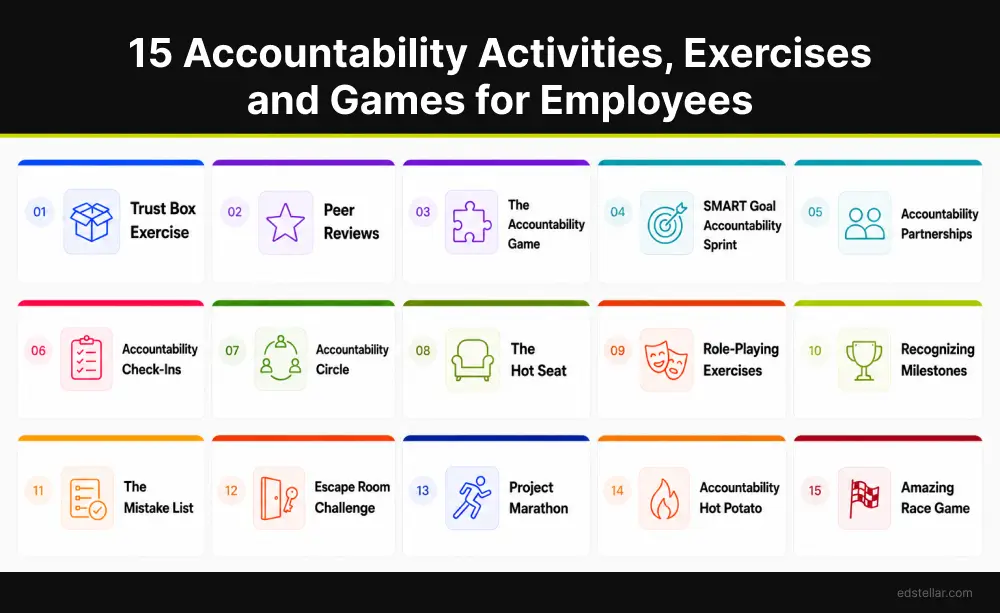


















.svg "Click Here to Follow on Medium")
.svg)



.svg)


.svg)
.svg)
.svg)

.svg)