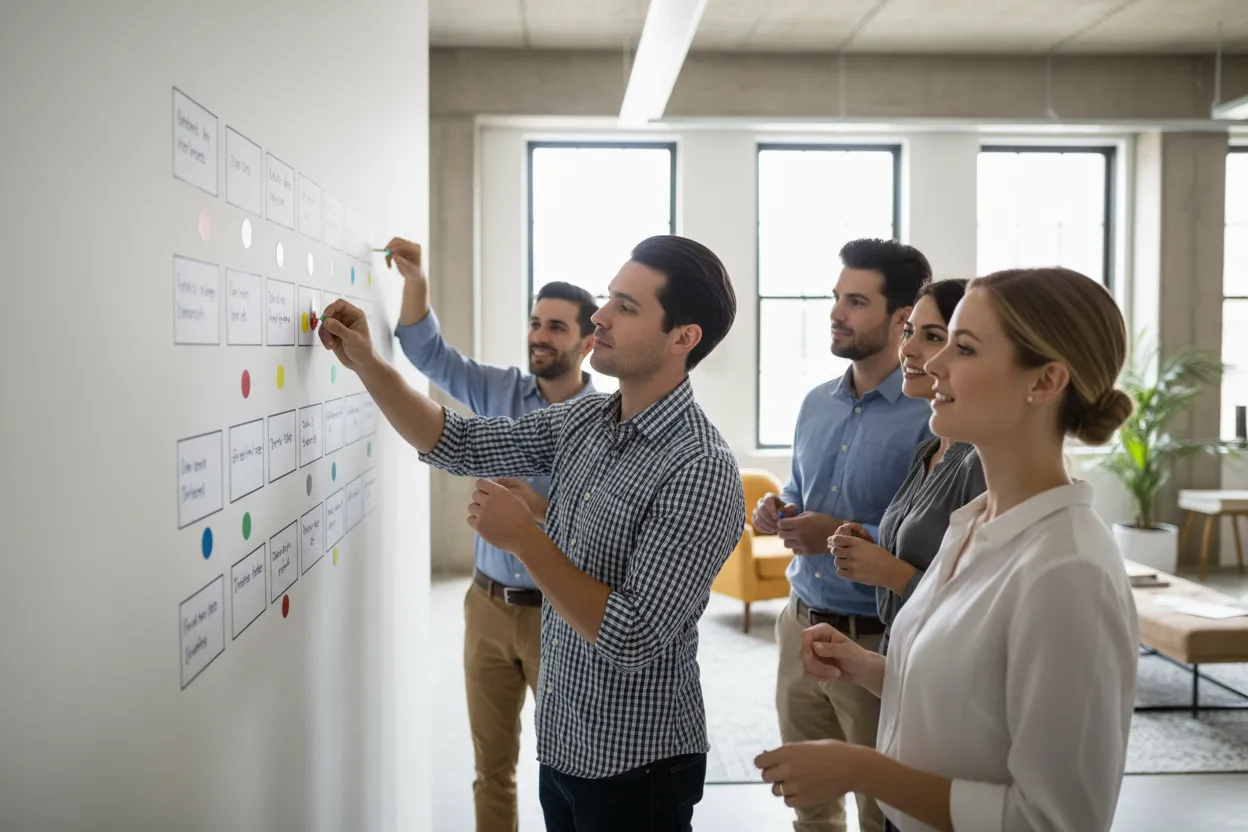
18 Decision Making Activities, Games & Exercises for Employees
A detailed guide to decision making games for teams, curated by an L&D leader with 24+ years of experience in strategic and operational leadership across multiple industries.
Subbaiah M UCorporate Training Consultant - IndiaUpdated 29 January 202589 min read
Share
Quick Overview
18 decision making activities cover every gap, from decision framing and bias management to trade-off analysis and group consensus building exercises.
Each of the decision making activities includes an interactive demo, materials list, facilitator guide, and debrief prompts for workplace transfer.
Decision making games simulate real workplace pressure, time constraints, ambiguous data, and competing priorities in a safe environment.
Group decision making activities strengthen team consensus skills, reduce escalation rates, and build shared judgment frameworks.
A Skills Matrix maps five common decision-making gaps to the exact activities that resolve them, so L&D teams can target training precisely.
In the modern workplace, structured decision making activities build the ability to make sound decisions quickly and effectively a critical skill that influences everything from team dynamics to overall business performance. Structured decision making activities give employees the deliberate practice they need to develop faster judgment, sharper analysis, and stronger consensus skills before high-stakes decisions arise.
While expertise and technical knowledge are important, the ability to evaluate options, anticipate outcomes, and choose the best course of action drives success. Decision-making isn't just an isolated skill; it's intertwined with problem-solving, critical thinking, and collaboration, making it essential to cultivate within teams.
Organizations are increasingly recognizing the value of decision making activities and decision making exercises as a way to enhance interpersonal skills and judgment. The WEF report report identifies analytical thinking and creative problem solving as the two most in-demand skills globally, both are built through structured decision making training. An activity used to study people's decision-making strategies, such as interactive games, places employees in scenarios that demand careful analysis and strategic thinking.
By integrating decision making exercises into their training programs, companies can empower their employees to become more effective decision-makers, contributing to a more responsive organization. This guide covers 18 of the most effective decision making activities, games, and exercises, each mapped to a real workplace decision gap, alongside a Skills Matrix, a Decision Operating System framework, and a practical measurement guide. For teams working on complementary capabilities, see Edstellar's guide to problem solving.
Decision making team building activities, group decision making activities, and decision making games for teams are vital in developing critical thinking and problem-solving skills. By simulating real-world scenarios and challenges, these exercises improve individual capabilities and help build a culture of strategic thinking and collaboration within the organization, the same culture that strong leadership coaching programs reinforce day after day.
Author Insight
"Good decision making is rarely about having more information. Effective decision making activities teach teams how to weigh trade-offs, manage bias, and commit under uncertainty. The best exercises put teams in scenarios where there is no perfect answer, forcing them to practice the real, human side of making choices that matter.
"
Subbaiah M U
✓ 24+ years of strategic and operational leadership, translating complex business challenges into actionable decisions across training, operations, and enterprise learning functions.
Why Decision Making Matters in 2026
Organizations worldwide grapple with an intricate web of challenges requiring sophisticated responses. Companies face overwhelming data streams, rapid AI integration, and volatile global markets while managing remote workforce dynamics and combating misinformation. These accelerated decision-making pressures create a complex environment where traditional reactive methods prove inadequate, which is why decision making activities and structured exercises have become a core part of modern L&D programs.
Critical thinking for adults in leadership positions becomes the cornerstone for navigating this complexity, and decision making activities offer the deliberate practice that turns critical thinking from a concept into a workplace habit. This cognitive framework revolutionizes organizational operations by enabling systematic risk evaluation, evidence-based strategic planning, and innovative problem-solving methodologies. Teams equipped with these skills can effectively differentiate between correlation and causation, uncover underlying assumptions, and craft resilient strategies that drive breakthrough innovations.
The measurable impact is undeniable. The APA 2023 survey found that employees who lack decision-making authority report significantly higher stress and lower engagement confirming that regular decision making activities address a workforce health issue, not just a performance one. Organizations fostering strong analytical cultures and judgment skills, often built through ongoing decision making activities and games, consistently outperform competitors across essential performance indicators.
They demonstrate superior decision-making capabilities, streamlined resource optimization, and enhanced resilience against market turbulence. The stark reality of 2026 reveals a clear divide: companies that embrace sophisticated analytical approaches achieve informed decision-making, strategic market positioning, and proactive planning that fuels long-term success and workforce engagement.
Meanwhile, organizations that neglect these capabilities find themselves trapped in cycles of poor judgments, resource misallocation, and missed market opportunities, ultimately relegating them to reactive crisis management rather than strategic leadership. Structured decision making activities, games, and training workshops are the practical intervention that closes this gap, giving teams the frameworks, practice, and shared vocabulary to make better decisions faster.
"Decision makers are the only differentiators between the successful organizations and the less successful ones."
Harjeet Khanduja
Senior Vice President - HR, Jio · Mumbai, India
✔ HR leader, author, and speaker focused on leadership development, decision-making, organizational culture, and people strategy.
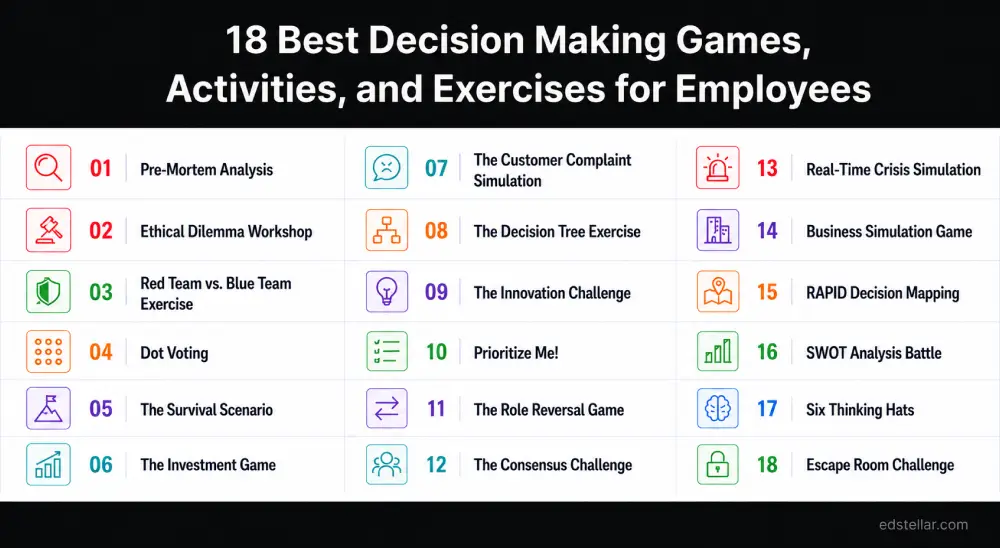
18 Best Decision-Making Activities, Games & Exercises for Employees
Tested in live workshops, the 18 decision making activities and exercises below help organizations build teams that make faster, more confident decisions under pressure. Each of these decision making activities targets a specific workplace breakdown, from poor framing to weak commitment, so L&D teams can pick the right team decision making games for their cohort in seconds. Each includes an interactive demo, required materials, measurable learning outcomes, and expert facilitator guidance.
👤 Age 18+👥 6+ Players⏱ 30-45 min
1. Six Thinking Hats
De Bono's hats framework applied to a real workplace decision: each hat forces the group to examine the problem from a single, deliberate angle (facts, feelings, risks, benefits, creativity, process) before synthesizing. Sharpens decisions and shortens meetings. One of the most repeatable decision making activities for cross-functional teams.
FrameworkPerspectivesAnalysis
1 Interactive Guided Demo
1
2
3
4
5
6
7
8
Step 1 of 8
👆
🎩
🤍❤️🖤
🤍❤️🖤💛💚
🎩
💙🎯🧠🏆
✨✨
🤍❤️🖤💛
🎩
💙🎯🧠🏆
✨✨
🤍❤️🖤💛💚
💚🤍❤️🖤
🎩
🎉🌟✨🎊💫
Welcome to Six Thinking Hats
Apply six perspectives to make better decisions.
👆 Click anywhere to continue
2 Activity Details
🎩
De Bono's hats framework applied to a real workplace decision: each hat forces the group to examine the problem from a single, deliberate angle , facts, feelings, risks, benefits, creativity, process , before synthesizing. Sharpens decisions and shortens meetings.
Players
👥 6+ Players
Recommended
Time
⏱ 30-45 min
Activity + debrief
Format
Team Game
Facilitated
Skill
Risk Assessment
Primary outcome
What You'll Need
Prepare these items before the activity begins so the session runs smoothly.
🎩
Six Hat Cards
One set per team
📋
Decision Brief
Real workplace decision to evaluate
📝
Sticky Notes
50-100 for capturing perspectives
🖊️
Markers
One pack per team
⏱️
Timer
Visible to all participants
Step-by-Step Walkthrough
1
Frame the Decision
Bring all employees together in a collaborative setting with brainstorming tools such as a whiteboard, flip chart, or virtual platform.
5 min
2
White & Red Hats
Introduce a hypothetical project or decision the group will evaluate together.
5 min
3
Black & Yellow Hats
Explain that the project has failed catastrophically and provide realistic context for the failure.
5 min
4
Green & Blue Hats
Participants brainstorm and document every potential reason the project could have failed.
5 min
5
Pick the Path
Analyze each failure point to develop actionable prevention and mitigation strategies.
5 min
6
Refine and Debrief
Lead a discussion to evaluate and refine the identified failure points and chosen mitigations.
5 min
Ground Rules
✓ Do
Explain the goal and constraints before starting.
Give every participant a clear role or opportunity to contribute.
Keep the timer visible and the rules consistent.
Encourage teams to explain their reasoning.
Close with a structured debrief.
✕ Don't
Do not let one person dominate the activity.
Do not change the rules midway unless it is a planned variation.
Do not skip reflection after the activity.
Do not make the activity personal or uncomfortable.
Do not focus only on winning; focus on learning.
What Your Team Will Learn
These outcomes should be reinforced during the debrief.
🧠
Outcome
Risk Assessment
Participants identify, quantify, and prioritize risks before they materialize as crises.
🛠️
Outcome
Foresight
Participants train the muscle of anticipating second-order effects before they become first-order problems.
🤝
Outcome
Strategic Thinking
Participants connect short-term tactics to long-term outcomes and surface unstated assumptions.
⏱
Outcome
Critical Analysis
Participants stress-test reasoning, separate correlation from causation, and challenge confident claims.
💡
Outcome
Planning
Participants sequence work realistically, accounting for dependencies and the inevitable mid-course correction.
📊
Outcome
Collaboration
Participants discover how shared problem-solving outperforms individual brilliance under realistic constraints.
Ways to Mix It Up
🔁
Repeat Round
Run a second round after debrief to test improved thinking.
🤐
Silent Mode
Add a short no-speaking phase to test non-verbal coordination.
💰
Budget Mode
Assign costs or limits to resources to force prioritization.
🌐
Virtual Edition
Adapt the activity using breakout rooms and shared documents.
🏆
Scored Challenge
Award points for creativity, teamwork, and quality of reasoning.
Debrief Questions
Use these prompts to convert the activity into workplace learning.
What did your team do first during Six Thinking Hats?
Which assumption turned out to be wrong?
How did communication affect the result?
Where did the team lose time or clarity?
What workplace situation feels similar to this activity?
What would you change if you ran the activity again?
3 Tips for Facilitators
⏱
Time Box Clearly
Use a visible timer so participants feel the constraint and pace their decisions.
🧑🏫
Facilitate, Don't Solve
Guide with questions instead of giving answers.
📌
Capture Observations
Note communication patterns, decision points, and bottlenecks.
💬
Debrief Deeply
Reserve enough time to connect the activity to workplace behavior.
4 Real-World Applications
🎯
Strategy Reviews
Use the six perspectives to pressure-test a quarterly strategy before it ships.
📈
Product Pitch Triage
Evaluate competing feature proposals through facts, risks, benefits, and creative angles.
🤝
Post-Incident Reviews
Separate emotional reactions from causal analysis to avoid blame-fueled conclusions.
🚀
Hiring Decisions
Examine candidates from process, risk, upside, and team-fit angles in turn.
👤 Age 18+👥 6+ Players⏱ 30-45 min
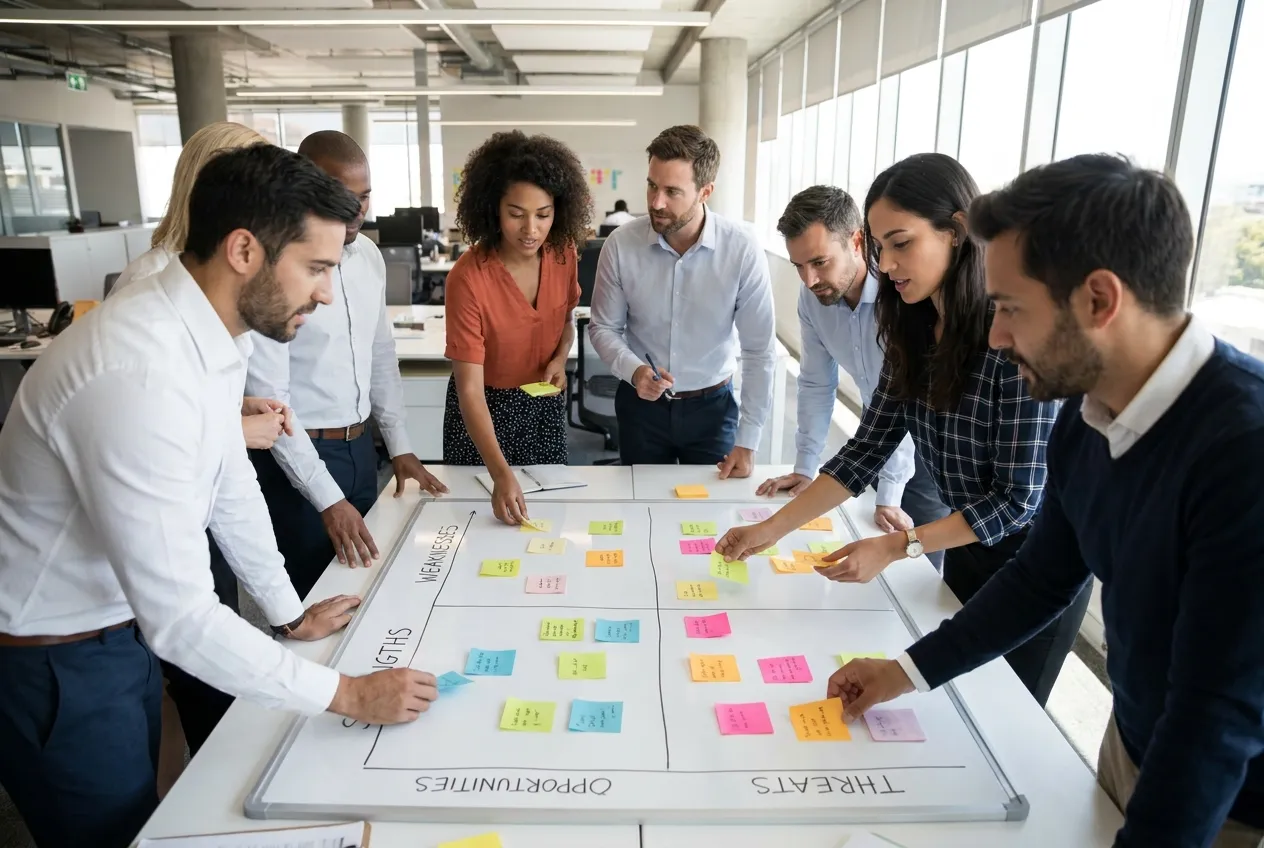
2. SWOT Analysis Battle
Competing teams each build a SWOT for the same business problem and present their recommendation; the rest of the room cross-examines and votes on the strongest reasoning. Builds rigor by exposing the SWOT to live argument instead of a quiet slide review. A high-impact addition to any list of decision making activities for managers.
StrategyAnalysisDebate
1 Interactive Guided Demo
1
2
3
4
5
6
7
8
Step 1 of 8
👆
⚔️
💪⚠️🎯
💪⚠️🎯🛡️🚀
⚔️
📊💡🤝🏆
✨✨
💪⚠️🎯🛡️
⚔️
📊💡🤝🏆
✨✨
💪⚠️🎯🛡️🚀
🚀💪⚠️🎯
⚔️
🎉🌟✨🎊💫
Welcome to SWOT Analysis Battle
Compete to build the stronger strategic case.
👆 Click anywhere to continue
2 Activity Details
⚔️
Competing teams each build a SWOT for the same business problem and present their recommendation; the rest of the room cross-examines and votes on the strongest reasoning. Builds rigor by exposing the SWOT to live argument instead of a quiet slide review.
Players
👥 6+ Players
Recommended
Time
⏱ 30-45 min
Activity + debrief
Format
Team Game
Facilitated
Skill
Risk Assessment
Primary outcome
What You'll Need
Prepare these items before the activity begins so the session runs smoothly.
📊
SWOT Templates
One large grid per team
📋
Business Brief
Real decision context for analysis
🖊️
Markers
Multiple colors per team
📝
Voting Cards
For the cross-examination round
⏱️
Timer
Visible to all participants
Step-by-Step Walkthrough
1
Set the Business Problem
Bring all employees together in a collaborative setting with brainstorming tools such as a whiteboard, flip chart, or virtual platform.
5 min
2
Build the SWOT
Introduce a hypothetical project or decision the group will evaluate together.
5 min
3
Pitch the Decision
Explain that the project has failed catastrophically and provide realistic context for the failure.
5 min
4
Cross-Examine
Participants brainstorm and document every potential reason the project could have failed.
5 min
5
Vote and Reflect
Analyze each failure point to develop actionable prevention and mitigation strategies.
5 min
6
Refine and Debrief
Lead a discussion to evaluate and refine the identified failure points and chosen mitigations.
5 min
Ground Rules
✓ Do
Explain the goal and constraints before starting.
Give every participant a clear role or opportunity to contribute.
Keep the timer visible and the rules consistent.
Encourage teams to explain their reasoning.
Close with a structured debrief.
✕ Don't
Do not let one person dominate the activity.
Do not change the rules midway unless it is a planned variation.
Do not skip reflection after the activity.
Do not make the activity personal or uncomfortable.
Do not focus only on winning; focus on learning.
What Your Team Will Learn
These outcomes should be reinforced during the debrief.
🧠
Outcome
Risk Assessment
Participants identify, quantify, and prioritize risks before they materialize as crises.
🛠️
Outcome
Foresight
Participants train the muscle of anticipating second-order effects before they become first-order problems.
🤝
Outcome
Strategic Thinking
Participants connect short-term tactics to long-term outcomes and surface unstated assumptions.
⏱
Outcome
Critical Analysis
Participants stress-test reasoning, separate correlation from causation, and challenge confident claims.
💡
Outcome
Planning
Participants sequence work realistically, accounting for dependencies and the inevitable mid-course correction.
📊
Outcome
Collaboration
Participants discover how shared problem-solving outperforms individual brilliance under realistic constraints.
Ways to Mix It Up
🔁
Repeat Round
Run a second round after debrief to test improved thinking.
🤐
Silent Mode
Add a short no-speaking phase to test non-verbal coordination.
💰
Budget Mode
Assign costs or limits to resources to force prioritization.
🌐
Virtual Edition
Adapt the activity using breakout rooms and shared documents.
🏆
Scored Challenge
Award points for creativity, teamwork, and quality of reasoning.
Debrief Questions
Use these prompts to convert the activity into workplace learning.
What did your team do first during SWOT Analysis Battle?
Which assumption turned out to be wrong?
How did communication affect the result?
Where did the team lose time or clarity?
What workplace situation feels similar to this activity?
What would you change if you ran the activity again?
3 Tips for Facilitators
⏱
Time Box Clearly
Use a visible timer so participants feel the constraint and pace their decisions.
🧑🏫
Facilitate, Don't Solve
Guide with questions instead of giving answers.
📌
Capture Observations
Note communication patterns, decision points, and bottlenecks.
💬
Debrief Deeply
Reserve enough time to connect the activity to workplace behavior.
4 Real-World Applications
🎯
New Market Entry
Stress-test the case for entering a new geography or customer segment.
📈
Product Launch Reviews
Surface strengths and weaknesses before committing to a launch window.
🤝
Competitive Response
Build a faster, more rigorous response to a competitor move.
🚀
Annual Planning
Anchor the strategy with a defensible read of internal and external position.
👤 Age 18+👥 6+ Players⏱ 30-45 min
3. Desert Survival
After a fictional desert crash, teams rank survival items individually then negotiate a group ranking, surfacing how consensus is really built and how often the group outperforms its strongest individual. The classic exercise reveals exactly where teams overrule the right voice. Belongs in any well-designed set of workplace decision making activities.
ConsensusNegotiationRanking
1 Interactive Guided Demo
1
2
3
4
5
6
7
8
Step 1 of 8
👆
🏜️
🧭💧🤝
🧭💧🤝⛺🌵
🏜️
☀️🎯💡🏆
✨✨
🧭💧🤝⛺
🏜️
☀️🎯💡🏆
✨✨
🧭💧🤝⛺🌵
🌵🧭💧🤝
🏜️
🎉🌟✨🎊💫
Welcome to Desert Survival
Prioritize resources, survive together.
👆 Click anywhere to continue
2 Activity Details
🏜️
After a fictional desert crash, teams rank survival items individually then negotiate a group ranking, surfacing how consensus is really built and how often the group outperforms its strongest individual. The classic exercise reveals exactly where teams overrule the right voice.
Players
👥 6+ Players
Recommended
Time
⏱ 30-45 min
Activity + debrief
Format
Team Game
Facilitated
Skill
Risk Assessment
Primary outcome
What You'll Need
Prepare these items before the activity begins so the session runs smoothly.
📜
Scenario Brief
Crash scenario printed for each participant
📋
Item Ranking Sheet
Solo ranking before group discussion
🧭
Expert Key
Reveal after group ranking is complete
🖊️
Pens
One per participant
⏱️
Timer
Phased timing for solo and group
Step-by-Step Walkthrough
1
Set the Crash Scene
Bring all employees together in a collaborative setting with brainstorming tools such as a whiteboard, flip chart, or virtual platform.
5 min
2
Rank Solo
Introduce a hypothetical project or decision the group will evaluate together.
5 min
3
Negotiate the Group List
Explain that the project has failed catastrophically and provide realistic context for the failure.
5 min
4
Compare to Expert Ranking
Participants brainstorm and document every potential reason the project could have failed.
5 min
5
Debrief the Process
Analyze each failure point to develop actionable prevention and mitigation strategies.
5 min
6
Refine and Debrief
Lead a discussion to evaluate and refine the identified failure points and chosen mitigations.
5 min
Ground Rules
✓ Do
Explain the goal and constraints before starting.
Give every participant a clear role or opportunity to contribute.
Keep the timer visible and the rules consistent.
Encourage teams to explain their reasoning.
Close with a structured debrief.
✕ Don't
Do not let one person dominate the activity.
Do not change the rules midway unless it is a planned variation.
Do not skip reflection after the activity.
Do not make the activity personal or uncomfortable.
Do not focus only on winning; focus on learning.
What Your Team Will Learn
These outcomes should be reinforced during the debrief.
🧠
Outcome
Risk Assessment
Participants identify, quantify, and prioritize risks before they materialize as crises.
🛠️
Outcome
Foresight
Participants train the muscle of anticipating second-order effects before they become first-order problems.
🤝
Outcome
Strategic Thinking
Participants connect short-term tactics to long-term outcomes and surface unstated assumptions.
⏱
Outcome
Critical Analysis
Participants stress-test reasoning, separate correlation from causation, and challenge confident claims.
💡
Outcome
Planning
Participants sequence work realistically, accounting for dependencies and the inevitable mid-course correction.
📊
Outcome
Collaboration
Participants discover how shared problem-solving outperforms individual brilliance under realistic constraints.
Ways to Mix It Up
🔁
Repeat Round
Run a second round after debrief to test improved thinking.
🤐
Silent Mode
Add a short no-speaking phase to test non-verbal coordination.
💰
Budget Mode
Assign costs or limits to resources to force prioritization.
🌐
Virtual Edition
Adapt the activity using breakout rooms and shared documents.
🏆
Scored Challenge
Award points for creativity, teamwork, and quality of reasoning.
Debrief Questions
Use these prompts to convert the activity into workplace learning.
What did your team do first during Desert Survival?
Which assumption turned out to be wrong?
How did communication affect the result?
Where did the team lose time or clarity?
What workplace situation feels similar to this activity?
What would you change if you ran the activity again?
3 Tips for Facilitators
⏱
Time Box Clearly
Use a visible timer so participants feel the constraint and pace their decisions.
🧑🏫
Facilitate, Don't Solve
Guide with questions instead of giving answers.
📌
Capture Observations
Note communication patterns, decision points, and bottlenecks.
💬
Debrief Deeply
Reserve enough time to connect the activity to workplace behavior.
4 Real-World Applications
🎯
Crisis Drills
Rehearse a high-pressure scenario where the team must prioritize under threat.
📈
Resource Triage
Decide which workstreams to fund and which to cut when capacity drops.
🤝
On-Call Coordination
Build the muscle of fast collective decision-making during a live incident.
🚀
Onboarding Bootcamps
Help new joiners experience how the team actually decides under pressure.
👤 Age 18+👥 6+ Players⏱ 30-45 min
4. Pre-Mortem Analysis
Teams imagine a project has already failed and brainstorm every reason why, then turn those failure points into prevention strategies before work begins. Among the most flexible decision making activities for hybrid teams.
Risk AssessmentStrategic ThinkingForesight
1 Interactive Guided Demo
1
2
3
4
5
6
7
8
Step 1 of 8
👆
🔮
⚠️🔮📋
📋🖊️📝⏱️📄
🖊️
📋✨🎯🤝
✨✨
📝✅🌟💡
⏱️
🎯🤝📌💡
✨✨
📄📋🖊️📝⏱️
💡🚀📌🤝
🏆
🎉🌟✨🎊💫
Welcome to Pre-Mortem Analysis
Imagine failure first, then prevent it.
👆 Click anywhere to continue
2 Activity Details
🔮
Teams imagine a project has already failed and brainstorm every reason why, then turn those failure points into prevention strategies before work begins.
Players
👥 6+ Players
Recommended
Time
⏱ 30-45 min
Activity + debrief
Format
Team Game
Facilitated
Skill
Risk Assessment
Primary outcome
What You'll Need
Prepare these items before the activity begins so the session runs smoothly.
📋
Whiteboard
Required for activity
🖊️
Markers
Required for activity
📝
Sticky Notes
Required for activity
⏱️
Timer
Required for activity
📄
Project Brief
Required for activity
Step-by-Step Walkthrough
1
Gather the Team
Bring all employees together in a collaborative setting with brainstorming tools such as a whiteboard, flip chart, or virtual platform.
5 min
2
Introduce the Project
Introduce a hypothetical project or decision the group will evaluate together.
5 min
3
Declare Catastrophic Failure
Explain that the project has failed catastrophically and provide realistic context for the failure.
5 min
4
Brainstorm Failure Reasons
Participants brainstorm and document every potential reason the project could have failed.
5 min
5
Build Mitigation Strategies
Analyze each failure point to develop actionable prevention and mitigation strategies.
5 min
6
Refine and Debrief
Lead a discussion to evaluate and refine the identified failure points and chosen mitigations.
5 min
Ground Rules
✓ Do
Explain the goal and constraints before starting.
Give every participant a clear role or opportunity to contribute.
Keep the timer visible and the rules consistent.
Encourage teams to explain their reasoning.
Close with a structured debrief.
✕ Don't
Do not let one person dominate the activity.
Do not change the rules midway unless it is a planned variation.
Do not skip reflection after the activity.
Do not make the activity personal or uncomfortable.
Do not focus only on winning; focus on learning.
What Your Team Will Learn
These outcomes should be reinforced during the debrief.
🧠
Outcome
Risk Assessment
Participants identify, quantify, and prioritize risks before they materialize as crises.
🛠️
Outcome
Foresight
Participants train the muscle of anticipating second-order effects before they become first-order problems.
🤝
Outcome
Strategic Thinking
Participants connect short-term tactics to long-term outcomes and surface unstated assumptions.
⏱
Outcome
Critical Analysis
Participants stress-test reasoning, separate correlation from causation, and challenge confident claims.
💡
Outcome
Planning
Participants sequence work realistically, accounting for dependencies and the inevitable mid-course correction.
📊
Outcome
Collaboration
Participants discover how shared problem-solving outperforms individual brilliance under realistic constraints.
Ways to Mix It Up
🔁
Repeat Round
Run a second round after debrief to test improved thinking.
🤐
Silent Mode
Add a short no-speaking phase to test non-verbal coordination.
💰
Budget Mode
Assign costs or limits to resources to force prioritization.
🌐
Virtual Edition
Adapt the activity using breakout rooms and shared documents.
🏆
Scored Challenge
Award points for creativity, teamwork, and quality of reasoning.
Debrief Questions
Use these prompts to convert the activity into workplace learning.
What did your team do first during Pre-Mortem Analysis?
Which assumption turned out to be wrong?
How did communication affect the result?
Where did the team lose time or clarity?
What workplace situation feels similar to this activity?
What would you change if you ran the activity again?
3 Tips for Facilitators
⏱
Time Box Clearly
Use a visible timer so participants feel the constraint and pace their decisions.
🧑🏫
Facilitate, Don't Solve
Guide with questions instead of giving answers.
📌
Capture Observations
Note communication patterns, decision points, and bottlenecks.
💬
Debrief Deeply
Reserve enough time to connect the activity to workplace behavior.
4 Real-World Applications
🎯
Major Project Kick-Offs
Surface the failure modes before they happen, while changes are still cheap.
📈
Product Launch Planning
Test the launch plan against every realistic way it could fail.
🤝
M&A Integration
Identify integration risks before signing rather than after closing.
🚀
Roadmap Reviews
Pressure-test each major bet against the most likely failure paths.
👤 Age 18+👥 4-15 Players⏱ 30-45 min
5. The Decision Tree Exercise
Participants map every option, branch, and consequence of a complex problem into a visual decision tree to reduce impulsive choices. A staple of evidence-based decision making activities for L&D programs.
Systematic ThinkingAnalysisVisualization
1 Interactive Guided Demo
1
2
3
4
5
6
7
8
9
Step 1 of 9
👆
🌳
🌳🔀🎯
📋🖊️📝📏📌
🖊️
📋✨🎯🤝
✨✨
📝✅🌟💡
📏
🎯🤝📌💡
✨✨
📌📋🖊️📝📏
💡🚀📌🤝
✨📋🖊️📝📏
🏆
🎉🌟✨🎊💫
Welcome to Decision Tree Exercise
Map every branch, then choose wisely.
👆 Click anywhere to continue
2 Activity Details
🌳
Participants map every option, branch, and consequence of a complex problem into a visual decision tree to reduce impulsive choices.
Players
👥 4-15 Players
Recommended
Time
⏱ 30-45 min
Activity + debrief
Format
Team Game
Facilitated
Skill
Systematic Thinking
Primary outcome
What You'll Need
Prepare these items before the activity begins so the session runs smoothly.
📋
Cardboard
Required for activity
🖊️
Markers
Required for activity
📝
Paper
Required for activity
📏
Rulers
Required for activity
📌
Pins
Required for activity
Step-by-Step Walkthrough
1
Open the Space
Gather all employees in an open area with room to spread out and work.
5 min
2
Hand Out Supplies
Distribute stationery such as cardboard, markers, and sketches for tree building.
5 min
3
Present the Problem
Present each employee with a complex problem or scenario that requires a decision.
5 min
4
Build the Tree
Instruct employees to create a decision tree, starting with the main decision point and branching outward.
5 min
5
Add Factors
Encourage employees to consider various factors influencing each choice along every branch.
5 min
6
Review and Choose
Employees review their trees to identify the most logical and beneficial course of action.
5 min
7
Discuss Insights
Discuss how the decision tree clarified the decision-making process and surfaced new options.
5 min
Ground Rules
✓ Do
Explain the goal and constraints before starting.
Give every participant a clear role or opportunity to contribute.
Keep the timer visible and the rules consistent.
Encourage teams to explain their reasoning.
Close with a structured debrief.
✕ Don't
Do not let one person dominate the activity.
Do not change the rules midway unless it is a planned variation.
Do not skip reflection after the activity.
Do not make the activity personal or uncomfortable.
Do not focus only on winning; focus on learning.
What Your Team Will Learn
These outcomes should be reinforced during the debrief.
🧠
Outcome
Systematic Thinking
Participants see the system, not just the parts, and trace cause and effect through indirect paths.
🛠️
Outcome
Analysis
Participants break information into components, weigh each, and surface the pattern that matters.
🤝
Outcome
Foresight
Participants train the muscle of anticipating second-order effects before they become first-order problems.
⏱
Outcome
Clarity
Participants practice cutting ambiguity from instructions, decisions, and shared definitions of done.
💡
Outcome
Logic
Participants build arguments from clear premises and spot the gap when reasoning skips a step.
📊
Outcome
Patience
Participants resist the urge to jump in, allowing the team to find its own answer when it should.
Ways to Mix It Up
🔁
Repeat Round
Run a second round after debrief to test improved thinking.
🤐
Silent Mode
Add a short no-speaking phase to test non-verbal coordination.
💰
Budget Mode
Assign costs or limits to resources to force prioritization.
🌐
Virtual Edition
Adapt the activity using breakout rooms and shared documents.
🏆
Scored Challenge
Award points for creativity, teamwork, and quality of reasoning.
Debrief Questions
Use these prompts to convert the activity into workplace learning.
What did your team do first during Decision Tree Exercise?
Which assumption turned out to be wrong?
How did communication affect the result?
Where did the team lose time or clarity?
What workplace situation feels similar to this activity?
What would you change if you ran the activity again?
3 Tips for Facilitators
⏱
Time Box Clearly
Use a visible timer so participants feel the constraint and pace their decisions.
🧑🏫
Facilitate, Don't Solve
Guide with questions instead of giving answers.
📌
Capture Observations
Note communication patterns, decision points, and bottlenecks.
💬
Debrief Deeply
Reserve enough time to connect the activity to workplace behavior.
4 Real-World Applications
🎯
Build-vs-Buy Choices
Map the cascade of consequences for each option before committing budget.
📈
Pricing Changes
Trace how a single pricing move propagates through customer segments and revenue.
🤝
Hiring Strategy
Compare growth scenarios under different hiring sequences and capacity bets.
🚀
Customer Escalations
Map the realistic paths a customer escalation can take before choosing the response.
👤 Age 18+👥 6-20 Players⏱ 30-45 min
6. The Trade-Off Game
Teams allocate scarce resources across competing objectives, forcing tough trade-offs that build resource management and strategic planning skills. Pairs well with other decision making activities focused on consensus.
Resource AllocationStrategyPrioritization
1 Interactive Guided Demo
1
2
3
4
5
6
7
8
Step 1 of 8
👆
⚖️
⚖️🔄🎯
📊📋🖊️⏱️📝
📋
✨🎯🤝📌
✨✨
🖊️✅🌟💡
⏱️
🎯🤝📌💡
✨✨
📝📊📋🖊️⏱️
💡🚀📌🤝
🏆
🎉🌟✨🎊💫
Welcome to Trade-Off Game
Allocate scarce resources, accept trade-offs.
👆 Click anywhere to continue
2 Activity Details
⚖️
Teams allocate scarce resources across competing objectives, forcing tough trade-offs that build resource management and strategic planning skills.
Players
👥 6-20 Players
Recommended
Time
⏱ 30-45 min
Activity + debrief
Format
Team Game
Facilitated
Skill
Resource Allocation
Primary outcome
What You'll Need
Prepare these items before the activity begins so the session runs smoothly.
📊
Resource Tokens
Required for activity
📋
Objective Sheet
Required for activity
🖊️
Markers
Required for activity
⏱️
Timer
Required for activity
📝
Strategy Pad
Required for activity
Step-by-Step Walkthrough
1
Present the Scenario
Present a scenario where participants must allocate limited resources across multiple objectives.
5 min
2
Form Teams
Divide employees into teams to tackle the allocation challenge together.
5 min
3
List Constraints
Provide a list of objectives along with the resource constraints in play.
5 min
4
Make Trade-Offs
Teams evaluate objectives, identify trade-offs, and allocate resources strategically.
5 min
5
Present Strategy
Each team presents their resource allocation strategy and explains the rationale.
5 min
6
Compare Choices
Facilitate a group discussion comparing strategies and the trade-offs each team accepted.
5 min
Ground Rules
✓ Do
Explain the goal and constraints before starting.
Give every participant a clear role or opportunity to contribute.
Keep the timer visible and the rules consistent.
Encourage teams to explain their reasoning.
Close with a structured debrief.
✕ Don't
Do not let one person dominate the activity.
Do not change the rules midway unless it is a planned variation.
Do not skip reflection after the activity.
Do not make the activity personal or uncomfortable.
Do not focus only on winning; focus on learning.
What Your Team Will Learn
These outcomes should be reinforced during the debrief.
🧠
Outcome
Resource Allocation
Participants make explicit trade-offs about where finite people, time, and budget go.
🛠️
Outcome
Strategic Thinking
Participants connect short-term tactics to long-term outcomes and surface unstated assumptions.
🤝
Outcome
Prioritization
Participants practice saying yes to the highest-leverage work and no to the merely urgent.
⏱
Outcome
Trade-Off Analysis
Participants explicitly name what is being given up to gain something else, instead of hiding the trade-off.
💡
Outcome
Planning
Participants sequence work realistically, accounting for dependencies and the inevitable mid-course correction.
📊
Outcome
Decisiveness
Participants commit before all information is in, with a plan to course-correct as more arrives.
Ways to Mix It Up
🔁
Repeat Round
Run a second round after debrief to test improved thinking.
🤐
Silent Mode
Add a short no-speaking phase to test non-verbal coordination.
💰
Budget Mode
Assign costs or limits to resources to force prioritization.
🌐
Virtual Edition
Adapt the activity using breakout rooms and shared documents.
🏆
Scored Challenge
Award points for creativity, teamwork, and quality of reasoning.
Debrief Questions
Use these prompts to convert the activity into workplace learning.
What did your team do first during Trade-Off Game?
Which assumption turned out to be wrong?
How did communication affect the result?
Where did the team lose time or clarity?
What workplace situation feels similar to this activity?
What would you change if you ran the activity again?
3 Tips for Facilitators
⏱
Time Box Clearly
Use a visible timer so participants feel the constraint and pace their decisions.
🧑🏫
Facilitate, Don't Solve
Guide with questions instead of giving answers.
📌
Capture Observations
Note communication patterns, decision points, and bottlenecks.
💬
Debrief Deeply
Reserve enough time to connect the activity to workplace behavior.
4 Real-World Applications
🎯
Budget Allocation
Force explicit trade-offs across functions instead of giving everyone a haircut.
📈
Roadmap Sequencing
Decide what ships now, what waits, and what gets killed, with clear reasoning.
🤝
Hiring Plan
Choose between senior depth and junior breadth with the trade-off visible.
🚀
Vendor Selection
Compare vendors on the criteria that actually matter rather than the loudest.
👤 Age 18+👥 6-20 Players⏱ 45-60 min
7. The Survival Scenario
Teams stranded in a fictional survival situation must reach consensus on the five most critical items from a supply list and justify their reasoning. A core entry on any short list of decision making activities for new managers.
Consensus BuildingDecision MakingTeamwork
1 Interactive Guided Demo
1
2
3
4
5
6
7
8
9
Step 1 of 9
👆
🏝️
⛺🤝💬
📜📝🖊️⏱️📋
📝
📋✨🎯🤝
✨✨
🖊️✅🌟💡
⏱️
🎯🤝📌💡
✨✨
📋📜📝🖊️⏱️
💡🚀📌🤝
✨📜📝🖊️⏱️
🏆
🎉🌟✨🎊💫
Welcome to Survival Scenario
Pick five items, survive together.
👆 Click anywhere to continue
2 Activity Details
🏝️
Teams stranded in a fictional survival situation must reach consensus on the five most critical items from a supply list and justify their reasoning.
Players
👥 6-20 Players
Recommended
Time
⏱ 45-60 min
Activity + debrief
Format
Team Game
Facilitated
Skill
Consensus Building
Primary outcome
What You'll Need
Prepare these items before the activity begins so the session runs smoothly.
📜
Scenario Sheet
Required for activity
📝
Item List
Required for activity
🖊️
Pens
Required for activity
⏱️
Timer
Required for activity
📋
Flip Chart
Required for activity
Step-by-Step Walkthrough
1
Form Teams
Assemble employees in a comfortable space and divide them into small teams.
5 min
2
Set the Scene
Present a survival scenario such as a deserted island, life raft, or Arctic landscape.
5 min
3
Reveal the Supply List
Provide a list of 20 to 30 items that could be useful for survival.
5 min
4
Choose Five Items
Teams evaluate the list and decide which five items are most important for survival.
5 min
5
Reach Consensus
Teams must reach consensus and prepare to justify their decisions to the room.
5 min
6
Present Choices
Each group presents their chosen items and explains the reasoning behind each pick.
5 min
7
Compare and Discuss
Facilitate discussion comparing decisions made by different groups and the strategies behind them.
5 min
Ground Rules
✓ Do
Explain the goal and constraints before starting.
Give every participant a clear role or opportunity to contribute.
Keep the timer visible and the rules consistent.
Encourage teams to explain their reasoning.
Close with a structured debrief.
✕ Don't
Do not let one person dominate the activity.
Do not change the rules midway unless it is a planned variation.
Do not skip reflection after the activity.
Do not make the activity personal or uncomfortable.
Do not focus only on winning; focus on learning.
What Your Team Will Learn
These outcomes should be reinforced during the debrief.
🧠
Outcome
Consensus Building
Participants align a group without flattening disagreement or forcing premature compromise.
🛠️
Outcome
Decision Making
Participants learn to frame the choice, weigh trade-offs, and commit before perfect information arrives.
🤝
Outcome
Teamwork
Participants align on roles, hand-offs, and shared rhythm so the team performs as a unit, not a crowd.
⏱
Outcome
Prioritization
Participants practice saying yes to the highest-leverage work and no to the merely urgent.
💡
Outcome
Communication
Participants practice expressing ideas with precision and confirming understanding before assuming alignment.
📊
Outcome
Negotiation
Participants practice trading what they value less for what they value more without damaging the relationship.
Ways to Mix It Up
🔁
Repeat Round
Run a second round after debrief to test improved thinking.
🤐
Silent Mode
Add a short no-speaking phase to test non-verbal coordination.
💰
Budget Mode
Assign costs or limits to resources to force prioritization.
🌐
Virtual Edition
Adapt the activity using breakout rooms and shared documents.
🏆
Scored Challenge
Award points for creativity, teamwork, and quality of reasoning.
Debrief Questions
Use these prompts to convert the activity into workplace learning.
What did your team do first during Survival Scenario?
Which assumption turned out to be wrong?
How did communication affect the result?
Where did the team lose time or clarity?
What workplace situation feels similar to this activity?
What would you change if you ran the activity again?
3 Tips for Facilitators
⏱
Time Box Clearly
Use a visible timer so participants feel the constraint and pace their decisions.
🧑🏫
Facilitate, Don't Solve
Guide with questions instead of giving answers.
📌
Capture Observations
Note communication patterns, decision points, and bottlenecks.
💬
Debrief Deeply
Reserve enough time to connect the activity to workplace behavior.
4 Real-World Applications
🎯
Crisis Response
Build the team's ability to prioritize ruthlessly when most options are off the table.
📈
Resource Constraints
Decide what truly matters when budget or headcount drops mid-cycle.
🤝
Customer Outage
Rehearse the cold-headed prioritization needed in the first hour of a major incident.
🚀
Startup Decisions
Stress-test the small set of bets a resource-constrained team can actually make.
Ready to Roll Out Decision Making Workshops for Your Team?
Edstellar facilitators deliver all 18 activities live, on-site or virtually, fully tailored to your team's roles, schedules, and specific decision-making challenges.
Teams act as investors with a fixed budget, allocating funds across fictional ventures to maximize returns while managing risk and uncertainty. One of the best decision making activities for surfacing hidden assumptions.
Risk ManagementStrategyAnalysis
1 Interactive Guided Demo
1
2
3
4
5
6
7
8
9
Step 1 of 9
👆
💰
💰📈🎲
💵📊🖊️📝⏱️
📊
📋✨🎯🤝
✨✨
🖊️✅🌟💡
📝
🎯🤝📌💡
✨✨
⏱️💵📊🖊️📝
💡🚀📌🤝
📋💵📊🖊️📝
🏆
🎉🌟✨🎊💫
Welcome to Investment Game
Allocate wisely, balance risk and reward.
👆 Click anywhere to continue
2 Activity Details
💰
Teams act as investors with a fixed budget, allocating funds across fictional ventures to maximize returns while managing risk and uncertainty.
Players
👥 6-24 Players
Recommended
Time
⏱ 45-75 min
Activity + debrief
Format
Team Game
Facilitated
Skill
Risk Management
Primary outcome
What You'll Need
Prepare these items before the activity begins so the session runs smoothly.
💵
Play Money
Required for activity
📊
Venture Cards
Required for activity
🖊️
Pens
Required for activity
📝
Scorecards
Required for activity
⏱️
Timer
Required for activity
Step-by-Step Walkthrough
1
Set Budgets
Divide employees into small groups and provide each team with a fictional investment budget.
5 min
2
Present Ventures
Present a range of business ventures or investment opportunities with varying risk and reward levels.
5 min
3
Analyze Options
Teams analyze information about each venture and discuss the risks and rewards involved.
5 min
4
Allocate Funds
Each team decides how to allocate their budget across the available ventures.
5 min
5
Reveal Outcomes
Outcomes of each venture are revealed, either pre-determined or simulated by the facilitator.
5 min
6
Score Returns
Success is measured by the return on investments, accounting for both profits and losses.
5 min
7
Debrief Strategy
Conclude with a discussion on decisions, strategies that worked, and risk management lessons.
5 min
Ground Rules
✓ Do
Explain the goal and constraints before starting.
Give every participant a clear role or opportunity to contribute.
Keep the timer visible and the rules consistent.
Encourage teams to explain their reasoning.
Close with a structured debrief.
✕ Don't
Do not let one person dominate the activity.
Do not change the rules midway unless it is a planned variation.
Do not skip reflection after the activity.
Do not make the activity personal or uncomfortable.
Do not focus only on winning; focus on learning.
What Your Team Will Learn
These outcomes should be reinforced during the debrief.
🧠
Outcome
Risk Management
Participants build a calibrated view of risk and mitigation that scales with the size of the decision.
🛠️
Outcome
Strategic Thinking
Participants connect short-term tactics to long-term outcomes and surface unstated assumptions.
🤝
Outcome
Analysis
Participants break information into components, weigh each, and surface the pattern that matters.
⏱
Outcome
Resource Allocation
Participants make explicit trade-offs about where finite people, time, and budget go.
💡
Outcome
Decisiveness
Participants commit before all information is in, with a plan to course-correct as more arrives.
📊
Outcome
Teamwork
Participants align on roles, hand-offs, and shared rhythm so the team performs as a unit, not a crowd.
Ways to Mix It Up
🔁
Repeat Round
Run a second round after debrief to test improved thinking.
🤐
Silent Mode
Add a short no-speaking phase to test non-verbal coordination.
💰
Budget Mode
Assign costs or limits to resources to force prioritization.
🌐
Virtual Edition
Adapt the activity using breakout rooms and shared documents.
🏆
Scored Challenge
Award points for creativity, teamwork, and quality of reasoning.
Debrief Questions
Use these prompts to convert the activity into workplace learning.
What did your team do first during Investment Game?
Which assumption turned out to be wrong?
How did communication affect the result?
Where did the team lose time or clarity?
What workplace situation feels similar to this activity?
What would you change if you ran the activity again?
3 Tips for Facilitators
⏱
Time Box Clearly
Use a visible timer so participants feel the constraint and pace their decisions.
🧑🏫
Facilitate, Don't Solve
Guide with questions instead of giving answers.
📌
Capture Observations
Note communication patterns, decision points, and bottlenecks.
💬
Debrief Deeply
Reserve enough time to connect the activity to workplace behavior.
4 Real-World Applications
🎯
Capital Allocation
Decide where to put scarce investment dollars across competing opportunities.
📈
Portfolio Reviews
Rebalance the portfolio between safe bets and high-upside experiments.
🤝
R&D Funding
Test how the team weighs near-term ROI against long-horizon bets.
🚀
Vendor Bake-Offs
Allocate evaluation budget across vendor finalists with clear decision criteria.
👤 Age 18+👥 5-30 Players⏱ 15-25 min
9. Dot Voting
Participants place a limited number of sticky dots next to their preferred options on a board to quickly and democratically surface group priorities. Among the most facilitator-friendly decision making activities in this guide.
PrioritizationCollaborationClarity
1 Interactive Guided Demo
1
2
3
4
5
6
7
8
Step 1 of 8
👆
🔴
🟢🗳️🎯
📋🔴🖊️📝🔴
🖊️
📋✨🎯🤝
✨✨
📝✅🌟💡
💡
🤝📌📋✨
✨✨
✨🔴📋🖊️📝
🎯🚀📌🤝
🏆
🎉🌟✨🎊💫
Welcome to Dot Voting
Vote with dots, surface priorities fast.
👆 Click anywhere to continue
2 Activity Details
🔴
Participants place a limited number of sticky dots next to their preferred options on a board to quickly and democratically surface group priorities.
Players
👥 5-30 Players
Recommended
Time
⏱ 15-25 min
Activity + debrief
Format
Team Game
Facilitated
Skill
Prioritization
Primary outcome
What You'll Need
Prepare these items before the activity begins so the session runs smoothly.
🔴
Sticky Dots
Required for activity
📋
Whiteboard
Required for activity
🖊️
Markers
Required for activity
📝
Option Cards
Required for activity
Step-by-Step Walkthrough
1
Set the Stage
Gather the group in a space where everyone can clearly see a shared board or wall.
5 min
2
List the Options
Present a list of options, ideas, or tasks on the board for the group to consider.
5 min
3
Distribute Dots
Provide each employee with a set number of sticky dots, usually three to five.
5 min
4
Cast Votes
Participants place their dots next to the options they prefer most.
5 min
5
Tally Results
Count the dots next to each option to determine the group's favorites.
5 min
6
Discuss Outcomes
Facilitate a group discussion about the results and the final priorities chosen.
5 min
Ground Rules
✓ Do
Explain the goal and constraints before starting.
Give every participant a clear role or opportunity to contribute.
Keep the timer visible and the rules consistent.
Encourage teams to explain their reasoning.
Close with a structured debrief.
✕ Don't
Do not let one person dominate the activity.
Do not change the rules midway unless it is a planned variation.
Do not skip reflection after the activity.
Do not make the activity personal or uncomfortable.
Do not focus only on winning; focus on learning.
What Your Team Will Learn
These outcomes should be reinforced during the debrief.
🧠
Outcome
Prioritization
Participants practice saying yes to the highest-leverage work and no to the merely urgent.
🛠️
Outcome
Clarity
Participants practice cutting ambiguity from instructions, decisions, and shared definitions of done.
🤝
Outcome
Collaboration
Participants discover how shared problem-solving outperforms individual brilliance under realistic constraints.
⏱
Outcome
Speed
Participants experience how decisive action under uncertainty often outperforms a slower, more confident plan.
💡
Outcome
Consensus
Participants reach a workable agreement where every voice was heard and the path forward is owned by the group.
📊
Outcome
Focus
Participants practice protecting attention against interruption, scope creep, and competing priorities.
Ways to Mix It Up
🔁
Repeat Round
Run a second round after debrief to test improved thinking.
🤐
Silent Mode
Add a short no-speaking phase to test non-verbal coordination.
💰
Budget Mode
Assign costs or limits to resources to force prioritization.
🌐
Virtual Edition
Adapt the activity using breakout rooms and shared documents.
🏆
Scored Challenge
Award points for creativity, teamwork, and quality of reasoning.
Debrief Questions
Use these prompts to convert the activity into workplace learning.
What did your team do first during Dot Voting?
Which assumption turned out to be wrong?
How did communication affect the result?
Where did the team lose time or clarity?
What workplace situation feels similar to this activity?
What would you change if you ran the activity again?
3 Tips for Facilitators
⏱
Time Box Clearly
Use a visible timer so participants feel the constraint and pace their decisions.
🧑🏫
Facilitate, Don't Solve
Guide with questions instead of giving answers.
📌
Capture Observations
Note communication patterns, decision points, and bottlenecks.
💬
Debrief Deeply
Reserve enough time to connect the activity to workplace behavior.
4 Real-World Applications
🎯
Backlog Grooming
Surface the highest-priority items quickly without endless debate.
📈
Retro Action Items
Decide which improvement actions the team will actually own this sprint.
🤝
Feature Prioritisation
Compress a long list of customer requests into the few that ship next.
🚀
Workshop Synthesis
Converge a divergent brainstorm into a clear set of next steps.
👤 Age 18+👥 6-20 Players⏱ 20-30 min
10. The Consensus Challenge
Teams must reach a unanimous decision on a high-stakes scenario, navigating diverse viewpoints and resolving conflict along the way. A reliable choice when designing decision making activities for remote teams.
Teams must reach a unanimous decision on a high-stakes scenario, navigating diverse viewpoints and resolving conflict along the way.
Players
👥 6-20 Players
Recommended
Time
⏱ 20-30 min
Activity + debrief
Format
Team Game
Facilitated
Skill
Consensus Building
Primary outcome
What You'll Need
Prepare these items before the activity begins so the session runs smoothly.
📜
Scenario Card
Required for activity
📋
Flip Chart
Required for activity
🖊️
Markers
Required for activity
⏱️
Timer
Required for activity
📝
Notepads
Required for activity
Step-by-Step Walkthrough
1
Present the Scenario
Present a scenario where a team must make a high-stakes decision together.
5 min
2
Form Teams
Divide participants into teams for the challenge.
5 min
3
Discuss the Scenario
Give teams 15 to 20 minutes to discuss the scenario and work toward a unanimous decision.
5 min
4
Include Every Voice
Encourage teams to consider diverse viewpoints and ensure everyone contributes to the decision.
5 min
5
Present Decisions
Once consensus is reached, have each team present their decision and reasoning.
5 min
6
Debrief Process
Conclude with a discussion on how consensus was achieved and the challenges that arose.
5 min
Ground Rules
✓ Do
Explain the goal and constraints before starting.
Give every participant a clear role or opportunity to contribute.
Keep the timer visible and the rules consistent.
Encourage teams to explain their reasoning.
Close with a structured debrief.
✕ Don't
Do not let one person dominate the activity.
Do not change the rules midway unless it is a planned variation.
Do not skip reflection after the activity.
Do not make the activity personal or uncomfortable.
Do not focus only on winning; focus on learning.
What Your Team Will Learn
These outcomes should be reinforced during the debrief.
🧠
Outcome
Consensus Building
Participants align a group without flattening disagreement or forcing premature compromise.
🛠️
Outcome
Conflict Resolution
Participants move disagreement from positional standoff to interest-based problem solving.
🤝
Outcome
Collaboration
Participants discover how shared problem-solving outperforms individual brilliance under realistic constraints.
⏱
Outcome
Active Listening
Participants demonstrate they have understood before responding, using paraphrase and clarifying questions.
💡
Outcome
Negotiation
Participants practice trading what they value less for what they value more without damaging the relationship.
📊
Outcome
Inclusion
Participants experience how to draw out quieter voices and design conversations where every perspective lands.
Ways to Mix It Up
🔁
Repeat Round
Run a second round after debrief to test improved thinking.
🤐
Silent Mode
Add a short no-speaking phase to test non-verbal coordination.
💰
Budget Mode
Assign costs or limits to resources to force prioritization.
🌐
Virtual Edition
Adapt the activity using breakout rooms and shared documents.
🏆
Scored Challenge
Award points for creativity, teamwork, and quality of reasoning.
Debrief Questions
Use these prompts to convert the activity into workplace learning.
What did your team do first during Consensus Challenge?
Which assumption turned out to be wrong?
How did communication affect the result?
Where did the team lose time or clarity?
What workplace situation feels similar to this activity?
What would you change if you ran the activity again?
3 Tips for Facilitators
⏱
Time Box Clearly
Use a visible timer so participants feel the constraint and pace their decisions.
🧑🏫
Facilitate, Don't Solve
Guide with questions instead of giving answers.
📌
Capture Observations
Note communication patterns, decision points, and bottlenecks.
💬
Debrief Deeply
Reserve enough time to connect the activity to workplace behavior.
4 Real-World Applications
🎯
Cross-Functional Decisions
Build agreement across functions where each owns a different success metric.
📈
Architecture Reviews
Reach a workable architecture decision without losing the dissenters' insight.
🤝
Policy Roll-Outs
Co-design a policy so the affected teams own implementation, not resentment.
🚀
Leadership Alignment
Get a leadership team to a decision the entire team will defend in public.
👤 Age 18+👥 6-20 Players⏱ 45-60 min
11. Ethical Dilemma Workshop
Small groups work through morally complex scenarios, balancing fairness, integrity, and profitability to reach decisions aligned with organizational values. Combines well with framing-focused decision making activities.
Ethical ReasoningEmpathyJudgment
1 Interactive Guided Demo
1
2
3
4
5
6
7
8
9
Step 1 of 9
👆
🏛️
⚖️💭🤔
📜🖊️📝📋⏱️
🖊️
📋✨🎯🤝
✨✨
📝✅🌟💡
📋
🤝📌💡✨
✨✨
⏱️📜🖊️📝📋
💡🚀📌🤝
✨📜🖊️📝📋
🏆
🎉🌟✨🎊💫
Welcome to Ethical Dilemma Workshop
Weigh values, choose with integrity.
👆 Click anywhere to continue
2 Activity Details
🏛️
Small groups work through morally complex scenarios, balancing fairness, integrity, and profitability to reach decisions aligned with organizational values.
Players
👥 6-20 Players
Recommended
Time
⏱ 45-60 min
Activity + debrief
Format
Team Game
Facilitated
Skill
Ethical Reasoning
Primary outcome
What You'll Need
Prepare these items before the activity begins so the session runs smoothly.
📜
Scenario Cards
Required for activity
🖊️
Pens
Required for activity
📝
Notebooks
Required for activity
📋
Flip Chart
Required for activity
⏱️
Timer
Required for activity
Step-by-Step Walkthrough
1
Set Up the Room
Gather employees in a collaborative setting with note-taking and brainstorming tools ready.
5 min
2
Frame the Ethics
Explain the importance of ethics in decision-making and how it shapes trust and culture.
5 min
3
Assign Scenarios
Divide employees into small groups or pairs and assign different ethical scenarios to each.
5 min
4
Evaluate Options
Groups identify possible courses of action, evaluate pros and cons, and prioritize based on ethical principles.
5 min
5
Present and Justify
Each group presents their chosen solution and justifies the reasoning behind it.
5 min
6
Cross-Group Feedback
Other groups provide feedback and suggest alternative approaches to each dilemma.
5 min
7
Wrap With Principles
Summarize the ethical principles and organizational guidelines surfaced during the workshop.
5 min
Ground Rules
✓ Do
Explain the goal and constraints before starting.
Give every participant a clear role or opportunity to contribute.
Keep the timer visible and the rules consistent.
Encourage teams to explain their reasoning.
Close with a structured debrief.
✕ Don't
Do not let one person dominate the activity.
Do not change the rules midway unless it is a planned variation.
Do not skip reflection after the activity.
Do not make the activity personal or uncomfortable.
Do not focus only on winning; focus on learning.
What Your Team Will Learn
These outcomes should be reinforced during the debrief.
🧠
Outcome
Ethical Reasoning
Participants apply principled thinking to grey-area situations where the legal answer and the right answer differ.
🛠️
Outcome
Empathy
Participants build the habit of reading the emotion behind the words and naming what the other person is experiencing.
🤝
Outcome
Decision Making
Participants learn to frame the choice, weigh trade-offs, and commit before perfect information arrives.
⏱
Outcome
Integrity
Participants honour commitments and tell the inconvenient truth, especially when it is costly to do so.
💡
Outcome
Judgment
Participants practice the executive skill of choosing wisely when no option is obviously correct.
📊
Outcome
Communication
Participants practice expressing ideas with precision and confirming understanding before assuming alignment.
Ways to Mix It Up
🔁
Repeat Round
Run a second round after debrief to test improved thinking.
🤐
Silent Mode
Add a short no-speaking phase to test non-verbal coordination.
💰
Budget Mode
Assign costs or limits to resources to force prioritization.
🌐
Virtual Edition
Adapt the activity using breakout rooms and shared documents.
🏆
Scored Challenge
Award points for creativity, teamwork, and quality of reasoning.
Debrief Questions
Use these prompts to convert the activity into workplace learning.
What did your team do first during Ethical Dilemma Workshop?
Which assumption turned out to be wrong?
How did communication affect the result?
Where did the team lose time or clarity?
What workplace situation feels similar to this activity?
What would you change if you ran the activity again?
3 Tips for Facilitators
⏱
Time Box Clearly
Use a visible timer so participants feel the constraint and pace their decisions.
🧑🏫
Facilitate, Don't Solve
Guide with questions instead of giving answers.
📌
Capture Observations
Note communication patterns, decision points, and bottlenecks.
💬
Debrief Deeply
Reserve enough time to connect the activity to workplace behavior.
4 Real-World Applications
🎯
Policy Edge Cases
Prepare leaders for the grey-area calls policies cannot fully anticipate.
📈
AI Use Decisions
Practice the ethical trade-offs in deploying AI features that affect customers or staff.
🤝
Customer Data Choices
Decide what data to collect and how to use it against principles, not just legal minimums.
🚀
Whistleblower Response
Rehearse the leader response to a serious internal report before it actually arrives.
👤 Age 18+👥 8-24 Players⏱ 60-90 min
12. Real-Time Crisis Simulation
Teams respond to a fast-moving crisis like a product recall or cyber breach, making strategic calls as new twists land throughout the simulation. A widely-used entry in modern decision making activities for leadership.
Crisis ManagementAdaptabilityLeadership
1 Interactive Guided Demo
1
2
3
4
5
6
7
8
Step 1 of 8
👆
🚨
🚨⚡🤝
📞🚨⏱️📋🖊️
⏱️
📋✨🎯🤝
✨✨
📋✅🌟💡
🖊️
🎯🤝📌💡
✨✨
💡🚨📞⏱️📋
✨🎯🚀📌
🏆
🎉🌟✨🎊💫
Welcome to Real-Time Crisis Simulation
Decide under pressure, contain the crisis.
👆 Click anywhere to continue
2 Activity Details
🚨
Teams respond to a fast-moving crisis like a product recall or cyber breach, making strategic calls as new twists land throughout the simulation.
Players
👥 8-24 Players
Recommended
Time
⏱ 60-90 min
Activity + debrief
Format
Team Game
Facilitated
Skill
Crisis Decisioning
Primary outcome
What You'll Need
Prepare these items before the activity begins so the session runs smoothly.
🚨
Crisis Brief
Required for activity
📞
Comms Sheet
Required for activity
⏱️
Timer
Required for activity
📋
Whiteboard
Required for activity
🖊️
Markers
Required for activity
Step-by-Step Walkthrough
1
Launch the Crisis
Present a realistic crisis scenario aligned with the organization's industry context.
5 min
2
Assign Roles
Divide participants into teams and assign roles such as incident lead, comms, and ops.
5 min
3
Inject Twists
Provide new developments and twists as the scenario unfolds to force fresh decisions.
5 min
4
Decide in Real Time
Teams collaborate, strategize, and make real-time decisions to contain and resolve the crisis.
5 min
5
Present Response
After the simulation, each team presents their crisis response strategy.
5 min
6
Discuss Outcomes
Discuss decisions made, outcomes reached, and lessons that translate to real incidents.
5 min
Ground Rules
✓ Do
Explain the goal and constraints before starting.
Give every participant a clear role or opportunity to contribute.
Keep the timer visible and the rules consistent.
Encourage teams to explain their reasoning.
Close with a structured debrief.
✕ Don't
Do not let one person dominate the activity.
Do not change the rules midway unless it is a planned variation.
Do not skip reflection after the activity.
Do not make the activity personal or uncomfortable.
Do not focus only on winning; focus on learning.
What Your Team Will Learn
These outcomes should be reinforced during the debrief.
🧠
Outcome
Crisis Management
Participants stabilize, communicate, and decide rapidly when the situation is volatile and incomplete.
🛠️
Outcome
Adaptability
Participants change approach mid-activity based on new information without losing momentum.
🤝
Outcome
Leadership
Participants step into the role of guiding others through ambiguity without claiming all the credit.
⏱
Outcome
Composure
Participants stay grounded and clear-headed when pressure, ambiguity, or emotion spikes.
💡
Outcome
Communication
Participants practice expressing ideas with precision and confirming understanding before assuming alignment.
📊
Outcome
Speed
Participants experience how decisive action under uncertainty often outperforms a slower, more confident plan.
Ways to Mix It Up
🔁
Repeat Round
Run a second round after debrief to test improved thinking.
🤐
Silent Mode
Add a short no-speaking phase to test non-verbal coordination.
💰
Budget Mode
Assign costs or limits to resources to force prioritization.
🌐
Virtual Edition
Adapt the activity using breakout rooms and shared documents.
🏆
Scored Challenge
Award points for creativity, teamwork, and quality of reasoning.
Debrief Questions
Use these prompts to convert the activity into workplace learning.
What did your team do first during Real-Time Crisis Simulation?
Which assumption turned out to be wrong?
How did communication affect the result?
Where did the team lose time or clarity?
What workplace situation feels similar to this activity?
What would you change if you ran the activity again?
3 Tips for Facilitators
⏱
Time Box Clearly
Use a visible timer so participants feel the constraint and pace their decisions.
🧑🏫
Facilitate, Don't Solve
Guide with questions instead of giving answers.
📌
Capture Observations
Note communication patterns, decision points, and bottlenecks.
💬
Debrief Deeply
Reserve enough time to connect the activity to workplace behavior.
4 Real-World Applications
🎯
Outage Drills
Rehearse the first 60 minutes of a production incident before it happens for real.
📈
PR Crisis Response
Practice the decision speed needed when a story is breaking in real time.
🤝
Security Incident
Build the muscle of decisive containment under incomplete information.
🚀
Executive Escalations
Train leaders to triage and decide when multiple senior voices need answers fast.
👤 Age 18+👥 6-20 Players⏱ 60-90 min
13. The Innovation Challenge
Pairs invent a new product or improve a process under tight resource limits, then pitch their solution to the group for feedback. A go-to choice when running decision making activities for project teams.
CreativityCollaborationPrioritization
1 Interactive Guided Demo
1
2
3
4
5
6
7
8
9
Step 1 of 9
👆
💡
💡🚀✨
🧰💡⏱️📋🖊️
⏱️
📋✨🎯🤝
✨✨
📋✅🌟💡
🖊️
🎯🤝📌💡
✨✨
✨💡🧰⏱️📋
🎯🚀📌🤝
🤝💡🧰⏱️📋
🏆
🎉🌟✨🎊💫
Welcome to Innovation Challenge
Innovate with limits, pitch with conviction.
👆 Click anywhere to continue
2 Activity Details
💡
Pairs invent a new product or improve a process under tight resource limits, then pitch their solution to the group for feedback.
Players
👥 6-20 Players
Recommended
Time
⏱ 60-90 min
Activity + debrief
Format
Team Game
Facilitated
Skill
Creative Decisioning
Primary outcome
What You'll Need
Prepare these items before the activity begins so the session runs smoothly.
💡
Idea Cards
Required for activity
🧰
Craft Supplies
Required for activity
⏱️
Timer
Required for activity
📋
Pitch Sheet
Required for activity
🖊️
Markers
Required for activity
Step-by-Step Walkthrough
1
Gather the Group
Assemble all employees in a comfortable room set up for hands-on work.
5 min
2
Pair Up
Divide employees into pairs for the challenge.
5 min
3
Present the Challenge
Present a challenge to create a new product or improve an existing process.
5 min
4
Set Constraints
Provide limited resources including materials, time, and budget to force creative trade-offs.
5 min
5
Build the Idea
Pairs brainstorm and collaborate to develop their product or process under the constraints.
5 min
6
Prepare Pitches
Each team prepares a pitch presenting their innovation to the group.
5 min
7
Reflect on Choices
Facilitate a group discussion to reflect on innovations and the decision-making process.
5 min
Ground Rules
✓ Do
Explain the goal and constraints before starting.
Give every participant a clear role or opportunity to contribute.
Keep the timer visible and the rules consistent.
Encourage teams to explain their reasoning.
Close with a structured debrief.
✕ Don't
Do not let one person dominate the activity.
Do not change the rules midway unless it is a planned variation.
Do not skip reflection after the activity.
Do not make the activity personal or uncomfortable.
Do not focus only on winning; focus on learning.
What Your Team Will Learn
These outcomes should be reinforced during the debrief.
🧠
Outcome
Creativity
Participants generate options beyond the first reasonable answer and combine ideas in unexpected ways.
🛠️
Outcome
Collaboration
Participants discover how shared problem-solving outperforms individual brilliance under realistic constraints.
🤝
Outcome
Prioritization
Participants practice saying yes to the highest-leverage work and no to the merely urgent.
⏱
Outcome
Resourcefulness
Participants accomplish more with less by improvising creatively within the available constraints.
💡
Outcome
Communication
Participants practice expressing ideas with precision and confirming understanding before assuming alignment.
📊
Outcome
Initiative
Participants act before being asked when they see a problem worth solving.
Ways to Mix It Up
🔁
Repeat Round
Run a second round after debrief to test improved thinking.
🤐
Silent Mode
Add a short no-speaking phase to test non-verbal coordination.
💰
Budget Mode
Assign costs or limits to resources to force prioritization.
🌐
Virtual Edition
Adapt the activity using breakout rooms and shared documents.
🏆
Scored Challenge
Award points for creativity, teamwork, and quality of reasoning.
Debrief Questions
Use these prompts to convert the activity into workplace learning.
What did your team do first during Innovation Challenge?
Which assumption turned out to be wrong?
How did communication affect the result?
Where did the team lose time or clarity?
What workplace situation feels similar to this activity?
What would you change if you ran the activity again?
3 Tips for Facilitators
⏱
Time Box Clearly
Use a visible timer so participants feel the constraint and pace their decisions.
🧑🏫
Facilitate, Don't Solve
Guide with questions instead of giving answers.
📌
Capture Observations
Note communication patterns, decision points, and bottlenecks.
💬
Debrief Deeply
Reserve enough time to connect the activity to workplace behavior.
4 Real-World Applications
🎯
Quarterly Hack Weeks
Generate genuinely new product or process ideas under tight time pressure.
📈
Customer Problem Reframing
Find the non-obvious angle that turns a tired feature debate into a fresh option.
🤝
Cost Reduction Sprints
Find creative paths to cost savings beyond the usual rounds of cuts.
🚀
New Market Discovery
Surface novel ways to serve a market segment the team has not cracked.
👤 Age 18+👥 8-20 Players⏱ 60-90 min
14. Red Team vs. Blue Team Exercise
Two opposing teams build strategies for the same scenario, critique each other, then revise their plans to sharpen strategic thinking and adaptability. Among the strongest decision making activities for time-pressured decisions.
Strategic ThinkingAdaptabilityCollaboration
1 Interactive Guided Demo
1
2
3
4
5
6
7
8
9
Step 1 of 9
👆
🛡️
🔴🔵⚔️
📋🖊️📄⏱️📝
🖊️
📋✨🎯🤝
✨✨
📄✅🌟💡
⏱️
🎯🤝📌💡
✨✨
📝📋🖊️📄⏱️
💡🚀📌🤝
✨📋🖊️📄⏱️
🏆
🎉🌟✨🎊💫
Welcome to Red Team vs. Blue Team
Attack, defend, refine your strategy.
👆 Click anywhere to continue
2 Activity Details
🛡️
Two opposing teams build strategies for the same scenario, critique each other, then revise their plans to sharpen strategic thinking and adaptability.
Players
👥 8-20 Players
Recommended
Time
⏱ 60-90 min
Activity + debrief
Format
Team Game
Facilitated
Skill
Strategic Thinking
Primary outcome
What You'll Need
Prepare these items before the activity begins so the session runs smoothly.
📋
Whiteboards
Required for activity
🖊️
Markers
Required for activity
📄
Scenario Brief
Required for activity
⏱️
Timer
Required for activity
📝
Notepads
Required for activity
Step-by-Step Walkthrough
1
Form the Teams
Assemble employees in a collaborative setting with brainstorming tools and split them into Red and Blue teams with diverse skills.
5 min
2
Present the Scenario
Present a detailed hypothetical situation with clear strategic goals for both teams.
5 min
3
Strategize
Provide each team 20 to 30 minutes to brainstorm and document their strategies.
5 min
4
Present and Critique
Teams present strategies while the opposing team critiques the approach.
5 min
5
Revise Strategies
Allow teams to revise their strategies based on feedback received.
5 min
6
Final Pitch
Teams present revised strategies, highlighting key improvements made.
5 min
7
Debrief
Lead a discussion about decision-making processes, risk assessments, and lessons learned.
5 min
Ground Rules
✓ Do
Explain the goal and constraints before starting.
Give every participant a clear role or opportunity to contribute.
Keep the timer visible and the rules consistent.
Encourage teams to explain their reasoning.
Close with a structured debrief.
✕ Don't
Do not let one person dominate the activity.
Do not change the rules midway unless it is a planned variation.
Do not skip reflection after the activity.
Do not make the activity personal or uncomfortable.
Do not focus only on winning; focus on learning.
What Your Team Will Learn
These outcomes should be reinforced during the debrief.
🧠
Outcome
Strategic Thinking
Participants connect short-term tactics to long-term outcomes and surface unstated assumptions.
🛠️
Outcome
Adaptability
Participants change approach mid-activity based on new information without losing momentum.
🤝
Outcome
Collaboration
Participants discover how shared problem-solving outperforms individual brilliance under realistic constraints.
⏱
Outcome
Risk Analysis
Participants quantify probability and impact rather than treating every risk as equally urgent.
💡
Outcome
Decision Making
Participants learn to frame the choice, weigh trade-offs, and commit before perfect information arrives.
📊
Outcome
Leadership
Participants step into the role of guiding others through ambiguity without claiming all the credit.
Ways to Mix It Up
🔁
Repeat Round
Run a second round after debrief to test improved thinking.
🤐
Silent Mode
Add a short no-speaking phase to test non-verbal coordination.
💰
Budget Mode
Assign costs or limits to resources to force prioritization.
🌐
Virtual Edition
Adapt the activity using breakout rooms and shared documents.
🏆
Scored Challenge
Award points for creativity, teamwork, and quality of reasoning.
Debrief Questions
Use these prompts to convert the activity into workplace learning.
What did your team do first during Red Team vs. Blue Team?
Which assumption turned out to be wrong?
How did communication affect the result?
Where did the team lose time or clarity?
What workplace situation feels similar to this activity?
What would you change if you ran the activity again?
3 Tips for Facilitators
⏱
Time Box Clearly
Use a visible timer so participants feel the constraint and pace their decisions.
🧑🏫
Facilitate, Don't Solve
Guide with questions instead of giving answers.
📌
Capture Observations
Note communication patterns, decision points, and bottlenecks.
💬
Debrief Deeply
Reserve enough time to connect the activity to workplace behavior.
4 Real-World Applications
🎯
Strategy Review
Have a dedicated Red Team attack the strategy before competitors do.
📈
Pricing Decisions
Pressure-test a new pricing structure against every realistic objection.
🤝
Security Review
Translate the cyber Red Team / Blue Team pattern into business strategy testing.
🚀
Go-to-Market Plans
Stress-test the launch plan against the strongest possible competitive response.
👤 Age 18+👥 6-20 Players⏱ 30-45 min
15. The Role Reversal Game
Participants swap into a colleague's role and tackle a scenario from their seat, building empathy for the decisions others face every day. Frequently included in role-based decision making activities for managers.
EmpathyPerspective TakingCollaboration
1 Interactive Guided Demo
1
2
3
4
5
6
7
Step 1 of 7
👆
🔄
🔄🎭👀
🎭📜📝🖊️📜
📜
📋✨🎯🤝
✨✨
📝✅🌟💡
🖊️
🎯🤝📌💡
✨✨
💡🎭📜📝🖊️
🏆
🎉🌟✨🎊💫
Welcome to Role Reversal Game
Swap roles, see the other side.
👆 Click anywhere to continue
2 Activity Details
🔄
Participants swap into a colleague's role and tackle a scenario from their seat, building empathy for the decisions others face every day.
Players
👥 6-20 Players
Recommended
Time
⏱ 30-45 min
Activity + debrief
Format
Team Game
Facilitated
Skill
Empathy
Primary outcome
What You'll Need
Prepare these items before the activity begins so the session runs smoothly.
🎭
Role Cards
Required for activity
📜
Scenario Sheet
Required for activity
📝
Notebooks
Required for activity
🖊️
Pens
Required for activity
Step-by-Step Walkthrough
1
Swap Roles
Divide employees into pairs or small groups and assign them roles different from their usual responsibilities.
5 min
2
Present a Scenario
Present a hypothetical workplace scenario or task relevant to the assigned roles.
5 min
3
Act It Out
Allow participants time to act out their assigned roles and approach the problem.
5 min
4
Share Experiences
Bring everyone back together to share experiences and insights from the swap.
5 min
5
Discuss Dynamics
Facilitate a group discussion about the challenges and decision-making faced in each role.
5 min
Ground Rules
✓ Do
Explain the goal and constraints before starting.
Give every participant a clear role or opportunity to contribute.
Keep the timer visible and the rules consistent.
Encourage teams to explain their reasoning.
Close with a structured debrief.
✕ Don't
Do not let one person dominate the activity.
Do not change the rules midway unless it is a planned variation.
Do not skip reflection after the activity.
Do not make the activity personal or uncomfortable.
Do not focus only on winning; focus on learning.
What Your Team Will Learn
These outcomes should be reinforced during the debrief.
🧠
Outcome
Empathy
Participants build the habit of reading the emotion behind the words and naming what the other person is experiencing.
🛠️
Outcome
Perspective Taking
Participants step into the shoes of stakeholders whose incentives and constraints differ from their own.
🤝
Outcome
Communication
Participants practice expressing ideas with precision and confirming understanding before assuming alignment.
⏱
Outcome
Collaboration
Participants discover how shared problem-solving outperforms individual brilliance under realistic constraints.
💡
Outcome
Self Awareness
Participants observe their own default patterns, biases, and triggers in a safe rehearsal setting.
📊
Outcome
Trust
Participants experience how transparency, consistency, and follow-through build psychological safety inside a team.
Ways to Mix It Up
🔁
Repeat Round
Run a second round after debrief to test improved thinking.
🤐
Silent Mode
Add a short no-speaking phase to test non-verbal coordination.
💰
Budget Mode
Assign costs or limits to resources to force prioritization.
🌐
Virtual Edition
Adapt the activity using breakout rooms and shared documents.
🏆
Scored Challenge
Award points for creativity, teamwork, and quality of reasoning.
Debrief Questions
Use these prompts to convert the activity into workplace learning.
What did your team do first during Role Reversal Game?
Which assumption turned out to be wrong?
How did communication affect the result?
Where did the team lose time or clarity?
What workplace situation feels similar to this activity?
What would you change if you ran the activity again?
3 Tips for Facilitators
⏱
Time Box Clearly
Use a visible timer so participants feel the constraint and pace their decisions.
🧑🏫
Facilitate, Don't Solve
Guide with questions instead of giving answers.
📌
Capture Observations
Note communication patterns, decision points, and bottlenecks.
💬
Debrief Deeply
Reserve enough time to connect the activity to workplace behavior.
4 Real-World Applications
🎯
Sales-Product Friction
Have sales and product swap roles to see how the other side experiences the hand-off.
📈
Customer Empathy
Step into the customer's shoes to feel where the product or process actually fails.
🤝
Manager-IC Tension
Let managers experience the IC perspective and vice versa to rebuild empathy.
🚀
Cross-Team Reviews
Have each team review the other's work from inside the other's constraints.
👤 Age 18+👥 6+ Players⏱ 30-45 min
16. Phone Booth
Teams must fit an ever-growing number of people into a shrinking marked space, forcing collaborative constraint-solving and creative trade-offs in real time. The physical pressure shows who proposes, who edits, and who quietly redesigns the whole approach. A practical option in any catalogue of workplace decision making activities.
CollaborationConstraintDecisions
1 Interactive Guided Demo
1
2
3
4
5
6
7
8
Step 1 of 8
👆
📞
👥📦🤝
👥📦🤝💡🎯
📞
⚡🔄✨🏆
✨✨
👥📦🤝💡
📞
⚡🔄✨🏆
✨✨
👥📦🤝💡🎯
🎯👥📦🤝
📞
🎉🌟✨🎊💫
Welcome to Phone Booth
Decide and communicate under pressure.
👆 Click anywhere to continue
2 Activity Details
📞
Teams must fit an ever-growing number of people into a shrinking marked space, forcing collaborative constraint-solving and creative trade-offs in real time. The physical pressure shows who proposes, who edits, and who quietly redesigns the whole approach.
Players
👥 6+ Players
Recommended
Time
⏱ 30-45 min
Activity + debrief
Format
Team Game
Facilitated
Skill
Risk Assessment
Primary outcome
What You'll Need
Prepare these items before the activity begins so the session runs smoothly.
🚪
Marked Space
A defined area or actual booth-sized room
📞
Scenario Prompts
Decision scenarios that escalate in pressure
📝
Observer Notes
For participants watching each round
⏱️
Timer
Tightening rounds need visible countdown
🎙️
Recording (optional)
For deeper post-round debrief
Step-by-Step Walkthrough
1
Mark the Booth
Bring all employees together in a collaborative setting with brainstorming tools such as a whiteboard, flip chart, or virtual platform.
5 min
2
Round 1 ; Five People
Introduce a hypothetical project or decision the group will evaluate together.
5 min
3
Round 2 ; Eight People
Explain that the project has failed catastrophically and provide realistic context for the failure.
5 min
4
Round 3 ; Twelve
Participants brainstorm and document every potential reason the project could have failed.
5 min
5
Reflect on Strategy
Analyze each failure point to develop actionable prevention and mitigation strategies.
5 min
6
Refine and Debrief
Lead a discussion to evaluate and refine the identified failure points and chosen mitigations.
5 min
Ground Rules
✓ Do
Explain the goal and constraints before starting.
Give every participant a clear role or opportunity to contribute.
Keep the timer visible and the rules consistent.
Encourage teams to explain their reasoning.
Close with a structured debrief.
✕ Don't
Do not let one person dominate the activity.
Do not change the rules midway unless it is a planned variation.
Do not skip reflection after the activity.
Do not make the activity personal or uncomfortable.
Do not focus only on winning; focus on learning.
What Your Team Will Learn
These outcomes should be reinforced during the debrief.
🧠
Outcome
Risk Assessment
Participants identify, quantify, and prioritize risks before they materialize as crises.
🛠️
Outcome
Foresight
Participants train the muscle of anticipating second-order effects before they become first-order problems.
🤝
Outcome
Strategic Thinking
Participants connect short-term tactics to long-term outcomes and surface unstated assumptions.
⏱
Outcome
Critical Analysis
Participants stress-test reasoning, separate correlation from causation, and challenge confident claims.
💡
Outcome
Planning
Participants sequence work realistically, accounting for dependencies and the inevitable mid-course correction.
📊
Outcome
Collaboration
Participants discover how shared problem-solving outperforms individual brilliance under realistic constraints.
Ways to Mix It Up
🔁
Repeat Round
Run a second round after debrief to test improved thinking.
🤐
Silent Mode
Add a short no-speaking phase to test non-verbal coordination.
💰
Budget Mode
Assign costs or limits to resources to force prioritization.
🌐
Virtual Edition
Adapt the activity using breakout rooms and shared documents.
🏆
Scored Challenge
Award points for creativity, teamwork, and quality of reasoning.
Debrief Questions
Use these prompts to convert the activity into workplace learning.
What did your team do first during Phone Booth?
Which assumption turned out to be wrong?
How did communication affect the result?
Where did the team lose time or clarity?
What workplace situation feels similar to this activity?
What would you change if you ran the activity again?
3 Tips for Facilitators
⏱
Time Box Clearly
Use a visible timer so participants feel the constraint and pace their decisions.
🧑🏫
Facilitate, Don't Solve
Guide with questions instead of giving answers.
📌
Capture Observations
Note communication patterns, decision points, and bottlenecks.
💬
Debrief Deeply
Reserve enough time to connect the activity to workplace behavior.
4 Real-World Applications
🎯
Difficult Conversations
Rehearse hard conversations in a contained space before having them in real time.
📈
Negotiation Prep
Practice the high-stakes phone call before it happens for real.
🤝
Customer Escalations
Build the calm, fast decision-making needed when an angry customer is on the line.
🚀
Crisis Comms
Rehearse the executive communication needed when a situation is moving faster than the facts.
👤 Age 18+👥 8-24 Players⏱ 20-30 min
17. Prioritize Me!
Teams race a clock to complete tasks worth different point values, choosing which to tackle and which to skip to maximize their score. Belongs in any well-curated set of decision making activities for analysts.
PrioritizationTime ManagementTeamwork
1 Interactive Guided Demo
1
2
3
4
5
6
7
8
9
Step 1 of 9
👆
⏰
📋🎯⏱️
📋⏱️🖊️📝🏆
⏱️
📋✨🎯🤝
✨✨
🖊️✅🌟💡
📝
🎯🤝📌💡
✨✨
💡📋⏱️🖊️📝
✨🎯🚀📌
🎯📋⏱️🖊️📝
🏆
🎉🌟✨🎊💫
Welcome to Prioritize Me!
Pick high-value tasks, beat the clock.
👆 Click anywhere to continue
2 Activity Details
⏰
Teams race a clock to complete tasks worth different point values, choosing which to tackle and which to skip to maximize their score.
Players
👥 8-24 Players
Recommended
Time
⏱ 20-30 min
Activity + debrief
Format
Team Game
Facilitated
Skill
Prioritization
Primary outcome
What You'll Need
Prepare these items before the activity begins so the session runs smoothly.
📋
Task List
Required for activity
⏱️
Timer
Required for activity
🖊️
Pens
Required for activity
📝
Scorecards
Required for activity
🏆
Prize
Required for activity
Step-by-Step Walkthrough
1
Form Teams
Gather all employees and divide them into teams of four to six members.
5 min
2
Hand Out Task Lists
Provide each team with a list of tasks, each assigned a specific point value.
5 min
3
Set the Clock
Explain that teams have 20 to 30 minutes to complete as many tasks as possible.
5 min
4
Strategize
Teams strategize and prioritize which tasks to tackle first to maximize their points.
5 min
5
Delegate Tasks
Throughout the game, teams delegate tasks among members based on individual strengths.
5 min
6
Tally Scores
At the end of the time limit, teams tally their points and report results.
5 min
7
Announce Winners
The team with the highest score is announced as the winners of the round.
5 min
Ground Rules
✓ Do
Explain the goal and constraints before starting.
Give every participant a clear role or opportunity to contribute.
Keep the timer visible and the rules consistent.
Encourage teams to explain their reasoning.
Close with a structured debrief.
✕ Don't
Do not let one person dominate the activity.
Do not change the rules midway unless it is a planned variation.
Do not skip reflection after the activity.
Do not make the activity personal or uncomfortable.
Do not focus only on winning; focus on learning.
What Your Team Will Learn
These outcomes should be reinforced during the debrief.
🧠
Outcome
Prioritization
Participants practice saying yes to the highest-leverage work and no to the merely urgent.
🛠️
Outcome
Time Management
Participants protect time for what matters and defend it from low-value interruptions.
🤝
Outcome
Teamwork
Participants align on roles, hand-offs, and shared rhythm so the team performs as a unit, not a crowd.
⏱
Outcome
Delegation
Participants hand off work with the context, authority, and trust required for the delegate to succeed.
💡
Outcome
Speed
Participants experience how decisive action under uncertainty often outperforms a slower, more confident plan.
📊
Outcome
Focus
Participants practice protecting attention against interruption, scope creep, and competing priorities.
Ways to Mix It Up
🔁
Repeat Round
Run a second round after debrief to test improved thinking.
🤐
Silent Mode
Add a short no-speaking phase to test non-verbal coordination.
💰
Budget Mode
Assign costs or limits to resources to force prioritization.
🌐
Virtual Edition
Adapt the activity using breakout rooms and shared documents.
🏆
Scored Challenge
Award points for creativity, teamwork, and quality of reasoning.
Debrief Questions
Use these prompts to convert the activity into workplace learning.
What did your team do first during Prioritize Me!?
Which assumption turned out to be wrong?
How did communication affect the result?
Where did the team lose time or clarity?
What workplace situation feels similar to this activity?
What would you change if you ran the activity again?
3 Tips for Facilitators
⏱
Time Box Clearly
Use a visible timer so participants feel the constraint and pace their decisions.
🧑🏫
Facilitate, Don't Solve
Guide with questions instead of giving answers.
📌
Capture Observations
Note communication patterns, decision points, and bottlenecks.
💬
Debrief Deeply
Reserve enough time to connect the activity to workplace behavior.
4 Real-World Applications
🎯
Backlog Grooming
Force decisive prioritization when the team owns more than it can deliver.
📈
Quarterly Planning
Practice the discipline of saying no to good work to make room for great work.
🤝
Inbox Triage
Build the personal habit of choosing what gets attention vs what gets archived.
🚀
Cross-Team Requests
Decide which incoming asks fit the team's mission and which need a polite redirect.
👤 Age 18+👥 4-16 Players⏱ 30-60 min
18. The Customer Complaint Simulation
Teams role-play customer service scenarios and decide how to balance company policy, customer satisfaction, and resource limits in real time. A high-engagement option among decision making activities for new leaders.
EmpathyProblem SolvingCommunication
1 Interactive Guided Demo
1
2
3
4
5
6
7
8
Step 1 of 8
👆
💬
📣🤝💡
📜📞📋🖊️⏱️
📋
✨🎯🤝📌
✨✨
🖊️✅🌟💡
⏱️
🎯🤝📌💡
✨✨
💡📞📜📋🖊️
✨🎯🚀📌
🏆
🎉🌟✨🎊💫
Welcome to Customer Complaint Simulation
Resolve complaints, balance policy and care.
👆 Click anywhere to continue
2 Activity Details
💬
Teams role-play customer service scenarios and decide how to balance company policy, customer satisfaction, and resource limits in real time.
Players
👥 4-16 Players
Recommended
Time
⏱ 30-60 min
Activity + debrief
Format
Team Game
Facilitated
Skill
Service Decisioning
Primary outcome
What You'll Need
Prepare these items before the activity begins so the session runs smoothly.
📞
Phone Props
Required for activity
📜
Scenario Cards
Required for activity
📋
Policy Sheet
Required for activity
🖊️
Pens
Required for activity
⏱️
Timer
Required for activity
Step-by-Step Walkthrough
1
Form Teams
Gather employees and divide them into small teams or pairs.
5 min
2
Assign Roles
Assign various customer service roles within the simulation, such as agent, supervisor, and customer.
5 min
3
Present Scenarios
Present each team with different customer complaint scenarios to resolve.
5 min
4
Decide a Resolution
Teams assess the situation and decide how to resolve the issue within policy and resource limits.
5 min
5
Present Solutions
Teams present their solutions and explain the rationale behind each decision.
5 min
6
Compare Approaches
Facilitate group discussion where teams compare approaches and discuss alternatives.
5 min
Ground Rules
✓ Do
Explain the goal and constraints before starting.
Give every participant a clear role or opportunity to contribute.
Keep the timer visible and the rules consistent.
Encourage teams to explain their reasoning.
Close with a structured debrief.
✕ Don't
Do not let one person dominate the activity.
Do not change the rules midway unless it is a planned variation.
Do not skip reflection after the activity.
Do not make the activity personal or uncomfortable.
Do not focus only on winning; focus on learning.
What Your Team Will Learn
These outcomes should be reinforced during the debrief.
🧠
Outcome
Empathy
Participants build the habit of reading the emotion behind the words and naming what the other person is experiencing.
🛠️
Outcome
Problem Solving
Participants break complex problems into solvable parts and test assumptions one at a time.
🤝
Outcome
Communication
Participants practice expressing ideas with precision and confirming understanding before assuming alignment.
⏱
Outcome
Judgment
Participants practice the executive skill of choosing wisely when no option is obviously correct.
💡
Outcome
Composure
Participants stay grounded and clear-headed when pressure, ambiguity, or emotion spikes.
📊
Outcome
Customer Focus
Participants design choices around the customer experience instead of internal convenience.
Ways to Mix It Up
🔁
Repeat Round
Run a second round after debrief to test improved thinking.
🤐
Silent Mode
Add a short no-speaking phase to test non-verbal coordination.
💰
Budget Mode
Assign costs or limits to resources to force prioritization.
🌐
Virtual Edition
Adapt the activity using breakout rooms and shared documents.
🏆
Scored Challenge
Award points for creativity, teamwork, and quality of reasoning.
Debrief Questions
Use these prompts to convert the activity into workplace learning.
What did your team do first during Customer Complaint Simulation?
Which assumption turned out to be wrong?
How did communication affect the result?
Where did the team lose time or clarity?
What workplace situation feels similar to this activity?
What would you change if you ran the activity again?
3 Tips for Facilitators
⏱
Time Box Clearly
Use a visible timer so participants feel the constraint and pace their decisions.
🧑🏫
Facilitate, Don't Solve
Guide with questions instead of giving answers.
📌
Capture Observations
Note communication patterns, decision points, and bottlenecks.
💬
Debrief Deeply
Reserve enough time to connect the activity to workplace behavior.
4 Real-World Applications
🎯
Support Team Training
Rehearse the recovery conversation in a setting where mistakes are cheap.
📈
Account Recovery
Practice the calm, accountable response that turns a complaint into retention.
🤝
PR Response Prep
Build the muscle of public-facing recovery before a real complaint goes viral.
🚀
Service Design Reviews
Expose the points where the customer journey actually breaks and design the recovery.
"In real-world decision-making, even if you have amazing data processing capacity, you never know everything you need to know to answer the question."
Rory Sutherland
Vice Chairman, Ogilvy UK · London, UK
✔ Marketing strategist and behavioral economics expert known for decision science, innovation, and consumer psychology.
Which Decision Making Gap Does Your Team Actually Have?
Most decision making training, and the broader investment in manager skills, fails because it targets the wrong gap. A team that struggles to commit to decisions doesn't need more option-generation decision making activities, they need a commitment framework and practice holding to it under pressure. The underlying capability, structured critical thinking, is built one gap at a time. Use the table below to identify your team's primary breakdown point, then run the team decision making exercises for managers listed in that row first. Most teams need only three to five decision making activities to close their primary gap.
Decision Gap
Symptoms in the Workplace
Best Activities
Works Best For
Decision Framing
Teams jump to solutions before the decision is clearly defined; meetings re-litigate the same question repeatedly.
Six Thinking Hats, Pre-Mortem Analysis
Cross-functional teams, strategy meetings, new product decisions
Bias & Information
The first option raised dominates; contradictory data is ignored; the loudest voice wins.
SWOT Analysis Battle, Red Team vs. Blue Team, The Consensus Challenge
Leadership teams, risk committees, teams with strong hierarchies
Option Generation
Teams evaluate only one or two options; creative alternatives are never surfaced; "we've always done it this way."
The Innovation Challenge, Desert Survival, Ethical Dilemma Workshop
R&D teams, stagnant project teams, new manager cohorts
Trade-Off Selection
Decisions are delayed indefinitely waiting for a "perfect" option; teams can't commit when every choice has a downside.
The Trade-Off Game, The Investment Game, Dot Voting
Decisions are made but quietly relitigated; ownership is unclear; the same decision is escalated multiple times.
The Survival Scenario, Real-Time Crisis Simulation, Prioritize Me!
Management teams, project managers, teams implementing major changes
Building a Decision Operating System: Framework, Owner, Cadence
Decision making activities, consensus building activities for groups, and workshops produce their highest ROI not as one-off events but as part of a structured operating system. Treating decision making activities as a recurring practice (rather than a one-time intervention) is what builds durable improvement in decision speed and quality. Running a decision making workshop once is a start, not a system. The teams that sustain measurably better decisions over time are the ones that have operationalized three components: a shared decision framework, explicit decision ownership, and a regular practice cadence, supported by deliberate development of analytical skills at every level of the team. Without these three elements in place, even the best workshop fades within six weeks as default habits reassert themselves.
Activity
Framework Link
Decision Owner
Cadence
Workplace Analog
Six Thinking Hats
RACI / DACI, Consulted / Contributors
Facilitator or team lead
Monthly strategy meetings
New product / budget decision
Pre-Mortem Analysis
DACI, Driver & Contributors
Project manager
Before every major project kick-off
Launch risk review
The Trade-Off Game
RAPID, Recommend & Decide
Department head
Quarterly resource allocation
Budget prioritization
Red Team vs. Blue Team
RAPID, Recommend & Agree
Senior leader or L&D
Before major strategic pivots
Market entry / M&A evaluation
Dot Voting
RACI, Accountable & Consulted
Scrum master / team lead
Sprint planning and retrospectives
Feature prioritization
Disagree & Commit
All frameworks, final commitment stage
Whole team, led by manager
Close of every decision meeting
Any decision with minority dissent
A decision framework, paired with regular decision making activities, establishes the rules of engagement: who has authority to decide, who must be consulted, who needs to be informed, and what counts as a valid input versus a delay tactic. The most widely used frameworks in corporate environments are RACI (Responsible, Accountable, Consulted, Informed), DACI (Driver, Approver, Contributors, Informed), and RAPID (Recommend, Agree, Perform, Input, Decide).
Edstellar's managerial training programs help leaders apply these frameworks to real organizational decisions, not abstract case studies. Each framework maps cleanly to a subset of the decision making activities in this guide, RACI-based teams benefit most from decision making activities such as The Consensus Challenge and Red Team vs. Blue Team; DACI-based teams get the most from Pre-Mortem Analysis and Six Thinking Hats; RAPID-based teams should prioritize The Trade-Off Game and Dot Voting.
Once a framework is chosen, map your 18 decision making activities to real decision categories your team faces. The table below shows how to connect each of the decision making activities in this guide to a framework element, a decision owner, and a practice cadence that fits into existing team rhythms without adding calendar overhead.
Conclusion
The 18 decision making activities and exercises in this guide are not a catalogue, they are a diagnostic toolkit. Each activity targets a specific breakdown point in the decision cycle, from the framing problems that cause teams to solve the wrong question, to the commitment failures that leave decisions relitigated in the next meeting. Running the right decision making activities for the right gap is what separates training that changes behavior from training that passes the time. Start with the Skills Matrix to identify your team's primary gap, then run the corresponding two or three activities back to back with a structured debrief after each one.
Sustainable decision quality requires more than a one-off workshop or a single set of decision making activities, it requires a Decision Operating System: a shared framework (RACI, DACI, or RAPID), a clear owner for each decision category, and a regular cadence that gives teams structured practice. Gallup research research consistently shows that teams with clear decision-making norms score significantly higher on both engagement and productivity, which means the investment in decision making activities and structured decision training pays a dividend that shows up in more than just decision speed. For organizations building end-to-end capability programs, Edstellar's skill gaps guide provides the development infrastructure to embed decision training at scale.
The best decision making activities for employees in the workplace combine structured decision making exercises, facilitated debrief, and a framework that travels back to the team's day-to-day work. Real-world cases like the gap examples seen across industries make clear why this matters. Edstellar's facilitators are experienced in designing and delivering full decision training programs, including decision making training games for new leaders, from a single 90-minute team session to a multi-cohort leadership development track. Request a quote to discuss the decision gaps your team faces and the program design that will close them fastest.
Frequently Asked Questions
What are decision making activities?
Decision making activities are structured exercises, games, and simulations designed to help employees practice judgment, risk evaluation, and consensus building in a safe, low-stakes environment. They work by recreating the conditions that trigger poor decisions at work, time pressure, ambiguous data, competing priorities, so that teams can develop automatic habits for navigating those conditions. Examples from this guide include Six Thinking Hats, Pre-Mortem Analysis, The Trade-Off Game, and Desert Survival, each targeting a different breakdown point in the decision cycle. Unlike passive training, these activities require participants to make actual choices and defend them, which is where the learning transfers.
Why use decision making games and exercises at work?
Decision making games replace passive instruction with active practice, which is the only format that builds the behavioural muscle memory required for faster, more confident judgment under pressure. Teams that regularly run decision making exercises develop shared mental models, they learn each other's reasoning styles, risk tolerances, and blind spots, which shortens deliberation time and reduces the cost of disagreement in real meetings. Research from the World Economic Forum's Future of Jobs 2025 report confirms that analytical thinking and creative problem solving are the top two skills employers are investing in, precisely because decision quality is a measurable driver of organizational performance. The ROI shows up in fewer rework cycles, faster project approvals, and measurable reductions in escalated decisions.
What are the best decision making activities for employees in the workplace?
The best decision making activities for employees in workplace settings are the ones that match the specific gap your team faces, not the most entertaining option in isolation. For teams that struggle with framing decisions clearly before jumping to solutions, run Six Thinking Hats and Pre-Mortem Analysis. For teams that collapse under time pressure or ambiguity, use Desert Survival and Real-Time Crisis Simulation. For teams that avoid difficult trade-offs, The Trade-Off Game and Dot Voting build the ability to commit and move on. The Skills Matrix section in this guide maps five common decision-making gaps, Decision Framing, Bias and Information, Option Generation, Trade-Off Selection, and Commitment, directly to the activities that resolve them.
How long should a decision making session last?
A single decision making activity runs 20 to 45 minutes, followed by a mandatory 15-minute debrief. The debrief is non-negotiable, it is where behavior transfers from the simulation back to real workplace decisions. A focused half-day workshop covering three activities along a single theme (such as consensus building or trade-off analysis) runs three to four hours. Full-day programs are most effective when facilitated by a trained instructor who can adapt the debrief to what actually emerged during each activity. Cutting the debrief consistently halves the lasting impact of the session, because participants leave with the experience but not the language to apply it.
What group size works for these exercises?
Most decision making activities in this guide work for groups of 4 to 15 participants per session. Pair-based exercises like The Decision Tree Exercise and Pre-Mortem Analysis scale to any group size by running multiple pairs or small groups simultaneously. Team-based activities such as Desert Survival, The Consensus Challenge, and Red Team vs. Blue Team work best with 6 to 12 participants in a single group. For larger cohorts, split into parallel sub-groups with a shared debrief at the end. For company-wide rollouts, one facilitator per sub-group of 10 to 12 participants ensures active participation and prevents the dynamic from collapsing into passive observation.
What are fun decision making games for remote teams and hybrid groups?
The most effective decision making games for remote and hybrid teams are activities that translate cleanly to digital tools without losing the time-pressure or accountability dynamic that makes in-person sessions work. Six Thinking Hats runs well in virtual breakout rooms with a shared document as the hat board. Desert Survival and The Survival Scenario use a shared voting platform to replicate the consensus tension. The Innovation Challenge and Dot Voting work on any digital whiteboard. Pre-Mortem Analysis is arguably more powerful in a virtual format because async pre-work allows deeper individual reflection before the live debrief. Edstellar's facilitators are experienced in delivering the full 18-activity set in virtual and hybrid formats.
What does decision making training cost?
The cost of decision making training depends on group size, delivery format, and whether the session is a one-off workshop or part of an ongoing program. A single 90-minute facilitated workshop for one team typically falls in the low four figures for virtual delivery and slightly higher for on-site sessions. Multi-team programs scale efficiently because the same facilitator can run consecutive sessions and the decision operating system framework (RACI, DACI, RAPID) carries forward between cohorts. For accurate budgeting, request a quote based on your team count, the specific decision gaps you want to address, and whether you need blended or pure facilitated delivery.
Can decision making exercises be customised for specific industries?
Yes, and customisation is what separates training that changes behavior from training that is forgotten by Monday. The most effective approach is to replace generic scenarios inside each activity with situations drawn from the team's actual work. For a healthcare team, Real-Time Crisis Simulation becomes a patient-pathway triage decision. For a technology team, Red Team vs. Blue Team becomes a product roadmap trade-off exercise. For a financial services team, The Trade-Off Game uses real capital allocation constraints. Edstellar's facilitators work with L&D teams before each session to embed industry-specific context into every activity, debrief prompt, and learning outcome.
How do you get senior buy-in for decision making workshops?
Anchor the conversation in a business outcome the senior leader already owns, not in the training itself. If there are repeated missed deadlines driven by slow decisions, frame the session as a decision velocity initiative. If escalation volume is high, frame it as a delegation-readiness program. Quantifying the cost helps: the American Psychological Association's 2023 Work in America survey found that employees who feel they lack the authority or confidence to make decisions at work report significantly higher stress and lower engagement, both of which carry measurable productivity costs. Offering a low-commitment pilot of a single 60-minute session almost always converts sceptical managers, because the behavioural shift is visible within one session.
How do I measure the success of decision making training?
Measure at three levels: behavioural, team, and business. At the behavioural level, use brief pre- and post-session self-assessments asking participants to rate confidence in specific skills, framing decisions clearly, generating at least three options before choosing, and committing to a path without excessive consensus-seeking. At the team level, track decision cycle times, escalation rates, and the frequency of decisions being revisited after they were made. At the business level, correlate training participation with project on-time rates, error rates in decision-heavy processes, and engagement scores in trained versus untrained teams. Gallup's State of the Global Workplace 2024 report shows that teams with clear decision-making norms score significantly higher on both engagement and productivity metrics.
How does facilitated decision making training compare to self-paced e-learning?
E-learning is effective for building conceptual knowledge: what a decision framework is, how to construct a decision tree, or why cognitive biases distort judgment. Facilitated decision making activities are effective for building behavioural muscle memory: the automatic habit of naming the decision type before jumping to solutions, generating multiple options under time pressure, and committing to a choice without defaulting to consensus. These are learned through repetition under realistic social pressure, which a video module cannot replicate. The strongest programs combine both: e-learning to establish the vocabulary and the framework, followed by facilitated activities to practice applying that framework in conditions close enough to real work to transfer.
Not Sure Which Decision Making Activities Fit Your Team?
Edstellar's L&D consultants help you map the right activities to your team's specific decision making gaps, design a multi-session program, and embed measurement from day one.
Subbaiah M.U. is the Learning and Development Head at Edstellar, bringing over 24 years of experience in driving organizational learning strategy and workforce transformation.
L&D Hub
Transform Your L&D Strategy Today
Unlock premium resources, tools, and frameworks designed for HR and learning professionals. Our L&D Hub gives you everything needed to elevate your organization's training approach.