

AI has created the biggest and fastest-developing tech skills shortage in over 15 years according to Nash Squared's Digital Leadership Report surveying 2,015 tech leaders across 62 countries. Fifty-one percent of technology leaders now report an AI skills shortage (up from 28% in the prior report, an 82% jump in a single year), AI Engineer is the fastest-growing job title with postings rising 143% year-over-year, and workers in roles requiring AI fluency grew from approximately 1 million in 2023 to 7 million in 2025.
The global cybersecurity workforce gap stands at 4.8 million unfilled positions, Korn Ferry projects 4.3 million tech jobs will go unfilled by 2030, and Gartner warns that by 2030 half of enterprises will face irreversible skill shortages in critical IT roles. For corporate L&D leaders and HR managers in the technology sector, these numbers define a global talent crisis where AI has simultaneously created the opportunity and widened the gap.
Several converging forces are reshaping the IT workforce. The World Economic Forum's Future of Jobs Report 2025 projects that 39% of key job skills will change by 2030, 78 million net new jobs will be created, and AI, big data, and cybersecurity rank as the fastest-growing skill areas globally. AI skills now appear in 42% of software job descriptions (up from 8% in 2022), roles requiring AI proficiency command a 56% wage premium, and generative AI engineer postings have grown 7x since 2022.
Cloud infrastructure spending hit USD 99 billion in a single quarter of 2025, the DevOps market is projected to grow from USD 13.2 billion to USD 81 billion by 2033, and 75% of new enterprise applications will be built using low-code platforms by 2026. With the US tech workforce at 5.9 million (median salary USD 112,667) and 2.5 million annual job postings, the IT industry's skills challenge is both the most acute and the most consequential workforce issue across any sector.
So which skills are truly driving the IT industry, and where should organisations invest their training budgets? This guide breaks down the top 10 most in-demand skills in IT, spanning AI/ML, cybersecurity, cloud computing, DevOps, full-stack development, data engineering, and more. Drawing on ISC2 workforce studies, CompTIA tech workforce reports, Stack Overflow developer surveys, and LinkedIn hiring data, it provides an evidence-based picture of the most in-demand IT skills, whether you are planning corporate upskilling programmes, building technology talent pipelines, or advising teams on the highest-impact tech skills for 2026 and beyond.
Sources Behind This Research
Every ranking in this guide is backed by data from global technology research organisations, industry bodies, and established workforce analytics platforms.
World Economic Forum
Future of Jobs Report 2025Surveyed 1,000+ employers representing 14 million workers across 55 economies. Projected 78 million net new jobs by 2030 with 39% of key skills changing. Identified AI, big data, and networks/cybersecurity as the three fastest-growing technology skill areas.
View source →CompTIA
State of the Tech Workforce 2025Reported the US tech workforce at 5.9 million with 2.5 million annual job postings. Documented median tech salary at USD 112,667 (127% premium over national median), approximately 125,000 active AI job postings, and tech employment projected to grow twice as fast as the overall workforce over the next decade.
View source →US Bureau of Labor Statistics
Occupational Employment and Wage Statistics 2024Reported software developer employment projected to grow 15% from 2024 to 2034, data scientist growth at 34%, and median software developer salary at USD 133,080. Provided salary benchmarks across all technology occupations.
View source →ISC2
Cybersecurity Workforce Study 2024 & 2025Documented the global cybersecurity workforce at 5.5 million with a 4.8 million person gap (19.1% increase year-on-year). Found 90% of respondents face skills shortages, 95% have at least one skill need, and AI jumped into the top 5 priority skills alongside cloud security and zero trust.
View source →Nash Squared / Harvey Nash
Digital Leadership Report 2025Surveyed 2,015 tech leaders across 62 countries finding 51% report AI skills shortage (82% jump year-on-year), the biggest single-skill shortage increase in 15+ years. Found 65% of tech leaders prefer an AI-enabled developer with 2 years' experience over a non-AI developer with 5 years.
View source →PwC / Lightcast
Global AI Jobs Barometer & GenAI Job Market 2025Documented AI-skilled roles earning a 56% wage premium (up from 25% a year earlier), AI fluency requirements growing 7x in two years, and generative AI engineer postings growing 7x since 2022. Reported non-IT roles requiring gen AI skills up 9x and other IT roles requiring gen AI up 35x.
View source →Stack Overflow
Developer Survey 2024Surveyed 65,000+ developers finding JavaScript (62%) and Python (51%) as most-used languages, Rust as most-admired (83%, 9th consecutive year), and Docker as most-admired tool (78%). Reported backend developer median salary at USD 170,000 and mobile developer median at USD 185,000.
View source →Reported AI-related skills appearing 6x more frequently in job descriptions year-on-year, professionals adding AI skills to profiles growing 20x globally since 2016, full-stack developer postings up 35% year-on-year, and 70% of job skills projected to change by 2030.
View source →"The IT industry is evolving rapidly, and the professionals who stand out are those who combine technical knowledge with strong communication, collaboration, and interpersonal skills. Organizations that invest in building well rounded capabilities across their teams create a workforce that adapts faster and delivers better results in any technology driven environment. "
Sudipta Saha
10 Most In-Demand Skills in the IT Industry
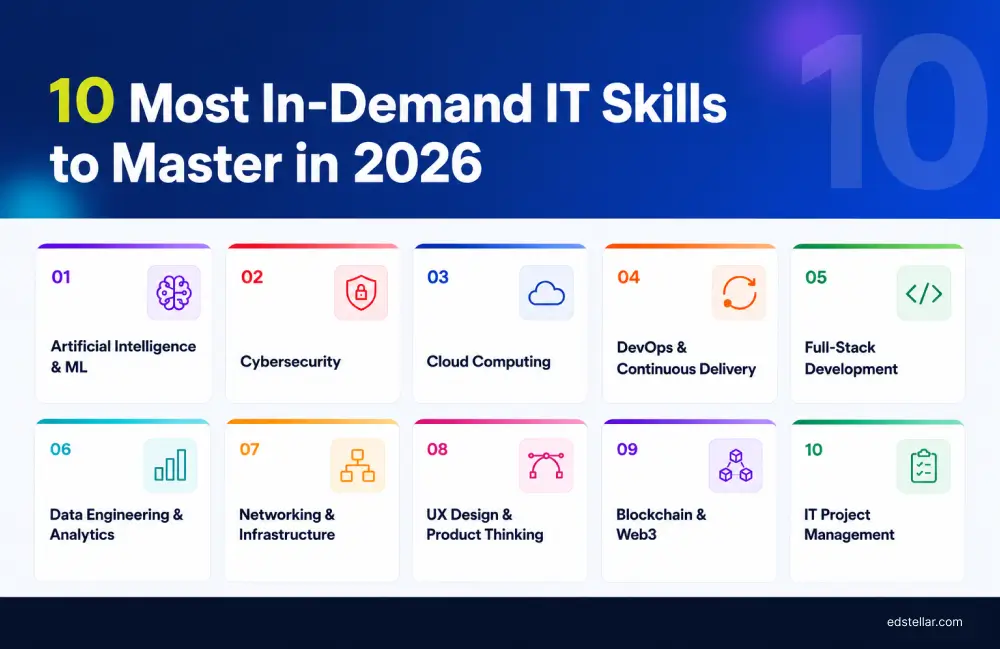
The IT industry's skills landscape in 2026 is dominated by a single theme: AI has reshaped every discipline. Cybersecurity now requires AI threat detection, cloud architects need AI service integration, DevOps pipelines incorporate AI-assisted code review, and full-stack developers are expected to leverage AI coding assistants. The 10 skills below span AI/ML, cybersecurity, cloud computing, DevOps, full-stack development, data engineering, networking, low-code development, Agile leadership, and emerging quantum computing, reflecting the capabilities where employer demand, salary premiums, and workforce shortages are most acute.
AI & Machine Learning Engineering
Research Score: 9.6/10
AI Engineer is the fastest-growing job title in the US with postings rising 143% year-over-year, AI/ML job postings surged 163% from 2024 to 2025 reaching 49,200 US positions, and workers in roles requiring AI fluency grew 7x in two years to approximately 7 million globally. AI skills now appear in 42% of software job descriptions (up from 8% in 2022), generative AI engineer postings have grown 7x since 2022, and Coursera recorded 7.4 million AI enrollments in 2024 with 3.2 million specifically in generative AI training. Fifty-one percent of tech leaders report an AI skills shortage, the steepest single-skill shortage increase in 15+ years of tracking.
The AI engineering landscape has evolved rapidly beyond traditional ML model training. LLM fine-tuning, RAG (Retrieval-Augmented Generation) architecture, AI agent development, prompt engineering, and MLOps have emerged as distinct sub-disciplines. Sixty-five percent of tech leaders would choose an AI-enabled developer with 2 years' experience over a non-AI developer with 5 years, signalling that AI proficiency is becoming a baseline hiring criterion rather than a specialist skill. Non-IT roles requiring generative AI skills grew 9x, and IT roles requiring them grew 35x, confirming that AI capability is now expected across the entire technology function.
AI engineers earn an average of USD 206,000 annually (a USD 50,000 jump year-over-year), LLM fine-tuning specialists command USD 195,000 to 350,000, and AI Lab Directors earn USD 250,000+. Roles requiring AI skills carry a 56% wage premium over comparable non-AI roles (up from 25% just one year earlier). For IT organisations, the combination of exponential demand growth, constrained supply (only 8% of qualified AI candidates are actively job-seeking), and the 56% salary premium means that internal AI upskilling programmes are the most cost-effective path to building capability that the open market cannot provide at any price.
Key Sub-skills
Top Industries
Technology, Financial Services, Healthcare, Retail/E-Commerce, Manufacturing
Explore Related Training:
Generative AI Machine Learning With Python All Artificial Intelligence ProgramsCybersecurity & Information Security
Research Score: 9.3/10
The global cybersecurity workforce reached 5.5 million professionals in 2024 but the gap grew to 4.8 million unfilled positions (a 19.1% increase year-on-year) according to ISC2's 2024 Workforce Study. Ninety percent of respondents face skills shortages, 64% say skills gaps present a greater challenge than headcount shortages, and 95% have at least one skill need. AI jumped into the top 5 priority skills alongside cloud security (40%) and zero trust implementation (27%), reflecting how AI is reshaping both the threat landscape and the defensive toolkit. Cybersecurity skills shortages rose 22% globally in the Nash Squared 2025 report, driven by a spike in cyberattacks.
The cybersecurity skills crisis is no longer primarily about headcount but about depth of expertise. Organisations needing new specialist OT/ICS security roles jumped from 23% to 53% in a single year, AI security is an entirely new discipline that barely existed two years ago, and only 19% of organisations consider their cybersecurity engineering teams fully skilled. The ICS security market alone is projected to reach USD 23.7 billion by 2027, and the convergence of IT and OT environments across manufacturing, energy, and critical infrastructure has created attack surfaces that traditional IT security teams cannot defend.
For IT organisations, cybersecurity is simultaneously the highest-risk skills gap and one of the highest-compensation career paths. The combination of a 4.8 million person workforce gap, AI-driven threat evolution, regulatory expansion (NIS2 in Europe, SEC disclosure rules in the US), and the 22% annual increase in shortage severity means that cybersecurity training investment delivers returns in both risk reduction and talent retention. Organisations that develop their security teams internally retain professionals that competitors would need to hire at premium salaries from an exhausted market.
Key Sub-skills
Top Industries
All Industries (Especially Finance, Healthcare, Government, Manufacturing, Energy)
Cloud Computing & Architecture
Research Score: 9.0/10
Global cloud infrastructure spending reached USD 99 billion in a single quarter of 2025 (25% year-on-year increase), AWS holds 32 to 34% market share, Azure 23%, and GCP 11%, and 64% of organisations report a shortage of skilled cloud and automation staff. Seventy-nine percent of organisations are in or planning multi-cloud deployments, and all three major cloud providers have integrated generative AI services (AWS Bedrock, Azure OpenAI, Google Vertex AI) that require professionals who combine cloud architecture expertise with AI service orchestration skills.
Cloud certifications command significant salary premiums: AWS Professional and Azure Expert certifications correlate with USD 130,000 to 180,000 annual salaries, and AWS AI certifications can bring salary increases of up to 47%. The cloud architect role has evolved from infrastructure design to encompass AI service integration, FinOps (cloud cost optimisation), and security architecture as cloud environments become the primary platform for AI workloads, data lakes, and enterprise applications.
For IT organisations, cloud computing skills are no longer a specialisation but a baseline capability. The shift of AI workloads to cloud platforms means that cloud engineers who cannot integrate AI services, manage GPU instances, or optimise inference costs are increasingly misaligned with what organisations need. Training in multi-cloud architecture, cloud-native AI deployment, FinOps, and cloud security provides the foundation on which every other IT skill in this guide depends.
Key Sub-skills
Top Industries
Technology, Financial Services, Healthcare, Retail, Government
"The talent gap in our profession isn't just a workforce issue. It's a barrier to progress for business and for the future of the world."


DevOps & Platform Engineering
Research Score: 8.7/10
The global DevOps market is projected to grow from USD 13.2 billion in 2024 to USD 81 billion by 2033, DevOps was a top-5 most in-demand job globally in 2024, and Platform Engineer roles in Q1 2025 were nearly double Q1 2024 levels, making platform engineering the fastest-growing DevOps specialisation. DevOps engineers earn a median of USD 185,000 annually (average USD 190,810), Platform Engineers average USD 170,657, and 77.1% of positions offer remote work.
The infrastructure as code (IaC) market is growing from USD 1.74 billion to USD 12.86 billion by 2032, 90% of cloud users now employ IaC, and IBM closed its USD 6.4 billion HashiCorp acquisition in February 2025, uniting Terraform and Vault under one parent. AWS (272 job posting mentions), Kubernetes (268), Python (237), and Terraform (234) are the most in-demand tools. DevOps engineers who can bridge development, security, and operations (DevSecOps) rank among the most sought-after IT professionals globally.
For IT organisations, the structural shift from traditional DevOps to platform engineering represents both an opportunity and a training priority. Platform engineering creates self-service developer platforms that abstract infrastructure complexity, improving developer productivity and reducing the need for dedicated infrastructure specialists per team. Training in Kubernetes, Terraform, CI/CD pipeline design, and internal developer platform architecture offers the highest-leverage investment for organisations looking to scale engineering output without proportionally scaling headcount.
Key Sub-skills
Top Industries
Technology, Financial Services, E-Commerce, SaaS, Telecommunications
Full-Stack Development
Research Score: 8.5/10
Full-stack developer ranked in LinkedIn's Top 10 Most In-Demand Jobs with postings up 35% year-on-year, 63% of US tech developer job postings list "full stack" as a top requirement, and BLS projects software developer employment to grow 15% from 2024 to 2034. Stack Overflow's 2024 survey of 65,000+ developers found JavaScript (62%) and Python (51%) as the most-used languages, React and Node.js as the dominant framework combination, and TypeScript adoption approaching universality in modern full-stack roles.
The full-stack development landscape has shifted significantly with AI integration. Developers with AI tool proficiency secure roles 2.3x faster, AI coding assistants (GitHub Copilot, Cursor, Amazon CodeWhisperer) are reshaping development workflows, and the distinction between frontend and backend is blurring as frameworks like Next.js enable full-stack development from a single codebase. Rust emerged as the most-admired language for the 9th consecutive year (83% admiration), Go continues to gain traction for backend microservices, and Python's rise to the most-desired language (overtaking JavaScript) reflects the convergence of web development and AI/data engineering.
Full-stack developers earn approximately USD 159,570 on average (Glassdoor 2025), backend developers reach USD 170,000 median (Stack Overflow), and mobile developers USD 185,000. For IT organisations, full-stack capability remains the most versatile and cost-effective development hiring strategy: a full-stack developer who can build across frontend, backend, and API layers with AI-assisted tooling provides more organisational flexibility than a team of specialists for projects below enterprise scale. Training in React + Node.js (the "gold standard" stack), Python/FastAPI, TypeScript, and AI-assisted development tools delivers the broadest applicable skillset.
Key Sub-skills
Top Industries
Technology/SaaS, E-Commerce, Fintech, Healthcare Tech, Startups
Need a Training Plan for Your IT Team?
Edstellar's Training Needs Analysis consultants identify your priority skill gaps and build a customised training roadmap. Get matched with the right programmes in 48 hours.
Request a Free Consultation →Data Engineering & Analytics
Research Score: 8.3/10
Data engineering demand grew 22.9% in the past year, outpacing data science roles by 50% year-on-year, driven by the infrastructure requirements of AI workloads. BLS projects data scientist employment to grow 34% from 2024 to 2034 and data architect demand to grow 28% through the decade. Average data engineer salary reached USD 153,000 in 2024, and the global big data and data engineering services market is projected to exceed USD 106 billion in 2025. The shift from traditional analytics to AI-ready data infrastructure (vector databases, embedding pipelines, RAG architecture) has made data engineering the foundation on which AI applications depend.
Modern data stack expertise now requires distributed systems design, SQL/Python fluency, open table formats (Apache Iceberg, Delta Lake), cloud data platform operations (Snowflake, Databricks), data governance and cataloguing, and AI/ML data requirements. Most enterprises now blend data fabric (automated technology layer) and data mesh (domain team ownership) approaches, and the proliferation of generative AI has created entirely new data pipeline requirements for embedding generation, vector storage, and retrieval-augmented generation workflows.
For IT organisations, data engineering is the skill area where investment delivers the most direct AI capability returns. AI models are only as good as the data pipelines that feed them, and organisations that build robust data engineering teams can deploy AI applications faster, achieve better model performance, and maintain data quality at scale. Training in Apache Spark, Kafka, dbt, modern lakehouse architecture, and vector database management provides the foundation for both traditional analytics and AI-ready data infrastructure.
Key Sub-skills
Top Industries
Technology, Financial Services, Healthcare, E-Commerce, Telecommunications
Networking & 5G Infrastructure
Research Score: 7.8/10
The WEF Future of Jobs Report 2025 lists networks and cybersecurity as the second-fastest-growing technology skills category globally. The SD-WAN market reached USD 5.5 billion in 2024 and is projected to grow to USD 20.2 billion by 2033, SASE (Secure Access Service Edge) architecture is replacing traditional VPN-based remote access, and 5G commercial deployments are driving demand for network engineers who can design, deploy, and secure next-generation connectivity infrastructure.
Network automation and intent-based networking are transforming the discipline from manual configuration to programmable infrastructure. Cisco-certified professionals remain in high global demand across enterprise networking, data centre, and security specialisations, and the Cisco certification ecosystem is continuously updating to cover 5G, intent-based networking, and AI-integrated network management. The convergence of networking and security under SASE frameworks means that network engineers increasingly need security competencies and vice versa.
For IT organisations, networking skills underpin every other technology in this guide: cloud architectures depend on network connectivity, AI workloads require high-bandwidth low-latency infrastructure, and cybersecurity strategies fail without network visibility and segmentation. Training in SD-WAN configuration, 5G network architecture, network automation (Ansible, Python for networking), and SASE implementation ensures that the infrastructure foundation supports the AI, cloud, and security investments organisations are making across their technology stacks.
Key Sub-skills
Top Industries
Telecommunications, Enterprise IT, Cloud Providers, Government, Manufacturing
"Skill gaps are categorically seen as the biggest barrier to business transformation. It is not investment capital, it is not regulations it is really skill gaps that are hindering being ready for future markets."

Low-Code / No-Code Development
Research Score: 7.5/10
The global low-code market reached USD 30.1 billion in 2024 and is projected to hit USD 101.7 billion by 2030. Gartner projects that 75% of new enterprise applications will be built using low-code platforms by 2026, 80% of low-code users will be outside IT departments by 2026 (up from 60% in 2021), and citizen developer application demand is growing 5x faster than IT can respond. The Microsoft Power Platform alone delivers 206% ROI (Forrester TEI study), saving organisations 1 million cumulative hours by year three.
Low-code development represents a fundamental shift in how organisations build applications. Rather than replacing professional developers, low-code platforms enable business users to build departmental applications, workflow automations, and data integrations that would otherwise queue in IT backlogs for months. The leading platforms (Microsoft Power Platform, Appian, OutSystems, Mendix) compete to offer the best balance of ease-of-use for citizen developers and extensibility for professional developers. IT professionals who can architect low-code governance frameworks, build reusable components, and integrate low-code applications with enterprise systems represent a new and increasingly valuable hybrid skill set.
For IT organisations, low-code capability addresses the demand-supply imbalance from both sides: it increases the supply of people who can build applications while reducing the demand on professional development teams for routine business applications. Training in Power Platform (Power Apps, Power Automate, Power BI), low-code governance, API integration, and citizen developer enablement programmes delivers returns in both IT productivity and business agility.
Key Sub-skills
Top Industries
Financial Services, Healthcare, Government, Insurance, Retail
Agile & IT Project Leadership
Research Score: 7.3/10
PMI reports that 87% of organisations worldwide use Agile in some form, 81% of Agile teams use Scrum as their primary framework, and Scrum Master job growth is projected at 24% by 2026. Agile adoption has expanded well beyond software development into healthcare, finance, marketing, and education, and product management skills are increasingly valued in data engineering and ML roles where data mesh domain ownership requires product management thinking.
The evolution of IT project leadership reflects the broader shifts in the technology landscape. AI project delivery requires understanding of ML experiment management, model lifecycle governance, and data pipeline dependencies that traditional project management frameworks do not address. Cloud migration projects demand FinOps awareness, infrastructure-as-code deployment coordination, and multi-team dependency management. Cybersecurity incident response requires Agile-style rapid iteration under extreme time pressure. The project management skills that organisations value most in 2026 combine Agile methodology with domain-specific technical understanding.
For IT organisations, Agile and project leadership capability determines whether technology investments deliver on time and within scope. CSM (Certified Scrum Master), CSPO (Certified Scrum Product Owner), and SAFe certifications remain among the most commonly requested credentials in IT job postings, and professionals who combine Agile certification with AI, cloud, or cybersecurity domain knowledge command significant salary premiums over general project managers.
Key Sub-skills
Top Industries
Technology, Financial Services, Consulting, Healthcare, Government
Explore Related Training:
Scrum Product Owner Agile Business Analysis All Project Management ProgramsQuantum Computing (Emerging)
Research Score: 6.8/10Quantum computing job listings rose approximately 180% from 2020 to 2024, approximately 8,400 job advertisements were posted in mid-2024, and 250,000 quantum computing jobs will need to be filled globally by 2030. The current global quantum workforce is estimated at approximately 30,000 professionals, creating a 3:1 gap between job openings and qualified candidates. Seventy-five percent of applicants lack the necessary skills competency, and less than half of quantum job openings are likely to be filled by 2025.
Quantum computing remains pre-commercial for most enterprise applications, but the talent formation window is now. More than 200 new quantum education programmes launched in 2024, Germany leads globally in quantum master's programmes, and the UK and US together represent 45% of all quantum master's degree programmes. The MIT Quantum Computing Index tracked a USD 1.6 billion investment surge, and organisations in cryptography, pharmaceuticals, financial modelling, and materials science are already building quantum-ready teams to prepare for the computational advantages that quantum hardware will unlock.
For IT organisations, quantum computing represents a strategic horizon skill. While most enterprises will not deploy quantum applications before 2028 to 2030, professionals who understand quantum algorithms, quantum-safe cryptography, and hybrid classical-quantum architectures will be in extreme demand as the technology matures. Training in quantum programming frameworks (Qiskit, Cirq, Q#), quantum error correction concepts, and post-quantum cryptography provides a forward-looking capability that positions organisations ahead of competitors who wait until commercial availability to begin workforce development.
Key Sub-skills
Top Industries
Financial Services, Pharmaceuticals, Government/Defence, Materials Science, Cryptography
"The scope is broader, and the stakes higher. Businesses need a pipeline of early-career talent, reskilled employees from other disciplines and cross-functional training to bridge skill gaps and allow for career growth."


The Challenge of Upskilling the AI Workforce: World Economic Forum panel examining global IT skills gaps, AI workforce development, and technology training priorities.
IT Skills Demand by Technology Domain
The IT skills gap varies significantly across technology domains, with some areas experiencing acute shortages while others show relative balance. Understanding these domain-level patterns helps L&D teams and HR managers prioritise training investments where the return will be greatest.
| Technology Domain | Shortage Severity | Top In-Demand Roles |
|---|---|---|
| AI / Machine Learning | 51% of leaders report shortage; 143% posting growth | AI Engineer, ML Engineer, LLM Specialist, MLOps Engineer |
| Cybersecurity | 4.8M global gap; 90% face shortages | Cloud Security Architect, SOC Analyst, OT Security, AI Security |
| Cloud Computing | 64% report shortage; $99B quarterly spend | Cloud Architect, FinOps Engineer, Cloud Security, AI Cloud Specialist |
| DevOps / Platform Eng. | Top-5 global demand; 2x growth in platform roles | Platform Engineer, SRE, DevSecOps, IaC Specialist |
| Data Engineering | 22.9% growth; 34% BLS projection | Data Engineer, Data Architect, Analytics Engineer, ML Data Engineer |
| Full-Stack Development | 35% posting growth; 15% BLS projection | Full-Stack Developer, Frontend (React), Backend (Node/Python/Go) |
AI/ML faces the most severe and fastest-growing shortage, with 51% of tech leaders reporting an AI skills gap (82% year-on-year increase) and only 8% of qualified candidates actively job-seeking. Cybersecurity has the largest absolute gap at 4.8 million unfilled positions globally, but the nature of the shortage is shifting from headcount to skills depth as AI, cloud, and OT security create new specialist requirements. Cloud computing shortages affect 64% of organisations and will intensify as AI workloads move to cloud platforms.
DevOps is evolving structurally from traditional CI/CD to platform engineering, creating demand for a new specialist profile. Data engineering is outpacing data science in hiring growth because AI applications require robust data infrastructure before models can be deployed. Full-stack development remains the broadest demand category by volume, with AI-assisted development skills increasingly differentiating candidates. For IT organisations planning workforce strategy, the common thread is that AI proficiency is now embedded in every domain, making AI upskilling the highest-leverage investment across the entire technology function.
How to Develop These In-Demand IT Skills
The IT skills challenge is defined by the intersection of exponential technology change and constrained talent supply. AI has created the biggest skills shortage in 15+ years, the cybersecurity workforce gap grew 19.1% in a single year to 4.8 million, and Gartner warns that by 2030 half of enterprises will face irreversible skill shortages. With AI skills commanding a 56% salary premium, AI fluency requirements growing 7x in two years, and 39% of job skills projected to change by 2030, IT organisations must treat workforce development as a strategic function that directly determines competitive positioning.
- Start with a skills audit. Use a structured training needs analysis to map your current team capabilities against the skills your technology roadmap requires over the next 12 to 24 months. Focus on the gaps that directly affect delivery capacity, security posture, or time-to-market. With 51% of tech leaders reporting AI skills shortages and 90% of cybersecurity teams facing gaps, identifying your organisation's specific mismatches is essential before committing training budgets.
- Build individual development plans. Generic training programmes produce generic results. Use individual development plan templates to tailor learning pathways to each team member's current skills and career trajectory. A backend developer upskilling into MLOps has different needs than a network engineer transitioning to cloud security, even though both reflect the AI-driven transformation reshaping IT roles.
- Combine certifications with applied learning. Industry certifications (AWS Solutions Architect, CompTIA Security+, Kubernetes CKA, Lean Six Sigma, Terraform Associate) validate knowledge and correlate with salary premiums of 20 to 47%. However, applied projects and instructor-led workshops using real production scenarios build the practical capability that certifications alone cannot provide. The most effective programmes pair certification preparation with hands-on labs, production-grade exercises, and team-based projects that mirror actual work environments.
- Address performance gaps systematically. A guide to understanding performance gaps can help managers distinguish between skill deficits, tooling limitations, and process failures before investing in training. A team struggling with deployment frequency may need CI/CD pipeline training rather than additional developers, while a security team failing to detect threats may need AI-powered SIEM training rather than more headcount.
- Embed AI proficiency across the entire IT function. AI is not a standalone skill but a capability multiplier that enhances every IT discipline. Cybersecurity teams need AI threat detection, DevOps teams need AI-assisted code review, data engineers need vector database management, and developers need AI coding assistant proficiency. Rather than creating a separate AI team, organisations that embed AI skills across all IT roles achieve faster adoption, broader capability, and better retention than those that concentrate AI expertise in isolated specialist groups.
The IT industry's workforce trajectory, shaped by AI's 7x growth in fluency requirements, a 4.8 million cybersecurity gap, cloud spend at USD 99 billion per quarter, and DevOps evolving into platform engineering, signals that technology skills will continue to change faster than at any point in the industry's history. Organisations that build their training strategies around these realities, supported by a catalogue of over 2,000 instructor-led courses, will be better positioned to deliver technology outcomes, retain top talent, and sustain competitive advantage in an industry where workforce capability is the primary differentiator.
Frequently Asked Questions
What are the most in-demand IT skills in 2026?
The most in-demand IT skills for 2026 are AI and machine learning engineering, cybersecurity and information security, cloud computing and architecture, DevOps and platform engineering, full-stack development, data engineering and analytics, networking and 5G infrastructure, low-code/no-code development, Agile and IT project leadership, and quantum computing (emerging). AI/ML engineering leads with job postings growing 143% year-on-year, a 56% salary premium for AI-skilled roles, and 51% of tech leaders reporting an AI skills shortage.
How big is the global IT skills gap?
The global IT skills gap spans multiple dimensions. Cybersecurity has the largest measured gap at 4.8 million unfilled positions globally (ISC2 2024). Korn Ferry projects 4.3 million tech jobs unfilled by 2030 with a potential USD 162 billion in lost US revenue. The WEF projects 39% of key job skills will change by 2030, and Gartner warns that by 2030 half of enterprises will face irreversible skill shortages. AI has become the fastest-growing gap, with 51% of tech leaders reporting AI skills shortages (an 82% increase in one year). The US alone posts 2.5 million tech job openings annually.
What is the average IT salary?
IT salaries vary significantly by role and region. In the US, the median across all tech occupations is USD 112,667 (CompTIA 2025), representing a 127% premium over the national median. AI engineers average USD 206,000 (a USD 50,000 year-on-year jump), DevOps engineers earn USD 185,000 to 190,000 median, cloud architects USD 150,000 to 200,000+, full-stack developers USD 159,570, and data engineers USD 153,000. AI-skilled roles carry a 56% wage premium over comparable non-AI roles. In Western Europe, salaries range from USD 80,800 to 93,000, while Eastern Europe offers USD 33,850 to 50,400.
How is AI changing IT jobs?
AI is reshaping every IT discipline rather than replacing IT workers. AI skills now appear in 42% of software job descriptions (up from 8% in 2022), workers requiring AI fluency grew from 1 million to 7 million in two years, and 65% of tech leaders prefer an AI-enabled developer with 2 years' experience over a non-AI developer with 5 years. AI is creating new roles (AI Engineer, MLOps Engineer, Prompt Engineer) while augmenting existing ones: cybersecurity now requires AI threat detection, DevOps uses AI-assisted code review, and developers leverage AI coding assistants to secure roles 2.3x faster. Tech leaders expect 1 in 5 technology jobs to be fulfilled by AI within 5 years.
Which IT certifications are most valuable?
The most valuable IT certifications for 2026 include AWS Solutions Architect Professional (correlates with USD 130,000 to 180,000 salaries), CompTIA Security+ (cybersecurity foundation), Kubernetes CKA/CKAD (DevOps/platform engineering), Google Professional ML Engineer (AI/ML), Azure AI Engineer (cloud AI), Terraform Associate (infrastructure as code), and CSM/CSPO (Agile leadership). AWS AI certifications can bring salary increases of up to 47%. All three major cloud providers now offer AI-integrated certifications reflecting the convergence of cloud and AI skills.
What is platform engineering?
Platform engineering is the fastest-growing DevOps specialisation, with roles nearly doubling between Q1 2024 and Q1 2025. Platform engineers build and maintain internal developer platforms (IDPs) that provide self-service infrastructure, CI/CD pipelines, and observability tools to application development teams. This abstracts infrastructure complexity, improves developer productivity, and reduces the need for dedicated infrastructure specialists per team. Platform engineers earn an average of USD 170,657 annually and work primarily with Kubernetes, Terraform, and cloud-native tooling. The shift from traditional DevOps to platform engineering represents a structural evolution in how organisations manage their technology infrastructure.
Is quantum computing a real career opportunity?
Quantum computing is a pre-commercial but rapidly growing career field. Job listings rose 180% from 2020 to 2024, 250,000 quantum jobs will need to be filled globally by 2030, and the current workforce of approximately 30,000 creates a 3:1 vacancy-to-candidate gap. Seventy-five percent of applicants lack necessary competencies. More than 200 new quantum education programmes launched in 2024, and the MIT Quantum Computing Index tracked a USD 1.6 billion investment surge. While most enterprises will not deploy quantum applications before 2028 to 2030, organisations in cryptography, pharmaceuticals, financial modelling, and materials science are already hiring quantum-ready professionals.
Conclusion
The IT industry in 2026 faces the most acute skills crisis in its history. AI has created the biggest skills shortage in 15+ years with 51% of tech leaders affected, the cybersecurity workforce gap stands at 4.8 million globally, cloud spending hits USD 99 billion per quarter while 64% of organisations cannot find skilled staff, and Korn Ferry projects 4.3 million tech jobs unfilled by 2030. The 56% wage premium for AI-skilled roles, 143% growth in AI engineer postings, and the WEF projection that 39% of job skills will change by 2030 confirm that the IT workforce is transforming faster than at any point in the industry's 70-year history.
The ten most in-demand skills in IT covered in this guide represent the intersection of technology transformation and workforce scarcity. From AI engineering with 143% posting growth and a 7x expansion in fluency requirements, through cybersecurity defending against an ever-expanding threat landscape, cloud architecture supporting USD 99 billion quarterly investment, and DevOps evolving into platform engineering, each skill area offers clear returns on training investment. The organisations that close their skills gaps fastest will be the ones that ship AI applications to production, defend their digital assets, scale their cloud infrastructure, and lead their industries as technology capability becomes the primary determinant of enterprise success.
Ready to Upskill Your IT Team?
Join 500+ organizations that trust Edstellar for corporate training. Get matched with expert trainers in 48 hours.
Schedule a Free Training Consultation →