

A Nexford University survey found that 78% of leading Egyptian companies struggle to hire talent with the right skills, with 41% calling it a "major challenge." Business analytics tops the shortage list at 52% employer difficulty, followed by digital transformation at 45% and digital marketing at 37%. Egypt's ICT sector has been the fastest-growing industry for eight consecutive years at 14–16% annual growth, digital exports surged 124% to USD 7.4 billion, and the Information Technology Industry Development Agency (ITIDA) signed 55 new offshoring agreements in November 2025 targeting 75,000 additional jobs. For corporate L&D leaders and HR managers operating in the Arab world's most populous country, these numbers translate directly into urgent training priorities.
Several structural forces are converging to reshape Egypt's labour market. The World Bank estimates that 1.3 million young Egyptians enter the labour market annually, yet only around 500,000 jobs are created each year. The National AI Strategy 2025–2030 targets 30,000 AI specialists, IBM and Microsoft have committed to training 200,000 Egyptians in artificial intelligence, and the Suez Canal Economic Zone has attracted $12.96 billion in investment across 380 projects.
Egypt's renewable energy budget for FY 2025–26 nearly doubled to $2.8 billion, $64 billion in green hydrogen framework agreements are advancing in the SCZone, and the nationwide 5G rollout launched in June 2025 with $2.7 billion in combined operator investment. With a labour force of 34.7 million, 140,000 annual STEM graduates, and financial inclusion surging from 27.4% to 76.3% in under a decade, Egypt has the scale to power this transformation if it can close the skills gap.
So which skills are truly driving Egypt's economy, and where should organisations invest their training budgets? This guide breaks down the top 10 skills in demand in Egypt, spanning artificial intelligence, cybersecurity, cloud computing, renewable energy, fintech, and supply chain management. Drawing on MCIT policy data, ITIDA industry outlooks, CAPMAS labour statistics, and hiring platform benchmarks, it provides an evidence-based picture of what jobs are in demand in Egypt, whether you are planning corporate upskilling programmes, building internal talent pipelines, or advising teams on high demand skills in Egypt for 2026 and beyond.
Sources Behind This Research
Every ranking in this guide is backed by data from Egyptian government bodies, industry associations, and local recruitment platforms.
Ministry of Communications and Information Technology (MCIT)
ICT 2030 Strategy & National AI Strategy 2025–2030Published Egypt's second-edition National AI Strategy targeting 30,000 AI specialists and 7.7% ICT GDP contribution by 2030. Documented Digital Egypt training initiatives reaching 100,000 youth, six new technology parks, and the nationwide 5G rollout with $2.7 billion in operator investment.
View source →Information Technology Industry Development Agency (ITIDA)
ICT Sector Outlook 2026 & Offshoring StrategyReported 240+ offshoring companies and 270+ delivery centres generating USD 4.8 billion in exports. Documented 55 new agreements signed at the November 2025 ITIC summit, targeting 75,000 additional jobs and $9 billion in export revenue by 2026.
View source →Central Agency for Public Mobilization and Statistics (CAPMAS)
Quarterly Labour Force Survey Q3 2025Confirmed Egypt's labour force at 34.7 million with unemployment at 6.4% in Q3 2025. Provided sector-level employment breakdowns showing agriculture at 20.5%, trade at 16.1%, manufacturing at 13.2%, and construction at 11.8%.
View source →State Information Service (SIS)
Egyptian Smart Cities Strategy & SCZone Investment DataDocumented the New Administrative Capital's smart infrastructure including 6,000+ AI-monitored cameras and smart energy management. Reported SCZone investment of $12.96 billion across 380 projects generating 121,500 jobs.
View source →Nexford University Employer Survey (via Zawya)
Egyptian Skills Gap and Talent Shortage Report 2025Surveyed leading Egyptian companies and found 78% struggle to hire talent with the right skills. Identified business analytics (52%), digital transformation (45%), and digital marketing (37%) as the hardest skills to recruit for.
View source →PMI MENA Construction Talent Report (via Daily News Egypt)
Project Management Workforce Demand & Certification RankingsReported a projected 34.8% surge in project management demand creating a 69,000-role talent gap by 2035. Confirmed Egypt ranks first globally in PMI-PMOCP certification and second in PMI-RMP.
View source →World Bank
More Jobs, Better Jobs: The Engine for Egypt's Future GrowthAnalysed Egypt's structural employment challenge where 1.3 million young Egyptians enter the labour market annually against approximately 500,000 jobs created. Provided context on skills mismatch between education output and employer requirements.
View source →Wuzzuf
Egypt Job Market Data & Hiring Trends 2025Egypt's largest job platform with over 5 million applications and 50,000+ postings in 2025. Provided salary benchmarks, sector-level hiring volumes, and skills demand patterns across technology, engineering, finance, and marketing roles.
View source →10 Key Skills in Demand Across Egypt's Job Market
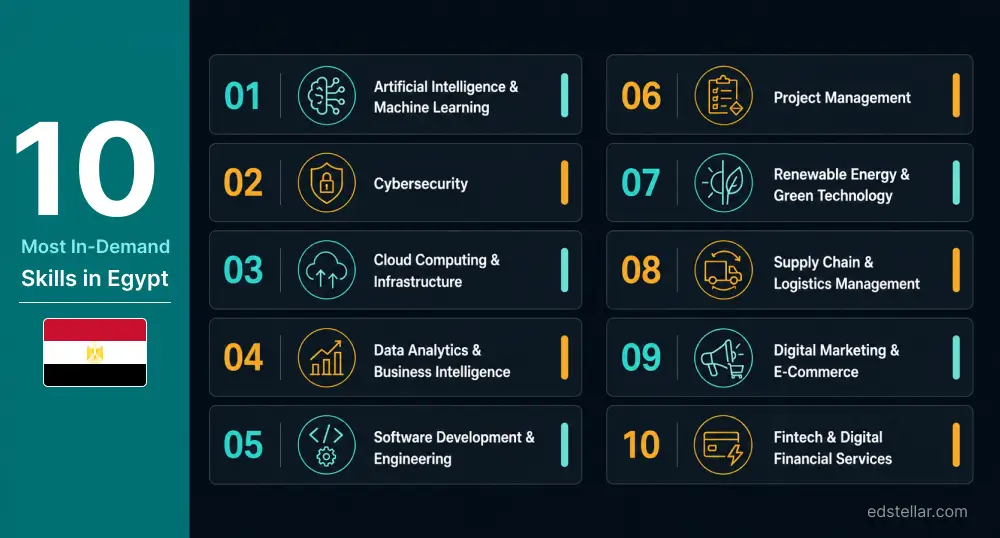
Egypt's skills landscape in 2026 reflects the convergence of the National AI Strategy 2025–2030, a rapidly scaling IT offshoring sector generating USD 7.4 billion in digital exports, $12.96 billion in Suez Canal Economic Zone investment, and a renewable energy transition targeting 42% clean electricity by 2030. The 10 skills below span artificial intelligence, cybersecurity, cloud computing, data analytics, software development, project management, renewable energy, logistics, marketing, and fintech, mirroring the sectors where government investment, employer demand, and growth potential are highest.
Artificial Intelligence & Machine Learning
Research Score: 9.45/10
Egypt's National AI Strategy 2025–2030, launched in January 2025 as a second edition, targets 30,000 AI specialists, 250+ startups, and a 7.7% ICT GDP contribution by 2030. The strategy's six pillars cover governance, technology, data, infrastructure, ecosystem, and talent, with a dedicated "Sovereign AI" programme building localised Arabic-language foundational models. IBM signed a five-year partnership with MCIT in January 2025 to train 100,000 Egyptians through IBM SkillsBuild, and Microsoft Egypt followed in April 2025 with a commitment to train another 100,000 in AI and cloud skills.
The private sector is responding at scale. Foundever is expanding AI-driven outsourcing operations in Cairo, Coca-Cola HBC established a digital hub in Egypt leveraging machine learning for supply chain optimisation, and Check Point is partnering with Egyptian universities to develop AI-powered cybersecurity talent. The AI sector is growing at 28.63% annually according to market forecasts, and Egypt's 140,000 annual STEM graduates provide a pipeline that few countries in the Middle East and Africa can match. MCIT's six new technology parks in Upper Egypt (Minya, Sohag, Qena, Aswan, Menoufiya, Mansoura) will extend AI training capacity beyond Cairo.
AI specialists in Egypt earn EGP 120,000 to 250,000 annually in domestic roles, with senior remote positions reaching USD 40,000 to 60,000. The skill commands premium salaries because demand spans banking (fraud detection and credit scoring), healthcare (diagnostic imaging), manufacturing (predictive maintenance), agriculture (crop optimisation), and smart city management (the New Administrative Capital runs 6,000+ AI-monitored cameras). For organisations operating in Egypt, AI capability is no longer a technology department concern but a cross-functional business requirement.
Key Sub-skills
Top Industries
Technology/IT Services, Banking/Finance, Healthcare, Smart Cities
Explore Related Training:
AI Automation Mastery AI Programming with Python All Artificial Intelligence ProgramsCybersecurity
Research Score: 9.10/10
Egypt's cybersecurity market is valued at USD 230 million in 2025 and projected to reach USD 405 million by 2030, growing at a 12.17% compound annual rate according to Mordor Intelligence. The National Cybersecurity Strategy 2023–2027 established mandatory compliance frameworks, the Data Protection Law (Law No. 151 of 2020) requires organisations to register with the Data Protection Authority, and the nationwide 5G rollout launched in June 2025 with $2.7 billion in combined operator investment has created an entirely new attack surface that requires dedicated security specialists. With 120 million internet users and EGP 150 billion invested in broadband infrastructure since 2018, the digital footprint requiring protection is growing faster than the talent pool to secure it.
Banking and telecommunications are the largest employers of cybersecurity professionals. The Central Bank of Egypt's push to raise financial inclusion from 27.4% to 76.3% means that three-quarters of Egypt's 70.5 million adults now hold bank accounts, creating massive data protection obligations for financial institutions. Telecom operators Vodafone Egypt, Orange, Etisalat (e&), and WE are investing in 5G security infrastructure simultaneously. Check Point's partnership with Egyptian universities signals a recognition that domestic training capacity must expand rapidly to meet growing enterprise demand.
Experienced cybersecurity professionals in Egypt earn EGP 150,000 to 300,000 annually, with SOC managers and chief information security officers commanding the upper range. The skill carries strong cross-sector demand because Data Protection Law compliance applies to every organisation processing personal data, not just technology companies. Government agencies relocating to the New Administrative Capital require cybersecurity architects for smart city infrastructure, energy companies managing critical national assets need operational technology security, and healthcare providers handling patient data face increasing regulatory scrutiny.
Key Sub-skills
Top Industries
Banking/Finance, Telecommunications, Government, Energy/Utilities
Cloud Computing & Infrastructure
Research Score: 8.85/10
Egypt's cloud data centre and colocation market is valued at USD 1.2 billion, with EGP 500 million allocated by the government to support local data centre development under the Digital Egypt Strategy according to GlobeNewswire. The government's target of digitising 32,000 buildings, of which 5,300 are already connected via fibre-optic, is driving cloud migration at scale across ministries, public agencies, and state-owned enterprises. The June 2025 5G rollout by all four telecom operators (Vodafone, Orange, e&, WE) further accelerates edge computing and cloud-native application demand.
AWS, Microsoft Azure, and IBM all maintain active training and partnership programmes in Egypt. Cloud engineers who can architect hybrid environments, manage containerised workloads, and implement infrastructure as code are among the most sought-after technology professionals. Over 50% of technology job postings reference cloud skills, and the offshoring sector's 240+ companies increasingly require cloud-native development capability to serve international clients. The banking sector's digital transformation, driven by the Central Bank of Egypt's push toward 76.3% financial inclusion, requires robust cloud infrastructure for mobile banking, digital payment platforms, and data analytics workloads.
Cloud architects and senior DevOps engineers in Egypt earn EGP 120,000 to 240,000 annually in domestic roles, with remote positions for international clients reaching USD 35,000 to 55,000. The skill's value is amplified by its role as the foundation layer for nearly every other in-demand skill on this list. AI workloads require cloud GPU infrastructure, cybersecurity tools operate in cloud environments, data analytics platforms run on cloud data warehouses, and fintech applications are built cloud-native. For L&D teams prioritising a single technology investment, cloud computing delivers the broadest return across the organisation.
Key Sub-skills
Top Industries
Technology/IT Services, Banking/Finance, Telecommunications, Government
Data Analytics & Business Intelligence
Research Score: 8.70/10
Business analytics is the single hardest skill to recruit in Egypt: 52% of leading employers find it "hard" or "very hard" to fill according to the Nexford University survey. Glassdoor listed over 1,050 data analysis positions and 830 data science positions in Egypt in December 2025, reflecting a demand pipeline that stretches across banking, e-commerce, telecommunications, and government analytics. MCIT's "Our Future is Digital" initiative includes data analysis as one of its three core training pillars alongside website design and digital marketing, targeting 100,000 young Egyptians.
The banking sector is the largest single employer of data analysts in Egypt. The Central Bank of Egypt's digital transformation has created 40 million Apple Pay transactions and EGP 905 billion in mobile wallet activity, generating datasets that require analysts for customer behaviour modelling, fraud pattern detection, and regulatory reporting. Beyond banking, Egypt's $9.05 billion e-commerce market needs analytics professionals for conversion optimisation and demand forecasting, telecommunications providers use data teams for network capacity planning and churn prediction, and SCZone logistics operations require demand forecasting to manage 380 industrial projects.
Data scientists in Egypt earn EGP 100,000 to 200,000 annually, with senior analytics leaders at multinational firms reaching higher brackets. The 52% recruitment difficulty rate reflects a genuine structural shortage rather than cyclical demand: Egypt produces 140,000 STEM graduates annually, but the university system has not scaled data science and analytics programmes at the pace the market requires. Organisations that invest in converting existing technical staff (engineers, accountants, operations managers) into analytics-capable professionals through Power BI, SQL, and Python training will gain a measurable advantage over competitors still competing for a limited pool of ready-made data analysts.
Key Sub-skills
Top Industries
Banking/Finance, E-commerce/Retail, Telecommunications, Healthcare
Software Development & Engineering
Research Score: 8.55/10
Software development roles account for 58% of all technology job openings in Egypt according to Qureos market data. ITIDA's Digital Egypt Strategy for Offshoring 2022–2026 has built an ecosystem of 240+ offshoring companies and 270+ delivery centres generating USD 4.8 billion in exports, with a target of 500,000 offshoring jobs and $9 billion in export revenue. The 55 new agreements signed at the November 2025 ITIC summit are expected to create 75,000 additional jobs over three years, the majority in software engineering, quality assurance, and cloud development.
Egypt's competitive advantage in software outsourcing rests on cost and talent volume. Junior developers earn approximately EGP 93,600 per year ($7,800), mid-level developers earn EGP 144,000 ($12,000), and senior engineers reach EGP 360,000 ($30,000) according to Glassdoor benchmarks. These rates are 60–70% below Western European equivalents, making Egypt attractive for nearshore development by European and Gulf clients. DevOps engineers with cloud-native deployment skills command premium rates, particularly those serving international clients where remote salaries average USD 44,958 to 47,315.
The Egypt FWD scholarship programme, administered by ITIDA in partnership with Udacity, has trained thousands of developers in full-stack development, data science, and cloud engineering. Full-stack JavaScript and Python development are the most requested skill combinations, followed by mobile development (React Native and Flutter) and API integration. Quality assurance and software testing also face significant demand, driven by the offshoring sector's need to deliver production-grade code to international standards. Organisations building development teams in Egypt benefit from a timezone that overlaps with both European and Gulf business hours.
Key Sub-skills
Top Industries
IT Outsourcing/BPO, E-commerce, Fintech, Telecommunications
Want Your Egypt Training Investments to Deliver Results?
Edstellar's L&D consulting services help organisations move from ad-hoc training to structured capability development aligned with business priorities.
Schedule a Strategy Session →Project Management
Research Score: 8.30/10
Egypt ranks first globally in PMI-PMOCP (Portfolio Management of Change in Organizations and Projects) certification and second in PMI-RMP (Risk Management Professional), according to PMI's November 2025 MENA Construction Talent Report. Despite this certification strength, a projected 34.8% surge in demand will create a 69,000-role talent gap by 2035. Egypt's $29.3 billion construction market, growing at 7.62% CAGR through 2034, is absorbing project managers faster than the certification pipeline can produce them.
The New Administrative Capital, the Suez Canal Economic Zone expansion, renewable energy mega-projects (including a $2.3 billion ACWA Power wind farm and the $64 billion green hydrogen pipeline), and nationwide 5G infrastructure all require programme-level project management capability. Construction project management carries the highest demand, followed by technology project management for Digital Egypt initiatives and energy project management for the renewable transition. The SCZone alone encompasses 380 industrial, service, and logistics projects requiring coordinated delivery against government timelines.
Project managers in Egypt earn EGP 150,000 to 350,000 annually depending on sector, certification level, and project scale. PMP-certified professionals command a documented salary premium, and the PMI-RMP certification is particularly valued given the risk complexity of Egypt's mega-project portfolio. Agile and hybrid methodologies are increasingly required alongside traditional waterfall approaches, particularly in technology-enabled construction projects and banking digital transformation programmes. For organisations managing multi-year initiatives in Egypt, the project management talent gap represents both a hiring challenge and a compelling case for internal upskilling.
Key Sub-skills
Top Industries
Construction/Infrastructure, Energy, Manufacturing, Technology
Renewable Energy & Green Technology
Research Score: 8.15/10
Egypt's electricity and renewable energy budget for FY 2025–26 nearly doubled to $2.8 billion, with national targets of 20% renewable energy by 2026, 42% by 2030, and 65% by 2040 according to the Ministry of Electricity and Renewable Energy. The Benban Solar Park in Aswan, already Africa's largest at 1,465 MW, is expanding toward 2,000–2,100 MW. ACWA Power's $2.3 billion, 2 GW wind farm is under construction for completion by 2026, and a 1.1 GW Suez wind farm is co-financed by the OPEC Fund, EBRD, and AfDB. The government plans to add 3 GW of solar capacity and 600 MW of battery energy storage systems in 2026 alone.
Green hydrogen represents the most ambitious component of Egypt's energy transition. Twelve framework agreements worth $64 billion in investment commitments have been signed for green hydrogen production in the Suez Canal Economic Zone, and the first 100 MW green hydrogen facility became operational in Ain Sokhna in January 2026. UNIDO established a Green Hydrogen Innovation Centre in Egypt to support workforce development. These projects require hydrogen engineers, electrochemist technicians, and carbon accounting professionals that Egypt's education system has not historically produced.
Renewable energy engineers in Egypt earn EGP 120,000 to 280,000 annually, with hydrogen specialists commanding the upper range due to scarcity. Solar PV design and installation is the highest-volume skill need, followed by wind turbine engineering and battery storage system management. The energy transition also creates demand for adjacent skills including ESG reporting (required by international investors), environmental impact assessment, and grid modernisation engineering. For organisations in the energy sector, the combination of massive capital deployment and limited local talent creates a compelling argument for building internal renewable energy capabilities rather than competing for scarce external hires.
Key Sub-skills
Top Industries
Energy/Utilities, Engineering/EPC, Manufacturing, Construction
Supply Chain & Logistics Management
Research Score: 7.95/10
The Suez Canal Economic Zone has attracted $12.96 billion in confirmed investment contracts covering 380 industrial, service, and logistics projects, expected to generate 121,500 jobs according to SIS. AD Ports Group signed a 50-year agreement to develop a 20 km2 industrial and logistics park at East Port Said with $120 million in initial investment. China accounts for 50% of SCZone investment, including a $360 million tire factory and a $110 million bromine processing complex. Egypt's freight and logistics market is growing at 8.31% CAGR through 2030, driven by the country's strategic position connecting three continents through the Suez Canal.
Professionals with supply chain management expertise are needed across the SCZone's industrial zones, the growing e-commerce fulfilment sector (Egypt's $9.05 billion e-commerce market requires last-mile delivery infrastructure), pharmaceutical cold chain operations, and automotive component distribution. The AD Ports logistics hub at East Port Said will require warehouse management, customs compliance, and international trade specialists. Egypt's position as a gateway for African Continental Free Trade Area (AfCFTA) commerce is expected to increase transit volumes and the demand for trade facilitation professionals.
Supply chain managers in Egypt earn EGP 100,000 to 250,000 annually depending on seniority and sector. The SCZone's 121,500 projected jobs represent the single largest concentrated demand source, but e-commerce logistics, pharmaceutical distribution, and FMCG supply chains also face persistent shortages. Digital supply chain skills, including demand forecasting using AI, warehouse management systems (WMS), and transport management platforms, carry a salary premium over traditional logistics experience. Organisations expanding into Egypt's industrial zones benefit from investing in supply chain talent development programmes aligned with SCZone operational requirements.
Key Sub-skills
Top Industries
Logistics/Freight, Manufacturing, Retail/E-commerce, Automotive
Digital Marketing & E-Commerce
Research Score: 7.75/10
Egypt's e-commerce market reached $9.05 billion in 2025 with a projected CAGR of 14.80% through 2033, while 37% of employers report difficulty finding digital marketing talent according to the Nexford survey. Internet penetration stands at 81.9% with 96.3 million users, and the June 2025 5G rollout is accelerating mobile commerce adoption. The digital advertising and AdTech market is valued at USD 2.3 billion, and 73% of Egyptian businesses report increasing their digital marketing budgets year-over-year.
MCIT's "Our Future is Digital" initiative targets 100,000 young Egyptians with training in digital marketing alongside website design and data analysis, signalling government recognition of the skill's economic importance. The tourism sector (Egypt received 15.7 million visitors in 2024) is shifting marketing spend toward digital channels, FMCG brands are competing for social media engagement in a market of 49+ million Facebook users, and real estate developers marketing the New Administrative Capital rely heavily on digital lead generation. E-commerce platform management, particularly Shopify, WooCommerce, and regional platforms like Jumia, is a distinct sub-skill with its own hiring demand.
Digital marketing professionals in Egypt earn EGP 80,000 to 180,000 annually, with senior digital marketing managers and e-commerce directors exceeding EGP 200,000. English-fluent marketing professionals earn significantly more than Arabic-only counterparts, reflecting the outsourcing sector's demand for marketers serving international clients. SEO/SEM specialists and performance marketing analysts command the highest premiums within the field, driven by measurable ROI expectations from both domestic brands and international clients outsourcing digital operations to Egypt. For organisations with consumer-facing operations in Egypt, digital marketing capability directly affects revenue growth in a market where online transactions are growing at nearly 15% annually.
Key Sub-skills
Top Industries
E-commerce/Retail, Tourism/Hospitality, FMCG, Financial Services
Fintech & Digital Financial Services
Research Score: 7.60/10
Egypt's financial inclusion rate surged from 27.4% in 2016 to 76.3% in June 2025, with three-quarters of the country's 70.5 million adults now holding bank accounts according to Central Bank of Egypt data. Mobile wallet transactions exceeded EGP 905 billion, 40 million Apple Pay transactions were processed, and Fawry, Egypt's leading digital payments platform, serves 35 million users. The country's first fully digital-native bank, onebank (backed by Banque Misr), received regulatory approval in August 2025, marking a structural shift in Egypt's banking landscape.
Egypt accounts for approximately 10% of Africa's fintech operators, and the mobile payments market is growing at a 16.76% CAGR through 2030. The Central Bank of Egypt's regulatory framework has enabled rapid fintech adoption while maintaining consumer protection standards. Digital payment infrastructure, blockchain applications for trade finance, and regulatory technology (RegTech) for anti-money laundering compliance are the primary skill demand areas. Insurance technology (insurtech) is an emerging segment, with traditional insurers exploring digital distribution to reach Egypt's largely underinsured population.
Fintech professionals in Egypt earn EGP 120,000 to 280,000 annually, with payment systems architects and blockchain developers at the upper end. The skill set combines financial domain expertise with technology capability, making it difficult to hire but possible to develop through targeted upskilling of existing banking or technology staff. Organisations in the financial sector benefit from training programmes that bridge these two knowledge areas, particularly for regulatory compliance professionals who need technology literacy and technology professionals who need financial domain understanding. Egypt's fintech trajectory, from 27% to 76% financial inclusion in under a decade, confirms that this skill demand is structural rather than cyclical.
Key Sub-skills
Top Industries
Banking/Finance, Insurance, E-commerce, Telecommunications
"As digital transformation accelerates worldwide, the demand for skilled professionals in areas like AI, big data, and Cloud is growing, yet the shortage of talent remains a pressing global challenge."



Egypt 2025 Building Bridges of Prosperity: A CNBC Africa documentary exploring the economic transformation, technology growth, and workforce trends shaping Egypt's job market.
Egypt's Mega-Project Pipeline and the Skills They Demand
Egypt is executing one of the most ambitious infrastructure and industrial investment programmes in the Middle East and Africa. Understanding which mega-projects drive which skills helps corporate L&D teams and HR managers target training investments where they will have the greatest impact. The table below maps Egypt's largest active projects to their investment scale and the specific workforce skills each requires.
| Mega-Project | Investment | Skills Created |
|---|---|---|
| New Administrative Capital (NAC) | $58B+ smart city | IoT, Cybersecurity, Smart Infrastructure, Project Management |
| Suez Canal Economic Zone (SCZone) | $12.96B across 380 projects | Supply Chain, Manufacturing, Logistics, Industrial Engineering |
| Green Hydrogen Hub (Ain Sokhna) | $64B framework pipeline | Hydrogen Engineering, Chemical Processing, ESG Reporting |
| Benban Solar Park Expansion | $2B+ capacity upgrade | Solar PV Engineering, BESS, Grid Management |
| 5G National Rollout | $2.7B operator investment | Network Engineering, Cloud Computing, Cybersecurity |
| Digital Egypt Offshoring | $9B export revenue target | Software Development, AI/ML, Data Analytics, QA |
The New Administrative Capital represents Egypt's largest single infrastructure project, with smart city systems including 6,000+ AI-monitored cameras, smart traffic management, 5G connectivity, and IoT-enabled energy and water management. The SCZone's 380 projects span electronics, pharmaceuticals, automotive, metals, and renewable energy manufacturing, creating diversified skills demand across an industrial corridor designed to leverage Egypt's position on the Suez Canal.
The $64 billion green hydrogen pipeline is attracting global energy companies to Ain Sokhna, where the first 100 MW facility became operational in January 2026, and the Digital Egypt offshoring ecosystem has grown to 240+ companies generating $7.4 billion in digital exports. For organisations planning workforce development in Egypt, aligning training programmes with these mega-project timelines ensures that upskilling investments match the sectors where hiring will be most intense.
How to Develop These Skills in Demand in Egypt
Egypt's skills challenge sits at the intersection of rapid digital transformation and structural workforce mismatch. The World Bank estimates that 1.3 million young Egyptians enter the labour market annually while only 500,000 jobs are created, and 78% of leading employers struggle to find talent with the right skills. With ICT exports at $7.4 billion, $12.96 billion invested in the SCZone, and a $64 billion green hydrogen pipeline advancing, the demand side is growing faster than the supply side can respond. Organisations need a structured approach to close these gaps.
- Start with a skills audit. Use a structured training needs analysis to map your current team capabilities against the skills your business needs over the next 12 to 24 months. Focus on the gaps that directly affect service delivery, digital transformation, and revenue growth. With 78% of leading Egyptian companies struggling to find talent with the right skills, identifying your organisation's specific mismatches is essential before committing training budgets.
- Build individual development plans. Generic training programmes produce generic results. Use individual development plan templates to tailor learning pathways to each employee's current skills and career trajectory. A cybersecurity analyst at a Cairo banking institution has different development needs than a cloud engineer supporting ITIDA's offshoring delivery centres, even though both operate within Egypt's growing digital economy.
- Combine certifications with applied learning. International certifications (AWS, Azure, CISSP, PMP, PMI-PMOCP) carry significant weight in the Egyptian market and command salary premiums across technology, energy, and infrastructure roles. However, applied projects and instructor-led workshops build the practical capability that certifications alone cannot provide. The most effective programmes pair certification preparation with hands-on exercises drawn from Egypt-specific industry scenarios, particularly in the SCZone, offshoring, and renewable energy sectors where local context matters.
- Address performance gaps systematically. A guide to understanding performance gaps can help managers distinguish between skill deficits, tool familiarity gaps, and systemic barriers before investing in training. A data analytics team at an Egyptian bank may need Power BI and Python training, while a supply chain team at an SCZone logistics company may need process redesign rather than more certification courses.
- Leverage Egypt's government-backed training ecosystem. IBM SkillsBuild and Microsoft's AI initiative each target 100,000 Egyptian learners, and AWS maintains certification tracks through MCIT partnerships. ITIDA's Egypt FWD scholarship programme covers full-stack development, data science, and cloud engineering. Organisations that actively align employee development with these government-affiliated programmes can extend their L&D reach while reducing internal training costs, particularly for foundational digital and AI skills.
Egypt's economic trajectory, driven by a National AI Strategy targeting 30,000 specialists, an offshoring sector generating $7.4 billion in exports, $12.96 billion in SCZone industrial investment, and a renewable energy transition backed by $64 billion in green hydrogen commitments, signals that demand for skilled professionals will only intensify. Organisations that build their training strategies around these national priorities, supported by a catalogue of over 2,000 instructor-led courses, will be better positioned to attract talent and maintain competitive advantage in the Middle East and Africa's largest labour market.
Frequently Asked Questions
What skills are in high demand in Egypt?
The most in-demand skills in Egypt for 2026 include artificial intelligence and machine learning, cybersecurity, cloud computing and infrastructure, data analytics and business intelligence, software development and engineering, project management, renewable energy and green technology, supply chain and logistics management, digital marketing and e-commerce, and fintech and digital financial services. AI and machine learning lead the list, driven by the National AI Strategy 2025–2030 targeting 30,000 AI specialists and IBM and Microsoft partnerships training 200,000 Egyptians.
What jobs are in demand in Egypt in 2026?
The highest-demand jobs in Egypt for 2026 include AI engineers, cybersecurity analysts, cloud architects, data scientists, full-stack developers, project managers, solar energy engineers, logistics coordinators, digital marketing specialists, and fintech developers. Software development roles account for 58% of all technology job openings, ITIDA's 55 new offshoring agreements target 75,000 additional jobs, and the $29.3 billion construction market requires thousands of certified project managers.
What is the average salary for technology professionals in Egypt?
Technology salaries in Egypt vary significantly by role and experience level. Junior software developers earn approximately EGP 93,600 per year, mid-level developers earn EGP 144,000, and senior engineers reach EGP 360,000. AI specialists earn EGP 120,000 to 250,000, cybersecurity professionals earn EGP 150,000 to 300,000, and project managers earn EGP 150,000 to 350,000. Remote positions serving international clients command significantly higher rates, with senior developers averaging USD 44,958 to 47,315 annually.
Why do Egyptian companies struggle to hire skilled talent?
According to a Nexford University survey, 78% of leading Egyptian companies find it difficult to hire talent with the right skills. Business analytics tops the shortage at 52% employer difficulty, followed by digital transformation at 45% and digital marketing at 37%. The root cause is a structural mismatch between education output and employer needs. While Egypt produces 140,000 STEM graduates annually, the university system has not scaled programmes in data science, AI, cloud computing, and cybersecurity at the pace the market requires. The World Bank notes that 1.3 million young Egyptians enter the labour market annually while only 500,000 jobs are created.
How do I get a job in Egypt as a foreigner?
Foreign professionals access Egypt's job market through employer-sponsored work permits issued by the Ministry of Manpower, which require demonstrating that the position cannot be filled by a local candidate. Technology, engineering, energy, and senior management roles offer the strongest prospects. The Suez Canal Economic Zone attracts international companies in manufacturing, logistics, and energy. Multinational offshoring firms, international banks, and renewable energy companies operating on mega-projects are the most common employers of foreign professionals. English and Arabic proficiency are both valued, with English-fluent professionals earning significantly higher salaries in the outsourcing sector.
What is Egypt's IT outsourcing industry?
Egypt's IT outsourcing industry is one of the fastest-growing in the Middle East and Africa. ITIDA's Digital Egypt Strategy for Offshoring has built an ecosystem of 240+ offshoring companies and 270+ delivery centres generating USD 4.8 billion in exports, with a target of 500,000 jobs and $9 billion in export revenue. In November 2025, ITIDA signed 55 new agreements targeting 75,000 additional jobs over three years. Egypt's competitive advantages include a 34.7 million labour force, 140,000 annual STEM graduates, competitive salary rates (60–70% below Western European equivalents), and a timezone that overlaps with both European and Gulf business hours.
What kind of jobs are available in Egypt for young people?
Young Egyptians have growing opportunities across the economy's fastest-expanding sectors. Software development and IT outsourcing offer the highest entry-level technology salaries, with the Egypt FWD scholarship and MCIT's "Our Future is Digital" programme providing free training. Digital marketing and e-commerce roles are accessible with shorter training pathways and growing demand from the $9.05 billion e-commerce market. Renewable energy installation and maintenance at projects like Benban Solar Park provide engineering career pathways. Fintech customer service and operations roles are expanding with 76.3% financial inclusion, and SCZone logistics operations are creating thousands of entry-level positions in warehousing, customs processing, and supply chain coordination.
What jobs does Egypt need most?
Egypt's most acute workforce needs are in technology and engineering. The country needs 30,000 AI specialists by 2030 (National AI Strategy), 69,000 additional project managers by 2035 (PMI forecast), and tens of thousands of software developers to fill the 75,000 jobs created by ITIDA's 55 new offshoring agreements. Cybersecurity professionals are needed to protect 120 million internet users and the $405 million security market. Renewable energy engineers are required for $64 billion in green hydrogen projects and the expansion toward 42% clean electricity by 2030. Data analysts face 52% employer recruitment difficulty, the single highest shortage rate among all skills surveyed.
Conclusion
Egypt's skills landscape in 2026 is defined by a country that has grown its ICT sector at 14–16% annually for eight consecutive years, pushed digital exports to $7.4 billion, raised financial inclusion from 27.4% to 76.3% in under a decade, and attracted $12.96 billion in Suez Canal Economic Zone investment. Yet 78% of leading employers struggle to hire talent with the right skills, 52% cannot find business analytics professionals, and 1.3 million young Egyptians enter the labour market annually against only 500,000 jobs created. The gap between what Egypt's rapidly transforming economy demands and what its education and training systems deliver remains the central barrier to converting ambition into inclusive prosperity.
The ten skills in demand in Egypt covered in this guide represent the intersection of national strategy and acute workforce need. From artificial intelligence backed by a government strategy targeting 30,000 specialists, through cybersecurity protecting 120 million internet users, cloud computing underpinning $1.2 billion in data centre investment, and renewable energy positioning Egypt as a green hydrogen export hub with $64 billion in commitments, each skill area offers clear returns on training investment. The organisations that close their skills gaps fastest will be the ones that attract talent, win contracts, and lead their industries as Egypt executes the most ambitious digital and industrial transformation programme in its history.
Organisations looking to upskill their Egyptian workforce across these in-demand skills can also explore our detailed comparison of corporate training companies in Egypt to find the right training partner based on industry focus, delivery format, and programme coverage.
Looking for a Corporate Training Partner?
Get a custom training plan from Edstellar's 5,000+ expert trainers. Virtual or onsite delivery across North America, Europe, Asia-Pacific, and beyond.
Request a Free Consultation →