Corporate Kubernetes Training Course
The Kubernetes instructor-led training course empowers professionals to deploy, scale, and manage containerized applications effectively. This course provides teams a resilient, adaptable, and scalable platform, enhancing operational efficiency and agility. Unlock the power of container orchestration with Edstellar's Kubernetes training.
(Virtual / On-site / Off-site)
Available Languages
English, Español, 普通话, Deutsch, العربية, Português, हिंदी, Français, 日本語 and Italiano
Drive Team Excellence with Kubernetes Corporate Training
Empower your teams with expert-led on-site, off-site, and virtual Kubernetes Training through Edstellar, a premier corporate training provider for organizations globally. Designed to meet your specific training needs, this group training program ensures your team is primed to drive your business goals. Help your employees build lasting capabilities that translate into real performance gains.
Kubernetes is an open-source container orchestration platform that automates containerized applications' deployment, scaling, and management. It is essential for organizations to streamline the deployment and management of containerized applications, ensuring scalability, high availability, and efficient resource utilization in both on-premises and cloud environments. The Kubernetes training empowers professionals with the essential skills and techniques needed to proficiently manage, deploy, and troubleshoot containerized applications within a Kubernetes environment.
The Kubernetes instructor-led training course provided by Edstellar can be customized to meet team requirements. The virtual/onsite Kubernetes training course led by expert trainers ensures comprehensive understanding and mastery of Kubernetes architecture, deployment strategies, and management, equipping professionals with the practical skills to effectively orchestrate containerized applications in real-world scenarios.

Key Skills Employees Gain from instructor-led Kubernetes Training
Kubernetes skills corporate training will enable teams to effectively apply their learnings at work.
- Container OrchestrationContainer Orchestration is the automated management of containerized applications. This skill is important for DevOps and cloud engineering roles, ensuring efficient deployment, scaling, and management of applications.
- Kubernetes ArchitectureKubernetes Architecture is the design and structure of Kubernetes clusters for container orchestration. This skill is important for DevOps and cloud engineers to ensure efficient deployment, scaling, and management of applications.
- Pod ManagementPod Management involves overseeing and coordinating teams or groups working on specific projects. This skill is important for project managers and team leaders to ensure efficiency, collaboration, and successful outcomes.
- Service DiscoveryService Discovery is the process of identifying and locating services within a network. this skill is important for IT roles, as it enhances system efficiency and reliability.
- Persistent StoragePersistent Storage refers to the ability to save data permanently, ensuring it remains accessible after a system restarts. This skill is important for roles in software development, data engineering, and IT, as it enables efficient data management, reliability, and user experience.
- Cluster ScalingCluster Scaling is the ability to efficiently manage and expand a group of interconnected servers or resources. This skill is important for cloud engineers and data scientists, as it ensures optimal performance, resource allocation, and cost-effectiveness in handling large datasets and applications.
Key Learning Outcomes of Kubernetes Training Workshop for Employees
Upon completing Edstellar’s Kubernetes workshop, employees will gain valuable, job-relevant insights and develop the confidence to apply their learning effectively in the professional environment.
- Deploy a multi-node Kubernetes cluster using Kubeadm
- Automate application scaling using Horizontal Pod Autoscaling (HPA)
- Secure access to cluster resources with Role-Based Access Control (RBAC)
- Analyze cluster health and resource usage using the Kubernetes Dashboard
- Implement rolling updates and rollbacks for deployments to minimize downtime
- Manage Persistent Storage Volumes (PVs) and Claims (PVCs) for applications
- Evaluate container logs to troubleshoot application failures and networking issues
- Configure different service types (ClusterIP, NodePort, LoadBalancer) to expose applications
Key Benefits of the Kubernetes Group Training
Attending our Kubernetes group training classes provides your team with a powerful opportunity to build skills, boost confidence, and develop a deeper understanding of the concepts that matter most. The collaborative learning environment fosters knowledge sharing and enables employees to translate insights into actionable work outcomes.
- Cultivates ideas for securing Kubernetes clusters with Role-Based Access Control (RBAC)
- Provides insights into monitoring and troubleshooting Kubernetes applications and cluster health
- Develops required skills in configuring and managing Kubernetes services for internal and external access
- Equips the team with the techniques to implement storage solutions for persistent data across deployments
- Develops expertise in automating deployments and scaling using features like horizontal pod autoscaling (HPA)
- Provides a foundation for managing Kubernetes clusters across different environments (Dev, QA, Staging, Production)
- Empowers professionals with the skills to deploy, manage, and scale containerized applications in a clustered environment
Topics and Outline of Kubernetes Training
Our virtual and on-premise Kubernetes training curriculum is structured into focused modules developed by industry experts. This training for organizations provides an interactive learning experience that addresses the evolving demands of the workplace, making it both relevant and practical.
- API and K8s features
- Understanding Kubernetes API
- Key features of Kubernetes
- Kubernetes architecture overview
- Docker Swarm vs Kubernetes
- Introduction to Docker Swarm
- Differences between Docker Swarm and Kubernetes
- When to use Docker Swarm vs Kubernetes
- CKA and its importance
- What is CKA?
- Benefits of CKA certification
- Exam structure and preparation tips
- Apiserver
- Role and functionality
- Communication with other components
- Etcd
- Understanding Etcd in Kubernetes
- Importance of Etcd for cluster management
- Scheduler
- Role of scheduler in Kubernetes
- How scheduling works in Kubernetes
- Master and Worker Nodes
- Differences and responsibilities
- Node communication and management
- Kubeadm
- Introduction and installation
- Using kubeadm to bootstrap a cluster
- Kubectl
- Overview and basic commands
- Managing and monitoring clusters with kubectl
- Kubelet
- Role and responsibilities
- Configuring and managing kubelet
- Workloads
- Understanding workloads in Kubernetes
- Types of Kubernetes workloads
- Pods Deployment
- What are pods?
- Deploying and managing pods in Kubernetes
- Auto-scaling
- Introduction to auto-scaling
- Horizontal vs vertical pod auto-scaling
- Deployment concepts
- What is deployment in Kubernetes?
- Deployment objectives and benefits
- Components of a deployment
- Understanding ReplicaSets in deployment
- Deployment strategies
- Rolling updates
- Blue-green deployments
- Canary deployments
- Manifest Pod definition (YAML)
- Understanding pod manifest files
- Creating and managing pods with YAML
- Pod autoscaling
- Setting up horizontal pod autoscaling
- Monitoring and managing autoscaled pods
- Rolling updates
- Strategies and benefits
- Performing rolling updates in pods
- Pod CPU/ memory reservation
- Allocating resources to pods
- Best practices for resource management
- Kubernetes Services
- Introduction to Kubernetes services
- Types of Kubernetes services
- Internal/External Services
- Differences and use cases
- Configuring internal and external services
- ClusterIP
- Understanding ClusterIP
- How to use and configure ClusterIP
- NodePort
- What is NodePort?
- Setting up and managing NodePort services
- LoadBalancer
- Setting up a LoadBalancer service
- Integrating with cloud providers
- Ingress
- Introduction to Kubernetes Ingress
- Configuring and managing Ingress resources
- Resource Quota
- Setting resource limits
- Monitoring and managing resource usage
- Secrets management
- Understanding Kubernetes secrets
- Best practices for managing secrets
- Creating Secrets
- Creating and managing Kubernetes secrets
- Using secrets in deployments
- ConfigMaps
- Introduction to ConfigMaps
- Creating and managing ConfigMaps
- Volumes
- Understanding Kubernetes volumes
- Types of volume options in Kubernetes
- Storage
- Persistent storage in Kubernetes
- Storage classes and volume options
- PV & PVC
- Persistent volumes in Kubernetes
- Persistent volume claims and management
- Daemon Sets
- Understanding Daemon Sets
- Deploying and managing Daemon Sets
- Node Affinity
- Using node affinity in Kubernetes
- Best practices for node affinity
- Namespace
- Introduction to Kubernetes namespaces
- Creating and managing namespaces
- Dev
- Kubernetes in development environments
- Best practices for dev environments
- QA
- Kubernetes in quality assurance
- Setting up and managing QA environments
- Staging
- Introduction to staging environments
- Best practices for Kubernetes in staging
- Prod Teams
- Kubernetes in production
- Monitoring and managing production clusters
- Deployment
- Deploying the Kubernetes Dashboard
- Accessing and navigating the Dashboard
- Live visualization of cluster activities
- Real-time monitoring and visualization
- Understanding cluster health and status
- Hands-on activities
- Practical exercises using the Kubernetes Dashboard
- Monitoring and managing Kubernetes resources via the Dashboard
- Storage classes, persistent volumes
- Introduction to storage classes in Kubernetes
- Persistent volumes in Kubernetes: types and configurations
- Volume mode, access modes and reclaim policies for volumes
- Understanding volume modes
- Configuring volume access modes and reclaim policies
- Persistent volume claims primitive
- Persistent volume claims in Kubernetes
- Managing and configuring volume claims
- Configure applications with persistent storage
- Integrating persistent storage with Kubernetes applications
- Best practices for persistent storage management
- Evaluate cluster and node logging
- Accessing and interpreting Kubernetes logs
- Troubleshooting common issues using logs
- How to monitor applications
- Monitoring Kubernetes applications and services
- Tools and techniques for application monitoring
- Manage container stdout & stderr logs
- Understanding container logs
- Managing and troubleshooting container logs
- Troubleshoot application failure & networking & Cluster component failure
- Common application failures and troubleshooting steps
- Networking issues and troubleshooting
- Handling cluster component failures
- Deployments and perform rolling updates and rollbacks
- Managing deployments in Kubernetes
- Performing rolling updates and rollbacks
- Configure applications using ConfigMaps and Secrets
- Integrating applications with ConfigMaps and Secrets
- Best practices for managing configurations and secrets
- Scale applications
- Understanding application scaling in Kubernetes
- Manual and auto-scaling techniques
- Techniques used to create robust, self-healing, application deployments
- Best practices for creating robust deployments
- Implementing self-healing mechanisms in Kubernetes
- Work with resource limits and their effect on Pod scheduling
- Configuring and managing resource limits
- Understanding the impact of resource limits on Pod scheduling
- Manifest management and common templating tools
- Managing Kubernetes manifests
- Introduction to templating tools like Helm
- Manage Role-Based Access Control (RBAC)
- Understanding Kubernetes RBAC
- Configuring and managing RBAC policies
- Use Kubeadm to install a basic cluster
- Installing Kubernetes using Kubeadm
- Cluster setup and configurations
- Manage a highly-available Kubernetes cluster
- Setting up high-availability in Kubernetes
- Configuring and managing HA components
- Provision of the underlying infrastructure to deploy a Kubernetes cluster
- Infrastructure requirements for Kubernetes
- Best practices for infrastructure provisioning
- Perform a version upgrade on a Kubernetes cluster using kubeadm
- Upgrading Kubernetes version using Kubeadm
- Pre and post-upgrade considerations
- Implement Etcd backup and restore
- Backing up and restoring Etcd data
- Best practices for Etcd management and recovery
- Host networking configuration on the cluster nodes
- Configuring host networking in Kubernetes
- Understanding network configurations and settings
- Connectivity between Pods
- Ensuring proper connectivity between Kubernetes Pods
- Troubleshooting connectivity issues
- ClusterIP, NodePort, LoadBalancer service types and endpoints
- Understanding different service types in Kubernetes
- Configuring and managing service endpoints
- Ingress controllers and Ingress resources
- Introduction to Kubernetes Ingress controllers
- Configuring and managing Ingress resources
- Configure and use CoreDNS
- Understanding CoreDNS in Kubernetes
- Configuring and managing CoreDNS settings
- Choose an appropriate container network interface plugin
- Selecting and configuring container network interfaces
- Best practices for container networking in Kubernetes
Who Can Take the Kubernetes Training Course
The Kubernetes training program can also be taken by professionals at various levels in the organization.
- Kubernetes Administrator
- Developers
- Container Orchestration Engineers
- Cloud Architects
- Cloud Engineers
- Software Engineers
- Infrastructure Engineers
- Site Reliability Engineers
- Network Engineers
- Application Developers
- QA Engineers
- Managers
Prerequisites for Kubernetes Training
There are no prerequisites for the Kubernetes training course. However, professionals with a basic understanding of containerization concepts, Linux command line usage, basic networking knowledge, and system administration tasks can take up the Kubernetes training course.
Corporate Group Training Delivery Modes
for Kubernetes Training
At Edstellar, we understand the importance of impactful and engaging training for employees. As a leading Kubernetes training provider, we ensure the training is more interactive by offering Face-to-Face onsite/in-house or virtual/online sessions for companies. This approach has proven to be effective, outcome-oriented, and produces a well-rounded training experience for your teams.
.webp)
Edstellar's Kubernetes virtual/online training sessions bring expert-led, high-quality training to your teams anywhere, ensuring consistency and seamless integration into their schedules.
.webp)
Edstellar's Kubernetes inhouse training delivers immersive and insightful learning experiences right in the comfort of your office.
.webp)
Edstellar's Kubernetes offsite group training offer a unique opportunity for teams to immerse themselves in focused and dynamic learning environments away from their usual workplace distractions.
Explore Our Customized Pricing Package
for
Kubernetes Corporate Training
Looking for pricing details for onsite, offsite, or virtual instructor-led Kubernetes training? Get a customized proposal tailored to your team’s specific needs.
64 hours of group training (includes VILT/In-person On-site)
Tailored for SMBs
Tailor-Made Trainee Licenses with Our Exclusive Training Packages!
160 hours of group training (includes VILT/In-person On-site)
Ideal for growing SMBs
Tailor-Made Trainee Licenses with Our Exclusive Training Packages!
400 hours of group training (includes VILT/In-person On-site)
Designed for large corporations
Tailor-Made Trainee Licenses with Our Exclusive Training Packages!
Unlimited duration
Designed for large corporations
Edstellar: Your Go-to Kubernetes Training Company
Experienced Trainers
Our trainers bring years of industry expertise to ensure the training is practical and impactful.
Quality Training
With a strong track record of delivering training worldwide, Edstellar maintains its reputation for its quality and training engagement.
Industry-Relevant Curriculum
Our course is designed by experts and is tailored to meet the demands of the current industry.
Customizable Training
Our course can be customized to meet the unique needs and goals of your organization.
Comprehensive Support
We provide pre and post training support to your organization to ensure a complete learning experience.
Multilingual Training Capabilities
We offer training in multiple languages to cater to diverse and global teams.
What Our Clients Say
We pride ourselves on delivering exceptional training solutions. Here's what our clients have to say about their experiences with Edstellar.
"The Kubernetes course revolutionized how I approach my daily responsibilities. As a Lead Container Specialist, understanding strategic frameworks was essential, and this training delivered beyond all expectations. The real-world experience. The knowledge gained has been immediately applicable to mission-critical projects and initiatives. The instructor's insights on expert-led workshops have proven instrumental in my professional advancement.”
Donna Gilbert
Lead Container Specialist,
Scalable Container Management Platform
"The Kubernetes training enhanced my ability to architect and implement sophisticated technical mastery strategies. Understanding industry best practices through intensive practical simulations exercises proved invaluable for client optimize professional services initiatives. Our client satisfaction scores improved by 35% across all accounts. The detailed exploration of interactive labs provided methodologies I leverage in every engagement.”
Imre Toth
Principal DevSecOps Engineer,
Microservices Infrastructure Company
"The Kubernetes training gave our team advanced practical applications expertise that revolutionized our operational excellence approach. As a Principal Multi-Cloud Architect, understanding hands-on exercises and expert-led workshops has been entire portfolio. Our team has automated eighteen critical business processes, reducing manual effort by 70%. This training has become foundational to our team's strategic capabilities and continued growth.”
Anil Mazumdar
Principal Multi-Cloud Architect,
Cloud-Native Application Solutions Firm
“Edstellar’s IT & Technical training programs have been instrumental in strengthening our engineering teams and building future-ready capabilities. The hands-on approach, practical cloud scenarios, and expert guidance helped our teams improve technical depth, problem-solving skills, and execution across multiple projects. We’re excited to extend more of these impactful programs to other business units.”
Aditi Rao
L&D Head,
A Global Technology Company
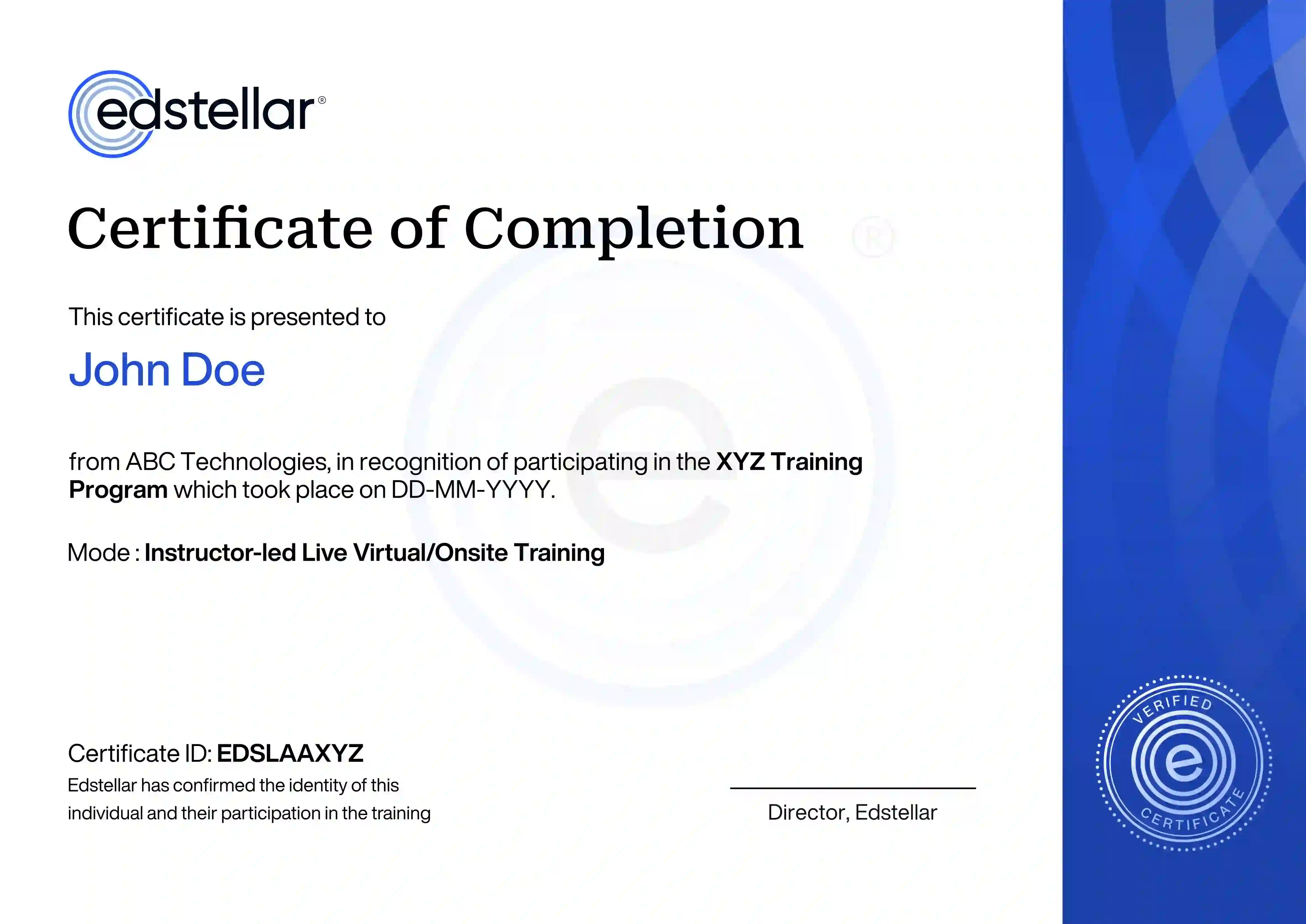
Get Your Team Members Recognized with Edstellar’s Course Certificate
Upon successful completion of the training course offered by Edstellar, employees receive a course completion certificate, symbolizing their dedication to ongoing learning and professional development.
This certificate validates the employee's acquired skills and is a powerful motivator, inspiring them to enhance their expertise further and contribute effectively to organizational success.


We have Expert Trainers to Meet Your Kubernetes Training Needs
The instructor-led training is conducted by certified trainers with extensive expertise in the field. Participants will benefit from the instructor's vast knowledge, gaining valuable insights and practical skills essential for success in Access practices.
Other Related Corporate Training Courses
Explore More Courses
Edstellar is a one-stop instructor-led corporate training and coaching solution that addresses organizational upskilling and talent transformation needs globally. Edstellar offers 2000+ tailored programs across disciplines that include Technical, Behavioral, Management, Compliance, Leadership and Social Impact.
FAQs
BlogSitemap