10 Most In-Demand Skills in Namibia for 2026

.svg "edstellar")

Namibia records shortages across 73+ occupations despite 36.9% unemployment, the highest rate in the Southern African Development Community. The country is simultaneously building the US$10 billion Hyphen green hydrogen project (Africa's largest single investment), developing 11 billion barrels of offshore oil in the Orange Basin, producing uranium from three major mines, and targeting 80,000 tourism jobs by 2030.
Yet only 11.8% of the population holds tertiary qualifications, TVET graduation rates sit at 14%, and 9,251 health ministry posts remain vacant. For corporate L&D leaders and HR managers operating in Southern Africa's fastest-growing investment destination, these numbers define a structural mismatch between what the economy demands and what the workforce can deliver.
Several transformative forces are converging to reshape Namibia's labour market. The green hydrogen sector faces a projected 130,000-worker shortfall by 2040 if training is not urgently scaled up, the National Digital Strategy 2025–2029 targets lifting ICT's GDP contribution from 1.6% to 4%, and the Namibia Investment Promotion and Development Board reports that graduates flood business and public administration programmes while agriculture, manufacturing, and engineering go undersupplied.
NDP6 requires N$505 billion in investment to lift formal employment to 75% by 2030, mining exports reached N$64.7 billion in 2025/26, and Walvis Bay port recorded its highest cargo throughput in a decade. With the minimum wage set at N$18 per hour from January 2025 and youth unemployment at 44.4%, Namibia's skills challenge is both an opportunity gap and a development imperative.
So which skills are truly driving Namibia's economy, and where should organisations invest their training budgets? This guide breaks down the top 10 skills in demand in Namibia, spanning green hydrogen, oil and gas, mining, software development, cybersecurity, healthcare, logistics, and financial services. Drawing on NIPDB skills research, NSA labour statistics, Chamber of Mines data, and industry salary benchmarks, it provides an evidence-based picture of what jobs are in demand in Namibia, whether you are planning corporate upskilling programmes, building talent pipelines, or advising teams on high demand skills in Namibia for 2026 and beyond.
Every ranking in this guide is backed by data from Namibian government bodies, international organisations, industry associations, and local recruitment platforms.
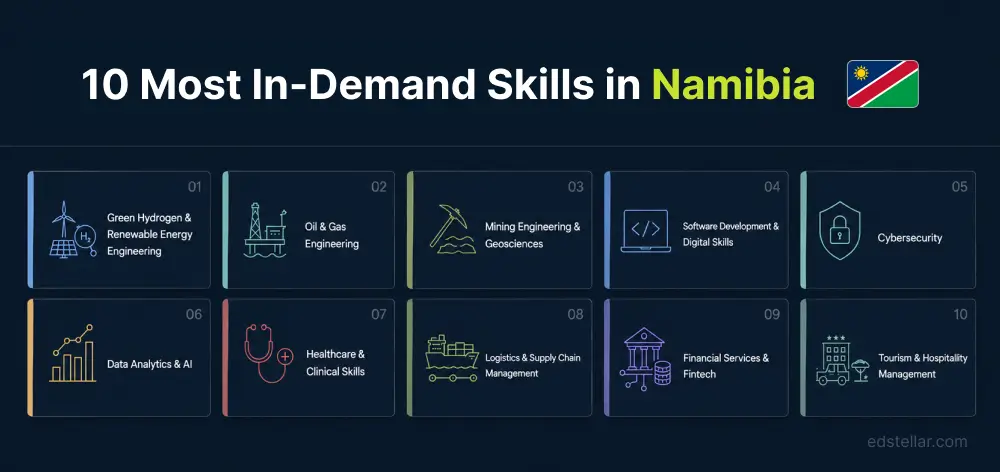
Namibia's skills landscape in 2026 reflects a country undergoing simultaneous energy, extractive, and digital transitions. The US$10 billion Hyphen green hydrogen project, 11 billion barrels of offshore oil discoveries, uranium production from three major mines, and a national digital strategy targeting 4% ICT GDP contribution are all creating demand that the education system cannot yet meet. The 10 skills below span green hydrogen, oil and gas, mining, software development, cybersecurity, data analytics, healthcare, logistics, financial services, and tourism, mirroring the sectors where government policy, employer demand, and foreign investment are highest.

Namibia's green hydrogen ambitions are among the most ambitious on the continent, with the US$10 billion Hyphen Hydrogen Energy project alone targeting 350,000 tonnes of green hydrogen annually from the Tsau Khaeb National Park. The project will create 15,000 direct jobs during its four-year construction phase and 3,000 permanent operational positions, with 90% targeted for Namibian nationals. A skills census conducted by Hyphen mapped 18,000 total jobs the hydrogen sector will require, and the country faces a projected 130,000-worker shortfall by 2040 if training is not urgently scaled up according to analysis published in The Namibian.
Beyond Hyphen, the Daures Green Hydrogen Village (Africa's first net-zero village concept) created 376 Namibian jobs during construction, the HyIron Oshivela project is producing 15,000 tonnes of direct reduced iron annually, and the government targets three "hydrogen valleys" for a combined 15 million tonnes per annum. The EU-funded IGNITE GH2 project is training 700+ unemployed youth and upskilling 300 TVET graduates, NUST is leading curriculum design for green hydrogen technologies, and N$25 million in scholarships has been secured for youth from the Hardap and Kharas regions. NamPower is investing N$4.7 billion to add 220 MW of renewable capacity, the Tsau //Khaeb Wind Power Project adds 450 MW (N$8 billion), and Namibia targets 70% renewable energy by 2030.
The core workforce challenge is that many Namibian tradespeople have relevant skills but lack internationally recognised certifications. Project managers, civil engineers, mechanical and electrical engineers, welders, riggers, scaffolders, and safety officers are all in acute demand. For organisations operating in Namibia's energy sector, the green hydrogen transition represents the country's largest single employment opportunity, and companies that invest in certification and applied training for existing workers will have first access to the talent pipeline as construction scales from 2026 onward.
Green Hydrogen, Renewable Energy, Power Generation, Industrial Manufacturing
Explore Related Training:
Energy Transition and Innovation All Environmental Sustainability Programs
Namibia's Orange Basin contains an estimated 11 billion barrels of light oil and 2.2 trillion cubic feet of natural gas across 14 fields discovered since 2022. TotalEnergies' Venus field holds up to 5.1 billion barrels with first oil targeted for 2029–2030 at 150,000 barrels per day, Shell plans five new exploration wells in PEL 39 in 2026, and Galp Energia earned the "2025 Discovery of the Year" designation in the deepwater Orange Basin. These discoveries have the potential to transform Namibia from a net energy importer into a significant African producer.
The National Upstream Petroleum Local Content Policy (finalised March 2025) mandates skills transfer and local workforce participation, and PETROFUND signed an MOU with McDermott to develop oil and gas workforce capabilities in engineering, fabrication, operations, and project management. NUST has established a Centre for Oil and Gas, but no sub-Saharan institution is currently dedicated to petroleum sector capacity building at the scale required. The sector relies heavily on expatriate expertise for reservoir engineering, well technology, exploration data interpretation, and offshore-specific certifications including HUET, BOSIET, and dynamic positioning.
For organisations positioned in Namibia's emerging petroleum sector, the Local Content Policy creates both an obligation and an opportunity to develop Namibian talent. Subsea contracts worth over US$2.5 billion are in play for the Venus project alone, and companies that train local engineers, geoscientists, and offshore technicians ahead of the final investment decision will secure preferential positioning in what could become Southern Africa's largest hydrocarbon province.
Oil and Gas Exploration, Offshore Services, Engineering Consulting, Energy Services

Mining contributed 13.3% of Namibia's GDP in 2024 with N$52.3 billion in total revenue and 20,843 direct employees, a 14.6% increase from the prior year. Namibia ranks among the world's top uranium producers with three active mines: Husab (4,300 workers, targeting output above 6,000 tonnes per year), Langer Heinrich (460 permanent staff, restarted 2024), and Rossing (mine life extended to 2036). Gold production rose 6% in 2025, lithium exploration is expanding rapidly at the Uis and Lithium Ridge projects, and KoBold Metals (backed by Bill Gates and Jeff Bezos) is expanding critical mineral exploration into Namibia's southern and central regions.
The Chamber of Mines has warned that skills gaps in geology, mine engineering, metallurgy, and safety/environmental management threaten sustainable growth in the sector. The government's ban on exporting unprocessed lithium and critical minerals (June 2025) is designed to force local beneficiation, which requires mineral processing engineers, metallurgists, and quality control specialists that the country does not yet produce in sufficient numbers. Mining companies spent N$23.94 billion on local procurement in 2024, creating downstream demand for skilled technical workers in equipment maintenance, electrical systems, and process engineering.
Engineers in Namibia's mining sector earn approximately N$45,300 monthly, well above the national average of N$13,500–N$17,400. Rossing uranium negotiated 7% wage increases in 2024 with 6% in 2025 and 2026 for bargaining unit employees, reflecting the premium employers pay to retain scarce technical talent. For organisations in the mining value chain, the combination of rising commodity prices (gold averaged $3,668 per troy ounce in 2025), critical mineral demand, and the beneficiation mandate creates a sustained need for geoscientists, process engineers, and mine management professionals that will only intensify through the decade.
Uranium Mining, Gold Mining, Lithium/Critical Minerals, Diamond Mining
"The country cannot compete or grow without a workforce equipped with the right skills, further highlighting the importance of entrepreneurship, stronger career guidance and curriculum reform to ensure young people are prepared for the future economy."



The National Digital Strategy 2025–2029 targets raising ICT's GDP contribution from 1.6% to 4% by 2030, expanding internet penetration from 53% to 90%, and implementing a national digital ID by 2026 alongside a national instant payment system. Namibia's startup ecosystem now comprises 46 startups with over $14.53 million in total funding, and Windhoek jumped 104 places in the 2025 StartupBlink Global Startup Index to rank 512th globally, the strongest growth among Southern African cities. The government launched the ScaleUp Namibia (SUN) initiative in 2025 to provide mentorship, investment access, and co-working space for technology entrepreneurs.
The digital transformation extends across every sector of the economy. Mining companies require data infrastructure and automation engineers, the Bank of Namibia's Financial Sector Transformation Strategy demands digital banking and fintech development capabilities, tourism operators need booking platform and e-commerce developers, and the green hydrogen sector requires DevOps engineers for industrial control systems. The oil and gas sector's Local Content Policy will create demand for software engineers who can build local capacity in exploration data management, production monitoring, and supply chain digitisation.
UNAM and NUST both offer computer science, AI, and data science programmes, but the NIPDB reports that graduates are concentrated in business and social sciences rather than STEM fields. Only 11.8% of the population holds tertiary qualifications, and TVET graduation rates sit at 14%. For organisations building digital capabilities in Namibia, the combination of a small developer talent pool, rapid digital strategy implementation, and cross-sector demand means that internal upskilling programmes will often deliver results faster than competing for the limited supply of qualified graduates.
Financial Services, Government/e-Services, Mining Technology, Startups/BPO

Namibia recorded 1.1 million cyberattacks in the past year according to Xinhua, and the National Digital Strategy 2025–2029 identifies cybersecurity as a foundational pillar for the country's digital transformation. The strategy calls for national cybersecurity legislation to be enacted, the Nam-CSIRT (Namibia Cybersecurity Incident Response Team) to be strengthened, and AI and cybersecurity education to be integrated into basic and higher education institutions. As Namibia implements its national digital ID in 2026 and rolls out a national instant payment system, the attack surface will expand significantly across government, financial services, and critical infrastructure.
The oil and gas sector introduces offshore operational technology (OT) security requirements that Namibia has never had to address at scale, and cybersecurity engineers who can protect both IT and OT environments will be among the most sought-after professionals in the country. Mining operations require protection against industrial espionage and ransomware targeting production systems, the Bank of Namibia's fintech regulatory sandbox creates compliance requirements for payment security, and the green hydrogen sector will need to secure industrial control systems across remote solar and wind installations.
Namibia does not yet produce cybersecurity professionals at scale, and the 1.1 million attack figure underscores the gap between threat exposure and defensive capability. UNAM and NUST are developing cybersecurity programmes, but the current output cannot match the combined demands of government digitisation, financial sector transformation, and energy sector expansion. For organisations in Namibia, cybersecurity capability is no longer optional: the pending national legislation will create compliance obligations, and the cost of a breach in the banking or energy sector would be disproportionately high for a small economy.
Government, Financial Services, Mining, Oil and Gas, Energy

Namibia's data analytics demand is driven by the convergence of mining sector optimisation, financial services digitisation, and government policy monitoring. The Bank of Namibia's Financial Sector Transformation Strategy 2025–2035 requires data-driven decision-making across banking, insurance, and fintech operations, with non-banking financial institution assets reaching N$552.8 billion by Q4 2025 (a 16.6% year-on-year increase). Mining companies operating at the scale of Husab (N$8.8 billion turnover) and B2Gold require predictive analytics for resource estimation, production forecasting, and equipment maintenance, while the NSA's own labour force surveys depend on statistical modelling capacity that is in short supply.
The National Digital Strategy explicitly targets AI education integration across learning institutions, and both UNAM and NUST now offer AI and data science programmes. The green hydrogen sector will generate vast volumes of operational data from solar installations, wind farms, and electrolysers that require real-time analytics for efficiency optimisation. Tourism operators managing 1.26 million visitors annually need revenue management and demand forecasting capabilities, and the agricultural sector (supporting 70% of the population's livelihoods) is adopting precision farming and satellite monitoring tools that require data interpretation skills.
The skills gap in data analytics is structural: the NIPDB's State of Skills report documented oversupply in business and public administration graduates alongside undersupply in science and technical professions. Organisations that need data analysts, business intelligence specialists, or AI engineers in Namibia are competing for a limited graduate pool, and the cross-sector nature of the demand, from mining to banking to tourism, means that every industry faces the same constraint simultaneously.
Financial Services, Mining, Government, Tourism, Agriculture

Namibia's health ministry has 9,251 vacant posts out of a total establishment, and the country has just one neonatologist serving the entire population. The doctor-to-patient ratio stands at approximately 1 per 1,000, and 80% of the population is served by only 38% of health professionals due to severe geographic maldistribution between urban hospitals and rural clinics. Specialist vacancies are particularly acute: only 141 of 230 specialist posts are filled, leaving 89 specialist positions vacant across the public health system, according to the 2022 Workforce Status Report.
The challenges are compounded by inadequate local training capacity, uncompetitive salaries relative to South Africa and other regional destinations, and high staff attrition. Nurses earn an average of N$14,000 per month (range N$6,990 to N$21,700), and while overall nursing numbers are adequate nationally, they are maldistributed with clinics understaffed and hospitals overstaffed. The most acute shortages are in specialist doctors and pharmacists. The GIZ Sector Brief on Health identified low staff motivation and limited continuing professional development as systemic barriers to retention.
For healthcare organisations and government agencies in Namibia, the 9,251-vacancy figure represents both a crisis and an investment priority. The NDP6 targets of lifting formal employment to 75% and improving social outcomes require a functioning healthcare system, and the influx of construction and industrial workers from the green hydrogen and oil/gas projects will place additional demand on health services in the Kharas, Erongo, and Kunene regions. Training programmes that focus on specialist clinical skills, telemedicine, rural health management, and community health worker development offer the most direct path to closing the gap.
Public Health, Mining (Occupational Health), Private Hospitals, NGO/Development
"A green hydrogen economy requires more than infrastructure; it requires a skilled workforce to design, build and sustain it. Without deliberate action, Namibia faces a talent gap of up to 130,000 workers by 2040."


Walvis Bay port recorded its highest cargo throughput in a decade at 8.42 million tonnes and 253,996 TEUs in 2024/25, driven by MSC securing a 25-year concession for the New Container Terminal and Africa Global Logistics signing a contract to manage the multipurpose bulk terminal. The transport and logistics sector grew 6.4% in 2024 with 5.9% projected for 2025 according to the Bank of Namibia, and Walvis Bay serves as a critical transit hub for landlocked Botswana, Zambia, Zimbabwe, and the DRC through the Trans-Caprivi and Trans-Kalahari corridors.
The green hydrogen sector will generate massive logistics requirements for ammonia export infrastructure, and the oil and gas industry will need offshore supply chain capabilities that Namibia has never operated at scale. Supply chain managers who can coordinate multi-modal transport, manage cold chain logistics for the fishing industry (N$13.8 billion in exports, 19,440 workers), and implement smart tracking and warehouse efficiency systems are in growing demand. The NIPDB's State of Skills report specifically identified transport and logistics as one of four sectors with persistent shortages confirmed by job vacancy analysis.
NUST offers a Bachelor of Logistics and Supply Chain Management, but graduate output has not kept pace with the simultaneous expansion of port operations, energy sector construction logistics, and mining supply chains. For organisations operating in Namibia's transport corridor, the MSC concession signals a long-term commitment to port capacity expansion, and the professionals who manage these operations, from freight forwarding to customs brokerage to warehouse automation, represent a critical workforce need that will grow in parallel with the country's energy and mining investments.
Port Operations, Fishing/Processing, Mining Supply Chain, Energy Construction

The Bank of Namibia launched its Financial Sector Transformation Strategy 2025–2035, a decade-long roadmap covering digital innovation, financial inclusion, localisation of financial services, and skills development. Banking sector advances grew 5.0% to N$121 billion in 2025, non-banking financial institution assets reached N$552.8 billion by Q4 2025 (16.6% year-on-year growth), and the central bank is actively exploring a retail Central Bank Digital Currency (CBDC) with IMF technical assistance. A national instant payment system is planned for 2026 implementation, and the fintech regulatory sandbox enables startups to test products under Bank of Namibia supervision.
Namibia's four commercial banks (Standard Bank, Nedbank, Bank Windhoek, FNB) are all investing in digital transformation, and the insurance sector (Old Mutual, Sanlam, Metropolitan) holds N$82 billion in assets requiring actuarial, risk management, and compliance expertise. The oil and gas discoveries will create demand for new banking products including project finance, commodity hedging, and trade finance instruments that the local financial sector has limited experience structuring. Mobile money operators including MobiPay are expanding financial inclusion to rural communities, creating demand for digital payment infrastructure specialists.
The Financial Sector Transformation Strategy explicitly identifies skills development as one of its five strategic pillars, acknowledging that the sector cannot digitise without qualified professionals. For financial institutions operating in Namibia, the combination of CBDC preparation, instant payment system implementation, fintech sandbox activity, and oil/gas project finance requirements creates a concentrated demand for financial technology developers, compliance analysts, risk modellers, and digital banking architects that the current workforce cannot fully satisfy.
Commercial Banking, Insurance, Fintech, Central Banking/Regulation

Namibia welcomed 1,257,093 international visitors in 2024 (a 45.5% increase from the prior year), hotel occupancy reached an all-time high of 67.55% in August 2024, and the tourism sector is projected to generate N$4.6 billion in 2025. The industry currently employs 57,600 people directly (7.9% of the national workforce), and the National Spatial Development Master Plan targets 80,000 direct tourism jobs by 2030, requiring an additional 22,400 positions across hospitality, guiding, transport, and eco-tourism operations. Tourism contributes N$24.8 billion indirectly (12% of GDP when accounting for supply chain effects).
The government's three-year rolling tourism strategy aims to distribute visitors across all 14 regions to ease pressure on iconic destinations like Etosha National Park and Sossusvlei, and to empower 86 community-based conservancies to develop local tourism products. Infrastructure upgrades include 229 km of Etosha gravel roads being sealed and new entrance gates completed in July 2025. The eco-tourism focus requires professionals who combine hospitality management with conservation knowledge, sustainable operations planning, and community engagement skills.
Tourist spending is expected to rise 50% year-on-year during peak season, and the sector needs revenue management, digital marketing, and booking platform capabilities alongside traditional hospitality skills. For organisations in Namibia's tourism value chain, the gap between 57,600 current employees and the 80,000 target represents 22,400 new positions that require training in guest experience management, food safety, tour operations, conservation-compatible tourism development, and multilingual service delivery for European and regional African markets.
Safari/Eco-Tourism, Hospitality/Hotels, Transport, Community Conservancies
"The needs are urgent. Namibia faces high unemployment, especially among women and youth. Economic growth, job creation, and skills development must go hand in hand."


NAMCOR MD Calls on Youth to Skill Up for Namibia's Emerging Oil Industry: NBC Digital News covers the workforce development priorities for Namibia's oil and gas sector.
Namibia's skills demand is shaped by the geographic distribution of its energy projects, mining operations, port infrastructure, and tourism destinations. Understanding these regional patterns helps corporate L&D teams and HR managers target training investments where they will have the greatest impact.
Windhoek dominates financial services, government, and technology employment as the capital and commercial centre, hosting all four major banks, the startup ecosystem, and the majority of IT professionals. Erongo anchors mining and logistics through Walvis Bay port (253,996 TEUs in 2024/25) and the uranium mines at Husab, Langer Heinrich, and Rossing.
The Kharas Region in the south will be transformed by the Hyphen green hydrogen project, with 15,000 construction jobs and 3,000 permanent positions creating an entirely new industrial workforce in one of Namibia's least populated areas. The Orange Basin offshore operations will require a maritime support base likely centred on Walvis Bay, and Kunene/Otjozondjupa regions combine Etosha tourism with livestock farming and gold mining. For organisations planning multi-site operations, aligning training programmes with these regional demand patterns ensures that upskilling investments match actual hiring needs across Namibia's geographically dispersed economic landscape.
Pete Ford is a corporate training specialist with over 15 years of experience in training methodologies, employee engagement, and performance improvement. He has a proven track record of developing and implementing effective training programs that enhance employee skills and productivity.
#On-site #Virtual #GroupTraining #Customized
Explore 2000+ industry ready instructor-led training programs.

Create dynamic leaders and cohesive teams. Learn more now!


Do a quick Skill gap analysis with Edstellar’s Free Skill Matrix tool

Unlock premium resources, tools, and frameworks designed for HR and learning professionals. Our L&D Hub gives you everything needed to elevate your organization's training approach.
Access L&D Hub Resources.svg)
.svg)
.svg)
.svg)

.svg)


.svg "Click Here to Follow on Medium")
.svg)


