10 Key Skills Every DevOps Engineer Should Have in 2026

.svg "edstellar")

The digital transformation wave sweeping across enterprises has positioned DevOps engineers at the forefront of organizational success. As businesses accelerate their cloud adoption and automation initiatives, the demand for skilled DevOps professionals continues to surge, creating both opportunities and challenges for organizations worldwide. Understanding the essential skills that define exceptional DevOps engineers has become critical for enterprises seeking to maintain a competitive advantage in an increasingly technology-driven marketplace.
According to a 2025 report by Burning Glass Institute, job postings for DevOps engineers have grown by 18% annually since 2020, reflecting the escalating importance of this role across industries. This explosive growth underscores a fundamental shift in how organizations approach software development and operational excellence. Yet, despite this rising demand, 37% of IT leaders identify DevOps and DevSecOps as their top technical skills gap, creating a significant talent shortage that enterprises must address through strategic training and development initiatives.
The DevOps landscape has evolved far beyond its original promise of breaking down silos between development and operations teams. Today’s DevOps engineers serve as strategic architects who orchestrate complex cloud infrastructures, implement security protocols, automate deployment pipelines, and drive continuous improvement across entire technology ecosystems. This transformation requires a sophisticated skill set that blends technical expertise with collaboration and strategic thinking.
““A DevOps engineer is often chosen as the technical leader in the process of transformation, which is based on implementing the so-called ‘DevOps culture.’ It relies on automation, CI/CD processes, and migration to the cloud.” "


Container orchestration has emerged as a cornerstone skill for modern DevOps professionals. Kubernetes, the de facto standard for container management, enables organizations to deploy, scale, and manage containerized applications with unprecedented efficiency. The technology has become so integral to modern infrastructure that Kubernetes skills appeared in approximately 28.02% of DevOps job listings in 2024, ranking as the second most sought-after technical capability after Docker.
The power of Kubernetes lies in its ability to automate the deployment, scaling, and operations of application containers across clusters of hosts. Organizations leveraging Kubernetes experience faster deployment cycles, improved resource utilization, and enhanced application reliability. For enterprises operating in multi-cloud environments, Kubernetes provides a consistent platform that abstracts away underlying infrastructure complexity, enabling seamless workload portability across cloud providers.
Mastering Kubernetes requires understanding pod architecture, service networking, persistent storage management, and cluster security configurations. DevOps engineers must navigate complex concepts, including deployments, stateful sets, daemon sets, and custom resource definitions. Additionally, proficiency in Kubernetes requires familiarity with complementary tools, including Helm for package management, Prometheus for monitoring, and Istio for service mesh implementation.
Organizations investing in Kubernetes training enable their teams to architect resilient, scalable systems that meet demanding business requirements. The skill directly translates to improved system reliability, reduced operational overhead, and accelerated time-to-market for new features and services.
Docker revolutionized application deployment by introducing lightweight, portable containers that encapsulate applications and their dependencies. This containerization technology has become foundational to modern DevOps practices, with Docker skills appearing in 42.77% of DevOps job postings, making it the most in-demand technical skill in the DevOps ecosystem.
The significance of Docker extends beyond simple application packaging. Containers enable consistent environments across development, testing, and production stages, eliminating the classic “it works on my machine” problem that has plagued software teams for decades. This consistency accelerates development cycles, simplifies troubleshooting, and reduces deployment-related failures.
DevOps engineers proficient in Docker understand image creation, container lifecycle management, networking configurations, and volume management. They leverage Docker Compose for multi-container applications, implement efficient layering strategies to minimize image sizes, and apply security best practices, including image scanning and vulnerability assessment. Advanced Docker users optimize build processes by using multi-stage builds and caching to accelerate image creation.
The combination of Docker and Kubernetes creates a powerful platform for modern application delivery. While Docker provides the containerization foundation, Kubernetes orchestrates these containers at scale, creating a comprehensive ecosystem for cloud-native application development and deployment.
Cloud computing has fundamentally transformed IT infrastructure, and DevOps engineers must possess deep expertise in at least one major cloud platform. AWS skills appeared in 12.1% of DevOps job postings, though comprehensive cloud knowledge extends across multiple providers, including Microsoft Azure and Google Cloud Platform.
Modern enterprises increasingly adopt multi-cloud strategies to avoid vendor lock-in, optimize costs, and leverage best-of-breed services across different providers. DevOps engineers must understand core cloud services, including compute instances, storage solutions, networking configurations, identity management, and serverless architectures. This knowledge enables them to architect resilient, cost-effective infrastructure that scales dynamically with business demands.
Cloud expertise encompasses several critical dimensions. DevOps professionals must design highly available architectures spanning multiple availability zones and regions, implement disaster recovery strategies, optimize resource allocation to control costs, and configure security controls, including firewalls, encryption, and access policies. They leverage infrastructure-as-code tools to provision and manage cloud resources consistently across environments.
Organizations benefit significantly from investing in cloud computing training programs that enable teams to maximize their use of cloud platforms. Cloud-skilled DevOps engineers reduce infrastructure costs, improve system reliability, and accelerate digital transformation initiatives through strategic cloud adoption.
Infrastructure as Code represents a paradigm shift in how organizations manage IT infrastructure. Rather than manually configuring servers and services, IaC enables DevOps engineers to define infrastructure through code, bringing software development best practices to infrastructure management. Terraform has emerged as the leading IaC tool, enabling consistent, repeatable infrastructure deployment across multiple cloud providers and on-premises environments.
The value of IaC extends beyond automation. By codifying infrastructure, organizations gain version control, enabling teams to track changes, review modifications, and roll back problematic updates. Infrastructure definitions become living documentation that accurately reflects current system configurations. This approach eliminates configuration drift, reduces human error, and enables rapid disaster recovery through infrastructure redeployment.
Proficient Terraform users understand state management, module creation, workspace utilization, and provider configurations. They implement remote state backends for team collaboration, leverage workspaces for environment management, and create reusable modules that standardize infrastructure patterns across projects. Advanced practitioners integrate Terraform into CI/CD pipelines to enable automated infrastructure testing and deployment.
IaC skills directly impact organizational agility and reliability. Teams practicing IaC provision new environments in minutes rather than weeks, maintain consistent configurations across development and production, and recover from disasters rapidly through automated infrastructure recreation. This capability becomes particularly crucial as organizations scale their cloud footprint and manage increasingly complex distributed systems.
CI/CD pipelines form the automation backbone of modern software delivery, enabling organizations to release software faster, more reliably, and with higher quality. DevOps engineers must master CI/CD concepts and tools to orchestrate automated testing, building, and deployment processes that transform code changes into production-ready applications.
Effective CI/CD implementation requires understanding multiple components. Continuous Integration automates code compilation, unit testing, and integration testing whenever developers commit changes. This practice detects integration issues early when they’re easiest and cheapest to fix. Continuous Deployment extends automation through staging environments to production, enabling rapid feature delivery and quick bug fixes.
Modern CI/CD tools, including Jenkins, GitLab CI, CircleCI, and GitHub Actions, provide flexible platforms for pipeline implementation. DevOps engineers configure these tools to run automated tests, perform security scans, build container images, and deploy applications across environments. They implement deployment strategies, including blue-green deployments, canary releases, and feature flags that minimize deployment risk and enable rapid rollback when issues arise.
Organizations embracing CI/CD practices experience transformative benefits. Development teams release features more frequently, often multiple times daily, rather than quarterly. Automated testing catches defects earlier, reducing production incidents and improving software quality. The rapid feedback loops enabled by CI/CD accelerate learning and innovation, giving organizations a competitive advantage through faster time-to-market.
DevOps tools training empowers engineering teams to implement sophisticated CI/CD pipelines that accelerate delivery while maintaining quality and reliability standards. This investment pays dividends through improved developer productivity, reduced deployment failures, and enhanced customer satisfaction.
Version control systems are the foundation of collaborative software development, and Git has become the de facto standard for source code management. Every DevOps engineer must master Git to manage code effectively, collaborate with distributed teams, and maintain a comprehensive project history.
Git proficiency extends far beyond basic commit and push operations. Skilled practitioners understand branching strategies that support parallel development, merge conflict resolution, rebasing to maintain a clean history, and tag management for release tracking. They implement workflows such as GitFlow or trunk-based development that align with organizational release practices and team sizes.
Advanced Git users leverage features including interactive rebasing for commit refinement, cherry-picking for selective change application, bisect for efficient bug hunting, and submodules for managing project dependencies. They understand distributed version control concepts that enable offline work and robust collaboration across geographically dispersed teams.
The importance of Git extends into broader DevOps practices. Pull requests facilitate code review processes that improve code quality and knowledge sharing. Integration with CI/CD systems enables automated testing and deployment triggered by code changes. Git hooks enable custom automation to enforce coding standards, run automated tests, or prevent problematic commits.
Organizations benefit when DevOps engineers possess deep Git knowledge, as this skill underpins efficient collaboration, code quality practices, and automated delivery pipelines. Version control mastery reduces integration conflicts, preserves project history, and enables rapid experimentation through branching without risking stable codebases.
Automation distinguishes exceptional DevOps engineers from average practitioners. Linux and Bash skills appeared in 9.17% and 4.44% of DevOps job postings, respectively, while Python has become the automation language of choice for complex tasks requiring robust functionality.
Bash scripting enables quick automation of Linux system administration tasks, log parsing, file manipulation, and process management. DevOps engineers leverage Bash to create startup scripts, automate backups, and streamline routine maintenance. Proficiency includes understanding shell variables, control structures, regular expressions, and system command integration.
Python offers more sophisticated capabilities for complex automation scenarios. Its extensive standard library and third-party packages enable DevOps engineers to interact with APIs, process JSON and XML data, implement sophisticated logic, and create maintainable automation tools. Python’s readability makes scripts accessible to team members, facilitating knowledge sharing and maintenance.
Automation skills directly impact operational efficiency. Tasks that previously required hours of manual effort can be completed in seconds or minutes when automated. Automated processes eliminate human error, ensuring consistent execution every time. This reliability becomes crucial for operations, including deployment procedures, security compliance checks, and infrastructure monitoring.
Organizations investing in programming and frameworks training enable their DevOps teams to develop sophisticated automation solutions that multiply productivity and reduce operational toil. The ability to automate repetitive tasks frees engineers to focus on higher-value activities, including architecture design, process improvement, and innovation.
Modern distributed systems require comprehensive monitoring and observability to maintain reliability and performance. DevOps engineers must implement monitoring solutions that provide visibility into application health, infrastructure performance, and user experience. This capability enables proactive issue detection and rapid troubleshooting when problems occur.
Effective monitoring encompasses multiple layers. Infrastructure monitoring tracks server health, resource utilization, and network performance. Application performance monitoring (APM) measures response times, error rates, and transaction traces. Log aggregation centralizes logs from distributed systems, enabling efficient troubleshooting and audit trail maintenance. Distributed tracing tracks requests across microservices, revealing bottlenecks and dependencies.
Tools including Prometheus, Grafana, ELK Stack (Elasticsearch, Logstash, Kibana), Datadog, and New Relic provide comprehensive monitoring capabilities. DevOps engineers configure these tools to collect relevant metrics, create insightful dashboards, and implement alerting that notifies teams of critical issues without overwhelming them with noise.
Observability extends beyond traditional monitoring by enabling engineers to ask arbitrary questions about system behavior. Well-instrumented systems produce telemetry data, including metrics, logs, and traces that enable investigation of novel issues without pre-configured monitors. This capability proves invaluable when troubleshooting complex problems in distributed systems where cause-and-effect relationships aren’t immediately apparent.
Organizations with strong monitoring practices experience fewer production incidents, faster mean time to resolution when issues occur, and better capacity planning through historical trend analysis. These capabilities directly translate to improved customer satisfaction and reduced operational costs.
Security integration throughout the development lifecycle has become non-negotiable as cyber threats proliferate and regulatory requirements intensify.
DevSecOps integrates security practices into every phase of software delivery. This approach includes security scanning in CI/CD pipelines, container image vulnerability assessment, secrets management, infrastructure security configuration, and compliance automation. DevOps engineers must understand common vulnerabilities, security best practices, and remediation strategies.
Key security skills include implementing least-privilege access controls, encrypting data in transit and at rest, managing secrets with tools such as HashiCorp Vault, conducting security testing, including SAST and DAST, and ensuring compliance with frameworks such as SOC 2, HIPAA, and PCI DSS. Engineers must also understand cloud security configurations that prevent common misconfigurations that can lead to data breaches.
The shift-left approach to security embeds security considerations early in development rather than treating it as a final gate before production. This integration catches security issues when they’re cheaper to fix and creates a culture where security becomes everyone’s responsibility rather than a separate team’s concern.
Cybersecurity training equips DevOps professionals with essential skills to protect organizational assets and customer data. As security breaches carry enormous financial and reputational costs, security-skilled DevOps engineers provide invaluable risk mitigation.
Technical expertise alone doesn’t define exceptional DevOps engineers. The DevOps philosophy fundamentally emphasizes collaboration across traditionally siloed teams. Successful DevOps professionals possess strong interpersonal skills that enable effective communication with developers, operations staff, security teams, and business stakeholders.
Collaboration takes many forms in DevOps practice. Engineers participate in code reviews that share knowledge and maintain quality standards. They conduct post-incident reviews that focus on learning rather than blame. They facilitate architectural discussions that balance technical considerations with business requirements. They mentor junior team members, accelerating skill development across organizations.
Communication skills prove equally critical. DevOps engineers translate technical concepts for non-technical audiences, enabling informed business decisions. They document architectural decisions, runbooks, and troubleshooting procedures, capturing knowledge and facilitating operational support. They present technical proposals clearly and persuasively, building consensus around technology adoption.
The cultural aspects of DevOps often determine success or failure more than technical capabilities. Organizations with collaborative cultures leverage automation and tooling effectively, continuously improve processes, and adapt quickly to changing requirements. Those lacking collaboration struggle despite implementing identical technical solutions.
Soft skills training and interpersonal skills development strengthen these crucial capabilities. Organizations that invest in both technical and soft skills develop high-performing DevOps teams that deliver exceptional business value through technical excellence and effective collaboration.
The DevOps skills landscape continues evolving as technologies mature and new capabilities emerge. Organizations must take a proactive approach to workforce development, ensuring teams have the skills required for current operations and are prepared for future demands. This dual focus on present competencies and future readiness creates a sustainable competitive advantage.
The global DevOps market projected to reach $81.1 billion by 2028, reflects the strategic importance organizations place on DevOps capabilities. Yet, 68% of IT teams now have upskilling programs, up dramatically from just 30% in 2020, demonstrating widespread recognition that continuous learning must become organizational DNA.
Successful skill development strategies combine multiple approaches. Formal training programs provide structured learning paths for foundational skills and certification preparation. Hands-on projects enable practical application that deepens understanding and builds confidence. Mentorship pairs experienced practitioners with developing engineers, accelerating knowledge transfer and cultural integration. Communities of practice foster knowledge sharing and collaborative problem-solving across organizational boundaries.
Technology leaders should assess current team capabilities against required skills, identify gaps, and develop comprehensive development plans that address both immediate needs and strategic objectives. This planning should consider individual career aspirations and align personal development with organizational requirements to maximize engagement and retention.
Comprehensive corporate training solutions enable organizations to systematically build DevOps capabilities. These programs provide customized learning experiences aligned with specific technology stacks, organizational contexts, and skill levels, ensuring maximum relevance and immediate applicability.
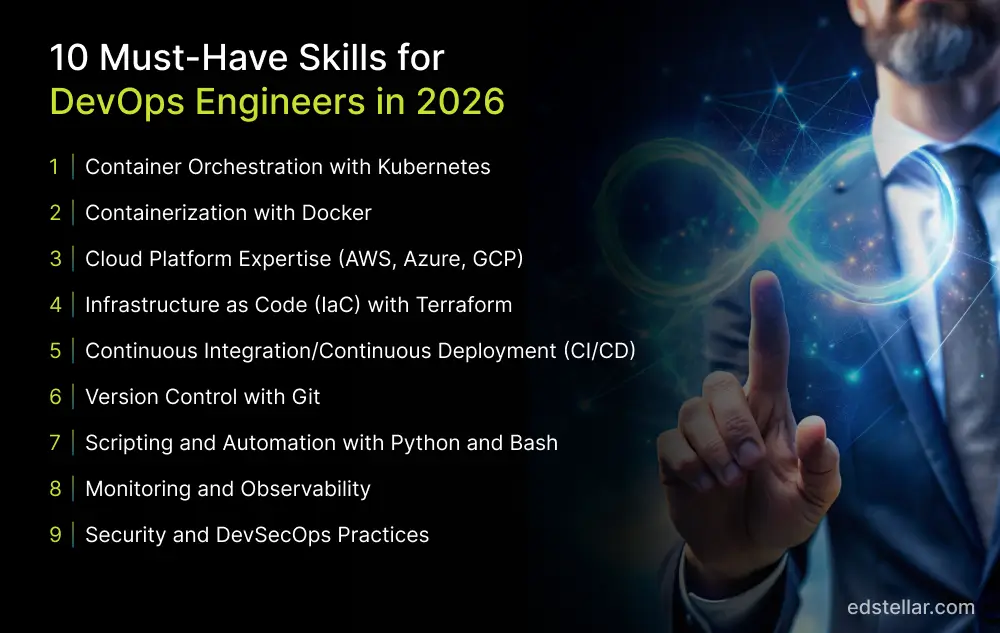
The ten skills outlined above form a comprehensive foundation for DevOps excellence. However, true organizational transformation requires more than individual technical capabilities. Organizations must cultivate cultures that value collaboration, experimentation, and continuous improvement. They must invest in tools and platforms that enable automation and efficiency. They must align processes with DevOps principles to eliminate bottlenecks and waste that undermine potential gains.
Leadership commitment proves essential for DevOps success. Leaders must champion cultural change, provide necessary resources, remove organizational obstacles, and celebrate successes that demonstrate value. They must create psychological safety where teams can experiment, learn from failures, and innovate without fear of punishment.
The path to DevOps maturity involves continuous evolution rather than one-time transformation. Organizations should implement incremental improvements, measure results, learn from outcomes, and adjust approaches based on experience. This experimental mindset enables sustainable progress while avoiding disruptive “big bang” changes that often fail.
As enterprises navigate digital transformation imperatives, DevOps capabilities become differentiating factors that determine market success. Organizations with mature DevOps practices release software faster, operate more reliably, respond to customer needs more quickly, and adapt to market changes more effectively than competitors relying on traditional approaches.
The investment in DevOps skill development yields returns across multiple dimensions: improved operational efficiency, enhanced software quality, accelerated innovation, better employee engagement, and ultimately, superior business outcomes. These benefits compound over time, creating sustainable competitive advantages that are difficult for competitors to replicate.
Organizations serious about digital transformation must prioritize building DevOps capabilities as a strategic imperative, not a tactical IT initiative. This elevation requires executive sponsorship, adequate resource allocation, and integration with broader business strategy. When properly implemented, DevOps becomes more than a set of practices; it becomes a fundamental organizational capability that drives business success in the digital age.
#On-site #Virtual #GroupTraining #Customized
Explore 2000+ industry ready instructor-led training programs.

Create dynamic leaders and cohesive teams. Learn more now!


Do a quick Skill gap analysis with Edstellar’s Free Skill Matrix tool

Unlock premium resources, tools, and frameworks designed for HR and learning professionals. Our L&D Hub gives you everything needed to elevate your organization's training approach.
Access L&D Hub Resources.svg)
.svg)
.svg)
.svg)

.svg)


.svg "Click Here to Follow on Medium")
.svg)


