10 Most In-Demand Skills in the Philippines for 2026
.webp)

.svg "edstellar")

The Philippines' IT-BPM sector ended 2025 with $40 billion in export revenues and 1.9 million workers, outpacing global industry growth, yet the country faces a widening skills gap across virtually every sector driving its economy. The Philippine Statistics Authority reports a 5.0% unemployment rate alongside 12.3% underemployment in March 2026, with 2.58 million jobless and 6.03 million underemployed, reflecting a structural mismatch between available talent and employer needs.
The semiconductor and electronics industry alone needs 56,605 trained workers by 2026, the construction sector requires 200,000 additional tradespeople for the Build Better More programme, and the healthcare system faces a shortage of approximately 290,000 professionals. For corporate L&D leaders and HR managers operating in Southeast Asia's fastest-growing major economy, these numbers translate directly into urgent training priorities.
Several structural forces are intensifying this demand simultaneously. The Trabaho Para Sa Bayan Plan, the Philippines' 10-year labour market strategy, directly addresses skills mismatch, youth unemployment, and digital disruption. The digital economy expanded to PhP 2.74 trillion in 2025, accounting for 9.8% of GDP and employing 10.39 million people.
Nearly 50% of Filipino workers now use generative AI tools, surpassing the global average, and the World Economic Forum projects that 68% of Filipino workers will require retraining by 2030, above the 59% global average. The Philippines plans to invest over $26 billion in renewable energy projects between 2025 and 2030, the fintech market is growing at 16.75% CAGR, and IBPAP projects the IT-BPM sector will reach $59 billion with 2.5 million workers by 2028.
So which skills are truly driving the Philippines' economy, and where should organisations invest their training budgets? This guide breaks down the top 10 skills in demand in the Philippines, spanning IT-BPM, cybersecurity, healthcare, construction, and renewable energy. Drawing on PSA labour data, TESDA workforce reports, IBPAP industry analysis, and Robert Walters salary benchmarks, it provides an evidence-based picture of what jobs are in demand in the Philippines, whether you are planning corporate upskilling programmes, building internal talent pipelines, or advising teams on high demand skills in the Philippines for 2026 and beyond.
Every ranking in this guide is backed by data from Philippine government bodies, industry associations, and established hiring platforms.
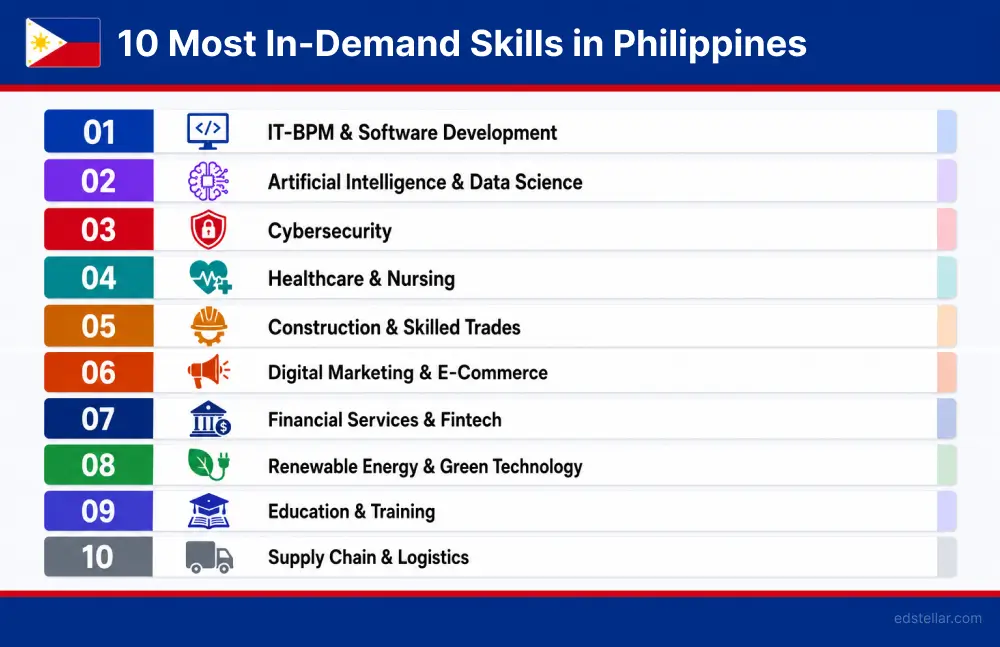
The Philippines' skills landscape in 2026 reflects the convergence of a $40 billion BPO industry navigating AI disruption, a healthcare system losing nearly 27,000 workers annually to overseas migration, a construction sector building the country's future infrastructure, and a digital economy employing 10.39 million people. The 10 skills below span technology, healthcare, construction, financial services, and energy, mirroring the sectors where employer demand, salary premiums, and government investment are highest. Each ranking draws on the policy signals, job market data, and industry investments outlined in the sources above.

The IT-BPM sector generated $40 billion in export revenues with 1.9 million workers in 2025, growing faster than the global average at 5% revenue growth and 4% employment growth. IBPAP projects the sector will reach $59 billion with 2.5 million workers by 2028, requiring an additional 600,000 professionals over three years. The Philippines ranks first globally for English-language operations outsourcing and second in the 2026 Global Outsourcing Talent Index behind India, offering cost savings of 60–80% compared to US, UK, and Australian hires.
The shift from traditional voice-based BPO to higher-value services is transforming skill requirements. Global capability centres (GCCs) expanded significantly in 2025, reflecting rising demand for Filipino professionals in analytics, business intelligence, project management, transformation, and strategy roles. Mid-level developers earn PHP 50,000–80,000 monthly, while senior developers with specialised skills command PHP 80,000–150,000+, particularly those working remotely for international clients. Remote work opportunities allow Filipino IT professionals to earn international-level salaries while based in the Philippines.
67% of IBPAP member companies have adopted AI technologies, and the net effect has been higher output quality and productivity rather than reduced headcount, with professionals using AI tools delivering 2–3x output per hour. The administration targets upskilling one million BPO workers by 2028, with PHP funding allocated to retrain 340,000 workers. Major employers include Accenture, Concentrix, TELUS International, TaskUs, and dozens of multinational and local firms across Metro Manila, Cebu, Clark, and Davao. The DICT has been directed to lift the digital economy's GDP contribution to 12%.
IT-BPM & Outsourcing, Global Capability Centres, E-Commerce & Platforms, Financial Technology
Explore Related Training:
Python Programming MERN Full Stack Development All Software Development Programs
Nearly 50% of Filipino workers now use generative AI tools, surpassing the global average, and the demand for data scientists is growing rapidly with over 340,000 job openings expected according to industry projections. The IMF found that one-third of Philippine jobs are highly exposed to AI, with the BPO sector at the greatest displacement risk, but 60% of those exposed roles are rated highly complementary, indicating productivity gains rather than replacement. The National AI Strategy Roadmap 2.0 (NAISR 2.0) and the establishment of the Center for AI Research (CAIR) are positioning the Philippines as a regional AI adoption leader.
Entry-level AI engineers earn approximately PHP 50,000 monthly, while senior positions reach over PHP 350,000, and AI-skilled professionals command a 12% salary premium over general software engineering roles. Data science professionals earn an average of PHP 618,828 annually. The banking and financial services sector's focus on AI/GenAI adoption, digital banking expansion, and fintech innovation is reshaping hiring, shifting demand from traditional operations toward data scientists, AI engineers, and digital product managers. 28% of CEOs cite skills shortage as their primary challenge, particularly for AI, machine learning, and data science candidates. The banking and financial services sector's pivot toward AI-driven decision-making is creating particular demand for data scientists who can deploy models in production environments, not just build them in notebooks.
Major employers include the Philippine operations of Accenture, IBM, Google, and Microsoft, alongside domestic firms like Ayala Corporation's digital ventures, Globe Telecom, and PLDT/Smart. The startup ecosystem, supported by DICT and PEZA incentives, is also absorbing AI talent. For professionals in traditional BPO roles, upskilling into AI and data science represents the most direct pathway to higher compensation and career resilience as the industry shifts toward AI-augmented service delivery.
IT-BPM & Outsourcing, Financial Services & Banking, Telecommunications, Government & Public Sector
Explore Related Training:
Machine Learning with Python Data Science with Python All AI Training Programs
Cybersecurity jobs in the Philippines are projected to grow 20% in 2026, with entry-level positions starting at PHP 50,000 monthly and experienced professionals earning upwards of PHP 120,000. Chief Information Security Officers command PHP 150,000–200,000 monthly, and Security Architects earn PHP 100,000–170,000. The Philippines' massive BPO industry, handling sensitive data for global clients, creates non-negotiable demand for security professionals who can protect customer information, financial transactions, and intellectual property across millions of daily interactions. With international clients demanding SOC 2, ISO 27001, and PCI-DSS compliance from their Philippine providers, cybersecurity engineers who can implement these frameworks while managing day-to-day threat detection are in acute demand across the BPO corridor.
The expansion of the digital economy to PhP 2.74 trillion (9.8% of GDP) with 10.39 million workers means a dramatically larger attack surface requiring protection. Financial services institutions, telecommunications companies (Globe, PLDT/Smart), government agencies, and healthcare systems all face growing cyber threats. The concentration of global business data processed through Philippine BPO operations makes the country a high-value target, and international clients increasingly require their Philippine service providers to demonstrate cybersecurity certifications and compliance frameworks.
Major employers include Accenture (recognised among the Philippines' Best 300 Employers for cybersecurity), NCC Group (recently opened Manila office), Trend Micro Philippines, and the security operations of major banks including BDO, BPI, and Metrobank. CISSP, CEH, and CompTIA Security+ certifications carry significant salary premiums. For mid-career professionals, cybersecurity offers one of the highest-return reskilling pathways in the Philippine market, with structured training available through both international certification bodies and TESDA programmes.
IT-BPM & Outsourcing, Financial Services & Banking, Telecommunications, Government & Defence
"The Philippines is an important player in the global IT-BPO economy, supporting countless products and operations. By upskilling our workforce with in-demand skills, we're maintaining our competitive edge as a global industry leader, driven by top-tier talent and cost-efficiency."



The Philippines faces a shortage of approximately 290,000 healthcare professionals according to EDCOM 2's Workforce Development Plan, with projected shortfalls of 94,000 doctors, 196,000 nurses, and thousands more midwives and allied health workers. The country has only 21.2 healthcare workers per 10,000 people, less than half the WHO's recommended ratio of 44.5. Nearly 27,000 Filipino healthcare workers leave the country each year for higher compensation abroad, and 3,300 Department of Health plantilla positions remain unfilled.
The education pipeline crisis compounds the migration problem. Approximately 56% of students entering healthcare degree programmes (about 33,000 annually) never reach the workforce, creating a "leaky pipeline" that fails to produce enough professionals to replace those lost to migration and attrition. Systemic barriers including restrictive hiring policies, uncompetitive salaries, and limited career progression drive healthcare workers away from domestic service. The Philippines supplies nurses globally, with Filipinos comprising 4% of the U.S. nursing workforce despite accounting for only 1% of the population.
For organisations operating healthcare facilities in the Philippines, the challenge is retention rather than recruitment: competitive domestic salaries, professional development pathways, and improved working conditions are the primary levers. Major employers include government hospitals under DOH, private groups including St. Luke's Medical Center, The Medical City, Makati Medical Center, and Manila Doctors Hospital. The growing medical tourism sector and the expansion of HMO coverage are creating additional demand for clinical professionals across Metro Manila, Cebu, and Davao.
Government Hospitals & Health Centres, Private Hospital Groups, HMOs & Health Insurance, Pharmaceutical & Medical Devices

The Philippines' construction sector, valued at $43.44 billion in 2025, requires an additional 200,000 qualified tradespeople to meet Build Better More programme deadlines according to CIDB estimates. Northern Mindanao alone is short 7,000 workers, and contractors across the country are forced to either import labour or postpone projects. Historically, technical education through TESDA has leaned toward tourism and IT, leaving fields like masonry, welding, and heavy equipment operation underrepresented in the training pipeline.
The skills gap is compounded by overseas migration, as skilled construction workers frequently seek higher-paying opportunities in the Middle East, Singapore, Japan, and South Korea, leaving the domestic industry with an ever-growing talent deficit. TESDA's enterprise-based schemes and tax credits target an annual graduation of 10,000 construction entrants in Metro Manila, while accelerated apprenticeship models and improved on-site conditions are gradually improving retention rates. The semiconductor and electronics industry adds another layer of demand, requiring 56,605 trained individuals including 44,247 operators, 6,483 technicians, and 5,875 engineers by 2026.
Major infrastructure projects driving demand include the Metro Manila Subway, the North-South Commuter Railway, Sangley Point International Airport, and dozens of road, bridge, and flood control projects under the national infrastructure programme. For young Filipinos without university degrees, TESDA-certified construction and manufacturing skills offer one of the most direct pathways to domestic employment or OFW opportunities abroad with significantly higher earning potential.
Infrastructure & Transport, Real Estate & Mixed-Use Development, Semiconductor & Electronics, Industrial & Manufacturing

E-commerce makes up 32.2% of the Philippines' digital economy value and accounts for 75.8% of the sector's 10.39 million workers, making it the single largest digital employment category. The digital economy expanded to PhP 2.74 trillion in 2025 (9.8% of GDP), and the DICT targets lifting this to 12%. Shopee, Lazada, TikTok Shop, and dozens of local e-commerce platforms are driving demand for digital marketers, content creators, social media managers, and e-commerce operations specialists.
The Philippines has one of the world's highest social media usage rates, with over 86 million active users, creating a massive market for digital advertising and content-driven commerce. Filipino consumers spend an average of four hours daily on social media, and the intersection of social commerce, influencer marketing, and live-selling has created uniquely Philippine marketing skill requirements. SEO, SEM, social media advertising, content marketing, and performance analytics are the core technical requirements, with Shopify, Lazada Seller Center, and TikTok Shop management tools increasingly appearing in job descriptions.
The BPO sector is also a major employer of digital marketing professionals, as international clients outsource social media management, content moderation, and digital advertising operations to Philippine teams. Salaries range from PHP 20,000–30,000 for entry-level roles to PHP 60,000–100,000 for senior digital marketing managers and e-commerce directors. For young Filipinos with strong English skills and digital native capabilities, digital marketing represents one of the most accessible pathways to professional employment.
E-Commerce & Retail, IT-BPM (Digital Marketing Outsourcing), FMCG & Consumer Brands, Media & Advertising
Explore Related Training:
Fundamentals of Digital Marketing Search Engine Optimization (SEO) All Marketing Programs
The Philippines fintech market reached $1.16 billion in 2025 and is projected to grow to $4.66 billion by 2034 at a 16.75% CAGR, driven by digital payments expansion, financial inclusion initiatives, and mobile banking innovation. The Bangko Sentral ng Pilipinas (BSP) has issued digital banking licences and established a regulatory framework that is accelerating financial technology adoption. E-wallets GCash and Maya (formerly PayMaya) have become essential financial infrastructure, serving tens of millions of previously unbanked Filipinos.
The banking sector's shift toward AI/GenAI adoption, digital banking expansion, and fintech innovation is reshaping hiring profiles, with demand moving from traditional operations toward data scientists, AI engineers, and digital product managers according to Robert Walters. BDO, BPI, Metrobank, and UnionBank are all building internal technology teams, while international fintechs and digital lenders are entering the Philippine market. Financial inclusion remains a massive growth opportunity: approximately 34% of Filipino adults remain unbanked, representing a market that fintech is uniquely positioned to serve.
Accountants, financial analysts, and auditing professionals remain in demand across the traditional financial sector, while the convergence of finance with technology is creating hybrid roles in digital lending, payment systems, and regulatory technology. For finance professionals, adding digital skills, data analytics capabilities, or fintech product management expertise represents a high-return career investment in a market where financial technology adoption is accelerating rapidly.
Banking & Universal Banks, Digital Banking & E-Wallets, Insurance & HMOs, Microfinance & Lending
Explore Related Training:
AI for Financial Services Industry Financial Risk Management All Finance & Accounting Programs"In light of the rapidly changing landscape, businesses have recognized the importance of fostering an agile workplace that encourages flexibility and continuous improvement. By upskilling both technological and essential skills, organizations ensure that their professionals remain relevant and have the necessary tools to excel in their roles."


The Philippines plans to invest over $26 billion in renewable energy between 2025 and 2030, and the ILO projects 350,000 new green jobs by 2030 across solar, wind, hydro, and battery sectors. Solar power dominates job creation, accounting for over half of the workforce demand, with 3,060 solar PV projects out of 7,000 total energy projects as of January 2025. The Terra Solar project, which will be the world's largest solar plant, and a partnership with UAE's Masdar for 10 GW of solar, wind, and storage are creating massive demand for skilled workers.
The country is accelerating 22 renewable energy projects to strengthen power supply, and the Board of Investments provides incentives for renewable energy companies. However, current training systems are outdated and fragmented, and as demand surges, the country faces a shortage of skilled renewable energy talent. Solar PV designers, installation technicians, electrical engineers, project managers, and environmental specialists are among the most sought-after roles.
ACEN (formerly AC Energy), Solar Philippines, Citicore Renewable Energy, and international developers are the largest employers. For professionals in engineering, construction, or electrical trades, transitioning into renewable energy offers strong career prospects backed by government policy support and long-term investment commitments. The Renewable Energy Act and feed-in tariff system provide the regulatory certainty that makes career investment in the sector worthwhile.
Solar Energy, Wind & Hydro Power, Utilities & Distribution, Construction & Engineering
Explore Related Training:
Renewable Energy and Sustainability All Environmental Sustainability Programs
With 68% of Filipino workers expected to require retraining by 2030, above the 59% global average, the Philippines represents one of Southeast Asia's most active corporate training markets. The IT-BPM industry alone needs to upskill one million workers by 2028 for AI-augmented operations, while TESDA must expand its construction and manufacturing programmes to produce 10,000 entrants annually in Metro Manila alone. The 56% attrition rate in healthcare education programmes highlights a broader challenge: the training infrastructure itself needs transformation.
Corporate training is growing rapidly as organisations invest in workforce development to bridge the skills gap between formal education and employer requirements. Training roles, instructional designers, L&D specialists, and digital learning developers are among the fastest-growing job categories in 2026. The shift toward blended learning, with face-to-face instruction combined with online platforms and AI-powered adaptive learning, is creating new skill requirements for educators and trainers across every sector.
For international education professionals, the Philippines offers opportunities in English-language instruction, STEM education, and corporate training delivery. The country's large, young, English-speaking population creates a massive addressable market for skills development. TESDA, the Commission on Higher Education (CHED), and the Department of Education (DepEd) are all expanding training programmes aligned with industry needs, and private training providers serve the corporate sector's growing demand for specialised upskilling.
Corporate Training & L&D, TESDA & TVET Institutions, K–12 & Higher Education, EdTech & Online Learning
Explore Related Training:
Advanced Leadership Communication Strategies All Leadership Communication Programs
The Philippines' archipelagic geography, with over 7,600 islands, creates unique logistics challenges that demand skilled supply chain professionals. The country's position in the global semiconductor supply chain, its expanding e-commerce sector (32.2% of the digital economy), and its role as a major agricultural producer all require sophisticated logistics networks. The 120,000+ active job vacancies across the economy include significant demand in logistics, warehousing, and distribution roles.
The growth of e-commerce has transformed last-mile delivery in the Philippines, with Shopee Express, Lazada Logistics, J&T Express, and local carriers building nationwide delivery networks. Cold chain logistics for the agricultural and pharmaceutical sectors present additional technical challenges and career opportunities. Port operations at Manila International Container Terminal, Subic Bay, and Cebu's port facilities require international-standard supply chain management capabilities.
The Build Better More infrastructure programme is generating massive procurement and logistics requirements, as construction materials, heavy equipment, and specialised components must be sourced, transported, and delivered to project sites across the archipelago. For professionals in operations, procurement, or transportation, adding digital supply chain capabilities and sustainability certifications represents a strong career investment in a market where logistics efficiency is both a competitive advantage and a national development priority.
E-Commerce & Retail Logistics, Port & Maritime Operations, Construction Procurement, Agricultural & Cold Chain
"Our goal is to ensure the workforce has access to the skills that are not only in demand today but also essential for sustaining competitiveness in the years to come."


CNA Insight documentary on how outsourcing jobs in the Philippines are changing as AI transforms the BPO industry and workers adapt to new skill requirements.
The Philippines' skills demand is distributed across multiple economic centres, each with distinct industry concentrations and talent needs. Understanding these regional patterns helps corporate L&D teams and HR managers target training investments where they will have the greatest impact.
Metro Manila dominates IT-BPM, financial services, and government hiring, with Makati, BGC, Ortigas, and Quezon City serving as the primary employment centres. Cebu has emerged as the second-largest BPO hub, with IT Park and Cebu Business Park hosting hundreds of outsourcing firms. Clark in Pampanga is growing rapidly as a BPO and freeport zone, while CALABARZON (Laguna, Cavite) hosts the semiconductor and electronics manufacturing corridor that needs 56,605 skilled workers by 2026. For organisations planning multi-site operations, aligning training programmes with these regional demand patterns ensures that upskilling investments match actual hiring needs across the archipelago.
#On-site #Virtual #GroupTraining #Customized
Explore 2000+ industry ready instructor-led training programs.

Create dynamic leaders and cohesive teams. Learn more now!

Do a quick Skill gap analysis with Edstellar’s Free Skill Matrix tool

Unlock premium resources, tools, and frameworks designed for HR and learning professionals. Our L&D Hub gives you everything needed to elevate your organization's training approach.
Access L&D Hub Resources.svg)
.svg)
.svg)
.svg)

.svg)


.svg "Click Here to Follow on Medium")
.svg)


