10 Most In-Demand Skills in Malaysia for 2026

.svg "edstellar")

Malaysia faces a widening skills gap at the centre of its most ambitious economic transformation. The Malaysia Critical Occupations List (MyCOL) 2024/2025 identifies 66 critical occupations across 18 economic sectors where demand exceeds available talent, while 48% of companies report talent shortages and 70% of new job openings require digital skills that only 30% of the current workforce possesses according to MDEC data.
Penang alone is short of 50,000 engineers to support the semiconductor boom, the National Semiconductor Strategy targets training 60,000 highly skilled engineers by 2030, and the electrical and electronics sector pulled in RM28.5 billion in approved investments in 2025. For corporate L&D leaders and HR managers operating in Southeast Asia's emerging tech hub, these numbers translate directly into urgent training priorities.
Several structural forces are intensifying this demand simultaneously. The Department of Statistics Malaysia (DOSM) reports a stable 2.9% unemployment rate, yet skill-related underemployment signals a persistent gap between talent growth and high-productivity jobs. Nvidia, Intel, Microsoft, Google, and Infineon are making massive investments in Malaysian semiconductor manufacturing and AI data centres, with Johor expected to account for 60% of Malaysia's data centre capacity by 2030.
MDEC recorded US$13.3 billion in approved Malaysia Digital investments in Q3 2025, generating 21,815 high-value jobs across 402 digital companies. The Ekonomi MADANI agenda targets 500,000 high-value jobs by 2026, the HR Action Plan aims to reskill one million workers by 2027, and Microsoft launched an initiative to equip 800,000 Malaysians with AI skills by end-2025.
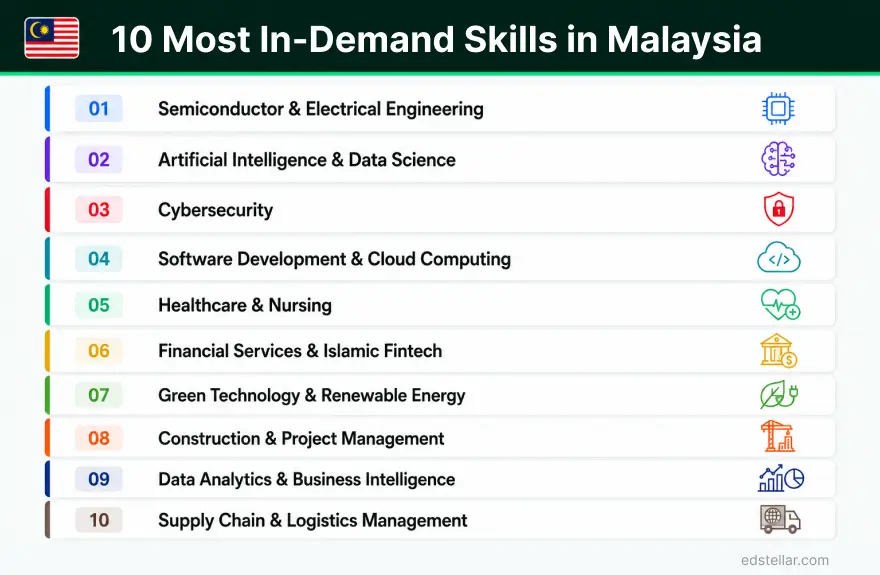
So which skills are truly driving Malaysia's economy, and where should organisations invest their training budgets? This guide breaks down the top 10 skills in demand in Malaysia, spanning semiconductors, artificial intelligence, cybersecurity, healthcare, and green technology. Drawing on DOSM labour data, TalentCorp's MyCOL, MDEC digital economy reports, and Randstad salary benchmarks, it provides an evidence-based picture of what jobs are in demand in Malaysia, whether you are planning corporate upskilling programmes, building internal talent pipelines, or advising teams on high demand skills in Malaysia for 2026 and beyond.
Every ranking in this guide is backed by data from Malaysian government bodies, industry associations, and established hiring platforms.
Malaysia's skills landscape in 2026 reflects the convergence of a global semiconductor investment surge, a national AI strategy producing measurable results, a healthcare system serving 33 million people with persistent nursing shortages, and a green energy transition gaining momentum. The 10 skills below span technology, manufacturing, healthcare, financial services, and energy, mirroring the sectors where government investment, employer demand, and salary premiums are highest. Each ranking draws on the policy signals, job market data, and industry investments outlined in the sources above.
.svg "Semiconductor and Electrical Engineering")
Penang alone faces a shortfall of 50,000 engineers to support the semiconductor boom, while the Malaysia Semiconductor Industry Association reports the country loses an average 15% of its talent annually to brain drain, with engineers actively recruited by companies in Singapore, Taiwan, the United States, and Europe. The electrical and electronics sector attracted RM28.5 billion in approved investments in 2025, and the National Semiconductor Strategy targets training 60,000 highly skilled engineers by 2030. Malaysia's path to its RM1 trillion E&E export target by 2030 depends on solving this talent crisis.
Multinational investment is accelerating. Nvidia is constructing a $4.3 billion AI data centre, Intel and Infineon are expanding production capacity, and Texas Instruments is establishing new assembly plants. Budget 2026 prioritises cultivation of highly skilled talent in AI and upstream semiconductor industries, building on the RM6.8 billion allocated for TVET development. The Semiconductor Technology Academy (STAc-JTM) is training technicians for high-tech manufacturing, while AMRO Asia analysis argues that time is ripe for Malaysia to move upstream into chip design services rather than remaining in assembly and test.
Professionals moving between data centre and semiconductor projects can anticipate salary increases of 20–50% above their previous compensation. The concentration of semiconductor operations in Penang, Kulim Hi-Tech Park, and Johor creates regional demand clusters where competition for engineers is intense. IC design engineers, process engineers, equipment technicians, test engineers, and packaging specialists are the most sought-after roles. For international professionals, MyCOL listing speeds up Employment Pass approvals for semiconductor roles.
Semiconductor Manufacturing, IC Design Houses, E&E Assembly & Test, Data Centre Hardware

MDEC recorded US$13.3 billion in approved Malaysia Digital investments in Q3 2025, with AI-related investments alone accounting for 8,328 jobs, representing 38% of total projected employment. Malaysia saw a 344% rise in generative AI course enrolments, and over 75% of employers now prioritise candidates with AI proficiency. The MyDigital blueprint and national AI roadmap aim to make AI a core part of the economy, with Microsoft's "AI for Malaysia's Future" initiative targeting 800,000 Malaysians with AI skills by end-2025.
AI specialists in Malaysia earn up to RM182,502 annually, and candidates moving jobs in specialised tech roles can expect salary increases of approximately 25% according to Randstad data. Mid-career professionals in AI/ML earn RM120,000–180,000 depending on specialisation and experience. The data centre boom, with Johor expected to account for 60% of national capacity by 2030, is creating AI infrastructure demand that extends beyond pure data science into MLOps, AI platform engineering, and GPU cluster management. Malaysia's lower operating costs compared to Singapore make it attractive for companies establishing AI development centres.
Major employers include the Malaysian operations of Nvidia, Intel, Microsoft, Google, and Amazon, alongside domestic firms like Petronas Digital, Axiata Digital Labs, and AirAsia's digital arm. The FSTC (Future Skills Talent Council) and AI Readiness Index (AIRI) are government tools designed to align AI skills development with industry needs. For international professionals, Malaysia offers a cost-of-living advantage with competitive technology salaries and a multicultural English-speaking work environment.
Technology & Data Centres, Financial Services, Oil & Gas (Petronas), E-Commerce & Digital Platforms
Explore Related Training:
Machine Learning with Python Data Science with Python All AI Training Programs
Malaysia requires 27,000 cybersecurity knowledge workers by end-2025, facing a shortfall of 12,000, with an average of 3,677 workers per year needed from 2023 to 2026 to meet the total required workforce of 24,883. The Malaysia Cybersecurity Strategy aimed to develop 20,000 cybersecurity professionals by 2025, but the country remains short on talent due to a persistent skills gap. CyberSecurity Malaysia and the National Cyber Security Agency (NACSA) are driving policy and workforce development, yet demand continues to outpace supply, particularly in financial services and telecommunications.
Entry-level cybersecurity salaries start at RM3,500–5,500 monthly, but experienced professionals earn RM120,000–180,000 annually, and senior roles exceed RM13,000 monthly. The skills shortage is particularly acute in penetration testing, network security engineering, and security analysis, with rising demand for governance, risk management, and compliance (GRC) professionals as data protection regulations tighten. Financial services, telecoms (Maxis, CelcomDigi, TM), and government agencies are the primary hiring sectors. As data centre investments flood into Johor and Selangor, the demand for professionals with strong cybersecurity skills spanning cloud security, penetration testing, and compliance is outpacing every other technical specialisation in the Malaysian market.
The concentration of data centre investments in Johor, Selangor, and Kuala Lumpur is expanding the cybersecurity attack surface dramatically, creating demand for cloud security architects and infrastructure protection specialists. MyCOL includes cybersecurity professionals as critical occupations, speeding up Employment Pass approvals. For mid-career professionals, cybersecurity represents one of the strongest reskilling pathways in Malaysia's technology sector, with certifications like CISSP, CEH, and CompTIA Security+ carrying significant salary premiums.
Financial Services & Banking, Telecommunications, Government & Parastatals, Data Centre Operations
"Investing in workforce development is very much a forward-thinking strategy. Providing upskilling guidance and training support to employees today can promise a much more competent workforce that delivers results faster and adapts more agilely to evolving industry trends."



Software developers and engineers are listed as critical occupations on MyCOL 2024/2025, and Malaysia's tech sector is enjoying robust growth driven by cloud computing, AI integration, and foreign companies leveraging the country's strong skills base at lower operating costs than Singapore. Tech salaries reached RM182,502 for senior roles, and candidates moving jobs in 2025 could expect salary increases of approximately 25%. The data centre boom in Johor and Selangor is creating cascading demand for cloud architects, site reliability engineers, and DevOps professionals.
Local professionals have traditionally focused on application development, creating an acute shortage of Mechanical and Electrical (M&E) skills necessary for complex, international-standard data centres. Cloud expertise in AWS, Azure, and Google Cloud Platform commands significant premiums, and professionals moving between data centre projects anticipate salary increases of 20–50%. Cloud engineers who can manage multi-cloud environments and implement infrastructure-as-code are among the most sought-after professionals in the Malaysian market. The convergence of semiconductor software (EDA tools, firmware, embedded systems) with enterprise cloud development creates uniquely Malaysian career pathways that blend hardware and software engineering.
Major employers include the Malaysian operations of Nvidia, Intel, Google, Microsoft, Amazon, alongside domestic companies including Petronas ICT, Axiata Digital Labs, Grab Malaysia, and AirAsia's technology division. The startup ecosystem in KL, Penang, and Cyberjaya absorbs talent in mobile development, fintech platforms, and e-commerce. For international developers, Malaysia offers a multicultural, English-speaking environment with living costs significantly below Singapore, making it an increasingly attractive alternative for technology professionals seeking Southeast Asian experience.
Data Centres & Cloud Providers, Semiconductor Software, Financial Technology, E-Commerce & Platforms

According to Sunway University analysis, Malaysia's Ministry of Health projects a shortage of 57.9% of nurses by 2030 to fulfil healthcare demand, and the health ministry estimated a gap of approximately 8,000 nurses across 2023 and 2024. While the registered nurse pool grew from around 102,000 in 2016 to over 115,000 in 2022, this growth has been insufficient to match the simultaneous rise in demand driven by an aging population and rising chronic disease incidence. Physiotherapists are specifically identified on MyCOL 2024/2025 as critical occupations, particularly in the aged care sector.
Post-pandemic factors have worsened the shortage. There has been a noticeable drop in young Malaysians pursuing nursing, and many graduates are enticed by foreign job offers from Singapore, the Middle East, and other countries offering higher salaries, extended leave, and housing benefits. The private healthcare sector, which serves a significant share of medical tourists and domestic patients, competes with government hospitals for the same limited nursing pool, driving up compensation across the sector.
Major employers include government hospitals under the Ministry of Health, private groups including IHH Healthcare (owner of Gleneagles and Pantai hospitals), KPJ Healthcare, Sunway Medical Centre, and Columbia Asia. Medical tourism, a significant revenue generator for Malaysia, requires healthcare professionals who can deliver international-standard care. For international healthcare workers, Malaysia offers pathways through the Malaysian Medical Council and nursing board registration, with English widely used in clinical settings alongside Bahasa Malaysia.
Government Hospitals & Clinics, Private Healthcare Groups, Medical Tourism, Pharmaceutical & Biotech

Malaysia sits firmly in the top two positions globally for Islamic fintech alongside Saudi Arabia, and the estimated Islamic fintech market is projected to grow from $198 billion in 2024/25 to $341 billion by 2029 at 11.5% annually. Over 50 Islamic fintech companies operate in Malaysia, offering solutions from digital zakat platforms to earned wage access. Finance Managers with expertise in actuarial science and IFRS 17, and Accountants with knowledge of ESG and green accounting, are listed as critical occupations on MyCOL 2024/2025.
Malaysia's conventional fintech ecosystem is also expanding, with digital banking licences issued by Bank Negara Malaysia creating new categories of financial technology roles. Maybank, CIMB, Public Bank, and RHB are all investing in digital transformation, while GXBank, Boost Bank, and AEON Bank are scaling their digital-first banking operations. The convergence of Islamic finance principles with modern fintech creates unique career pathways that do not exist in most other markets, requiring professionals who understand both Shariah compliance and technology architecture.
Kuala Lumpur's Tun Razak Exchange (TRX) financial district and Labuan International Business and Financial Centre provide the regulatory frameworks attracting both domestic and international financial services firms. For finance professionals, adding digital skills, ESG reporting capabilities, or Islamic finance certifications represents high-return career investments. The growing demand for professionals who can bridge traditional banking with digital platforms and Islamic finance with technology innovation is one of the most distinctive features of Malaysia's financial sector.
Banking & Financial Holdings, Islamic Finance & Takaful, Digital Banking, Capital Markets & Asset Management
Explore Related Training:
AI for Financial Services Industry Financial Risk Management All Finance & Accounting Programs
The National Energy Transition Roadmap (NETR) projects RM60.7 billion in foreign direct investments and 84,544 new jobs, with renewable energy expected to create 300,000 positions by 2050, a tenfold increase from the 30,000 green jobs available in 2023. IRENA analysis suggests the energy workforce could nearly double to over one million jobs under an ambitious transition scenario. The government raised the National Energy Transition Facilitation Fund allocation to RM300 million in Budget 2025, and the large-scale solar programme (LSS5) targets at least 2,000 MW of solar PV capacity by 2026.
Remuneration in green jobs ranges from RM3,000 to RM16,000 monthly, with senior roles in solar engineering, energy management, and sustainability consulting commanding the highest packages. Malaysia's tropical location provides excellent solar resources, and the country is positioning itself as a regional hub for renewable energy manufacturing, with solar panel and component production expanding alongside utility-scale solar installations. Carbon management, ESG reporting, and climate risk assessment skills are in growing demand as sustainability reporting requirements expand across Malaysia's corporate sector.
Major employers include TNB (Tenaga Nasional Berhad), Petronas (through its clean energy division), Sarawak Energy, and international developers operating in the Malaysian market. The MGTC (Malaysian Green Technology and Climate Change Corporation) coordinates national green economy initiatives. For professionals in engineering, manufacturing, or project management, adding green technology credentials represents one of the highest-return career investments in Malaysia's evolving economy.
Solar Energy & Power Generation, Utilities (TNB), Oil & Gas (Energy Transition), Manufacturing & Green Tech
Explore Related Training:
Renewable Energy and Sustainability Energy Transition and Innovation All Environmental Sustainability Programs"There is a shortage of those suitable for the specific experience and skill sets that we are looking for. I call it the war on talent because everybody is short on talent and they are here looking for talent, they are everywhere all over the world."


Malaysia's Construction Industry Development Board (CIDB) cites a 180,000-worker skilled-trade shortfall against project pipelines through 2028. Civil Engineers, Mechanical Engineers, and Electrical Engineers are all listed as critical occupations on MyCOL 2024/2025. The February 2025 wage floor increase from $337 to $382 monthly and a 15% climb in foreign-worker levies are creating additional cost pressures, accelerating the shift toward industrialised building systems (IBS) that cut on-site labour by 30–40%.
The data centre construction boom in Johor is creating a new layer of demand. Local professionals have traditionally focused on residential and commercial projects, resulting in an acute shortage of M&E skills necessary for complex, international-standard data centres. CIDB's 70% IBS mandate is making prefabrication 15–20% cheaper on labour and 20% faster on schedules, but the shift requires new skills in modular construction, digital project management, and BIM coordination that the traditional construction workforce does not possess.
Major infrastructure projects including MRT3 in Kuala Lumpur, the Penang Transport Master Plan, and continued development across Iskandar Malaysia in Johor are driving sustained demand. Quantity surveyors, structural engineers, project managers, and site supervisors remain consistently among the hardest positions to fill. For young Malaysians, CIDB's TVET programmes offer structured pathways into construction careers without requiring university degrees.
Infrastructure & Transport (MRT, Rail), Data Centre Construction, Real Estate & Mixed Development, Industrial & Manufacturing Facilities

Data Scientists and Analysts are listed as critical occupations on MyCOL 2024/2025, and the demand for data professionals is growing rapidly as Malaysian enterprises adopt data-driven decision-making across financial services, manufacturing, retail, and government. MDEC's vision of a data-driven digital economy requires professionals who can transform operational data into business insights, yet the pipeline of graduates with the right combination of statistical, programming, and domain expertise remains insufficient. The growing convergence of analytics with AI means that data scientists who can bridge statistical modelling with machine learning applications are commanding premium compensation across financial services, semiconductor, and e-commerce sectors.
The convergence of data analytics with manufacturing is a particularly Malaysian phenomenon. Semiconductor fabs, automotive plants, and palm oil processing facilities are all deploying data analytics for yield optimisation, predictive maintenance, and supply chain efficiency. Financial institutions including Maybank, CIMB, and Public Bank need data scientists for credit risk modelling, fraud detection, and customer segmentation. E-commerce platforms (Shopee Malaysia, Lazada) and ride-hailing services (Grab) are also major consumers of analytics talent.
Python, SQL, R, Tableau, Power BI, and cloud-based analytics platforms are the core technical requirements. Mid-career professionals in data analytics earn RM120,000–180,000 annually at specialised firms, with financial services and technology offering the highest compensation. For professionals transitioning from traditional business roles, data analytics represents one of the strongest reskilling pathways, supported by government TVET funding and HRD Corp levy-based training programmes.
Financial Services, Semiconductor & Manufacturing, E-Commerce & Retail, Government & Public Sector

Malaysia's strategic position in the ASEAN trade corridor, combined with its strong manufacturing base and port infrastructure, creates sustained demand for supply chain and logistics professionals. Port Klang and Tanjung Pelepas are among the busiest container ports in Southeast Asia, and the semiconductor and electronics supply chain connecting Malaysia's fabs to global customers requires sophisticated logistics coordination. The Ekonomi MADANI agenda's focus on manufacturing expansion will add further supply chain complexity as the country scales domestic production.
The shift toward AI-driven supply chain management, warehouse automation, and green logistics is creating demand for professionals who can bridge physical operations with digital systems. E-commerce growth (Shopee, Lazada, TikTok Shop) is driving last-mile delivery innovation and warehouse management system implementation. The construction of new data centres across Johor requires specialised supply chain management for high-value technology equipment, cooling systems, and backup power infrastructure.
The palm oil industry, Malaysia's largest agricultural export, requires supply chain professionals who can manage RSPO sustainability certification, traceability systems, and international trade compliance. Halal supply chain management is another distinctively Malaysian specialisation, as the country positions itself as the global halal certification hub. For professionals in logistics, procurement, or operations, adding digital supply chain capabilities and sustainability certifications represents a strong career investment.
Semiconductor & E&E Supply Chain, E-Commerce & Retail Logistics, Palm Oil & Agriculture, Port & Maritime Operations
Explore Related Training:
Supply Chain Management Fundamentals AI for Supply Chain All Operations Management Programs"Talent and workforce readiness would remain central to the country's next phase of digital growth. The need for Malaysia to continue building a digitally skilled workforce that is able to participate in emerging forms of work and enterprise is critical as AI and digital tools reshape business models across sectors."

CNA Correspondent report on Malaysia's race to become a global tech hub, covering the semiconductor talent shortage, data centre boom, and workforce skills challenge.
Malaysia's skills demand is shaped by the geographic concentration of industrial clusters, technology investment, and government policy. Understanding these regional patterns helps corporate L&D teams and HR managers target training investments where they will have the greatest impact.
Kuala Lumpur and Selangor dominate financial services, government, and technology headquarters hiring. Penang is Malaysia's semiconductor heartland, hosting Intel, Infineon, AMD, and hundreds of E&E companies within the Bayan Lepas Free Industrial Zone. Johor is the fastest-growing region, driven by data centre construction and proximity to Singapore, with Iskandar Malaysia attracting billions in investment. For organisations planning multi-site operations, aligning training programmes with these regional demand patterns ensures that upskilling investments match actual hiring needs across Malaysia's diverse economic geography.
Pete Ford is a corporate training specialist with over 15 years of experience in training methodologies, employee engagement, and performance improvement. He has a proven track record of developing and implementing effective training programs that enhance employee skills and productivity.
#On-site #Virtual #GroupTraining #Customized
Explore 2000+ industry ready instructor-led training programs.

Create dynamic leaders and cohesive teams. Learn more now!

Do a quick Skill gap analysis with Edstellar’s Free Skill Matrix tool

Unlock premium resources, tools, and frameworks designed for HR and learning professionals. Our L&D Hub gives you everything needed to elevate your organization's training approach.
Access L&D Hub Resources.svg)
.svg)
.svg)
.svg)

.svg)


.svg "Click Here to Follow on Medium")
.svg)


