10 Most In-Demand Skills in Singapore for 2026
.webp)

.svg "edstellar")

Singapore topped the 2025 Global Talent Competitiveness Index for the first time, yet 83% of employers still report difficulty finding skilled talent according to ManpowerGroup data, with 79% of companies specifically struggling to fill technology positions. The Ministry of Manpower recorded 77,700 job vacancies in December 2025, employment grew for 17 consecutive quarters, and 49.3% of all vacancies were newly created positions rather than backfills, signalling genuine expansion rather than simple turnover.
For corporate L&D leaders and HR managers operating in Asia's most talent-competitive economy, these numbers translate directly into urgent training priorities that will determine whether organisations can secure the skills driving Singapore's next phase of growth.
Several structural forces are intensifying this talent crunch. Singapore's resident labour force is increasingly educated, with 63.8% holding tertiary qualifications in 2024 (up from 51.5% in 2014) and 63.7% of employed residents in PMET roles. Yet the gap between available skills and market demands in AI, cybersecurity, data analytics, and healthcare is widening as the economy transforms.
Microsoft has committed $5.5 billion to cloud and AI infrastructure through 2029, OpenAI chose Singapore as its Asia-Pacific base, and the government aims to triple the AI workforce to 15,000 practitioners. The COMPASS Shortage Occupation List for 2026 spans Agritech, Financial Services, Green Economy, Healthcare, Infocomm Technology, and Maritime, signalling where the most acute shortages persist.
So which skills are truly driving Singapore's economy, and where should organisations invest their training budgets? This guide breaks down the top 10 skills in demand in Singapore, spanning artificial intelligence, cybersecurity, financial services, healthcare, and sustainability. Drawing on Ministry of Manpower labour data, SkillsFuture workforce reports, the COMPASS Shortage Occupation List, and Robert Half salary benchmarks, it provides an evidence-based picture of what jobs are in demand in Singapore, whether you are planning corporate upskilling programmes, supporting Employment Pass applications, or building workforce strategies for one of Asia's most dynamic economies.
Every ranking in this guide is backed by data from Singaporean government bodies, industry associations, and established hiring platforms.
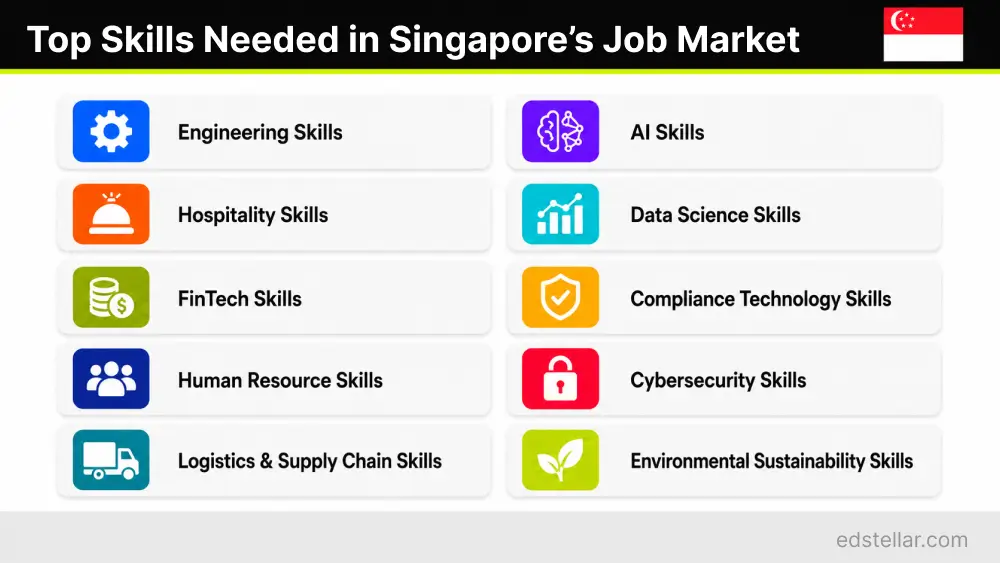
Singapore's skills landscape in 2026 reflects the convergence of Asia's most talent-competitive economy with rapid AI adoption, an aging population, climate imperatives, and the city-state's strategic positioning as a global hub for finance, technology, and trade. The 10 skills below span technology, healthcare, financial services, sustainability, and supply chain, mirroring the sectors where government investment, employer demand, and salary premiums are highest. Each ranking draws on the policy signals, job market data, and industry investments outlined in the sources above.

Demand for AI talent in Singapore surged 40% in 2025 while 74% of employers struggled to find qualified candidates, according to industry reporting. Singapore recorded a 38% increase in AI talent job postings across banking, insurance, and technology in 2024, and by 2026, demand for AI engineers, data scientists, MLOps engineers, and AI product managers is projected to increase by 20–30% annually. The government aims to triple the AI workforce to 15,000 practitioners by 2029 through the National AI Strategy and AI Singapore initiative.
The scale of investment backing this demand is extraordinary. Microsoft committed $5.5 billion to cloud and AI infrastructure in Singapore through 2029, OpenAI selected Singapore as its Asia-Pacific headquarters, and 80 of the world's top 100 technology firms maintain operations here. AI professionals command salary premiums of 25–35% above traditional tech roles, with ML engineers earning S$108,000–S$168,000, AI product managers earning S$144,000–S$180,000, and prompt engineers commanding S$100,000–S$140,000. DBS, OCBC, UOB, Grab, Sea Group, and Shopee are all building internal AI capabilities alongside the international technology firms.
The convergence of AI with Singapore's strengths in finance, healthcare, and logistics creates unique hybrid roles. Financial institutions need AI engineers for credit risk modelling and fraud detection. Healthcare systems deploy AI-assisted diagnostics and drug discovery. Logistics firms use machine learning for demand forecasting and route optimisation. The Research, Innovation and Enterprise 2025 plan allocated $25 billion to support this transformation, and AI Singapore provides training pathways including the AI Apprenticeship Programme for professionals transitioning into AI from adjacent fields.
Financial Services, Technology & Cloud Platforms, Healthcare & Life Sciences, Logistics & Supply Chain
Explore Related Training:
Machine Learning with Python AI Programming with Python All AI Training Programs
Singapore has approximately 4,000 cybersecurity vacancies, with 400–800 new roles posted monthly on LinkedIn alone, and cybersecurity job postings rose 57% between 2024 and end-2025, the steepest growth recorded over the past three years. The Cyber Security Agency of Singapore (CSA) backed over 30,000 cybersecurity jobs by 2025 and invested S$50 million to enhance talent, innovation, and growth in the sector. According to SkillsFuture data, 39 different cybersecurity role types featured on the Shortage Occupation List for 2025, underscoring the breadth of the talent gap.
Salaries reflect the scarcity. Fresh graduates and junior professionals start at S$3,500–S$5,000 monthly, but compensation increases rapidly with experience and certifications. Professionals with 10–15 years of experience earn annual packages between S$130,000 and S$240,000. The Monetary Authority of Singapore (MAS) is tightening compliance requirements, increasing demand for governance, threat intelligence, and cloud security roles across the financial sector. Understanding the full scope of cybersecurity engineer roles and responsibilities helps L&D teams design training that meets both CSA standards and employer expectations.
SOC analysts, incident responders, and threat hunters are among the most urgently needed roles, many of which do not require a computer science degree or prior IT experience, making cybersecurity one of the most accessible mid-career switch pathways in Singapore's technology sector. Major employers include government agencies (CSA, GovTech, MINDEF), financial institutions (DBS, OCBC, UOB, Standard Chartered), telecommunications companies (Singtel, StarHub), and cybersecurity firms (Ensign InfoSecurity, Custodio Technologies). The CSA's SG Cyber Talent initiative provides structured pathways including bootcamps and apprenticeships.
Financial Services, Government & Defence, Telecommunications, Technology & Cloud Providers
Explore Related Training:
Cybersecurity Risk Management Threat Intelligence All Cybersecurity Programs
Software developers and systems analysts are among the most in-demand roles in Singapore according to MOM data, with average salaries ranging from S$55,000 for junior positions to over S$180,000 for senior and lead roles. Cloud professionals skilled in AWS, Google Cloud, and Azure architectures earn S$150,000–S$200,000 annually, and Kubernetes-certified administrators command a 15–20% premium above peers with similar experience levels. The persistent shortage of talent in cloud computing, combined with Singapore's role as a regional tech hub, keeps compensation well above the national median.
Singapore's data centre sector is experiencing robust growth through greenfield projects, including the Punggol Digital District, creating strong demand for cloud architects and site reliability engineers. Microsoft's $5.5 billion investment, Google's expanded cloud region, and AWS's continued infrastructure build-out all require local engineering talent to design, deploy, and manage cloud-native services. Cloud engineers who can manage multi-cloud environments and implement infrastructure-as-code are among the most sought-after professionals in Singapore's technology market.
Major employers span every sector. Google, Meta, Grab, Sea Group (Shopee), ByteDance, and Stripe maintain significant engineering teams in Singapore, while DBS, OCBC, and UOB compete for fintech developers. GovTech recruits for the government's digital services platform, and startups across the Launchpad ecosystem absorb talent in platform engineering, API development, and mobile applications. For international professionals, software engineering and cloud computing roles qualify for Employment Pass applications, with the COMPASS framework providing bonus points for shortage occupations in Infocomm Technology.
Technology & Cloud Platforms, Financial Services & Fintech, Government Digital Services, E-Commerce & Platform Tech
"Most Singaporeans and PRs believe that the way they do their work today will change dramatically in the next 5 to 10 years and that reskilling will be necessary to remain employable. Having a growth mindset with the confidence that you can adapt is a critical attitude for change."



Singapore's 2026 Shortage Occupation List has officially recognised data science as one of the country's highest-demand roles, particularly in finance, healthcare, and technology sectors. Data scientists earn S$60,000–S$200,000 annually depending on experience and sector, with senior data scientists at major banks commanding S$12,000–S$16,000 monthly and quant researchers at hedge funds earning S$200,000+ packages. The job market shows 15% annual growth in data roles, and entry-level data analysts now start at S$4,000–S$4,800 per month.
Financial services is the highest-paying sector for data professionals in Singapore, where DBS, OCBC, and UOB need data scientists for credit risk modelling, fraud detection, and algorithmic trading. Healthcare systems use predictive analytics for patient outcomes and resource allocation. E-commerce platforms deploy recommendation engines and demand forecasting models. Understanding the scope of data analyst roles and responsibilities helps organisations build effective teams by matching analyst specialisations to business needs across these diverse applications.
The convergence of traditional analytics with AI is creating hybrid roles where professionals need both statistical foundations and machine learning capabilities. Python, SQL, R, Tableau, and Power BI remain core technical requirements, with cloud-based analytics platforms (Databricks, Snowflake, BigQuery) increasingly appearing in job descriptions. Senior-level data analysts earn S$90,000–S$170,000 according to Morgan McKinley data. For mid-career professionals, data analytics represents one of the strongest reskilling pathways, supported by SkillsFuture credits and the TechSkills Accelerator (TeSA) programme.
Financial Services & Banking, Healthcare & Life Sciences, E-Commerce & Retail, Logistics & Supply Chain
Explore Related Training:
Data Science with Python Data Visualization with Tableau All Data Science Programs
Financial services is among Singapore's strongest hiring sectors, with a 25% rise in digital banking and payments roles in 2024 and compliance hiring growing 18% driven by MAS regulatory updates. The COMPASS Shortage Occupation List specifically includes financial services roles such as investment advisers and relationship managers serving ultra-high net worth clients. Average salary growth in financial services is projected at 4% in 2026, with high-impact roles in MAS regulatory reporting, financial crime, risk modelling, digital assets, and fund management seeing increases of 3–6%.
Singapore's position as Asia's leading financial centre creates demand across the full spectrum of financial skills. Wealth management, private banking, and family office services are expanding rapidly as the city-state attracts global capital flows. Digital banking licences issued by MAS to operators like GXS Bank and Trust Bank are creating new categories of fintech roles. The growing digital assets and tokenisation sector requires blockchain developers, smart contract auditors, and regulatory specialists who can navigate MAS's regulatory sandbox.
Governance, Risk and Compliance (GRC) and data science remain the most resilient career paths within financial services. Professionals who combine financial certifications (CFA, FRM, CAIA) with production-level technology experience are the most valuable and hardest to find. MAS is tightening compliance requirements, creating sustained demand for financial crime prevention, AML specialists, and regulatory technology professionals. The FinTech Festival and the vibrant startup ecosystem centred on the Singapore Fintech Association make the city-state one of the most dynamic financial innovation markets in the world.
Banking & Private Wealth, Insurance & Reinsurance, Capital Markets & Asset Management, Digital Banking & Payments
Explore Related Training:
AI for Financial Services Industry Financial Risk Management All Finance & Accounting Programs
The Ministry of Health projects Singapore will need an additional 15,000 healthcare professionals by 2030, with current registered nurse vacancy rates at 12% and an estimated 3,000–4,000 nurse vacancies across the city-state in 2026. Singapore's rapidly aging population, with 21% of residents aged 65 or over by 2025, is driving significant increases in demand for geriatric care, primary healthcare, and community health services. The COMPASS Shortage Occupation List includes multiple healthcare roles: clinical psychologists, diagnostic radiographers, occupational therapists, physiotherapists, registered nurses, podiatrists, and medical social workers.
Turnover rates averaging 18–22% across nursing and allied health compound the shortage, driven by workload pressures, limited career progression, and competition from regional healthcare systems offering attractive packages. The Healthier SG initiative is shifting resources toward prevention and early intervention, requiring expansion of primary care physician and care coordinator roles. Medical school intake has been expanded at NUS and NTU, targeting 500 graduates annually by 2025–2030, up from approximately 300 previously.
The integration of digital health technology is creating hybrid roles that command premiums. Health informatics specialists, telemedicine platform managers, and AI-assisted diagnostics professionals are increasingly valued alongside traditional clinical roles. Singapore's public healthcare groups (SingHealth, National Healthcare Group, National University Health System) and private providers (Raffles Medical, Parkway Pantai, Thomson Medical) all face the same recruitment challenge. For international healthcare professionals, Singapore offers structured pathways through the Singapore Nursing Board registration and Employment Pass applications for healthcare shortage roles.
Public Hospitals & Polyclinics, Private Healthcare Groups, Community Care & Home Health, Pharmaceutical & Biotech
Explore Related Training:
ChatGPT for Healthcare AI for Medical Professionals All Health & Well-Being Programs"I encourage workers to actively seize training opportunities to prevent skills atrophy and skills obsolescence, and employers to invest in their workers by sending them for upskilling and reskilling."


Green jobs in Singapore surged 27% in March 2025, and the green job sector is projected to grow 11% overall in 2025 according to industry tracking. A joint study by Arup and Oxford Economics projected approximately 170,000 green-related jobs across sectors by 2025. The COMPASS Shortage Occupation List includes Green Economy roles such as carbon project managers, carbon traders, and carbon verification specialists, signalling the government's recognition that sustainability talent is in critical short supply.
The Singapore Green Plan 2030 and the S$800 million Decarbonisation RIE Grand Challenge are funding projects that require renewable energy systems expertise, carbon capture and storage, circular economy principles, and waste-to-energy technologies. ESG analyst roles grew 28% year-over-year, sustainability consultants 24%, and renewable energy engineers 22%. Singapore plans to mandate climate reporting for all listed companies by FY 2025 and large non-listed companies from FY 2027, creating sustained demand for ESG reporting, carbon accounting, and climate risk assessment professionals.
Singapore's branding of 2026 as the "Year of Climate Adaptation" signals a policy shift toward preparing for physical climate impacts, creating demand in climate adaptation planning, coastal engineering, heat resilience, and energy grid optimisation. MAS has been a driving force through its Green Finance Industry Taskforce, with the city-state channelling S$35 billion in green government bonds by 2030. For professionals in engineering, finance, or consulting, adding sustainability credentials represents one of the highest-return career investments in Singapore's evolving economy.
Financial Services (Green Finance), Government & Policy, Real Estate & Built Environment, Energy & Utilities
Explore Related Training:
Renewable Energy and Sustainability Environmental Sustainability All Environmental Sustainability Programs
Singapore's position as one of the world's busiest port cities and a global logistics hub creates sustained demand for supply chain professionals, with 1,767 supply chain management jobs listed on major platforms and the COMPASS Shortage Occupation List including Maritime sector roles. The data centre sector's rapid expansion through greenfield projects is creating cascading demand across manufacturing and supply chain sectors, while semiconductor supply chain roles are growing as the Asia-Pacific chip ecosystem expands.
The rise of AI in supply chain management is transforming operational processes and creating new roles including AI-driven logistics managers and data analysts specialising in supply chain optimisation. Procurement landscape growth is concentrated in supplier and vendor management, emphasising client relationship management and quality assurance capabilities. The Punggol Digital District and Changi Airport logistics expansions are creating new infrastructure that requires supply chain professionals with both traditional logistics expertise and digital capabilities.
For supply chain professionals, Singapore offers one of the most dynamic career environments in Asia-Pacific. Apple, Amazon, Procter & Gamble, and dozens of global manufacturers maintain regional supply chain hubs in the city-state. The maritime sector, supported by the Maritime and Port Authority of Singapore (MPA), continues to employ thousands in port operations, freight forwarding, and shipping logistics. Green logistics and sustainable supply chain management are emerging as priority areas, driven by Singapore's climate commitments and the growing expectations of multinational corporate customers for carbon-neutral supply chains.
Maritime & Shipping, Manufacturing & Semiconductors, E-Commerce & Retail, Data Centre Infrastructure
Explore Related Training:
Supply Chain Management Fundamentals AI for Supply Chain All Operations Management Programs
Software developers, systems analysts, engineers, and sales and marketing executives are among the most in-demand roles according to MOM data, and project managers who can deliver digital transformation, infrastructure expansion, and organisational change programmes are the connective tissue that makes these initiatives succeed. Singapore's GDP growth forecast of 2.0–4.0% for 2026 is driving business expansion across financial services, technology, healthcare, and sustainability, each requiring structured programme delivery capabilities.
The proposed merger of SkillsFuture Singapore and Workforce Singapore into the new Skills and Workforce Development Agency (SWDA), expected to be operational by Q3 2026, signals the government's commitment to integrated workforce transformation. Organisations undergoing digital transformation, AI adoption, or sustainability transitions need project leaders who can manage cross-functional teams, navigate regulatory requirements, and deliver outcomes on time and within budget. PMP, PRINCE2, and Agile/Scrum certifications carry significant weight in Singapore's job market.
The shift toward skills-first hiring, where academic qualifications were not the main consideration for 79.6% of vacancies in 2025, means that demonstrated project delivery capability and relevant certifications can outweigh formal degree requirements. Understanding the full breadth of project manager roles and responsibilities helps organisations hire and train the right level of capability for their transformation programmes. Construction, infrastructure, technology, and healthcare are the sectors with the highest project management demand.
Technology & IT Services, Financial Services, Government & Public Sector, Healthcare & Life Sciences
Explore Related Training:
ChatGPT for Project Management Agile Leadership All Project Management Programs.svg "Advanced Manufacturing and Semiconductor Engineering")
Agritech is one of the six sectors on the COMPASS Shortage Occupation List for 2026, with roles including alternative protein food application scientists and novel food biotechnologists specifically identified as shortage occupations. Singapore's "30 by 30" goal to produce 30% of nutritional needs locally by 2030 is driving investment in vertical farming, aquaculture, and alternative proteins. The Singapore Food Agency (SFA) oversees regulatory approval for novel foods, and the city-state was the first country to approve cultured meat for sale in 2020.
The agritech ecosystem is attracting significant investment. Companies including Eat Just (GOOD Meat), Shiok Meats, Sustenir Agriculture, and VertiVegies are building production facilities and R&D laboratories in Singapore, creating demand for food scientists, plant biologists, bioprocess engineers, and quality assurance specialists. The Agri-Food Innovation Park in Lim Chu Kang is being developed as a high-tech food production hub, while the Singapore Institute of Technology and NUS offer specialised programmes in food science and technology.
For professionals in biology, chemistry, or engineering, agritech represents an emerging career pathway with strong government policy support and growing private investment. The convergence of food science with data analytics, IoT sensor networks, and controlled environment agriculture is creating hybrid roles that did not exist five years ago. Singapore's position as a global food innovation hub, combined with its food security imperative as a country that imports over 90% of its food supply, ensures that agritech skills will remain in demand for the foreseeable future.
Alternative Protein & Novel Foods, Vertical Farming & Urban Agriculture, Aquaculture, Food Manufacturing & Processing
"In a talent short market, employers must act quickly and decisively to secure the necessary skills for growth or commit to developing the talent they need internally through a targeted learning and development program."


CNA's review of Singapore's job market challenges, workforce transformation, and employment trends shaping career opportunities across the economy.
Singapore's compact geography means skills demand is best understood by sector rather than region. The COMPASS Shortage Occupation List and SkillsFuture's Skills Demand for the Future Economy report together provide the clearest picture of where talent gaps are most acute.
Infocomm Technology and Financial Services together account for the largest share of PMET vacancies in Singapore, reflecting the city-state's dual identity as a technology hub and financial centre. Healthcare demand is concentrated in the three public healthcare clusters (SingHealth, NHG, NUHS), which serve the majority of the population and face the most acute staffing pressures. The Green Economy is the fastest-growing new sector, with the Singapore Green Plan 2030 creating demand across real estate, finance, energy, and policy roles simultaneously. For organisations planning workforce strategies, aligning training investments with these sector-level demand patterns ensures the strongest return on upskilling budgets.
#On-site #Virtual #GroupTraining #Customized
Explore 2000+ industry ready instructor-led training programs.

Create dynamic leaders and cohesive teams. Learn more now!

Do a quick Skill gap analysis with Edstellar’s Free Skill Matrix tool

Unlock premium resources, tools, and frameworks designed for HR and learning professionals. Our L&D Hub gives you everything needed to elevate your organization's training approach.
Access L&D Hub Resources.svg)
.svg)
.svg)
.svg)

.svg)


.svg "Click Here to Follow on Medium")
.svg)


