An expert-curated list of the top in-demand skills in Mexico, reviewed by an executive coach and mental wellbeing specialist with 18+ years of experience in leadership and human development across Latin America and Europe.
Mexico became the largest source of US imports in 2024 at $466.6 billion, with total bilateral trade reaching a record $840 billion as nearshoring investment accelerated across manufacturing, technology, and logistics. Foreign direct investment hit $40.9 billion in the first three quarters of 2025 alone, up 14.5% year-over-year, yet 68% of Mexican companies report they cannot find qualified personnel and the country faces a projected shortfall of 2 million engineers across IT, manufacturing, biotechnology, and AI according to the Pan American Development Foundation.
AI skills demand surged 148% between 2023 and 2025, the cybersecurity talent gap stands at 6,300 to 8,800 professionals annually, and only 34% of companies have formally registered training programmes with the Secretaria del Trabajo. For corporate L&D leaders and HR managers operating in Latin America's second-largest economy, these numbers define the most urgent training priorities of the decade.
Several structural forces are converging to reshape Mexico's labour market simultaneously. AWS launched its Mexico (Central) cloud region in Queretaro with a $5 billion commitment over 15 years, Guadalajara attracted $890 million in Silicon Valley investments from Intel, HP, Oracle, and Micron, and BMW committed EUR 800 million for an EV battery plant in San Luis Potosi.
President Claudia Sheinbaum's Plan Mexico includes semiconductor tax incentives targeting doubled chip exports by 2030, the $7.5 billion Interoceanic Corridor of the Isthmus of Tehuantepec (CIIT) is connecting Pacific and Atlantic trade routes, and the National AI Strategy 2.0 launched in 2025 alongside a new Agency for Digital Transformation and Telecommunications. Mexico produced 3.95 million vehicles in 2025, its aerospace cluster in Queretaro crossed $2.8 billion in output, and 795 active fintechs are reshaping financial services under the country's Fintech Law framework.
So which skills are truly driving Mexico's economy, and where should organisations invest their training budgets? This guide breaks down the top 10 skills in demand in Mexico, spanning artificial intelligence, cloud computing, advanced manufacturing, cybersecurity, supply chain management, and fintech. Drawing on INEGI labour data, STPS workforce policies, AMITI technology reports, and hiring platform benchmarks, it provides an evidence-based picture of what jobs are in demand in Mexico, whether you are planning corporate upskilling programmes, building nearshoring talent pipelines, or advising teams on high demand skills in Mexico for 2026 and beyond.
Sources Behind This Research
Every ranking in this guide is backed by data from Mexican government bodies, industry associations, and local recruitment platforms.
Government
INEGI (Instituto Nacional de Estadistica y Geografia)
National Survey of Occupation and Employment (ENOE) 2025
Reported Mexico's economically active population at 62.5 million with 60.8 million employed and unemployment at 2.7%. Documented that only 34% of companies have formally registered training programmes with STPS, and 44.6% of workers hold formal employment.
Published official nearshoring policy data including $40.9 billion FDI in the first three quarters of 2025, semiconductor strategy tax incentives, and the $7.5 billion Interoceanic Corridor (CIIT) investment connecting Pacific and Atlantic via railway and 14 industrial development poles.
Federal Labour Law Training Mandates & CONOCER Framework
Administers Article 153-A training requirements mandating employer-provided skills programmes. Oversees CONOCER (National Council for Standardization and Certification of Labor Competencies) certification framework. Documented 66% company non-compliance rate with training registration requirements.
AMITI (Asociacion Mexicana de la Industria de Tecnologias de Informacion)
Mexico IT Industry Report & Workforce Data 2025
Reported Mexico's IT market at MXN 397.4 billion (~$20.4 billion) with a tech workforce exceeding 700,000 professionals across 38 IT clusters. Documented Guadalajara's $890 million in Silicon Valley investments and 115,000+ developers and engineers in the Jalisco tech ecosystem.
Documented 3.95 million vehicles produced in 2025 with over 1 million automotive workers. Reported $119 billion in autoparts production value, 45 electromobility investment projects totalling $1.57 billion, and the Bajio region employing approximately 235,000 in automotive (25% of national workforce).
Reported 148% surge in AI skills demand between 2023 and 2025 based on Get on Board/AWS research. Documented 965% growth in AI firms from 2018 to 2024 creating 11,000+ jobs, and the 2 million engineer shortfall across IT, manufacturing, biotechnology, and AI sectors.
Job Market Distribution & Skill Demand by Sector 2025
Analysed job vacancy distribution showing sales at 25%, finance/administration at 16%, customer service at 10%, and growing demand for logistics, engineering, and IT professionals. Provided candidate supply data across Mexico's regional labour markets.
Published role-based salary benchmarks for Mexico's technology sector including AI/ML engineers at MXN 1.4–1.8 million annually, regional premiums for Mexico City, Guadalajara, and Monterrey, and the 15–25% bilingual salary premium for English-Spanish professionals.
"The most in-demand skills in Mexico today require a well-rounded approach that balances technical expertise with strong professional and interpersonal capabilities. Organizations that develop both dimensions across their workforce build teams that perform sustainably and drive meaningful business results."
Rubens Nuñez
✓ 18+ years of leadership, executive coaching, and mental wellbeing expertise across six Latin American countries, with wellbeing programs delivered at Oftalmo University in Mexico City and Barcelona.
10 Key Skills in Demand Across Mexico's Job Market
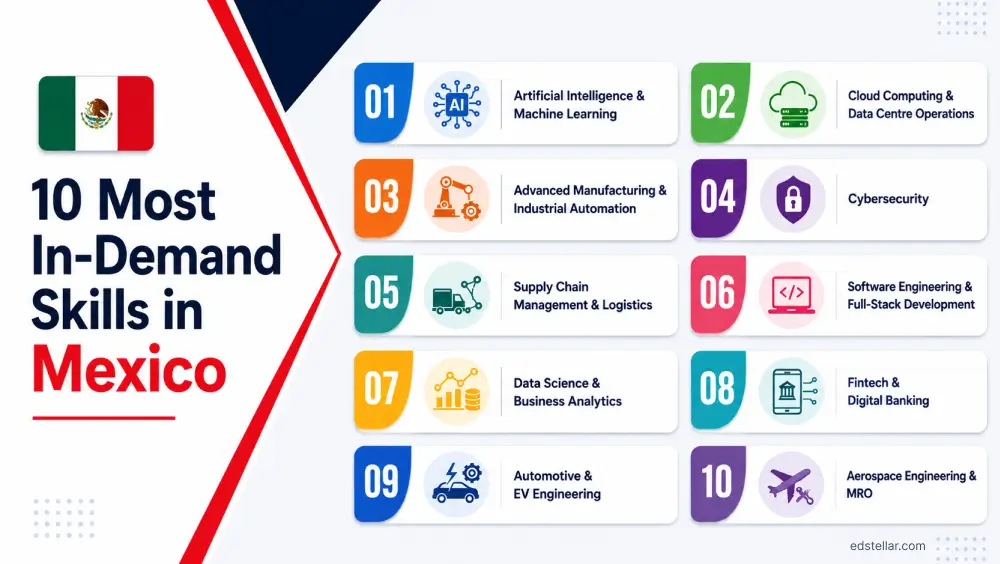
Mexico's skills landscape in 2026 reflects the convergence of a nearshoring manufacturing boom driven by $40.9 billion in FDI, a $5 billion hyperscaler cloud investment in Queretaro, the world's seventh-largest automotive industry transitioning to electric vehicles, and a fintech ecosystem of 795 companies reshaping financial services. The 10 skills below span artificial intelligence, cloud computing, advanced manufacturing, cybersecurity, supply chain management, software engineering, data science, fintech, automotive engineering, and aerospace, mirroring the sectors where government policy, employer demand, and investment are highest.
1
Artificial Intelligence & Machine Learning
Research Score: 9.45/10
AI skills demand in Mexico surged 148% between 2023 and 2025 according to Get on Board and AWS research, while the number of AI firms grew 965% from 2018 to 2024, creating over 11,000 jobs. The Secretaria de Economia launched the National AI Strategy 2.0 in 2025, Plan Mexico's semiconductor incentives target doubled chip exports by 2030, and Foxconn committed $900 million for Nvidia GB200 superchip manufacturing in Guadalajara. TecNM (National Technological Institute of Mexico) launched seven new degree programmes focused on semiconductors, data science, and artificial intelligence, with free "English for the Semiconductor Industry" courses engaging 21,000+ learners.
The skill set required by AI and machine learning engineers in Mexico is shaped by the country's unique combination of manufacturing and technology sectors. Automotive OEMs use machine learning for predictive maintenance and quality control across production lines, financial institutions deploy fraud detection models processing millions of daily transactions, and the 795 active fintechs apply AI to credit scoring for underserved populations. Mexico's 66% AI adoption rate exceeds the global average according to Google and Ipsos research, yet the Salesforce AI Readiness Index scored Mexico at just 3.3 versus the global average of 5.8, revealing a gap between adoption interest and implementation capability that creates demand for skilled practitioners.
Senior ML engineers in Mexico earn MXN 1,400,000 to 1,800,000 annually ($5,000 to $7,500 per month), with MLOps engineers reaching MXN 2,000,000 at the upper range according to CodersLink. Mexico City, Guadalajara, and Monterrey command the highest premiums, and bilingual professionals (English-Spanish) earn 15 to 25% more than monolingual counterparts. With 94% of Mexican employers preferring candidates with generative AI credentials, organisations that invest in AI training now will secure talent before the 2 million engineer shortfall intensifies further.
Key Sub-skills
Machine Learning Model DevelopmentNatural Language ProcessingComputer VisionMLOps and Model DeploymentGenerative AI Applications
AWS launched its Mexico (Central) cloud region in Queretaro in January 2025 with a $5 billion commitment over 15 years, projecting 7,000 highly qualified jobs per year and a $10 billion GDP impact according to AMITI. Queretaro now concentrates 65% of Mexico's installed data centre capacity with 26 additional projects under development. MEXDC (the Mexican Data Center Association) projects $9.2 billion in direct data centre investment by 2029, generating 14,000+ indirect jobs. Microsoft Azure and Google Cloud are also expanding their Mexican infrastructure, drawn by the country's proximity to the US market, competitive energy costs, and growing tech workforce.
The new Agency for Digital Transformation and Telecommunications, created through November 2024 reforms, is charged with issuing federal technology policies and accelerating government cloud migration. Financial institutions are moving core banking systems to hybrid cloud environments, manufacturing companies are deploying edge computing for Industry 4.0 applications, and the healthcare sector is adopting cloud-based electronic health records. AWS aims to train 400,000 people to support its Queretaro infrastructure, signalling that cloud skills development is becoming as critical as the physical data centre buildout itself.
Cloud engineers in Mexico earn approximately MXN 95,000 per month ($4,500 to $6,000 monthly) according to CodersLink, with DevOps specialists and cloud architects commanding premiums of 20 to 30% above these benchmarks. The skill's value extends beyond technology companies: Mexico's IT services market is expected to reach $20.04 billion by 2030 according to AMITI, and every sector from banking to agriculture requires cloud infrastructure professionals. For organisations in Mexico, cloud computing capability is the foundation upon which AI, cybersecurity, data analytics, and fintech applications are built.
Key Sub-skills
Cloud Architecture (AWS/Azure/GCP)DevOps and CI/CD PipelinesInfrastructure as CodeKubernetes and Container OrchestrationCloud Security
"Mexico presents a paradox in talent development. While we have a demographic advantage, with 2 million young workers entering the labor force every year over the next five years, nearly 50% do not have the adequate skills for today's jobs."
Gabriel Aparicio
Country General Manager, Kelly Services · Miguel Hidalgo, Mexico
3
Advanced Manufacturing & Industrial Automation
Research Score: 9.10/10
Mexico faces a projected shortfall of 2 million engineers across IT, manufacturing, biotechnology, and AI according to the Pan American Development Foundation, while 68% of companies report they cannot find qualified personnel. The country holds fourth place globally in robotics and automation with over 40,000 industrial robots installed and projected 61% year-over-year growth. FDI of $40.9 billion in the first nine months of 2025, with 36% flowing into manufacturing, confirms that nearshoring is translating investment into factory floor demand for automation-capable workers.
Plan Mexico's fiscal incentives for export industries, lower income tax and VAT rates in border regions, and USMCA compliance requirements are attracting capital-intensive plants that require Industry 4.0 skills rather than traditional assembly labour. Manufacturing employment fell by 127,200 positions in 2025 (the worst decline since 2008), but this reflects a shift from labour-intensive to technology-intensive production, not a decline in the sector itself. New plants from Foxconn, BMW, VW, and Chinese manufacturers require PLC programmers, robotics technicians, and IoT integration specialists rather than manual assembly workers. Mexico's 9.3 million manufacturing workers and 145,000+ annual engineering graduates provide the pipeline, but the skills must evolve.
Manufacturing engineers in the Bajio region earn MXN 600,000 to 1,200,000 annually ($3,000 to $5,000 per month), with automation specialists commanding the upper range. IATF 16949 (automotive quality) and ISO 9001 certifications carry documented salary premiums, and Lean Six Sigma competency is a baseline requirement across Tier 1 and Tier 2 suppliers. For organisations operating manufacturing facilities in Mexico, the return on automation training is direct: McKinsey estimates 45% of manufacturing functions could be automatable by 2030, and the companies that upskill their workforce now will capture the productivity gains that nearshoring promises.
Key Sub-skills
Industrial IoT and Sensor IntegrationRobotic Process AutomationPLC/SCADA ProgrammingLean Six SigmaQuality Management (ISO/IATF)
Top Industries
Automotive, Aerospace, Electronics, Medical Devices
Mexico's cybersecurity market is valued at $2.80 billion in 2025 and projected to reach $5.36 billion by 2031, growing at an 11.43% compound annual rate. The annual talent shortfall stands at 6,300 to 8,800 professionals against demand of 8,500 to 11,000 positions, while the cybersecurity workforce is growing at 12.4% CAGR, significantly outpacing the general tech sector's 7.2% growth rate. The new Agency for Digital Transformation and Telecommunications carries cybersecurity mandates for federal systems, the Fintech Law imposes data protection requirements on 795 financial technology companies, and the banking regulator (CNBV) enforces strict security compliance across Mexico's financial sector.
The convergence of nearshoring, cloud migration, and 5G expansion is creating attack surfaces faster than cybersecurity engineers can be trained. Manufacturing companies connecting operational technology (OT) to enterprise networks for Industry 4.0 applications introduce vulnerabilities that traditional IT security teams are not equipped to handle. Financial institutions processing millions of cross-border transactions under USMCA require real-time fraud detection and regulatory compliance. Healthcare organisations digitising patient records face ransomware threats that have targeted Mexican hospitals in recent years. The 145,000 cybersecurity professionals currently in Mexico are projected to grow to 260,000 by 2030, but the gap between supply and demand will persist without accelerated training.
Cybersecurity specialists in Mexico earn $3,500 to $5,500 per month (MXN 700,000 to 1,100,000 annually) according to industry benchmarks, with banking sector roles growing at 18% and healthcare at 14%. Cloud security and IoT/OT security command the highest premiums due to scarcity. Certifications including CISSP, CEH, and CompTIA Security+ carry documented salary advantages, particularly for professionals serving multinational companies that require internationally recognised credentials. For organisations managing digital transformation in Mexico, cybersecurity is not optional, it is the cost of operating in a connected economy.
Key Sub-skills
Cloud SecurityIncident Response and ForensicsEthical Hacking and Penetration TestingIoT/OT SecuritySOC Management
US-Mexico trade reached a record $840 billion in 2024, making Mexico the largest US trading partner, and the logistics industry requires approximately 150,000 new professionals annually to keep pace according to industry estimates based on INEGI employment data. The $7.5 billion Interoceanic Corridor of the Isthmus of Tehuantepec (CIIT), connecting Pacific and Atlantic via railway and 14 industrial development poles, is projected to generate 150,000+ formal jobs by 2030 and increase regional GDP by 2.5 percentage points annually. Hyundai Glovis has already begun pilot shipments, confirming that the corridor is transitioning from construction to operation.
Nearshoring is fundamentally restructuring supply chains that previously ran from Asia through Pacific ports. Companies relocating manufacturing to Mexico need professionals who understand USMCA rules of origin (75% regional content for automotive), Mexican customs procedures, cross-border logistics with the United States, and last-mile delivery in a market where e-commerce is growing rapidly. AD Ports Group and other logistics operators are expanding warehouse and distribution capacity along border crossings and in industrial corridors. The complexity of managing multi-modal supply chains across rail, road, port, and air freight creates demand for professionals who combine logistics expertise with technology skills including warehouse management systems and route optimisation software.
Supply chain managers in Mexico earn MXN 800,000 to 1,500,000 annually ($4,000 to $6,500 per month), with USMCA compliance specialists and bilingual logistics coordinators commanding the upper range. The nearshoring boom is projected to create 2 to 4 million new jobs by 2030 according to various estimates, and a significant portion of these will be in logistics, warehousing, and supply chain coordination. For organisations expanding operations in Mexico, supply chain talent is the connective tissue between manufacturing investment and market delivery.
Key Sub-skills
Supply Chain Resilience PlanningUSMCA Customs ComplianceWarehouse Automation and WMSRoute Optimisation and Last-Mile DeliveryProcurement and Vendor Management
Edstellar's Training Needs Analysis consultants identify your priority skill gaps and build a customised training roadmap. Get matched with the right programmes in 48 hours.
Mexico's tech workforce exceeds 700,000 professionals across hubs in Mexico City, Guadalajara, and Monterrey according to AMITI. Guadalajara, known as Mexico's Silicon Valley, attracted $890 million in investments from Intel, HP, Oracle, and Micron in 2025, creating 11,500 new specialised technology jobs. The city alone hosts 115,000+ software developers and engineers, Jalisco produces 10,000+ tech specialists annually, and the broader IT services market is expected to reach $20.04 billion by 2030. Average tech salaries of $55,500 versus $109,000 in the United States give Mexico a 49% cost advantage that drives nearshore software development demand.
The Agency for Digital Transformation and Telecommunications created in November 2024 is accelerating government digitisation, and private sector demand for DevOps engineers and full-stack developers continues to outpace supply. Python and JavaScript frameworks dominate job requirements, followed by React/Angular for frontend development and microservices architecture for backend systems. The 795 active fintechs, growing e-commerce sector, and manufacturing companies digitising operations all require custom software solutions. Remote work has expanded the talent pool beyond traditional tech hubs, but senior engineers with cloud-native development experience and English proficiency remain scarce.
Senior software engineers in Mexico earn MXN 1,000,000 to 1,400,000 annually ($4,000 to $5,500 per month), while junior developers start at MXN 500,000 to 700,000 according to CodersLink. Mexico City commands the highest premiums at $5,500 to $7,500 monthly for senior roles, followed by Monterrey at $5,200 to $7,200 and Guadalajara at $5,000 to $7,000. The bilingual premium of 15 to 25% applies strongly in software development, where communication with US-based product teams and clients is a daily requirement. For organisations building nearshore development teams, Mexico offers a timezone-aligned, cost-competitive, and culturally proximate alternative to offshore markets.
Key Sub-skills
Python and JavaScript FrameworksReact/Angular Frontend DevelopmentAPI Design and MicroservicesDatabase Management (SQL/NoSQL)Agile and DevOps Practices
Data and AI roles in Mexico are anticipated to see a 60% demand increase, with only 30% of graduates possessing the necessary skills, resulting in a shortage of approximately 90,000 qualified professionals according to Talenbrium. Glassdoor listed 1,896 data science positions in Mexico in 2025, and the World Economic Forum estimates that 22% of Mexican roles could be disrupted by data-driven automation by 2030. TecNM launched new data science degree programmes as part of the government's push to address the skills mismatch, and the National AI Strategy 2.0 positions data literacy as a foundation for the country's digital economy ambitions.
The manufacturing sector is the largest emerging consumer of data analytics talent in Mexico, driven by nearshoring companies deploying Industry 4.0 systems that generate terabytes of production data requiring analysis. Automotive OEMs use predictive analytics for quality control and supply chain optimisation, financial institutions build risk models and credit scoring systems for the growing fintech market, and retail companies analyse consumer behaviour across both physical and e-commerce channels. Mexico's 66% AI adoption rate (above the global average according to Google/Ipsos) confirms that organisations are collecting data at scale, but the shortage of analysts who can extract actionable business intelligence creates a persistent bottleneck.
Senior data scientists in Mexico earn MXN 1,200,000 to 1,600,000 annually ($4,500 to $6,500 per month) according to CodersLink, with business intelligence specialists and data engineers earning comparable ranges. Power BI and Tableau proficiency are the most requested visualisation tools, Python and R dominate statistical modelling requirements, and SQL remains the baseline technical competency. For organisations across Mexico's diverse industrial sectors, data analytics capability translates directly into operational efficiency, better customer understanding, and competitive advantage in a market where 2 to 4 million new nearshoring jobs will generate unprecedented volumes of business data.
Key Sub-skills
Statistical Modelling and Predictive AnalyticsBusiness Intelligence (Power BI/Tableau)Big Data Engineering (Spark/Hadoop)Python/R for Data AnalysisData Visualisation and Storytelling
"The labor market is no longer just about availability; it is about alignment between skills and organizational needs."
Sofía Bentinck
CEO and Co-Founder, Anchor Relocation Worldwide · Nuevo León, Mexico
8
Fintech & Digital Banking
Research Score: 7.90/10
Mexico hosts 795 active fintechs by end of 2025, with 89 authorised Financial Technology Institutions operating under the Fintech Law framework. Electronic Payment Funds reached MXN 34 billion in September 2025, up from MXN 24.62 billion the prior year, and Banxico projects that updated regulatory frameworks could unlock $12 billion in additional fintech credit by 2030, with 30% flowing to underserved small and medium enterprises. Nubank reached 12 million clients in Mexico, Amazon launched its Amazon Access debit product, and Mexico's first fully digital banks are scaling rapidly in a market where financial inclusion remains a priority.
The Fintech Law (originally enacted in 2018, with 2.0 regulatory updates ongoing) created Latin America's most comprehensive fintech regulatory framework, attracting both domestic startups and international players. Open banking mandates are requiring traditional banks to share data through APIs, creating demand for developers who can build interoperable financial applications. RegTech compliance, mobile-first application development, and risk analytics are the primary skill demands. The intersection of fintech and nearshoring is particularly notable: cross-border payment solutions serving Mexico-US trade corridors, payroll platforms for nearshoring employees, and supply chain finance products all require fintech-skilled professionals.
Fintech developers in Mexico earn MXN 800,000 to 1,400,000 annually ($3,500 to $5,500 per month), with payment systems architects and blockchain developers commanding premiums. The skill set bridges financial domain knowledge and software engineering, making it difficult to hire externally but feasible to develop through targeted upskilling of either banking professionals or technology staff. Mexico's position as Latin America's largest fintech market after Brazil ensures that demand will continue to grow as digital financial services penetrate the 35+ million adults who remain outside the formal banking system.
Key Sub-skills
Digital Payment Systems and APIsRegulatory Technology (RegTech)Open Banking IntegrationRisk Analytics and Fraud DetectionMobile-First Application Development
Top Industries
Banking and Insurance, Fintech Startups, E-commerce, Government Services
Mexico produced 3.95 million vehicles in 2025 with over 1 million automotive workers, making it the world's seventh-largest vehicle manufacturer according to Prodensa. BMW is investing EUR 800 million for EV battery production in San Luis Potosi with a 2027 launch, Volkswagen is building its first battery plant outside Germany at the Puebla facility for 2026, and 45 electromobility investment projects totalling $1.57 billion are transforming Mexico's automotive sector from internal combustion to electric vehicle production. The autoparts sector generated $119 billion in production value, and Mexico produced 198,678 EV units in 2025.
The Bajio region (Guanajuato, Aguascalientes, San Luis Potosi) employs approximately 235,000 workers in automotive, representing 25% of the national automotive workforce. USMCA's 75% regional content requirement ensures that component manufacturing stays in North America, driving demand for quality engineers, EV powertrain specialists, and high-voltage battery technicians. The transition from internal combustion to electric vehicles requires entirely new skill sets: high-voltage safety systems, battery management, ADAS (Advanced Driver Assistance Systems) software, and connected vehicle architecture. Mexico's 26 automotive-focused R&D centres staffed by 15,000+ engineers are expanding their EV programmes, and 145,000+ technicians and engineers graduate from relevant programmes annually.
Senior automotive engineers in Mexico earn MXN 700,000 to 1,200,000 annually ($3,500 to $5,000 per month), with EV-specific skills commanding 15 to 20% premiums over traditional powertrain experience. IATF 16949 certification remains the baseline quality credential, and CNC machining and composite fabrication skills carry strong demand from both OEMs and Tier 1 suppliers. For organisations in Mexico's automotive corridor, the EV transition represents both a workforce challenge and an opportunity: companies that retrain their existing automotive engineers for electrification will capture the value of $1.57 billion in new EV investment rather than competing for scarce external talent.
Key Sub-skills
Electric Vehicle Powertrain DesignHigh-Voltage Battery SystemsADAS and Connected Vehicle SoftwareIATF 16949 Quality SystemsCNC Machining and Composite Fabrication
The Queretaro Aerocluster crossed $2.8 billion in output value in 2024 and reported 10% growth in 2025, with FDI commitments of $380 million for 2024–2025. Mexico's total aerospace workforce stands at 72,000 across 400+ companies including Safran, Bombardier, and 80+ firms in the Queretaro cluster alone. The sector posted 2,400 net new vacancies in 2024 with an average fill time of 67 days for technical roles, stretching to 120–150 days for NADCAP-certified non-destructive testing (NDT) technicians, according to FEMIA (Mexican Federation of the Aerospace Industry) and ProQueretaro.
Mexico's aerospace industry has evolved from basic assembly operations to advanced manufacturing and MRO (Maintenance, Repair, and Overhaul) services. Composite fabrication, precision CNC machining, and avionics integration are the core manufacturing skills, while MRO operations require AS9100 quality management expertise and specialised inspection capabilities. UNAQ (Universidad Aeronautica de Queretaro) graduates 412 specialists annually, but the market needs ten times that number. ProQueretaro and FEMIA project 8 to 12% employment growth for 2026, and USMCA provisions that favour North American aerospace supply chains are directing additional investment toward Mexico.
Aerospace engineers in Mexico earn MXN 600,000 to 1,100,000 annually ($3,000 to $5,000 per month), with NADCAP-certified NDT technicians and avionics specialists at the upper range due to extreme scarcity. The 120–150 day fill time for certified positions reflects a global shortage that benefits Mexican professionals with the right qualifications. For organisations in the aerospace supply chain, the Queretaro cluster offers a concentrated talent pool, dedicated training infrastructure through UNAQ, and proximity to both the US market and a growing Latin American aviation sector. Internal development of composite fabrication and NDT skills is often faster and more cost-effective than external recruitment in this specialised market.
The Rise of Mexico: A documentary examining Mexico's manufacturing revolution, nearshoring boom, young workforce, and the economic transformation driving workforce skills demand.
Skills Demand Across Mexico's Industrial Corridors
Mexico's skills demand is shaped by the geographic concentration of industrial clusters, trade infrastructure, and technology hubs. Understanding these regional patterns helps corporate L&D teams and HR managers target training investments where they will have the greatest impact.
Industrial Corridor
Primary Industries
Top Skills in Demand
Bajio Automotive Belt (Guanajuato, Aguascalientes, San Luis Potosi)
Automotive OEM, Autoparts, EV Manufacturing
Advanced Manufacturing, EV Engineering, Lean Six Sigma
The Bajio region anchors Mexico's automotive industry with 25% of the national automotive workforce and BMW, VW, and GM investing billions in EV transition infrastructure. Queretaro has emerged as a dual hub for aerospace (80+ companies, $2.8 billion output) and cloud computing (65% of national data centre capacity, AWS $5 billion investment). Guadalajara leads in software and semiconductors with 115,000+ developers and $890 million in Silicon Valley investment, while Monterrey combines heavy manufacturing heritage with a growing technology and financial services sector.
Mexico City dominates financial services, fintech, and business process outsourcing, and the northern border zone serves as the primary maquila corridor for electronics, medical devices, and consumer goods export manufacturing. For organisations planning multi-site operations, aligning training programmes with these regional demand patterns ensures that upskilling investments match actual hiring needs.
How to Develop These Skills in Demand in Mexico
Mexico's skills challenge is defined by a paradox of scale and mismatch: the country has 62.5 million economically active workers, produces 120,000+ new engineers and technical professionals annually, and maintains the world's seventh-largest automotive industry, yet faces a projected shortfall of 2 million engineers, 68% of companies cannot find qualified personnel, and only 34% have formally registered training programmes with STPS. With $40.9 billion in FDI flowing in, the nearshoring boom creating demand for 2 to 4 million new jobs by 2030, and AI skills demand surging 148%, organisations need a systematic approach to close these gaps.
Start with a skills audit. Use a structured training needs analysis to map your current team capabilities against the skills your business needs over the next 12 to 24 months. Focus on the gaps that directly affect production output, compliance, and nearshoring competitiveness. Mexico's Federal Labour Law Article 153-A mandates that employers provide training enabling workers to improve their skills and productivity, yet only 34% of companies have formally registered programmes with STPS, so a documented skills audit also satisfies your legal and regulatory baseline.
Build individual development plans. Generic training programmes produce generic results. Use individual development plan templates to tailor learning pathways to each employee's current skills and career trajectory. A manufacturing engineer in a Silao automotive plant has different development needs than a software developer supporting a Monterrey nearshoring hub, even though both operate within Mexico's nearshoring-driven economy.
Combine certifications with applied learning. International certifications (IATF 16949, AWS, Azure, CISSP, CEH, Lean Six Sigma) carry significant weight in the Mexican market and command salary premiums of 15 to 25% in technology and manufacturing roles. However, applied projects and instructor-led workshops build the practical capability that certifications alone cannot provide. The most effective programmes pair certification preparation with hands-on exercises drawn from Mexico-specific industry scenarios, particularly in automotive, aerospace, and nearshoring where USMCA compliance and client-facing English proficiency matter as much as technical knowledge.
Address performance gaps systematically. A guide to understanding performance gaps can help managers distinguish between skill deficits, process barriers, and infrastructure limitations before investing in training. A maquiladora team struggling with Industry 4.0 adoption may need PLC and robotics training, while a fintech compliance team in Mexico City may need regulatory knowledge rather than additional technology courses.
Leverage Mexico's national workforce development infrastructure. TecNM launched seven new degree programmes in semiconductors, data science, and AI to support the nearshoring pipeline. CONOCER provides nationally recognised competency certification that carries weight with both domestic employers and foreign investors. The CIIT Interoceanic Corridor's 14 industrial development poles are each backed by workforce readiness commitments, creating regional training partnerships organisations can connect employees with, particularly for foundational digital skills and English language proficiency that multiply the return on every training peso invested.
Mexico's economic trajectory, driven by $40.9 billion in nearshoring FDI, a $5 billion AWS cloud investment, 3.95 million vehicles produced annually with $1.57 billion in EV transition projects, and a $7.5 billion interoceanic trade corridor, signals that demand for skilled professionals will only intensify. Organisations that build their training strategies around these national priorities, supported by a catalogue of over 2,000 instructor-led courses, will be better positioned to attract talent and maintain competitive advantage in one of the world's most dynamic and rapidly transforming economies.
Frequently Asked Questions
What skills are in high demand in Mexico?
The most in-demand skills in Mexico for 2026 include artificial intelligence and machine learning, cloud computing and data centre operations, advanced manufacturing and industrial automation, cybersecurity, supply chain management and logistics, software engineering, data science and business analytics, fintech and digital banking, automotive and EV engineering, and aerospace engineering and MRO. AI and machine learning lead the list with 148% demand growth between 2023 and 2025, driven by the National AI Strategy 2.0 and nearshoring investment.
What jobs are in demand in Mexico in 2026?
The highest-demand jobs in Mexico for 2026 include AI engineers, cloud architects, industrial automation specialists, cybersecurity analysts, supply chain coordinators, full-stack developers, data scientists, fintech developers, EV powertrain engineers, and aerospace manufacturing technicians. Software development roles dominate the technology sector with 700,000+ professionals, nearshoring is creating demand for manufacturing engineers across the Bajio automotive corridor, and the cybersecurity sector has an annual talent shortfall of 6,300 to 8,800 professionals.
How is nearshoring affecting Mexico's job market?
Nearshoring is the dominant force reshaping Mexico's labour market. FDI reached $40.9 billion in the first three quarters of 2025, US-Mexico trade hit a record $840 billion in 2024, and the nearshoring trend is projected to create 2 to 4 million new jobs by 2030. However, new plants are capital-intensive rather than labour-intensive, requiring Industry 4.0 skills such as robotics programming, PLC/SCADA operation, and data analytics rather than traditional assembly labour. This explains why manufacturing employment fell by 127,200 positions despite record investment.
What is the average salary for technology professionals in Mexico?
Technology salaries in Mexico vary by role, experience, and city. Senior ML/AI engineers earn MXN 1,400,000 to 1,800,000 annually ($5,000 to $7,500 per month), senior software engineers earn MXN 1,000,000 to 1,400,000 ($4,000 to $5,500), and cloud engineers average MXN 95,000 per month ($4,500 to $6,000). Mexico City commands the highest premiums at $5,500 to $7,500 monthly for senior roles, followed by Monterrey and Guadalajara. Bilingual English-Spanish professionals earn 15 to 25% more than monolingual counterparts across all technology roles.
How do I get a job in Mexico as a foreigner?
Foreign professionals access Mexico's job market through employer-sponsored temporary resident visas, which require a job offer from a Mexican company. Technology, engineering, and senior management roles offer the strongest prospects, particularly in nearshoring manufacturing plants, technology hubs (Guadalajara, Mexico City, Monterrey), and multinational companies. Spanish proficiency is a significant advantage, though English-language roles exist in nearshoring operations, BPO centres, and international technology companies. Mexico's timezone alignment with the US and competitive cost of living make it attractive for remote workers, and the digital nomad visa provides an alternative pathway for independent professionals.
Why does Mexico have a skills shortage despite low unemployment?
Mexico's unemployment rate of 2.7% masks a structural skills mismatch. The country faces a projected shortfall of 2 million engineers, 68% of companies cannot find qualified talent, and only 34% have formally registered training programmes. The nearshoring boom is attracting capital-intensive manufacturing that requires Industry 4.0 skills, AI demand surged 148%, and the cybersecurity sector has thousands of unfilled positions annually. Meanwhile, 55.4% of workers remain in informal employment, and the education system has not scaled engineering, technology, and data science programmes at the pace the economy requires.
What kind of jobs are available in Mexico for young people?
Young Mexicans have growing opportunities across the economy's fastest-expanding sectors. Software development in Guadalajara, Monterrey, and Mexico City offers the highest entry-level technology salaries, with junior developers earning MXN 500,000 to 700,000 annually. The automotive sector employs over 1 million workers, with 145,000+ graduates entering relevant programmes each year. TecNM's new degree programmes in semiconductors, data science, and AI provide direct pathways to emerging technology roles. Fintech startups offer fast-track career growth, digital marketing roles are accessible with shorter training pathways, and nearshoring manufacturing plants in the Bajio and border regions provide engineering positions with competitive benefits.
What jobs does Mexico need most?
Mexico's most acute workforce needs are in technology and advanced manufacturing. The country needs to fill 2 million engineering positions across IT, manufacturing, biotechnology, and AI. AI specialists are in highest demand with 148% growth, the cybersecurity sector faces 6,300 to 8,800 annual vacancies, and the logistics industry requires 150,000 new professionals each year. Cloud computing professionals are needed for the $9.2 billion data centre buildout projected by 2029. Aerospace engineering roles take 67 to 150 days to fill due to certification requirements. The automotive sector needs EV powertrain and battery engineers as the industry transitions from internal combustion to electrification.
Conclusion
Mexico's skills landscape in 2026 is defined by a country that attracted $40.9 billion in foreign direct investment in just nine months, became the largest source of US imports at $466.6 billion, produced 3.95 million vehicles, and grew its AI sector by 965% in six years. Yet 68% of companies cannot find qualified talent, 2 million engineering positions remain projected shortfalls, only 34% of employers comply with mandatory training registration, and 55.4% of workers remain in informal employment. The gap between what Mexico's nearshoring-powered economy demands and what its education and training systems deliver remains the central barrier to converting record investment into inclusive prosperity.
The ten skills in demand in Mexico covered in this guide represent the intersection of national industrial strategy and acute workforce need. From artificial intelligence with 148% demand growth, through cloud computing backed by a $5 billion AWS investment, advanced manufacturing absorbing $40.9 billion in FDI, and supply chain management supporting $840 billion in bilateral trade, each skill area offers clear returns on training investment. The organisations that close their skills gaps fastest will be the ones that attract talent, win nearshoring contracts, and lead their industries as Mexico executes the most significant manufacturing and technology transformation in its history.
Organisations looking to upskill their Mexican workforce across these in-demand skills can also explore our detailed comparison of corporate training companies in Mexico to find the right training partner based on industry focus, delivery format, and programme coverage.
Ready to Upskill Your Mexico Team?
Join 500+ organizations that trust Edstellar for corporate training. Get matched with expert trainers in 48 hours.
An expert-curated list of top corporate training providers in Mexico, reviewed by an executive coach and mental wellbeing specialist with 18+ years of experience in leadership and human development across Latin America and Europe.
Explore High-impact instructor-led training for your teams.
Unlock premium resources, tools, and frameworks designed for HR and learning professionals. Our L&D Hub gives you everything needed to elevate your organization's training approach.
.svg "edstellar")

.webp)

















.svg "Click Here to Follow on Medium")
.svg)




.svg)


.svg)
.svg)
.svg)

.svg)