10 Most In-Demand Skills in Turkey for 2026

.svg "edstellar")

Turkey's defence exports reached $10.054 billion in 2025, up 48.8% year-over-year, the country commands 65% of the global drone export market, and the 12th Development Plan targets growing the defence workforce from 100,000 to 158,000 by 2028. Yet the skills challenge extends far beyond defence. The government estimates that 21.2 million workers need upskilling for a digitised workplace, the cybersecurity sector faces a shortage of 40,000 professionals, and earthquake reconstruction has spent $91 billion while 600,000 people remain in temporary housing.
ICT spending is projected at $30 billion in 2025, Turkey's EV market share surged from 1% to 10% in just two years, and Istanbul ranks third globally in emerging startup ecosystems. For corporate L&D leaders and HR managers operating in this G20 economy, these numbers define a workforce transformation as ambitious as the country's industrial strategy.
Several mega-trends are converging to reshape Turkey's labour market simultaneously. The High Technology Investment Programme (HIT-30) allocates $30 billion across semiconductors, EVs, batteries, solar cells, wind turbines, and industrial robots. Google Cloud committed $2 billion over ten years, the Akkuyu nuclear power plant represents over $20 billion in investment with 4,000 permanent high-skilled positions, and BYD is building a $1 billion EV factory in Manisa.
Turkey's power capacity reached 122 GW with 62% from renewables, the tech sector is projected to grow 25% in 2025, and the e-commerce market is estimated at $93.5 billion. A new Cybersecurity Law enacted in March 2025 established a dedicated Cybersecurity Authority with enforcement powers, the Tech Visa programme launched in September 2024, and Baykar, ASELSAN, and TUSAS are hiring thousands of engineers as defence sector brain drain reverses for the first time.
So which skills are truly driving Turkey's economy, and where should organisations invest their training budgets? This guide breaks down the top 10 skills in demand in Turkey, spanning artificial intelligence, cybersecurity, defence engineering, software development, renewable energy, cloud computing, EV technology, and construction. Drawing on TurkStat labour statistics, Defence Turkey industry analysis, Trade.gov digital economy data, and hiring platform benchmarks, it provides an evidence-based picture of what jobs are in demand in Turkey, whether you are planning corporate upskilling programmes, building talent pipelines, or advising teams on high demand skills in Turkey for 2026 and beyond.
Every ranking in this guide is backed by data from Turkish government bodies, industry associations, and local recruitment platforms.
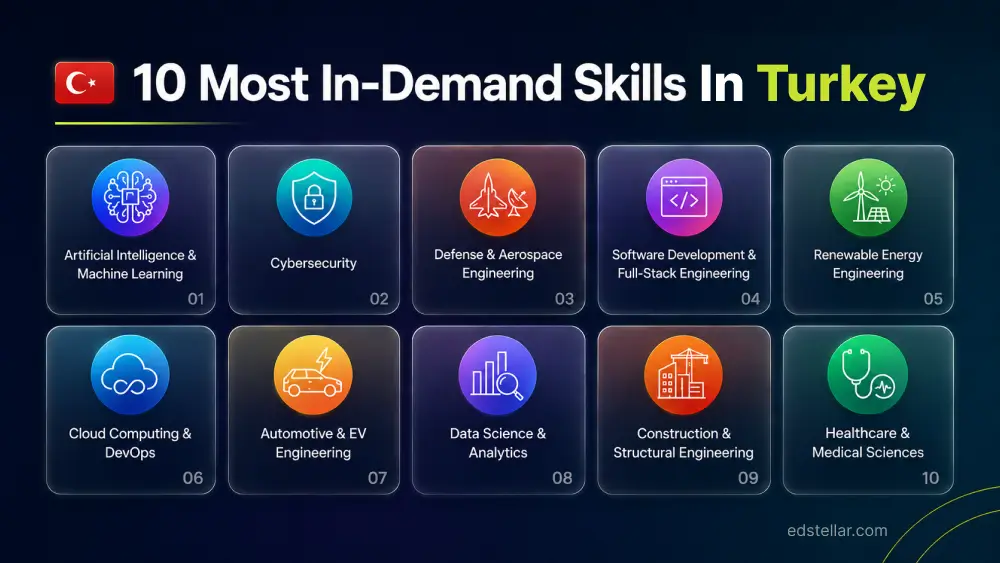
Turkey's skills landscape in 2026 reflects the convergence of a $20.2 billion defence industry targeting 158,000 employees, a $30 billion High Technology Investment Programme, 122 GW of power capacity with 62% from renewables, and a $93.5 billion e-commerce market driving digital transformation. The 10 skills below span artificial intelligence, cybersecurity, defence engineering, software development, renewable energy, cloud computing, automotive/EV, data science, construction, and healthcare, mirroring the sectors where government policy, employer demand, and investment are highest across this G20 economy.

Turkey's National AI Strategy 2024–2025 Action Plan includes 71 priority actions targeting AI's contribution at 5% of GDP, projected to create 50,000 new technology jobs according to Trade.gov. The defence sector launched SAYZEK (Defence AI Talent Cluster) at IDEF 2025, and 72% of Turkish internet users engage with generative AI tools compared to the global average of 42%. Turkey's AI and machine learning engineers work across a uniquely diverse set of applications: autonomous drone navigation at Baykar, fraud detection at major banks, recommendation engines at Trendyol (Turkey's largest e-commerce platform), and predictive maintenance across 20.26 million manufacturing workers.
The HIT-30 programme allocates funding for AI infrastructure alongside semiconductors and data centres, and TUBITAK provides competitive grants for AI research. ASELSAN is investing $616 million in new facilities including AI-enabled photon detectors, radar systems, and smart ammunition production. The country's 246,000+ ICT workforce (70% under 35) provides a young talent base, but the AI specialist pipeline cannot match the pace of deployment across defence, fintech, healthcare, and manufacturing. Turkish universities are expanding AI programmes, and TEKNOFEST (which attracted 1.03 million visitors) serves as a national talent identification platform for AI and robotics competitions.
AI/ML specialists in Turkey earn 300,000 to 600,000+ TRY annually (approximately $8,500 to $17,000), with senior AI architects at multinational firms and defence companies commanding significantly higher packages. Teknopark income tax exemptions boost take-home pay by 35 to 40% for engineers working in designated technology development zones, making effective compensation substantially more competitive. For organisations operating in Turkey, AI capability is the connecting thread across the economy's highest-priority sectors: defence autonomy, financial technology, e-commerce personalisation, and industrial modernisation.
Defence and Aerospace, Banking and Fintech, E-Commerce, Manufacturing
Explore Related Training:
AI Programming with Python Machine Learning With Python All Artificial Intelligence Programs
Turkey faces an estimated shortage of 40,000 cybersecurity professionals according to the Turkish Cybersecurity Association, while the cybersecurity market is projected at $514 million in 2025 and growing at 15% annually. A new Cybersecurity Law enacted in March 2025 established a dedicated Cybersecurity Authority with direct supervisory power over public entities and regulated sectors, and 38% of telecom and media companies report they cannot find qualified cybersecurity professionals. The BTK (Information and Communication Technologies Authority) oversees USOM (National Cyber Incident Response Centre) and is expanding its regulatory mandate to cover critical infrastructure protection.
The defence sector is the largest single employer of cybersecurity engineers in Turkey. ASELSAN, HAVELSAN, and TUSAS all maintain dedicated cybersecurity divisions protecting military communications, weapons systems, and intelligence platforms. The banking sector's 126 million active digital banking customers require fraud prevention and data protection at scale, the $93.5 billion e-commerce market needs transaction security, and the Akkuyu nuclear power plant requires the highest levels of operational technology protection. Turkey's 5G spectrum auction (announced October 2025) with implementation from mid-2026 will create an entirely new attack surface requiring dedicated security specialists.
Cybersecurity professionals in Turkey earn 250,000 to 500,000 TRY annually (approximately $7,000 to $14,000), with senior security architects and CISOs reaching $70,000+ in USD-benchmarked roles. The new Cybersecurity Law has converted cybersecurity from a discretionary investment into a compliance mandate for every regulated organisation, and Teknopark tax exemptions apply to security professionals working in designated zones. For organisations in Turkey, the combination of regulatory requirements, a 40,000-professional shortage, and a growing threat landscape makes cybersecurity the most time-sensitive training investment after AI.
Banking and Finance, Defence and Government, Telecommunications, E-Commerce

Turkey's defence sector employs 100,000 people across 3,500 companies and targets 158,000 by 2028 under the 12th Development Plan, requiring 58,000 new positions in less than three years according to Defence Turkey. Sector turnover reached $20.2 billion in 2025, exports hit $10.054 billion (up 48.8% year-over-year), and 79 R&D centres employ 23,700 personnel. ASELSAN is investing $616 million in new facilities for photon detectors, radar, air defence systems, and smart ammunition, with 2,244 new hires planned. Baykar's drone exports alone reached $2.2 billion, and Turkey commands 65% of the global UAV export market according to CNAS.
In 2025, for the first time, more engineers returned to Turkey's defence sector than departed, with 190 returnees versus 98 departures, signalling that the brain drain that previously weakened the sector is reversing. TUSAS reached milestones on the HURJET supersonic trainer (Mach 1.2) and Kizilelma unmanned fighter jet, while TURKSAT 6A became Turkey's first indigenous communications satellite. The defence technology pipeline extends into civilian applications: autonomous driving systems, satellite communications, electronic warfare technology, and AI-powered sensor systems all require embedded systems, avionics, and systems integration skills that transfer across sectors. The 340 defence startups operating in technoparks represent a growing ecosystem of specialised employers.
Defence production engineers earn 180,000 to 350,000 TRY annually, with senior aerospace engineers and systems architects commanding significantly higher compensation. The sector offers strong benefits packages and Teknopark tax exemptions apply to R&D centres. Turkey's National Technology Initiative (MTH) positions defence as the locomotive of the country's technology independence, and the localisation rate exceeding 80% means that skills must be developed domestically rather than imported. For organisations in Turkey's defence supply chain, the 58,000 new positions represent both a hiring challenge and a clear indicator that internal engineering talent development programmes will define which companies capture the sector's growth.
Defence Manufacturing, Aerospace, Unmanned Systems (UAV), Electronic Warfare
Explore Related Training:
C++ for Embedded Systems FPGA Design for Embedded Systems All IoT Programs"As we enter an era where artificial intelligence is driving performance and efficiency, human competence is becoming more central than ever. Organizations must support their employees for the future while managing today's business results."



Turkey's tech sector is projected to grow 25% in 2025, with ICT spending reaching $30 billion and the IT market climbing from $16.9 billion (2023) to $20.8 billion (2024) according to IDC and Trade.gov. Istanbul ranked third globally in Emerging Startup Ecosystems in the Startup Genome 2025 report, a 10-position leap from 2024, and Turkish startup funding reached $2.6 billion in 2024, a 423% increase from the previous year. The Tech Visa programme launched in September 2024 offers three-year work permits with tax breaks, free healthcare, and office space in technoparks for technology professionals and startup founders.
Trendyol, Hepsiburada, and Getir are among the largest technology employers, while the gaming sector attracted $72.4 million in startup investment in H1 2025 and fintech drew $97.1 million. DevOps engineers and full-stack developers with React, Node.js, and Python expertise are the most sought-after technology professionals on Kariyer.net (Turkey's largest job platform). HAVELSAN, the defence sector's software house, hires hundreds of developers annually for military-grade applications, and the $93.5 billion e-commerce market requires continuous platform development, payment integration, and mobile application engineering.
The median software engineer compensation in Turkey is TRY 1,279,000 per year (approximately $36,500), with the 75th percentile reaching TRY 1,740,000 according to Levels.fyi data. Entry-to-mid-level developers earn 180,000 to 350,000 TRY, and remote positions serving international clients average $56,658 in USD-equivalent. Teknopark income tax exemptions boost effective take-home pay by 35 to 40% for engineers in designated technology zones. For organisations building technology teams in Turkey, the combination of a young ICT workforce (70% under 35), competitive salary-to-skill ratios, and a timezone bridging Europe and Asia makes the country an increasingly attractive engineering hub.
E-Commerce and Digital Platforms, Fintech, Gaming, Defence Technology

Turkey's power capacity reached 122 GW in 2025 with 62% from renewable sources, and 99% of new capacity additions in 2025 were renewable according to Ember. The country ranked fifth globally in solar capacity installation, adding 4.9 GW of solar and 1.7 GW of wind in 2025 alone. To meet the 2035 target of 120 GW from solar and wind alone (up from approximately 40 GW today), Turkey needs to commission 8 GW of solar and wind capacity annually. The HIT-30 programme allocates funding for domestic production of solar cells and wind turbines, reducing dependence on imported components.
The Akkuyu nuclear power plant, with over $20 billion invested by Rosatom, represents Turkey's largest single energy project. The 4.8 GW facility (four 1.2 GW units) employed 25,000 workers during peak construction and will create 4,000 permanent high-skilled positions for reactor operations, with a projected $50 billion GDP impact over its lifecycle. Since 2011, 319 Turkish engineers have been trained in Russia for nuclear operations, but the scale of the workforce requirement far exceeds this pipeline. Over 400 Turkish companies participate in the Akkuyu supply chain at a 56% local content rate, creating demand for nuclear quality control, radiation safety, and power plant maintenance professionals.
Renewable energy engineers in Turkey earn 180,000 to 350,000 TRY annually, with nuclear engineers commanding premium rates due to extreme scarcity. Solar PV system design and installation is the highest-volume skill need, followed by wind turbine engineering and grid modernisation. The combination of ambitious government targets (8 GW annually), nuclear operations ramp-up, and domestic manufacturing requirements under HIT-30 makes renewable energy one of Turkey's most time-sensitive training priorities. For energy sector organisations, the window to build internal clean-tech capabilities coincides with the country's most aggressive capacity expansion in its history.
Solar Energy, Wind Energy, Nuclear Power, Grid Infrastructure
Explore Related Training:
Renewable Energy and Sustainability All Environmental Sustainability Programs
Google Cloud committed $2 billion over ten years to Turkey's cloud infrastructure, Istanbul leads the country's data centre boom with 65% market share, and Turkey's public cloud market is growing at an 18.62% compound annual rate according to Business Wire. The 5G spectrum auction announced in October 2025 with implementation from mid-2026 will accelerate edge computing and cloud-native application demand across telecommunications, banking, and manufacturing. The Digital Turkiye Strategy positions cloud engineers and architects as essential to the government's e-government services modernisation, healthcare digitisation, and defence cloud initiatives.
The banking sector's 126 million active digital banking customers require robust cloud infrastructure for mobile banking, real-time payment processing, and regulatory reporting. Turkey's $93.5 billion e-commerce market (projected to reach $154.9 billion by 2030) runs on cloud platforms that must scale during peak demand periods. The defence sector maintains secure cloud environments for intelligence systems and communications, and the Akkuyu nuclear plant requires specialised operational technology cloud solutions. AWS, Azure, and GCP certifications all carry salary premiums, and the teknopark tax exemption structure further increases effective compensation for cloud professionals.
Cloud engineers in Turkey earn 200,000 to 400,000 TRY annually, with senior cloud architects exceeding 500,000 TRY. The combination of Google's $2 billion commitment, imminent 5G rollout, and the Digital Turkiye Strategy creates a demand trajectory that the current cloud skills pipeline cannot match. For organisations undergoing digital transformation in Turkey, cloud computing capability is the foundation upon which AI, cybersecurity, data analytics, and fintech applications are deployed.
Telecommunications, Banking and Finance, E-Commerce, Government Digital Services

Turkey's EV market share surged from 1% in 2022 to 10% in 2024, driven by TOGG (Turkey's national EV brand, approximately 50,000 vehicles produced in 2023–2025) and incoming investment from BYD ($1 billion for a Manisa plant producing 150,000 vehicles annually with approximately 5,000 jobs) according to Daily Sabah and Trends Research. The HIT-30 programme allocates $5 billion for EVs and $4.5 billion for batteries, SIRO (a TOGG-Farasis joint venture) is producing 3 GWh of battery cells with a target of 20 GWh by 2031, and Turkey's EV charging network expanded to 28,000+ points in 2025 with a 140,000 target by 2030.
Ford Otosan, Toyota Turkey, and Hyundai Assan maintain major manufacturing operations alongside TOGG and the incoming BYD facility. The transition from internal combustion to electric vehicles requires EV powertrain design, battery management systems, automotive software (ADAS and connected vehicle systems), and lightweight materials engineering. Turkey's established automotive ecosystem, which accounts for 15% of national exports, has the manufacturing base to transition, but the EV-specific skills set is fundamentally different from traditional powertrain engineering. The 45 electromobility projects worth $1.57 billion and the government's target of a domestic battery supply chain through SIRO confirm that EV engineering demand is structural, not cyclical.
Production engineers in Turkey's automotive sector earn 180,000 to 350,000 TRY annually, with EV specialists commanding premiums due to scarcity. Battery management system engineers, power electronics specialists, and ADAS software developers represent the highest-demand profiles. For organisations in Turkey's automotive corridor (Bursa, Kocaeli, Sakarya, Manisa), the EV transition represents both a workforce transformation challenge and a competitive opportunity: companies that retrain existing automotive engineers for electrification will capture the value of $9.5 billion in combined HIT-30 EV and battery investment.
Automotive Manufacturing, Battery Technology, EV Charging Infrastructure, Components and Parts

Turkey's e-commerce market is estimated at $93.5 billion in 2025 and projected to reach $154.9 billion by 2030 at a 10.6% CAGR according to Trade.gov, generating massive datasets that require data analysts and scientists for customer behaviour modelling, demand forecasting, and pricing optimisation. The National AI Strategy positions data infrastructure as a foundational pillar, and the Digital Turkiye Strategy targets data-driven governance across public services. Turkey's banking sector, with 126 million active digital customers, deploys data science for credit scoring, fraud detection, and real-time risk assessment at a scale matched by few European markets.
The defence sector is an increasingly significant employer of data scientists. Intelligence analysis, satellite imagery processing, radar data interpretation, and predictive maintenance for military platforms all require advanced statistical modelling and big data engineering capabilities. Manufacturing companies applying Industry 4.0 principles use production analytics for quality control across the 15% of exports generated by the automotive sector alone. Trendyol, Hepsiburada, and the broader retail sector compete for data professionals who can optimise marketing spend, personalise customer experiences, and manage supply chain forecasting.
Data scientists in Turkey earn 200,000 to 400,000 TRY annually (approximately $5,700 to $11,400), with senior roles at multinational technology companies and defence firms commanding higher brackets. Power BI, Tableau, and SQL are the most requested visualisation and query tools, while Python and R dominate statistical modelling requirements. For organisations across Turkey's diverse economy, data analytics capability translates directly into competitive advantage in a market where digital commerce, defence modernisation, and financial services are all racing to leverage their data assets.
E-Commerce and Retail, Banking and Insurance, Defence and Intelligence, Healthcare

Turkey has spent $91 billion+ on earthquake reconstruction since the February 2023 disasters, yet fewer than one-third of the 680,000 homes lost have been rebuilt and 600,000 people remain in temporary housing according to AGBI. Labour costs in the earthquake zone climbed 109% year-over-year and equipment rental costs increased 200%, reflecting extreme labour scarcity. Beyond reconstruction, Turkey's infrastructure pipeline includes 270 completed PPP projects worth $204 billion, the Akkuyu nuclear plant construction employing 25,000 workers, and a public investment programme of $46.2 billion including new airports, high-speed rail, and urban regeneration.
The earthquake highlighted structural deficiencies that are reshaping Turkey's construction workforce requirements. Seismic-resistant design, prefabrication and modular construction techniques (for faster reconstruction), and BIM (Building Information Modelling) capability for complex infrastructure projects have become baseline requirements rather than specialist skills. The construction sector's infrastructure segment is growing at a 6.92% CAGR through 2031, and the residential segment accounts for 61% of the market. ASELSAN's $616 million in new facility construction, defence industry infrastructure expansion, and renewable energy installation projects all compete for the same limited pool of skilled construction professionals.
Skilled construction workers in Turkey earn 120,000 to 220,000 TRY annually (with the 109% earthquake zone premium applied), while construction and project managers earn 200,000 to 400,000 TRY. PMP certification and BIM competency carry documented salary premiums, particularly for engineers managing international contractor relationships on PPP and nuclear projects. For organisations in Turkey's construction sector, the workforce challenge is both a volume problem (hundreds of thousands of positions across reconstruction, infrastructure, and energy) and a skills problem (seismic design, BIM, and prefabrication represent capabilities that the majority of existing workers lack).
Residential Construction, Infrastructure and Transport, Nuclear Construction, Urban Regeneration

Over 21,000 specialist doctors resigned from Turkish public hospitals over 13 years, and 1,759 left in the first 10 months of 2025 alone, an average of six specialists per day, according to the Turkish Medical Association and Turkish Minute. Turkey's doctor density stands at 239 per 100,000 population versus the EU average of 402 and OECD average of 390. The nurse-to-population ratio is 2.8 per 1,000 compared to the OECD average of 9.2, and 76.3% of nurses express a desire to migrate according to the Turkish Nurses Association.
Medical tourism has emerged as a counterbalancing force, generating over $3 billion in 2023 and projected to reach $9.49 billion by 2031. Private hospital groups including Acibadem, Memorial, and Medical Park are expanding capacity to serve international patients, creating demand for specialist physicians, surgeons, and multilingual healthcare coordinators. The emigration of 3,050 doctors in 2023, 2,669 in 2024, and 2,400 in the first 11 months of 2025 reflects a chronic compensation gap with European markets that no single policy intervention has resolved. Health informatics, telemedicine platforms, and digital health record systems are emerging skill requirements as Turkey's healthcare sector modernises under financial pressure.
Specialist doctor salaries in the public sector remain the primary emigration driver, while private healthcare and medical tourism roles offer significantly higher compensation. Nursing salaries also lag regional benchmarks, contributing to the 76.3% migration intent. For healthcare organisations in Turkey, the workforce crisis requires a dual strategy: improving retention through compensation and working conditions while building digital health capabilities (telemedicine, health informatics, AI-assisted diagnostics) that extend the reach of existing clinical staff. Medical tourism growth provides revenue that can fund these investments, but only if the specialist workforce stabilises.
Public Healthcare, Private Hospital Groups, Medical Tourism, Pharmaceutical
"We must view the green transition and the digital transition not merely as trends, but as the unstoppable, productivity- and cost-driven realities of global competition. At the same time, we will keep the social impacts of this transformation and our workforce's needs for skills and competences."


Turkiye Advances Its Defence Industry Beyond Self-Sufficiency: TRT World examines how Turkey's defence sector growth is driving technology employment and workforce transformation.
Turkey's skills demand is shaped by the geographic concentration of its mega-projects, industrial clusters, and technology hubs. Understanding these regional patterns helps corporate L&D teams and HR managers target training investments where they will have the greatest impact.
Istanbul dominates technology, fintech, and financial services, hosting 2,500+ startups, Turkey's banking headquarters, and the $93.5 billion e-commerce market. Ankara anchors the defence corridor with ASELSAN, TUSAS, HAVELSAN, and Baykar employing tens of thousands of engineers across 79 R&D centres. The Bursa/Kocaeli automotive belt is transforming through TOGG's EV production and BYD's incoming $1 billion plant, while Mersin's Akkuyu nuclear zone requires 4,000 permanent high-skilled positions for the $20 billion+ power plant.
The southeast earthquake zone continues to absorb massive reconstruction investment ($91 billion+ spent, 600,000 still displaced), and the Antalya/Aegean tourism corridor drives medical tourism projected at $9.49 billion by 2031. For organisations planning multi-site operations, aligning training programmes with these regional demand patterns ensures that upskilling investments match actual hiring needs across Turkey's distinct economic geography.
Pete Ford is a corporate training specialist with over 15 years of experience in training methodologies, employee engagement, and performance improvement. He has a proven track record of developing and implementing effective training programs that enhance employee skills and productivity.
#On-site #Virtual #GroupTraining #Customized
Explore 2000+ industry ready instructor-led training programs.

Create dynamic leaders and cohesive teams. Learn more now!


Do a quick Skill gap analysis with Edstellar’s Free Skill Matrix tool

Unlock premium resources, tools, and frameworks designed for HR and learning professionals. Our L&D Hub gives you everything needed to elevate your organization's training approach.
Access L&D Hub Resources.svg)
.svg)
.svg)
.svg)

.svg)


.svg "Click Here to Follow on Medium")
.svg)


