

A Chief Financial Officer (CFO) plays a huge role in any company or institution. They are responsible for managing finances and projects in an organization. They make principal decisions that are related to the finances and they have the overall authority over the units of finances. Their responsibilities encompass regulatory compliance, financial planning and analysis (FP&A), cash flow management, forecasting and strategizing, treasury, and management of liquidity.
A Chief Financial Officer is the key advisor to the Executive Committee, Chief Executive Officer, and Audit and Risk Committee. Because of their crucial role they normally play, they are often referred to as the business’ heartbeat. They are, therefore, expected to keep the low finances in good condition to enable the business to achieve its mission and vision.
According to the U.S. Bureau of Labor Statistics, employment of accountants and auditors is projected to grow 5 percent from 2024 to 2034, reflecting sustained demand for senior financial professionals.
Chief Financial Officers are highly rewarded. Their roles include analyzing data, building models, preparing statements to reconciling income and expenses. They are also responsible for tracking the earnings of the company and projected cash flows. They are therefore highly rewarded in terms of salaries and other benefits. They are also full-time employees and are also highly experienced.
We are now going to dive deeper into the role and responsibility of Chief Financial Officer as we have a basic understanding of their role. This blog will be a great guide to those aspiring to become Chief Financial Officer.
“Look at the markets, the customers, and what's happening around us. It's actually not acceptable for us to just sit in our offices and come out at month end and quarter end. We're really at the core of what's happening in the organizations.”


What Does a Chief Financial Officer (CFO) Do?
A Chief Financial Officer is responsible for tracking cash flows, preparing forecasts, and creating profit projections for the organization. They play a very critical role in the financial success of a company. They therefore ensure that the financial operations and the day-to-day accounting and financial operations run smoothly.
They are mostly concerned with cash flow management, strategic decision-making, and financial reporting. Their role extends beyond the traditional responsibilities of managing finances and accounts of a company to analyzing strengths and weaknesses in the company’s finances, building and maintaining trust which improves the bottom line.
Chief Financial officers are required to hold a degree in accounting or finance. They may also be required to have an advanced business degree like an MBA. They should have experience in general management or operations, and a deep understanding of budgeting, financial planning, risk management, and financial reporting. They should be knowledgeable of different businesses and strong industry insights, have strong communication skills, and problem-solving skills, and be able to mobilize change in the organization.
The responsibilities of the Chief Financial Officer are wide and cover a range of financial activities. They include financial reporting, financial planning and analysis, capital management, risk management, investor relations, and financial compliance. They oversee the finance department and play a critical role in decision-making that is strategic. Like budgeting, capital allocation, and risk management. They usually report to the CEO and work closely together in aligning all the financial strategies and broadening business objectives.
Every success in the Chief Financial Officer's role is achieved by focusing on technology, analysis, strategy, and personnel leadership. They must also adhere to the generally accepted accounting principles (GAAP), and all the financial reports from the CFO must be in line with Financial Standards.
Chief Financial Officers work in all types of industry and organisations. According to the U.S. Bureau of Labor Statistics, accountants and auditors held approximately 1.6 million jobs in 2024, with the profession continuing to attract growing diversity across gender and ethnic backgrounds.
New york city has the highest demand of CFOs and the construction industry is the highest paying for the Chief Financial officers.
According to McKinsey's 2024 CFO pulse survey, 60 percent of finance leaders now cite strategic planning as a top priority for their function up significantly from 38 percent in the previous year's survey reflecting the growing expectation that CFOs lead beyond the numbers. Other skills cited are a future-forward mindset, broad business understanding, cyber security competency, data analytics capabilities, talent development, and storytelling influencer skills.
With the basic knowledge of the roles of a chief finance officer, we can now introduce the core business of this blog: The chief finance officer’s key role and responsibility.
Key Skills Required for a Chief Financial Officer (CFO)
| Skill | Why is this Skill needed? |
|---|---|
| Analytical Skills | This promotes decision-making and steering the growth of the company. They should be able to use data to maximize profitability. When a chief finance officer has good analytical skills, he will ensure that the procurement process runs smoothly, oversee all the business units, help in laying out IT infrastructure, and be conversant with the sales and marketing department, inventory management, and supply chain logistics. |
| Risk Assessment Skills | This involves predicting and managing risk. The chief financial officer should be the first line of defense in mitigating and limiting any effects of a business crisis. They identify potential threats and put prevention measures. Calculating and managing risk is a very important skill for every CFO. They should be able to calculate risk in IT, Security, Personnel, and compliance. With this skill, they are therefore able to help the senior leadership teams in navigating through these risks. |
| Innovative Management | Adapting to new technology is a very crucial skill for any Chief Financial Officer. A completely unique way of thinking has been brought about by advancements in technology. They are no longer depending on old practices and they are focusing on innovative management to accelerate and energize the company’s culture. This will help the Chief Financial Officer in:
|
| Leadership Skills | Before, Chief Finance Officers used to do financial reporting, compliance, and audits but nowadays they are expected to understand, envision, and work on a bigger picture. They are therefore involved in technical problem-solving, managing relationships with stakeholders, and making crucial decisions. The Chief Finance Officer must make sure that all teams are working together and leading them forward. This also means that they must balance financial management. The best CFO must adopt a leadership style that aligns with the company’s goals. |
| Strategic Mindset | They should have business acumen. This will help them take strategic initiatives in every department. The best way to enhance their strategic thinking ability is through analyzing, asking, and strategizing:
|
| Communication and Collaboration | Chief Financial Officers are nowadays involved in conceptualizing data from the past, present, and future which helps them create meaningful insights that help them in decision making. They also work in collaboration with multiple stakeholders that are not directly associated with finance. They are therefore required to broaden their skills thereby becoming very good communicators. They should therefore:
|
| Business Intelligence | Chief Finance Officers can use business intelligence (BI) to promote the company’s growth. Business Intelligence translates raw, unstructured data into useful insight that enhances strategic decisions. If the chief Financial officer has business intelligence, they can be able to check the company’s financial strength, drive profitability, and improve on competitive edge. This is important because:
|
Essential Skills and Competencies for Chief Revenue Officers
The multi-dimensional nature of the CRO role requires a unique blend of strategic vision, operational excellence, and interpersonal effectiveness. Based on the Revenue Operations Alliance CRO Insights Report (2025), successful CROs demonstrate mastery across several core competencies:
1. Strategic Thinking and Business Acumen
Successful CROs think beyond quarterly targets to develop long-term growth strategies. They understand market dynamics, competitive positioning, and how to align revenue strategies with overall business objectives. This requires strong analytical capabilities and the ability to synthesize complex information into actionable strategies.
2. Cross-Functional Leadership
CROs must excel at leading through influence, particularly when managing teams that may not directly report to them. Building an effective leadership team is crucial for CROs. They build coalitions, navigate organizational politics, and create alignment across diverse stakeholders with competing priorities.
3. Financial Acumen
Deep understanding of financial metrics, revenue modeling, and business economics is non-negotiable. CROs must speak the language of the CFO and board, translating revenue strategies into financial outcomes and demonstrating ROI on investments.
4. Data Literacy and Technology Savviness
Modern revenue leadership requires comfort with data analytics, business intelligence tools, and revenue technology stacks. CROs must be able to derive insights from data and leverage technology to drive operational efficiency.
5. Customer-Centric Mindset
Understanding customer needs, behaviors, and decision-making processes is fundamental. Successful CROs obsess over customer experience and use customer insights to inform strategy across all revenue functions.
6. Change Management Expertise
CROs often drive significant organizational transformation. The ability to manage change, overcome resistance, and build buy-in across the organization is critical to success.
The Strategic Impact of Chief Revenue Officers
Organizations with effective CROs consistently outperform competitors in revenue growth and operational efficiency.
According to McKinsey research, companies with a single executive owner of revenue functions (whether titled CRO, Chief Revenue Officer, or Chief Growth Officer) see up to 2.3 times more growth than those with multiple fragmented roles.
The CRO’s strategic impact manifests in several key areas:
- Revenue Predictability: By implementing robust forecasting processes and data-driven decision-making, CROs create more predictable revenue streams that reduce volatility and enable better planning.
- Operational Efficiency: Through process optimization and technology integration, CROs eliminate redundancies, improve productivity, and reduce customer acquisition costs.
- Customer Experience: By unifying teams around the customer journey, CROs create seamless experiences that improve satisfaction, retention, and lifetime value.
- Market Responsiveness: CROs enable organizations to adapt quickly to market changes, competitive threats, and emerging opportunities through their comprehensive view of revenue operations.
- Organizational Alignment: Perhaps most importantly, CROs create alignment across previously siloed functions, fostering collaboration and shared accountability for revenue outcomes.
Challenges Facing Chief Revenue Officers
While the CRO role offers tremendous strategic value, it also comes with significant challenges. Research from the Revenue Operations Alliance (2025) identified three critical challenges:
- Role Ambiguity and Misunderstanding: Half of CROs cite lack of role clarity or being miscast as glorified VP of Sales as a key challenge. Organizations must clearly define the CRO’s scope and authority to maximize effectiveness.
- Balancing Short-Term and Long-Term Objectives: One-third of CROs struggle with the pressure to deliver immediate results while building scalable systems for future growth. Successful CROs create dual operating rhythms that address both timeframes.
- Organizational Readiness: 43% of CROs face challenges with organizational readiness and structural misalignment. Companies must achieve certain maturity levels, including product-market fit, repeatable sales processes, and executive alignment, before a CRO can drive maximum impact.
How Edstellar Supports Chief Revenue Officers
Effective revenue leadership requires continuous learning and development across leadership, strategic thinking, data analytics, and change management. Edstellar offers comprehensive training programs designed specifically for revenue leaders and their teams:
- Leadership at the Peak Training: Strategic leadership development for executives
- Strategic Social Selling Training: Modern revenue generation strategies
- Core Sales Skills Training: Essential competencies for sales teams
- Marketing Leadership Training: Aligning marketing with business objectives
- Leading Leaders Training: Advanced leadership for guiding high-performing teams
Our customized corporate training solutions help CROs and their teams develop the essential competencies required for modern revenue leadership. From strategic planning to cross-functional collaboration, our expert instructors deliver practical, actionable training that drives measurable results.
6 Key Chief Financial Officer (CFO) Roles and Responsibilities
A Chief Financial Officer is a high-ranking finance professional in a company. They are responsible for promoting the financial health of the business. They are usually measured by their management methods in promoting the company’s financial health and how they ensure that the strategic goals are efficiently attained.
According to Oracle, the role of CFO has tremendously evolved in the last several decades. They have shifted from traditional financial stewards to becoming strategic leaders who drive change across organizations. Chief Financial Officers are now focusing more on cash management, cost cutting, digital transformation, talent attraction and retention, and risk management, this emphasis reflects on Chief Financial Officers to do more with less to drive the profitability growth of the organization.
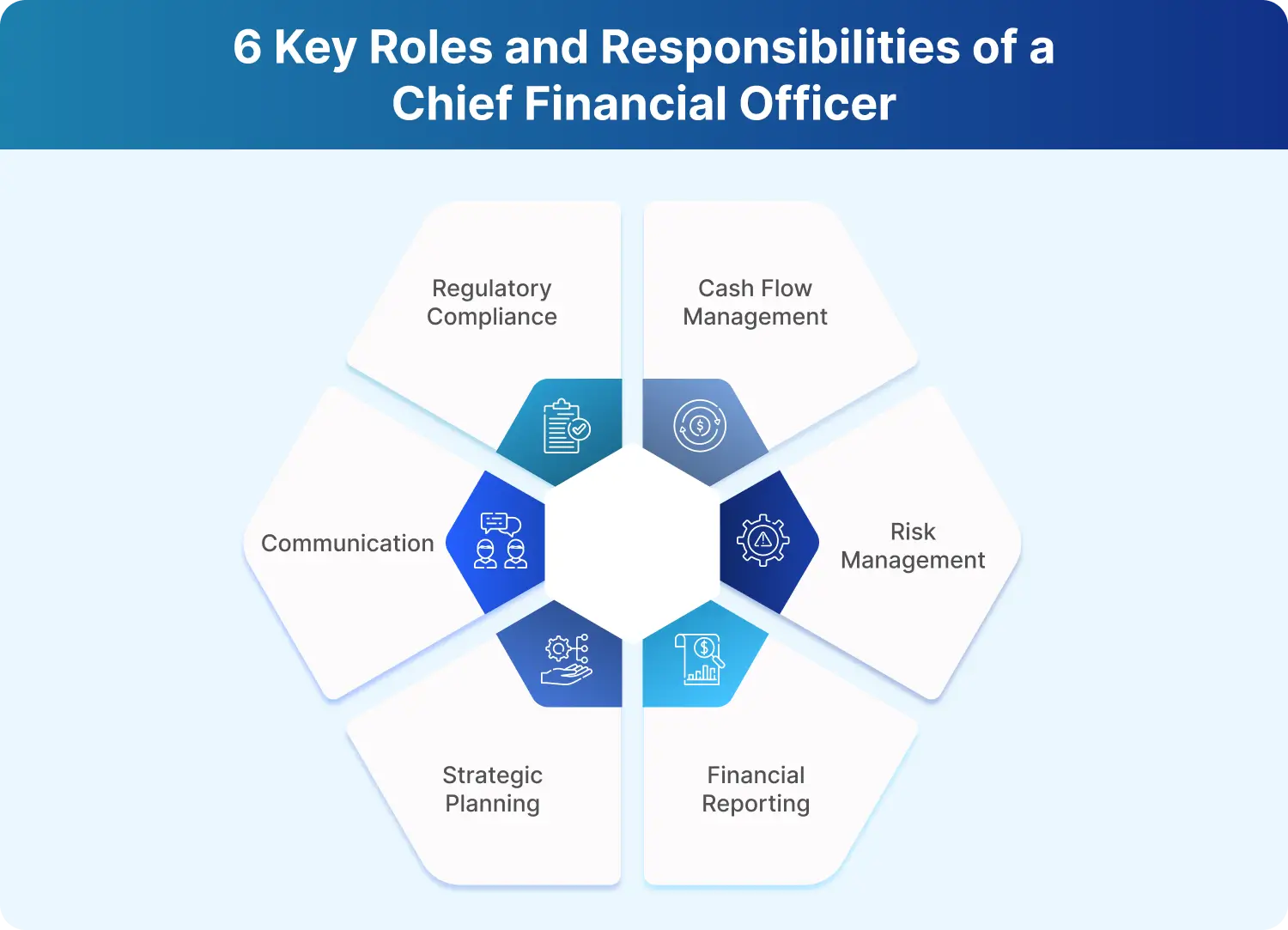
The following are the main responsibilities of Chief Finance Officer:
1. Cash Flow Management
Chief Financial Officers are involved in the management of cash flows. This is the process of making sure that they understand forecasting and optimize the cash flow of the company. Cashflow management is a process of money movement in and out of the company over a certain time period. This is the key factor in any business success.
The aspects of cash flow management include:
- Calculation of Cash Flows: This is done by adding net income, noncash items, and working capital changes.
- Cash Flow from Operating Activities: This is cash obtained through regular business activities of the organization, such as selling goods, manufacturing, or providing services.
- Forecasting: This involves forecasting cash flows to anticipate financial needs and plan accordingly.
- Cash Flow Types: This includes understanding different types of cash flows, such as operating, investing, and financing cash flows.
- Optimizing Accounts: This includes managing accounts payable and receivable effectively to improve cash flow.
- Automation: Automation is implemented to increase efficiency and accuracy in cash flow management processes.
A positive cash flow means inflows are greater than outflows, and if negative it means outflow is greater than inflows. Chief Financial Officers must report the cash flow in their financial statements.
2. Risk Management
This role has expanded to include strategic risk management in response to uncertainties to financial uncertainties and regulatory complexities. The risk management that the chief financial officer is responsible for include:
- Assessment of Risk: Identify potential risks, evaluate their likelihood of occurrence, and analyze their impact on the company.
- Risk Management Strategy: Develop and organize a comprehensive approach to risk management, including priority assumption, constraints, acceptance criteria, and tolerance levels.
- Monitoring of Risk: Control and monitor the probability and impact of adverse events to mitigate their effects.
- Insurance Coverage: Determine appropriate insurance coverage to safeguard against potential risks.
- Human Resource Policies: Establish and implement HR policies to minimize potential liabilities and ensure compliance with regulations.
- Legal Affairs: Effectively manage the legal affairs of the company to avoid legal disputes and promote organizational compliance.
As the chief finance officer has access to data that govern the overview of the company and the risks they can impact, they should work closely with the board of directors to establish and maintain strong governance and internal controls.
3. Financial Reporting
This involves record compilation and tracking how the money in the business is used and managed. This will involve revenue streaming, cost of goods sold, operating expenses, current assets, liabilities, and owner equity.
The different types of reports that the chief finance officer should produce include:
- Income statement by month or year
- Comparisons to budget
- Cash Flow forecasts
- Sales reports
- Inventory reports
- Financial trend analysis
This will provide an in-depth picture of the performance of the company and its financial situation financially. They should be well organized and easy to understand.
4. Strategic Planning
A chief finance officer is very crucial in strategic planning implementation as he uses data to determine the direction of the company and how it can meet its financial goals. These roles include:
- Data-Backed Decision: Use forecasting tools and reports to aid in strategic decisions through thorough data analysis.
- Business Direction: Ensure that teams follow specific directions to enhance business profitability, efficiency, growth, and productivity.
- Financial Goals: Play a key role in determining both short-term and long-term business objectives.
- Budget and Cost Management: Ensure the business maintains liquidity to cover all expenses and make informed financial decisions.
- Talent Recruitment: Collaborate with Human Resources to create opportunities for attracting high-performing financial talents.
Strategic plans may have several steps that involve the determination of strategic positions, objectives prioritization, plan development, managing and executing the plan, and revising and reviewing the plan.
5. Communication
This is a crucial skill and entails the chief finance officer being able to:
- Act as Strategic Business Partners: Collaborate with senior management to provide strategic insights and support for key business decisions.
- Sharing of Financial Knowledge: Possess in-depth knowledge of current financial topics and demonstrate the ability to identify risks and opportunities based on financial data.
- Manage the Finance Team: Beyond communication, they must effectively lead and manage the finance team to ensure efficiency and alignment with business goals.
They should keep the communication short and on point focusing on items that are relevant in making sure they confirm the understanding from the audience.
6. Regulatory Compliance
A chief finance officer is responsible for the business's financial health and this includes regulatory compliance, regulatory management involves the management of the business's legal and financial well-being. This includes:
- Payroll filings
- Ta regulations
- Corporate governance
They are also involved in the management of cash flow, strategy and forecasting, financial planning and analysis (FP&A), and liquidity and treasury management.
They, therefore make sure that the company adheres to all laws and regulations that are applicable. They also develop and implement policies and procedures and ensure compliance with all the laws.
Understanding CFO Roles and Stakeholder Dynamics
Stakeholders are groups or individuals who have an interest in any or all financial decisions that are made by the organization. They can use the technology to analyze data, automate tasks, create reports, and give real-time insights.
The internal stakeholders include the CEO, Chairperson, Leadership team, finance team, and employees. The eternal stakeholders include shareholders, investors, customers or suppliers, banks, and regulators. For the CFO to succeed in the role he has, he must balance across all vital programs.
Various Types of Chief Finance Officer
There are Two Types:
- Interim Chief Finance Officer: They usually offer temporary finance leadership during a transition or crisis, such as acquisitions or mergers. They normally ensure that the company maintains stability by providing expertise, which helps them maintain a healthy situation.
- Strategic planning chief finance officer: They formulate corporate strategies that align with the company’s goals.
Other Types Include:
- Corporate CFO Consultant: They may lead the financial aspects of the business as they are highly experienced in business finance. Their role involves developing and maintaining budgets, networking with investors, and raising funds. They also analyze business data and create forecasts.
- Virtual CFO: They are financial experts offering remote financial services to organizations on a part time basis. They perform various tasks like cashflow management budgeting and forecasting, and financial business advice.
- Public Sector CFO Specialist: They focus on development of public sector finance. They focus on expenditure management, SCM revenue management, budget management and compliance. They act as thought leaders in public sectors and SCM and offer financial leadership. They perform their duties through continuous engagement, strategic gatherings and other impacts.
- Full Time CFO: They manage the finances of a company on a full time basis. However the cost of sustaining this type of CFO is substantial and includes the salary, benefits, and overheads.
Frequently Asked Questions
Why is the role of a Chief Finance Officer essential in organizations?
Chief Finance Officers manage the financial health of the organization and promote business growth. Through financial management, they are responsible for the company’s budgets, goals, and cash flows. They also ensure that the company complies with all regulatory requirements.
What business functions are most impacted by a Chief Finance Officer?
The Chief Finance Officer impacts many business functions, including financial planning and analysis, cash flow management, regulatory compliance, liquidity and treasury management, and strategic and operational advice.
How does the Chief Finance Officer role differ based on organizational type and maturity?
This has no big difference. Their role is the same in all organizations. The only thing that might differ is the magnitude of the roles. If the organization is large, they have more tasks to perform compared to smaller companies.
Which industries have seen a growing demand for a Chief Finance Officer?
The Bureau of Labour and Statistics (BIS) projects an 8% increase in job growth for top executives between 2029 to 2030, which includes the Chief Finance Officer. They will continue to grow, especially in financial services sectors. The reasons might be:
- Rise in basic salaries and other benefits.
- There is a continuous labor shortage in this role.
- Digital transformation acceleration.
- In certain industries, there are abnormally high quits.
- Integration of AI and machine learning in key business processes.
What are the common challenges faced by a Chief Finance Officer?
Chief Finance Officers face the following challenges:
- Risk Management: Managing the risk of macroeconomic trends like worker shortage and inflation. This may involve employee layoffs, cost-cutting, or investment.
- Cash Flow: Ensuring sufficient cash to sustain business growth and cover the loss of revenue during recess periods, especially when interest rates are high.
- Supply Chain: Managing disruptions due to labor shortages and geopolitical uncertainties.
- ESG: Creating narrative reports in line with regulatory demands by gathering accurate data from the company.
- Talent: Attracting and retaining qualified talent.
- Adapting to Changes: Being prepared to adapt to the ever-changing business environments.
- Financial Strategies: Developing and implementing effective financial procedures, ensuring accurate forecasts, and developing an investment strategy.
Conclusion
The role of a Chief Financial Officer is more dynamic and demanding than ever before. From managing cash flows and regulatory compliance to risk assessment and strategic planning, a CFO serves as a cornerstone for an organization’s financial health and success.
With evolving business landscapes, CFOs are now expected to be strategic visionaries, adept problem-solvers, and influential communicators, capable of driving organizational growth and innovation. This evolution underscores the importance of not only financial acumen but also skills like leadership, adaptability, and collaboration.
For professionals aspiring to excel as CFOs, continuous upskilling and staying updated on industry trends are crucial. Corporate training providers like Edstellar can play a pivotal role in this journey. By offering cutting-edge solutions such as their Skill Matrix, Edstellar enables organizations to identify skill gaps, assess proficiencies, and design personalized learning pathways.
This ensures CFOs and finance teams are equipped with the latest competencies in areas like data analytics, cybersecurity, and strategic management empowering them to lead in an ever-changing business environment.
In conclusion, the Chief Financial Officer is no longer just a financial steward but a transformational leader essential for shaping a company’s future. Whether it's navigating economic uncertainties, driving digital transformation, or fostering strong stakeholder relationships, the modern CFO’s role is integral to business success.
Partnering with platforms like Edstellar helps ensure that CFOs and finance leaders remain ahead of the curve, prepared to meet the demands of a dynamic and competitive global economy.