6 Roles & Responsibilities of HR Business Partner in 2026
.webp)
.svg "edstellar")

In today’s rapidly evolving business landscape, the role of the HR Business Partner (HRBP) has transformed from a traditional administrative function to a strategic powerhouse that drives organizational success. As companies navigate workforce challenges, digital transformation, and changing employee expectations, HRBPs have emerged as critical architects of people strategy, bridging the gap between human capital and business objectives.
“The most important asset of any organization across industries is its people. HR as a function, has definitely evolved over the years from being seen as a support/operations partner to a strategic partner to the business."


An HR Business Partner is a senior-level human resources professional who serves as a strategic liaison between HR functions and business units. Unlike traditional HR roles focused primarily on administrative tasks, HRBPs serve as consultants and strategic advisors, aligning people strategies with organizational goals. They possess deep business acumen and HR expertise, enabling them to influence executive-level decision-making.
According to the 2025 SHRM State of the Workplace Research Report, 43% of HR professionals identified recruiting as their top priority in 2024, while 31% focused on employee experience and 27% on leadership development. These priorities underscore the multifaceted nature of the HRBP role, which must address talent acquisition, retention, and development simultaneously.
The evolution of this role has been significant. Research from The Josh Bersin Company in 2024 revealed that only 11% of companies have a systemic HR function operating at the highest level of maturity. Yet, these organizations are twice as likely to exceed financial targets and 12 times more likely to accomplish high levels of workforce productivity.
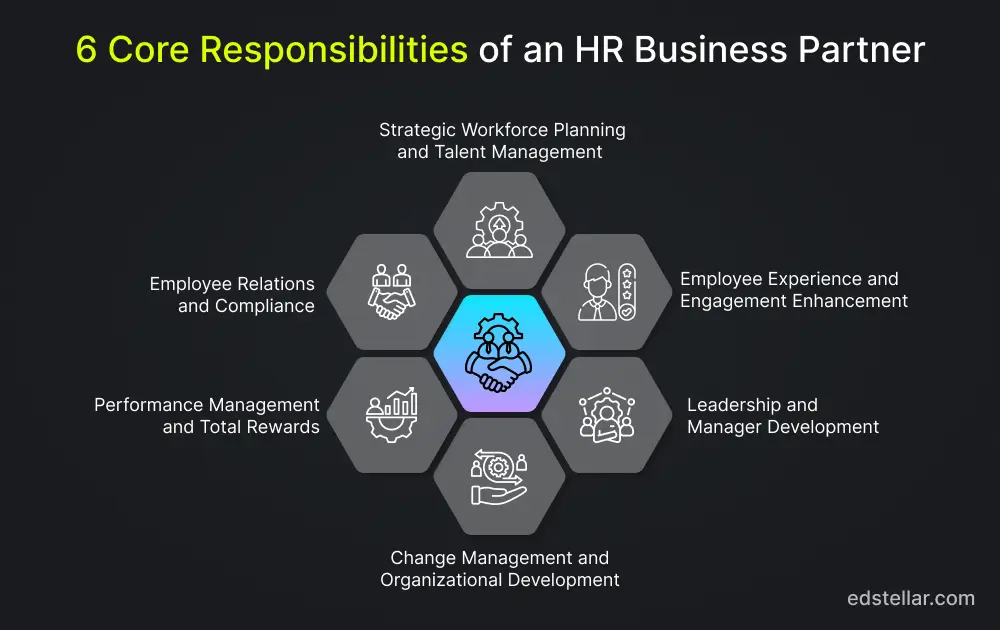
HRBPs play a pivotal role in aligning workforce capabilities with business strategies. According to Mercer’s 2024-2025 Global Talent Trends report, 48% of organizations are improving their workforce planning to inform better buy/build/borrow talent strategies, while 53% are designing talent processes around skills rather than traditional job descriptions.
The strategic nature of this responsibility involves:
Data from CIPD’s 2024 Resourcing and Talent Planning Report shows that 69% of organizations report increased competition for well-qualified talent, and 84% struggle to fill vacancies. This underscores the critical importance of HRBPs in navigating talent scarcity.
Creating exceptional employee experiences has become a strategic imperative. The 2025 SHRM report reveals that only 49% of HR professionals rated their organizations as effective in employee experience, yet organizations that prioritize this area see measurable business outcomes.
HRBPs enhance employee experience by:
Gallup’s 2024 State of the Global Workplace report found that global employee engagement fell from 23% to 21% in 2024, marking only the second decline since 2009. In the United States, engagement dropped to 31%, an 11-year low. This data emphasizes the urgent need for HRBPs to drive meaningful engagement strategies.
Developing effective leaders remains a top priority. Gartner’s 2024 HR Leaders Survey of 1,403 HR leaders identified leader and manager development as the number one organizational priority for 2025.
HRBPs contribute to leadership development through:
The 2025 SHRM report indicates that only 42% of U.S. workers felt their organizations were effective at leadership and manager development in 2024, with 35% reporting poor or ineffective management, highlighting a significant opportunity for HRBP intervention.
HRBPs serve as change agents, guiding organizations through transitions. Whether implementing new technologies, restructuring departments, or managing mergers, these professionals ensure that the people side of change is addressed effectively.
Their change management responsibilities include:
HRBPs design and run performance management systems that drive accountability, development, and business outcomes. They also partner with leaders to align compensation and recognition with performance so rewards actually reinforce the behaviors the organization wants to scale. To strengthen manager capability and improve performance conversations, many organizations invest in high-impact leadership training to equip leaders with coaching, feedback, and goal-setting skills that translate strategy into execution.
Performance management activities include:
Labor and employee relations emerged as the strongest-performing HR practice area in 2024, according to the 2025 SHRM report, with 70% of HR professionals rating their organizations as effective in this domain.
HRBPs manage employee relations by:
Organizations with effective HRBPs see measurable business outcomes. Research from the Josh Bersin Company in 2024 found that companies with systemic HR functions are seven times more likely to adapt effectively to change and achieve superior workforce productivity.
Retention has become increasingly challenging. CIPD’s 2024 report found that 56% of organizations report that retaining talent has become more difficult, rising to 71% in the public sector. HRBPs address this through targeted retention strategies, career development programs, and culture-building initiatives.
Forward-thinking HRBPs drive innovation by:
Mercer’s 2024 research indicates that 66% of organizations are focusing on improving people managers’ skills, while 58% are enhancing employee experience to attract and retain top talent.
The Josh Bersin Company study found that HRBPs currently excel at individually focused, low-impact work rather than shaping the company's future. Only 11% of HRBPs operate at the highest maturity level, suggesting significant room for role evolution.
According to Mercer’s 2024 Global Talent Trends, more than half of executives expect AI and automation to boost productivity by 10-30% by 2027, yet only about 40% believe their employees have the necessary skills. HRBPs must guide organizations through this technological transformation.
The 2025 SHRM report shows that 75% of organizations struggled to fill full-time roles in 2024, citing gaps in technical and soft skills. This creates pressure on HRBPs to develop robust upskilling and reskilling programs.
HR departments are stretched thin. The 2025 SHRM report found that 62% of HR professionals reported their departments were working beyond typical capacity in 2024, up from 57% in 2023. Additionally, 57% reported that their departments lacked sufficient staff to handle the workload.
Successful HRBPs invest time in understanding their business partners’ challenges, goals, and strategies. Regular meetings with department leaders, participation in business planning sessions, and proactive consultation establish credibility and trust.
Leading organizations such as The Lego Group, as highlighted by The Josh Bersin Company, allocate 70-80% of HRBPs to functional areas and 20-30% to priority projects. This approach ensures HRBPs develop expertise while maintaining strategic flexibility.
The 2025 SHRM report finds that HR technology effectiveness showed the second-strongest correlation with learning and development effectiveness (r = .67). HRBPs should champion technology adoption to enhance both efficiency and strategic impact.
The Josh Bersin Company notes that organizations spend a fraction of their HR development budget compared to their overall employee development budget. HRBPs should advocate for professional development opportunities, including certifications, workshops, and cross-functional projects.
The 2025 SHRM report reveals a significant shift: while recruiting dominated 2024 priorities, both HR professionals and workers identified leadership development (41%), employee experience (37%), and learning and development (25%) as top priorities for 2025, signaling a transition from talent acquisition to talent development.
Gartner’s 2024 research found that CEOs ranked workforce as their third most important business priority for 2024-2025, behind growth and technology. HRBPs will increasingly leverage AI for workforce planning, predictive analytics, and employee experience personalization.
Mercer’s 2024 research shows 53% of organizations are designing talent processes around skills rather than traditional roles. This shift requires HRBPs to reimagine talent management, focusing on capabilities rather than job titles.
Organizations seeking to develop high-performing HRBPs can benefit from comprehensive training programs that build both technical and strategic capabilities. Edstellar’s Human Resource training courses offer instructor-led, customizable programs designed to enhance HR professionals’ skills across talent acquisition, employee relations, performance management, and strategic planning.
Through Edstellar’s HR Excellence Program, organizations can revitalize their HR departments with custom-designed curricula led by industry experts. These programs address both soft and hard HR skills, ensuring that HRBPs are equipped to drive organizational success in an increasingly complex business environment.
For teams looking to strengthen specific competencies, Edstellar offers targeted training, including High Impact Leadership Training and HR Fundamentals Training, enabling HRBPs to develop the business acumen, strategic thinking, and leadership capabilities essential for success in modern organizations.
The HR Business Partner role has become a strategic imperative for organizations navigating complex workforce challenges, technological disruption, and evolving employee expectations. With employee engagement at an 11-year low and talent competition intensifying, HRBPs serve as critical architects of people strategy, driving performance, retention, and competitive advantage.
Research consistently shows that organizations with mature HR functions and effective HRBPs significantly outperform their peers across financial metrics, workforce productivity, and adaptability. As priorities shift from recruiting to employee development and engagement in 2025, HRBPs must continue evolving, embracing data-driven decision-making, leveraging technology, and developing deep business acumen.
Success as an HRBP requires balancing strategic consultation with operational excellence, building trust with business leaders, and continuously developing capabilities to meet emerging challenges. Organizations that invest in HRBP development and empower these professionals to operate as true business partners will be best positioned to thrive in the dynamic workplace of the future.
#On-site #Virtual #GroupTraining #Customized
Explore 2000+ industry ready instructor-led training programs.

Create dynamic leaders and cohesive teams. Learn more now!

Do a quick Skill gap analysis with Edstellar’s Free Skill Matrix tool

Unlock premium resources, tools, and frameworks designed for HR and learning professionals. Our L&D Hub gives you everything needed to elevate your organization's training approach.
Access L&D Hub Resources.svg)
.svg)
.svg)
.svg)

.svg)


.svg "Click Here to Follow on Medium")
.svg)


