10 Most In-Demand Skills in Ghana for 2026

.svg "edstellar")

Ghana's economy grew 5.7% in 2024 and accelerated to 6.1% through the first three quarters of 2025, the fastest pace since 2019, yet the country faces a structural paradox: over 380,000 new job seekers enter the labour market every year while employers across technology, healthcare, mining, and construction cannot find workers with the skills they need. According to Ghana Statistical Service data, national unemployment averaged 12.8% across the first three quarters of 2025, with youth unemployment for ages 15 to 24 at 32.5%. Approximately 1.34 million young Ghanaians are classified as NEET (not in education, employment, or training), and 7 in 10 unemployed persons in the country are youth.
The gap between what the education system produces and what the economy demands is widening. A UNICEF report on Ghana's TVET sector found that out of 57 pre-tertiary vocational institutions surveyed in the Ashanti Region, only one offered agriculture-related training despite high labour demand, and just four provided ICT training despite the digital economy's rapid expansion. At the same time, Ghana's fintech sector has driven financial inclusion to 81% with mobile money transaction values reaching GHS 3.01 trillion in 2024 (a 56.8% year-on-year increase), gold exports account for over half of the country's $16.5 billion in total exports, and the government has secured $200 million from the World Bank for the Ghana Digital Acceleration Project. GSMA projects that Ghana's digital economy could add $3.4 billion and 500,000 jobs by 2029.
So which skills in demand in Ghana should corporate L&D leaders, HR managers, and workforce planners focus on? This guide identifies the top 10 high demand skills in Ghana across technology, healthcare, mining, agriculture, and infrastructure. It draws on Ghana Statistical Service data, MOEL employment reports, World Bank policy notes, the Cyber Security Authority's assessments, and industry hiring data to map what jobs are in demand in Ghana, whether you are planning workforce development programmes, building AfCFTA-ready capabilities, or investing in one of West Africa's most dynamic economies.
Every ranking in this guide is backed by data from Ghanaian government bodies, international development partners, and local industry sources.
Ghana's skills demand reflects an economy in transition: a traditional agricultural and mining base layered with one of Africa's fastest-growing digital and fintech ecosystems, chronic healthcare worker shortages, and massive infrastructure investment needs. The 10 skills below are ranked by a weighted research score factoring in government policy investment, shortage severity, salary premium, cross-sector applicability, and alignment with national priorities including the Ghana Digital Economy Policy, the AfCFTA headquarter advantage, and the Big Push infrastructure programme.
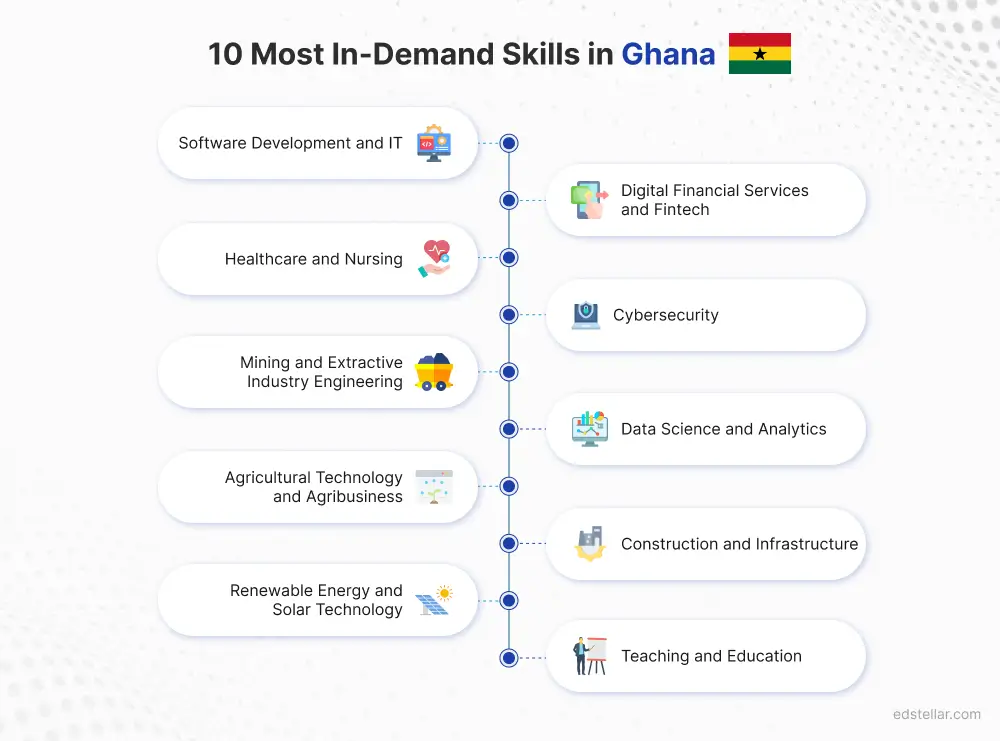

Ghana's ICT sector is one of the fastest-growing segments of the economy, with the software subsector valued at $200 million and over 100 tech hubs and accelerators spread across Accra, Kumasi, and Takoradi according to U.S. Commercial Service data. The Ghana Digital Acceleration Project (GDAP), backed by $200 million from the World Bank, aims to expand broadband access, enhance digital public services, and strengthen the digital innovation ecosystem. The Ghana Digital Economy Policy and Strategy, launched in November 2024, identifies digital skills as one of its five core pillars.
Despite this growth, the TVET report found that only four out of 57 vocational institutions surveyed offered ICT training, creating a severe pipeline bottleneck. Global technology companies including IBM, Cognizant, HPE, and TCS are active in Ghana through B2B and government engagements, while local companies like Hubtel, Zeepay, and Expresspay are scaling rapidly. The eSkills4Jobs programme, a collaboration between the government, the World Bank, and the Kofi Annan Centre of Excellence in ICT, targets training over 5,000 young people in essential digital skills, but demand far outstrips these numbers.
Entry-level IT professionals in Ghana earn GHS 3,500 to GHS 7,000 monthly, mid-level professionals earn GHS 8,000 to GHS 18,000, and senior developers can command GHS 20,000 to GHS 40,000 or more according to industry salary surveys. Senior developers at fintech companies and multinational firms earn at the top end of these ranges. Python, JavaScript, Java, PHP, and mobile development frameworks (Flutter, React Native) are the most requested skills, reflecting Ghana's mobile-first digital economy.
Fintech, E-commerce, Telecommunications, Government Digital Services
Explore Related Training:
AI Programming with Python Full Stack Development All Software Development Programs
Ghana ranks number one globally for mobile money regulation on the GSMA Mobile Money Regulatory Index, with overall financial inclusion reaching 81% in 2025, up from 68% in 2021. More than 60% of Ghanaian adults have a mobile money account, with 26.7 million active accounts and over 80 million registered accounts nationwide. Total mobile money transaction value reached approximately $300 billion in the most recent year, and the mobile money interoperability system grew 87% in transaction value during 2025 alone.
MTN Ghana generated $549 million in fintech revenue from Ghana alone in 2025, completing the merger of its mobile money operations into MobileMoney Fintech Ltd (MMFL) as an independently operated entity. The Bank of Ghana has actively supported fintech growth through regulatory sandboxes and digital payment mandates. Companies including Zeepay, Hubtel, Expresspay, Fidelity Bank, and Stanbic Bank are all expanding their digital financial services teams, creating demand for payment system architects, fraud detection specialists, and mobile platform engineers.
Fintech professionals in Ghana earn GHS 5,000 to GHS 25,000 monthly depending on role and experience, with senior payment architects and risk analysts at the higher end. Key skills include mobile money API integration, USSD application development, payment gateway architecture, regulatory compliance (Bank of Ghana directives), and fraud detection using machine learning. Ghana's position as the AfCFTA headquarters adds further demand for cross-border payment and trade finance expertise.
Mobile Network Operators, Banking and Insurance, Payment Processors, Microfinance

Ghana meets only 67% of its aggregate health workforce needs, translating into a shortage of 73,203 health professionals across 11 cadres according to research published in PMC. The doctor deficit stands at 7,876 (a 56% shortage), medical laboratory scientists face a 70.4% shortage, and pharmacists a 73.7% shortage. Paradoxically, over 100,000 trained health professionals remain unemployed due to government hiring freezes, and the gap is projected to grow to 161,502 health workers by 2035 without intervention. Ghana increased the density of physicians, nurses, and midwives from 1.07 per 1,000 population in 2005 to 2.65 per 1,000 in 2017, but this still falls well short of WHO's recommended threshold of 4.45 per 1,000.
The shortage is particularly acute in rural and northern regions. The registered general nurse stock is projected to reach 76,158 by 2025, a 27% increase from 2020, but much of this growth is concentrated in Accra and other urban centres. The Savannah, Northern, and Upper East regions face the most severe gaps, with community health facilities often staffed by a single nurse covering thousands of residents. Major teaching hospitals including Korle Bu, Komfo Anokye, and Tamale Teaching Hospital are all recruiting, but brain drain to the UK, US, and Gulf states continues to drain the pipeline.
Registered nurses in Ghana earn GHS 2,500 to GHS 6,000 monthly, with specialist nurses and those at private hospitals earning more. Doctors earn GHS 8,000 to GHS 25,000 monthly depending on specialisation and seniority. Key shortage areas include geriatric care (as Ghana's elderly population grows), mental health services, surgical nursing, and community health. Digital health skills including telemedicine platform operation and health data analytics are increasingly valued as the government expands e-health initiatives.
Public Health Service, Teaching Hospitals, Private Hospitals, NGO Health Programmes
"The poverty gap is a technology gap. The mastery of technology is what separates developed countries from developing ones. Digital technologies are no longer a luxury but a necessity, and this policy will ensure every Ghanaian, regardless of social or geographic status, benefits from this transformation."



Ghana needs over 5,000 additional cybersecurity professionals to meet current demand, with this number expected to grow by 30% annually through 2027 according to industry assessments. The Cyber Security Authority (CSA), established under the Cybersecurity Act 2020 (Act 1038), regulates cybersecurity activities and promotes capacity development. Ghana's rapid digital payment adoption, with $300 billion in mobile money transactions, has made the financial sector a prime target for cybercriminals, driving urgent demand for security professionals who understand both technology and the West African threat landscape.
The CSA coordinates national cyber defence and works with the National Communications Authority (NCA) on regulatory compliance. As more government services go digital through the GDAP initiative, the attack surface expands, creating demand for professionals who can secure public sector systems alongside private enterprise networks. Key employers include MTN Ghana, Vodafone Ghana, Stanbic Bank, Fidelity Bank, and the growing number of fintech startups that must comply with Bank of Ghana cybersecurity directives. Cloud security engineers are increasingly sought after as Ghanaian enterprises migrate to cloud platforms.
Cybersecurity professionals in Ghana earn GHS 5,000 to GHS 20,000 monthly, with senior security architects and compliance officers at larger institutions earning more. Key certifications valued by Ghanaian employers include CISSP, CEH, CompTIA Security+, and ISO 27001 Lead Auditor. International certifications command a significant premium in the Ghanaian market, as the domestic cybersecurity training pipeline remains small relative to demand.
Banking and Financial Services, Telecommunications, Government, Fintech
Explore Related Training:
Cybersecurity Risk Management Threat Intelligence All Cybersecurity Programs
Gold exports accounted for $9.58 billion in 2024, representing more than half of Ghana's total export earnings of $16.5 billion. Ghana's gold output is projected to reach 4.4 to 5.1 million ounces in 2025, buoyed by increased production from Newmont's Ahafo South and Shandong's Namdini mine. Newmont achieved commercial production at Ahafo North in September 2025, creating 560 permanent and 1,000 contracted roles, with a workforce pipeline focused on building skilled professionals from local communities.
Major mining operators including AngloGold Ashanti, Gold Fields (operating Tarkwa and Damang mines producing approximately 700,000 ounces combined), Perseus Mining, and Asante Gold Corporation are all investing in workforce development. The sector requires mining engineers, geologists, environmental compliance specialists, heavy equipment operators, and processing plant technicians. Ghana has set a December 2026 deadline for foreign miners to transition operations to local Ghanaian contractors, a policy shift that will reshape workforce planning across the sector. As mining companies also adopt digital technologies for autonomous drilling, fleet management, and ore-body modelling, demand is growing for professionals who combine traditional mining expertise with data analytics and automation skills.
Mining engineers in Ghana earn GHS 8,000 to GHS 30,000 monthly, with senior geologists and processing plant managers at multinational companies commanding higher compensation. Environmental compliance specialists are increasingly valued as Ghana's Environmental Protection Agency (EPA) tightens regulations on mining operations. The sector also requires occupational health and safety professionals, particularly for underground and open-pit operations where Ghana has historically faced safety challenges.
Gold Mining, Bauxite and Manganese, Oil and Gas, Environmental Consulting

Ghana's expanding digital economy is generating data at a scale the country has never seen before, from mobile money transactions and digital banking to agricultural supply chains and public health records. The Ghana Digital Economy Policy identifies data and emerging technologies as one of its five strategic pillars, and the National Information Society Agency coordinates data-driven government initiatives. Financial institutions including Stanbic Bank, Fidelity Bank, and Ecobank Ghana are building analytics teams to power credit scoring, fraud detection, and customer segmentation for the growing digital banking customer base.
The mining sector uses data analytics for ore-body modelling, production optimisation, and environmental monitoring. Telecommunications companies MTN Ghana and Vodafone Ghana analyse network data and customer behaviour patterns at scale. The public health sector is increasingly data-driven, with the Ghana Health Service using analytics for disease surveillance, resource allocation, and vaccination campaign planning. Understanding how data analysts contribute across these sectors helps organisations define clearer hiring criteria.
Data analysts in Ghana earn GHS 4,000 to GHS 15,000 monthly, with data scientists and senior analytics managers at financial institutions and mining companies earning GHS 12,000 to GHS 25,000. Key skills in demand include Python, R, SQL, Power BI, Tableau, and experience with cloud analytics platforms. The domestic pipeline for data science talent is growing through programmes at the University of Ghana, KNUST, and Ashesi University, but demand significantly exceeds supply, particularly for professionals with both technical skills and domain expertise in finance, health, or mining.
Financial Services, Mining, Telecommunications, Public Health

Agriculture employs approximately 35% of Ghana's workforce and remains the backbone of rural livelihoods, yet the UNICEF TVET report found that only 1 out of 57 vocational institutions surveyed offered agriculture-related training. Ghana's agritech sector includes 75 companies, with 21 having secured funding according to Tracxn data. Esoko reaches over 1 million smallholder farmers via SMS and voice messages on market prices, weather updates, and best farming practices, while Farmerline's Mergdata platform serves over 1.7 million farmers across Africa with agricultural advisory services in multiple local languages.
The gap between traditional farming and technology-enabled agriculture represents one of Ghana's largest workforce development opportunities. Complete Farmer, one of Ghana's most funded agritech startups, connects commercial farming with technology platforms. Farmerline's Grow programme employs community-based agents (Grow Ambassadors) as digital extension workers, creating a new category of tech-enabled agricultural jobs. The Planting for Food and Jobs programme has been a government priority, though its successor under the current administration is evolving. Cocoa production, Ghana's second-largest export commodity, is ripe for technology-driven efficiency improvements in areas like traceability, quality control, and supply chain management.
Agritech professionals in Ghana earn GHS 3,000 to GHS 12,000 monthly, with agricultural engineers and supply chain specialists at larger companies earning more. Key skills in demand include precision agriculture technology, drone operation for crop monitoring, agricultural data analytics, cold chain logistics management, and digital extension service delivery. Professionals who combine agronomic knowledge with digital skills are particularly scarce and valuable.
Commercial Farming, Cocoa Processing, Agritech Startups, Food Processing

Ghana's construction industry employs approximately 420,000 people and is forecast to return to pre-crisis growth levels by the end of 2026, with average annual sector growth of over 5% projected between 2024 and 2027 according to Oxford Business Group. The government issued commitment authorisations for 32 road infrastructure projects under the Big Push Programme, and major railway investments include the Western Railway Line ($3.2 billion) and the Eastern Railway Line ($2.2 billion build-operate-transfer project).
The sector faces significant skills challenges. High costs of building materials, inadequate funding, and the need for a skilled workforce are cited as the primary headwinds. Skilled tradespeople including masons, carpenters, electricians, plumbers, and heavy equipment operators are in chronic short supply, and the TVET system has not produced enough construction-trained graduates to meet demand. Companies including Contracta Construction, Amandi Group, and China State Engineering compete for the limited pool of qualified site supervisors, quantity surveyors, and structural engineers.
Construction professionals in Ghana earn GHS 3,000 to GHS 15,000 monthly for skilled trades, while civil engineers and project managers earn GHS 8,000 to GHS 25,000. Key skills in demand include structural engineering, quantity surveying, site management, heavy equipment operation, and increasingly, building information modelling (BIM). The Big Push Programme and railway investments are expected to create thousands of construction jobs over the next five years, intensifying the skilled worker shortage.
Road and Bridge Construction, Railway Infrastructure, Housing Development, Water and Sanitation
The Bui Power Authority has installed 250 MWp of solar capacity and is developing Africa's largest floating solar farm, with a 50 MW phase completed and plans to expand to 250 MW by 2030. Ghana targets 500 MW of renewable energy capacity, and the government's Renewable Energy Master Plan (REMP) promotes solar, wind, small-scale hydropower, and biomass development. The deployment of off-grid solar systems and mini-grids has brought electricity to thousands of rural households, creating demand for installation, maintenance, and operations professionals.
Solar companies operating in Ghana include PEG Africa (pay-as-you-go solar), Black Star Energy, SolarNow Ghana, and BPA Solar. The Bui Power Authority's solar projects alone have created construction, engineering, and operations jobs across the Northern and Bono regions. As Ghana's Renewable Energy Act mandates increasing the share of renewables in the national energy mix, demand for solar PV technicians, energy auditors, and grid integration specialists will continue to grow. Mini-grid development for rural electrification represents a particularly strong growth area.
Renewable energy professionals in Ghana earn GHS 4,000 to GHS 15,000 monthly, with electrical engineers specialising in solar and grid integration at the higher end. Key skills include solar PV system design and installation, battery storage systems, mini-grid engineering, energy auditing, and environmental impact assessment. International certifications from organisations like NABCEP (North American Board of Certified Energy Practitioners) and REA (Renewable Energy Association) are valued in the market.
Solar Energy, Power Generation, Rural Electrification, Environmental Consulting
Explore Related Training:
Renewable Energy and Sustainability All Environmental Sustainability Programs
Ghana has expanded education access dramatically: Senior High School gross enrolment tripled from 25% to 72% between 2001 and 2023, driven by the Free SHS policy. However, quality has not kept pace with access. The pupil-to-trained-teacher ratio exceeds 50 in the Northern, North East, and Savannah regions, more than double the ratio of 25 recorded in Greater Accra according to the 2025 Ghana Statistical Service education report. In 2022, 8.5% of Junior High School teachers lacked formal training in teaching.
The regional disparity is the central challenge. A 2025 study found that 68% of teaching vacancies in rural schools remain unfilled, while the Ghana Education Service received over 40,000 applications for just 7,000 positions when it opened recruitment in 2026, demonstrating that the problem is distribution, not supply. STEM subjects (mathematics, science, and ICT) have the most severe teacher shortages across all regions. The National Teaching Council regulates teacher licensing, and the government has introduced rural posting incentives, but retention in deprived areas remains a persistent problem. Private and international schools in Accra are also competing for the limited pool of qualified teachers.
Teachers in Ghana earn GHS 2,000 to GHS 5,000 monthly in the public sector, with private and international school teachers earning GHS 4,000 to GHS 10,000. Key shortage areas include STEM teaching (particularly mathematics and science), special needs education, early childhood education, and ICT instruction. Teachers who combine subject expertise with digital pedagogy skills are particularly valued as Ghana's education system increasingly integrates technology into classrooms.
Public Basic Education, Senior High Schools, Private and International Schools, Vocational Training Centres
"The One Million Coders Programme aims to train one million Ghanaians in digital skills such as coding, data science, software development, cybersecurity, and other emerging technology fields. Accessible technology is not a privilege, but a human rights obligation."


Ghana Economic Expansion and Jobs: World Bank analysis of why Ghana's strong GDP growth has not translated into adequate job creation, covering structural challenges and skills development priorities.
Ghana's most acute workforce problem is not a lack of young people entering the job market. It is the mismatch between what vocational and tertiary institutions teach and what employers actually need. Understanding this mismatch helps L&D leaders and HR managers identify where external training investment will have the greatest impact.
The most offered TVET trade, fashion design and garment, has an oversupply of graduates, while the sectors with the most acute shortages (ICT, agriculture, green technology) have almost no TVET presence. For corporate training teams, this means that external upskilling programmes are not a supplement to the education system but often the only viable pathway to building the workforce capabilities that Ghana's economy requires.
Pete Ford is a corporate training specialist with over 15 years of experience in training methodologies, employee engagement, and performance improvement. He has a proven track record of developing and implementing effective training programs that enhance employee skills and productivity.
#On-site #Virtual #GroupTraining #Customized
Explore 2000+ industry ready instructor-led training programs.

Create dynamic leaders and cohesive teams. Learn more now!

Do a quick Skill gap analysis with Edstellar’s Free Skill Matrix tool

Unlock premium resources, tools, and frameworks designed for HR and learning professionals. Our L&D Hub gives you everything needed to elevate your organization's training approach.
Access L&D Hub Resources.svg)
.svg)
.svg)
.svg)

.svg)


.svg "Click Here to Follow on Medium")
.svg)


