10 Most In-Demand Skills in Finland for 2026
.webp)

.svg "edstellar")

Finland's labour market in 2025 presents a paradox: unemployment reaches 10.3% by October 2025, yet employers across technology, healthcare, and green energy report that finding qualified talent is their single biggest growth obstacle. The Ministry of Economic Affairs and Employment tracks 56 shortage occupations spanning ICT, health services, construction, and industry. In June 2025, the Finnish government issued a landmark decree naming nine professions so critically understaffed that foreign workers can switch employers freely without requiring new permit applications.
Understanding which skills are in demand in Finland is essential intelligence for any professional, organisation, or hiring team operating in the Finnish market.
For foreign professionals, Finland's job market in 2025 presents a rare combination of structured immigration pathways and genuine employer urgency. Finland's Talent Boost programme actively channels international talent into shortage roles, and the country's technology sector alone needs 130,000 new hires by 2030. Whether assessing high demand jobs in Finland for foreigners, benchmarking workforce readiness, or planning corporate training investments, this guide ranks the top ten in-demand skills using government barometers, industry federation surveys, and live job-market data.
Every ranking in this guide is backed by data from Finland's government bodies, industry federations, and live labour market platforms. Below are the primary sources that informed each skill's demand score, shortage classification, and narrative.
Finland's shortage list spans both highly specialised professional roles and essential public service occupations. The skills below reflect where hiring pressure is highest in 2026, from AI engineers and cybersecurity specialists to nurses, physicians, and construction tradespeople.
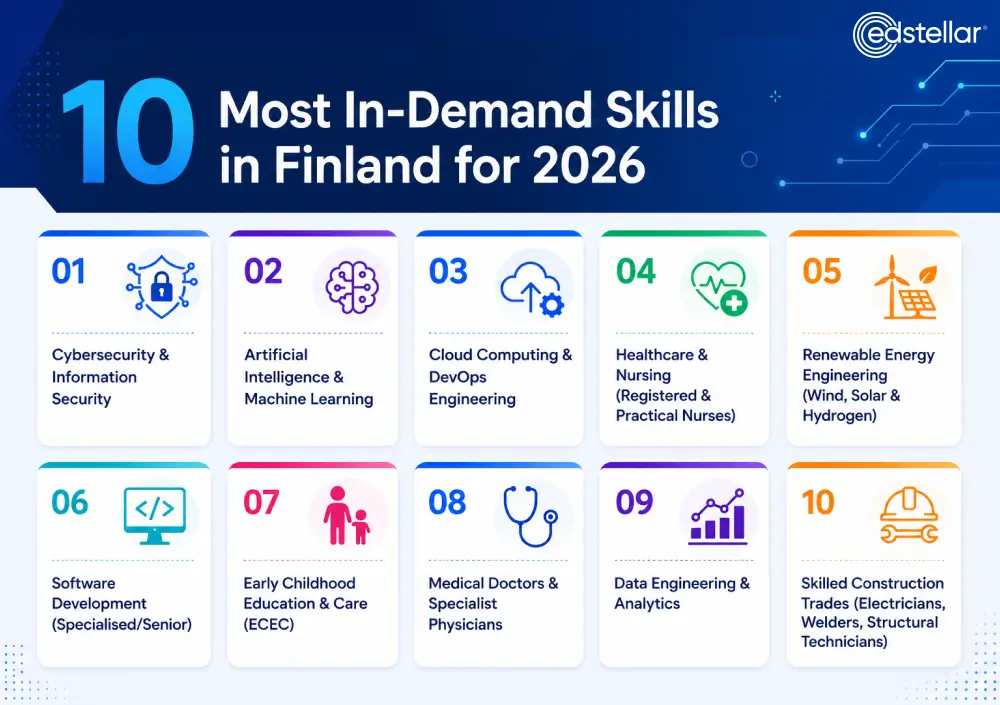

Finland's Cybersecurity Act 124/2025, which entered into force on 8 April 2025 as the national transposition of the EU's NIS2 Directive, pulled approximately 5,500 organisations into mandatory compliance obligations, up from roughly 1,100 under NIS1. This fivefold expansion of the regulated perimeter created an immediate, legally mandated demand for cybersecurity professionals across every critical sector: energy, finance, healthcare, telecommunications, and public administration. The Finnish government simultaneously revised its National Cybersecurity Strategy 2024–2035, and the DNV funding programme allocated EUR 2 million to Finnish companies strengthening cyber resilience.
Duunitori's 2025 market data confirms cybersecurity as one of the top skills Finnish employers actively seek, with SOC analysts, penetration testers, and NIS2 compliance managers in short supply despite a general contraction in ICT job postings. Finland's cybersecurity market is projected to reach USD 471.7 million by 2029. Professionals with strong cybersecurity skills have some of the clearest entry pathways into Finland's structured, growing market with regulatory tailwinds ensuring demand will not dissipate.
Finland's technology sector is growing at 15%, adding 25,000 or more positions, and 66% of Finnish firms now use GenAI tools, a statistic that directly escalates security requirements as AI-powered attack surfaces expand. Organisations across the private and public sectors are simultaneously managing cloud migration, OT/ICS security for industrial systems, and incident response readiness.
Information Technology, Finance & Banking, Energy & Utilities, Telecommunications, Public Administration, Healthcare
Explore Related Training:
Cloud Penetration Testing Cybersecurity Risk Management All Cybersecurity Programs
Finland holds a remarkable distinction in Europe: 66% of Finnish firms reported using generative AI tools in late 2025, nearly double the EU average of approximately 35%, making it the EU's top adopter of GenAI technology. This exceptional adoption rate creates urgent, compound demand for professionals who can build, deploy, govern, and optimise AI systems at scale. The Finnish Center for Artificial Intelligence (FCAI) and the newly launched ELLIS Institute Finland both drive research investment.
Technology Industries of Finland's 2025 workforce survey found that 82% of member companies intend to recruit internationally for higher-education-level skills over the next four years, with AI explicitly among the targeted competencies. The technology sector needs 140,000 new professionals over the next decade, and AI engineering roles account for a disproportionate share of the most acute shortages.
For professionals in the Finland jobs in demand space, the AI skillset is the most versatile entry point: demand spans technology, manufacturing, financial services, healthcare technology, gaming, and retail. Professionals who have mastered the essential AI and ML engineering skills for 2026, including LLM fine-tuning, MLOps, and AI governance, will be best positioned as the market matures through 2026 and beyond.
Technology, Manufacturing, Financial Services, Healthcare Technology, Gaming, Retail & E-commerce
Explore Related Training:
Computer Vision with Python Computer Vision with TensorFlow All Artificial Intelligence Programs"In Finland and the Nordics in general, there has been high curiosity towards artificial intelligence and machine learning. However, despite the early interest, studies indicate that most companies are just beginning their journey in AI adoption."



Cloud infrastructure skills rank as the third most-demanded technical competency in Duunitori's 2025 employer data, with roles for cloud engineers, site reliability engineers (SREs), and DevOps specialists identified as persistently undersupplied. Finland's public and private sector digital transformation, aligned with the EU's Digital Decade 2030 targets, requires substantial cloud migration capability across government services, financial institutions, manufacturing firms, and telecommunications providers.
Uusimaa, Finland's most economically active region, posted approximately 3,450 ICT job advertisements between January and August 2025, with cloud and DevOps roles among the most contested. Notably, while national ICT postings fell 16% year-on-year, Pirkanmaa grew 4% and Northern Ostrobothnia grew 7%, demonstrating that regional demand remains robust outside the capital.
Cloud engineers with AWS, Azure, Kubernetes, and CI/CD expertise command average salaries of EUR 4,400 per month, with top earners exceeding EUR 10,000, among the highest in Finland's ICT sector. The Talent Boost Programme explicitly targets technology professionals in these roles for international recruitment.
Information Technology, Financial Services, Public Sector & Government, Telecommunications, Manufacturing, Media & Entertainment
Explore Related Training:
Multi-Cloud (AWS + Azure) with DevOps AWS Cloud Financial Management for Builders All Cloud Computing Programs
Nurses and practical nurses are among the nine occupations on Finland's government June 2025 critical shortage decree, a landmark policy allowing foreign permit-holders to change employers freely within the healthcare sector without a new permit application. Finland's occupational barometer consistently places health and social service professionals at the top of shortage lists, and CEDEFOP's 2024 mismatch data confirms nurses as a priority shortage occupation. The 2025–2030 nursing demand analysis projects the shortfall growing from 309 in 2025 to over 15,000 by 2030 without additional measures.
Finland's ageing population is a structural, long-term driver of healthcare demand that operates independently of short-term fiscal pressures. The social and health care workforce is projected to grow from 150,000 to 220,000 employees, and TE-palvelut logged 2,342 open practical nurse positions at a single point in time in 2025. The government has signed bilateral recruitment cooperation agreements with India, Brazil, Vietnam, and the Philippines specifically to channel healthcare talent into Finnish hospitals.
For nurses considering Finland jobs in demand as a career destination, the combination of government-backed immigration reform, structured professional recognition pathways through OPH, and competitive salaries within Finland's wellbeing services counties makes this one of the most accessible high-demand professions for international applicants. Finnish language proficiency at B2 level is a practical requirement for most patient-facing roles.
Public Healthcare (Wellbeing Services Counties), Private Healthcare (Mehilainen, Terveystalo), Elderly Care, Mental Health Services, Home Care Services
Explore Related Training:
ChatGPT for Healthcare Healthcare Data Analysis With Machine Learning All Leadership Communication Programs
Finland's legally-binding carbon neutrality target of 2035, ten years ahead of the EU's main timeline, has triggered EUR 294 billion in planned green transition investments confirmed by the EK Confederation of Finnish Industries as of April 2025. Wind capacity has already reached 8,200 MW with offshore expansion underway, while Plug Power's USD 6 billion three-plant green hydrogen investment and a EUR 1.4 billion Verso Energy sustainable aviation fuel plant in Oulu signal massive near-term project demand for specialist engineers.
Finland's green hydrogen economy alone is projected to create 240,000 jobs and add EUR 69 billion in economic value over its full development arc, representing one of Europe's most significant cleantech employment opportunities. The Business Finland Hydrogen and Batteries Programme is actively co-funding R&D and skills development, creating a structured pipeline from education to employment in this sector.
For corporate training leaders at Finnish engineering firms, EPC contractors, and cleantech manufacturers, this is the sector where skills gap risks are most acutely tied to revenue-generating project timelines. A single delayed offshore wind project due to a shortage of qualified installation technicians or hydrogen electrolyser specialists can cost millions. Structured upskilling in wind turbine maintenance, grid integration, and project management for large-scale energy infrastructure is an immediate business priority.
Wind Energy, Green Hydrogen, Sustainable Aviation Fuel, Solar Energy, Energy Storage & Batteries, Cleantech Manufacturing
Explore Related Training:
Asana Project Management Project Management with Trello All Quality Management Programs
While overall ICT postings fell 16% in January through August 2025 versus the prior year, Duunitori's analysis reveals a sharply polarised market. Experienced software developers with niche skills in AI integration, financial systems, and embedded software remain in acute shortage, even as junior generalist roles face increased competition. Finland's technology industry needs 140,000 new professionals over the next decade, and senior software engineers command average salaries of EUR 4,400 per month, with top earners exceeding EUR 10,000.
CEDEFOP's mismatch data lists software developers as a priority shortage in Uusimaa, and Teknologiateollisuus' survey confirmed 82% of member companies plan international tech recruitment over the next four years. The gaming industry (Supercell, Rovio), fintech sector, defence technology, and industrial automation all compete for the same shallow pool of senior specialists.
Full-stack developers with AI integration capability, test automation maturity, and domain-specific knowledge in financial or industrial systems are the profiles Finnish employers find hardest to source. Upskilling current mid-level developers into senior specialists is a faster and more cost-effective route than competing for an already thin external talent pool.
Technology & Software, Financial Technology, Gaming & Entertainment, Telecommunications, Industrial Automation, Defence & Security
Explore Related Training:
Python Automation Testing C++ for Embedded Systems All Software Development Programs
Finland faces a structural shortage of qualified ECEC teachers driven by mandatory qualification thresholds rising through 2030, requiring two-thirds of ECEC centre staff to hold higher education degrees. The six largest Finnish cities Helsinki, Espoo, Tampere, Vantaa, Oulu, and Turku alone report a shortage of 2,600 or more ECEC professionals currently and project needing 9,000 new higher-education-qualified staff by 2030.
The Ministry of Education and Culture has responded with EUR 10 million for a 2025–2026 pilot integrating work and study in ECEC, plus EUR 41 million allocated by OPH to create 1,886 new higher-education places in shortage fields including early childhood education. The national training cost to meet the 2030 qualification target is estimated at EUR 360 million or more.
For international ECEC professionals considering this pathway, Finnish language proficiency is a non-negotiable professional requirement for all client-facing roles. For L&D and HR professionals at larger private ECEC chains or municipal operators, identifying and funding staff qualification pathways from practical nurse level to higher education ECEC teacher status is the most strategic workforce investment available.
Public Municipal ECEC Services, Private Day-Care Centres, Special Needs Early Education, Family Day Care Supervision
Explore Related Training:
All Leadership Communication Programs"Anticipating skills needs and training will help us be successful in a changing world. There is already a shortage of expertise in circular economy and other sustainability solutions in many sectors. We need to identify future skills needs today so that we can respond to change in time."


General practitioners and specialist physicians are among Finland's nine officially designated critical shortage occupations under the June 2025 government decree, enabling foreign-trained doctors to change employers without new permit applications. CEDEFOP data shows 110 open dentist positions against just 70 qualified unemployed candidates, illustrating the acute imbalance across the medical profession. Regional disparities are severe: Kainuu recorded a 20% vacancy rate in physician posts.
Finland's ageing population is increasing healthcare utilisation while the working-age cohort of physicians contracts due to retirements, creating a structural gap that cannot be resolved through domestic training alone. More than 220 full-time physician positions are unfilled nationally, and the government has launched bilateral recruitment cooperation agreements with India, Brazil, Vietnam, and the Philippines specifically to source medical professionals.
For international physicians evaluating best jobs in Finland, the combination of official shortage status, active government recruitment partnerships, employer-sponsored relocation support, and salaries of EUR 5,000 to EUR 8,000 or more per month makes this one of the most structured and rewarding pathways into Finland's labour market. Finnish or Swedish language proficiency at B2 to C1 level is required for patient-facing roles.
Public Primary Care (Health Centres), Hospital Districts & Wellbeing Services Counties, Occupational Health, Private Healthcare (Mehilainen, Terveystalo, Pihlajalinna), Mental Health Services
Explore Related Training:
ChatGPT for Healthcare Healthcare Data Analysis With Machine Learning All Leadership Communication Programs
Data engineering and analytics skills rank as the fourth most-demanded technical competency identified by Duunitori in its 2025 employer survey, driven by Finnish companies' rapid adoption of AI tools that require clean, well-engineered data pipelines to function correctly. Finland's position as Europe's leading GenAI adopter at 66% firm adoption creates compounding downstream demand: every generative AI deployment is only as reliable as the data infrastructure supporting it.
Finland's financial services sector (Nordea, OP Group, Danske Bank Finland), manufacturing industry (Kone, Wartsila, Metso), and retail segment are all undergoing data-driven transformation that requires architects who can design scalable data warehouses, govern data quality, and build real-time analytics pipelines.
Professionals with the needed skills for data scientists in 2026, including cloud data warehousing (Snowflake, BigQuery, Databricks), business intelligence tooling (Power BI, Tableau), and data quality engineering with tools like dbt, are the most sought-after data professionals in Finland's market.
Technology, Financial Services & Insurance, Retail & E-commerce, Manufacturing & Logistics, Public Sector Analytics, Healthcare Data
Explore Related Training:
Data Warehousing and Business Intelligence Data Warehousing with BigQuery All Data Analytics Programs
Building and related trades workers rank as Finland's second-largest shortage occupation group in CEDEFOP's 2024 mismatch data, with 12 construction occupations among TEM's 56 shortage listings. Metal processing operators, including welders, appear directly on the June 2025 official critical shortage decree, confirming the acute nature of the gap. Finland's EUR 294 billion green transition investment pipeline through 2035 requires a large skilled trades workforce that cannot be sourced domestically.
The real estate and construction sector is projected to create 130,000 to 140,000 new job openings between 2020 and 2040, a demand trajectory driven by infrastructure renewal, green building retrofits, and the physical construction of renewable energy assets. Shipbuilding at Meyer Turku, steel fabrication for offshore wind foundations, and industrial facility construction for hydrogen plants all compete for the same limited pool of certified tradespeople.
For Finland skilled immigration list purposes, skilled construction trades offer a practical pathway for international workers with recognized certifications. The Occupational Safety Card (Tyoturvallisuuskortti) is required for all construction site workers in Finland, and welding certifications to EN ISO standards are directly transferable. Finnish construction sites have strict safety and quality standards that investment in SFS 6000 electrical standard training and BIM literacy accelerates the pathway from arrival to full productive employment.
Construction & Civil Engineering, Renewable Energy Infrastructure, Shipbuilding & Marine, Metal & Mechanical Engineering, Building Maintenance & Renovation, Industrial Manufacturing

Living and Working in Finland: EURES official guide covering key job sectors, salary expectations, work contracts, and workplace culture for professionals considering Finland.
Finland's skills demand varies significantly across its regions, shaped by local industry concentrations and the geographic distribution of infrastructure investments. Understanding these patterns helps corporate L&D teams target training investments where they will deliver the greatest impact.
Uusimaa (Helsinki region) dominates technology, finance, and cybersecurity hiring, accounting for the largest share of Finland's ICT job openings. Pirkanmaa around Tampere is the second-largest tech hub, with growing demand for AI, automation, and software development professionals. Northern Ostrobothnia (Oulu) is emerging as Finland's cleantech and renewable energy hub, with the Verso Energy sustainable aviation fuel plant and multiple hydrogen projects creating concentrated demand for engineering talent. For organisations operating across multiple Finnish locations, aligning training programmes with these regional demand patterns ensures that upskilling investments match actual hiring needs.
"Now, if ever, it's time to invest in the quality of education and research. The shortage of experts has long hampered the sustainable growth of businesses. As a nation, we need to strengthen our own capabilities."

#On-site #Virtual #GroupTraining #Customized
Explore 2000+ industry ready instructor-led training programs.

Create dynamic leaders and cohesive teams. Learn more now!

Do a quick Skill gap analysis with Edstellar’s Free Skill Matrix tool

Unlock premium resources, tools, and frameworks designed for HR and learning professionals. Our L&D Hub gives you everything needed to elevate your organization's training approach.
Access L&D Hub Resources.svg)
.svg)
.svg)
.svg)

.svg)


.svg "Click Here to Follow on Medium")
.svg)


