10 Most In-Demand Skills in Ireland for 2026

.svg "edstellar")

Ireland's labour market sits at an extraordinary intersection of global technology investment and domestic workforce pressure. As home to the European headquarters of Apple, Google, Meta, LinkedIn, Salesforce, and Microsoft, the country hosts over 1,700 foreign direct investment companies employing more than 300,000 people, yet the Department of Enterprise, Trade and Employment's Critical Skills Employment Permit list grows longer every year. ManpowerGroup's 2025 Global Talent Shortage Survey found 76% of Irish employers reporting difficulty filling roles, among the highest rates in Europe.
The challenge is not confined to tech. Ireland's construction sector needs 50,000 additional workers by 2030 to deliver 300,000 homes under the Government's Housing for All plan. The HSE is operating with approximately 7,500 vacancies in nursing, midwifery, and allied health professions. And Ireland's position as the world's second-largest pharmaceutical exporter means life sciences skills shortages carry global supply chain consequences. Whether you are asking what skills are in demand in Ireland in the technology sector, healthcare, or construction, the answer is the same: urgency is everywhere.
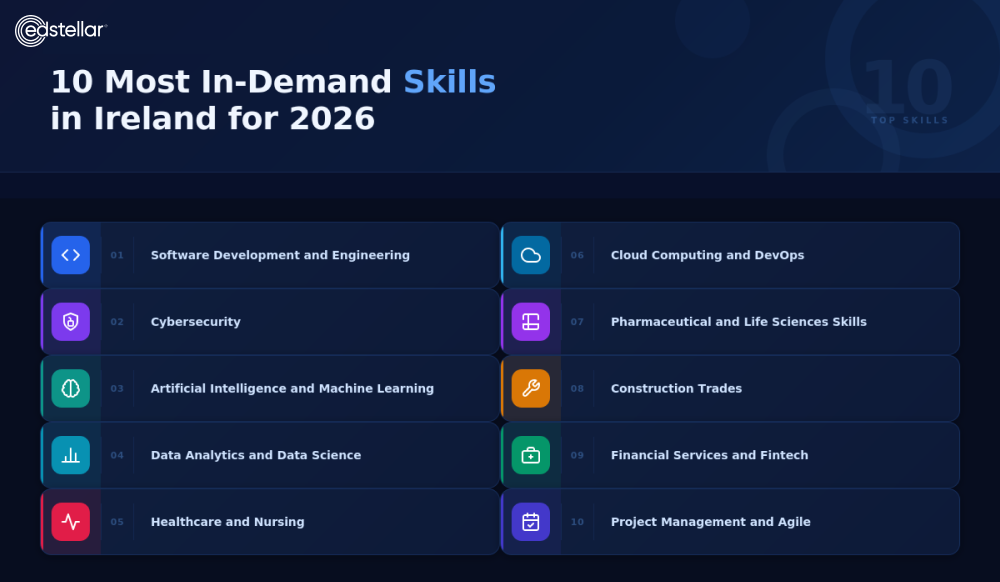
This guide ranks the 10 most in-demand skills in Ireland for 2025 and 2026, using a weighted methodology that prioritises local government data, Irish industry body reports, and employer surveys. For each skill, you will find the policy evidence behind the demand, the industries driving it, and practical paths to closing the gap.
Every ranking in this guide is backed by data from Irish government bodies, industry federations, and established hiring platforms. We weighted Ireland-specific sources more heavily than global reports, because local data reflects what is actually happening across the Irish labour market. Here is where the numbers come from.
Ireland's shortage list spans technology multinationals competing for engineers, a healthcare system under structural pressure, a construction sector racing to meet housing targets, and a pharmaceutical industry requiring specialist talent at global scale. The skills below reflect where hiring pressure is highest in 2026.

Software development and engineering sits at the top of Ireland's in-demand skills list for one simple reason: the country is the European headquarters for the world's largest technology companies. Apple, Google, Meta, LinkedIn, Salesforce, Microsoft, and Amazon all run major Irish operations, and they are all competing for the same limited pool of qualified engineers. The Department of Enterprise, Trade and Employment's Critical Skills Employment Permit list has ranked software engineers and developers at the top for years, and that position shows no sign of changing.
With Ireland's tech sector employing over 160,000 people in 2025 and IDA Ireland continuing to win new FDI investment in AI, cloud, and digital infrastructure, demand for software professionals is structural rather than cyclical. Median salaries for experienced software engineers range from EUR 70,000 to EUR 100,000+, with senior and specialist roles commanding EUR 120,000 to EUR 150,000 in Dublin. The gap between the number of computer science graduates produced domestically and the number of engineering roles available has not closed despite significant expansion in third-level provision.
For organisations building engineering capability, the core sub-skills include full-stack development, Python and Java engineering, cloud-native application development, APIs and microservices architecture, and mobile development for iOS and Android.
Technology Multinationals, Financial Services and Fintech, Pharma and Life Sciences, Retail Technology, Government Digital Services
Explore Related Training:
Full Stack Web Development Python Programming All Software Development Programs
Ireland's position as the data processing hub of Europe, hosting the EU headquarters of Meta, Google, Microsoft, and Apple, makes it a high-value target for cyber attacks. The National Cyber Security Centre's Annual Report 2024 showed a 23% year-on-year increase in significant cyber incidents. IBEC's ICT sector surveys consistently rank cybersecurity as the single hardest skill to recruit in Ireland, with vacancy periods for cyber roles regularly exceeding 18 months. The National Cyber Security Strategy is being refreshed for 2025 onwards with expanded investment in NCSC operational capacity.
The Digital Operational Resilience Act (DORA), which entered force across EU financial services in January 2025, has added a new compliance dimension to cybersecurity demand. Every bank, insurer, and investment firm regulated in Ireland must now demonstrate ICT risk management and incident response capability, creating a second wave of hiring urgency beyond the technology sector. When you combine Ireland's role as a global data custodian with binding EU regulatory requirements, the case for cybersecurity as one of Ireland's most in-demand skills is irrefutable.
Key sub-skills include network security, cloud security, SIEM and threat detection, penetration testing, and governance, risk and compliance (GRC).
Technology Multinationals, Financial Services and Insurance, Government and Public Sector, Healthcare IT, Critical National Infrastructure
Explore Related Training:
Cybersecurity Risk Management Oracle Cloud Infrastructure Security Professional All Cybersecurity Programs"As AI transforms the world of work, Irish employees and employers are navigating rapid change and new opportunities. The message from workers is urgent: they want tools and support to adapt."



Ireland's National AI Strategy "AI: Here for Good" was refreshed in 2024 with a renewed commitment to positioning Ireland as an EU leader in responsible AI adoption. Science Foundation Ireland committed EUR 90 million to AI research centres, including the ADAPT Centre (focused on AI-driven digital content) and the Insight SFI Research Centre for Data Analytics. IDA Ireland's 2025 FDI results show AI and data analytics investment accounting for a growing proportion of wins, with Google DeepMind, Meta AI, and Microsoft Azure AI all expanding their Irish teams.
For Irish employers, AI skill demand is no longer a future-state concern. Organisations across financial services, healthcare, retail, and manufacturing are actively deploying AI tools and discovering that their existing workforce lacks the capability to build, manage, or critically evaluate these systems. AI engineers in Ireland command median salaries of EUR 95,000 to EUR 130,000, with AI product managers and ML engineers among the fastest-rising salary bands in the country. LinkedIn Ireland data shows a 40%+ year-on-year increase in AI-specific job postings between 2024 and 2025.
Priority sub-skills include machine learning engineering, natural language processing, computer vision, generative AI development, and AI ethics and governance.
Technology Multinationals, Financial Services, Healthcare, Pharma and Life Sciences, Retail
Explore Related Training:
Introduction to Natural Language Processing (NLP) NLP with Python All Artificial Intelligence Programs
Ireland's "Harnessing Digital: Digital Ireland Framework" targets Ireland as a global data hub, and the country already hosts the European data centres for Google, Amazon AWS, Meta, Microsoft, and Apple. SOLAS's FET Forward strategy identifies data analytics as a priority skill across all employment sectors. SkillNet Ireland's 2025 workforce development survey found data literacy as the top learning and development priority cited by Irish businesses, with 68% of organisations reporting difficulty hiring qualified data professionals.
The demand for data professionals in Ireland is unusually broad. Financial services firms need data engineers to build regulatory reporting pipelines for the Central Bank of Ireland. Pharma companies need biostatisticians and quality data analysts. Retailers need demand forecasting and supply chain analytics capability. Government departments implementing Sláintecare and Housing for All need workforce and project data analytics. SkillNet Ireland's data programmes are oversubscribed by 200%, which is as clear a market signal as exists. Data roles grew 35% in Irish job postings between 2024 and 2025.
Key sub-skills include data analysis and visualisation, SQL and Python for data, business intelligence, data engineering and ETL, and statistical modelling.
Technology, Financial Services, Pharma and Life Sciences, Retail and E-commerce, Public Sector
Explore Related Training:
Data Warehousing and Business Intelligence Business Analytics Fundamentals All Data Analytics Programs
The HSE National Service Plan 2026 identifies workforce as its primary operational challenge, with approximately 7,500 whole-time equivalent vacancies across nursing, midwifery, and allied health professions. The Irish Nurses and Midwives Organisation's vacancy survey for Q4 2025 recorded 3,400+ nursing vacancies in public hospitals alone. The DETE has maintained nursing and midwifery on the Critical Skills Employment Permit list every year, reflecting the Government's recognition that domestic training output cannot meet demand.
The Sláintecare reform programme is reshaping Ireland's health service into Regional Health Areas (RHAs), a transformation that requires substantial workforce expansion over the next five years. New regional hospitals, expanded primary care networks, and the shift from acute to community-based care all demand additional nursing and allied health capacity. An ageing population, workforce retirements, and persistent burnout among existing staff compound the structural shortage. The vacancy rate for nursing roles in Irish public hospitals sits above 10%, making this among the most acute skills shortages in demand in Ireland by volume.
Key sub-skills in demand include general nursing (RGN), mental health nursing, midwifery, theatre and ICU nursing, and allied health professions including physiotherapy and occupational therapy.
HSE Acute Hospitals, Primary Care Centres, Mental Health Services, Disability Services, Community Healthcare

Ireland hosts the European data centres for Amazon Web Services, Microsoft Azure, and Google Cloud Platform, making it one of the most cloud-intensive economies per capita in the world. IDA Ireland's Digital Infrastructure strategy positions Ireland as Europe's primary cloud hub, and that investment is generating enormous demand for professionals who can architect, deploy, and manage cloud environments. SkillNet Ireland's cloud learning programmes are consistently oversubscribed, and industry estimates suggest 12,000+ cloud-specific roles need to be filled in Ireland by 2027.
AWS, Microsoft, and Google all operate dedicated skills academies in Ireland, yet the gap between available talent and open roles continues to widen. The National Digital Strategy designates cloud and infrastructure skills as critical to public sector modernisation, and government departments are actively recruiting cloud architects to support the transition of legacy systems. DevOps engineers who can bridge development and operations are among the highest-paid professionals in the Dublin market, with senior roles regularly commanding EUR 100,000 to EUR 130,000.
Key sub-skills include Amazon Web Services (AWS), Microsoft Azure, Google Cloud Platform, DevOps and CI/CD pipeline management, and Kubernetes and Docker containerisation.
Technology Multinationals, Financial Services, Government Digital Services, Retail and E-commerce, Healthcare IT
Explore Related Training:
Multi-Cloud (AWS + Azure) with DevOps AWS Security Engineering All Cloud Computing Programs
Ireland is the world's second-largest exporter of pharmaceuticals after Germany, with nine of the world's ten largest pharma companies operating in the country. Pfizer, Johnson & Johnson, AbbVie, Eli Lilly, Medtronic, Boston Scientific, and Abbott all have major Irish manufacturing or research operations. IDA Ireland's Life Sciences 2030 strategy aims to sustain Ireland's position as a global pharma hub as companies invest in biologics and cell and gene therapy manufacturing, requiring highly specialised skills not yet widely available in the domestic workforce.
Pharmachemical Ireland has identified a critical need for 5,000+ additional skilled workers in manufacturing, quality assurance, and regulatory affairs over the next three years. Bioprocessing engineers command EUR 65,000 to EUR 95,000, and quality assurance specialists are consistently included on the DETE's Critical Skills Employment Permit list. The shift from small-molecule chemistry to biologics and advanced therapy medicinal products (ATMPs) means existing pharma workers must retrain, adding an upskilling dimension alongside the hiring challenge.
Priority sub-skills include GMP and quality assurance, bioprocessing engineering, regulatory affairs, validation engineering, and lean manufacturing and process excellence.
Pharmaceutical Manufacturing, Medical Devices, Bioprocessing, Contract Research Organisations, Diagnostics
"Strengthening capability, skills and talent among any size team is critical for Irish SMEs seeking to grow internationally. Ability to attract, develop and retain right skills is essential."


The Government's "Housing for All" plan targets 300,000 homes by 2030, requiring a construction workforce of approximately 165,000, up from around 130,000 currently. The Construction Industry Federation estimates a shortfall of 50,000+ workers needed by 2030 to deliver both housing targets and the National Development Plan, which commits EUR 165 billion to public capital investment in transport (MetroLink, DART+, BusConnects), schools, hospitals, and energy infrastructure. Without a rapid workforce expansion, these targets are at serious risk of further delay.
SOLAS reported a 14% decline in construction apprenticeship completions in 2024, precisely the opposite of what Ireland needs. With housing affordability at a crisis point and multiple major infrastructure programmes simultaneously under delivery, the construction sector is the most visible bottleneck in Ireland's economic and social development agenda. The CIF's outlook consistently shows that skilled tradespeople, including electricians, plumbers, bricklayers, and carpenters, are among the hardest roles to fill in the country, competing with better-marketed tech and financial services careers for school leavers.
Key trades in shortage include bricklaying and masonry, electrical installation, plumbing and heating, carpentry and joinery, and civil engineering groundworks.
Residential Construction, Infrastructure and Civil Engineering, Commercial Development, Energy Infrastructure, Public Sector Building Programmes

Ireland's "Ireland for Finance" strategy has accelerated the country's financial services expansion, with post-Brexit relocations adding over 5,000 financial services jobs to Ireland since 2021. The Banking and Payments Federation Ireland reports financial services employing 55,000+ people in the country, with Ireland now home to the largest number of financial services firms authorised under EU passporting rules. The Central Bank of Ireland has expanded its supervisory headcount by 25% to manage the growing number of regulated entities, itself creating demand for compliance and risk professionals.
FinTech Ireland recorded 40%+ growth in fintech employment between 2022 and 2025, with companies including Stripe, Mastercard, Citi, and Fiserv all running significant Irish operations. The Digital Operational Resilience Act (DORA), which entered force in January 2025, has created urgent demand for professionals who combine financial services knowledge with ICT risk management capability. The intersection of regulation, technology, and finance makes this a skills area where generalist professionals are being displaced by specialists, and where hybrid competency commands a significant salary premium.
Key sub-skills include risk management and regulatory compliance (GDPR, MiFID II, DORA), FinTech and payments development, financial analysis and modelling, AML and KYC, and ESG reporting and sustainable finance.
Banking, Insurance, Investment Management, Fintech and Payments, International Financial Services (IFSC)
Explore Related Training:
Environmental Protection and Sustainability Global Environmental Law and Governance All Data Analytics Programs
The National Development Plan commits EUR 165 billion in public capital investment across transport, housing, healthcare, and energy infrastructure. MetroLink, DART+, BusConnects, new national children's hospitals, and offshore wind projects all require sustained project management capacity at a scale Ireland has not previously needed to maintain. The Major Projects Advisory Group has repeatedly identified project management capability gaps across government departments as a primary contributor to cost overruns and delivery delays.
In the private sector, every technology transformation, regulatory change programme, and product launch requires qualified project and programme managers. PMI Ireland chapter membership grew 28% between 2023 and 2025, and SkillNet Ireland project management programmes are consistently fully booked. Agile methodology in particular is in high demand across Dublin's technology sector, where iterative delivery models have become the norm for software development. Professionals with both traditional PMP or PRINCE2 credentials and Agile/Scrum experience command the strongest salary premiums.
Key sub-skills include Agile and Scrum methodology, PMP and PRINCE2 certification, risk management, stakeholder engagement, and programme and portfolio management.
Technology, Infrastructure and Construction, Financial Services, Healthcare, Public Sector
Explore Related Training:
Construction Project Management Earned Value Management in Primavera All Project Management Programs"With talent shortages growing and resources stretched, it is concerning that firms contributing 1% of payroll to National Training Fund cannot access supports to prepare workforce."


Irish Economic Outlook: Central Bank of Ireland quarterly bulletin covering economic growth, employment trends, and labour market conditions shaping Ireland's workforce.
Ireland's skills demand varies across its regions, shaped by the concentration of FDI operations in Dublin and Cork, the strength of the MedTech cluster in Galway, and the national distribution of construction and healthcare needs. Understanding these regional patterns helps corporate L&D teams target training investments effectively.
Dublin dominates technology and financial services hiring, accounting for the majority of Ireland's software engineering, cybersecurity, and AI/ML roles. Cork is the country's pharma and life sciences capital, anchored by Pfizer, Eli Lilly, and Johnson & Johnson operations alongside a growing technology cluster. Galway's MedTech corridor, centred around Medtronic and Boston Scientific, creates concentrated demand for bioprocessing and quality assurance talent. Construction and healthcare shortages are distributed nationally, with the most acute pressure in Dublin, Cork, and Galway where population growth outpaces infrastructure delivery.
Pete Ford is a corporate training specialist with over 15 years of experience in training methodologies, employee engagement, and performance improvement. He has a proven track record of developing and implementing effective training programs that enhance employee skills and productivity.
#On-site #Virtual #GroupTraining #Customized
Explore 2000+ industry ready instructor-led training programs.

Create dynamic leaders and cohesive teams. Learn more now!


Do a quick Skill gap analysis with Edstellar’s Free Skill Matrix tool

Unlock premium resources, tools, and frameworks designed for HR and learning professionals. Our L&D Hub gives you everything needed to elevate your organization's training approach.
Access L&D Hub Resources.svg)
.svg)
.svg)
.svg)

.svg)


.svg "Click Here to Follow on Medium")
.svg)


