8 Must-Have Skills for a Cloud Engineer

.svg "edstellar")

The cloud computing landscape is undergoing a fundamental transformation. What began as a straightforward infrastructure migration strategy has evolved into a complex ecosystem demanding multidimensional expertise. Cloud engineers who once focused primarily on deployment and maintenance now find themselves at the intersection of artificial intelligence, security governance, financial optimization, and business strategy.
“I’ve only been in tech for a few years, but one challenge is universal for cloud engineers the complexity and scale of cloud infrastructure. It can quickly become a performance, security, and cost problem, especially early in your career. The way through is staying current on tools and best practices, and being resourceful about applying them."


The evolution reflects broader market dynamics. Gartner identified six critical trends reshaping infrastructure and operations in 2025, with cloud capabilities embedded across all dimensions. Organizations are not simply seeking cloud engineers; they are searching for professionals who can architect resilient systems, optimize costs, integrate AI workloads, and navigate complex security landscapes while maintaining operational excellence.
This transformation creates both opportunity and urgency. The World Economic Forum’s Future of Jobs Report 2025 projects 170 million new jobs by 2030, with technology roles anchoring this growth. However, success in this new era requires more than knowledge of traditional cloud platforms. Engineers must develop a strategic skill portfolio that addresses emerging challenges while building on foundational competencies.
Multi-cloud architecture has transitioned from a competitive advantage to an operational necessity. Organizations no longer debate whether to adopt multi-cloud strategies; they now focus on how to optimize them effectively. This shift creates demand for engineers who can design cohesive systems spanning multiple cloud providers while managing complexity, cost, and performance.
Multi-cloud proficiency extends beyond basic platform familiarity. Engineers must understand the architectural nuances of AWS, Microsoft Azure, and Google Cloud Platform, recognizing when each provider’s native services offer optimal solutions for specific workloads. They architect systems that leverage AWS’s extensive compute options, Azure’s enterprise integration capabilities, and GCP’s data analytics strengths without creating operational silos or introducing unnecessary complexity.
The skill encompasses workload portability strategies that enable organizations to shift applications across environments based on cost, performance, or compliance requirements. Engineers design abstraction layers using containerization and orchestration technologies that prevent vendor lock-in while maintaining system reliability. They implement unified observability frameworks that provide consistent visibility across diverse cloud environments, enabling operational teams to monitor, troubleshoot, and optimize performance regardless of the underlying infrastructure.
Data residency and sovereignty requirements add another dimension to multi-cloud expertise. Engineers must design architectures that comply with regional regulations while maintaining system performance and user experience. They implement intelligent routing mechanisms that direct workloads to appropriate geographic regions based on data classification, user location, and regulatory requirements.
Edstellar’s Multi-Cloud (AWS + Azure) with DevOps training equips professionals with practical skills to design, automate, and manage workloads across multiple cloud platforms, helping them address the complexity modern organizations face.
Artificial intelligence is reshaping cloud infrastructure requirements at an unprecedented pace. Cloud engineers now face the dual challenge of supporting traditional enterprise workloads while accommodating the intensive computational demands of AI and machine learning applications. This convergence creates entirely new skill requirements that blend infrastructure expertise with AI operational knowledge.
The integration challenge begins with infrastructure sizing and optimization. AI workloads demand substantially different resource profiles than traditional applications, requiring engineers to understand GPU architectures, high-bandwidth networking, and specialized storage systems optimized for processing massive datasets. Engineers must design infrastructure that scales dynamically based on training workloads while managing costs that can escalate rapidly with inadequate oversight.
Model deployment and serving introduce additional complexity. Engineers implement MLOps pipelines that automate model training, validation, deployment, and monitoring across cloud environments. They design inference architectures that balance latency requirements with cost efficiency, determining when to use specialized AI accelerators versus general-purpose compute. They establish version control systems for models and datasets to ensure reproducibility and regulatory compliance.
AI workload security presents unique challenges. Engineers implement controls that protect sensitive training data, prevent model theft, and ensure inference results meet privacy requirements. They design systems that detect and prevent adversarial attacks targeting AI models while maintaining performance and user experience.
Organizations can develop these critical capabilities through Edstellar’s Artificial Intelligence training courses, which prepare teams to architect and deploy AI workloads effectively in cloud environments.
The ISC2 Cybersecurity Workforce Study revealed that 36% of organizations identified cloud security as their most pressing skills need in 2024, maintaining its position as a top priority alongside AI capabilities. This statistic underscores a fundamental reality: cloud security has evolved from a specialized domain to a core competency for every cloud engineer.
Zero-trust security models now define modern cloud architectures. Engineers must abandon perimeter-based security thinking and implement systems that verify every access request regardless of origin. This requires a deep understanding of identity and access management, implementing granular permissions that follow the principle of least privilege across all cloud services and resources.
Engineers design security that integrates seamlessly with development workflows without impeding velocity. They implement automated security scanning in CI/CD pipelines, catching vulnerabilities before code reaches production environments. They configure cloud-native security services that deliver real-time threat detection, automated response, and forensic analysis during incidents.
Compliance requirements add layers of complexity. Engineers must understand regulatory frameworks such as GDPR, HIPAA, SOC 2, and industry-specific regulations, and translate these requirements into technical controls. They implement audit logging systems that capture comprehensive activity data while managing storage costs and query performance. They design data classification systems that automatically apply appropriate protections based on sensitivity levels.
Encryption key management presents particular challenges in cloud environments. Engineers implement key rotation policies, design systems that maintain encrypted data access during key transitions, and ensure keys themselves remain protected against unauthorized access. They balance security requirements with operational needs, ensuring encryption doesn’t create performance bottlenecks or complicate disaster recovery procedures.
Edstellar’s Cloud Security training programs prepare professionals to implement comprehensive security frameworks that protect cloud infrastructure while enabling business agility.
Modern cloud operations demand automation at every layer. The days of manual infrastructure configuration have given way to Infrastructure as Code (IaC) practices that treat infrastructure with the same rigor as application development. Engineers who master these practices drive efficiency, reduce errors, and enable their organizations to scale operations without proportional increases in operational overhead.
IaC proficiency begins with declarative infrastructure definition using tools like Terraform, AWS CloudFormation, Azure Resource Manager, or Google Cloud Deployment Manager. Engineers define desired infrastructure states in version-controlled code, enabling peer review, testing, and rollback capabilities previously impossible with manual configurations. They design modular infrastructure components that promote reusability across projects and teams while maintaining consistency and reducing configuration drift.
GitOps practices extend IaC principles into operational workflows. Engineers implement systems that route infrastructure changes through Git repositories, triggering automated validation, testing, and deployment pipelines. They design approval workflows that balance security requirements with deployment velocity, ensuring critical infrastructure changes receive appropriate oversight without creating bottlenecks.
Configuration management extends beyond initial infrastructure deployment. Engineers implement systems that continuously verify that the actual infrastructure state matches the desired configurations and automatically remediate drift that could introduce security vulnerabilities or performance issues. They design self-healing systems that detect and respond to failures without human intervention, improving reliability while reducing operational burden.
Policy as Code adds another layer of automation. Engineers define infrastructure compliance requirements in code and automatically validate that configurations meet security, cost, and operational standards before deployment. They implement guardrails that prevent misconfigurations while giving development teams freedom to innovate within defined boundaries.
Organizations seeking to develop these capabilities can explore Edstellar’s DevOps training courses, which cover automation, Infrastructure as Code, and continuous delivery practices essential for modern cloud operations.
The global cloud FinOps market is projected to grow from $14.34 billion in 2025 to $32.83 billion by 2033, reflecting the critical importance organizations place on cloud cost management. Cloud engineers must now balance technical excellence with financial responsibility, developing skills that bridge infrastructure optimization with business value delivery.
FinOps expertise begins with cost visibility. Engineers implement comprehensive tagging strategies that enable granular cost allocation across business units, projects, and environments. They design dashboards that make cloud spending transparent to stakeholders who lack technical backgrounds, translating complex billing data into actionable insights that drive decision-making.
Right-sizing represents a continuous optimization process. Engineers analyze resource utilization patterns to identify instances where provisioned capacity exceeds actual demand. They implement automated scaling policies that match resources to workload requirements, reducing waste without impacting performance. They evaluate compute options, including spot instances, reserved capacity, and savings plans, developing procurement strategies that balance cost optimization with operational flexibility.
Architects design applications with cost consciousness embedded from inception. Engineers evaluate service options through both technical and financial lenses, selecting architectures that deliver required functionality at optimal cost. They implement cost anomaly detection systems that alert teams to unexpected spending spikes, enabling rapid response before costs escalate significantly.
Storage optimization presents particular opportunities. Engineers implement lifecycle policies that automatically migrate data to cost-appropriate storage tiers based on access patterns. They design systems that compress data, deduplicate redundant information, and archive rarely accessed content without compromising availability requirements.
Cross-functional collaboration defines successful FinOps practices. Engineers work closely with finance teams to establish budgets, forecast spending, and develop cost allocation models. They partner with development teams to optimize application architectures for cost efficiency while maintaining necessary functionality.
Edstellar’s Cloud Computing training courses include cost-optimization strategies that help professionals balance performance requirements with cost efficiency.
The distinction between development and operations has blurred significantly, giving rise to Site Reliability Engineering (SRE) practices that apply software engineering principles to infrastructure operations. Cloud engineers must develop SRE capabilities that ensure system reliability while maintaining the rapid development pace modern businesses demand.
Service Level Objectives (SLOs) provide the foundation for reliability engineering. Engineers define measurable reliability targets aligned with business requirements and establish clear thresholds for availability, latency, and error rates. They implement monitoring systems that track SLO compliance in real-time, alerting teams when performance approaches defined limits before customer impact occurs.
Error budgets transform reliability from subjective judgment into quantifiable metrics. Engineers calculate acceptable error thresholds based on SLOs, then manage development velocity accordingly. When systems operate within error budgets, teams proceed with feature releases and experimental deployments. When error budgets deplete, teams prioritize reliability improvements over new features until systems return to acceptable performance levels.
Observability extends beyond traditional monitoring. Engineers implement comprehensive instrumentation that captures metrics, logs, and traces across distributed systems. They design systems that enable teams to understand system behavior without predefined assumptions about failure modes. They implement distributed tracing to track requests across microservices, identify performance bottlenecks, and prevent cascading failures.
Incident response procedures distinguish mature operations from reactive troubleshooting. Engineers design runbooks that guide responders through systematic diagnosis and remediation. They implement blameless postmortem processes that focus on systemic improvements rather than individual accountability. They establish on-call rotations that balance operational coverage with engineers' well-being, preventing burnout that undermines long-term reliability.
Chaos engineering introduces controlled failures that validate system resilience. Engineers design experiments that simulate infrastructure failures, network partitions, and resource exhaustion. They validate that systems respond gracefully to adverse conditions and identify weaknesses before they manifest as production incidents that affect customers.
Professionals can develop these critical capabilities through Edstellar’s IT Operations training programs, which cover monitoring, incident response, and reliability engineering practices.
Container orchestration has become foundational to modern cloud architectures. While containers themselves are not new, the complexity of managing them at scale across hybrid and multi-cloud environments demands sophisticated expertise. Cloud engineers must master Kubernetes not merely as a tool but as a platform for building resilient, scalable applications.
Container design patterns form the knowledge base for effective orchestration. Engineers understand microservice architectures and implement patterns such as sidecars, ambassadors, and adapters to address common distributed-system challenges. They design stateless containers that externalize configuration and data, enabling horizontal scaling without session-management complexity.
Kubernetes networking introduces layers of abstraction that simplify while adding complexity. Engineers implement service meshes that provide traffic management, security, and observability without requiring application modifications. They design ingress configurations that route external traffic to appropriate services while implementing rate limiting, authentication, and SSL termination. They troubleshoot network policies that control pod-to-pod communication, balancing security requirements with operational complexity.
Persistent storage in containerized environments challenges traditional assumptions. Engineers implement storage classes that provision volumes dynamically as applications require them. They design systems that manage stateful applications requiring persistent data, implementing backup and disaster recovery processes optimized for containerized architectures.
Security in container environments demands special attention. Engineers implement admission controllers that validate container configurations before deployment, preventing common misconfigurations that create vulnerabilities. They design network policies that implement zero-trust networking between services. They implement runtime security monitoring that detects anomalous container behavior, indicating potential compromise.
Resource management ensures container workloads coexist efficiently. Engineers define resource requests and limits that prevent containers from monopolizing cluster resources while ensuring adequate capacity for peak loads. They implement horizontal pod autoscaling, which adjusts replica counts based on metrics such as CPU utilization or custom application metrics.
Organizations can build these capabilities through Edstellar’s Cloud Infrastructure training courses, preparing teams to architect and manage containerized applications at enterprise scale.
Data has emerged as the strategic asset driving competitive advantage across industries. Cloud engineers must now integrate data engineering capabilities into their skill portfolio, designing infrastructures that support advanced analytics, real-time processing, and AI/ML workloads while managing scale, cost, and governance.
Data lake and data warehouse architectures serve different analytical needs. Engineers design data lakes that ingest raw data from diverse sources, supporting exploratory analysis and AI/ML training. They implement data warehouses optimized for structured analytical queries, enabling business intelligence and reporting. They architect lakehouse patterns that combine both approaches, providing flexibility without data duplication.
Real-time data pipelines enable immediate insights from streaming data. Engineers implement systems using technologies such as Apache Kafka, AWS Kinesis, or Azure Event Hubs to process millions of events per second. They design stream-processing applications that perform filtering, aggregation, and enrichment in real time, enabling use cases such as fraud detection, personalization, and operational monitoring.
Data governance frameworks ensure quality, security, and compliance. Engineers implement data catalogs that provide discoverability, lineage tracking, and quality metrics. They design access controls that protect sensitive data while enabling appropriate usage. They implement data quality monitoring to detect issues such as schema drift, missing values, and anomalous patterns that could corrupt analytical insights.
Performance optimization for analytical workloads requires specialized knowledge. Engineers design partitioning strategies that accelerate query performance for common access patterns. They implement caching layers to reduce query latency for frequently accessed data. They optimize data formats by using columnar storage and compression techniques that reduce storage costs while improving query performance.
Cost management for data infrastructure demands continuous attention. Engineers implement lifecycle policies that automatically archive or delete data based on retention requirements. They optimize query patterns to minimize compute costs by implementing materialized views and pre-aggregations that reduce redundant processing. They select appropriate service tiers, balancing performance requirements with cost constraints.
Professionals can develop data engineering expertise through Edstellar’s Data Analytics training programs, which equip teams to build scalable data infrastructure that supports advanced analytics and AI/ML workloads.
The cloud engineering profession continues evolving at an extraordinary pace. Skills that defined excellence two years ago now represent baseline competencies, while entirely new disciplines emerge regularly. Success requires commitment to continuous learning, strategic skill development, and practical application that transforms knowledge into demonstrable expertise.
Organizations must approach cloud engineering talent development strategically. Individual certification achievements provide validation but prove insufficient without practical application in complex environments. Teams require structured learning pathways that progress from foundational cloud concepts through advanced specializations, supported by hands-on projects that mirror production challenges.
Certification programs offer valuable frameworks for skill development. AWS certifications, ranging from the Cloud Practitioner to the Solutions Architect Professional, provide validated pathways for progression. Azure certifications covering Administrator, Developer, and Solutions Architect roles establish structured learning journeys. Google Cloud certifications, ranging from Associate Cloud Engineer to Professional Cloud Architect, validate comprehensive knowledge of the Google Cloud platform.
However, certifications alone do not create capable cloud engineers. Practical experience building, operating, and troubleshooting cloud systems develops the judgment that distinguishes competent practitioners from exceptional engineers. Organizations should create opportunities for engineers to work on diverse projects spanning multiple cloud providers, architectural patterns, and business contexts.
Cross-functional collaboration accelerates skill development. Engineers working alongside security professionals develop security awareness that extends beyond compliance checkboxes. Those partnering with finance teams understand cost optimization from business perspectives. Engineers collaborating with data scientists gain insights into AI/ML infrastructure requirements.
The investment in cloud engineering skill development delivers measurable returns. Organizations with strong cloud engineering capabilities deploy new features faster, operate more reliably, optimize costs more effectively, and respond to security threats more rapidly than those with skill gaps. The difference compounds over time, creating competitive advantages that grow increasingly difficult for competitors to overcome.
Edstellar’s comprehensive cloud computing training solutions provide organizations with structured learning pathways that develop the multidimensional expertise required for modern cloud engineering. Through instructor-led courses covering AWS, Azure, Google Cloud, DevOps, security, and advanced specializations, organizations can build the cloud capabilities necessary for 2026 and beyond.
Cloud engineering in 2026 demands more than technical proficiency it requires strategic thinking, business acumen, and cross-functional collaboration. Engineers who develop this comprehensive skill portfolio position themselves and their organizations for sustained success in an environment where technological change accelerates continuously.
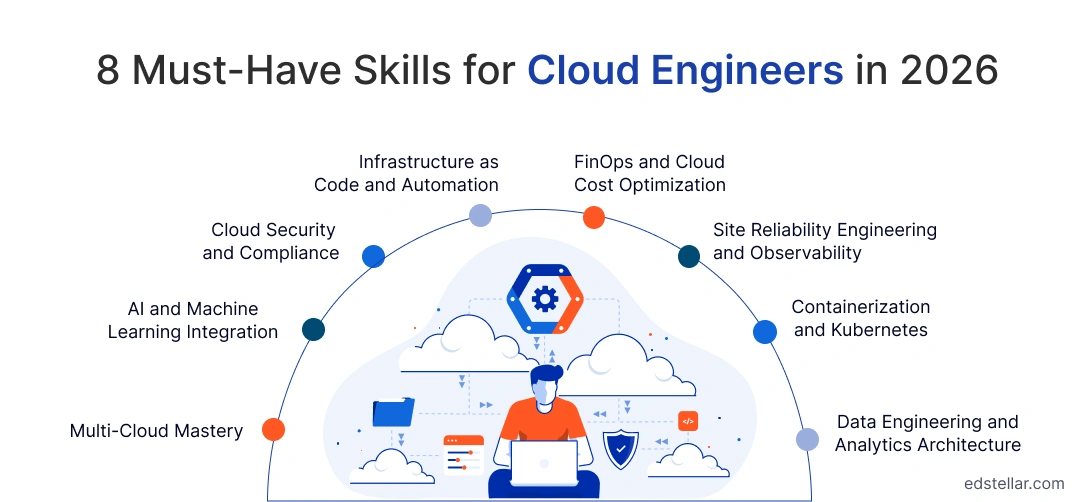
The skills outlined represent a roadmap rather than a destination. Multi-cloud mastery, AI integration, security expertise, automation proficiency, financial responsibility, reliability engineering, container orchestration, and data architecture create a foundation for addressing challenges we face today. New skills will emerge as technologies evolve, regulatory requirements expand, and business models transform.
Organizations that invest strategically in cloud engineering talent development gain competitive advantages extending far beyond cost savings or operational efficiency. They build capabilities that enable innovation, support growth, and create the agility needed to respond to market changes. They attract and retain engineering talent by offering opportunities for continuous learning and professional growth.
The path forward requires commitment from both organizations and individuals. Companies must provide learning opportunities, hands-on experience, and time for skill development. Engineers must embrace continuous learning, seek challenging projects, and develop expertise beyond their immediate comfort zones. Together, these efforts create the cloud engineering excellence that drives business success in an increasingly cloud-dependent world.
#On-site #Virtual #GroupTraining #Customized
Explore 2000+ industry ready instructor-led training programs.

Create dynamic leaders and cohesive teams. Learn more now!


Do a quick Skill gap analysis with Edstellar’s Free Skill Matrix tool

Unlock premium resources, tools, and frameworks designed for HR and learning professionals. Our L&D Hub gives you everything needed to elevate your organization's training approach.
Access L&D Hub Resources.svg)
.svg)
.svg)
.svg)

.svg)


.svg "Click Here to Follow on Medium")
.svg)


