

The UAE will need an additional 1.03 million workers by 2030, lifting its total workforce by 12.1%, one of the highest projected growth rates among major economies according to ServiceNow and Pearson's Workforce Skills Forecast 2025. The workforce recorded annual growth of 12.4% during 2025 while the number of establishments increased by 7.8%, yet three out of four hiring professionals report it is harder than ever to find qualified candidates.
AI-related positions have grown 340% since 2022, cybersecurity hiring demand increased 60% year-over-year, and the construction sector tracked $308 billion in project value through 2030. For corporate L&D leaders and HR managers operating in the Gulf's most dynamic economy, these numbers translate directly into urgent training priorities that will determine whether organisations can secure the talent powering the UAE's transformation.
Several structural forces are accelerating this demand simultaneously. The Ministry of Human Resources and Emiratisation (MOHRE) reported a 2.5% workforce increase in Q1 2026, and tech demand alone is forecast to surge 54% against overall workforce growth of 12.1%. The UAE ranked seventh globally for AI job postings in 2025, above the United States (2.6%) and the UK (1.9%), with over 800 AI firms operating in Dubai and 400+ in Abu Dhabi.
Emiratisation requirements are tightening, with private sector companies of 20–49 employees now required to employ at least two UAE nationals, backed by penalties of AED 108,000 per missing Emirati. Meanwhile, tourism contributed AED 267.5 billion to the national economy in 2025, Masdar targets 100 GW of renewable capacity by 2030, and DIFC and ADGM have positioned the UAE as the Middle East's premier fintech hub.
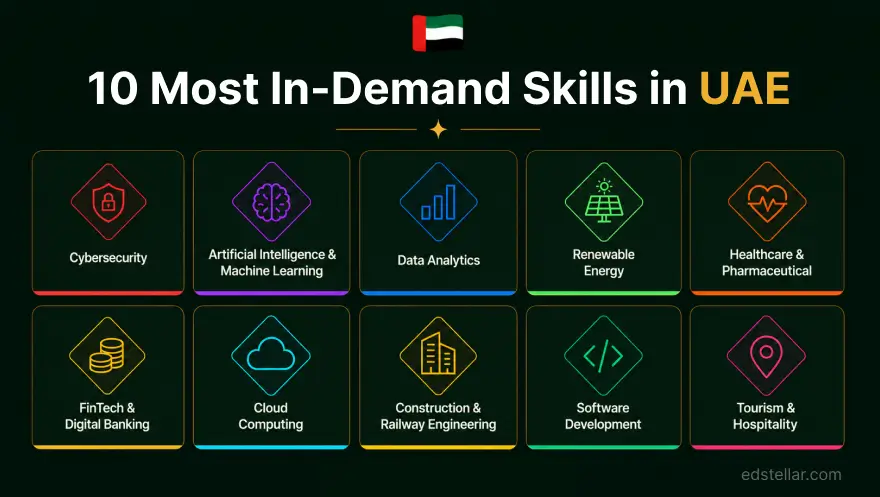
So which skills are truly driving the UAE's economy, and where should organisations invest their training budgets? This guide breaks down the top 10 skills in demand in the UAE, spanning artificial intelligence, cybersecurity, construction, financial services, healthcare, and renewable energy. Drawing on MOHRE labour data, industry workforce forecasts, Michael Page salary benchmarks, and hiring trend analysis, it provides an evidence-based picture of what jobs are in demand in the UAE, whether you are planning corporate upskilling programmes, supporting Emiratisation compliance, or building workforce strategies for one of the world's fastest-growing economies.
Sources Behind This Research
Every ranking in this guide is backed by data from UAE government bodies, industry associations, and established hiring platforms.
Ministry of Human Resources and Emiratisation (MOHRE)
Labour Market Observatory & Workforce Growth Data 2025–2026Reported 12.4% annual workforce growth in 2025, 2.5% growth in Q1 2026, 7.8% establishment growth, and Emiratisation targets requiring private sector companies to hire UAE nationals with penalties of AED 108,000 per shortfall.
View source →UAE National AI Strategy 2031
National Strategy for Artificial IntelligenceEstablished the framework for AI adoption across government, healthcare, energy, transport, and education. Created the Mohamed Bin Zayed University of Artificial Intelligence (MBZUAI), the world's first graduate-level AI university, and drove a 340% increase in AI positions since 2022.
View source →U.S. International Trade Administration
UAE Country Commercial Guide: Renewable Energy & Clean EnergyDocumented Masdar's 100 GW renewable energy target by 2030, the National Hydrogen Strategy 2050 targeting 14–22 million tonnes annually, and the broader clean energy investment landscape driving workforce demand.
View source →ServiceNow & Pearson
Workforce Skills Forecast 2025: UAEProjected the 1.03 million additional workers needed by 2030, 54% surge in tech demand, and sector-level job creation forecasts: manufacturing (+133,000), education (+78,000), retail (+60,000), finance (+40,000), and healthcare (+39,000).
View source →MEED Projects
UAE Construction Pipeline & Workforce Report 2026Tracked approximately $308 billion in construction project value through 2030, with $184 billion in Dubai and $87 billion in Abu Dhabi. Reported the 69% rise in blue-collar job demand alongside a 21% hiring decline, and peak workforce needs for anchor projects.
View source →PwC Middle East
Workforce Hopes and Fears Survey 2025: UAE FindingsSurveyed UAE workers on AI adoption, upskilling priorities, and workforce sentiment. Provided data on the intersection of technology transformation and employee readiness across sectors.
View source →Gulf News & The National
UAE Jobs & Labour Market Reporting 2025–2026Covered the 1 million jobs forecast, AI salary competitiveness with the US, 60% cybersecurity hiring surge, tourism workforce reaching 925,000, and Emiratisation progress across sectors. Primary source for real-time hiring trends.
View source →Michael Page, Robert Half & Yotru
UAE Salary Guides & Hiring Trends 2026Provided role-level salary benchmarks across technology, financial services, construction, and healthcare. Reported that 48% of companies plan to increase hiring in 2026, with tech salaries ranging from AED 25,000 to AED 80,000 monthly.
View source →10 Key Skills in Demand Across the UAE's Job Market
The UAE's skills landscape in 2026 reflects the convergence of the world's most ambitious infrastructure programme, a national AI strategy producing measurable results, an energy transition led by Masdar, and a financial services sector that rivals London and Singapore. The 10 skills below span technology, construction, healthcare, financial services, and energy, mirroring the sectors where government investment, employer demand, and salary premiums are highest. Each ranking draws on the policy signals, job market data, and industry investments outlined in the sources above.
Artificial Intelligence & Data Science
Research Score: 9.40/10
AI-related positions in the UAE have grown approximately 340% since 2022, with demand for data scientists rising 43%, AI product manager roles growing 37%, and AI engineer hiring increasing 31% between 2024 and 2025 according to Gulf News reporting. The UAE ranked seventh globally for AI job postings in 2025 at 2.87%, above the United States (2.6%) and the UK (1.9%), and the country has deployed over 500 billion dirhams into AI since 2014. Dubai alone hosts more than 800 AI firms, while Abu Dhabi has over 400, and the UAE saw a 344% rise in generative AI course enrolments, significantly outpacing global averages.
The National AI Strategy 2031 and the Mohamed Bin Zayed University of Artificial Intelligence (MBZUAI) anchor the country's talent development pipeline. According to The National reporting, senior AI engineers earn AED 50,000–80,000+ monthly, ML engineers command AED 45,000–75,000, and AI researchers earn AED 50,000–75,000+. All salaries are tax-free, with benefits packages commonly adding 20–30% through housing allowances, annual flights, health insurance, and performance bonuses. Entry-level AI engineers start at AED 5,000–20,000 monthly, reflecting the broad range between junior and senior compensation.
The UAE's ambition to become a "factory of intelligence" is driving AI adoption across every sector. Aramco's Abu Dhabi operations use AI for predictive maintenance, Emirates NBD and First Abu Dhabi Bank deploy ML for credit scoring and fraud detection, and DEWA uses AI for smart grid optimisation. The 5 GW Stargate AI campus in Abu Dhabi, developed in partnership with the United States, will create thousands of additional technology roles. For international professionals, the Golden Visa programme is actively attracting Western tech workers to AI positions, with Dubai AI Week and the Dubai AI Academy training 10,000 leaders annually.
Key Sub-skills
Top Industries
Government & Smart City, Financial Services, Energy & Petrochemicals, Healthcare & Life Sciences
Explore Related Training:
Machine Learning with Python Data Science with Python All AI Training ProgramsCybersecurity
Research Score: 9.10/10
Approximately 90% of UAE companies struggle to find qualified cybersecurity talent, and cybersecurity hiring demand in Dubai increased 60.59% across major job platforms. The Gulf region has invested heavily in digital transformation, but local talent has not scaled at the same pace, with the UAE, Saudi Arabia, and Qatar importing a significant portion of their cybersecurity workforce. Financial services in DIFC and ADGM account for 35% of UAE cybersecurity vacancies, government and smart city entities in Abu Dhabi account for 30%, and telecom and critical infrastructure firms in Dubai account for 25%.
Cybersecurity analysts earn AED 14,000–58,000 monthly, with an average annual salary of approximately AED 319,600. CISSP, CISM, and CEH certifications add AED 3,000–8,000 per month to base offers, and the average annual pay raise in cybersecurity is 9%. The scale of the UAE's digital infrastructure, including smart city platforms, AI data centres, financial technology systems, and critical energy infrastructure, creates an attack surface that demands a large and continuously growing security workforce. The growing need for professionals with both regulatory knowledge and hands-on technical ability makes cybersecurity skills among the most valued competencies in the UAE market, particularly for roles spanning DIFC compliance and smart city infrastructure protection.
Major employers include Etisalat (e&), du, Emirates NBD, First Abu Dhabi Bank, ADNOC, government agencies including the Telecommunications and Digital Government Regulatory Authority (TDRA), and international firms including DarkMatter, Help AG, and the Big Four consulting practices. The UAE's position as a target for state-sponsored and criminal cyber threats, combined with the concentration of financial assets in DIFC and ADGM, makes cybersecurity a matter of national economic security.
Key Sub-skills
Top Industries
Financial Services (DIFC/ADGM), Government & Smart City, Telecommunications, Energy & Petrochemicals
Software Development & Cloud Computing
Research Score: 8.80/10
The UAE will need over 91,000 additional technology specialists in roles spanning software engineering, cloud architecture, and systems analysis according to workforce forecasts. Tech salaries range from AED 25,000 to AED 80,000 monthly, with Cloud Solution Architects earning up to AED 65,000 monthly and professionals who combine technical expertise with business understanding earning 25–40% higher than their peers. Amazon AWS, Microsoft Azure, Google Cloud, and Oracle are all expanding data centre operations in the UAE, creating sustained demand for cloud engineers, site reliability engineers, and DevOps professionals.
Dubai attracted AED 40.4 billion ($11 billion) in tech-focused FDI in H1 2025, a 62% year-over-year increase, and supported 582 digital startups from Q1–Q3 2025. The concentration of technology investment in Dubai Internet City, Abu Dhabi's Hub71, and the free zones is creating a vibrant ecosystem for software engineers. Careem (Uber), Talabat (Delivery Hero), Noon, and dozens of regional platform companies compete with international firms for full-stack developers and mobile engineers. Software developers earn AED 6,000–25,000 monthly depending on experience, with senior roles at major technology firms commanding significantly higher packages.
For international professionals, the UAE offers tax-free salaries combined with housing allowances, health insurance, and annual flight tickets that make total compensation highly competitive globally. The Golden Visa programme and freelancer visa provide flexible residency options for technology professionals. Python, JavaScript, TypeScript, Java, and cloud-native frameworks lead skill requirements, with AI/ML integration, Kubernetes, and microservices architecture carrying the highest premiums. Emiratisation requirements for technology roles remain relatively low compared to other sectors, though companies actively seek to develop local tech talent.
Key Sub-skills
Top Industries
Technology & Startups, Government Digital Services, Financial Technology, E-Commerce & Logistics
"Some 46 per cent of leaders see skill shortages as a top threat to their business. The lift in productivity expected from innovations like AI will only come if people are reskilled and ready to incorporate these solutions into new working practices."


Construction & Project Management
Research Score: 8.55/10
MEED Projects tracks approximately $308 billion in construction project value in the UAE pipeline through 2030, with roughly $184 billion in Dubai and $87 billion in Abu Dhabi. The UAE witnessed a 69% rise in blue-collar job demand in 2024, yet actual hirings declined by 21%, signalling a widening gap between demand and available skilled labour. Anchor projects including Etihad Rail Phase 2 (peak workforce of 12,000), Wynn Al Marjan resort (peak workforce of 8,500), and major developments across Dubai and Abu Dhabi are driving unprecedented demand for construction professionals at every level.
The trade mix has shifted decisively toward skilled roles, with certified skilled trades rising from 18% to 27% of the construction workforce between 2020 and 2025, while helper and unskilled positions declined from 22% to 11%. Key skill shortages include shuttering carpenters, rebar fitters, MEP technicians, and project supervisors. Employers increasingly require skill-certified workers who can contribute from day one, as projects are time-bound, cost-sensitive, and quality-focused. Project engineers earn an average of AED 15,000–35,000 monthly, with senior programme directors at mega-projects commanding significantly higher packages.
International contractors including Bechtel, Samsung C&T, Jacobs, and AECOM operate alongside regional firms such as Arabtec, Al Habtoor, and Aldar Properties. Indians represent 38% of the construction workforce, followed by Bangladeshis (22%), Pakistanis (14%), and Nepalis (8%). For international construction professionals, the UAE offers some of the most financially attractive packages in the global market, with tax-free salaries, housing allowances, and project completion bonuses. BIM expertise, modular construction knowledge, and digital project management capabilities command the highest premiums.
Key Sub-skills
Top Industries
Real Estate & Mega-Projects, Infrastructure & Transport, Hospitality Construction, Industrial & Energy Projects
Explore Related Training:
Construction Project Management Agile Leadership All Project Management ProgramsFinancial Services & Fintech
Research Score: 8.30/10
Dubai is the largest fintech hub in the MENA region, competing directly with Singapore and London for a position in the global top five. The Dubai International Financial Centre (DIFC) and Abu Dhabi Global Market (ADGM) have established progressive regulatory frameworks for virtual assets, open banking, and digital payments, turning the UAE into the premier crypto and fintech hub of the Middle East. Fintech Product Managers earn AED 30,000–50,000 monthly, Quantitative Analysts earn AED 35,000–55,000, and C-level Web3 compliance experts frequently command packages exceeding AED 100,000 monthly plus bonuses and equity.
The fintech talent market is simultaneously one of the most active and most difficult in which to hire, particularly for intersection roles: engineers who understand financial regulation, compliance professionals who understand technology architecture, and product managers who can bridge both. DORA compliance, Open Banking regulation under CBUAE Phase 2 (from Q3 2025), and virtual asset regulatory frameworks are creating specialist demand that did not exist three years ago. The UAE Central Bank's regulatory sandbox and DIFC Innovation Hub are accelerating fintech company growth and associated hiring.
Major employers include Emirates NBD, First Abu Dhabi Bank, Mashreq, Abu Dhabi Islamic Bank, and regional fintech companies including stc bank, Tabby, Tamara, and HyperPay. International firms including PayPal, Stripe, and Checkout.com are expanding in the UAE market. Investment banking salaries are among the highest in the MENA region, with associates earning AED 30,000–45,000 monthly at major banks. For finance professionals, the combination of tax-free income, regulatory innovation, and access to Gulf capital flows makes the UAE one of the most attractive financial centres globally.
Key Sub-skills
Top Industries
Banking & Private Wealth (DIFC/ADGM), Digital Banking & Payments, Insurance & Takaful, Capital Markets & Asset Management
Explore Related Training:
AI for Financial Services Industry Financial Risk Management All Finance & Accounting ProgramsWant Your UAE Training Investments to Deliver Results?
Edstellar's L&D consulting services help organisations move from ad-hoc training to structured capability development aligned with business priorities.
Schedule a Strategy Session →Healthcare & Nursing
Research Score: 8.05/10
According to TASC Outsourcing analysis, Abu Dhabi faces a projected shortfall of 15,000 nurses and allied health professionals, while Dubai needs an additional 6,000 physicians and 11,000 nurses by 2030. The World Health Organization reported a projected regional shortage of 4.1 million nurses, and the UAE has developed a Nursing and Midwifery Strategy for 2022–2026 aimed at building a sustainable, future-ready workforce. The ServiceNow/Pearson forecast projects 39,000 additional healthcare roles across the UAE by 2030, making it one of the five largest job-creation sectors.
Emiratisation in healthcare is progressing but remains uneven. The Emirati workforce within Emirates Health Services has reached approximately 14%, and while the UAE is not facing an immediate nursing crisis according to senior health officials, the reliance on expatriate nurses remains structurally high. Recruitment campaigns are targeting young Emiratis to enter the profession, but the pipeline development is a long-term effort. International nurses from the Philippines, India, Egypt, Jordan, and other countries continue to form the backbone of the healthcare workforce.
The integration of AI-assisted diagnostics, telemedicine, and electronic health records is creating hybrid roles that command premiums. Cleveland Clinic Abu Dhabi, Mediclinic, NMC Healthcare, Aster DM Healthcare, and government health authorities (DHA in Dubai, DoH in Abu Dhabi) are the largest employers. Salary packages for international healthcare professionals include base pay, housing allowances, health insurance, and annual return flights, making the UAE financially attractive compared to many source countries. The UAE's Healthier SG-equivalent initiatives are shifting resources toward preventive care and community health, creating new role categories.
Key Sub-skills
Top Industries
Hospitals & Medical Cities, Private Health Groups, Government Health Authorities, Pharmaceutical & Medical Devices
Explore Related Training:
ChatGPT for Healthcare AI for Medical Professionals All Health & Well-Being ProgramsTourism & Hospitality Management
Research Score: 7.80/10
The World Travel & Tourism Council projects that tourism will contribute AED 267.5 billion to the UAE's national economy in 2025, accounting for nearly 13% of GDP and supporting over 925,000 jobs. Dubai's aviation industry alone is expected to create an additional 185,000 jobs over the next five years, and the sector targets a contribution of 15% of GDP by 2030. The UAE welcomed record visitor numbers across Dubai, Abu Dhabi, and emerging destinations including Ras Al Khaimah and Fujairah, driving demand for hospitality professionals at every level.
Emiratisation in hospitality is expanding, with private sector companies now required to hire UAE nationals and penalties climbing to AED 108,000 per missing Emirati. The Nafis programme provides salary support, pension contributions, and training subsidies for employers hiring Emiratis, though the programme concludes in 2026. Major hotel groups including Marriott, Hilton, Accor, Jumeirah Group, Rotana, and Emaar Hospitality are expanding across the UAE, each requiring trained managers, chefs, guest experience specialists, and revenue management professionals.
The addition of luxury resort destinations including The Red Sea Global (shared with Saudi Arabia), Wynn Al Marjan Island, and the continued expansion of Saadiyat Island cultural district in Abu Dhabi is creating demand for premium hospitality talent. For international professionals, the UAE's hospitality sector offers competitive tax-free packages with accommodation, and the scale of hotel construction, estimated at tens of thousands of new rooms across the next decade, ensures sustained hiring demand for years to come.
Key Sub-skills
Top Industries
Hotels & Luxury Resorts, Airlines & Aviation, Entertainment & Leisure, Cruise & Travel Services
"Data literacy, AI fluency, cybersecurity awareness, and advanced problem-solving are becoming essential across most roles. The best starting point is to build a strong foundation in digital and data literacy, even for non-technical roles."

Renewable Energy & Sustainability
Research Score: 7.55/10
Masdar, the UAE's clean energy champion jointly owned by ADNOC, Mubadala, and TAQA, targets a renewable energy portfolio of at least 100 GW by 2030 and annual green hydrogen production of up to one million tonnes by 2030. The National Hydrogen Strategy 2050 positions the UAE as a leading global producer and exporter of low-carbon hydrogen, targeting 14–22 million tonnes annually by 2050. The MENA region is projected to require over 1.1 million new energy workers by end-2027 according to Gartner's Talent and Energy 2025 Outlook, and the UAE is at the centre of this demand.
Masdar is currently hiring for more than 300 roles tied to overseas green energy partnerships, and DEWA plans to increase staff capacity by 40% by 2026. The roles span far beyond traditional energy engineering: data analysts monitoring consumption patterns, software engineers building energy distribution tools, environmental scientists, drone operators, and civil engineers are all part of the clean energy workforce. The legacy of COP28, hosted in Dubai in 2023, continues to drive the UAE's climate and sustainability commitments.
Solar energy is a particular strength, with the UAE's Al Dhafra Solar PV project (2 GW) among the world's largest single-site solar installations. For professionals in engineering, data science, or project management, adding renewable energy and sustainability credentials represents a high-return career investment. ESG reporting, carbon accounting, and climate risk assessment skills are in growing demand as the UAE's mandatory sustainability reporting framework expands. The convergence of traditional energy expertise with clean technology creates unique career pathways in a country that understands both sides of the energy transition.
Key Sub-skills
Top Industries
Clean Energy (Masdar, DEWA), Oil & Gas (Energy Transition), Utilities & Grid Operations, Government & Policy
Explore Related Training:
Renewable Energy and Sustainability Energy Transition and Innovation All Environmental Sustainability ProgramsData Analytics & Business Intelligence
Research Score: 7.30/10
Data science and AI jobs in the UAE are projected to grow 15–20% annually, and nearly half of companies plan to expand their workforce in 2026 with data analytics among the most actively recruited skill categories. Financial analysts supporting decision-making through data visualisation and forecasting earn AED 18,000–40,000 monthly, and professionals who combine technical analytics expertise with business domain knowledge earn 25–40% more than peers with purely technical profiles.
The UAE's smart city initiatives, e-government platforms, and enterprise digital transformation programmes are generating massive volumes of data that require skilled analysts to interpret and act upon. Dubai's Smart Dubai initiative, Abu Dhabi's TAMM platform, and Sharjah's digital government services all need data professionals who can turn operational data into policy insights and service improvements. The retail, logistics, and real estate sectors are also major consumers of analytics talent, using data for demand forecasting, pricing optimisation, and customer segmentation.
Python, SQL, R, Tableau, Power BI, and cloud-based analytics platforms (Databricks, Snowflake, BigQuery) are the core technical requirements. The role of data analysts has expanded well beyond traditional reporting, now encompassing predictive modelling, automated dashboards, and AI-assisted decision support across government and enterprise applications. For mid-career professionals transitioning from traditional business roles, data analytics represents one of the strongest reskilling pathways in the UAE market, with multiple training providers and certification programmes available through free zone education partners. The UAE launched an AI-powered skills platform connecting labour market data with over 200 educational institutions, serving more than 200,000 students.
Key Sub-skills
Top Industries
Financial Services, Government & Smart City, Retail & E-Commerce, Real Estate & Property
Supply Chain & Logistics
Research Score: 7.10/10
The UAE's strategic position as a trade corridor between Asia, Europe, and Africa, combined with world-class port and aviation infrastructure, creates sustained demand for supply chain and logistics professionals. Jebel Ali Port is the largest port in the Middle East, Dubai International Airport is the world's busiest for international passengers, and Etihad Rail is connecting the emirates with a national freight and passenger network for the first time. The ServiceNow/Pearson forecast identifies manufacturing as the single largest job-creation sector at 133,000 additional roles by 2030, with supply chain skills essential to support this industrial expansion.
The mega-project construction pipeline generates massive procurement and logistics challenges. Sourcing materials, managing just-in-time delivery to dozens of concurrent construction sites, and coordinating international supply chains across thousands of suppliers requires professionals with both traditional logistics expertise and digital capabilities. The rise of AI-driven supply chain optimisation, automated warehousing, and digital freight platforms is creating demand for professionals who can bridge physical logistics with technology systems.
Major employers include DP World, Emirates Group (SkyCargo), Agility, Aramex, and the logistics divisions of major construction and retail groups. Free zone operations in JAFZA, DAFZA, and Khalifa Industrial Zone Abu Dhabi (KIZAD) require supply chain managers, customs specialists, and trade compliance professionals. For international logistics professionals, the UAE offers tax-free compensation, access to one of the world's most connected trade networks, and career opportunities that span aviation, maritime, road, and rail logistics.
Key Sub-skills
Top Industries
Ports & Maritime (DP World), Aviation & Cargo, E-Commerce & Retail Logistics, Free Zone Operations
Explore Related Training:
Supply Chain Management Fundamentals AI for Supply Chain All Operations Management Programs"As the UAE solidifies its status as a global hub for fintech and digital assets, the regulatory landscape has become more attractive yet increasingly complex. Professionals who can navigate this are highly sought after to help firms stay compliant while scaling."


From AI to Web3: Dubai's Model for a Future Economy, exploring how the emirate is building a technology-driven workforce across AI, fintech, and digital innovation.
Skills Demand Across the UAE's Key Economic Regions
The UAE's skills demand is shaped by the distinct economic identities of its seven emirates, with Dubai, Abu Dhabi, and the Northern Emirates each attracting different types of talent. Understanding these regional patterns helps corporate L&D teams and HR managers target training investments where they will have the greatest impact.
| Region | Key Industries | Top Shortage Skills |
|---|---|---|
| Dubai | Fintech (DIFC), Tourism, Real Estate, E-Commerce, Technology | AI/ML, Cybersecurity, Software Development, Fintech, Tourism & Hospitality |
| Abu Dhabi | Energy (ADNOC), Government, Healthcare, Defence, AI (MBZUAI) | AI & Data Science, Cybersecurity, Healthcare, Renewable Energy, Engineering |
| Sharjah | Manufacturing, Education, Healthcare, Cultural Tourism | Engineering, Healthcare, Education, Manufacturing, Data Analytics |
| Ras Al Khaimah | Tourism (Wynn resort), Manufacturing, Ceramics, Pharmaceuticals | Tourism & Hospitality, Construction, Manufacturing, Healthcare |
| Free Zones (JAFZA, DAFZA, KIZAD) | Logistics, Trade, Manufacturing, Technology | Supply Chain, Trade Compliance, Warehouse Automation, Software Development |
| Northern Emirates (Ajman, UAQ, Fujairah) | Maritime, Light Manufacturing, Tourism, Agriculture | Skilled Trades, Healthcare, Tourism, Logistics, Education |
Dubai dominates technology, fintech, tourism, and real estate hiring, with DIFC, Dubai Internet City, and Dubai Media City serving as the primary employment hubs for international professionals. Abu Dhabi leads in energy (through ADNOC and Masdar), government, healthcare (Cleveland Clinic, Sheikh Khalifa Medical City), and AI research (MBZUAI). The free zones operate as specialised economic clusters with their own regulatory frameworks, creating concentrated demand for logistics, trade, and manufacturing professionals. For organisations planning multi-emirate operations, aligning training programmes with these regional demand patterns ensures that upskilling investments match actual hiring needs.
How to Develop These Skills in Demand in the UAE
The UAE's skills challenge is defined by the pace and scale of its ambitions: 1.03 million additional workers needed by 2030, tech demand surging 54%, 90% of companies unable to find cybersecurity talent, and $308 billion in construction projects competing for the same skilled workforce. With three out of four hiring professionals reporting increased difficulty finding qualified candidates and Emiratisation requirements tightening annually, organisations need a systematic approach to close the gap between what the economy demands and what the talent pipeline delivers. Here is how to approach it.
- Start with a skills audit. Use a structured training needs analysis to map your current team capabilities against the skills your business needs over the next 12 to 24 months. Focus on the gaps that directly affect service delivery, Emiratisation compliance, or revenue generation. With AI positions growing 340% since 2022 and cybersecurity demand increasing 60% year-over-year, identifying your organisation's specific mismatches is essential before committing training budgets.
- Build individual development plans. Generic training programmes produce generic results. Use individual development plan templates to tailor learning pathways to each employee's current skills and career trajectory. A cybersecurity analyst at a DIFC bank navigating DFSA compliance has different development needs than a construction project manager adopting BIM for a mega-project, even though both roles require digital literacy fundamentals.
- Combine certifications with applied learning. International certifications (AWS, CISSP, PMP, CFA, Six Sigma) carry significant weight in the UAE job market, with CISSP adding AED 3,000–8,000 monthly and AI professionals earning 25–40% premiums. However, applied projects and instructor-led workshops build the practical capability that certifications alone cannot provide. The most effective programmes pair certification preparation with hands-on exercises drawn from UAE industry scenarios, particularly in DIFC/ADGM regulatory compliance, smart city infrastructure, and energy sector digital transformation where local context matters.
- Address performance gaps systematically. A guide to understanding performance gaps can help managers distinguish between skill deficits, technology limitations, and systemic barriers before investing in training. A construction team falling behind on digital project delivery may need BIM and drone inspection workshops, while a financial services team struggling with regulatory technology may need DFSA compliance training rather than more generic fintech courses.
- Leverage UAE government workforce initiatives. The Nafis programme provides salary support and training subsidies for Emiratisation. The Dubai AI Academy trains 10,000 leaders annually. MOHRE's AI-powered skills platform connects labour market data with 200+ educational institutions. The Coder's HQ and 42 Abu Dhabi provide free technology education. Companies can partner with these government programmes to supplement internal training budgets, meet Emiratisation requirements, and build genuinely capable local talent alongside international expertise.
The UAE's economic trajectory, driven by the National AI Strategy 2031, Masdar's 100 GW clean energy target, the $308 billion construction pipeline, and the expansion of DIFC and ADGM as global financial centres, signals that demand for skilled professionals will only accelerate. Organisations that build their training strategies around these national priorities, supported by a catalogue of over 2,000 instructor-led courses, will be better positioned to attract talent and maintain competitive advantage in the Gulf's most dynamic economy.
Frequently Asked Questions
What skills are in high demand in the UAE?
The most in-demand skills in the UAE for 2026 include artificial intelligence and data science, cybersecurity, software development and cloud computing, construction and project management, financial services and fintech, healthcare and nursing, tourism and hospitality management, renewable energy and sustainability, data analytics and business intelligence, and supply chain and logistics. Technology skills lead the list with AI positions growing 340% since 2022, while construction and tourism drive the highest volume of job creation.
What jobs are in demand in the UAE in 2026?
The highest-demand jobs in the UAE for 2026 include AI/ML engineers, cybersecurity analysts, cloud architects, software developers, construction project managers, MEP engineers, wealth managers, fintech developers, registered nurses, hotel operations managers, renewable energy engineers, data scientists, and supply chain managers. The UAE needs 1.03 million additional workers by 2030, with technology roles forecast to surge 54% and manufacturing expected to add 133,000 positions.
What are the highest paying jobs in the UAE?
Senior AI engineers earn AED 50,000–80,000+ monthly, ML engineers command AED 45,000–75,000, Cloud Solution Architects earn up to AED 65,000, and C-level Web3 compliance experts exceed AED 100,000 monthly. Cybersecurity analysts earn AED 14,000–58,000, construction programme directors at mega-projects command premium packages, and investment banking associates earn AED 30,000–45,000. All salaries in the UAE are tax-free, with additional benefits including housing allowances, health insurance, annual flights, and performance bonuses adding 20–30% to base packages.
How do I get a job in the UAE as a foreigner?
Foreign professionals access the UAE job market through employer-sponsored work visas, the Golden Visa programme (for highly skilled professionals, investors, and entrepreneurs), or free zone employment visas. Technology, engineering, healthcare, construction, and financial services are the sectors most actively hiring expatriates. The Golden Visa is actively attracting Western tech workers to AI positions, and the freelancer visa provides flexibility for independent consultants. International certifications (AWS, CISSP, PMP, CFA) strengthen applications. Dubai, Abu Dhabi, and the free zones offer the most opportunities.
What is Emiratisation and how does it affect hiring?
Emiratisation is the UAE's policy requiring private sector companies to employ UAE nationals. Companies with 50+ employees must increase their Emirati workforce by 2% annually, and those with 20–49 employees must employ at least two Emiratis. Non-compliance penalties have climbed to AED 108,000 per missing Emirati national. The Nafis programme provides salary support and training subsidies to incentivise Emirati hiring. Technology and healthcare have relatively lower requirements due to skill shortages, but financial services, telecommunications, and government-linked entities face stricter quotas.
Are salaries in the UAE tax-free?
Yes, the UAE does not impose personal income tax on employment income, making gross salary equal to net salary. This is one of the UAE's primary attractions for international professionals. In addition to tax-free base pay, many employers provide housing allowances (often 20–30% of base salary), annual return flight tickets, health insurance, children's education allowances, and end-of-service gratuity benefits. The combination of tax-free income with comprehensive benefits packages makes total compensation in the UAE highly competitive globally, particularly for senior technology, financial services, and engineering roles.
What is the UAE Golden Visa?
The UAE Golden Visa is a long-term residency programme granting 5 or 10-year renewable visas to investors, entrepreneurs, scientists, outstanding students, and highly skilled professionals. Unlike standard work visas, the Golden Visa is not tied to a specific employer, giving holders greater career flexibility. Technology professionals, particularly in AI, cybersecurity, and data science, are increasingly eligible. The programme allows holders to sponsor family members and does not require a local sponsor. It has become a key tool for attracting international tech talent, with Western professionals moving to Dubai and Abu Dhabi specifically for AI roles.
What kind of jobs are available in the UAE for foreigners?
Foreign professionals make up the majority of the UAE workforce and are actively recruited across virtually every sector. The most common roles for expatriates include software engineering and AI (at Google, Microsoft, Amazon, and regional tech firms), financial services (at Emirates NBD, First Abu Dhabi Bank, and DIFC firms), construction and engineering (at Bechtel, Jacobs, and regional contractors), healthcare (nurses and physicians from the Philippines, India, and Egypt), hospitality (at international hotel groups), and logistics (at DP World, Emirates SkyCargo, and free zone operations). The UAE's employment rate stands at 96.2% with 4.8 million expatriates contributing to the economy.
Conclusion
The UAE's skills landscape in 2026 is defined by the sheer velocity of economic transformation: 12.4% workforce growth in a single year, AI positions growing 340% since 2022, $308 billion in construction projects competing for talent, and a national commitment to adding 1.03 million workers by 2030 that outpaces every comparable economy. Yet three out of four hiring professionals report increasing difficulty finding qualified candidates, 90% of companies cannot fill cybersecurity roles, and the construction sector faces a widening gap between a 69% surge in demand and a 21% decline in actual hirings. The mismatch between what the UAE's economy demands and what the global talent pipeline delivers remains the central challenge for every HR leader operating in the Gulf's most dynamic market.
The ten skills in demand in the UAE covered in this guide represent the intersection of national strategic ambition and acute market need. From AI and cybersecurity powering the smart city vision, through construction and engineering building the physical infrastructure, to financial services driving the DIFC and ADGM as global hubs, healthcare serving a growing population, and renewable energy transforming the country's economic identity, each skill area offers clear returns on training investment. The organisations that close their skills gaps fastest will be the ones that attract talent, win contracts, and lead their industries as the UAE continues its transformation into a diversified, technology-driven economy.
Looking for a Corporate Training Partner?
Get a custom training plan from Edstellar's 5,000+ expert trainers. Virtual or onsite delivery across North America, Europe, Asia-Pacific, and beyond.
Request a Free Consultation →