BLOG
10 Most In-Demand Skills in India for 2026
""
In-Demand Skills

10 Most In-Demand Skills in India for 2026

A detailed list of the top in-demand skills in India, curated by a corporate trainer with 16+ years of experience and a track record of training 30,000+ professionals across MNCs, startups, and government organizations.

10 Most In-Demand Skills in India for 2026

Updated On Apr 22, 2026

Corporate Training Consultant - India

✓ Edstellar Verified SME

8 mins read

Content
Table of Content

India's employability rate has risen to 56.35% according to the India Skills Report 2026, yet a persistent and growing skills gap threatens to slow one of the world's fastest-growing economies. With 12.8 million new jobs projected in 2026 and the tech industry approaching $300 billion in revenue, the gap between what employers need and what the workforce can offer has never been wider.

As a corporate training specialist working across Bengaluru, Hyderabad, Pune, and other major hiring hubs, I see this gap play out daily. Companies are willing to pay premium salaries for the right skills, but candidates often lack the specific, current competencies that hiring managers demand. India Inc. projects a 9.1% average salary increase in 2026, with the sharpest gains going to professionals who hold skills aligned with market demand.

This guide breaks down the 10 most in-demand skills in India for 2025-2026, backed by data from NASSCOM, government policy documents, and real hiring trends. Whether you are an L&D leader planning your training roadmap or a professional choosing your next upskilling path, understanding which skills are in demand in India is the first step toward making smarter decisions. Organizations looking to identify and close common skills gap examples will find actionable insights throughout this article.

Sources Behind This Research

Every ranking in this guide is backed by data from Indian government bodies, local industry authorities, and established hiring platforms. We weighted India-specific sources more heavily than global reports, because local data reflects what is actually happening on the ground. Here is where the numbers come from.

Industry Body

NASSCOM

Technology Sector Strategic Review 2025

India's tech industry reached $282.6 billion in FY2025. Reports a 51% demand-supply gap for AI professionals and over 290,000 AI job postings. Primary source for technology skill rankings.

View source →
Government

Ministry of Electronics and IT (MeitY)

IndiaAI Mission

Rs 10,371 crore budget over five years (2024-2029) for AI infrastructure and skills. 18,000+ AI compute units deployed at 40% reduced cost; 31 Data and AI Labs in Tier 2/3 cities.

View source →
Industry Body

Wheebox India Skills Report 2026

With CII, AICTE, AIU, Taggd

India's employability rate rose to 56.35%. IT sector leads fresher hiring at 35%. Top skills in demand: AI, data analytics, cloud computing, and cybersecurity. Gig economy grew 38%.

View source →
Government

Ministry of New and Renewable Energy

National Green Hydrogen Mission

19 companies allocated 862,000 tonnes annual Green Hydrogen production. Three major ports designated as Green Hydrogen Hubs; 5,600 trainees certified in hydrogen qualifications.

View source →
Government

National Skill Development Corporation

Skill India Programme

Rs 8,800 crore outlay through 2025-26. 50 Future Skills Centres and 10 NSDC International Academies to be established; 50 new qualifications developed for Green Hydrogen sector.

View source →
Hiring Data

Taggd

IT Hiring Trends 2025-26

IT sector hiring intent at 59% in H1 2025. Top IT firms to onboard 82,000 graduates in FY2026. Hiring surged 23% in 2025 with BPO growing 21% and fresher hiring up 39%.

View source →
Hiring Data

foundit (formerly Monster India)

Annual Hiring Trend 2025

Hiring surged 23% in 2025. India projected to create 12.8 million new jobs in 2026. January 2026 saw 21% overall hiring growth with GCCs up 80%.

View source →
Industry Body

NASSCOM-Deloitte

India AI Talent Report

India's AI talent pool projected to grow to 1.25 million by 2027. India holds 16% of world's AI talent. Current supply meets barely 40% of AI talent demand, growing at 15% CAGR.

View source →
Author Insight

"The skills shaping India's workforce today span a wide range of technical and professional domains. Organizations that invest in structured, practical training designed around real industry challenges build teams that perform better, adapt faster, and deliver measurable results across every function and sector."

Vineet Barnwal

✓ Over 30,000 professionals trained across 16+ years, delivering impactful programs for multinational companies, startups, UNICEF, and government organizations in business, strategy, and leadership.

10 Key Skills in Demand Across India's Job Market

India's 2026 skill demand is being shaped less by broad shortages and more by a specificity problem. Employers want candidates with the exact current competencies, and they are willing to pay a premium to get them. The skills below are where that premium is sharpest, and where careful training investment delivers the fastest hiring returns.

1

Artificial Intelligence and Machine Learning

Research Score: 9.65/10
Artificial Intelligence and Machine Learning

India's AI market is projected to reach $17 billion by 2027, growing at 25-35% CAGR, and it is no surprise that AI and Machine Learning tops the list of most demanding skills in India. The government has allocated Rs 10,371 crore for the IndiaAI Mission (2024-2029), including Rs 500 crore for Centres of Excellence in AI under the Union Budget 2025-26. This level of policy commitment signals that AI is not just a corporate priority; it is a national one.

NASSCOM reports a staggering 51% demand-supply gap, with over 290,000 AI job postings in 2025 alone. AI/ML engineer roles are growing at 67% year-on-year, and 99% of Indian companies plan to hire for GenAI roles. Major IT firms have already moved aggressively: TCS trained 350,000 employees and Wipro trained 220,000 on AI technologies in 2023-24.

AI/ML is reshaping every major sector. In IT/ITeS, companies are embedding AI into service delivery and product development. BFSI firms use AI for fraud detection, credit scoring, and customer service automation. Healthcare providers are deploying AI for diagnostics and drug discovery, while manufacturing firms leverage ML for predictive maintenance and quality control. E-commerce giants like Flipkart and Amazon India rely on recommendation engines and supply chain optimization powered by AI. Professionals looking to build foundational skills should consider courses in Introduction to Natural Language Processing (NLP) or the more advanced Natural Language Processing (NLP) with Python program.

Key Sub-skills

Generative AI and LLMs Prompt Engineering MLOps and LLMOps Natural Language Processing Computer Vision Deep Learning

Top Industries

IT/ITeS, BFSI, Healthcare, Manufacturing, E-commerce

"AI demand in India is projected to cross 1 million professionals by 2026, yet only 16% of IT professionals currently possess AI skills." - NASSCOM-Deloitte, India AI Talent Report
2

Cybersecurity

Research Score: 9.35/10
Cybersecurity

India faces a shortage of over 1 million cybersecurity professionals, with only 80,000 qualified experts currently available. The enforcement timeline of the Digital Personal Data Protection (DPDP) Act by May 2027 has escalated urgency across every sector, with penalties reaching up to Rs 250 crore per violation. CERT-In's enhanced incident reporting mandates and the Telecom Cybersecurity Rules 2024 are compounding compliance requirements.

The numbers paint a clear picture: 93% of Indian companies are increasing cybersecurity budgets, with 17% planning increases above 15%. India's cybersecurity market is projected to reach Rs 280 billion by 2025, growing at 18.33% annually. This makes cybersecurity one of the best skills in India for long-term career growth and organizational resilience.

IT/ITeS and BFSI lead cybersecurity hiring, driven by regulatory mandates from RBI and SEBI. Telecom operators are adapting to new cybersecurity rules, while healthcare organizations face rising threats to patient data. Government agencies and GCCs are expanding security teams across major cities. For professionals and teams, Edstellar offers targeted training in Cloud Data Security and Compliance and Cloud Penetration Testing.

Key Sub-skills

Cloud Security SOC Operations Data Protection and Privacy Compliance Penetration Testing Incident Response DevSecOps

Top Industries

IT/ITeS, BFSI, Telecom, Healthcare, Government and GCCs

Expert Insight

"The fact that CEOs in Cyprus identify skills, technology and geopolitical developments as their key concerns reflects the reality that transformation is no longer optional, it is a necessity. Given the current conditions of full employment, solutions for addressing the skills shortages need systemic thinking and strategic actions."

Philippos Soseilos
Philippos Soseilos LinkedIn

CEO, PwC Cyprus · Nicosia, Cyprus

3

Cloud Computing

Research Score: 8.45/10
Cloud Computing

India's cloud computing market is growing at 19% CAGR, projected to reach $86.39 billion by 2033. NASSCOM projects 14 million cloud jobs through 2026, and major investments from AWS and Microsoft are positioning India as a global cloud hub.

Cloud job openings have surged, with over 100,000 active vacancies across platforms. Nearly 89% of Indian enterprises now operate in multi-cloud environments, increasing demand for professionals skilled in cloud architecture, deployment, and management.

Cloud adoption spans industries, from IT and BFSI to telecom and manufacturing. Organizations are leveraging cloud for scalability, digital transformation, and innovation. Understanding management team roles and responsibilities is essential when planning enterprise cloud strategies.

Key Sub-skills

AWS Cloud Architecture Microsoft Azure Administration Google Cloud Platform Kubernetes and Docker Cloud Security Multi-cloud Management

Top Industries

IT/ITeS, BFSI, E-commerce, Telecom, Manufacturing

4

Data Science and Analytics

Research Score: 8.30/10
Data Science and Analytics

India currently faces a shortage of over 200,000 data professionals, with demand for data analysts growing 52% over the past five years. The India Skills Report 2026 identifies data analytics as a top employability skill, and NASSCOM reports a 60–73% demand-supply gap for roles like Data Scientist, ML Engineer, and Data Architect.

Major hiring hubs such as Bengaluru and Hyderabad continue to drive demand, with analytics roles growing rapidly across sectors. Government initiatives like the IndiaAI Mission are expanding data and AI labs across Tier 2 and Tier 3 cities, creating wider opportunities beyond metros.

Data science is widely applied across industries, from IT and BFSI to healthcare and retail. Organizations use analytics for decision-making, forecasting, and optimization. Understanding data analyst roles and responsibilities helps build effective data teams.

Key Sub-skills

Python and R Programming SQL and Database Management Machine Learning for Analytics Data Visualization (Tableau, Power BI) Big Data Technologies Statistical Modeling

Top Industries

IT/ITeS, BFSI, E-commerce, Healthcare, Retail

"With 84,000+ Data Scientist jobs listed in India and a 60-73% demand-supply gap, data professionals are among the most sought-after talent in the country." - NASSCOM, State of Data Science and AI Skills in India
5

Semiconductor and VLSI Design

Research Score: 8.30/10
Semiconductor and VLSI Design

India's semiconductor sector is projected to create 10 lakh new jobs by 2026, making it one of the most exciting emerging skill areas in the country. Government initiatives such as the PLI scheme and India Semiconductor Mission are accelerating investments in fabrication, design, and manufacturing.

Demand for skilled professionals is rising rapidly across R&D, chip design, and advanced packaging. Industry events and investments highlight India's ambition to become a global semiconductor hub, creating significant opportunities for engineers and technical professionals.

Semiconductor expertise is increasingly required across industries including electronics, automotive, telecom, and defence. Professionals can build relevant capabilities through specialized training in embedded systems and chip design technologies.

Key Sub-skills

VLSI Design and Verification Photolithography Semiconductor Wafer Fabrication Embedded Systems Advanced Packaging Chip Architecture

Top Industries

Electronics Manufacturing, Automotive, Telecom, Defence, Consumer Electronics

Bridge Your Team's Skills Gap with Edstellar

Instructor-led corporate training programs designed for the skills Indian employers need most.

Explore AI Training Programs
6

DevOps and Site Reliability Engineering

Research Score: 7.05/10
DevOps and Site Reliability Engineering

DevOps has become one of India's most demanding jobs in India as companies adopt cloud, microservices, and automation at scale. NASSCOM identifies DevOps Engineer as one of the roles with the highest demand-supply gap, ranging from 60–73%. Organizations across fintech, SaaS, and e-commerce are hiring aggressively to support scalable digital infrastructure.

Growth in DevOps is expanding hiring beyond traditional software roles. The shift toward microservices architecture and the need for high availability systems has made Site Reliability Engineering (SRE) a critical capability for modern enterprises.

DevOps skills are now essential across industries—from IT services and fintech to e-commerce and manufacturing. Companies rely on DevOps practices to ensure continuous delivery, system reliability, and faster product innovation cycles.

Key Sub-skills

CI/CD Pipeline Automation Docker and Kubernetes Infrastructure as Code (Terraform) Monitoring and Observability Linux Administration Site Reliability Engineering

Top Industries

IT/ITeS, Fintech, E-commerce, SaaS, Manufacturing

7

Data Privacy and Compliance Management

Research Score: 7.80/10
Data Privacy and Compliance Management

The DPDP Act Rules, notified in November 2025, have triggered an 18-month compliance timeline with penalties up to Rs 250 crore per violation. This has created urgent demand for data protection officers, compliance analysts, and privacy professionals across industries handling personal data.

Organizations must now implement Data Protection Impact Assessments (DPIAs), audits, and governance frameworks. Consulting firms and enterprises are seeing a surge in compliance requirements, making privacy management a top priority for corporate training initiatives.

Industries such as IT services, BFSI, healthcare, telecom, and e-commerce are heavily impacted. Companies must redesign data handling, consent management, and cross-border data transfer processes to stay compliant.

Key Sub-skills

DPDP Act Compliance Data Protection Impact Assessments Consent Management Systems Cross-border Data Transfer Compliance Privacy by Design Audit and Governance Frameworks

Top Industries

IT/ITeS, BPO, BFSI, Healthcare, Telecom, E-commerce

Expert Insight

"The rapid adoption of AI is likely to generate new job opportunities, but it creates a pressing need for a workforce equipped with advanced digital skills. AI 'superpowers' for every working professional are now within reach, and these advances are expected to fuel both economic growth and innovation in Cyprus."

Demetris Skourides
Demetris Skourides LinkedIn

Chief Scientist for Research, Innovation and Technology, Republic of Cyprus · Nicosia, Cyprus

8

Green Energy and EV Technology

Research Score: 7.30/10
Green Energy and EV Technology

India's National Green Hydrogen Mission and large-scale clean energy investments are driving demand for green skills across sectors. The country is making significant progress in renewable energy, EV adoption, and sustainable infrastructure development.

The EV sector alone is expected to generate over 200,000 jobs by 2030, while renewable energy capacity continues to expand rapidly. Investments in battery manufacturing, hydrogen production, and charging infrastructure are accelerating workforce demand.

Industries including automotive, manufacturing, logistics, and infrastructure are transitioning toward sustainability. Organizations now require professionals skilled in energy systems, carbon management, and EV technologies to support this shift.

Key Sub-skills

EV Battery Technology and Management Solar Energy Systems Green Hydrogen Production Charging Infrastructure Design Carbon Accounting Energy Storage Systems

Top Industries

Renewable Energy, Automotive, Manufacturing, Infrastructure, Logistics

9

Digital Marketing and Performance Analytics

Research Score: 6.40/10
Digital Marketing and Performance Analytics

India's digital advertising market is expanding rapidly, with strong growth in online channels across industries. Businesses are increasing investments in digital marketing to drive customer acquisition, engagement, and revenue growth.

There is a growing demand for professionals skilled in performance marketing, analytics, and marketing automation. Organizations are prioritizing talent that combines creative strategy with data-driven decision-making and proficiency in modern marketing tools.

Digital marketing roles are in high demand across e-commerce, FMCG, BFSI, EdTech, and SaaS sectors. Companies are shifting budgets toward digital platforms and require specialists who can manage campaigns, optimize performance, and deliver measurable outcomes.

Key Sub-skills

SEO and Content Strategy Performance Marketing (Google Ads, Meta Ads) Marketing Automation Analytics (GA4, Power BI) Social Media Strategy AI-Powered Marketing Tools

Top Industries

E-commerce and D2C, FMCG, BFSI, EdTech, SaaS

10

Full Stack Development

Research Score: 6.40/10
Full Stack Development

Full Stack Developers remain among the most demanded jobs in India, driven by their ability to work across frontend and backend technologies. The growth of India’s tech industry and increasing demand for digital products continues to fuel hiring for versatile developers.

Companies prefer professionals who can handle end-to-end development, from user interfaces to backend services and databases. The rise of the gig economy and startup ecosystem has further increased demand for full stack expertise.

Full stack development skills are essential across IT services, e-commerce, SaaS, and fintech sectors. Developers who combine technical expertise with problem-solving and collaboration skills are highly valued in modern development teams.

Key Sub-skills

MERN/MEAN Stack React.js and Node.js RESTful API Development Database Management (SQL and NoSQL) Version Control (Git) Agile and Scrum Methodologies

Top Industries

IT/ITeS, E-commerce, SaaS, BFSI, GCCs

Top Training Courses and Certifications in Demand in India

The top 10 courses in demand in India for 2026 reflect the skills employers value most. AWS Solutions Architect, Microsoft Azure certifications, and Google Cloud Professional remain the highest-demand cloud certifications. CISSP and CompTIA Security+ lead in cybersecurity, while PMP and Scrum Master certifications dominate project management hiring.

India's Rs 3,000 crore ITI upgrade and NSDC's 50 Future Skills Centres are expanding access to industry-aligned training. Corporate upskilling budgets are rising sharply, with companies like TCS training 350,000 employees and Wipro training 220,000 on AI technologies. AI/ML specializations from platforms and instructor-led programs are the fastest-growing certification category.

The India Skills Report 2026 confirms that 80% of employers now value practical skills and certifications above formal degrees when hiring. This shift means that professionals who invest in targeted certifications aligned with market demand can accelerate their careers faster than those relying on traditional qualifications alone.

Government Skill Development Programs Driving Workforce Readiness

The Union Cabinet approved the continuation of the Skill India Programme with Rs 8,800 crore outlay through 2025-26. This is complemented by Rs 3,000 crore for ITI upgrades and 50,000 Atal Tinkering Labs for hands-on learning. The National Skill Development Corporation (NSDC) is establishing 50 Future Skills Centres and 10 International Academies.

The IndiaAI Mission supports 500 PhD fellows, 5,000 postgraduate students, and 8,000 undergraduate students across India. Five National Centres of Excellence for competence building, including a dedicated AI centre, are being set up with combined funding exceeding Rs 500 crore. NSDC has also developed 50 new qualifications for the Green Hydrogen sector, ensuring the workforce is prepared for India's energy transition.

Salary Trends and Skill Premiums in India's Job Market

India Inc. projects a 9.1% average salary increase in 2026 according to the EY Future of Pay Report, with compensation becoming increasingly skills-led. 45-50% of organizations are shifting to skill-based pay frameworks, rewarding professionals who hold in-demand competencies over those with tenure alone.

The salary premiums are substantial. AI and GenAI roles command up to 40% skill premium over base salaries. Cybersecurity architects earn Rs 25 LPA and above. Cloud professionals earn between Rs 10-25 LPA depending on experience and certifications. The Michael Page India Salary Guide 2026 shows the highest premiums in AI engineering (Rs 18-40 LPA), data science (Rs 10-50 LPA), and semiconductor design (Rs 20-35 LPA for senior roles).

How to Develop These Most Demanding Skills in India

Developing these skills requires a structured approach that combines formal training, hands-on practice, and continuous learning. For organizations, the most effective path is instructor-led corporate training that can be customized to your team's specific technology stack, industry context, and skill level. Generic online courses often fall short because they lack the depth and relevance that corporate teams need.

  • Start with a skills audit. Conduct a skills audit to identify where your team stands today versus where they need to be. Prioritize the skills that align with your business goals and the market demands outlined above.
  • Build individual development plans. Use individual development plan templates to tailor learning pathways to each employee's current skills and career trajectory.
  • Focus on AI, cloud, and DevOps priorities. For AI and ML, consider starting with Edstellar's Artificial Intelligence programs. For cloud and DevOps capabilities, explore the Cloud Computing programs and DevOps programs.
  • Align with DPDP compliance. With the DPDP Act penalties reaching Rs 250 crore per violation, data privacy training should be a near-term priority for any organization handling personal data.
  • Leverage instructor-led corporate training. Edstellar delivers over 2,000 instructor-led courses across AI/ML, cybersecurity, cloud computing, data analytics, DevOps, and semiconductor design. Programs can be customized to Indian industry requirements, delivered virtually or on-site, and scaled across distributed teams in Bengaluru, Hyderabad, Pune, and beyond.

The most important factor is consistency. The skills landscape in India evolves rapidly, and organizations that build a culture of continuous learning outperform those that treat training as a one-time event. With hiring surged 23% in 2025 and 12.8 million new jobs projected for 2026, now is the time to invest.

Frequently Asked Questions

Which skills are in demand in India?

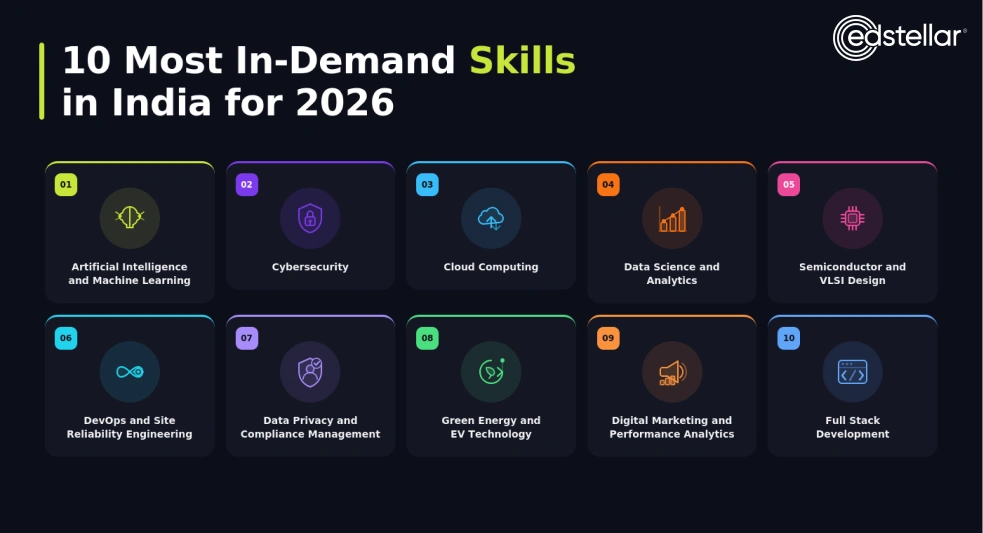
The most in-demand skills in India for 2025-2026 include Artificial Intelligence and Machine Learning, Cybersecurity, Cloud Computing, Data Science and Analytics, Semiconductor and VLSI Design, DevOps and SRE, Data Privacy and Compliance Management, Green Energy and EV Technology, Digital Marketing and Performance Analytics, and Full Stack Development. AI/ML tops the list with over 290,000 job postings and a 51% demand-supply gap reported by NASSCOM.

Which skills are in demand?

Globally and in India, technology-driven skills dominate demand. AI/ML, cybersecurity, cloud computing, and data science lead the pack. India also has unique demand in semiconductor design (Rs 76,000 crore PLI scheme) and data privacy compliance (DPDP Act 2023). Green energy skills are rising fast with government investment exceeding Rs 67 lakh crore committed through 2034.

What are the most in-demand skills?

The most in-demand skills center on AI and automation, cybersecurity, cloud infrastructure, and data analytics. In India, NASSCOM reports a 51% demand-supply gap for AI professionals and over 1 million cybersecurity professionals shortage. Skills with the highest salary premiums include AI engineering (Rs 18-40 LPA), data science (Rs 10-50 LPA), and semiconductor design (Rs 20-35 LPA for senior roles).

What skills are in demand?

Employers in India are actively hiring for AI/ML engineers, cybersecurity analysts, cloud architects, data scientists, DevOps engineers, and full stack developers. Beyond tech, there is growing demand for data privacy officers (DPDP Act), green energy technicians (National Green Hydrogen Mission), and digital marketing specialists as India's ad market grows at 19% annually.

Which skill is in demand in India?

Artificial Intelligence and Machine Learning is the single most in-demand skill in India right now. The country has over 290,000 AI job postings, a 51% talent gap, and the government has allocated Rs 10,371 crore for the IndiaAI Mission. AI/ML engineers earn salary premiums of up to 40% above base pay, and 99% of Indian companies plan to hire for GenAI roles.

What jobs are in demand in India?

The most demanding jobs in India include AI/ML Engineer, Cybersecurity Analyst, Cloud Architect, Data Scientist, DevOps Engineer, Full Stack Developer, Data Protection Officer, and EV Technology Specialist. The IT sector leads fresher hiring at 35%, with top firms planning to onboard 82,000 graduates in FY2026. India is projected to create 12.8 million new jobs in 2026.

Which IT skills are in demand in India?

The top IT skills in demand in India are AI/ML (including Generative AI and LLMs), cloud computing (AWS, Azure, GCP), cybersecurity (SOC operations, penetration testing), data science (Python, SQL, Tableau), DevOps (Docker, Kubernetes, Terraform), and full stack development (MERN/MEAN stack). NASSCOM reports a 60-73% demand-supply gap across these roles.

Which course is most demanding in India?

The most demanding courses in India are AWS Solutions Architect, Microsoft Azure certifications, CISSP and CompTIA Security+ for cybersecurity, AI/ML specializations, PMP and Scrum Master for project management, and Google Cloud Professional certifications. The India Skills Report 2026 confirms that 80% of employers now value practical skills and certifications above formal degrees when hiring.

Expert Insight

"The rapid green, digital, and energy transition requires the development of a new skills framework for maritime professionals. As shipping undergoes rapid technological changes, a highly trained and educated workforce is no longer just an advantage, it is a necessity for maintaining leadership and competitiveness."

Marina Hadjimanolis
Marina Hadjimanolis LinkedIn

Shipping Deputy Minister, Republic of Cyprus · Limassol, Cyprus

Conclusion

India's skills landscape in 2025-2026 is defined by rapid technological adoption, aggressive government policy, and a workforce that is eager to learn but needs structured support to close the gap. From AI/ML with its 51% demand-supply gap to cybersecurity's 1 million professional shortage, the data is clear: organizations that invest in targeted upskilling will outperform those that do not.

The 10 skills covered in this guide represent the areas where Indian employers are spending the most, hiring the fastest, and paying the highest premiums. Whether your priority is building AI capabilities, achieving DPDP compliance, or strengthening your cloud infrastructure team, the time to act is now.

Edstellar's instructor-led corporate training programs are designed to help organizations build these exact capabilities. With customizable courses, expert trainers, and a focus on practical, applicable skills, Edstellar helps teams move from awareness to proficiency. Explore Edstellar's corporate training programs and start closing your skills gap today.

Ready to Upskill Your Team?

Explore Edstellar's 2000+ instructor-led corporate training programs designed for the skills India needs most.

Explore Training Programs

Vineet Barnwal is an experienced corporate trainer with over 16 years in the industry, having successfully trained more than 30,000 corporate employees, teachers, and students across multinational companies, startups, UNICEF, and government organizations.

Explore High-impact instructor-led training for your teams.

#On-site  #Virtual #GroupTraining #Customized

Edstellar Training Catalog

Explore 2000+ industry ready instructor-led training programs.

Download Now

Coaching that Unlocks Potential

Create dynamic leaders and cohesive teams. Learn more now!

Explore 50+ Coaching Programs

Want to evaluate your team’s skill gaps?

Do a quick Skill gap analysis with Edstellar’s Free Skill Matrix tool

Get Started

Tell us about your corporate training requirements

Valid number