A curated list of the top in-demand skills in Morocco, compiled by a supply chain and operations transformation leader with 20+ years of international experience across healthcare, life sciences, FMCG, and shipping industries.
Morocco's economy grew 4.7% in 2025 with non-agriculture growth reaching 4.8%, yet unemployment stands at 13% with youth unemployment at 29.2% and up to 100,000 job openings could remain unfilled due to skills mismatch. Morocco produced one million cars in 2025, becoming Africa's undisputed automotive leader, while co-hosting the 2030 FIFA World Cup will create over 100,000 jobs annually and the new offshoring framework targets 130,000 additional jobs by 2030.
The paradox of high unemployment coexisting with unfilled vacancies defines Morocco's workforce challenge: the education system produces graduates in administrative fields while the economy demands automotive engineers, software developers, cybersecurity specialists, and renewable energy technicians. For corporate L&D leaders and HR managers operating in Africa's sixth-largest economy, these numbers translate directly into urgent training priorities.
Several structural forces are converging to reshape Morocco's labour market. The government unveiled a new offshoring incentive framework targeting MAD 40 billion ($4 billion) in revenue and 130,000 jobs by 2030, with MAD 25 billion projected for 2026. Stellantis announced a EUR 1.2 billion ($1.4 billion) investment to expand Kenitra production from 200,000 to 535,000 vehicles annually by 2030, while Renault signed an updated 2025–2030 agreement creating 7,500 direct and indirect jobs including hybrid and electric vehicle production.
The country aims to produce 52% of its electricity from renewables by 2030, OCP committed $7 billion for a green ammonia plant, and a $10.3 billion railway expansion plan will connect major cities with high-speed rail before the World Cup. With a median age of just 29, a workforce of 180,000+ university graduates and 19,000 engineers annually, Morocco possesses the demographic dividend to fuel this transformation if it can close the skills gap.
So which skills are truly driving Morocco's economy, and where should organisations invest their training budgets? This guide breaks down the top 10 skills in demand in Morocco, spanning automotive manufacturing, IT offshoring, renewable energy, healthcare, and construction. Drawing on HCP (Haut-Commissariat au Plan) labour data, ANAPEC employment reports, industry workforce analysis, and hiring benchmarks, it provides an evidence-based picture of what jobs are in demand in Morocco, whether you are planning corporate upskilling programmes, building internal talent pipelines, or advising teams on high demand skills in Morocco for 2026 and beyond.
Sources Behind This Research
Every ranking in this guide is backed by data from Moroccan government bodies, industry associations, and international development organisations.
Government
HCP (Haut-Commissariat au Plan)
Labour Market Statistics & Employment Data 2025
Reported 13% unemployment, 29.2% youth unemployment (15–24), 16.1% female unemployment, and sector-level employment data. Confirmed tourism supported 894,000 direct jobs in 2025, surpassing the 2023–2026 roadmap targets.
Automotive, Aerospace & Offshoring Investment Data
Documented one million vehicles produced in 2025, $17 billion automotive exports, the EUR 1.2 billion Stellantis expansion, and the new offshoring framework targeting 130,000 jobs and MAD 40 billion in revenue by 2030.
Administers the IDMAJ programme generating 30,000 job opportunities annually for non-graduate youth. Currently undergoing major reform to modernise its legal status and improve efficiency, with only 14% of registered jobseekers benefiting from services.
IFMIA (Institut de Formation aux Metiers de l'Industrie Automobile)
Automotive Workforce Training Reports
Trained over 50,000 automotive professionals with a 98% employment rate. Operates three institutes in Tangier, Kenitra, and Casablanca, aligned with Renault and Stellantis manufacturing needs. Primary source for automotive skills pipeline data.
Morocco Jobs Landscape & Energy Transition Workforce Reports
Analysed Morocco's structural unemployment, skills mismatch, and the gap between education output and employer requirements. Provided data on energy transition workforce needs and renewable energy training capacity.
Projected automotive industry growth from $4.76 billion to $8.44 billion by 2031 (12.15% CAGR). Reported labour costs averaging $106 per vehicle, making Morocco among the world's most competitive manufacturing locations.
Labour Market, Tourism & Industry Reporting 2025–2026
Covered automotive production milestones, World Cup infrastructure investment, tourism visitor records (19.8 million in 2025), healthcare brain drain (600–700 doctors leaving annually), and sector-level employment trends.
Confirmed Casablanca-Settat leads with 37.1% of developer respondents. Reported IT outsourcing overtaking CRM at 40.3% of export revenues. Provided salary benchmarks with Casablanca commanding 30–50% premiums over national averages.
"Among the most in-demand skills in Morocco by 2026 are operational excellence, supply chain transformation, digital enablement, and organizational agility. Organizations investing in these capabilities will be better positioned to build resilient operations, accelerate performance, and sustain competitive advantage in an increasingly dynamic market environment."
Hassan Ait Ali
✓ Founder of Absolute Logistics with 20+ years of international supply chain consulting experience, partnering with Bayer, P&G, Maersk Line, and CMA CGM to transform end-to-end supply chains into strategic enablers of performance and growth.
10 Key Skills in Demand Across Morocco's Job Market
Morocco's skills landscape in 2026 reflects the convergence of Africa's largest automotive industry, a rapidly scaling IT offshoring sector, massive World Cup infrastructure investment, and a renewable energy transition that targets 52% clean electricity by 2030. The 10 skills below span manufacturing, technology, energy, healthcare, and construction, mirroring the sectors where government investment, employer demand, and growth potential are highest. Each ranking draws on the policy signals, job market data, and industry investments outlined in the sources above.
1
Automotive & Aerospace Engineering
Research Score: 9.40/10
Morocco produced one million cars in 2025, becoming Africa's undisputed automotive leader and the continent's largest vehicle exporter with $17 billion in automotive exports. Stellantis announced a EUR 1.2 billion investment to expand Kenitra from 200,000 to 535,000 vehicles annually by 2030, incorporating electric and hybrid production lines with a 75% local sourcing rate. Renault's Tangier plant, the largest automotive factory in Africa spanning 300 hectares with 7,000 employees, is Renault's second-largest production site globally. The automotive sector contributes roughly 22% of Morocco's industrial GDP.
The shift toward electric and hybrid vehicle production is creating entirely new skill categories. BYD has set up operations in Morocco with plans for three additional factories focused on electric mobility, and Gotion committed $6.4 billion for an EV battery plant. The local content rate stands at 69%, with ambitions to reach 80%, meaning more components must be manufactured domestically, requiring quality engineers, supply chain specialists, and production technicians. IFMIA has trained over 50,000 automotive professionals across its three institutes in Tangier, Kenitra, and Casablanca, achieving a 98% employment rate at multinational companies.
Aerospace is the second pillar, with exports rising 17.3% to $2.16 billion and plans to double aerospace employment by 2030. Boeing, Safran, Airbus, and Bombardier all maintain manufacturing or MRO operations in Morocco. Labour costs average just $106 per vehicle according to Oliver Wyman, making Morocco among the world's most competitive production locations alongside Romania and Mexico, surpassing China in labour cost efficiency. For engineering graduates, Morocco's automotive and aerospace sectors offer career pathways in Africa's most advanced manufacturing ecosystem.
Key Sub-skills
EV & Hybrid Vehicle Production EngineeringQuality Engineering & Lean ManufacturingAerospace MRO & Composite MaterialsAutomotive Supply Chain & LogisticsRobotics & Production Automation
The government's new offshoring incentive framework targets MAD 40 billion ($4 billion) in revenue and 130,000 additional jobs by 2030, with MAD 25 billion projected for 2026. IT outsourcing has overtaken customer relationship management at 40.3% of export revenues, with engineering services contributing 13.2% and BPO adding 8.9%. Morocco's IT industry revenue is projected at $980.98 million in 2025, and German firms are increasingly drawn by competitive costs, a two-hour flight from Frankfurt to Casablanca, and a growing pool of engineering graduates.
Casablanca-Settat leads the developer ecosystem with 37.1% of respondents in the StateOfDev Morocco survey. A Moroccan IT architect earns approximately MAD 13,595 monthly, and international employers competing for senior talent should budget 30–50% above national averages for Casablanca-based roles. The offshoring sector is shifting from voice-based BPO toward higher-value IT services, data analytics, and engineering, requiring developers, cloud architects, and cybersecurity specialists rather than customer service agents.
Morocco's competitive advantage for European nearshoring is the combination of French and Arabic language capability, geographic proximity to the EU, compatible time zones, and a young workforce of 19,000 engineering graduates annually. Casablanca Nearshore Park, Rabat Technopolis, and Fez Shore host the largest concentration of offshoring firms. For young Moroccans, IT and software development represent one of the highest-paying career pathways, with remote work for European clients offering compensation significantly above domestic averages.
The 2030 FIFA World Cup co-hosting will create over 100,000 jobs annually, with a $10.3 billion railway expansion plan including a 430 km high-speed line from Kenitra to Marrakech costing 53 billion dirhams. Morocco's National Investment Commission authorised projects representing approximately 17.3 billion dirhams in committed capital in 2025, spanning tourism, manufacturing, renewables, and infrastructure, associated with 27,000 jobs. Stadium construction, airport expansions, hotel development, and road networks are all scaling simultaneously toward the 2030 deadline.
The employment decisions made between 2026 and 2028 will determine how companies navigate the 2030 peak and the transition beyond. Engineers, project managers, and digital specialists who can deliver under tight World Cup timelines are in immediate demand. The Cap Hospitality programme is financing the modernisation of 25,000 hotel rooms by 2026, and Morocco is charting $4 billion in hotel growth ahead of the tournament, requiring architects, interior designers, and construction managers alongside civil engineers and site supervisors.
The high-speed rail project, managed by an Egis-led consortium, will create thousands of direct construction jobs and thousands more in ongoing operations. For young Moroccans, TESDA-equivalent vocational training through OFPPT (Office de la Formation Professionnelle et de la Promotion du Travail) provides pathways into construction trades. The IDMAJ programme targets 30,000 job opportunities annually for non-graduate youth in construction, industry, and commerce, offering a structured entry point into the sector.
Key Sub-skills
Civil & Structural EngineeringRailway & Transport InfrastructureProject Management (PMP, PRINCE2)Building Information Modelling (BIM)Stadium & Hospitality Construction
Top Industries
World Cup Infrastructure, Railway & Transport, Real Estate & Hotels, Public Works & Utilities
"The development of green hydrogen and renewable energy is a crucial lever for the national economy. We expect job creation in the green hydrogen sector to account for around 10% of Morocco's needs."
Younes Sekkouri
Minister of Economic Inclusion, Small Business, Employment and Skills · Rabat, Morocco
4
Renewable Energy & Green Hydrogen
Research Score: 8.55/10
Morocco targets 52% of electricity from renewable sources by 2030, with the NOOR Ouarzazate Complex (582 MW) already one of the world's largest concentrated solar power plants, reducing CO2 emissions by 760,000 tonnes annually. Wind energy capacity reached 1.4 GW in 2023 and is expected to rise to 5 GW by 2030. OCP, the world's largest phosphate producer, committed $7 billion for a green ammonia plant with initial annual production of 200,000 tonnes by 2026, scaling to one million tonnes by 2027. The ORNX consortium signed a $4.5 billion deal for a green ammonia hub in Laayoune using 2 GW of renewables.
A professional baccalaureate in renewable energy was established in Ouarzazate in 2021, training 60 students annually in alternation between a technical high school and the training institute for renewable energy professions. The NOOR project created thousands of jobs during construction and spurred new training programmes in the region. Morocco's energy transition requires solar PV engineers, wind turbine technicians, electrolyser operators, grid integration specialists, and environmental scientists who can manage large-scale clean energy infrastructure.
Morocco's strategic position connecting Africa and Europe, combined with its renewable resources (3,000+ hours of sunshine and strong Atlantic winds), positions it as a green hydrogen export hub. The country plans to supply green electricity to Europe through subsea interconnectors, creating long-term demand for energy engineers and transmission specialists. For professionals in traditional energy, engineering, or environmental science, Morocco's clean energy sector offers one of Africa's most advanced career environments.
Key Sub-skills
Solar PV & Concentrated Solar Power (CSP)Wind Energy Engineering & MaintenanceGreen Hydrogen & Ammonia ProductionEnergy Storage & Grid IntegrationEnvironmental Impact Assessment
Top Industries
Solar Power (MASEN, NOOR), Wind Energy, Green Hydrogen (OCP, ORNX), Utilities & Grid Operations
Morocco has just 0.80 physicians and 1.03 nurses per 1,000 population, well below WHO reference values of 1.72 and 4.5 respectively. Responding to the population's needs would require approximately 32,000 doctors and 65,000 nurses, but there are only around 2,300 doctors in the public sector according to Morocco's Health Minister. An estimated 600–700 doctors leave annually to work abroad for better pay and conditions, with approximately 15,000 Moroccan doctors practising in France alone, constituting one of the most severe medical brain drains in Africa.
The government has responded with major expansion of nursing education, increasing training centre slots from 2,735 in 2019 to 9,500 in 2024. Medical law was reformed in 2023 to allow foreign doctors to practice in Morocco, though fewer than 50 have applied. Shortages, sanitation issues, and structural problems in public hospitals are driving reform urgency, with France 24 reporting that Morocco's public hospitals are at a "breaking point." The 3,300 unfilled Department of Health positions leave government hospitals chronically understaffed, particularly in rural areas.
For healthcare professionals, Morocco's crisis represents both a challenge and an opportunity. Private clinics and hospitals are expanding, medical tourism from sub-Saharan Africa is growing, and the World Cup 2030 preparations require healthcare infrastructure upgrades to meet international standards. Competitive domestic salaries, professional development pathways, and improved working conditions are the primary levers for retention. University Hospital Centres in Rabat, Casablanca, Fez, and Marrakech are the largest public employers.
Key Sub-skills
General & Specialist NursingEmergency & Critical Care MedicinePublic Health & Community MedicineHealthcare Management & AdministrationMedical Technology & Diagnostics
Top Industries
Government Hospitals (CHU), Private Clinics & Hospitals, Public Health Programmes, Pharmaceutical & Biotech
Get a custom training plan from Edstellar's 5,000+ expert trainers. Virtual or onsite delivery across Casablanca, Rabat, Marrakech, Tangier, and beyond.
Request a Free Consultation →
6
Tourism & Hospitality Management
Research Score: 8.05/10
According to HCP data, Morocco welcomed a record 19.8 million visitors in 2025, a 14% increase year-over-year, and emerged as Africa's most visited country in early 2026 with over 4.3 million international tourists in Q1 alone. Tourism supported 894,000 direct jobs in 2025, creating 92,000 new positions over three years and surpassing the roadmap's objective of 80,000. The government targets 26 million tourists by 2030, coinciding with the FIFA World Cup co-hosting with Spain and Portugal, and is charting $4 billion in hotel growth to meet this demand.
The Cap Hospitality programme is financing the modernisation of 25,000 hotel rooms by 2026, and Hilton alone announced 15 new hotels in Morocco. Luxury tourism is growing alongside budget and cultural tourism, with Marrakech, Fez, Chefchaouen, and the Atlas Mountains attracting diverse visitor segments. The government strengthened tourism training through OFPPT programmes in hospitality management, culinary arts, and guest services, but the pipeline remains insufficient for the scale of expansion planned before the World Cup.
Hotel managers, chefs, guest experience specialists, event coordinators, and tourism marketing professionals are in growing demand across the country. Morocco's position as a cultural crossroads between Africa, Europe, and the Arab world creates unique hospitality requirements, with multilingual capability (French, Arabic, English, Spanish) particularly valued. For young Moroccans, tourism offers accessible employment pathways that do not always require university degrees, with structured OFPPT training providing certification for hospitality careers.
Key Sub-skills
Hotel & Resort Operations ManagementCulinary Arts & Food Service ManagementGuest Experience & Multilingual ServiceRevenue Management & Tourism AnalyticsCultural Heritage & Sustainable Tourism
Top Industries
Hotels & Riads, Airlines & Aviation, Tour Operators & Cultural Tourism, Events & MICE
As Morocco scales its digital economy toward $4 billion in offshoring revenue and expands digital government services, the cybersecurity attack surface is growing dramatically. The financial sector (Casablanca Finance City hosts 225 companies across 115 countries), government digital platforms, and the expanding IT offshoring operations all require cybersecurity professionals who can protect client data, financial transactions, and critical infrastructure. Morocco's Data Protection Authority (CNDP) enforces the Law 09-08 on personal data protection, creating regulatory compliance demand.
The offshoring sector's growth is particularly relevant: European clients outsourcing IT services to Morocco increasingly require cybersecurity certifications and compliance frameworks. GDPR compliance expertise is especially valued given Morocco's role as a nearshore destination for EU companies. With European nearshoring clients requiring GDPR compliance and Morocco's own Law 09-08 adding domestic obligations, cybersecurity engineers who can manage both regulatory frameworks simultaneously are commanding significant premiums in the Casablanca market. Financial institutions including Attijariwafa Bank, BMCE Bank of Africa, and Banque Populaire are all investing in cybersecurity capabilities as digital banking adoption increases across the kingdom.
For Moroccan IT professionals, cybersecurity represents one of the highest-paying specialisations, with compensation significantly above general software development roles. CISSP, CEH, and CompTIA Security+ certifications carry salary premiums and improve employability with both domestic and international employers. The gap between cybersecurity talent supply and demand in Morocco mirrors the global pattern, creating opportunities for professionals who invest in structured security training.
Key Sub-skills
Cloud Security ArchitectureGDPR & Data Protection CompliancePenetration Testing & Vulnerability AssessmentIncident Response & Digital ForensicsGovernance, Risk & Compliance
Top Industries
IT Offshoring & Nearshoring, Financial Services (CFC), Government Digital Services, Telecommunications
"Artificial intelligence and Industry 4.0 will only produce value if they are built on digitized enterprises and on organized, interoperable, and governed data."
Redouane El Haloui
CEO, RED INNOV · Casablanca-Settat, Morocco
8
Financial Services & Fintech
Research Score: 7.55/10
Casablanca Finance City ranks first in Africa in the Global Financial Centres Index, hosting 225 companies across 115 countries and positioning Morocco as the continent's financial gateway. The Casablanca Stock Exchange introduced derivatives trading in 2025 (equity index futures on the MASI 20 index), a landmark step signalling the market's maturation toward hedging and risk management. The Morocco Fintech Center launched in January 2025, bringing together fifteen banks and financial institutions in a regulatory sandbox for innovation.
Notable fintech builders include ORA Technologies (mobile wallet, 50,000 accounts in five months), Woliz (retail-tech serving 55,000 small businesses), and Chari (B2B e-commerce with embedded fintech). Financial institutions establishing a Casablanca presence in 2025 or 2026 capture the full 2030 infrastructure financing cycle, and Moroccan banks including Attijariwafa, BMCE Bank of Africa, and Banque Populaire are expanding across francophone Africa, creating demand for bankers with pan-African experience.
For finance professionals, Morocco offers a unique position: the financial infrastructure of a regional hub combined with the growth dynamics of an emerging market. Accountants, financial analysts, risk managers, and compliance officers remain in demand, while the convergence of finance with technology is creating roles in digital payments, mobile banking, and regulatory technology. CFC status provides tax incentives that attract international financial firms, supporting above-market compensation for specialist roles.
Key Sub-skills
Pan-African Banking & Capital MarketsDigital Payments & Mobile BankingRisk Management & DerivativesAccounting & Auditing (IFRS)Regulatory Technology & Compliance
Top Industries
Banking (Attijariwafa, BMCE), Casablanca Finance City, Insurance & Capital Markets, Fintech Startups
Agriculture remains a critical sector for Morocco's economy, employing approximately 30% of the workforce and contributing significantly to GDP, though productivity challenges persist due to water scarcity, climate variability, and limited mechanisation. The Generation Green 2020–2030 strategy targets doubling the agri-food sector's GDP, creating 350,000 additional jobs, and tripling agricultural exports. Phosphates, managed by OCP Group, are Morocco's most valuable mineral resource, with exports reaching $6.87 billion, and OCP's move into green fertiliser production is creating intersection roles between agriculture and clean technology.
Morocco's agricultural sector faces the dual challenge of modernising traditional farming while adapting to climate change. Drip irrigation, precision agriculture, greenhouse cultivation, and digital crop monitoring are essential technologies for a country where water resources are increasingly scarce. The olive oil, citrus, and vegetable export sectors require food safety, quality management, and cold chain logistics professionals to meet European import standards. Agro-processing and value-added food manufacturing offer significant employment potential beyond primary production.
For young rural Moroccans, agricultural modernisation and agribusiness offer career pathways that leverage local knowledge while incorporating new technologies. The Suliman Raissouni training centres and OFPPT agricultural programmes are expanding vocational training in modern farming techniques. The intersection of agriculture with Morocco's renewable energy ambitions (solar-powered irrigation, green fertiliser production) creates uniquely Moroccan career opportunities.
Morocco's IDMAJ programme targets 30,000 job opportunities annually for non-graduate youth in construction, industry, commerce, and other sectors, reflecting the urgent need to channel the country's young population into productive employment. With 29.2% youth unemployment and the World Cup creating over 100,000 jobs annually, the demand for skilled tradespeople including electricians, plumbers, welders, carpenters, and heavy equipment operators will intensify dramatically over the next four years.
OFPPT (Office de la Formation Professionnelle et de la Promotion du Travail) is Morocco's primary vocational training institution, operating hundreds of centres across the country. The automotive sector's 55,000 trained technicians demonstrate what structured vocational training can achieve, but construction, renewable energy installation, and industrial maintenance trades remain underserved. The railway expansion ($10.3 billion) and stadium construction for the World Cup will require thousands of specialised tradespeople that the current training pipeline cannot produce without significant expansion.
For Morocco's 1.6 million unemployed, particularly the 29.2% of youth aged 15–24 without work, skilled trades offer the most accessible pathway to employment. The combination of World Cup construction, automotive factory expansion, renewable energy installation, and infrastructure modernisation creates a once-in-a-generation demand for vocational skills. Companies that invest in apprenticeship programmes and on-the-job training will gain a competitive advantage in a market where skilled labour is the binding constraint on project delivery.
Practical guide to finding jobs in Morocco covering the mindset and strategies needed to navigate the local employment market.
Skills Demand Across Morocco's Key Economic Regions
Morocco's skills demand is shaped by the geographic concentration of industrial clusters, tourism assets, and government investment. Understanding these regional patterns helps corporate L&D teams and HR managers target training investments where they will have the greatest impact.
Region
Key Industries
Top Shortage Skills
Casablanca-Settat
Financial Services (CFC), IT Offshoring, Automotive, Aerospace
Tourism, Agriculture, IT Offshoring (Fez Shore), Handicrafts
Tourism & Hospitality, IT & Software, Agriculture, Healthcare
Casablanca dominates financial services, IT offshoring, and corporate headquarters, hosting Africa's top-ranked financial centre and the largest concentration of technology firms. Tangier and Kenitra anchor the automotive manufacturing corridor, with Tanger Med port providing world-class export logistics. Marrakech and Ouarzazate represent the tourism and renewable energy hubs, while the World Cup infrastructure investment will create demand across all major cities including Casablanca, Rabat, Marrakech, Fez, Tangier, and Agadir. For organisations planning multi-site operations, aligning training programmes with these regional demand patterns ensures that upskilling investments match actual hiring needs.
How to Develop These Skills in Demand in Morocco
Morocco's skills challenge is defined by a paradox of youth and mismatch: a median age of 29, 180,000+ university graduates annually, and 19,000 engineers produced each year, yet 13% unemployment, 29.2% youth joblessness, and up to 100,000 positions that remain unfilled because the skills graduates possess do not match what employers need. With the 2030 World Cup creating a fixed deadline for infrastructure delivery, the automotive sector scaling toward two million vehicles, and the offshoring framework targeting 130,000 new jobs, organisations need a systematic approach to close these gaps. Here is how to approach it.
Start with a skills audit. Use a structured training needs analysis to map your current team capabilities against the skills your business needs over the next 12 to 24 months. Focus on the gaps that directly affect production capacity, client requirements, or project delivery timelines. With the automotive sector requiring EV and hybrid production skills and the World Cup creating non-negotiable infrastructure deadlines, identifying your organisation's specific mismatches is essential before committing training budgets.
Build individual development plans. Generic training programmes produce generic results. Use individual development plan templates to tailor learning pathways to each employee's current skills and career trajectory. An automotive assembly worker transitioning into EV battery production has different development needs than a BPO agent upskilling into IT outsourcing, even though both benefit from digital literacy fundamentals.
Combine certifications with applied learning. International certifications (PMP, AWS, CISSP, DELF/DALF, CompTIA) carry significant weight in Morocco's job market, particularly for offshoring roles serving European clients. However, applied projects and instructor-led workshops build the practical capability that certifications alone cannot provide. The most effective programmes pair certification preparation with hands-on exercises drawn from Moroccan industry scenarios, particularly in automotive manufacturing, GDPR compliance for offshoring clients, and renewable energy installation where local context matters.
Address performance gaps systematically. A guide to understanding performance gaps can help managers distinguish between skill deficits, technology limitations, and systemic barriers before investing in training. An automotive team underperforming on quality metrics may need lean manufacturing and statistical process control workshops, while a tourism team with guest satisfaction issues may need multilingual service standards training rather than more operational procedures.
Leverage Morocco's workforce development programmes. OFPPT provides vocational training across hundreds of centres nationwide. IFMIA offers automotive-specific training with 98% placement rates. The IDMAJ programme creates 30,000 annual opportunities for non-graduate youth. ANAPEC, currently undergoing major reform, connects jobseekers with employers. Companies can partner with these government programmes to supplement internal training budgets and access structured skills pipelines aligned with the country's industrial priorities.
Morocco's economic trajectory, driven by Africa's largest automotive industry scaling toward two million vehicles, the 2030 World Cup creating over 100,000 annual jobs, a $4 billion offshoring framework, and $7+ billion in green hydrogen investment, signals that demand for skilled professionals will only intensify. Organisations that build their training strategies around these national priorities, supported by a catalogue of over 2,000 instructor-led courses, will be better positioned to attract talent and maintain competitive advantage in Africa's fastest-industrialising economy.
Frequently Asked Questions
What skills are in high demand in Morocco?
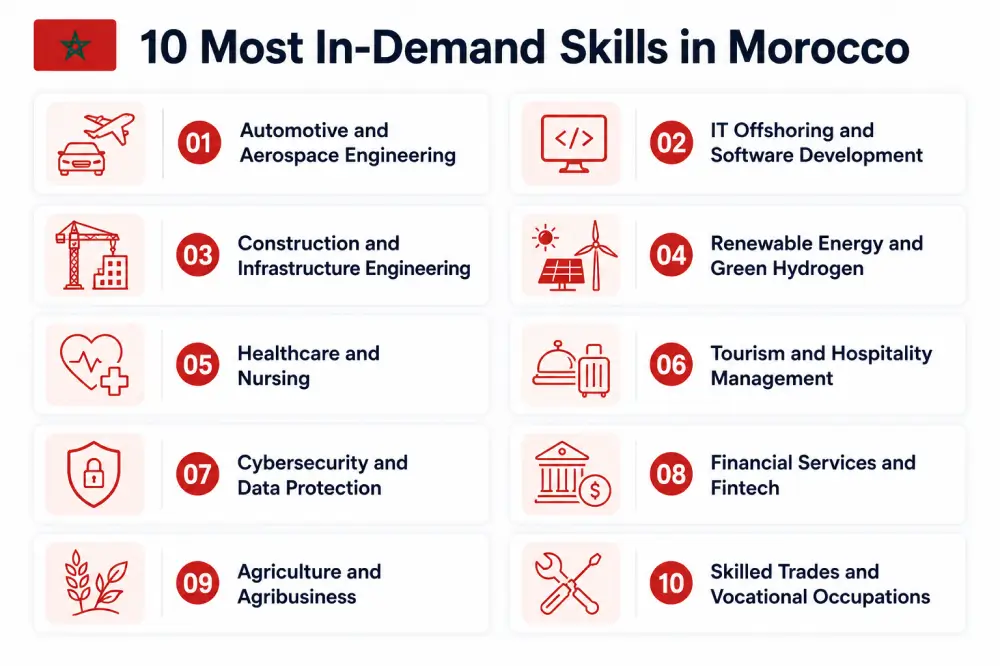
The most in-demand skills in Morocco for 2026 include automotive and aerospace engineering, IT offshoring and software development, construction and infrastructure engineering, renewable energy and green hydrogen, healthcare and nursing, tourism and hospitality management, cybersecurity, financial services and fintech, agriculture and agribusiness, and skilled trades. Automotive engineering leads the list, driven by Morocco's position producing one million cars annually as Africa's largest vehicle manufacturer, while World Cup 2030 infrastructure is creating massive construction demand.
What jobs are in demand in Morocco in 2026?
The highest-demand jobs in Morocco for 2026 include automotive production engineers, software developers, cloud architects, construction project managers, civil engineers, solar energy technicians, registered nurses, hotel operations managers, cybersecurity analysts, financial analysts, agricultural technologists, electricians, welders, and plumbers. The automotive sector alone employs tens of thousands, the offshoring framework targets 50,000 new IT positions by 2026, and World Cup infrastructure requires over 100,000 workers annually.
How is the 2030 FIFA World Cup affecting Morocco's job market?
The 2030 World Cup, co-hosted with Spain and Portugal, is creating over 100,000 jobs annually and contributing 0.6 to 0.9% additional GDP growth through 2030. A $10.3 billion railway expansion includes a 430 km high-speed line from Kenitra to Marrakech. The Cap Hospitality programme is modernising 25,000 hotel rooms by 2026, and $4 billion in new hotel investment is planned. Stadium construction, airport expansions, and road infrastructure across six host cities are driving demand for engineers, project managers, construction tradespeople, and hospitality professionals.
Why does Morocco have high unemployment despite its economic growth?
Morocco's 13% unemployment alongside 4.7% economic growth reflects a fundamental skills mismatch. Up to 100,000 positions remain unfilled because the education system produces graduates concentrated in administrative and general academic fields, while employers need automotive engineers, software developers, healthcare professionals, and skilled tradespeople. Youth unemployment at 29.2% is particularly severe, with women facing 16.1% unemployment. The ANAPEC employment agency serves only 14% of registered jobseekers, and vocational training historically favoured tourism and IT over construction, manufacturing, and healthcare.
How do I get a job in Morocco as a foreigner?
Foreign professionals access Morocco's job market through employer-sponsored work permits, which require demonstrating that the position cannot be filled by a local candidate. French-speaking professionals have a significant advantage, as French is the primary business language alongside Arabic. The automotive sector (Renault, Stellantis, and their suppliers), IT offshoring firms, Casablanca Finance City entities, and international organisations are the most common employers of foreign professionals. Engineering, technology, healthcare (since the 2023 medical law reform), and senior management roles offer the strongest prospects. Morocco's proximity to Europe and competitive living costs make it attractive for European professionals.
What is the average salary in Morocco?
The average salary in Morocco ranges from MAD 8,000 to MAD 9,800 per month in 2026, with significant variation by sector and location. IT architects earn approximately MAD 13,595 monthly, and Casablanca commands 30 to 50% salary premiums over national averages. Automotive assembly wages average $106 per vehicle in labour costs. Senior IT roles in offshoring can reach significantly higher for professionals with European client experience. Casablanca Finance City offers above-market compensation for financial services specialists. Salaries are generally lower than in the EU but purchasing power parity makes Morocco attractive for the region.
Why is Morocco Africa's largest car manufacturer?
Morocco produced one million cars in 2025, overtaking South Africa as Africa's largest vehicle manufacturer. This transformation was built on strategic partnerships with Renault (Tangier plant, 7,000 employees) and Stellantis (Kenitra plant, EUR 1.2 billion expansion), a network of 270+ suppliers achieving 69% local content, competitive labour costs ($106 per vehicle), Tanger Med port providing direct shipping to Europe, free trade agreements with the EU and US, and IFMIA's training of 50,000+ automotive professionals with 98% placement rates. The sector targets two million vehicles annually and 80% local content by 2030.
What kind of jobs are available in Morocco for young people?
Young Moroccans have growing opportunities across the economy's fastest-expanding sectors. The automotive industry employs tens of thousands through IFMIA-trained pathways. IT offshoring and software development offer the highest salaries for engineering graduates, with remote work enabling international-level compensation. Tourism and hospitality provide accessible entry points through OFPPT training. Construction trades are in acute demand ahead of the World Cup. The IDMAJ programme creates 30,000 annual opportunities for non-graduate youth. Renewable energy installation is a growing pathway, and agriculture modernisation combines traditional knowledge with new technology skills.
Conclusion
Morocco's skills landscape in 2026 is defined by a country that has built Africa's largest automotive industry from scratch, is preparing to co-host the world's biggest sporting event, and is positioning itself as a bridge between Europe and Africa for IT offshoring, clean energy, and financial services. Yet 13% unemployment coexists with 100,000 unfilled positions, 29.2% of youth are without work, and 600–700 doctors leave annually for better opportunities abroad. The gap between what Morocco's rapidly industrialising economy demands and what its education and training systems deliver remains the central barrier to converting ambition into inclusive prosperity.
The ten skills in demand in Morocco covered in this guide represent the intersection of national industrial strategy and acute workforce need. From automotive and aerospace engineering powering Africa's manufacturing leader, through IT offshoring scaling toward $4 billion in revenue, construction building World Cup infrastructure under fixed deadlines, and renewable energy positioning Morocco as a green hydrogen export hub, each skill area offers clear returns on training investment. The organisations that close their skills gaps fastest will be the ones that attract talent, win contracts, and lead their industries as Morocco executes the most ambitious infrastructure and industrial programme in its history.
Ready to Upskill Your Morocco Team?
Join 500+ organisations that trust Edstellar's Training Needs Analysis to find the gaps, pick the right skills, and build a training plan that works.
Hassan Ait Ali is a supply chain and operations consultant and transformation leader with more than 20 years of international experience across healthcare, life sciences, FMCG, consulting and shipping industries.
Explore High-impact instructor-led training for your teams.
Unlock premium resources, tools, and frameworks designed for HR and learning professionals. Our L&D Hub gives you everything needed to elevate your organization's training approach.
.svg "edstellar")

.webp)















.svg "Click Here to Follow on Medium")
.svg)




.svg)


.svg)
.svg)
.svg)

.svg)