An expert-curated list of the top in-demand skills in Tanzania, reviewed by a certified IT trainer with 10+ years of cross cultural experience and multiple certifications including CCNP, MCSA, CEH, and VMware VCA.
Tanzania's mining sector hit a historic 10.1% GDP contribution in 2024 with USD 4.1 billion in mineral exports, while the country is simultaneously negotiating a USD 42 billion LNG project with Shell and Equinor, welcomed 5.36 million tourists generating USD 3.9 billion in revenue, and registered 915 investment projects worth USD 10.95 billion in 2025. Yet 94.6% of employment remains informal, 72% of youth have only low-level skills, and 56% of all medical graduates enrolled between 2011 and 2020 are no longer practising in the country by 2025. For corporate L&D leaders and HR managers operating in East Africa's largest economy, these numbers define a structural gap between transformative investment and workforce readiness.
Several forces are converging to reshape Tanzania's labour market. The 2024 Integrated Labour Force Survey reported unemployment at 6.2%, but 800,000 to 1,000,000 youth enter the workforce annually against only 450,000 to 500,000 formal jobs created, leaving a persistent gap of 300,000 to 550,000 positions. The Tanzania Digital Economy Strategic Framework 2024–2034 targets digital transformation across government and industry, 60.75 million mobile money accounts process USD 80 billion in transactions annually, and the Standard Gauge Railway has generated 115,000+ construction jobs.
VETA is expanding enrolment 43% to 265,000 students through a TZS 54 billion Italian-funded programme, five new Special Economic Zones launched in August 2025 targeting textiles, pharmaceuticals, and automotive assembly, and the Julius Nyerere Hydropower Station (2,115 MW) is now fully operational. With agriculture still employing 61.4% of the workforce and average formal wages at TZS 477,241 per month, Tanzania's skills challenge spans every sector from extractives to digital services.
So which skills are truly driving Tanzania's economy, and where should organisations invest their training budgets? This guide breaks down the top 10 skills in demand in Tanzania, spanning mining, LNG, construction, software development, cybersecurity, agriculture, healthcare, tourism, financial services, and data analytics. Drawing on NBS labour force data, TIC investment records, Bank of Tanzania financial sector reports, and industry salary benchmarks, it provides an evidence-based picture of what jobs are in demand in Tanzania, whether you are planning corporate upskilling programmes, building talent pipelines, or advising teams on high demand skills in Tanzania for 2026 and beyond.
Sources Behind This Research
Every ranking in this guide is backed by data from Tanzanian government bodies, international organisations, industry associations, and local recruitment platforms.
Government
National Bureau of Statistics (NBS)
Integrated Labour Force Survey 2024
Reported unemployment declining from 8.7% to 6.2%, youth unemployment at 10%, and informality rising to 94.6%. Documented average formal monthly wages at TZS 477,241 and labour force participation at 73.2%. Confirmed agriculture's employment share falling from 60.4% to 54.2% while services rose to 35.5%.
Ministry of Information, Communication and Technology (MICT)
Tanzania Digital Economy Strategic Framework 2024–2034
Published Tanzania's digital transformation roadmap targeting ICT GDP contribution growth, 90% internet penetration by 2030, national digital ID implementation, and cybersecurity legislation. Outlined plans for National Data Centres in Dodoma and Zanzibar, NICTBB fibre expansion, and AI/cybersecurity curriculum integration.
Tanzania Investment and Special Economic Zones Authority (TISEZA)
Investment Registrations & SEZ Launch 2025
Registered 915 projects worth USD 10.95 billion in 2025. Launched five new Special Economic Zones in Dar es Salaam targeting textiles, pharmaceuticals, automotive assembly, and agro-processing. Consolidated TIC and EPZA under the Investment and Special Economic Zones Act 2024.
Documented mining's record 10.1% GDP contribution, USD 4.1 billion mineral exports, and 20,843+ direct employees. Reported mining FDI stock at USD 9.79 billion (75% of sector FDI), Barrick's USD 4.24 billion economic injection (2019–2024), and local procurement rising from 62% to 88%.
Financial Inclusion Report 2024 & Mobile Money Statistics
Reported Financial Inclusion Index rising to 0.81, 60.75 million active mobile money accounts (17.5% year-on-year growth), and 6.41 billion transactions valued at TZS 198,859 billion. Documented digital loans doubling and digital insurance premiums reaching TZS 1.4 trillion.
Documented 5.36 million total visitors (2.14 million international) generating USD 3.9 billion. Reported Serengeti at 589,300 visitors (+11.2%), Kilimanjaro as fastest-growing attraction (+13.4%), and tourism's GDP contribution rising to 17.2%.
Provided salary benchmarks: software developers earning TZS 30–50 million annually, data scientists TZS 36–65 million, cybersecurity professionals TZS 5.5–72 million (entry to senior). Documented 215,000 tech jobs expected by end-2025 (614% growth since 2019) and 25% annual growth in data analysis and cybersecurity roles.
Analysed formal employment trends across mining, tourism, agriculture, and manufacturing. Documented average formal earnings at TZS 609,354 monthly, public sector pay at TZS 1,270,000 versus private sector at TZS 549,373, and mobile money market reaching USD 80 billion annually.
"The most critical skills in Tanzania's evolving market are increasingly shaped by technology and IT infrastructure development. Professionals who build hands-on proficiency in networking, cloud computing, and systems administration position themselves and their organizations for long-term growth in a rapidly digitizing economy."
Kumar Rajnish
✓ 10+ years of cross-cultural IT training experience with certifications in CCNP, CCNA, MCSA, CEH, and VMware VCA, delivering hands-on training in networking, systems administration, and cybersecurity.
10 Key Skills in Demand Across Tanzania's Job Market
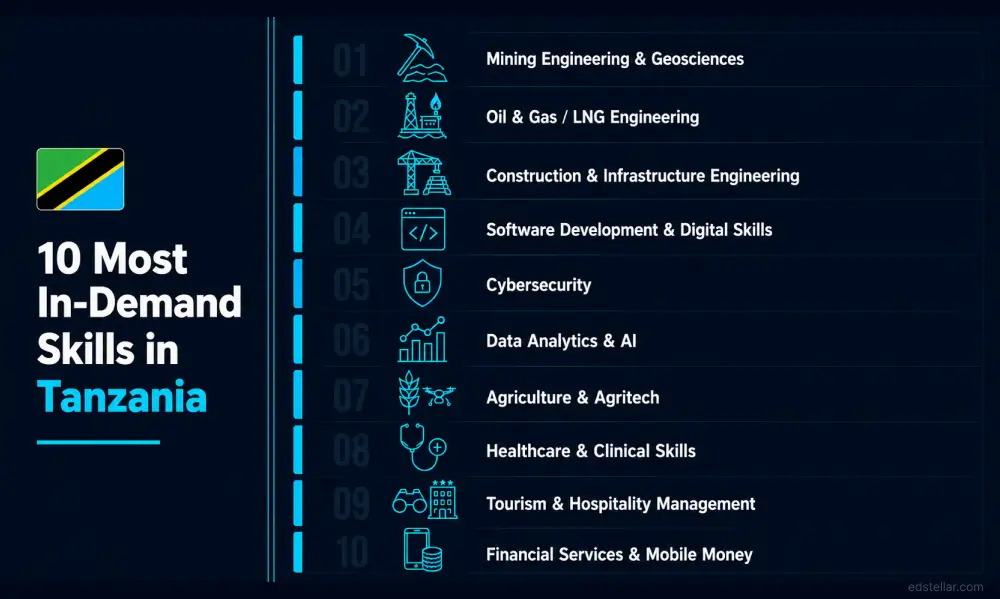
Tanzania's skills landscape in 2026 reflects East Africa's largest economy undergoing simultaneous extractive, infrastructure, and digital transitions. Record mining output, a pending USD 42 billion LNG investment decision, the completed Julius Nyerere Hydropower Station at 2,115 MW, five new Special Economic Zones, and 5.36 million tourists are all creating demand that the education system cannot yet meet. The 10 skills below span mining, LNG, construction, software development, cybersecurity, data analytics, agriculture, healthcare, tourism, and financial services, mirroring the sectors where government policy, employer demand, and foreign investment are highest.
1
Mining Engineering & Geosciences
Research Score: 9.2/10
Mining contributed a record 10.1% of Tanzania's GDP in 2024 with USD 4.1 billion in mineral exports, and the sector's quarterly GDP share reached 11.9% by Q1 2026. Tanzania is Africa's 8th-largest gold producer with 61.6 tonnes in 2024 and estimated reserves of 45 million ounces across mines operated by Barrick (Twiga joint venture: Bulyanhulu, North Mara), AngloGold Ashanti (Geita Gold Mine), and others. The Kabanga Nickel Project (Lifezone Metals) holds one of the world's largest undeveloped nickel sulphide deposits at 52.2 to 58.0 million tonnes grading 1.98% Ni, and USD 75 million was raised in H2 2025 for grid and railway infrastructure to support it.
The sector employed 20,843+ workers directly in 2024 (14.6% year-on-year increase), with Barrick alone employing 6,185 workers (96% Tanzanian) and injecting USD 4.24 billion into Tanzania's economy between 2019 and 2024. The government banned export of unprocessed critical minerals and the 2025 Mining Local Content Amendment Regulations now require non-Tanzanian companies to form joint ventures with 100% Tanzanian-owned firms holding minimum 20% equity, with 20 goods/services categories reserved exclusively for local companies. Local procurement by mining companies rose from 62% to 88% between 2018 and 2024.
Despite the local content push, skills gaps in geology, mine engineering, metallurgy, and safety/environmental management threaten sustainable growth according to Mining Weekly. Tanzania ranks 4th most attractive mining investment destination in Africa, critical minerals (graphite, lithium, nickel, rare earths) are in active development, and the mineral beneficiation mandate creates demand for processing engineers and quality specialists that the country does not yet produce at scale. Engineers in mining earn approximately TZS 15.1 million annually, with mining minimum wages rising to TZS 765,900 monthly from January 2026.
Key Sub-skills
Geological Mapping and ExplorationMineral Processing and MetallurgyMine Safety and Environmental ManagementGeotechnical and Hydrogeological EngineeringMining Equipment Maintenance
Tanzania's offshore recoverable gas reserves exceed 57 trillion cubic feet (sixth-largest in Africa), and the country is pushing for a final investment decision on the USD 42 billion Likong'o-Mchinga LNG Project before end-2025. Shell operates Blocks 1 and 4 (16 Tcf), Equinor operates Block 2 (20+ Tcf with 15+ exploration wells), and ExxonMobil, Pavilion Energy, and Medco Energi are also partners. If FID is achieved, construction will span four to five years with first LNG exports targeted for 2029 to 2030 at a capacity of up to 10 million tonnes per annum.
The LNG project will require large numbers of petroleum engineers, subsea engineers, instrumentation and control technicians, HSE specialists, and offshore logistics personnel that Tanzania does not currently produce domestically. The Tanzania Petroleum Development Corporation (TPDC) manages upstream operations, but the country has no established petroleum engineering training infrastructure at the scale the project demands. Gas-to-power projects are also advancing, with the completed Julius Nyerere Hydropower Station (2,115 MW) now reducing dependence on gas-fired generation while freeing gas reserves for export.
For organisations positioned in Tanzania's energy sector, the LNG investment decision represents the country's largest single economic opportunity. The project will transform the southern Lindi coast into an industrial hub, create thousands of construction and operational jobs, and generate export revenue that could rival the mining sector. Companies that invest in training Tanzanian petroleum engineers, process technicians, and offshore safety specialists ahead of construction will gain preferential positioning under the local content framework that the government has made central to the negotiations.
Key Sub-skills
Petroleum and Reservoir EngineeringLNG Process OperationsSubsea Engineering and Pipeline ConstructionHSE Management for Offshore OperationsInstrumentation and Control Systems
Top Industries
LNG Production, Offshore Exploration, Gas-to-Power, Energy Services
Tanzania is executing some of the largest infrastructure projects in East Africa simultaneously. The Standard Gauge Railway (total investment approximately USD 10 billion) has generated 115,000+ jobs across its six phases, with the Dar es Salaam to Dodoma passenger service launched in August 2024 and the Isaka to Mwanza section at 63% completion. A new 1,028 km line from Tanga to Musoma was announced in January 2025, and a USD 2.1 billion Tanzania-Burundi SGR contract was signed the same month. The Tanzania Railways Corporation advertised 2,460 operational positions for the Dar es Salaam to Makutopora section alone.
The Julius Nyerere Hydropower Station (2,115 MW) trained 5,000 Tanzanians during its construction phase, the Dodoma capital relocation has moved 25,039 civil servants and 65 institutions with a USD 5 billion "Magufuli City" development planned, and the World Bank approved USD 200 million for Dodoma urban mobility in March 2025 targeting 10,000+ jobs. The five new Special Economic Zones require roads, utilities, and factory buildings, and the 2025/26 Ministry of Transport budget of TZS 2.75 trillion focuses on SGR, airports, ports, and marine infrastructure.
The construction boom has created acute demand for civil engineers, project managers, quantity surveyors, structural engineers, and skilled tradespeople. The SGR alone requires thousands of operational and maintenance staff as completed sections enter service, and the LNG project will add further construction workforce requirements in Lindi. For organisations in Tanzania's infrastructure sector, the pipeline of committed projects provides multi-year visibility into workforce needs, and companies that develop construction management and engineering capabilities will have sustained demand through the end of the decade.
Key Sub-skills
Civil and Structural EngineeringRailway Construction and OperationsQuantity Surveying and Cost EstimationHeavy Equipment OperationsConstruction Project Management
Tanzania's tech sector is projected to employ 215,000 professionals by end-2025, representing 614% growth since 2019 according to COSTECH forecasts. The Tanzania Digital Economy Strategic Framework 2024–2034 drives government digitisation across public services, the Ministry of Communication and IT allocated 44% of its 2024/25 budget to national fibre backbone expansion, and 5G has been commercially deployed in Dar es Salaam and Dodoma by Vodacom and Airtel. Internet subscriptions surged 33% in 2024, mobile subscriptions reached 90.4 million (76.5% increase from 2020), and Windhoek's equivalent in Dar es Salaam hosts a growing startup ecosystem.
Software developers earn TZS 30 to 50 million annually, with Vodacom engineers earning up to TZS 25 million, and development roles are growing at 18% annually. The five new Special Economic Zones target electronics assembly and digital services alongside manufacturing, the mining sector requires automation and data infrastructure engineers, and the mobile money ecosystem (60.75 million accounts) depends on DevOps engineers for platform reliability and feature development. The Bank of Tanzania's fintech regulatory sandbox (launched July 2024) is creating demand for API developers and payment systems architects.
The constraint is education: 72% of youth remain in the low-skill category, only 3.6% have high-level skills (against a 12% target), and university graduates are concentrated in arts/social sciences (32.4%) and business/management (32.0%) rather than STEM. Employers cite deficits in critical thinking, problem-solving, and practical skills. For organisations building digital capability in Tanzania, the combination of rapid infrastructure deployment, mobile-first financial services, and a small developer talent pool means that structured internal training will deliver faster results than competing for graduates in a market where demand is growing at 18 to 25% annually.
Key Sub-skills
Full-Stack Web Development (Python, JavaScript)Mobile Application DevelopmentAPI Development and Payment IntegrationCloud Infrastructure and DevOpsAgile/Scrum Development Practices
The Tanzania Digital Economy Strategic Framework 2024–2034 identifies cybersecurity as a foundational pillar, calling for national cybersecurity legislation, strengthening of the Tanzania Computer Emergency Response Team (TZ-CERT), and integration of cybersecurity education into basic and higher education institutions. As the country processes TZS 198,859 billion in mobile money transactions annually across 60.75 million accounts, deploys 5G networks, and builds National Data Centres in Dodoma and Zanzibar, the attack surface is expanding faster than the country's defensive capabilities.
Cybersecurity professionals in Tanzania earn TZS 5.5 million at entry level to TZS 72 million for senior roles, and demand is growing at 25% annually. The mining sector requires protection against ransomware targeting production systems (Barrick's operations alone represent a USD 888 million annual economic footprint), the banking sector needs payment security specialists as the Bank of Tanzania eliminates card payment charges to accelerate digital adoption, and the LNG project will introduce critical infrastructure protection requirements at a scale Tanzania has never operated. Cybersecurity skills that span both IT and operational technology environments are becoming essential across extractives, energy, and financial services.
Tanzania does not yet produce cybersecurity professionals at scale. The digital economy framework calls for curriculum integration, but current university output cannot match the combined demands of fintech security, mining OT protection, government digitisation, and the forthcoming LNG infrastructure. For organisations in Tanzania, investing in cybersecurity training is both a risk management imperative and a competitive advantage, as the pending cybersecurity legislation will create compliance obligations that the current workforce cannot yet satisfy.
Key Sub-skills
Network Security and Threat DetectionMobile Payment and Fintech SecurityIncident Response and Digital ForensicsOT/ICS Security for Mining and EnergyGovernance, Risk, and Compliance (GRC)
Top Industries
Financial Services/Mobile Money, Government, Mining, Telecoms, Energy
Edstellar's Training Needs Analysis consultants identify your priority skill gaps and build a customised training roadmap. Get matched with the right programmes in 48 hours.
Data analytics demand in Tanzania is driven by the convergence of mobile money transaction analysis (6.41 billion transactions annually), mining optimisation across operations generating USD 4.1 billion in exports, and government policy monitoring through the NBS. Data scientists earn TZS 36 to 65 million annually (among the highest-paid technology roles in the country), and demand for data analysis roles is growing at 25% per year. The Bank of Tanzania's Financial Inclusion Index (0.81 in 2024) relies on data infrastructure that requires analytics professionals to maintain and improve.
The mining sector uses predictive analytics for resource estimation, production forecasting, and equipment maintenance across operations like Barrick's Twiga mines and AngloGold Ashanti's Geita. Tourism operators managing 5.36 million visitors need revenue management and demand forecasting, the agricultural sector (26.3% of GDP, serving 61.4% of the workforce) requires crop yield modelling and market price analytics, and the five new Special Economic Zones will generate manufacturing data requiring quality control and process optimisation analytics.
The skills gap is structural: university graduates are concentrated in business and social sciences rather than quantitative disciplines, and employers report deficits in critical thinking and problem-solving. Organisations that need data analysts, business intelligence specialists, or AI engineers in Tanzania compete for a limited talent pool against telecoms companies (Vodacom, Airtel, Yas), banks (NMB, CRDB), and mining companies, all of which are digitising simultaneously.
Key Sub-skills
Business Intelligence (Power BI, Tableau)Statistical Analysis and Predictive ModellingMachine Learning FundamentalsSQL and Database ManagementData Visualisation and Reporting
Agriculture contributes 26.3% of Tanzania's GDP and employs 61.4% of the national workforce, making it the country's largest employment sector by a wide margin. Agricultural exports surged from USD 2.1 billion in 2021/22 to USD 3.73 billion in 2024/25, food crop production jumped 38.69% to 23.78 million tonnes, and the government quadrupled the agriculture budget from TZS 294 billion to TZS 1.248 trillion over four years. Cashew nut production leads at 617,684 tonnes, coffee output rose 37.17% to 81,366 tonnes (4th in Africa), and horticulture exports reached USD 274 million.
The ASDP II (Agricultural Sector Development Programme Phase II, 2017/18–2027/28) targets irrigation expansion, improved inputs access, and value chain development. Agritech adoption is accelerating with drones used for crop monitoring and pesticide application, improved seed adoption above 60%, and mobile-based market linkage platforms connecting smallholders to buyers. The five new Special Economic Zones include agro-processing as a priority sector, and the mineral beneficiation strategy's focus on value addition has a parallel in agriculture where raw crop exports are being shifted toward processed products.
Despite employing the majority of Tanzanians, agriculture faces acute shortages of qualified agronomists, extension officers, irrigation engineers, cold chain logistics specialists, and agritech developers. The NIPDB equivalent in Tanzania has flagged agriculture as a persistent shortage sector, and the mismatch between 61.4% workforce participation and low productivity per worker reflects the need for technical upskilling. For organisations in Tanzania's agricultural value chain, training in precision farming, post-harvest management, and agricultural data science offers direct productivity returns in a sector where government investment is growing at 324% over four years.
Key Sub-skills
Precision Agriculture and Drone OperationsIrrigation Engineering and Water ManagementPost-Harvest Management and Cold ChainAgricultural Extension and Advisory ServicesAgribusiness Management and Market Linkage
Tanzania has one doctor per 8,882 people (the WHO recommends 22.8 doctors, nurses, and midwives per 10,000 population), one nurse per 1,289 people, and research by UCSF and MUHAS predicts that 50% of young doctors will leave the public health system by 2025. A study tracking all medical graduates enrolled between 2011 and 2020 found that 56% were no longer practising in Tanzania by 2025, driven by inadequate salaries, poor working conditions, limited career advancement, and burnout. The Tanganyika Medical Council registers 1,000+ doctors annually and the Nurses and Midwives Council registers 3,000, but public sector vacancies persist.
The brain drain crisis threatens progress toward Universal Health Coverage and disproportionately affects rural and underserved areas. Medical doctors are among the highest-paid professionals in Tanzania at approximately TZS 7 million monthly, yet public sector pay (averaging TZS 1,270,000 across all roles, rising to TZS 500,000 minimum from July 2025) cannot compete with opportunities in neighbouring countries or the private sector. The mining and LNG sectors will add occupational health demand in Geita, Lindi, and other remote industrial sites.
For healthcare organisations and government agencies in Tanzania, the combination of a 1:8,882 doctor ratio, 50% projected brain drain, and expanding industrial health requirements in mining and energy creates a workforce crisis that training alone cannot resolve. However, upskilling in telemedicine, community health worker deployment, digital health records management, and specialist clinical skills can improve the productivity and retention of existing healthcare workers, which remains the most practical path to expanding coverage in a system losing half its young doctors to emigration and the private sector.
Key Sub-skills
Specialist Clinical MedicineCommunity and Primary HealthcareTelemedicine and Digital HealthOccupational Health for Mining/Industrial SettingsPublic Health and Epidemiology
Top Industries
Public Health, Mining (Occupational Health), Private Hospitals, NGO/Development
Tanzania welcomed 5.36 million total visitors in 2024 (2.14 million international, a 45.5% increase), generated USD 3.9 billion in tourism revenue, and the sector's GDP contribution rose to 17.2%. Serengeti National Park recorded 589,300 visitors (+11.2%), Kilimanjaro was the fastest-growing attraction (+13.4%), and Zanzibar received 478,900 visitors with September 2025 arrivals growing 38.6% year-on-year. Tanzania was named World's Leading Safari Destination at the 2025 World Travel Awards, and full-year 2025 revenue is projected at USD 4.2 billion.
The sector supports 1.5 million+ direct and indirect jobs across safari guiding, hotel operations, transport, artisan crafts, and food services. The SGR passenger service (Dar es Salaam to Dodoma, launched August 2024) is improving internal connectivity between tourism circuits. The government's strategy aims to distribute visitors across all 14 regions, ease pressure on iconic sites, and empower 86 community-based conservancies to develop local tourism products. Zanzibar alone contributes 29% of the island's GDP through tourism.
The workforce challenge centres on hospitality management quality, multilingual guiding capability (French, Chinese, and German are increasingly needed alongside English), eco-tourism and conservation knowledge, and digital marketing/revenue management skills. For organisations in Tanzania's tourism value chain, the record visitor numbers create immediate demand for guest experience professionals, food safety specialists, tour operations managers, and sustainable tourism practitioners who can balance conservation requirements with visitor growth in one of Africa's most biodiverse destinations.
Key Sub-skills
Eco-Tourism and Conservation ManagementHospitality Operations and Guest ExperienceRevenue Management and Yield OptimisationMultilingual Tour GuidingDigital Marketing for Tourism
Tanzania's mobile money ecosystem is one of Africa's most developed, with 60.75 million active accounts (17.5% year-on-year growth), 6.41 billion transactions valued at TZS 198,859 billion, and 94% of Tanzanians using mobile money services. The market is valued at USD 80 billion annually and projected to reach USD 221 billion by 2033 at a 12% CAGR. M-Pesa (Vodacom) holds 38.9 to 40.4% market share, Mixx by Yas (formerly Tigo Pesa) and Airtel Money complete the big three controlling 89% of subscriptions, and the Bank of Tanzania launched a fintech regulatory sandbox in July 2024 to encourage innovation.
The Financial Inclusion Index rose to 0.81 in 2024, digital loans doubled, digital insurance premiums reached TZS 1.4 trillion, and the central bank eliminated card payment charges at POS terminals to accelerate digital adoption. The 2025 mining local content regulations require all mining financial transactions to route through Tanzania-registered financial institutions, creating additional demand for compliance and transaction monitoring expertise. NMB Bank, CRDB Bank, Standard Chartered, and ABSA are the major banking employers, and microfinance access points grew 21.4% year-on-year.
The financial services sector needs fintech developers who can build on mobile money platforms, compliance officers who understand both banking regulation and mobile payment frameworks, data analysts who can model risk across 60+ million accounts, and core banking system specialists. For organisations in Tanzania's financial sector, the mobile-first nature of the market means that technology skills are inseparable from financial expertise, and training programmes that combine fintech development, regulatory compliance, and data analytics will produce the professionals the sector needs as it evolves from basic money transfer toward lending, insurance, and investment products.
Key Sub-skills
Mobile Money Platform DevelopmentFinancial Risk Modelling and ComplianceDigital Lending and Credit ScoringAnti-Money Laundering (AML) and KYCCore Banking System Administration
Top Industries
Mobile Money Operators, Commercial Banking, Microfinance, Fintech Startups
Tanzania Focuses on Job Creation and Industrial Development: News report covering Tanzania's workforce priorities amid a 46.7% FDI surge in Q1 2025.
Tanzania's Skills Demand by Economic Region
Tanzania's skills demand is shaped by the geographic distribution of its mining operations, infrastructure projects, tourism circuits, and industrial zones. Understanding these regional patterns helps corporate L&D teams and HR managers target training investments where they will have the greatest impact.
Hospitality Management, Tour Guiding, Conservation, Agritech
Dodoma (Capital)
Government, Construction, Urban Development
Civil Engineering, Public Administration, IT/e-Government
Zanzibar
Tourism (29% of GDP), Spices, Marine, Digital Economy
Hospitality, Digital Marketing, Marine Sciences, Food Safety
Dar es Salaam dominates financial services, technology, and manufacturing as the commercial capital, hosting all major banks, telecoms headquarters, the startup ecosystem, and the port. The Lake Zone (Geita, Mwanza) anchors gold mining through AngloGold Ashanti and Barrick operations employing thousands. Lindi and Mtwara will be transformed by the LNG project if FID is achieved, creating an entirely new industrial workforce in the south.
The Northern Circuit (Arusha, Kilimanjaro) drives safari tourism with Serengeti and Kilimanjaro attracting over a million visitors combined. Dodoma is growing rapidly as government relocation continues, with 440% built-up area expansion since 2000, and Zanzibar contributes 29% of its GDP through tourism and is developing its own digital economy. For organisations planning multi-site operations, aligning training programmes with these regional demand patterns ensures that upskilling investments match actual hiring needs across Tanzania's geographically dispersed economic landscape.
How to Develop These Skills in Demand in Tanzania
Tanzania's skills challenge is defined by the paradox of East Africa's largest economy: 6.2% official unemployment masks a reality where 94.6% of employment is informal, 72% of youth have only low-level skills, and 800,000 to 1,000,000 new workers enter the labour market annually against only 450,000 to 500,000 formal jobs created. With mining at record GDP contribution, a USD 42 billion LNG decision pending, 5.36 million tourists, and 60.75 million mobile money accounts, the gap between what the economy demands and what the education system delivers is the central barrier to converting record investment into broad-based prosperity.
Start with a skills audit. Use a structured training needs analysis to map your current team capabilities against the skills your business needs over the next 12 to 24 months. Focus on the gaps that directly affect project delivery, compliance, or operational capacity. With mining local content regulations now requiring 20% Tanzanian equity in joint ventures and 20 service categories reserved for local companies, identifying your organisation's specific mismatches is essential before committing training budgets.
Build individual development plans. Generic training programmes produce generic results. Use individual development plan templates to tailor learning pathways to each employee's current skills and career trajectory. A mining technician transitioning from gold extraction to nickel processing at Kabanga has different development needs than a mobile money agent upskilling into fintech compliance, even though both roles reflect Tanzania's most critical workforce shifts.
Combine certifications with applied learning. International certifications (CompTIA Security+ for cybersecurity, PMP for project management, CFA for financial services, NEBOSH for mining safety) carry significant weight in the Tanzanian market given the heavy presence of international mining and energy operators. However, applied projects and instructor-led workshops build the practical capability that certifications alone cannot provide. The most effective programmes pair certification preparation with hands-on exercises drawn from Tanzanian industry scenarios, particularly in mining safety, LNG operations, and mobile money security where local context matters.
Address performance gaps systematically. A guide to understanding performance gaps can help managers distinguish between skill deficits, infrastructure limitations, and systemic barriers before investing in training. A mining team with production quality issues may need metallurgy workshops rather than additional safety training, while a bank struggling with digital transformation may need applied fintech development training rather than generic IT courses.
Leverage VETA, TISEZA, and sector-specific training programmes. VETA is expanding enrolment 43% to 265,000 students through the TZS 54 billion TELMS II programme funded by Italy. The Barrick Academy at Buzwagi has trained 1,700 individuals and targets 2,800 by end-2025. The new ESDP 2025/26–2029/30 focuses on producing job creators, and TISEZA's Special Economic Zones offer free land and fast-tracked permits for manufacturing training facilities. Companies can supplement internal training budgets by partnering with VETA centres, university programmes at UDSM and Ardhi, and sector-specific initiatives like the EEVT programme in Lindi/Mtwara where graduate employment rates increased 30%.
Tanzania's economic trajectory, driven by record mining output, a pending USD 42 billion LNG investment, USD 10 billion in SGR infrastructure, 5.36 million tourists, and 60.75 million mobile money accounts, signals that demand for skilled professionals will only intensify. Organisations that build their training strategies around these national priorities, supported by a catalogue of over 2,000 instructor-led courses, will be better positioned to attract talent and maintain competitive advantage in East Africa's largest and fastest-diversifying economy.
Frequently Asked Questions
What skills are in high demand in Tanzania?
The most in-demand skills in Tanzania for 2026 include mining engineering and geosciences, oil and gas/LNG engineering, construction and infrastructure engineering, software development, cybersecurity, data analytics and AI, agriculture and agritech, healthcare and clinical skills, tourism and hospitality management, and financial services/mobile money. Mining engineering leads due to the sector's record 10.1% GDP contribution and USD 4.1 billion in exports, while LNG engineering is emerging as the USD 42 billion Lindi project approaches a final investment decision.
What jobs are in demand in Tanzania in 2026?
The highest-demand jobs in Tanzania include mining engineers, geologists, petroleum engineers, software developers, cybersecurity analysts, data scientists, agronomists, doctors and nurses, hospitality managers, and fintech developers. The SGR has advertised 2,460 operational positions, tech jobs are growing at 614% since 2019 toward 215,000 roles, and the mining sector added 2,600+ direct jobs in 2024 alone. The LNG project will create thousands of additional engineering and construction positions if the investment decision proceeds.
What is the average salary in Tanzania?
The average formal monthly wage in Tanzania is TZS 477,241 (approximately USD 185). Public sector employees earn an average of TZS 1,270,000 monthly versus TZS 549,373 in the private sector. Technology salaries are significantly higher: software developers earn TZS 30 to 50 million annually, data scientists TZS 36 to 65 million, and senior cybersecurity professionals up to TZS 72 million. Medical doctors earn approximately TZS 7 million monthly. The public sector minimum wage was raised to TZS 500,000 from July 2025 (a 35.1% increase), and mining minimum wages rose to TZS 765,900 monthly from January 2026.
Why is Tanzania attracting so much investment?
Tanzania registered 915 investment projects worth USD 10.95 billion in 2025, with mining FDI stock alone at USD 9.79 billion. The country offers Africa's 4th most attractive mining investment environment, holds 57+ trillion cubic feet of offshore gas reserves, welcomed 5.36 million tourists in 2024, and launched five new Special Economic Zones with incentives including free land and 24-hour building permits. The Investment and Special Economic Zones Act 2024 consolidated the regulatory framework, and major investors include Barrick Gold (Canada), AngloGold Ashanti (South Africa), Shell (UK/Netherlands), Equinor (Norway), and Lifezone Metals (Isle of Man/UK). The UK leads cumulative FDI stock at USD 5.82 billion.
What is Tanzania's LNG project?
The Tanzania LNG Project (Likong'o-Mchinga) is a proposed USD 42 billion liquefied natural gas facility on the Lindi coast, drawing on 57+ trillion cubic feet of offshore gas reserves. Shell operates Blocks 1 and 4 (16 Tcf), Equinor operates Block 2 (20+ Tcf), and other partners include ExxonMobil, Pavilion Energy, and Medco Energi. Tanzania is pushing for a final investment decision by end-2025. If achieved, construction would span four to five years with first LNG exports targeted for 2029 to 2030 at up to 10 million tonnes per annum. The project would transform southern Tanzania's economy and create thousands of engineering, construction, and operational jobs.
How do I get a job in Tanzania as a foreigner?
Foreign professionals require an employer-sponsored work permit in Tanzania, and the 2025 Mining Local Content Amendment Regulations mandate that non-Tanzanian companies form joint ventures with local firms holding minimum 20% equity, with 20 service categories reserved for Tanzanian companies. Mining, oil and gas, engineering, healthcare, and technology roles offer the strongest prospects for foreign professionals given documented shortages. Barrick Gold employs 6,185 workers at its Twiga operations (96% Tanzanian, 4% expatriate), and the LNG project will require international petroleum expertise. EAC (East African Community) nationals have preferential treatment. English and Swahili are both official languages, with English sufficient for most professional roles in international companies.
What is Tanzania's mobile money market?
Tanzania has one of Africa's most developed mobile money ecosystems with 60.75 million active accounts, 6.41 billion transactions annually valued at TZS 198,859 billion (approximately USD 80 billion), and 94% of the population using mobile money. M-Pesa (Vodacom) leads with 38.9 to 40.4% market share, followed by Mixx by Yas (formerly Tigo Pesa) and Airtel Money. The market is projected to reach USD 221 billion by 2033. The Bank of Tanzania launched a fintech regulatory sandbox in July 2024, digital loans doubled in 2024, and the central bank eliminated card payment charges to accelerate digital adoption. The sector creates demand for fintech developers, data analysts, compliance officers, and mobile payment security specialists.
Conclusion
Tanzania's skills landscape in 2026 is defined by East Africa's largest economy operating at the intersection of record mining output (10.1% GDP, USD 4.1 billion exports), a pending USD 42 billion LNG investment, completed 2,115 MW hydropower infrastructure, 5.36 million tourists, and 60.75 million mobile money accounts. Yet 94.6% of employment remains informal, 72% of youth have only low-level skills, 56% of medical graduates have left the system, and 800,000+ new workers enter the labour market annually against only half that number of formal jobs. The gap between transformative investment and workforce readiness remains the central barrier to converting Tanzania's natural resource wealth and strategic position into broad-based economic development.
The ten skills in demand in Tanzania covered in this guide represent the intersection of structural investment and acute workforce need. From mining engineering supporting USD 4.1 billion in exports and record GDP contribution, through LNG capabilities for 57+ trillion cubic feet of offshore gas, construction skills for the USD 10 billion SGR, and software development growing at 614% since 2019, each skill area offers clear returns on training investment. The organisations that close their skills gaps fastest will be the ones that secure mining contracts, win LNG project positions, attract tourists, and lead their industries as Tanzania cements its position as East Africa's investment and growth powerhouse.
Ready to Upskill Your Tanzania Team?
Join 500+ organizations that trust Edstellar for corporate training. Get matched with expert trainers in 48 hours.
Unlock premium resources, tools, and frameworks designed for HR and learning professionals. Our L&D Hub gives you everything needed to elevate your organization's training approach.
.svg "edstellar")

















.svg "Click Here to Follow on Medium")
.svg)



.svg)


.svg)
.svg)
.svg)

.svg)