

Neo4j Corporate Training
Build production-ready graph database skills with Neo4j
Learn to design, query, and operate Neo4j in this instructor-led corporate training program. Your team practices Cypher, graph data modeling, graph algorithms, and clustering operations through guided hands-on labs.
Instructor-led group trainingVirtual / on-site / hybrid10+ languagesDelivered in English, Spanish, Mandarin, German, Arabic, Portuguese, Hindi, French, Japanese, Italian, and more100+ countriesWe have delivered in United States, United Kingdom, India, Canada, Germany, France, Netherlands, UAE, Saudi Arabia, Singapore, Australia, Japan, Brazil, South Africa and 90+ more countries
How we build a production-ready Neo4j team
The Edstellar DATABASE Capability Model
Diagnose
We assess your current data stores, relationship-heavy queries, and performance goals to find where a graph model fits your roadmap.
Standardize
Teams define labeling, property, and relationship conventions so every Neo4j graph stays queryable and consistent.
Practice
Learners model domains, write Cypher, and run graph algorithms in hands-on labs that mirror your production workloads.
Measure
We review lab results and query plans together, checking teams can profile slow queries and tune them before users notice.
Scale
Graduates carry the reference architecture to new workloads, with runbooks and modeling checklists that travel with them.
 Expert trainers
Need more than one program?Get a group quote
Trusted as a Leading Corporate Training Provider by
















Program Overview: What is Neo4j?
Neo4j is Edstellar's instructor-led technical program for database engineers, backend developers, and data teams working with connected data. It covers graph foundations and Neo4j deployment, Cypher query language fundamentals, graph data modeling and advanced Cypher, graph algorithms, indexing and performance, plus production operations: clustering, security, and backup.
Training is hands-on from the first module. Participants deploy Neo4j, model domains as graphs, and write Cypher queries that grow from traversals to complex patterns. Later sessions run graph algorithms, tune performance with indexing and query planning, and configure clustering and security for production, with instructors reviewing every data model and operations setup. The program closes with a capstone where teams build a production graph application.
Teams adopt graph databases for connected-data problems, then model them like relational tables and wonder why queries crawl. Performance tuning is guesswork and production setups lack clustering or tested backups. This program teaches engineers to think in graphs from the start: model for traversal, tune with evidence, and operate with production discipline.
The capstone is a production graph application: a modeled graph, a working application layer, performance benchmarks, and an operations plan covering clustering, security, and backup. Instructors review the data model for relational-thinking leftovers and the operations plan for single points of failure. Engineers return with an application architecture their team can build on and the evidence that it scales.
Across six instructor-led modules, your team learns Neo4j architecture, Cypher fundamentals, graph data modeling, advanced Cypher, graph algorithms, indexing and performance tuning, clustering, security, and backup. Every concept is reinforced with guided hands-on labs, so learners leave with working graph models, tuned queries, tested recovery drills, and a capstone application they can map to their own roadmap.
What's Included in this Workshop for Your Enterprise Teams
- 1
Guided hands-on labs
Practice Cypher, modeling, and algorithms in live lab sessions.
- 2
Capstone graph build
Design and present a production-grade Neo4j application.
- 3
Operations runbooks
Leave with monitoring, backup, and troubleshooting checklists.
- Instructor-led sessions in hybrid, onsite, or live virtual format
- Customized curriculum mapped to your graph workloads
- Pre-session skills assessment for every cohort
- Lab environment setup and guided lab workbooks
- Post-training assessment and completion reports
- Training materials and reference handouts for your team
Build your team's skills. Anywhere in the world.
Real-world use cases
from day one
Instructor-led training
for your teams
Delivered globally
in 100+ countries


Enterprise Training Solutions Customized for Your Company
One partner for instructor-led corporate training, delivered the way your teams work.
Request a Training Quote- Customized Training Delivery
- Scale Your Training: Small to Large Teams
- In-person Onsite, Live Virtual or Hybrid Training Modes
- Plan from 2000+ Industry-ready Training Programs
- Guided Technical Labs, Led by Industry Experts
Neo4j Course Topics and Program Outline
A customized, hands-on learning path from graph foundations to a production-grade Neo4j platform, built around your team's connected-data workloads.
Built by Edstellar with graph database expertise
Built by practitioners who design, tune, and operate Neo4j graph platforms in production, shaped around your stack and use cases.
We review your data models and query pain points, then set measurable graph skill targets for the cohort.
Foundations of property graphs and Cypher, taught with live demos and guided query exercises.
Hands-on labs in graph modeling, algorithms, and performance tuning on realistic datasets.
Clustering, security, and backup operations, ending with a capstone graph application build.
From first Cypher query to a production-grade Neo4j platform in 24 instructor-led hours.
Delivered as
Delivered as instructor-led sessions in hybrid, onsite, or live virtual format, with guided labs throughout.

Install Neo4j, connect the Browser, and load a sample movie graph for the coming labs.
learnProperty graphs: nodes, relationships, labels, and properties
Neo4j architecture: storage, cache, and transaction engine
Installing Neo4j Desktop and AuraDB trial environments
Browser, Bloom, and the Neo4j developer tooling set
Write Cypher queries against the sample graph and import a CSV dataset as nodes and relationships.
learnMATCH, WHERE, and RETURN: reading graph patterns
CREATE, MERGE, and SET: writing and updating data
Pattern matching with variable-length paths
Aggregations, UNWIND, and collection functions
Importing CSV data into the graph with LOAD CSV
Model a fraud-detection domain, write path queries, and refactor the model for performance.
practiceModeling domains as nodes, labels, and relationships
Relationship direction, types, and property design
Subqueries, CALL blocks, and APOC essentials
Working with paths: shortestPath and allShortestPaths
Refactoring models for query clarity and speed
Run centrality and community algorithms, then profile and tune a slow query with new indexes.
practiceCentrality algorithms: PageRank, betweenness, degree
Community detection: Louvain and connected components
Pathfinding: Dijkstra, A*, and Yen's K shortest
Indexes, constraints, and query plan profiling
Tuning slow Cypher with PROFILE and EXPLAIN
Configure a causal cluster, set up roles, and rehearse a backup and restore drill.
applyCausal clustering: core and read-replica roles
Authentication, authorization, and role design
Encryption in transit and at rest
Backup, restore, and point-in-time recovery
Monitoring with metrics, logs, and alerting
Ship a working graph application, document the operations runbook, and present it for instructor review.
applyEnd-to-end graph application design review
Integrating Neo4j with application drivers
Load testing and operations handover runbook
Capstone presentation and instructor review
Customize This Program Tailored to Your Team?
Tell us your training needs: what your team already works with, the level they’re at, and the topics you want them to focus on. We’ll adjust the modules, duration and hands-on labs, and send you a customized outline for your group.
Key Skills and Outcomes Your Team Will Gain
Practical graph database skills your team applies to production Neo4j workloads from the first week.
Install and deploy Neo4j
Install, configure, and connect Neo4j Desktop, server, and AuraDB environments.
Write Cypher queries
Read and write graph patterns with MATCH, CREATE, MERGE, and path queries.
Model graph domains
Design node, label, and relationship models for real business domains.
Run graph algorithms
Apply centrality, community detection, and pathfinding algorithms with the graph data science library.
Tune query performance
Profile Cypher with EXPLAIN and PLAN, then fix slow queries with indexes.
Operate clusters and backups
Run causal clustering, security roles, encryption, and backup and restore drills.
Build graph applications
Integrate Neo4j with application drivers and ship a complete graph application.
Teams that Benefit from this Neo4j Group Training
This program serves database administrators, developers, data engineers, and operations staff who work with connected data and relationship-heavy workloads. Content adapts to role and experience so each cohort practices the workflows it owns.
Run production Neo4j estates with confidence
Database administrators practice provisioning, clustering, backup, and troubleshooting for the graph estates they own.
Workflow friction
- Slow Cypher without clear causes
- Cluster behavior during failures
- Untested recovery procedures
How the program helps
- Faster, predictable backup and recovery drills
- Cleaner graph modeling standards
- Working cluster and monitoring runbooks
Practice use cases
- cypher tuning labs
- cluster drills
- backup restores
Ship apps on a dependable graph layer
Developers practice Cypher, graph modeling, and driver integration against real Neo4j instances.
Workflow friction
- Inefficient graph query patterns
- Model changes breaking deployments
- Driver connection management
How the program helps
- Confident Cypher usage in application code
- Graph models that query cleanly
- Fewer production data-layer incidents
Practice use cases
- cypher practice labs
- modeling reviews
- driver tuning
Power analytics on connected data
Data engineers learn graph imports, algorithm pipelines, and analytics-safe query patterns.
Workflow friction
- Large imports slowing the cluster
- Stale graph projections
- Long-running algorithm jobs
How the program helps
- Reliable graph pipelines for analytics
- Fast algorithm-backed recommendations
- Monitored import and refresh jobs
Practice use cases
- import pipelines
- algorithm runs
- projection tuning
Operate Neo4j at scale without surprises
Operations teams learn monitoring, alerting, hardening, and incident response for Neo4j estates.
Workflow friction
- Memory pressure from large graphs
- Access sprawl across clusters
- Incident response without runbooks
How the program helps
- Proactive alerts on risk signals
- Hardened access and encryption controls
- Documented recovery procedures
Practice use cases
- monitoring dashboards
- access hardening
- incident drills
Each department track uses the same curriculum spine, with lab scenarios tuned to that team's graph workloads.
Prerequisites: This program benefits teams already working with databases or applications backed by connected data. Familiarity with basic SQL and command-line tools helps but is not required; no prior graph database experience is needed. Labs and examples adapt to each cohort's tools, data models, and regional requirements.
Database administrator to graph platform engineer
Learners progress from installation and Cypher basics through modeling, algorithms, tuning, and production operations, measured across four skill levels.
One program that grows with database careers, from first Cypher query to confident graph platform operations.
Different Teams, Locations, Time Zones, or Languages? We've Got You Covered.
Whether your teams are spread across countries, time zones, languages, or experience levels, we deliver tailored training programs that ensure a consistent learning experience across your global workforce.
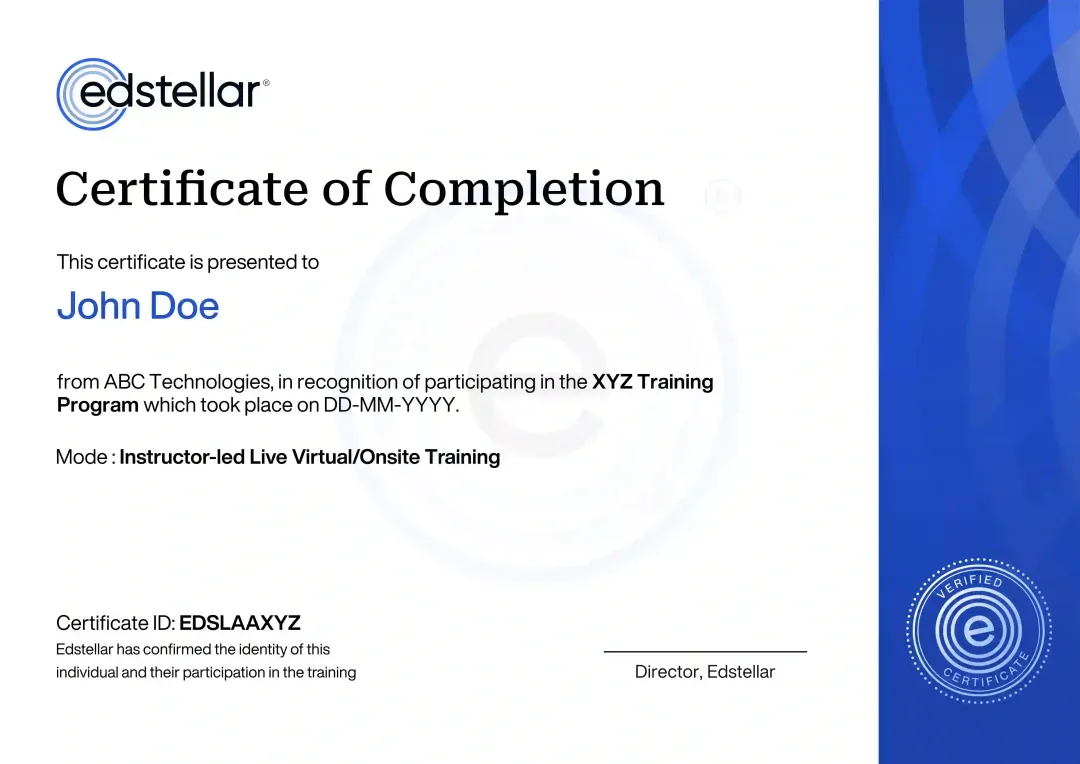
Certificate of Training Completion.
On successful completion, employees receive an Edstellar course completion certificate, recognizing their commitment to ongoing learning and professional development. It validates the skills they have built and motivates them to keep growing and contribute to organizational success.
Earned, not attended. Awarded on completion of all hands-on labs and the capstone project.
Training Delivery Modes: Onsite, Virtual and Hybrid
Choose the format that fits your team's schedule. Every mode is instructor-led and includes the same guided labs and capstone.
Onsite Training
The instructor delivers the full program at your office, with labs run against your network and database context.
- Instructor at your office for all sessions
- Labs tuned to your database environment
- Direct collaboration with your architects
- Onsite assessment and feedback reviews

Live Virtual Training
Live virtual sessions with real-time instructor support, breakout labs, and screen-shared troubleshooting.
- Real-time instructor guidance and support
- Cloud lab environments for every learner
- Breakout rooms for paired lab exercises
- Recorded sessions and digital materials

Hybrid Training
Split delivery across onsite and live virtual sessions, so distributed teams learn together with a single instructor and shared labs.
- One instructor across onsite and virtual cohorts
- Shared lab environments and workbooks
- Flexible scheduling across time zones
- Same assessments and completion reports

Need a Customized Training Format That Works for Your Team?
Our training delivery is customized to your team's schedule, full days, half days, sessions spread across weeks, or modular formats. Share your preferred timeline, and we'll plan the training around it.
Frequently Asked Questions
Share your team size, locations, and dates through the group quote form and we will respond with customized pricing.
Yes. A training advisor will walk through your connected-data workloads and map the curriculum to your goals on a short call.
Yes. Live virtual sessions run with real-time instructor support, shared labs, and breakout exercises for every learner.
Yes. Onsite delivery brings the instructor to your office, with labs tuned to your data environment and network.
The program runs 24 instructor-led hours across six modules, ending with a capstone graph application build.
Question Not Answered Here?
Put it in the request. A training specialist answers it directly, within one business day.
Where this Training Fits in Your Team's learning path.
Neo4j comes after graph and knowledge graph concepts, so your team designs a sound model before writing Cypher. Next, vector search and RAG show how a graph database can feed grounded answers into generative AI applications.

LEARN KNOWLEDGE GRAPHS
Graph Data & Knowledge Graphs Training
Learn graph thinking, ontologies and knowledge graph design before picking a graph database.

BUILD WITH NEO4J
Neo4j Training
Build, load and query Neo4j databases with Cypher, and tune them for real application traffic.

ADD VECTOR SEARCH
Vector Databases for AI Corporate Training
Store embeddings and run similarity search, adding a vector layer next to your Neo4j graph.

BUILD RAG
Retrieval Augmented Generation (RAG) Corporate Training
Combine graph and vector retrieval to ground language model answers in your own data.
Why Choose Edstellar as Your Neo4j Corporate Training Provider
Edstellar designs corporate training around your team's real graph workloads, with practitioner trainers and labs that mirror production.

EXPERT TRAINERS
YEARS DELIVERING
ORGANIZATIONS TRAINED
CERTIFIED
Tailored
Curriculum tuned to your data models, Cypher workloads, and availability targets before day one.
Proven Methodology
A learn, practice, apply arc refined across database programs, with assessments that prove skill growth.
Practice-Based Learning
Guided hands-on labs in every module, from first Cypher query to clustering drills and capstone.
Expert Trainers
Practitioners who operate Neo4j graph platforms in production lead every session.
Global Scale
One program delivered across regions and time zones, with consistent labs and reporting for every cohort.
Measurable Outcomes
Pre and post assessments plus lab reviews show exactly how Neo4j skills moved for your team.
Build Graph Applications With Defensible Models and Tested Neo4j Operations
Edstellar connects graph thinking with the development and operation of a Neo4j application. Participants write Cypher, model connected domains, and examine graph algorithms before tuning queries and testing recovery. The final application is reviewed for relationship logic, correct results, and operational evidence supporting its configuration and runbook.
- Step 01
Consult
We assess database and command-line familiarity alongside connected-data requirements to identify gaps in graph modeling, Cypher paths, algorithm interpretation, and Neo4j operations.
- Step 02
Plan
We establish graph foundations and Cypher before domain modeling and advanced queries, then develop algorithms, tuning, and operational controls ahead of the application capstone.
- Step 03
Align
We align graph database and Neo4j expertise with participants' application and database experience, calibrating introductory support and domain-model reviews to their connected-data needs.
- Step 04
Customize
Sample movie and fraud-detection graphs provide controlled connected-data cases, allowing tailored relationship and path-query exercises without implying wrongdoing in actual customer or employee records.
- Step 05
Execute
Participants import nodes and relationships, refactor graph models, profile queries, and rehearse backup recovery, receiving feedback on path semantics, indexes, algorithm use, and operational choices.
- Step 06
Evaluate
We assess the graph application for coherent relationships, accurate Cypher results, justified algorithm and index choices, and verified backup and cluster procedures documented in the runbook.
Also from Edstellar
Talent assessments
Psychometric, behavioral, leadership and 360-degree assessment.
→Training needs analysis
Needs analysis, gap identification, and a training roadmap.
→L&D consulting
Learning strategy, content, technology and ROI measurement.
→OD consulting
Org design, succession planning and cultural change.
→Managed training services
Training outsourcing, vendor management, logistics and administration.
→Coaching solutions
Executive and manager coaching that keeps skills in use.
Start an RFP shaped to your needs.
Answer three quick questions about team size, scope, and how often you need the program run, then send the request from the last step. Everything you choose travels with it, so you only fill this in once.
How many team members need training?
Neo4j Training Packages & Pricing
Where L&D holds an annual budget, license packages price the whole year at once instead of raising a purchase order per workshop. Hours and licenses are pooled across teams, programs and locations, so unused capacity is not stranded in one department.
Starter
120
trainee licenses64 hours of group training
Tailored for SMBs
Growth
320
trainee licenses160 hours of group training
Ideal for growing SMBs
Enterprise
800
trainee licenses400 hours of group training
Designed for large corporations
Custom
Unlimited
trainee licensesDuration set by the rollout
Multi-region and multi-year
Training Packages & Pricing
Choose the training format that works for your team. Pricing is customized based on your requirements, cohort size, and delivery needs.
Request a Quote for Neo4j Training for Your Team
Tell us about your team size, locations, and Neo4j goals, and we will design a customized program and quote.