

Cyprus operates as a fast-growing ICT hub, stressed public health system, international financial services base, and shipping industry powerhouse. In Q4 2025, CYSTAT recorded 13,538 job vacancies nationwide with a 2.8% vacancy rate, placing Cyprus fifth among EU member states. KEVE (Cyprus Chamber of Commerce and Industry) described the situation in January 2025 as a "serious shortage of labour in all sectors of economic activity."
The guide covers ten most in-demand skills ranked by composite research score weighing government policy priority, live market vacancy data, and source recency. Every skill is backed by official government data, EU agency forecasts, and confirmed industry reports from CEDEFOP, HRDA (AnAD), CYSTAT, OEB, and Cyprus Mail.
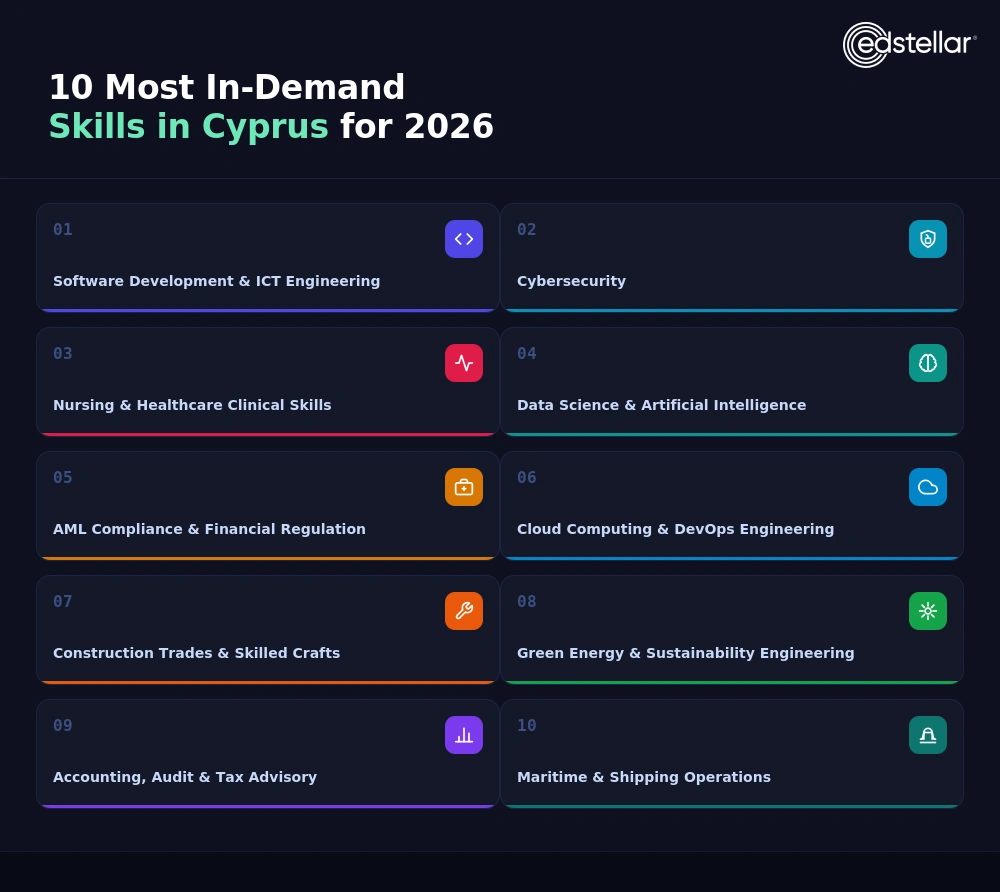
Cyprus in-demand skills span ICT engineering and cybersecurity at the technology agenda top, nursing and healthcare responding to staffing emergency, and maritime operations and construction trades where structural shortages have developed over years. Each skill profile includes hiring industries, specified sub-skills, and relevant training programme links.
Sources Behind This Research
Every ranking in this guide is backed by data from Cyprus government bodies, EU agencies, and verified industry reports. The research score assigned to each skill reflects the weight and quality of evidence across policy commitment, live vacancy data, and source recency. No source has been fabricated; every URL below links to the original publication.
CYSTAT (Cyprus Statistical Service)
Job Vacancies Q4 2025Recorded 13,538 job vacancies nationwide with a 2.8% vacancy rate, placing Cyprus fifth among EU member states. Primary source for sectoral vacancy data across all skill categories.
View source →HRDA (Human Resource Development Authority of Cyprus)
Employment Forecasts and Workforce Development ReportsConfirmed structural shortage of approximately 5,000 skilled construction workers and provides forecasts for workforce development needs across priority sectors.
View source →CEDEFOP
Cyprus: Mismatch Priority OccupationsEU agency dataset identifying nursing, software development, and construction as Cyprus's priority shortage occupations with projections for green economy employment.
View source →OEB (Employers & Industrialists Federation)
Annual General Meeting 2026: Services Sector AnalysisConfirmed labour shortages across services sector and highlighted the need for workforce development investment to sustain economic growth.
View source →Ergodotisi
Active Job Vacancy Data 2025–2026Cyprus's leading job portal used to validate real-time hiring activity across technology, finance, healthcare, and construction sectors.
View source →EURES - European Job Mobility Portal
Labour Market Information: CyprusEuropean Commission employment portal confirming ICT, healthcare, construction, and financial services as Cyprus's highest-demand sectors with workforce shortage data.
View source →"The organisations that will thrive in the future are those that create cultures where learning becomes a daily habit and new knowledge is consistently transformed into better decisions, stronger collaboration, and measurable business results."
Kypros Kyprianou
10 Key Skills in Demand Across Cyprus's Job Market
Cyprus's shortage list spans ICT engineering and cybersecurity at the technology frontier, nursing and healthcare responding to a staffing emergency, and maritime operations and construction trades where structural shortages have developed over years. The skills below reflect where hiring pressure is highest in 2026.
Software Development & ICT Engineering
Research Score: 9.25/10
Cyprus has recorded one of the fastest ICT job growth rates in Europe, driven by rapid digital transformation and increasing foreign investment. Demand for software developers and ICT engineers continues to outpace the available talent pool. Government-backed digital initiatives and expansion of international tech companies are accelerating the need for skilled professionals.
Organisations across fintech, gaming, and public services compete for the same limited talent. Full-stack developers with modern framework expertise and cloud-native capabilities are particularly sought after by Cyprus employers expanding their technology operations.
For employers and professionals, building strong development capabilities and adopting modern software practices are essential to remain competitive in Cyprus's evolving technology market.
Key Sub-skills
Top Industries
Technology & Software, Fintech, Gaming & iGaming, Shipping Technology, Government Digital Services
Explore Related Training:
Microservices Architecture Securing Web Applications, Services, and Servers All Software Development ProgramsCybersecurity
Research Score: 9.10/10
Cybersecurity is a strategic priority in Cyprus, supported by government investment and national digital transformation initiatives. Organisations across sectors are strengthening security capabilities to address growing cyber risks.
Demand for cybersecurity professionals continues to rise, particularly in financial services, fintech, and public sector organisations. Employers actively seek skilled professionals to manage security operations and protect digital infrastructure.
Building internal cybersecurity capability through structured training and certifications is essential for organisations aiming to reduce risk and ensure compliance. Professionals with SOC analysis, penetration testing, and cloud security capabilities are the ones Cyprus employers find hardest to recruit..
Key Sub-skills
Top Industries
Financial Services, Government & Public Sector, Technology, Fintech, Shipping
Explore Related Training:
Cloud Penetration Testing Symantec Advanced Threat Protection: Incident Response All Cybersecurity ProgramsNursing & Healthcare Clinical Skills
Research Score: 9.10/10
Cyprus is facing a significant shortage of nursing and healthcare professionals, driven by increasing medical services demand and limited workforce supply. Healthcare roles remain among the most critical and urgent hiring needs in the country, with 580 nursing vacancies confirmed as of April 2026.
Government initiatives and policy interventions are being introduced to address workforce gaps, including international recruitment and training capacity expansion. Hospitals and healthcare providers continue to face operational pressure due to staffing shortages.
Professionals with strong clinical expertise, specialist care experience, and familiarity with the GESY healthcare system are highly sought after. Greek language proficiency is essential for most clinical roles, and organisations are investing in workforce development to ensure quality patient care and long-term sustainability.
Key Sub-skills
Top Industries
Public Healthcare (GESY), Private Hospitals, Rehabilitation Centres, Home Care Services
"The fact that CEOs in Cyprus identify skills, technology and geopolitical developments as their key concerns reflects the reality that transformation is no longer optional, it is a necessity. Given the current conditions of full employment, solutions for addressing the skills shortages need systemic thinking and strategic actions."


Data Science & Artificial Intelligence
Research Score: 8.50/10
Data science and artificial intelligence are rapidly emerging as high-priority skills in Cyprus, driven by government-backed digital initiatives and increasing adoption across industries. Organisations are leveraging data and AI to improve decision-making and operational efficiency.
Demand for data scientists, machine learning engineers, and analytics professionals continues to grow, particularly in fintech, iGaming, and technology sectors. Companies actively invest in AI capabilities to remain competitive in a data-driven economy.
Professionals with the skills for data scientists in 2026, including Python, machine learning, and business intelligence expertise, are highly sought after across Cyprus's technology and financial services sectors.
Key Sub-skills
Top Industries
Technology & Software, Financial Services, iGaming, Government Digital Services, Fintech
Explore Related Training:
Healthcare Data Analysis With Machine Learning Machine Learning With Python All Artificial Intelligence ProgramsAML Compliance & Financial Regulation
Research Score: 8.25/10
Cyprus faces convergence of new anti-money laundering and counter-financing of terrorism regulatory requirements generating sustained demand for certified compliance professionals. The Central Bank of Cyprus issued a new AML/CFT Directive in 2025, introducing enhanced due diligence requirements and expanded compliance obligations for all regulated entities. CySEC has expanded its AML Certification Register mandates, making CySEC Advanced Certificate and AML Certification requirements for senior compliance roles across financial services.
As one of Europe's leading financial services and corporate services hubs with over 3,500 licensed investment firms, funds, and forex brokers, Cyprus requires large and continuously credentialled compliance professional pools. Live vacancy data confirms strong hiring demand across AML, audit, and compliance roles as organisations prepare for upcoming EU regulatory deadlines.
The EU AMLA Regulation deadline of 2026 adds further urgency, requiring all regulated entities to demonstrate compliance readiness. Professionals with CySEC certification, KYC expertise, and FATF risk-based approach knowledge are highly valued across banking, fintech, and crypto sectors.
Key Sub-skills
Top Industries
Financial Services, Forex & Investment Firms, Corporate Services, Banking, Cryptocurrency & Blockchain
Explore Related Training:
Investment Banking AI for Financial Services Industry All Finance and Accounting ProgramsWant Your Cyprus Training Investments to Deliver Results?
Edstellar's L&D consulting services help organisations move from ad-hoc training to structured capability development aligned with business priorities.
Schedule a Strategy Session →Cloud Computing & DevOps Engineering
Research Score: 7.70/10
The Cyprus Digital Decade Strategic Roadmap targets gigabit-capable internet for all businesses by 2030 and 5G coverage for 100% population, driving enterprise cloud adoption at private sector and government levels. A major milestone is the government public-sector cloud rollout scheduled for 2026, with a target to launch 100 new digital government services in the same year.
The EU Recovery and Resilience Plan is funding cloud and digital infrastructure upgrades across both public and private sectors, with 75% of enterprises targeted to adopt cloud or AI technologies by 2030. Cloud engineers at the senior end command salaries of EUR 80,000 to EUR 167,000 in Cyprus, reflecting scarcity of professionals with Kubernetes, Terraform, and CI/CD expertise.
The iGaming and fintech sectors in Limassol are among the most active cloud engineering employers, while government digital teams in Nicosia are also scaling hiring. As organisations mature their cloud capabilities, structured workforce development becomes critical to support both technical delivery and security compliance.
Key Sub-skills
Top Industries
Technology & Software, Government & Public Sector, Fintech, Telecommunications, iGaming
Construction Trades & Skilled Crafts
Research Score: 7.00/10
Cyprus faces a structural shortage of approximately 5,000 skilled construction workers and craftsmen, confirmed by the Human Resource Development Authority and classified as a CEDEFOP mismatch priority occupation group. CYSTAT data shows 1,117 construction vacancies in Q4 2025, up 21% year-on-year from 920 in Q4 2024.
The shortage is structural rather than cyclical, driven by declining domestic recruitment, ageing workforce, and strong infrastructure and real estate development demand. EU-funded projects and the Cyprus Recovery and Resilience Plan continue to accelerate hiring needs across construction trades.
For international workers, construction remains one of the most accessible employment sectors in Cyprus. Professionals with experience in supervision, BIM, and modern construction techniques are increasingly valued as the industry evolves toward more efficient and sustainable practices.
Key Sub-skills
Top Industries
Residential Construction, Commercial Construction, Public Infrastructure, Real Estate Development, Green Building
Explore Related Training:
Construction Project Management Asana Project Management All Project Management Programs"The rapid adoption of AI is likely to generate new job opportunities, but it creates a pressing need for a workforce equipped with advanced digital skills. AI 'superpowers' for every working professional are now within reach, and these advances are expected to fuel both economic growth and innovation in Cyprus."

Green Energy & Sustainability Engineering
Research Score: 7.20/10
CEDEFOP projects that approximately one in four employed persons in Cyprus will work in green economy sectors by 2030, with 3,125 green sector jobs needed annually. This shift is driven by EU Green Deal commitments and the Cyprus government's Recovery and Resilience Plan, which allocates around EUR 540 million to green transition initiatives.
Renewable energy could create between 11,000 and 22,000 new jobs by 2030, with solar PV installation leading current demand. Environmental consultants, energy auditors, and sustainability specialists are increasingly required across both private and public sector projects.
Professionals combining engineering expertise with EU sustainability regulations and project management skills are well-positioned to benefit from Cyprus's long-term green transformation strategy.
Key Sub-skills
Top Industries
Renewable Energy (Solar/Wind), Construction & Green Building, Environmental Consulting, Public Sector Infrastructure, Agriculture & Agri-tech
Explore Related Training:
Construction Project Management Green Project Management All Operations Management ProgramsAccounting, Audit & Tax Advisory
Research Score: 6.70/10
Cyprus remains a major European financial hub, with a 12.5% corporate tax rate attracting over 300 international companies and sustaining strong demand for qualified accountants. The professional services sector continues to expand, with audit firms and corporate service providers actively hiring across accounting and advisory roles.
The expansion of regulatory requirements driven by AMLA, CySEC, and CBC frameworks is increasing demand for professionals with expertise in fund administration, transfer pricing, and VAT advisory. IFRS proficiency remains a baseline requirement for senior roles.
For international professionals, Cyprus offers a strong opportunity due to its English-speaking business environment and consistent demand for ACCA-qualified talent. Professionals with accounting and financial compliance skills who also bring experience in cross-border taxation and corporate structuring hold a competitive advantage in the Cyprus market.
Key Sub-skills
Top Industries
Professional Services, Financial Services, Corporate Services, Shipping, Real Estate & Investment Funds
Explore Related Training:
Financial Accounting and Taxation Transfer Pricing in Taxation All Finance and Accounting ProgramsMaritime & Shipping Operations
Research Score: 6.80/10
Cyprus is the third-largest ship management centre globally, with over 250 shipping companies employing more than 55,000 seafarers and contributing over EUR 1 billion annually to the economy. A global 9% gap in the maritime officer supply pool is directly impacting Cyprus-based firms.
The Cyprus fleet registry continues to expand, with significant vessel growth increasing demand for maritime officers, compliance specialists, and operations professionals. Limassol remains the core hub of the shipping cluster, where competition for certified professionals is intensifying.
Beyond shipboard roles, demand is rising for maritime lawyers, insurance specialists, and port operations managers. Professionals with compliance expertise in ISM, ISPS, and IMO environmental regulations are particularly valued as the industry evolves toward decarbonisation targets.
Key Sub-skills
Top Industries
Ship Management, Maritime Law & Finance, Port Operations, Marine Insurance, Logistics & Trade
Explore Related Training:
Lean Logistics for Supply Chain Operations Maritime Logistics All Operations Management Programs
Living and Working in Cyprus: EURES official guide covering key job sectors, salary expectations, work contracts, and workplace culture for professionals considering Cyprus.
Skills Demand Across Cyprus's Key Regions
Cyprus's compact geography concentrates economic activity in a few key cities, each with distinct industry profiles. Understanding these regional patterns helps corporate L&D teams and professionals target their development investments effectively.
| Region | Key Industries | Top Shortage Skills |
|---|---|---|
| Nicosia | Government, Banking, Professional Services, Technology, Education | Cybersecurity, Software Development, AML Compliance, Data Science, Accounting |
| Limassol | Shipping, Fintech, iGaming, Corporate Services, Technology | Maritime Operations, Cloud/DevOps, Software Development, AML Compliance, Cybersecurity |
| Larnaca | Tourism, Healthcare, Construction, Logistics, Aviation | Healthcare/Nursing, Construction Trades, Green Energy, Accounting |
| Paphos | Tourism, Real Estate, Construction, Renewable Energy | Construction Trades, Green Energy, Healthcare/Nursing, Accounting |
| Famagusta District | Tourism, Agriculture, Education, Healthcare | Healthcare/Nursing, Construction Trades, Teaching, Green Energy |
Nicosia, as the capital, concentrates government, banking, and professional services hiring, making it the primary hub for cybersecurity, AML compliance, and accounting roles. Limassol is Cyprus's commercial engine, hosting the shipping cluster, fintech companies, and iGaming operators that drive the strongest demand for cloud engineering, software development, and maritime professionals. Larnaca and Paphos face acute construction and healthcare shortages driven by tourism infrastructure expansion and residential development. For organisations operating across multiple Cyprus locations, aligning training programmes with these city-level demand patterns ensures upskilling investments match actual hiring needs.
How to Develop These Skills in Demand in Cyprus
Cyprus's skills gaps span technology, healthcare, financial compliance, and construction simultaneously, creating a multi-front challenge that no single hiring strategy can solve. With 13,538 job vacancies, a 2.8% vacancy rate (fifth in the EU), and KEVE confirming labour shortages across all sectors, organisations that invest in structured workforce development will hold a decisive competitive advantage. Here is how to approach it.
- Start with a skills audit. Use a structured training needs analysis to map your current team capabilities against the 10 skills outlined in this guide. In Cyprus, sector-specific regulatory requirements (CySEC AML certification, GESY healthcare protocols, EU Green Deal compliance) should anchor the priority-setting process.
- Build individual development plans. Generic training programmes produce generic results. Use individual development plan templates to tailor learning pathways to each employee's current skills and career trajectory. A cybersecurity analyst at a Limassol fintech has different development needs than an AML compliance officer at a Nicosia bank, even though both roles require regulatory knowledge.
- Combine certifications with applied learning. International certifications (CISSP, AWS, ACCA, CySEC Advanced) carry significant weight in Cyprus's employer market. The most effective programmes pair certification preparation with hands-on exercises drawn from Cyprus-specific scenarios in financial services, iGaming, and shipping compliance.
- Address performance gaps systematically. A guide to understanding performance gaps can help managers distinguish between skill deficits, process limitations, and regulatory compliance shortfalls. An AML team underperforming on due diligence may need CySEC certification workshops, while a cloud team with deployment delays may need Kubernetes and Terraform training.
- Leverage HRDA-funded training programmes. The Human Resource Development Authority of Cyprus provides co-funded vocational training across priority sectors including technology, construction, and green energy. Companies can partner with HRDA-approved training providers to access subsidised programmes that reduce the net cost of structured workforce development investment.
Cyprus's Digital Decade Roadmap, Recovery and Resilience Plan, and EU Green Deal commitments signal that demand for these 10 skill areas will only intensify. Organisations that build their training strategies around these national priorities, supported by Edstellar's catalogue of over 2,000 instructor-led courses, will be better positioned to attract and retain the talent needed to compete in Cyprus's fast-growing economy.
Frequently Asked Questions
What jobs are in demand in Cyprus?
The most in-demand jobs in Cyprus in 2025 and 2026 span three broad categories. Technology roles, including software engineers, cybersecurity analysts, DevOps engineers, and AI/data scientists, are at the top of the demand list, driven by Cyprus leading the EU in ICT job growth at 9.2% annually. Healthcare roles, particularly nurses and specialist clinical staff, are in acute shortage with a confirmed 580 nursing vacancies nationwide. Financial services and compliance roles, including AML Compliance Officers and ACCA-qualified accountants, are in sustained demand due to Cyprus's position as a major European financial hub with over 3,500 licensed financial services entities. Construction trades, maritime officers, and green energy engineers complete the top ten.
What is the most common job in Cyprus?
Tourism, hospitality, and retail are the most common employment categories in Cyprus by total worker numbers, reflecting the island's position as a major Mediterranean tourism destination with 4,534,073 tourist arrivals in 2025. Professional services including accounting, financial services, and legal advisory are the most common white-collar employment category, particularly in Nicosia and Limassol.
How to find a job in Cyprus?
The most effective way to find a job in Cyprus is through the major local job platforms: Carierista, Ergodotisi, and CyprusWork. LinkedIn is widely used by technology, financial services, and corporate services employers. The EURES portal is useful for EU citizens and carries official labour market information. For healthcare roles, direct applications to GESY-registered hospitals are the most direct route. Non-EU applicants should confirm visa and work permit eligibility before applying.
Which work is best in Cyprus?
For career development, compensation, and long-term stability, technology and financial services roles offer the strongest combination in Cyprus. Software engineers with full-stack, cloud, or cybersecurity expertise command salaries of EUR 45,000 to EUR 90,000 or more. Cybersecurity and cloud architecture roles sit at the top of the salary range at EUR 55,000 to EUR 167,000. Maritime professionals with STCW certifications benefit from Cyprus's position as the world's third-largest ship management centre.
Where is Cyprus located?
Cyprus is an island nation located in the eastern Mediterranean Sea, approximately 75 kilometres south of Turkey and 380 kilometres north of Egypt. It is a full member state of the European Union (since 2004) and part of the Eurozone (since 2008). The capital is Nicosia and the main business centre is Limassol.
Is it easy to get a job in Cyprus?
For qualified professionals in the ten skill areas profiled in this guide, finding employment in Cyprus is relatively straightforward given the structural shortages across ICT, healthcare, construction, and financial services. The Cyprus vacancy rate of 2.8% in Q4 2025 confirms that employers are actively competing for talent. For EU/EEA citizens, there are no permit barriers. For non-EU nationals, the Business Facilitation Unit route is the fastest pathway for skilled professionals earning EUR 2,500 per month or more.
Is Cyprus good for work?
Cyprus is considered a good destination for skilled professionals. The island offers EU-standard working environment with competitive salaries in technology and financial services, a low corporate tax rate of 12.5% attracting international companies, a Mediterranean climate and high quality of life, and English widely spoken across the business community. The employment rate reached 79.8% in 2024, the highest in 15 years.
Is Cyprus in Europe or Asia?
Cyprus is geographically closer to Asia but is politically, economically, and culturally a European country. Cyprus has been a full member of the European Union since May 2004 and adopted the Euro in 2008. For employment purposes, Cyprus is unambiguously European: workers are employed under EU labour law standards, salaries are paid in Euros, and EU citizens have full working rights without permit requirements.
"The rapid green, digital, and energy transition requires the development of a new skills framework for maritime professionals. As shipping undergoes rapid technological changes, a highly trained and educated workforce is no longer just an advantage, it is a necessity for maintaining leadership and competitiveness."

Conclusion
Cyprus in 2025 and 2026 presents a labour market defined by genuine structural scarcity at the qualified end: the island's combination of EU membership, low corporate taxation, and strategic positioning as a hub for technology, financial services, and maritime industries has generated employment demand that the domestic education and training system cannot yet fully satisfy. The ten skills profiled in this guide, from Software Development and Cybersecurity at the top through to Maritime Operations and Accounting at the base, all share the characteristic that qualified candidates face a favourable hiring environment with competitive salaries and accessible visa pathways for non-EU professionals.
For individuals building skills to enter or advance in the Cyprus job market, the clearest priorities are: obtain EU-recognised certifications where they exist (CySEC, ACCA, CISSP, STCW, Google Cloud, AWS), develop at least working knowledge of the Greek language for healthcare and public sector roles, and engage with the Business Facilitation Unit process early if relocating from outside the EU. The organisations that close their skills gaps fastest will be the ones that attract talent, retain expertise, and lead their industries through the transformative years ahead.
Organisations looking to upskill their Cyprus-based workforce across these in-demand skills can also explore our detailed comparison of corporate training companies in Cyprus to find the right training partner based on industry focus, delivery format, and programme coverage.
Looking for a Corporate Training Partner?
Get a custom training plan from Edstellar's 5,000+ expert trainers. Virtual or onsite delivery across North America, Europe, Asia-Pacific, and beyond.
Request a Free Consultation →