A detailed list of the top in-demand skills in Taiwan, curated by an Ontario certified educator and PhD researcher specializing in cross cultural education, digital ethnography, and innovative learning in Taiwan.
Taiwan is facing one of the most severe talent shortages in the Asia-Pacific region, with 71% of employers reporting difficulty filling key positions according to ManpowerGroup data, particularly at manager and senior manager levels. The Ministry of Labor's nationwide vacancy survey recorded 276,000 job openings at the end of March 2025, while the National Development Council forecasts a 480,000 workforce gap by 2030
For corporate L&D leaders and HR managers operating in Asia's most advanced semiconductor economy, these numbers translate directly into urgent training priorities that will determine whether their organisations can compete for the talent that drives Taiwan's $46 billion chip industry and its expanding AI, healthcare, and clean energy sectors.
Several structural forces are converging to intensify this crisis. Taiwan officially became a "super-aged" society in 2025, with more than 20% of its population aged 65 or over, reaching this milestone in just seven years compared to 11 for Japan and 36 for Germany. The National Development Council projects that the country will lose 6.67 million workers in two waves of retirement over the next 15 years.
Meanwhile, Taiwan's birth rate has fallen from over 210,000 in 2014 to approximately 135,000 in 2024, shrinking the supply of STEM graduates by 15% over the same period. The semiconductor industry alone reported 34,000 unfilled positions in May 2025, and the gap between talent supply and market demand is widening across technology, healthcare, financial services, and manufacturing simultaneously.
So which skills are truly driving Taiwan's economy, and where should organisations invest their training budgets? This guide breaks down the top 10 skills in demand in Taiwan, spanning semiconductor engineering, artificial intelligence, cybersecurity, healthcare, and clean energy. Drawing on National Development Council workforce data, Ministry of Labor vacancy surveys, Robert Walters hiring trends, and industry salary benchmarks, it provides an evidence-based picture of what jobs are in demand in Taiwan, whether you are planning corporate upskilling programmes, supporting Gold Card or Employment Gold Card visa applications, or building workforce strategies for one of the world's most technologically critical economies.
Sources Behind This Research
Every ranking in this guide is backed by data from Taiwanese government bodies, industry associations, and established hiring platforms.
Government
National Development Council (NDC)
Industry Talent Shortages & National Development Plan 2025–2028
Forecast the 480,000 workforce gap by 2030, the 6.67 million retirement-wave projection, and policy responses including the Bilingual 2030 initiative and amendments to the Act for Recruitment and Employment of Foreign Professionals effective January 2026.
Reported 276,000 job vacancies at end of March 2025, with manufacturing accounting for 32.4% of all openings. Provided sector-level employment data and wage distribution statistics across the workforce.
Set the national goal of training 5,000 cybersecurity professionals annually. Reported that only 939 of 1,533 budgeted government cybersecurity positions are filled, a 61% fill rate. Informed our cybersecurity skills demand assessment.
Tracked the semiconductor talent shortage reaching 34,000 positions in May 2025, with breakdowns by role category: R&D (9,316), production/quality/safety (10,000), and operations/technical support (7,240, up 67% from 2023).
Taiwan Business Topics: Cybersecurity Workforce & Resilience
Detailed the cybersecurity workforce gap including government fill rates, mid-career attrition to Japan and Singapore (20–30% salary differentials), and the structural challenges of building a domestic cyber talent pipeline.
Reported that 71% of employers face talent shortages, 52% plan headcount increases, and job movers with in-demand skills receive 5–20% pay increments. Provided sector-specific hiring analysis for semiconductors, fintech, and technology.
Projected a 3,500-person supply deficit in hybrid financial-technology roles by late 2026. Reported that fintech engineer postings in Taipei rose 38% year-over-year in Q4 2024 while applications per vacancy dropped 22%.
Supplied data on Taiwan reaching super-aged society status, average annual salaries hitting NT$1.33 million in electronic components, the birth rate decline from 210,000 to 135,000, and the two-economy dynamic between tech and traditional sectors.
"The skills shaping Taiwan's workforce today require professionals who can embrace innovative approaches, communicate across cultural boundaries, and apply new learning methods effectively. Organizations that develop these capabilities build teams that connect and collaborate successfully in a globally interconnected market."
Michael Lesser
✓ Ontario certified educator and PhD researcher based in Taiwan, combining cross-cultural education, digital ethnography, and innovative learning to bridge education, culture, and technology across borders.
10 Key Skills in Demand Across Taiwan's Job Market
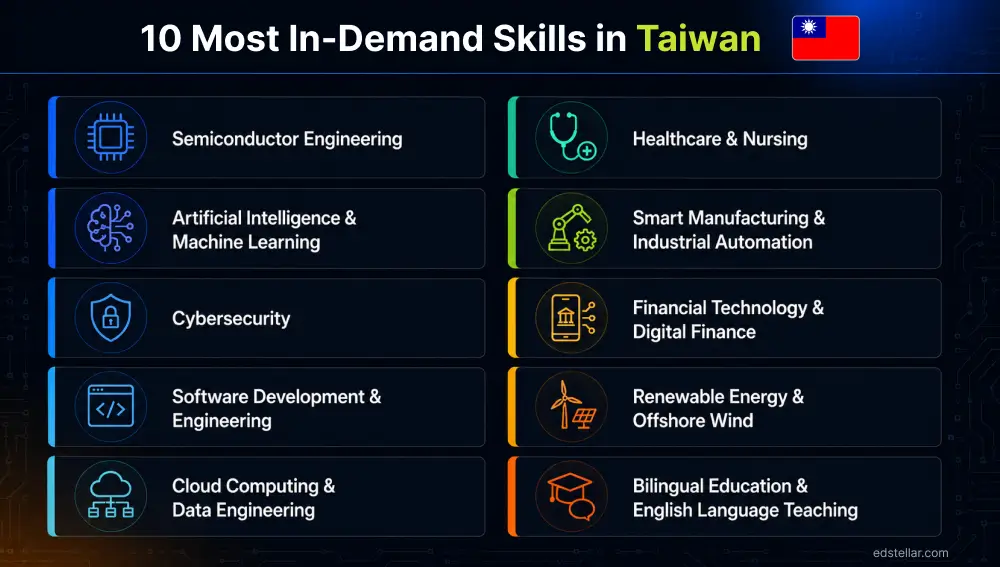
Taiwan's skills landscape in 2026 reflects the collision of the world's most advanced semiconductor industry, a super-aged society losing workers faster than it can replace them, and a digital transformation push that demands AI, cybersecurity, and cloud talent the domestic pipeline cannot produce. The 10 skills below span technology, healthcare, manufacturing, financial services, and energy, ranked by a weighted research score factoring in government policy investment, shortage volume, salary premium, cross-sector applicability, and recency of policy action.
1
Semiconductor Engineering
Research Score: 9.60/10
Taiwan's semiconductor talent shortage reached 34,000 positions in May 2025, with job openings surging from 19,401 in Q2 2020 to 33,725 in Q2 2025. Research and development vacancies rose to 9,316, production and quality roles reached 10,000, and operations and technical support positions grew 67% to 7,240. Taiwan alone accounted for 68.8% of the world's foundry market in 2024, led IC packaging and testing with nearly 50% market share, and produces approximately 83% of the world's AI chips, making the workforce behind these facilities a matter of global economic significance.
TSMC, the world's largest contract chipmaker, announced plans to hire 8,000 people in 2025 as part of a large-scale recruitment campaign. Newly recruited engineers with master's degrees receive an average salary of NT$2.2 million (US$60,912), significantly higher than the 2023 national average of NT$709,000 for the same qualification level. TSMC's total workforce reached 83,825 in 2024, a 9.61% increase from the previous year. Beyond TSMC, MediaTek, United Microelectronics Corporation (UMC), ASE Technology, and Nanya Technology are all competing for the same shrinking pool of STEM graduates, while the supply of those graduates has fallen 15% since 2014.
The government's Semiconductor Industry Talent Cultivation Programme expands subsidies, tax incentives, and career development grants to retain high-skill workers and encourage university-industry collaboration. Special semiconductor colleges have been established at National Taiwan University, National Cheng Kung University, National Tsing Hua University, and National Yang Ming Chiao Tung University to increase the pipeline. For international professionals, the Employment Gold Card and amendments to the Act for Recruitment and Employment of Foreign Professionals effective January 2026 are specifically designed to attract semiconductor talent from abroad.
AI-driven demand boosted pay in Taiwan's electronic components industry to an average annual salary of NT$1.33 million, the highest among all sectors, according to Taipei Times reporting. Monthly wages for AI-related positions jumped from NT$41,000 to NT$57,000 in 2024, an increase of more than 30%, with senior AI engineers commanding salaries exceeding NT$1 million per year. According to the National Science and Technology Council, Taiwan budgeted NT$158.8 billion ($4.99 billion) for technology development in 2025, with AI integration across smart manufacturing, healthcare, and national security identified as priority areas.
Despite rising salaries and government investment, 70% of Taiwan's businesses have not genuinely adopted AI according to a 2025 enterprise survey. The main barriers are practical: not knowing how to apply AI, insufficient data infrastructure, no internal talent, and perceived cost. This creates a paradox where massive demand for AI professionals coexists with limited organisational readiness. TSMC, MediaTek, Foxconn (Hon Hai), Quanta Computer, and Delta Electronics are leading AI adoption, while Appier, a Taiwan-based AI company listed on the Tokyo Stock Exchange, and Taiwan AI Labs represent the startup ecosystem building local AI capabilities.
High-performance computing now supplies 52% of TSMC's wafer revenue, and AI processors are on track to reach 20% of the company's sales by 2028. This semiconductor-AI convergence means that Taiwan's AI talent needs extend beyond software into hardware-software co-design, neural network accelerator architecture, and edge AI deployment for industrial applications. The Employment Gold Card programme covers AI specialist roles, and professionals who can bridge semiconductor hardware expertise with machine learning capabilities are commanding the highest premiums in the Taiwanese market.
Key Sub-skills
Machine Learning Engineering & MLOpsAI Chip Design & Hardware-Software Co-optimisationComputer Vision & Deep LearningNatural Language Processing (Mandarin NLP)Edge AI & Industrial IoT Integration
Taiwan's Ministry of Digital Affairs (Moda) has set a national goal of training 5,000 cybersecurity professionals annually to meet rising demand across government and critical infrastructure. Out of 1,533 budgeted cybersecurity positions across central and local governments, only 939 are filled, a 61% fill rate that leaves essential systems exposed. According to AmCham Taiwan reporting, Taiwan's ambition to remain a global tech leader is colliding with a severe shortage of skilled cybersecurity professionals, turning workforce gaps into one of the island's most urgent economic and national security risks.
The geopolitical dimension makes Taiwan's cybersecurity needs uniquely acute. As the world's dominant semiconductor manufacturer, Taiwan faces persistent state-sponsored cyber threats targeting its chip industry, defence systems, and government networks. Mid-career cybersecurity staff are frequently recruited abroad by employers in Japan and Singapore offering salaries 20–30% higher than domestic rates, compounding the shortage through talent attrition. Burnout, insufficient mentorship, and limited advancement opportunities also contribute to the pipeline problem. Major employers include Trend Micro (headquartered in Taipei), CyCraft, TeamT5, CHT Security, and the cybersecurity divisions of financial holding companies. Understanding the full scope of cybersecurity engineer roles and responsibilities helps L&D teams design training that addresses both technical and strategic security needs.
Entry-level cybersecurity roles in Taiwan start at approximately NT$1.38 million annually, rising to NT$2.46 million for experienced professionals. Cybersecurity specialists earn between NT$1.95 million and NT$2.07 million, while engineers command up to NT$2.19 million. Certifications like CISSP and CEH can boost salaries by up to 25%. Cloud security, DevSecOps, and OT/ICS security for manufacturing environments are the highest-demand specialisations, reflecting Taiwan's need to protect both its digital and industrial infrastructure.
Taiwan's software job market remains robust in 2026, with strong demand in semiconductors, AI, and enterprise software driving continuous expansion. The median base salary for software engineers is approximately NT$877,500 annually, with the full range extending from NT$1.1 million to NT$2.1 million depending on experience and specialisation. TSMC software engineers earn NT$2.1 million to NT$3.1 million annually, while Google Taiwan engineers command NT$2.2 million to NT$7.9 million including equity and bonuses, reflecting the premium that global technology firms pay for Taiwanese engineering talent.
The semiconductor software boom is the defining feature of Taiwan's developer market. Embedded systems engineers, EDA tool developers, and semiconductor automation specialists command 20–30% salary premiums over general software roles. Beyond semiconductors, the fintech sector is generating rapid demand: 104 Job Bank data shows that fintech engineer postings in Taipei rose 38% year-over-year in Q4 2024 while applications per vacancy dropped 22%. DevOps engineers are particularly sought after as Taiwanese enterprises accelerate their cloud-native transformation and CI/CD pipeline adoption.
Major employers span Taiwan's technology ecosystem. TSMC, MediaTek, Realtek, and Novatek recruit thousands of software engineers annually for chip design tools, firmware, and manufacturing systems. Line Taiwan, PChome, Shopee Taiwan, and 91APP absorb talent for e-commerce and platform engineering. International companies with significant Taiwan engineering operations include Google, Microsoft, Amazon, and Nvidia. Fresh graduates with computer science degrees typically earn NT$480,000 to NT$960,000 annually, while senior engineers at leading firms exceed NT$2 million. Python, C/C++, Java, and TypeScript are the most requested languages.
Key Sub-skills
Embedded Systems & Firmware DevelopmentFull-Stack Web Development (React, Node.js)EDA Tool & Semiconductor SoftwareDevOps & CI/CD AutomationMobile App Development (iOS, Android)
Cloud engineers in Taiwan earn between NT$50,000 and NT$180,000 per month, reflecting the strong demand driven by enterprise cloud migration across financial services, manufacturing, and government sectors. AWS leads the Taiwan market with a 45% adoption rate, Azure follows with a strong enterprise presence in financial and government sectors, and Google Cloud Platform is growing rapidly among startups and data-focused companies. Data engineers are in extreme demand in Hsinchu to build and manage data pipelines for chip manufacturing, and demand is growing rapidly in industrial hubs to support smart factories and IoT adoption.
Data scientists in Taipei earn an average of NT$1.21 million annually, with the typical range between NT$953,250 and NT$1.7 million. Full-time data engineers earn between NT$1.1 million and NT$2.6 million annually, with salaries highest in the tech hubs of Taipei and Hsinchu where the world's leading hardware and semiconductor firms are concentrated. The convergence of cloud infrastructure and AI workloads is creating hybrid roles where professionals who can deploy machine learning pipelines on cloud platforms command premiums above standard engineering salaries. Understanding the scope of data engineer roles and responsibilities helps organisations build effective data teams for their cloud transformation journeys.
Taiwan's smart manufacturing push is a key driver of cloud and data demand. The Industrial Development Bureau's Smart Manufacturing Promotion Plan targets 40% of Taichung Industrial Park companies completing Phase 1 automation by end-2026, and every automated production line requires cloud-connected data pipelines, real-time analytics dashboards, and predictive maintenance systems. TSMC, Foxconn, Delta Electronics, and Advantech are all building internal cloud and data engineering teams to support their Industry 4.0 transformation.
"There is a scarcity of talent worldwide. If we move globally, then we really need to expand our talent pool. We need more people with IC design, IC manufacturing, and materials science skills. Countries compete for this talent."
Lora Ho
Senior Vice President, TSMC · Hsinchu City, Taiwan
6
Healthcare & Nursing
Research Score: 8.10/10
Taiwan's transition to a super-aged society in 2025 has created acute demand for healthcare professionals that the domestic workforce cannot meet. According to Taipei Times reporting, experts estimate that in two decades approximately 700,000 Taiwanese older than 85 will need assistance with daily activities or medical care. Hospital nurse vacancy rates rose from 4.5% to 6.5% post-COVID, and nurses with over ten years of experience continue to be the most likely to leave the profession, with an overall nursing practice rate as low as 59.1%.
The disability rate among Taiwan's population aged 65 or older is approximately 15%, rising to about 50% after age 85 depending on gender. There are 97,000 to 100,000 licensed local caregivers, with about 70,000 providing hourly home services and 30,000 working in elderly care centres, nursing homes, or hospitals. The dependency ratio is projected to exceed 50% by 2026–2027, meaning that for every two working-age adults, there will be more than one dependent. This demographic reality is driving policy changes including expanded migrant worker quotas and incentives for retired healthcare professionals to re-enter the workforce.
The integration of AI and digital health technology into Taiwan's healthcare system is creating a new category of hybrid roles. National Taiwan University Hospital, Chang Gung Memorial Hospital, Taipei Veterans General Hospital, and other major institutions are deploying AI-assisted diagnostics, telemedicine platforms, and smart ward management systems. Professionals who combine clinical expertise with health informatics, data analytics, or AI application skills are commanding significant premiums. The government's NT$158.8 billion technology budget includes advanced healthcare AI solutions as a priority investment area.
Key Sub-skills
Geriatric & Long-Term Care NursingHealthcare Informatics & Digital HealthCritical Care & Emergency NursingAI-Assisted Diagnostics & TelemedicinePatient Safety & Quality Improvement
Top Industries
Hospitals & Health Systems, Long-Term Care & Home Health, Biotech & Pharmaceuticals, Medical Device Manufacturing
Edstellar's Training Needs Analysis consultants identify your priority skill gaps and build a customised training roadmap. Get matched with the right programmes in 48 hours.
Taiwan's smart machinery industry reached a production value of NT$1.2 trillion (approximately US$38 billion) in 2023, and the government's Industry 4.0 initiative continues to drive investment in automation, robotics, and digital manufacturing across the island's industrial base. According to DigiTimes, manufacturing accounts for 32.4% of Taiwan's 260,000+ job vacancies, making it the single largest sector for unfilled positions. The Industrial Development Bureau's Smart Manufacturing Promotion Plan targets widespread automation adoption, but this transition has not reduced the workforce problem; it has replaced one kind of worker with another that does not yet exist in sufficient numbers.
The skills in shortest supply are hybrid roles that combine traditional manufacturing expertise with digital capabilities. Automation engineers, technology integration specialists, and operations leaders who can manage both human teams and automated systems simultaneously are the most difficult positions to fill. In Taichung and Tainan, the precision machinery and metal fabrication sectors report that firms which invested in automation between 2022 and 2025 now face a secondary shortage of technicians qualified to programme, maintain, and optimise their new robotic systems. TSMC's intelligent manufacturing engineer positions specifically seek professionals who can apply AI and data analytics to fab operations.
Between 2022 and 2026, demand for robotic technicians and industrial automation specialists grew significantly across Taiwan's manufacturing heartland. Companies including Foxconn, Delta Electronics, Hiwin Technologies, and Advantech are actively building smart factory capabilities, and their recruitment needs span PLC programming, industrial IoT, machine vision, and predictive maintenance systems. For professionals already working in traditional manufacturing, upskilling into automation and digital production represents one of the most direct paths to higher compensation and career stability.
Key Sub-skills
PLC Programming & Industrial RoboticsIndustrial IoT & Sensor NetworksMachine Vision & Quality InspectionPredictive Maintenance & Digital TwinsManufacturing Execution Systems (MES)
Taiwan's financial sector eliminated 3,200 traditional banking roles in 2024 through branch closures and process automation, while simultaneously creating 4,800 new technical positions that the displaced workforce cannot fill. According to 104 Job Bank's Financial Sector Talent White Paper, the sector projects a 3,500-person supply deficit in hybrid financial-technology roles by late 2026. Fintech engineer postings in Taipei rose 38% year-over-year in Q4 2024 while applications per vacancy dropped 22%, reflecting a widening gap between employer demand and available talent.
The skills mismatch is structural. Tellers and back-office processors leaving the industry lack the machine learning, cybersecurity, and cross-border compliance skills the industry now demands. Roles requiring both financial certifications (CFA, FRM, or equivalent) and production-level experience deploying AI models are vanishingly rare, with 75% of qualified AI and ML architects in the financial domain classified as passive candidates. Senior AI architect and Chief Data Officer positions at major financial holding companies now take 90 to 120 days to fill. Taiwan's retirement wave among senior compliance officers and risk managers compounds this challenge.
Major employers include Cathay Financial Holdings, Fubon Financial, CTBC Bank, E.SUN Bank, and Taishin Financial, all of which are building internal technology teams. International fintechs and digital banks entering the Taiwan market add competitive pressure for the same talent pool. The Financial Supervisory Commission's sandbox framework and open banking initiatives are accelerating demand for API developers, blockchain specialists, and regulatory technology (RegTech) professionals. Professionals who can bridge traditional financial expertise with modern technology skills are the most valuable and hardest to find in Taiwan's job market.
Key Sub-skills
AI & ML for Financial ServicesAPI Development & Open BankingRegulatory Technology (RegTech) & ComplianceBlockchain & Digital Payment SystemsQuantitative Analysis & Risk Modelling
Taiwan has committed to boosting its offshore wind power generation capacity by 15 GW over 10 years between 2026 and 2035, building on the operational success of the Formosa 1 (128 MW), Formosa 2 (376 MW), and Greater Changhua wind farms. The government's target of generating 20% of Taiwan's power from renewable sources has catalysed one of Asia's most active offshore wind markets, attracting international developers including Orsted, Copenhagen Infrastructure Partners, and Northland Power alongside domestic firms like Swancor Holding and Taiwan Power Company.
The sector is creating job opportunities across multiple specialisations: wind turbine engineers, offshore installation managers, electrical engineers, environmental specialists, marine surveyors, and operations and maintenance technicians. The localisation requirements built into Taiwan's offshore wind auctions mandate that an increasing share of manufacturing, assembly, and service work be performed domestically, driving demand for locally trained professionals. SRE Taiwan, which delivered two of Taiwan's three operational offshore wind farms, is expanding its workforce for the Formosa 4, 5, 6, and 7 projects currently in development.
Solar energy is also expanding rapidly, with Taiwan installing significant new capacity each year to meet its energy transition targets. The convergence of renewable energy with smart grid technology, battery storage, and energy management systems is creating hybrid engineering roles that command premiums above traditional power sector salaries. For professionals in construction, electrical engineering, or marine operations, transitioning into renewable energy represents a growing career pathway with strong government policy support and long-term demand certainty.
Taiwan's Bilingual 2030 policy, launched by the National Development Council and Ministry of Education, aims to transform the country into a bilingual nation by training students and professionals in both Mandarin and English. The Ministry of Education confirmed it will continue recruiting foreign English teaching talent in 2026, with teachers working alongside local educators through co-teaching and collaborative lesson planning to create immersive English environments in elementary and junior high schools across all municipalities.
The shortage of bilingual teachers is a persistent bottleneck. Tainan City reported 121 bilingual teaching vacancies with only 89 educators passing the required language test, and similar gaps exist across other municipalities. As more multinational corporations invest in Taiwan, demand for professionals with bilingual proficiency has expanded beyond schools into corporate training, technical writing, and international business communication. The policy is increasing the establishment of bilingual experimental classes in public schools at all levels, including special classes for the children of foreign professionals recruited under the Employment Gold Card and other talent programmes.
For foreign professionals, English teaching remains one of the most accessible entry points into Taiwan's job market, with positions available through the Ministry of Education's Foreign English Teacher Programme, private language schools (buxibans), international schools, and university language centres. Monthly salaries for qualified English teachers range from NT$60,000 to NT$90,000, with international school positions commanding higher compensation. The broader demand for bilingual capability extends to corporate trainers, content creators, and professionals who can deliver technical training in English across Taiwan's semiconductor, technology, and financial services sectors.
Key Sub-skills
TESOL & CLIL MethodologyBilingual Curriculum DesignCorporate English Training & Business CommunicationCross-Cultural CommunicationEducational Technology & Digital Learning
Top Industries
K–12 Education, International Schools, Corporate Training, Higher Education & Research
"AI will continue to dominate the semiconductor space. The existing demand for AI and machine learning chip design engineers is expected to grow. Supply chain risk managers will also be in high demand to help companies navigate trade restrictions, mitigate risks from natural disasters, and ensure supply chain continuity."
As Taiwan Becomes "Super-Aged," Gov't Hopes to Retain More Migrant Workers: TaiwanPlus News coverage of Taiwan's workforce challenges as the country crosses the super-aged society threshold.
Skills Demand Across Taiwan's Key Economic Regions
Taiwan's skills demand is concentrated in distinct regional clusters shaped by industrial specialisation, government investment, and university talent pipelines. Understanding these geographic patterns helps corporate L&D teams and HR managers target training investments where they will have the greatest impact.
Region
Key Industries
Top Shortage Skills
Taipei & New Taipei
Financial Services, Technology HQs, E-Commerce, Government
Cybersecurity, Fintech, Software Development, Data Science, AI/ML
Hsinchu Science Park
Semiconductor Fabs, IC Design, Biotech, AI Hardware
Semiconductor Engineering, AI/ML, Software Development, Cloud Computing, Data Engineering
Taichung
Precision Machinery, Metal Fabrication, Smart Manufacturing, Optics
Offshore Wind Farms, Agriculture Technology, Traditional Manufacturing
Offshore Wind Engineering, Energy Storage, Agricultural Technology, Healthcare
Hsinchu Science Park remains Taiwan's silicon heartland, hosting TSMC's most advanced fabs, MediaTek's IC design headquarters, and hundreds of semiconductor supply chain companies. Tainan Science Park is the fastest-growing region driven by TSMC's expansion of next-generation fabrication facilities. Taipei dominates in financial services, cybersecurity, and software headquarters roles, while Taichung's precision machinery corridor represents the front line of Taiwan's Industry 4.0 transformation. Kaohsiung is emerging as a dual hub for offshore wind energy and semiconductor expansion, creating new demand patterns that did not exist five years ago.
How to Develop These Skills in Demand in Taiwan
Taiwan's skills challenge is defined by a demographic crisis that no amount of recruitment alone can solve: a super-aged society with the world's lowest fertility rate, a 480,000 workforce gap projected by 2030, and 34,000 unfilled semiconductor positions at the centre of a $46 billion industry. With 71% of employers reporting difficulty filling roles and the domestic talent pipeline shrinking by 15% over the past decade, organisations must take a structured approach to workforce development. Here is how to approach it.
Start with a skills audit. Use a structured training needs analysis to map your current team capabilities against the skills your business needs over the next 12 to 24 months. Focus on the gaps that directly affect production capacity, compliance, or revenue generation. With semiconductor operations and technical support vacancies growing 67% in two years and fintech roles taking 90 to 120 days to fill at senior levels, identifying your organisation's specific mismatches is essential before committing training budgets.
Build individual development plans. Generic training programmes produce generic results. Use individual development plan templates to tailor learning pathways to each employee's current skills and career trajectory. A semiconductor process engineer moving into AI-assisted yield optimisation has different development needs than a financial analyst transitioning into fintech product management, even though both benefit from data literacy fundamentals.
Combine certifications with applied learning. International certifications (AWS, CISSP, PMP, CFA, TOEFL) carry significant weight in Taiwan's job market and command salary premiums of 20–25%. However, applied projects and instructor-led workshops build the practical capability that certifications alone cannot provide. The most effective programmes pair certification preparation with hands-on exercises drawn from Taiwanese industry scenarios, particularly in semiconductor manufacturing, smart factory implementation, and financial technology where local context and regulatory knowledge matter.
Address performance gaps systematically. A guide to understanding performance gaps can help managers distinguish between skill deficits, technology limitations, and systemic barriers before investing in training. A manufacturing team underperforming on automation adoption may need PLC programming and industrial IoT workshops, while a cybersecurity team with incident response gaps may need threat intelligence training rather than more compliance coursework.
Leverage government talent development programmes. Taiwan's Semiconductor Industry Talent Cultivation Programme provides subsidies, tax incentives, and career development grants. The Bilingual 2030 initiative funds English-language training across government and education. The Employment Gold Card and amended Foreign Professionals Act (effective January 2026) create pathways to recruit international talent. Companies can partner with semiconductor colleges at NTU, NCKU, NTHU, and NYCU to access structured technical talent pipelines and co-develop curriculum aligned with industry needs.
Taiwan's economic trajectory, driven by semiconductor dominance in AI chip production, the offshore wind energy buildout, healthcare transformation for a super-aged society, and the DIGI+ digital nation initiative, signals that demand for skilled professionals will only intensify. Organisations that build their training strategies around these national priorities, supported by a catalogue of over 2,000 instructor-led courses, will be better positioned to attract talent and maintain competitive advantage in one of the world's most technologically critical economies.
Frequently Asked Questions
What skills are in high demand in Taiwan?
The most in-demand skills in Taiwan for 2026 include semiconductor engineering, artificial intelligence and machine learning, cybersecurity, software development, cloud computing and data engineering, healthcare and nursing, smart manufacturing and industrial automation, financial technology, renewable energy and offshore wind, and bilingual education. Semiconductor skills lead the list, driven by Taiwan's dominant position producing 68.8% of the world's foundry chips and approximately 83% of AI chips, with 34,000 unfilled positions in the sector alone.
What jobs are in demand in Taiwan in 2026?
The highest-demand jobs in Taiwan for 2026 include semiconductor process engineers, IC designers, AI/ML engineers, cybersecurity analysts, full-stack developers, cloud architects, data engineers, registered nurses, industrial automation engineers, fintech developers, offshore wind engineers, and bilingual educators. Manufacturing accounts for 32.4% of all vacancies, with the Ministry of Labor recording 276,000 total job openings. The semiconductor, technology, healthcare, and financial services sectors offer the strongest hiring volumes.
What are the highest paying jobs in Taiwan?
Semiconductor engineers at TSMC earn NT$2.1 million to NT$3.1 million annually, while Google Taiwan software engineers command NT$2.2 million to NT$7.9 million including equity. AI engineers earn over NT$1 million annually, with the electronic components industry averaging NT$1.33 million, the highest across all sectors. Cybersecurity professionals earn up to NT$2.46 million, data engineers earn NT$1.1 million to NT$2.6 million, and senior fintech specialists command premiums that take 90 to 120 days to fill at major financial holding companies.
How do I get a job in Taiwan as a foreigner?
Taiwan has expanded pathways for foreign professionals through the Employment Gold Card, which provides a combined work permit and residence visa for skilled workers in technology, education, finance, and other priority sectors. The amended Act for Recruitment and Employment of Foreign Professionals, effective January 2026, further removes barriers to residency and employment. Semiconductor engineering, AI, cybersecurity, and English teaching are the most accessible entry points. Mandarin proficiency is an advantage but not always required for international technology companies and English teaching positions.
Why does Taiwan have a labor shortage?
Taiwan's labor shortage stems from multiple structural factors. The country became a super-aged society in 2025 with more than 20% of the population over 65. Birth rates fell from 210,000 in 2014 to 135,000 in 2024, shrinking the STEM graduate pipeline by 15%. The National Development Council projects a loss of 6.67 million workers through retirement over the next 15 years and a 480,000 workforce gap by 2030. Simultaneously, rapid expansion in semiconductors, AI, and clean energy is creating demand that outpaces supply across virtually every skilled occupation.
What is Taiwan's Employment Gold Card?
The Employment Gold Card is Taiwan's flagship visa programme for attracting international talent. It combines a work permit, residence visa, re-entry permit, and alien resident certificate into a single document valid for one to three years. The card is available to professionals in technology, education, finance, architecture, defence, law, art, sports, and other designated fields. Gold Card holders can work for any employer or be self-employed without a separate work permit. The programme is part of Taiwan's broader strategy to address its 480,000 workforce gap through international recruitment.
Is Taiwan a good place to work in technology?
Taiwan is one of the world's premier technology employment markets, particularly for semiconductor and hardware engineering professionals. The country produces 68.8% of global foundry chips and 83% of AI chips, with TSMC, MediaTek, and hundreds of IC design firms offering competitive compensation. Software engineers earn NT$1.1 million to NT$7.9 million depending on company and seniority. However, average salaries in traditional sectors remain lower than in Singapore, Japan, or South Korea, contributing to talent attrition in non-semiconductor roles. The cost of living, particularly in Taipei, is moderate compared to other Asian tech hubs.
What kind of jobs are available in Taiwan for foreigners?
Foreign professionals in Taiwan most commonly work in English teaching (through the Ministry of Education's programme, private language schools, and international schools), semiconductor engineering (at TSMC, MediaTek, and supply chain firms), software development (at Google, Microsoft, Nvidia, and local tech companies), and business development roles at multinational corporations. The Employment Gold Card has expanded access to cybersecurity, AI, fintech, and renewable energy roles. Mandarin-speaking foreigners have additional opportunities in marketing, consulting, and cross-border business roles. Monthly salaries for English teachers range from NT$60,000 to NT$90,000, while technology professionals earn significantly more.
Conclusion
Taiwan's skills landscape in 2026 is shaped by a unique convergence of forces: the world's most critical semiconductor industry facing 34,000 unfilled positions, a super-aged society that became one of the fastest-aging nations in recorded history, and a digital transformation agenda spanning AI, cybersecurity, and smart manufacturing that requires talent the domestic pipeline simply cannot produce at scale. With 71% of employers reporting hiring difficulty, 276,000 job vacancies across the economy, and the National Development Council projecting a 480,000 workforce gap by 2030, the gap between what Taiwan's economy demands and what its shrinking workforce can deliver represents the island's most pressing business challenge.
The ten skills in demand in Taiwan covered in this guide represent the intersection of global technological leadership and acute domestic shortage. From semiconductor engineering and AI at the core of Taiwan's chip dominance, through cybersecurity protecting the world's most strategically important supply chain, to healthcare for a rapidly aging population and offshore wind powering the energy transition, each skill area offers clear returns on training investment. The organisations that close their skills gaps fastest will be the ones that attract talent, secure contracts, and lead their industries as Taiwan navigates demographic decline, geopolitical complexity, and the next wave of technological transformation.
Organisations looking to upskill their Taiwanese workforce across these in-demand skills can also explore our detailed comparison of corporate training companies in Taiwan to find the right training partner based on industry focus, delivery format, and programme coverage.
Ready to Upskill Your Taiwan Team?
Join 500+ organizations that trust Edstellar for corporate training. Get matched with expert trainers in 48 hours.
Unlock premium resources, tools, and frameworks designed for HR and learning professionals. Our L&D Hub gives you everything needed to elevate your organization's training approach.
.svg "edstellar")

.webp)

.svg "Semiconductor Engineering")















.svg "Click Here to Follow on Medium")
.svg)



.svg)


.svg)
.svg)
.svg)

.svg)