10 Most In-Demand Skills in Thailand for 2026

.svg "edstellar")

Thailand will require 1.08 million high-skilled professionals over the next five years across its 10 targeted industries, yet 34% of highly educated Thai workers are employed in low- or medium-skilled jobs, more than double the OECD average. The country's 2026 job market shows a 4.7% salary growth trend alongside an escalating AI and digital skills gap, with cloud computing, AI/ML, and cybersecurity commanding the highest premiums due to severe talent shortages.
Thailand's automotive sector, which contributes 4.5% of GDP and employs over 570,000 workers, is undergoing a wrenching EV transition that could displace over 100,000 auto workers between 2025 and 2026 while simultaneously creating demand for battery engineers, software developers, and EV maintenance specialists that the workforce cannot yet supply. For corporate L&D leaders and HR managers operating in Southeast Asia's second-largest economy, these numbers translate directly into urgent training priorities.
Several structural forces are converging to reshape Thailand's labour market. The Thailand 4.0 initiative and the Eastern Economic Corridor (EEC) are driving investment in advanced manufacturing, digital infrastructure, and biotechnology, with FDI applications nearly doubling in the first nine months of 2025 in digital infrastructure, batteries, electronics, and EV-related projects.
Thailand's aging population, with over 21% now aged 60 and above, is tightening labour supply while simultaneously driving healthcare demand, with nearly 900,000 new seniors added annually. The digital economy is projected at $36 billion (6% of GDP), tourism is targeting 43–45 million foreign arrivals in 2026–2027, and the Industry Ministry has set a 100,000-worker reskilling target to support new S-Curve sectors including EV manufacturing. The World Bank's February 2026 report confirms that Thailand's next phase of growth depends on scaling up advanced green manufacturing.
So which skills are truly driving Thailand's economy, and where should organisations invest their training budgets? This guide breaks down the top 10 skills in demand in Thailand, spanning AI and digital technology, automotive and EV manufacturing, cybersecurity, healthcare, and tourism. Drawing on BOI workforce data, EEC industry forecasts, Adecco salary benchmarks, and World Bank economic analysis, it provides an evidence-based picture of what jobs are in demand in Thailand, whether you are planning corporate upskilling programmes, building internal talent pipelines, or advising teams on high demand skills in Thailand for 2026 and beyond.
Every ranking in this guide is backed by data from Thai government bodies, industry associations, and established hiring platforms.
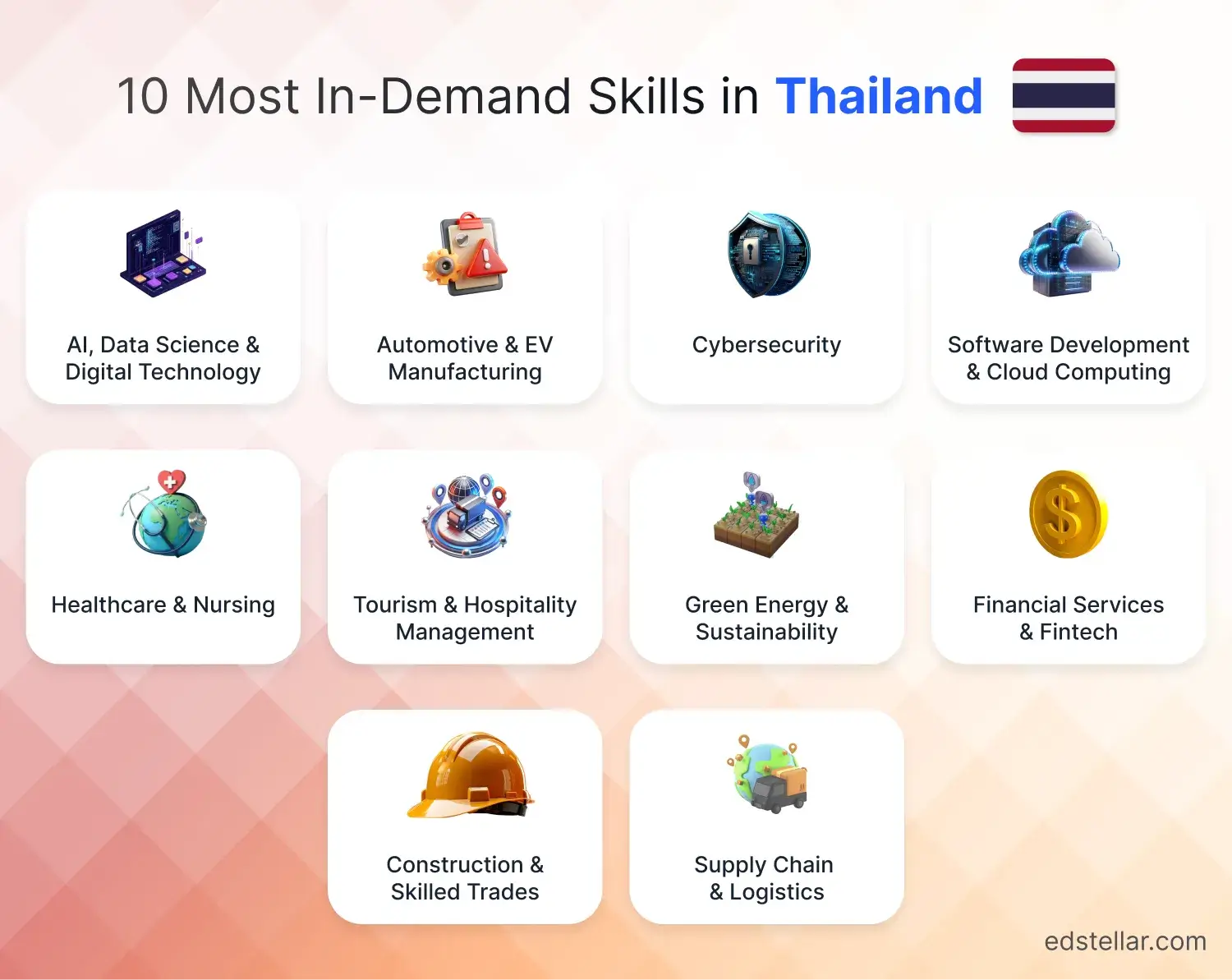
Thailand's skills landscape in 2026 reflects the collision of a Thailand 4.0 modernisation agenda with an aging workforce, an EV transition displacing traditional automotive workers, and a digital economy that cannot find enough qualified professionals. The 10 skills below span technology, manufacturing, healthcare, tourism, and green energy, mirroring the sectors where government investment, employer demand, and salary premiums are highest.

Thailand's digital economy is projected at $36 billion, constituting 6% of GDP, and the demand for specialised digital and AI talent is creating a hyper-competitive salary bubble. AI Engineers earn up to THB 1,500,000 annually, Cloud Architects command THB 1,012,581, and Data Scientists earn THB 60,000–120,000 monthly. Professionals changing jobs in specialised tech roles can command increments of 15–30%, far above the national 4.7% average salary growth, reflecting the severity of the talent shortage in a market where the pipeline produces far fewer qualified candidates than the economy absorbs.
The Thailand 4.0 initiative is accelerating AI adoption across manufacturing (predictive maintenance, quality inspection), financial services (fraud detection, credit scoring), healthcare (diagnostic support), and agriculture (precision farming). Bangkok salaries run 25–40% higher than other regions due to the concentration of corporate headquarters, tech startups, and international firms. AI and ML engineers who can deploy models in production environments, not just build prototypes, are in the most acute shortage across every sector of the Thai economy.
Major employers include True Corporation, AIS, DTAC (now merged as True Corp), SCB (Siam Commercial Bank), Agoda, Line Thailand, and the Thai operations of international tech firms. The government's Digital Economy and Society (DE&S) plan and the National AI Strategy are creating policy-backed demand, while the Eastern Economic Corridor's digital infrastructure investment is adding geographic concentration to the talent competition. For Thai professionals in traditional IT or business roles, upskilling into AI and data science represents the highest-return career investment in the current market.
Financial Services & Banking, Telecommunications, E-Commerce & Platforms, Manufacturing (Industry 4.0)
Explore Related Training:
Machine Learning with Python Data Science with Python All AI Training Programs
Thailand's automotive sector employs over 570,000 workers and contributes 4.5% of GDP, but the EV transition is creating a workforce crisis: the Federation of Thai Industries estimates over 100,000 auto workers face redundancy between 2025 and 2026, while EV component manufacturing is projected to represent 35% of output by end-2026, up from 18% in 2024. BEV production surged 1,974% year-over-year in November 2025 as manufacturers raced to meet government-mandated local production quotas, and BEV sales reached 100,553 units in the first 11 months of 2025, a 63.65% increase.
The skills mismatch is stark. CNC programmers for five-axis machining centres remain unfilled for 90–120 days, with the education pipeline delivering roughly one-third of what industry absorbs. The EEC offers 15–25% wage premiums for manufacturing engineering roles, and skilled CNC operator wages grew 8.3% year-over-year in early 2025, double the national manufacturing average. Battery engineers, EV diagnostics specialists, software-defined vehicle developers, and advanced packaging technicians are the new categories of demand that Thailand's traditional automotive training infrastructure was not designed to produce.
Major employers include Toyota, Honda, Mitsubishi, Isuzu, and the growing Chinese EV manufacturers (BYD, Great Wall Motor, SAIC) establishing Thai production bases. The government's EV 3.0 and EV 3.5 policies offer subsidies and require domestic production quotas, creating guaranteed demand for EV manufacturing skills. For workers in traditional ICE automotive roles, reskilling into EV battery systems, electric drivetrain maintenance, and vehicle software is becoming essential for career survival rather than just advancement.
Automotive OEMs (Toyota, BYD, Honda), EV Battery & Components, Tier 1–2 Auto Parts, Industrial Robotics

Thailand's cybersecurity market is growing at 9.21% through 2029, with the median cybersecurity engineer salary at THB 62,499 monthly and senior roles commanding significantly more. The country's financial services sector (Bangkok Bank, Kasikornbank, SCB, Krungthai Bank), telecommunications companies, and the growing digital economy all face escalating cyber threats that require specialised security professionals. Thailand's Personal Data Protection Act (PDPA), fully enforced since 2022, creates ongoing compliance demand similar to GDPR's impact in Europe.
The convergence of manufacturing digitisation under Thailand 4.0 with traditional IT security is creating demand for OT/ICS security specialists who can protect smart factories, automated production lines, and EV manufacturing systems. The financial services sector's rapid digitisation, with mobile banking and digital payments growing faster than almost any other ASEAN market, adds fintech security to the demand profile. Cybersecurity skills spanning cloud security, threat intelligence, and regulatory compliance are commanding premium compensation across Bangkok's corporate landscape.
CISSP, CEH, and CompTIA Security+ certifications carry salary premiums in a market where qualified security professionals can choose among competing offers. For IT professionals already working in systems administration, networking, or software development, transitioning into cybersecurity represents one of the highest-return career moves in the Thai market, with structured pathways available through international certification programmes and Thai university partnerships.
Financial Services & Banking, Telecommunications, Manufacturing (Industry 4.0), Government & Defence
"The challenge that Thailand faces today is the gap in implementation as organisations lack AI readiness. Although business leaders understand that AI is a technology that can't be overlooked, there is a shortage of employees with the necessary AI skills."



Cloud computing, DevOps, and software development are consistently among the highest-paying specialisations in Thailand due to a significant skills gap. Cloud engineers command THB 1,012,581 annually, and the demand for full-stack developers, backend engineers, and mobile developers is driven by the digital economy's $36 billion scale and the rapid digitisation of financial services, retail, and government operations. Remote software developers in Thailand earn an average of $70,691 in 2026, reflecting the growing international demand for Thai tech talent working for global clients.
The iGaming and digital entertainment sector, while smaller than Malta's, is growing in Thailand's regional context, and e-commerce platforms (Shopee Thailand, Lazada), ride-hailing (Grab), and fintech companies (Line BK, TrueMoney) are absorbing developer talent at scale. The EEC's digital infrastructure investment is creating additional demand for cloud architects and DevOps specialists who can design and manage the infrastructure supporting smart factories, logistics networks, and government digital services.
Major employers include True Corporation/DTAC, AIS, Agoda (Booking Holdings), Line Thailand, SCB, and international technology firms with Bangkok offices. For Thai developers, the combination of competitive domestic salaries, growing remote work opportunities paying international rates, and the relatively low cost of living makes software development one of the most attractive career pathways. Python, JavaScript, TypeScript, Java, and Go are the most requested languages.
Financial Technology, E-Commerce & Platforms, Telecommunications, Government Digital Services

Thailand's Public Health Minister has outlined a 10-year plan to recruit over 300,000 healthcare professionals, including a projected increase of 124,000 new nurses, responding to an aging population that adds nearly 900,000 new seniors annually. Over 21% of the population is now aged 60 and above, and the health workforce demand forecast projects 5,706–5,723 nurses, 7,356–7,378 public health professionals, and 3,990–4,002 physical therapists needed between 2026 and 2031. Thailand's universal healthcare coverage system serves the entire population, creating baseline demand that grows with demographic pressure.
Thailand is simultaneously one of Asia's leading medical tourism destinations, with hospitals like Bumrungrad International, Bangkok Hospital, and Samitivej attracting patients from across the region. This dual domestic-and-international demand creates particular pressure on specialist nurses, physicians, and allied health professionals. Geriatric care, chronic disease management, and preventive health services are the fastest-growing demand areas, while the government is implementing improved conditions and incentives to retain existing staff and reintegrate retired nursing professionals.
For international healthcare professionals, Thailand offers structured licensing pathways through the Medical Council of Thailand and the Thailand Nursing and Midwifery Council, though Thai language proficiency is typically required for clinical roles. The medical tourism sector, where English-language capability is essential, provides an alternative pathway for international nurses and physicians. Healthcare salaries, while lower than in Singapore or the Middle East, are supplemented by Thailand's significantly lower cost of living.
Government Hospitals (MoPH), Private Hospital Groups (Bumrungrad, Bangkok Dusit), Medical Tourism, Elderly Care & Nursing Homes

Thailand's tourism sector is targeting 40 million foreign arrivals in 2025 and 43–45 million in 2026–2027, with the industry projected to grow from THB 3.0 trillion to over THB 3.3 trillion by 2030. Over 300,000 job vacancies are projected across hospitality, and the sector faces seasonal labour shortages that prompted the government to simplify work permits for foreign workers in tourism. Hotel managers, chefs, guest experience specialists, digital marketing professionals, and revenue management analysts are consistently in demand across Bangkok, Phuket, Chiang Mai, Pattaya, and the island destinations.
Thailand's hospitality sector is evolving beyond traditional mass tourism toward higher-value segments including wellness tourism (Thai massage, meditation retreats), luxury resorts, MICE (Meetings, Incentives, Conferences, Exhibitions), and digital nomad services. The government's "Amazing Thailand" strategy targets quality over quantity, requiring hospitality professionals who can deliver premium service standards and manage the technology platforms (booking systems, revenue management, guest experience apps) that modern hospitality demands.
Major hotel groups including Marriott, Hilton, Accor, Minor International (Anantara, Avani), and Centara compete for trained hospitality staff alongside independent luxury resorts and the growing wellness tourism segment. For Thai graduates and career changers, hospitality offers accessible employment with international exposure, and Thailand's world-renowned culinary and wellness traditions create unique career specialisations not available in other markets.
Hotels & Resorts (Minor, Centara, Marriott), Wellness & Medical Tourism, MICE & Events, Airlines & Aviation

Scaling up EVs, solar PV components, and energy-efficient cooling could raise Thailand's GDP by 2.9% by 2035, creating approximately 203,000 additional jobs according to World Bank analysis. The Power Development Plan targets raising renewable energy's share of electricity generation to 51%, up from 36% under the previous plan, with solar energy playing the leading role. FDI applications in batteries, electronics, and EV-related projects nearly doubled in the first nine months of 2025, and 81% of energy sector employers are actively recruiting for green jobs and skills.
Thailand's position as a global EV manufacturing hub creates a unique intersection of green energy with automotive manufacturing. Battery production, EV charging infrastructure, solar panel manufacturing, and energy storage systems all require engineers and technicians with skills that bridge traditional manufacturing with clean technology. The Eastern Economic Corridor is positioning itself as a green manufacturing zone, attracting investment in renewable energy components alongside advanced automotive production.
For professionals in engineering, manufacturing, or energy, adding green technology credentials represents one of the highest-return career investments in Thailand's evolving economy. ESG reporting, carbon accounting, and sustainability consulting are growing service categories as Thai companies listed on the Stock Exchange of Thailand face increasing disclosure requirements. The government's 30/30 target (30% EVs in production, 30% renewable energy) provides long-term policy certainty for career investment in green skills.
EV & Battery Manufacturing, Solar & Renewable Energy, Utilities (EGAT, PEA), ESG Consulting & Finance
Explore Related Training:
Renewable Energy and Sustainability All Environmental Sustainability Programs"We want to help equip the workforce with what they need in this fast-changing landscape, and the goal is to upskill over 1 million Thais"


Thailand's banking sector is undergoing rapid digital transformation, with SCB (Siam Commercial Bank), Kasikornbank, Bangkok Bank, and Krungthai Bank all investing heavily in digital banking, mobile payments, and AI-driven financial services. The PromptPay real-time payment system has achieved near-universal adoption, and Thailand is one of ASEAN's fastest-growing digital payments markets. The Bank of Thailand's regulatory sandbox encourages fintech innovation, and digital lending, insurance technology, and wealth management platforms are creating new categories of financial technology roles.
Risk management, compliance, and regulatory technology professionals are in growing demand as Thailand's financial regulatory framework evolves alongside digital banking expansion. The PDPA creates data protection obligations across financial services, and anti-money laundering requirements add compliance complexity. For finance professionals, adding digital skills, data analytics capabilities, or fintech product expertise represents a strong career investment in a market where traditional banking is digitising faster than many other ASEAN economies.
Ascend Money (TrueMoney), Line BK, SCB 10X, and dozens of fintech startups are absorbing talent alongside established banks. Bangkok's emerging fintech cluster and the government's efforts to position Thailand as an ASEAN digital payments hub create a dynamic market for professionals who bridge financial expertise with technology capabilities.
Banking (SCB, Kasikornbank, Bangkok Bank), Digital Payments (PromptPay, TrueMoney), Insurance, Capital Markets

Over 300,000 job vacancies are projected across Thailand's key sectors, with construction among the most affected by skilled labour shortages. The Eastern Economic Corridor's ongoing infrastructure development, Bangkok's mass transit expansion, highway and dam projects, and the growth of industrial zones all require civil engineers, project managers, electricians, welders, and heavy equipment operators. The construction sector's labour shortage is compounded by competition from manufacturing, which can offer higher wages and better working conditions for the same pool of skilled tradespeople.
Thailand's aging workforce is particularly relevant in construction, where physical demands limit the working lifespan of tradespeople and the pipeline of young entrants is insufficient to replace retirements. The government's vocational education reforms through the Office of the Vocational Education Commission are expanding construction-related programmes, but graduate output remains below market demand. The EEC's industrial construction needs, including factory builds for EV and electronics manufacturers, add demand for specialised skills in cleanroom construction and high-tech facility engineering.
For young Thai workers, construction trades offer immediate employment without requiring university degrees, and the combination of domestic projects with international labour export opportunities (to Japan, South Korea, and the Middle East) creates a career pathway with both domestic and international potential. The government's 100,000-worker reskilling target for S-Curve sectors includes construction-adjacent skills in smart building systems and digital project management.
Infrastructure & Transport (EEC), Industrial Zone Construction, Real Estate & Mixed-Use, Government Public Works

Thailand's position as ASEAN's automotive manufacturing hub, a major electronics producer, and a global agricultural exporter creates complex supply chain requirements that demand skilled logistics professionals. The EV transition adds new supply chain complexity: battery materials sourcing, EV component logistics, and the management of new supplier networks for electric drivetrains require professionals who can manage global supply chains across different technology ecosystems simultaneously. The Laem Chabang deep-water port and Thailand's road and rail networks provide the physical infrastructure, but the human capital to manage increasingly digitised supply chains remains in short supply.
E-commerce growth (Shopee Thailand, Lazada, TikTok Shop) is driving last-mile delivery innovation and cold chain development for Thailand's massive agricultural export sector (rice, rubber, seafood, tropical fruits). The ASEAN free trade area creates cross-border supply chain management requirements, and Thailand's position connecting mainland Southeast Asia (Myanmar, Laos, Cambodia, Vietnam) with maritime routes adds a geographic logistics dimension unique to the Thai market. Supply chain managers who can integrate traditional logistics with digital platforms, AI-driven demand forecasting, and sustainability compliance are commanding premium compensation.
Major employers include CP Group (Charoen Pokphand), Thai Beverage, Central Group, and the logistics divisions of automotive and electronics manufacturers. International logistics firms including DHL, Maersk, and Kerry Logistics maintain significant Thai operations. For professionals in operations, procurement, or transportation, adding digital supply chain capabilities and cross-border trade expertise represents a strong career investment in Thailand's increasingly connected regional economy.
Automotive & EV Logistics, Agriculture & Food Export, E-Commerce Fulfilment, Port & Maritime Operations
Explore Related Training:
Supply Chain Management Fundamentals AI for Supply Chain All Operations Management Programs"While AI automates repetitive tasks, it also creates new opportunities for high-value roles that require advanced creativity, critical thinking and technical expertise. The country faces a critical shortage of 500,000 digital professionals by 2030, particularly in domains such as AI development, cloud architecture, and intelligent system design."


DW report on whether Thailand, the "Detroit of Asia," can retain its automotive crown amid the EV revolution reshaping the global car industry.
Thailand's skills demand is shaped by the geographic concentration of industries, the Eastern Economic Corridor's targeted investment zones, and the tourism geography of the southern coast and northern mountains. Understanding these regional patterns helps corporate L&D teams and HR managers target training investments where they will have the greatest impact.
Bangkok dominates financial services, technology headquarters, and government employment, with salaries running 25–40% above other regions. The Eastern Economic Corridor is Thailand's industrial heartland and the epicentre of the EV transition, where Toyota, Honda, BYD, and dozens of component manufacturers compete for engineers and technicians. The southern coast anchors tourism and hospitality, while Chiang Mai has emerged as Southeast Asia's most vibrant digital nomad hub, creating a unique market for remote-friendly technology talent. For organisations planning multi-site operations, aligning training programmes with these regional demand patterns ensures that upskilling investments match actual hiring needs.
"The demand for in-demand skills is growing globally, and especially in a corporate hub like Thailand, driven by three critical shifts. First, with the inevitable rise of AI and data, workforces urgently need digital literacy to keep pace with rapid technological advancement. Second, as consumers demand sustainability, organizations must develop ESG-related skills and embed them into their core work culture to future-proof themselves. Finally, with Millennials and Gen Z rapidly changing the demographics and values of the workplace, managers and executives must be equipped with the leadership, communication, and people-management skills needed to understand and lead this entirely new mindset."

Pete Ford is a corporate training specialist with over 15 years of experience in training methodologies, employee engagement, and performance improvement. He has a proven track record of developing and implementing effective training programs that enhance employee skills and productivity.
#On-site #Virtual #GroupTraining #Customized
Explore 2000+ industry ready instructor-led training programs.

Create dynamic leaders and cohesive teams. Learn more now!


Do a quick Skill gap analysis with Edstellar’s Free Skill Matrix tool

Unlock premium resources, tools, and frameworks designed for HR and learning professionals. Our L&D Hub gives you everything needed to elevate your organization's training approach.
Access L&D Hub Resources.svg)
.svg)
.svg)
.svg)

.svg)


.svg "Click Here to Follow on Medium")
.svg)


