10 Most In-Demand Skills in Hungary for 2026
.webp)

.svg "edstellar")

Hungary is the only EU member state where the number of ICT-educated employed persons declined between 2016 and 2024, falling 1.6% per annum while the rest of Europe expanded, according to Eurostat. The country has 30,000 unfilled software developer positions, ICT vacancies run 218% higher per employed person than the national average, and 69,152 job openings went unfilled as of March 2025.
Yet Hungary simultaneously attracted over EUR 10 billion in EV battery investment from CATL, Samsung SDI, BYD, and Sunwoda, operates five major automotive OEMs (Audi, BMW, Mercedes, Suzuki, and Opel), and employs 70,000+ professionals across 200 shared services centres. For corporate L&D leaders and HR managers operating in Central Europe's most industrially diverse economy, these numbers define a structural skills gap that is widening faster than the education system can respond.
Several structural forces are converging to reshape Hungary's labour market. The battery sector has created 33,000+ jobs and accounts for 6.4% of total exports, CATL's Debrecen gigafactory alone targets 9,000 employees at full capacity, and BMW's EUR 2 billion Neue Klasse plant commenced operations in 2025. The National AI Strategy targets training 100,000 AI specialists by 2030, the AI market is growing at 28.48% CAGR, and the National Digitalisation Strategy 2022–2030 aims for 10% of all graduates to hold ICT qualifications.
Hungary's solar capacity surpassed 8 GW, Paks II nuclear construction began in February 2026, and 40,000 nursing positions remain vacant while 2,000 nurses and 1,000 doctors emigrate annually. With 4.674 million employed, an ageing population losing 30,000 to 40,000 workers annually, and average gross wages at HUF 702,800 per month, Hungary's skills challenge is both a technology gap and a demographic race.
So which skills are truly driving Hungary's economy, and where should organisations invest their training budgets? This guide breaks down the top 10 skills in demand in Hungary, spanning software development, AI, cybersecurity, EV battery manufacturing, automotive engineering, cloud computing, and healthcare. Drawing on KSH labour statistics, HIPA investment data, Eurostat digital skills benchmarks, and hiring platform salary guides, it provides an evidence-based picture of what jobs are in demand in Hungary, whether you are planning corporate upskilling programmes, building talent pipelines, or advising teams on high demand skills in Hungary for 2026 and beyond.
Every ranking in this guide is backed by data from Hungarian government bodies, EU institutions, industry associations, and local recruitment platforms.
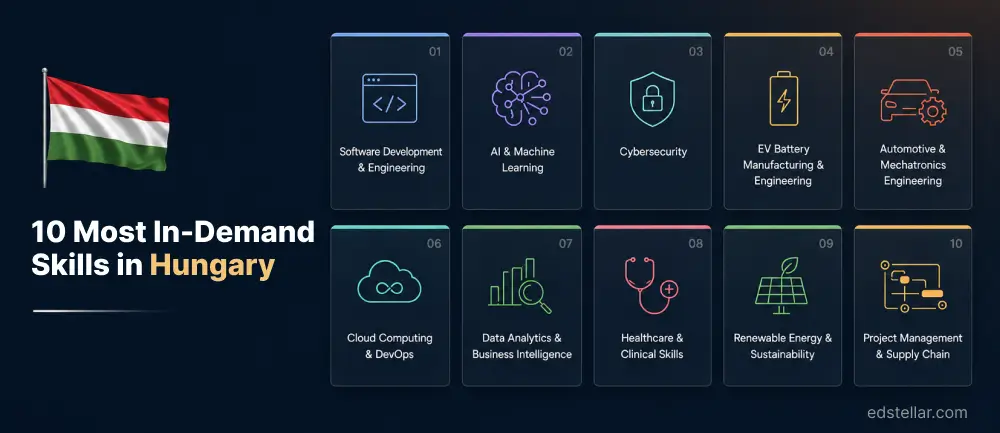
Hungary's skills landscape in 2026 reflects the convergence of a 30,000-position software developer shortage, EUR 10+ billion in EV battery investment from Asian manufacturers, five automotive OEMs transitioning to electric production, and 70,000+ shared services professionals evolving from transactional processing to analytics-driven operations. The 10 skills below span software development, AI, cybersecurity, battery manufacturing, automotive engineering, cloud computing, data analytics, healthcare, renewable energy, and supply chain management, mirroring the sectors where government policy, employer demand, and investment are highest.

Hungary has 30,000 unfilled software developer positions, ICT vacancies run 218% higher per employed person than the national average, and the country is the only EU member state where the number of ICT-educated workers declined between 2016 and 2024 according to Eurostat's 2024 Digital Decade Country Report. The National Digitalisation Strategy 2022–2030 targets 10% of all graduates holding ICT qualifications, the Digital Workforce Programme is expanding training capacity, and the EUR 1.4 billion RRP digital allocation funds institutional modernisation. Hungary's tech sector grew 15% in 2025, with ICT spending projected at USD 3.9 billion and growing at a 12.6% CAGR through 2030.
The SSC sector (70,000+ professionals across 200 centres) is the largest concentrated employer of DevOps engineers and software developers in Hungary, with Sanofi doubling its Budapest office space and Support Services Group (US) expanding operations. Automotive OEMs require embedded software engineers for EV platforms (AUTOSAR, ISO 26262), fintech companies build payment and lending applications, and the gaming sector (a growing startup vertical) demands Unity and Unreal Engine developers. Budapest's technology ecosystem produces the majority of graduates, but provincial universities in Debrecen, Szeged, and Miskolc are expanding computer science programmes to address the geographic concentration of talent.
Software engineers in Hungary earn HUF 10.8 to 19.5 million annually (approximately EUR 27,000 to 49,000) according to Hays Hungary, with average IT gross salaries exceeding HUF 1.5 million per month. Teknopark-style R&D tax incentives and social security contribution reductions improve effective compensation for qualifying technology roles. For organisations operating in Hungary, software development capability is the most acute hiring challenge across the economy: every sector from automotive to SSC to healthcare requires developers, and the declining domestic ICT workforce means that training existing employees is often faster than competing for external candidates.
SSC/BPO, Automotive, Financial Services, Technology/Startups

Hungary's AI Strategy 2020–2030 targets training 100,000 AI specialists, supporting 200 AI startups, and educating 1 million citizens about artificial intelligence. The AI market is projected to grow from US$350 million (2024) to US$1,575 million by 2030 at a 28.48% CAGR, with 20,000 new AI/ML jobs expected in 2025. The AI Coalition of Hungary (AICH) brings together 370+ members from government, academia, and the private sector to coordinate ecosystem development, and ML/AI engineering commands a 20 to 25% salary premium over standard developer roles.
Hungary's automotive sector is a primary driver of applied AI demand. BMW's Neue Klasse platform in Debrecen integrates AI-powered quality control systems, Audi's Gyor plant uses machine learning for predictive maintenance across its engine production lines, and CATL's battery manufacturing deploys computer vision for cell inspection at volumes exceeding human capability. The SSC sector is migrating from transactional processing to AI-augmented analytics, with financial institutions using ML for fraud detection and credit scoring. Budapest's startup ecosystem, anchored by companies like Prezi, Bitrise, and SEON (AI-powered fraud prevention), provides a growing pipeline of AI talent and commercial applications.
AI/ML engineers in Hungary earn an estimated HUF 14 to 22 million annually (approximately EUR 35,000 to 55,000), with the 20 to 25% premium reflecting acute scarcity. Deep learning frameworks (TensorFlow, PyTorch), NLP for multilingual SSC applications, and generative AI tools are the most requested competencies. For organisations across Hungary's economy, AI capability is transitioning from a competitive advantage to an operational requirement as automotive OEMs, battery manufacturers, SSC operators, and financial institutions all embed machine learning into core processes.
Technology/IT, Automotive (Autonomous Driving), Manufacturing (Predictive Maintenance), Financial Services

The EU NIS2 Directive, mandatory for all critical infrastructure operators, creates compliance demand across Hungary's banking, energy, telecommunications, and healthcare sectors. Cybersecurity professionals are part of the 30,000 unfilled IT positions, with cybersecurity analysts in Budapest earning HUF 9.9 to 14.1 million annually and cybersecurity engineers earning HUF 10.8 to 19.0 million (approximately EUR 27,000 to 48,000) according to ERI Economic Research Institute and Levels.fyi data. Hungary's ICT specialist share of 4.2% trails the EU average of 4.8%, and the declining domestic ICT workforce makes cybersecurity recruitment particularly challenging.
The battery manufacturing sector introduces a new cybersecurity dimension. CATL's EUR 7.3 billion Debrecen gigafactory, Samsung SDI's God facility, and BYD's Szeged plant all connect operational technology to enterprise networks, creating industrial control system (ICS) attack surfaces that traditional IT security teams are not equipped to protect. The Paks II nuclear expansion (construction began February 2026) requires the highest levels of cyber-physical security. Banking and financial services remain the largest traditional employers of cybersecurity staff, with Hungary's SSC sector handling sensitive financial data for multinational clients under EU regulatory frameworks.
The cybersecurity skills gap in Hungary reflects a broader EU challenge compounded by the country's unique ICT workforce decline. NIS2 compliance timelines are fixed, battery plant operational security requirements are growing with each new facility, and Paks II will require nuclear-grade cybersecurity from day one. For organisations in Hungary, upskilling existing IT professionals toward cybersecurity specialisation through certification programmes (CISSP, CEH, CompTIA Security+) offers a faster path to compliance than external recruitment in a market where qualified candidates are scarce across the entire EU.
Financial Services/Banking, SSC/BPO, Government/Public Sector, Energy/Utilities
"In the long run, we will face serious workforce scarcity issues due to our serious demographic situation: the competition for talent is enormous worldwide. We cannot escape it."


.svg "Semiconductor Engineering")
Five of the world's ten largest battery manufacturers chose Hungary as their European production base, with the government providing EUR 4+ billion in state aid and infrastructure investment. CATL's Debrecen gigafactory (EUR 7.3 billion, 100 GWh capacity, 9,000 jobs at full operation) is the largest single investment in Hungarian history. BYD is building its first European passenger car factory in Szeged with approximately 4,000 construction workers, Samsung SDI operates a 40 GWh facility in God, and Sunwoda received EUR 264 million in state aid for its EUR 1.43 billion plant in Nyiregyhaza (2,500+ jobs). Hungary targets 200 GWh battery capacity by 2030, which would represent one-third of total European production according to autopro.hu.
The battery sector has created 33,000+ jobs and accounts for 6.4% of Hungary's total exports, but the workforce faces both growth and cyclical challenges. Battery production fell 51% in December 2024 versus the year earlier due to the European EV demand slump, Samsung SDI laid off hundreds, and SK On's Komarom workforce dropped by 835. However, CATL, BYD, and Sunwoda are continuing expansion, and analysts project a new wave of growth as European EV adoption recovers. The skills required span electrochemistry and cell design, battery management systems (BMS) firmware development, thermal management engineering, cleanroom manufacturing processes, and IATF/ISO quality standards adapted for battery production.
Electronics engineers in the battery sector earn up to HUF 13.4 million annually, with battery cell specialists estimated at HUF 10 to 16 million (approximately EUR 25,000 to 40,000) according to Hays Hungary. BMW Debrecen is paying packages of EUR 75,000 to 85,000 for roles that would command EUR 52,000 to 58,000 in Kecskemet, a 35 to 45% premium reflecting the Debrecen talent war created by CATL and BMW competing for the same engineering pool. For organisations in Hungary's battery corridor, the combination of massive investment, workforce volatility, and specialised skill requirements makes internal training programmes essential for building a stable, qualified workforce.
Battery Cell Manufacturing, Automotive OEM, Chemical Processing, Electronics/Components

Hungary's automotive sector contributes 5% of national GDP and 21% of exports, producing 509,000 vehicles annually across plants operated by Audi (Gyor), BMW (Debrecen), Mercedes (Kecskemet), Suzuki (Esztergom), and Opel (Szentgotthard). There are 4,200 unfilled manufacturing positions with 1,800 classified as engineering and technical specialist roles, and the average time-to-fill for engineering vacancies reached 98 days in Q4 2024 according to CEDEFOP and the Hungarian Public Employment Service. BMW's EUR 2 billion Neue Klasse plant in Debrecen commenced production in 2025, and Audi's Gyor facility is transitioning to electric vehicle production.
The EV transition is fundamentally changing the skills requirements across Hungary's automotive supply chain. Traditional powertrain engineering is being replaced by demand for embedded software (C++, AUTOSAR, ISO 26262 functional safety), power electronics and inverter design for 800V systems, and vehicle connectivity software. Over 40 tier-1 suppliers operate in Hungary alongside the five OEMs, creating a deep supply chain that needs mechatronics engineers, robotics integration specialists, and PLC programmers (Siemens TIA Portal, Beckhoff) at every tier. The VET 4.0 reform, which increased vocational teacher salaries by 21.1% and invested HUF 100 billion in 34 institutions, is aimed at rebuilding the pipeline of skilled technical workers.
BMW Debrecen offers compensation packages of EUR 75,000 to 85,000 for roles paying EUR 52,000 to 58,000 at Mercedes Kecskemet, a 35 to 45% premium reflecting the talent war in Hungary's eastern industrial corridor. Electronics engineers earn up to HUF 13.4 million annually according to Hays Hungary. For organisations in Hungary's automotive sector, the EV transition represents the most significant workforce transformation in a generation: companies that retrain existing powertrain engineers for electric platform development will retain institutional knowledge while acquiring the skills that the sector's future demands.
Automotive OEM (Audi, BMW, Mercedes, Suzuki), Tier-1 Suppliers, Battery Manufacturing, Industrial Automation

Cloud architecture commands a 20 to 30% salary premium over standard IT roles in Hungary, DevOps engineering carries a 15 to 20% premium, and the ICT market is valued at USD 3.9 billion growing at 12.6% CAGR through 2030 according to Mordor Intelligence and TechPays Europe benchmarking. The National Digitalisation Strategy mandates digital transformation across public and private sectors, and the SSC industry (70,000+ professionals) is the primary driver of cloud migration as centres evolve from on-premises infrastructure to cloud-native service delivery for multinational clients.
Hungary's 200 shared services centres handle finance, accounting, HR, and IT operations for global companies including BP, Morgan Stanley, BT, and Sanofi, and nearly all are migrating workloads to AWS, Azure, or GCP environments. Financial institutions are modernising core banking platforms, automotive OEMs require cloud-based data platforms for connected vehicle telemetry, and the growing battery manufacturing sector needs cloud infrastructure for production analytics. The EU Digital Decade targets, including cloud-first public administration, reinforce demand from the government sector. Kubernetes, Terraform, and CI/CD pipeline automation are the most requested DevOps competencies across Hungarian job postings.
Cloud engineers and architects in Hungary earn HUF 12 to 20 million annually (approximately EUR 30,000 to 50,000), with DevOps engineers at HUF 11 to 18 million according to Glassdoor Hungary and TechPays Europe. AWS certification carries the strongest salary premium, followed by Azure and GCP credentials. For organisations in Hungary, cloud computing capability is the operational backbone for every digital transformation initiative, from SSC modernisation and automotive data platforms to healthcare systems and government e-services.
SSC/BPO, Technology/IT Services, Financial Services, Telecommunications

Hungary's SSC sector employs 70,000+ professionals and is migrating from transactional processing (invoice handling, payroll, basic accounting) to analytics-driven Global Business Services (GBS) models that require data analysts, business intelligence specialists, and decision support professionals according to HIPA and the European Business Services Association. The Digital Workforce Programme under the National Digitalisation Strategy targets upskilling employees across all sectors with data literacy as a core competency, and CEDEFOP projects that two-thirds of Hungarian job openings to 2030 will require high-level qualifications including analytical capability.
The automotive sector generates massive datasets from production lines, supplier networks, and connected vehicle platforms that require analytics professionals for quality improvement, supply chain optimisation, and demand forecasting. Financial institutions serving EU clients from Hungarian SSC hubs build risk models, regulatory reporting dashboards, and compliance analytics. Battery manufacturers use production analytics to monitor cell quality across millions of units. The e-commerce and retail sectors (growing rapidly in Hungary) need marketing analytics and customer behaviour modelling. Power BI, Tableau, SQL, and Python are the most requested tools across Hungarian data analytics job postings.
Data analysts in Hungary earn HUF 7.5 to 14 million annually (approximately EUR 19,000 to 35,000), with senior and lead data roles reaching HUF 14 to 20 million according to Glassdoor Hungary and Fizetesek.hu. The SSC sector's evolution from cost-centre to value-centre depends on analytics capability, making this a strategically important skill for the 200 centres that collectively employ more people than any single Hungarian industry segment. For organisations operating SSCs or planning to upscale Hungarian operations, data analytics training directly enables the transition to higher-margin GBS models.
SSC/BPO (Finance Analytics), Manufacturing (Industry 4.0), Financial Services, Retail/E-commerce

Hungary faces a shortage of nearly 40,000 nurses and 25,000 vacant healthcare positions, with only 5.5 nurses per 1,000 population compared to the OECD average of 9.2, and a doctor density of 3.6 per 1,000 versus the OECD average of 3.9 according to the OECD Health at a Glance 2025 and the Hungarian Chamber of Healthcare Professionals. Approximately 2,000 nurses and 1,000 doctors emigrate annually to Germany, Austria, and the United Kingdom, and critical shortages of anaesthesiologists are causing surgery postponements at multiple hospitals.
The government launched the "I will become a nurse" scholarship programme and implemented nurse and doctor salary increases in 2023–2024, but compensation remains the primary emigration driver. Hungary's ageing population (one of Europe's oldest) is increasing demand for geriatric care, chronic disease management, and palliative services at the same time that the healthcare workforce is shrinking. Telemedicine and digital health platforms represent an emerging opportunity to extend the reach of existing clinical staff, and health informatics skills are becoming relevant for the SSC sector as healthcare services companies establish Hungarian operations.
Nursing salaries range from HUF 4.5 to 9 million annually (approximately EUR 11,000 to 23,000), with doctor compensation varying significantly by speciality. The pay differential with Western European markets (German nurses earn 2 to 3 times more) explains the persistent emigration. For healthcare organisations in Hungary, the workforce challenge requires both retention strategies (competitive compensation, working conditions) and capability-building in digital health technologies that can partially offset the staffing shortfall through telemedicine, AI-assisted diagnostics, and automated patient monitoring.
Hospital Systems, Primary Care, Telemedicine/eHealth, Pharmaceutical, Elderly Care

Hungary's solar capacity surpassed 8 GW by mid-2025, accounting for nearly 30% of electricity generation in H1 2025, and the updated National Energy and Climate Plan (NECP) targets 30%+ renewables in gross final energy consumption by 2030. Wind power rules were liberalised from January 2024, cutting the minimum setback distance from 12 km to 700 m and enabling onshore wind development for the first time in nearly a decade. A national Battery Energy Storage System (BESS) support scheme launched in early 2024, and Paks II nuclear expansion (two VVER-1200 reactors at 1,200 MW each) began construction in February 2026 with Rosatom as contractor.
The solar installation workforce is the largest immediate skills demand driver, with Hungary adding GW-scale capacity annually. BESS project development is emerging as a new specialisation as storage becomes essential for grid stability with 30% solar penetration. The Paks II project creates a distinct nuclear engineering skills pipeline: reactor operations, radiation protection, nuclear safety systems, and specialised construction quality control. ESG reporting requirements under EU directives are creating demand for carbon accounting and sustainability management professionals across all sectors, particularly in manufacturing and financial services where EU taxonomy compliance affects access to capital.
Renewable energy engineers in Hungary earn an estimated HUF 8 to 14 million annually (approximately EUR 20,000 to 35,000), with nuclear engineering specialists commanding premium rates due to extreme scarcity. Solar PV installers and system designers are the highest-volume skills need, while BESS management and grid modernisation represent emerging specialisations. For organisations in Hungary, the renewable energy transition is driven by both EU policy requirements and economic opportunity: solar generation at 30% is already a commercial reality, not a future target, and the organisations that build clean-tech capabilities now will lead the market.
Solar Installation/Maintenance, Energy Storage (BESS), Nuclear Energy (Paks II), Green Construction
Explore Related Training:
Renewable Energy and Sustainability All Environmental Sustainability Programs
Hungary's strategic position as a Central European logistics hub, combined with the complexity of managing supply chains across five automotive OEMs and 40+ tier-1 suppliers, creates sustained demand for professionals with supply chain management expertise. Over 915 supply chain management positions are listed on LinkedIn Hungary at any given time, Corvinus University's MSc in Supply Chain Management reflects the academic response to employer demand, and logistics managers rank among the most sought-after roles according to Hays Hungary. The battery sector's just-in-time requirements for precursor chemicals, cathode materials, and electrolyte components add another layer of supply chain complexity.
Construction project management faces its own distinct demand drivers. Hungary's annual shortfall of 13,600 construction workers, 70% of the country's 4.2 million buildings requiring renovation, and EU-funded infrastructure projects all require PMP or PRINCE2-certified managers capable of delivering complex programmes on time and within budget. The Paks II nuclear construction, BMW Debrecen plant commissioning, and ongoing battery factory buildouts represent some of Europe's most technically demanding construction projects. Agile and hybrid project management methodologies are increasingly required in technology and SSC environments, adding Scrum Master and Agile Coach demand to the traditional project management pipeline.
Project managers in Hungary earn HUF 9 to 16 million annually (approximately EUR 23,000 to 40,000), with supply chain managers at HUF 8 to 15 million according to Hays Hungary and Glassdoor. Lean Six Sigma certification, SAP SCM expertise, and PMP/PRINCE2 credentials all carry documented salary premiums. For organisations managing multi-site operations across Hungary's dispersed industrial geography (Budapest SSC hub, Gyor automotive, Debrecen battery/automotive, Kecskemet automotive, Szeged battery), project management and supply chain capability is the operational discipline that converts investment into delivered value.
Automotive Manufacturing, Logistics/Warehousing, Construction, SSC/BPO (Procurement Services)
"In an economic environment with changing and hectic demands, we now face not only headcount problems but also competence problems. In addition, in the extremely tight labor market, we face increasingly serious moral issues and decreasing commitment, which entails severe risks for maintaining quality-oriented production processes."


Factories from China Spark Geopolitical Debates in Europe: Euronews examines CATL's gigafactory in Debrecen and how Chinese battery investment is transforming Hungary's industrial workforce.
Hungary's skills demand is shaped by the geographic distribution of its automotive plants, battery factories, shared services centres, and energy infrastructure. Understanding these regional patterns helps corporate L&D teams and HR managers target training investments where they will have the greatest impact.
Budapest dominates technology, SSC, and financial services, employing the majority of Hungary's 70,000+ shared services professionals alongside the country's startup ecosystem and banking headquarters. Gyor anchors the automotive industry through Audi's engine and EV production facility, which is one of Europe's largest automotive plants. Debrecen is transforming into a major industrial centre with CATL's EUR 7.3 billion gigafactory and BMW's EUR 2 billion Neue Klasse plant competing for engineers, creating a 35 to 45% salary premium war.
Kecskemet hosts Mercedes-Benz production alongside a growing manufacturing supplier base, Szeged is the site of BYD's first European passenger car factory and benefits from the University of Szeged's research output, and Komarom-Esztergom combines Suzuki automotive production with SK On's battery operations. For organisations planning multi-site operations, aligning training programmes with these regional demand patterns ensures that upskilling investments match actual hiring needs across Hungary's geographically dispersed industrial landscape.
#On-site #Virtual #GroupTraining #Customized
Explore 2000+ industry ready instructor-led training programs.

Create dynamic leaders and cohesive teams. Learn more now!


Do a quick Skill gap analysis with Edstellar’s Free Skill Matrix tool

Unlock premium resources, tools, and frameworks designed for HR and learning professionals. Our L&D Hub gives you everything needed to elevate your organization's training approach.
Access L&D Hub Resources.svg)
.svg)
.svg)
.svg)

.svg)


.svg "Click Here to Follow on Medium")
.svg)


