.svg "edstellar")

AI for Operations Managers Corporate Training Program for Employees
Equip your operations managers and teams to apply AI across demand forecasting, process automation, supply chain, and quality, through Edstellar's instructor-led, fully customized AI for Operations Managers training, delivered onsite or online worldwide.
(Virtual / On-site / Off-site)
.svg)
Equip Your Operations Teams to Turn AI Into Measurable Efficiency
AI for Operations Managers is the applied use of artificial intelligence, machine learning, and predictive analytics across operations management, from demand forecasting and process automation to supply chain, quality control, and workforce planning. For operations managers and their teams, AI now surfaces earlier demand signals, flags bottlenecks before they escalate, and automates repetitive workflows so people focus on higher-value decisions. AI for Operations Managers training gives your teams practical frameworks to identify high-impact use cases, select the right AI tools, and turn AI into measurable gains in efficiency, cost, and service levels, without needing to build models from scratch.
As organizations move AI from pilots into everyday planning, supply chain, and process workflows, this program helps your operations teams adopt AI confidently and within clear governance and data guardrails. Empower your people with expert-led on-site, off-site, and virtual sessions delivered by Edstellar, a premier corporate training provider serving organizations worldwide in-person and virtually across popular languages. Built around your goals, the program turns AI for Operations Managers skills into lasting capabilities that lift performance across operations, supply chain, and quality teams.
By the end of the program, your operations managers can pinpoint the AI use cases that matter most to throughput and cost, evaluate and govern AI tools responsibly, automate the right processes, and measure results against clear operational metrics. The outcome is faster forecasting, fewer bottlenecks, lower operating costs, and an operations function that turns AI from experiment into a dependable, well-governed capability.
.svg)

- Identify and prioritize high-impact AI use cases across forecasting, process automation, supply chain, quality, and workforce planning.
- Use predictive analytics to forecast demand, optimize inventory, and anticipate operational bottlenecks before they escalate.
- Automate repetitive operational workflows and integrate AI tools into existing processes and systems.
- Apply AI across supply chain and logistics to improve real-time tracking, risk detection, and mitigation.
- Deploy AI-driven quality control and workforce planning to lift consistency, scheduling, and engagement.
- Set fairness, transparency, and governance guardrails, and build a roadmap that scales AI responsibly across operations.
- Foundations of AI for operations
- What is artificial intelligence?
- Key components of AI: machine learning, deep learning, and neural networks
- The role of AI in modern business operations
- The evolution of AI in operations
- Historical perspective of AI in operations
- Milestones in AI development
- The impact of AI on traditional operations management
- Finding the right processes to automate
- Recognizing repetitive tasks suitable for automation
- Assessing the feasibility of AI integration
- Prioritizing processes for AI implementation
- Implementing AI in workflows
- Selecting appropriate AI tools and platforms
- Integrating AI into existing workflows
- Monitoring and evaluating AI performance
- Predictive analytics foundations
- Understanding predictive analytics and its significance
- Key techniques: regression analysis and time series forecasting
- Tools and software for predictive analytics
- Forecasting and inventory applications
- Developing predictive models for demand forecasting
- Utilizing predictive analytics for inventory management
- Case studies of successful predictive analytics applications
- AI across the supply chain
- Role of AI in supply chain optimization
- AI applications in logistics and distribution
- Real-time tracking and monitoring using AI
- Supply chain risk management
- Identifying risks in the supply chain
- Using AI to predict and mitigate risks
- Case studies on AI-driven risk management
- Quality inspection with AI
- Importance of quality control in operations
- AI techniques for quality inspection
- Benefits of AI in quality assurance
- Building AI quality systems
- Setting up AI-powered quality control systems
- Integrating AI with existing quality assurance processes
- Measuring the effectiveness of AI in quality control
- Planning and scheduling
- Forecasting workforce requirements using AI
- Scheduling and shift planning with AI tools
- Managing absenteeism and turnover through AI insights
- Performance and engagement
- Monitoring employee performance with AI analytics
- Identifying training needs using AI data
- Enhancing employee engagement through AI-driven feedback
- Fairness and transparency
- Ethical challenges in AI adoption
- Ensuring fairness and transparency in AI algorithms
- Addressing biases in AI systems
- Responsible AI practices
- Creating guidelines for ethical AI use
- Implementing ethical AI practices in operations
- Case studies on ethical AI implementations
- Emerging AI technologies
- Overview of cutting-edge AI technologies
- Impact of AI advancements on operations management
- Preparing for future AI trends in operations
- Building an AI strategy
- Developing long-term AI strategies for operations
- Aligning AI initiatives with business objectives
- Building a culture of continuous AI innovation
- AI Engineers in Healthcare
- Medical Officers
- General Practitioners
- Radiologists
- Cardiologists
- Oncologists
- Pathologists
- Neurologists
- Surgeons
- Pediatricians
No advanced technical or programming background is required. Operations managers, team leads, supply chain and logistics professionals, and process or quality leads with a working understanding of their operational workflows will benefit most, and basic familiarity with spreadsheets or operations data is helpful but not mandatory. The program suits teams across operations, supply chain, manufacturing, logistics, and quality, and Edstellar tailors the depth, examples, and case studies to your organization, your systems, and the AI initiatives you are already considering.


.webp "Virtual AI for Medical Professionals Training")
.webp "On-site AI for Medical Professionals Training")
.webp "Off-site AI for Medical Professionals Training")
64 hours of group training (includes VILT/In-person On-site)
Tailored for SMBs
160 hours of group training (includes VILT/In-person On-site)
Ideal for growing SMBs
Tailor-Made Trainee Licenses with Our Exclusive Training Packages!
400 hours of group training (includes VILT/In-person On-site)
Designed for large corporations
Tailor-Made Trainee Licenses with Our Exclusive Training Packages!
Unlimited duration
Designed for large corporations
Experienced Trainers
Our trainers are drawn from a vetted global network and bring years of industry expertise, keeping every session practical and impactful.
Proven Quality
With a strong global track record, Edstellar is known for quality and engaging delivery.
Industry-Relevant Curriculum
Our programs are built by experts to match the demands of today's industry.
Fully Customizable
Every program can be tailored to your organization's goals.
Comprehensive Support
We provide pre- and post-session support for a complete learning experience.
Global Multi-Location & Multilingual Training Delivery
We deliver in multiple languages to support diverse global teams.
Recognition That Motivates Your Team

Frequently Asked Questions
What is AI for Operations Managers, and what is this training about?
AI for Operations Managers is the applied use of artificial intelligence, machine learning, and predictive analytics across operations management, from demand forecasting and process automation to supply chain, quality control, and workforce planning. This instructor-led program helps your operations teams identify high-impact use cases, apply AI tools in real workflows, and govern AI responsibly, without needing to build models from scratch.
Who should attend this AI for Operations Managers training?
It suits operations managers, team leads, supply chain and logistics professionals, and process or quality leads who want to apply AI in their work. It also fits operations directors and heads of operations who want their teams aligned on AI use cases, automation priorities, and safe, governed adoption.
What are the prerequisites, and do participants need a technical or coding background?
No advanced technical or programming background is required. A working understanding of your operational workflows helps, and basic familiarity with spreadsheets or operations data is useful but not mandatory. Edstellar tailors the depth, examples, and case studies to your organization and your current AI initiatives.
How long is the training and what is the format?
The program typically runs 16 to 32 hours, instructor-led, delivered onsite, offsite, or virtually, and is fully customizable to your teams' schedules, processes, and the operational AI questions your organization is working through.
Is the training customizable to our organization?
Yes. Case studies, examples, and exercises are tailored to your operations, your systems, and your current AI initiatives, so your teams leave with a roadmap they can apply to their own processes, supply chain, and quality workflows.
Which AI topics does the training cover?
The program covers AI foundations for operations, AI-driven process optimization, predictive analytics, AI in supply chain management, AI for quality control, workforce management with AI, ethical considerations in AI implementation, and future trends in AI for operations.
How does AI help with forecasting, supply chain, and process optimization?
AI improves demand forecasting and inventory planning with predictive analytics, optimizes logistics and distribution, enables real-time supply chain tracking and risk mitigation, and automates repetitive processes. The training shows your teams how to apply these tools while keeping decisions, accountability, and measurement with operations leadership.
How does the training address AI ethics and governance?
A dedicated module covers ethical challenges in AI adoption, fairness and transparency in algorithms, bias mitigation, and guidelines for responsible AI use. Your teams learn to set governance and review practices so AI is deployed fairly, transparently, and in line with organizational values.
Can the training be delivered onsite and online?
Yes. Edstellar delivers this program onsite at your facilities, offsite, or virtually, in multiple languages, so the format fits your operations teams' locations, shift schedules, and availability across sites.
Do participants receive certification, and how do we get started?
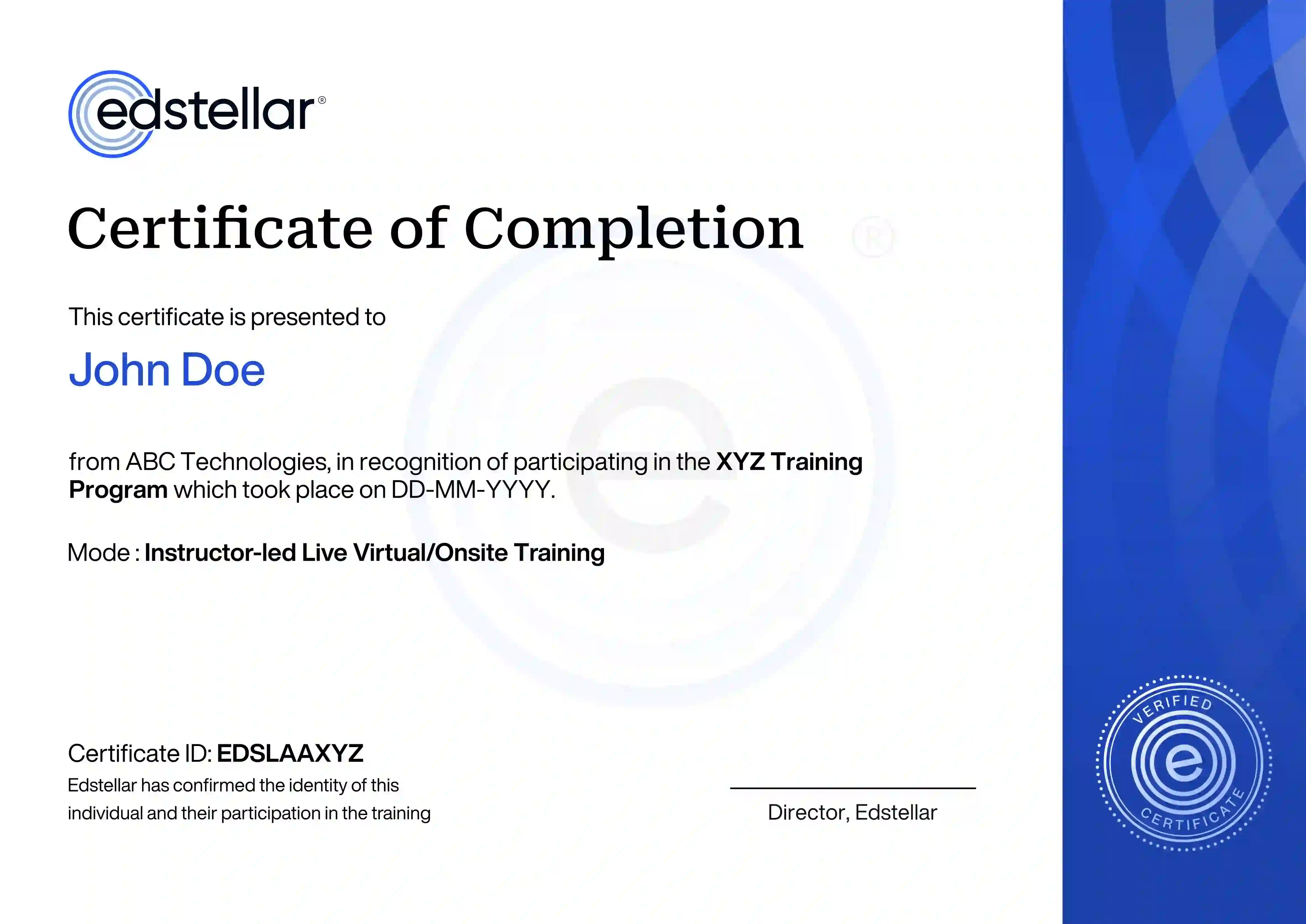
Participants receive an Edstellar course completion certificate, and the program builds practical AI skills your operations teams can apply at once. Contact Edstellar for a tailored proposal, and we will scope the curriculum, duration, and delivery format to your teams' needs.
Explore More Courses


.svg)
.svg)
.svg)

.svg)