10 Most In-Demand Skills in Indonesia for 2026
.webp)

.svg "edstellar")

Indonesia needs 9 million additional skilled digital professionals by 2030, yet 57.8% of the country's 146.5 million workers remain in informal employment according to BPS-Statistics Indonesia. Over 600,000 technology positions need filling in 2025, AI skills demand surged 148% between 2023 and 2025, and the cybersecurity sector requires approximately 100,000 experts while facing 3,300 cyberattacks per week.
Foreign direct investment reached IDR 1,434.3 trillion ($89.6 billion) in the first nine months of 2025, driven by nickel downstreaming, data centre construction, and EV battery manufacturing, yet only 0.8% of Indonesia's national workforce holds ICT professional qualifications. For corporate L&D leaders and HR managers operating in ASEAN's largest economy, these numbers define a structural skills gap that training alone can address.
Several mega-trends are converging to reshape Indonesia's labour market simultaneously. Microsoft committed US$1.7 billion for its Indonesia Central cloud region launched in May 2025, BYD is building a US$1.3 billion EV plant for 150,000 vehicles annually, and Hyundai-LG opened Indonesia's first EV battery cell plant. The government's Making Indonesia 4.0 programme produced 7,691 industry-ready workers in 2025, the Digital Talent Scholarship trained 100,000+ in AI, cybersecurity, and data analytics, and the Prakerja programme has reached 18.6 million participants since 2020.
Indonesia's e-commerce market reached US$90.35 billion, the data centre market is projected to grow from US$3.49 billion to US$7.96 billion by 2031, and the RUPTL electricity plan targets 42.6 GW of new renewable capacity through 2034. With a labour force of 153+ million, 10.7 million annual job seekers, and the Nusantara new capital city requiring 150,000 to 200,000 workers, Indonesia's skills challenge is as vast as its economic ambition.
So which skills are truly driving Indonesia's economy, and where should organisations invest their training budgets? This guide breaks down the top 10 skills in demand in Indonesia, spanning artificial intelligence, cybersecurity, cloud computing, fintech, renewable energy, manufacturing, and EV battery technology. Drawing on BPS labour statistics, BKPM investment data, Ministry of Industry workforce reports, and hiring platform benchmarks, it provides an evidence-based picture of what jobs are in demand in Indonesia, whether you are planning corporate upskilling programmes, building talent pipelines, or advising teams on high demand skills in Indonesia for 2026 and beyond.
Every ranking in this guide is backed by data from Indonesian government bodies, industry associations, and local recruitment platforms.
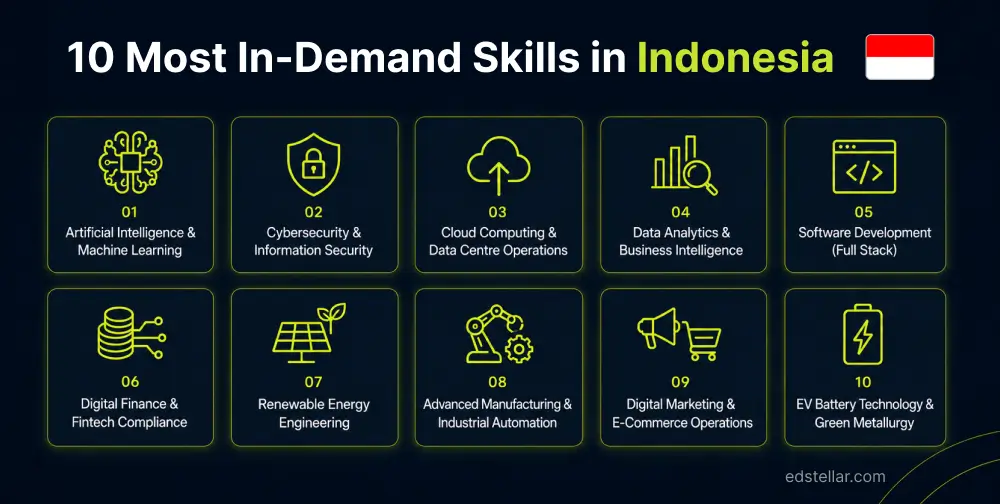
Indonesia's skills landscape in 2026 reflects the convergence of a US$1.7 billion Microsoft cloud investment, a US$90.35 billion e-commerce market, a nickel downstreaming strategy that exported US$27.2 billion in processed metals, and a renewable energy plan targeting 42.6 GW of new capacity. The 10 skills below span artificial intelligence, cybersecurity, cloud computing, data analytics, software development, fintech, renewable energy, manufacturing, digital marketing, and EV battery technology, mirroring the sectors where government policy, employer demand, and investment are highest across ASEAN's largest economy.

AI skills demand in Indonesia surged 148% between 2023 and 2025 according to Get on Board and AWS research, while AI and machine learning engineers are among the most sought-after professionals in the country. The government anticipates a shortfall of 9 million skilled digital professionals by 2030, and only 30,000 graduates in 2023 were qualified to work in data and AI roles. The Digital Talent Scholarship (DTS) has trained 100,000+ in AI, cybersecurity, and data analytics, Microsoft's elevAIte programme enrolled 840,000 people with a target of 1 million, and starting from the 2025–2026 academic year, AI and coding are being introduced as elective subjects for fourth graders.
Indonesia experienced 965% growth in AI firms from 2018 to 2024, creating over 11,000 jobs, and 92% of corporations report adopting AI in some form. GoTo, Traveloka, and Tokopedia deploy machine learning for fraud detection, personalisation, and logistics optimisation. The banking sector uses AI for credit scoring and anti-money laundering compliance under OJK regulations. Manufacturing companies applying predictive maintenance through Making Indonesia 4.0 programmes are reducing downtime across the 20.26 million-strong manufacturing workforce. The National AI Strategy 2.0, launched by the Secretariat of Economy, positions AI as a strategic priority alongside the broader Golden Indonesia 2045 vision targeting top-5 global GDP.
Senior AI specialists in Indonesia earn up to IDR 720 million annually (approximately US$45,000), while entry-level roles start at IDR 10 to 15 million per month (US$625 to 940) according to RainTech and PayScale data. AI/ML salaries are growing at 8 to 15% annually, significantly outpacing the 5 to 8% increases for standard roles. Jakarta commands a 10 to 15% premium over other cities, but Bandung and Yogyakarta are emerging as secondary AI hubs with lower costs and growing university-industry partnerships. For organisations operating in Indonesia, AI capability is transitioning from a competitive advantage to a baseline requirement across fintech, e-commerce, healthcare, and manufacturing.
Technology and Startups, Financial Services/Fintech, Manufacturing, E-Commerce
Explore Related Training:
AI Programming with Python Machine Learning With Python All Artificial Intelligence Programs
Indonesia faces approximately 3,300 cyberattacks per week, the highest rate in Southeast Asia, and needs roughly 100,000 cybersecurity experts to protect a digital economy projected to exceed US$109 billion according to BSSN (National Cyber and Crypto Agency) and IndoSecSummit data. The cybersecurity market is valued at US$1.15 billion in 2023 and projected to reach US$3.39 billion by 2028, growing at a 24.19% compound annual rate. Google partnered with BSSN to provide 1,000 cybersecurity certificate scholarships, and the Digital Talent Scholarship includes a dedicated cybersecurity training track targeting thousands of participants annually.
Cybersecurity engineers are in acute demand across banking, government, telecommunications, and energy. OJK's fintech regulations (No. 4/2025 and No. 16/2025) mandate compliance frameworks that require dedicated security teams at every licensed financial technology institution. Indonesia's 81 operational data centres and 24 under development create physical and virtual infrastructure that requires protection. The Nusantara new capital city, designed as a smart forest city with IoT integration across energy, water, and transport systems, will need cybersecurity architects from its first phase of operation.
Entry-level cybersecurity professionals in Indonesia earn IDR 10 to 13 million per month (approximately US$625 to 810), mid-career professionals earn IDR 14 to 18 million (US$875 to 1,125), and senior specialists reach IDR 18 to 26 million monthly (US$1,125 to 1,625) according to PayScale data. Salaries are growing at 8% annually, and top roles at major banks and technology companies command IDR 720 million per year. Banking sector cybersecurity job growth stands at 18%, and healthcare at 14%. For organisations in Indonesia, the regulatory environment (OJK compliance, personal data protection law, BSSN mandates) makes cybersecurity staffing a compliance requirement rather than a discretionary investment.
Banking and Financial Services, Government/Public Sector, Technology, Energy and Utilities

Microsoft launched its Indonesia Central cloud region in May 2025 with a US$1.7 billion investment, its largest ever in the country, projecting significant employment and GDP impact. Indonesia's hyperscale data centre market reached US$3.49 billion in 2025 and is projected to climb to US$7.96 billion by 2031 at a 14.71% CAGR according to Mordor Intelligence. The country operates 81 data centre facilities with 24 under development across 18+ cities, and the AI data centre sub-market alone is valued at US$0.66 billion, growing to US$1.44 billion by 2030. AWS, Google Cloud, and Alibaba Cloud all maintain or are expanding Indonesian infrastructure.
The Nusantara Data Centre Academy, launched by Microsoft in partnership with vocational institutions, trains cloud engineers and data centre technicians to support the Indonesia Central region. The Digital Roadmap's cloud computing training track and the Bangkit programme (led by Google) provide structured pathways for young professionals to enter the field. Financial institutions migrating to cloud environments under OJK digital transformation requirements, e-commerce platforms processing millions of daily transactions, and government agencies modernising public services under the digital government agenda all drive demand for cloud architecture, migration, and operations professionals.
Cloud engineers in Indonesia earn IDR 12 to 20 million per month (approximately US$750 to 1,250), cloud architects earn IDR 25 to 50 million (US$1,560 to 3,125), and data centre operations professionals earn IDR 8 to 15 million (US$500 to 940) according to Michael Page Indonesia. AWS certification carries the strongest salary premium, followed by Azure and GCP credentials. For organisations in Indonesia, cloud computing is the infrastructure layer upon which AI, cybersecurity, data analytics, and fintech applications are built, making it a foundational investment that multiplies the value of every other technology skill.
Technology, Financial Services, Telecommunications, Government
"Indonesia has the biggest number of workforce in ASEAN, so we are optimistic to take part in order to equalize quality education access and unleash the potency of Indonesian young talents, so they can compete both at the ASEAN region and global levels."



Only 30,000 Indonesian graduates in 2023 were qualified to work in data-related fields, against a digital economy valued at US$90+ billion that requires hundreds of thousands of data analysts and data engineers annually according to the Ministry of Education and RainTech research. The Digital Talent Scholarship includes a dedicated analytics track, the Bangkit programme (Google-led) provides data engineering pathways, and Making Indonesia 4.0 is driving data-driven manufacturing adoption. Data and AI roles are anticipated to see 60% demand growth, with only 30% of graduates possessing the necessary skills according to Talenbrium workforce analysis.
The e-commerce sector is the largest employer of data professionals in Indonesia. Tokopedia, Shopee, and Bukalapak analyse billions of transactions for demand forecasting, pricing optimisation, and personalised recommendations. Financial institutions build credit scoring models for the growing fintech market, where BNPL transactions alone reached US$8.59 billion. Telecommunications companies use data analytics for network optimisation across an archipelago of 17,000+ islands, and the manufacturing sector applies quality analytics across the 20.26 million-strong workforce. Indonesia's 92% corporate AI adoption rate confirms that organisations are generating data at scale, but the shortage of analysts who can convert raw data into actionable business intelligence creates a persistent bottleneck.
Data analysts in Indonesia earn IDR 5 to 10 million per month (approximately US$310 to 625), data engineers average IDR 78 million per year (US$4,900), and data scientists earn IDR 462 million annually (approximately US$31,000) according to PayScale and Glassdoor data. SQL, Python, Power BI, and Tableau are the most requested technical competencies, and bilingual professionals (Bahasa Indonesia plus English) command 15 to 20% salary premiums in roles serving multinational clients. For organisations across Indonesia's diverse economy, data analytics capability translates directly into competitive advantage in a market where the e-commerce sector alone is projected to grow to US$212.58 billion by 2031.
E-Commerce, Financial Services/Fintech, Telecommunications, Manufacturing
Explore Related Training:
Data Science with Python Business Analytics for Decision Making All Data Analytics Programs
Over 600,000 technology positions need filling in Indonesia in 2025, with full-stack and back-end developers ranked as the most demanded IT roles according to RainTech and Statista. The Digital Roadmap targets 10 million new digital talents, Prakerja has delivered coding and software development courses to millions of participants since 2020, and 42% of IT professionals are actively seeking new roles, creating both a talent shortage and high attrition risk. GoTo, Traveloka, Bukalapak, and hundreds of startups compete for developers in a market where demand far exceeds supply.
JavaScript/TypeScript (React, Node.js) and Python dominate job requirements, followed by Java for enterprise applications, mobile development (Flutter, React Native) for Indonesia's mobile-first population, and API design for the growing fintech ecosystem. The creative economy, employing 27.4 million workers (18.7% of the national labour force), intersects with software development through digital media, gaming, and content platforms. Indonesia's startup ecosystem, backed by significant venture capital from Singapore (28.8% of FDI), Hong Kong, and China, creates a continuous pipeline of software development demand that extends beyond traditional technology companies into retail, logistics, healthcare, and education.
Entry-level software developers in Indonesia earn IDR 7 to 10 million per month (approximately US$440 to 625), mid-career developers earn IDR 10 to 14 million (US$625 to 875), and senior engineers reach IDR 14 to 20 million (US$875 to 1,250) according to PayScale data, with 7% annual salary growth. The Jakarta premium of 10 to 15% applies strongly to software roles, though Bandung, Surabaya, and Yogyakarta are developing as alternative tech hubs with lower costs of living. For organisations building technology teams in Indonesia, the combination of a large English-speaking developer community, competitive salaries relative to Singapore and Australia, and a timezone aligned with major Asian markets makes the country an increasingly attractive nearshoring destination.
Technology and Startups, E-Commerce, Financial Services/Fintech, Digital Media

Indonesia's BNPL (Buy Now Pay Later) market is expected to reach US$8.59 billion in 2025, the financial literacy index rose from 38.03% in 2019 to 65.43% in 2024, and OJK (Financial Services Authority) issued Regulation No. 4/2025 on Financial Aggregators and Regulation No. 16/2025 on Fit and Proper Assessment for fintech operators, creating a regulatory framework that demands dedicated compliance professionals at every licensed institution. Finance and accounting roles generated 26,526 vacancies according to Kemenaker (Ministry of Manpower) data, the third-highest category after sales/marketing and production operators.
The convergence of digital banking, P2P lending, digital payments, and insurance technology creates a fintech landscape that is expanding rapidly while regulatory requirements tighten. OJK mandates that all licensed fintech institutions maintain qualified compliance officers, risk management systems, and data governance frameworks. Anti-money laundering (AML) compliance, personal data protection under Indonesia's PDP Law, and digital payment security requirements create a regulatory stack that requires professionals who combine financial domain knowledge with technology capability. Bank Indonesia's e-money and payment regulations add another compliance layer for digital wallet and payment gateway operators.
Fintech compliance professionals in Indonesia earn IDR 15 to 30 million per month (approximately US$940 to 1,875), risk analysts earn IDR 12 to 20 million (US$750 to 1,250), and senior compliance directors reach up to IDR 180 million monthly (approximately US$11,250) according to Michael Page Indonesia. The skill set bridges regulatory knowledge and technology implementation, making these professionals difficult to recruit externally but feasible to develop through targeted upskilling of existing banking or technology staff. Indonesia's position as Southeast Asia's largest fintech market ensures that regulatory compliance demand will continue to grow alongside the sector itself.
Banking, P2P Lending, Digital Payments, Insurance Technology

IRENA projects 1.3 million renewable energy jobs in Indonesia by 2030, up from just over 100,000 in 2017, yet only 31 vocational schools across the entire archipelago offer renewable energy engineering programmes with just 1,193 students enrolled. The RUPTL (Electricity Supply Business Plan) 2025–2034 targets 42.6 GW of new renewable capacity, Bappenas released a Green Workforce Roadmap in April 2025 targeting certification of 20,000 workers in green economy roles by 2029, and the SWIFT National Roadmap maps workforce development needs through 2060.
Indonesia is the world's second-largest geothermal energy producer, and the government plans 13.4 GW of additional solar capacity alongside significant wind, biomass, and mini-hydro development. The energy transition also creates demand for adjacent skills: energy efficiency auditing for Indonesia's 20.26 million manufacturing workers, grid integration engineering for connecting renewable capacity across an archipelago, and energy storage systems for managing intermittent generation. The government offers 126 free online training programmes covering renewables to EV batteries, and 32,000+ vocational training scholarships were awarded in 2023–2024, signalling recognition that the training pipeline must expand dramatically.
Renewable energy technicians in Indonesia earn IDR 6 to 12 million per month (approximately US$375 to 750), engineers earn IDR 12 to 25 million (US$750 to 1,560), and project managers reach IDR 20 to 40 million (US$1,250 to 2,500). Geothermal operations and maintenance skills are unique to Indonesia's market position as the world's second-largest producer, while solar PV installation and energy storage represent the highest-volume training needs. For organisations in Indonesia's energy sector, the gap between the RUPTL's 42.6 GW target and the current training infrastructure of 31 vocational schools represents both a workforce challenge and a compelling case for corporate-led upskilling programmes.
Energy and Utilities, Construction, Mining (Transition), Government/Infrastructure
Explore Related Training:
Renewable Energy and Sustainability All Environmental Sustainability Programs
Employment in Indonesia's non-oil and gas processing industry grew from 15.49 million in 2015 to 20.26 million by August 2025, while the base metal sector attracted US$3.5 billion in FDI in Q3 2025 alone according to ANTARA News and BKPM data. The Making Indonesia 4.0 programme produced 7,691 industry-ready workers under SBIN (National Industrialisation New Strategy) in 2025, with 5,472 vocational graduates and 2,305 workers completing reskilling programmes across 7 Industrial Training Centres. Production operator roles generated 38,565 vacancies according to Kemenaker, the second-highest category nationally.
Indonesia's nickel downstreaming policy, which banned raw ore exports to drive domestic processing, exported US$27.2 billion in nickel-related materials and downstream products by September 2025. This shift from commodity extraction to value-added manufacturing creates demand for professionals with supply chain management expertise alongside industrial IoT integration, robotic process automation, and quality management systems. The JARVIS (Industrial Vocational Admission Pathway) programme channels vocational graduates into manufacturing careers, and community colleges across Indonesia are aligning curricula with Making Indonesia 4.0 competency frameworks covering digital twins, predictive maintenance, and lean manufacturing principles.
Production engineers in Indonesia earn IDR 8 to 15 million per month (approximately US$500 to 940), automation engineers earn IDR 12 to 22 million (US$750 to 1,375), and industrial IoT specialists reach IDR 15 to 30 million (US$940 to 1,875). Lean Six Sigma certification and ISO quality management credentials carry documented salary premiums, particularly at multinational manufacturing plants and Tier 1 suppliers. For organisations operating factories in Indonesia, the transition from labour-intensive to technology-intensive manufacturing under Making Indonesia 4.0 is not optional: competitors investing in automation will capture the productivity gains that Indonesia's growing FDI promises.
Automotive Manufacturing, Metals and Mining (Downstream), Electronics, Food and Beverage Processing

Indonesia's e-commerce market is expected to grow from US$90.35 billion in 2025 to US$212.58 billion by 2031 according to Mordor Intelligence, and sales/marketing roles generated 72,511 vacancies, the single highest category reported by Kemenaker. Live commerce has become a defining feature of Indonesia's digital economy: 60% of online buyers purchase through live streaming sessions, video commerce accounts for 20% of online gross merchandise value, and live streaming host emerged as a formal job category with over 10,000 new positions. The Digital Roadmap targets 30 million MSMEs on digital platforms, creating massive demand for digital marketing professionals who can help small businesses compete online.
Tokopedia and Shopee together control over 60% of the Indonesian e-commerce market, and marketplace operations management (seller onboarding, product listing optimisation, promotional campaign management) has become a distinct professional skill set. Social media marketing is particularly critical in Indonesia, where platforms like TikTok, Instagram, and YouTube are primary purchase channels. SEO/SEM specialists, content marketers, and marketing analytics professionals are in high demand from both domestic brands and international companies entering the Indonesian market. The creative economy's 27.4 million workers, representing 18.7% of the national labour force, intersect directly with digital marketing through content creation, influencer partnerships, and brand storytelling.
Digital marketers in Indonesia earn IDR 5 to 12 million per month (approximately US$310 to 750), e-commerce managers earn IDR 10 to 20 million (US$625 to 1,250), and live streaming hosts earn IDR 3 to 5 million base plus performance commissions that can significantly exceed base salary. The accessibility of digital marketing careers (shorter training pathways than engineering or data science) makes it a high-impact upskilling target for Indonesia's large informal workforce. For consumer-facing organisations in Indonesia, digital marketing capability directly affects revenue in a market where 212+ million internet users are making purchasing decisions through social media and e-commerce platforms daily.
E-Commerce/Marketplace, Consumer Goods/FMCG, Media and Entertainment, Retail
Indonesia exported US$27.2 billion in nickel-related materials and downstream products by September 2025 and surpassed Japan and South Korea to become the world's second-largest producer of battery anode materials with 160,000 tons capacity according to Caixin Global and IBC Bulletin. Hyundai-LG opened Indonesia's first EV battery cell manufacturing plant in July 2024, BYD committed US$1.3 billion for an EV assembly plant producing 150,000 vehicles annually starting 2026, and the government's nickel downstreaming export ban policy is deliberately creating a domestic battery supply chain from raw material to finished product.
The combination of the world's largest nickel reserves, government policy mandating domestic processing, and global EV demand creates a uniquely Indonesian skill requirement. Lithium-ion battery cell manufacturing, nickel processing through HPAL (High Pressure Acid Leaching) and hydrometallurgy, and battery management systems (BMS) development are skills that Indonesia must build domestically because they are tied to physical resource locations. Power electronics engineering for EV drivetrains, quality control for battery cell production, and materials testing for cathode and anode materials represent the technical skills pipeline that Hyundai-LG, BYD, and CATL (which also has Indonesian operations) need at scale.
Battery technicians in Indonesia earn IDR 7 to 14 million per month (approximately US$440 to 875), metallurgical engineers earn IDR 12 to 25 million (US$750 to 1,560), and R&D specialists reach IDR 20 to 40 million (US$1,250 to 2,500). The 126 free online training programmes covering renewables and EV batteries, combined with 32,000+ vocational scholarships awarded in 2023–2024, signal government recognition that the EV battery workforce must grow rapidly. For organisations in Indonesia's mining and manufacturing sectors, the transition from raw nickel export to battery-grade processing and cell manufacturing represents the highest-value upskilling opportunity in the country's industrial history.
EV Manufacturing, Mining and Metals (Downstream), Battery Production, Automotive
"As Indonesia propels towards digitalisation and net zero, and transitions away from labour-intensive economic activities, upskilling is key to sustain the country's workforce development and thus maintain the economic competitive advantage."


Why Indonesia's Gen Zs Struggle To Thrive: CNA explores youth unemployment, the skills mismatch, and workforce challenges in Indonesia's growing economy.
Indonesia's skills demand is shaped by the geographic distribution of its industrial clusters, natural resources, and technology hubs across the world's largest archipelago. Understanding these regional patterns helps corporate L&D teams and HR managers target training investments where they will have the greatest impact.
Greater Jakarta dominates technology, fintech, and financial services, hosting GoTo, Traveloka, and the majority of Indonesia's 2,500+ startups alongside the country's banking headquarters. West Java anchors manufacturing with automotive plants, electronics assembly, and the Karawang industrial corridor that absorbs a significant share of manufacturing FDI. East Kalimantan is transforming through the Nusantara new capital city project, requiring 150,000 to 200,000 workers with smart city, BIM, and sustainability skills.
Central and East Java combine traditional manufacturing, shipping through Tanjung Perak port, and a growing e-commerce fulfilment infrastructure. The Sulawesi Nickel Belt around Morowali and Konawe is the epicentre of Indonesia's battery material processing, hosting Hyundai-LG and CATL operations. Bali and the broader tourism corridor employ millions in hospitality, with digital marketing and sustainable tourism skills increasingly required to manage record visitor flows. For organisations planning multi-site operations, aligning training programmes with these regional demand patterns ensures that upskilling investments match actual hiring needs across the archipelago.
#On-site #Virtual #GroupTraining #Customized
Explore 2000+ industry ready instructor-led training programs.

Create dynamic leaders and cohesive teams. Learn more now!

Do a quick Skill gap analysis with Edstellar’s Free Skill Matrix tool

Unlock premium resources, tools, and frameworks designed for HR and learning professionals. Our L&D Hub gives you everything needed to elevate your organization's training approach.
Access L&D Hub Resources.svg)
.svg)
.svg)
.svg)

.svg)


.svg "Click Here to Follow on Medium")
.svg)


