10 Most In-Demand Skills in Kenya for 2026
.webp)

.svg "edstellar")

Kenya's "Silicon Savannah" has positioned Nairobi as Africa's leading technology hub, yet the country faces a paradox of talent: over one million young people enter the labour market annually without marketable skills, youth unemployment exceeds 67% for those aged 15–34, and 45,000+ cybersecurity roles remain unfilled while the economy recorded 3.3 billion cyber threat events in Q1 2026 alone.
M-Pesa processes over 61 million transactions daily, Safaricom and the big four banks are building AI capabilities, and over 90% of Kenya's electricity comes from renewable sources, yet two-thirds of construction developers report that skilled worker shortages are the major constraint limiting activity. For corporate L&D leaders and HR managers operating in East Africa's largest economy, these numbers translate directly into urgent training priorities that will determine whether Kenya's innovation potential converts into inclusive economic growth.
Several structural forces are intensifying this demand simultaneously. President Ruto announced plans to invest KES 4.6 trillion ($31 billion) in infrastructure over the next decade, Kenya's green economy could create up to 240,000 jobs by 2030, and the BPO sector is projected to exceed $1 billion by 2030 from its current $430 million.
The National Artificial Intelligence Strategy 2025–2030 targets AI adoption across agriculture, security, healthcare, and education, the Data Protection Act is creating compliance demand across every sector, and the fintech ecosystem has grown to over 450 companies with mobile money reaching 91% market penetration. Meanwhile, Kenya's healthcare system is haemorrhaging nurses to the US, UK, and Gulf states, with the country identified as the leading African nation in nurse migration to the United States.
So which skills are truly driving Kenya's economy, and where should organisations invest their training budgets? This guide breaks down the top 10 skills in demand in Kenya, spanning technology, cybersecurity, fintech, healthcare, and renewable energy. Drawing on KNBS employment data, Kenya Labour Market Information System reports, CompTIA workforce analysis, and BrighterMonday hiring trends, it provides an evidence-based picture of what jobs are in demand in Kenya, whether you are planning corporate upskilling programmes, building internal talent pipelines, or advising teams on high demand skills in Kenya for 2026 and beyond.
Every ranking in this guide is backed by data from Kenyan government bodies, industry associations, and established hiring platforms.
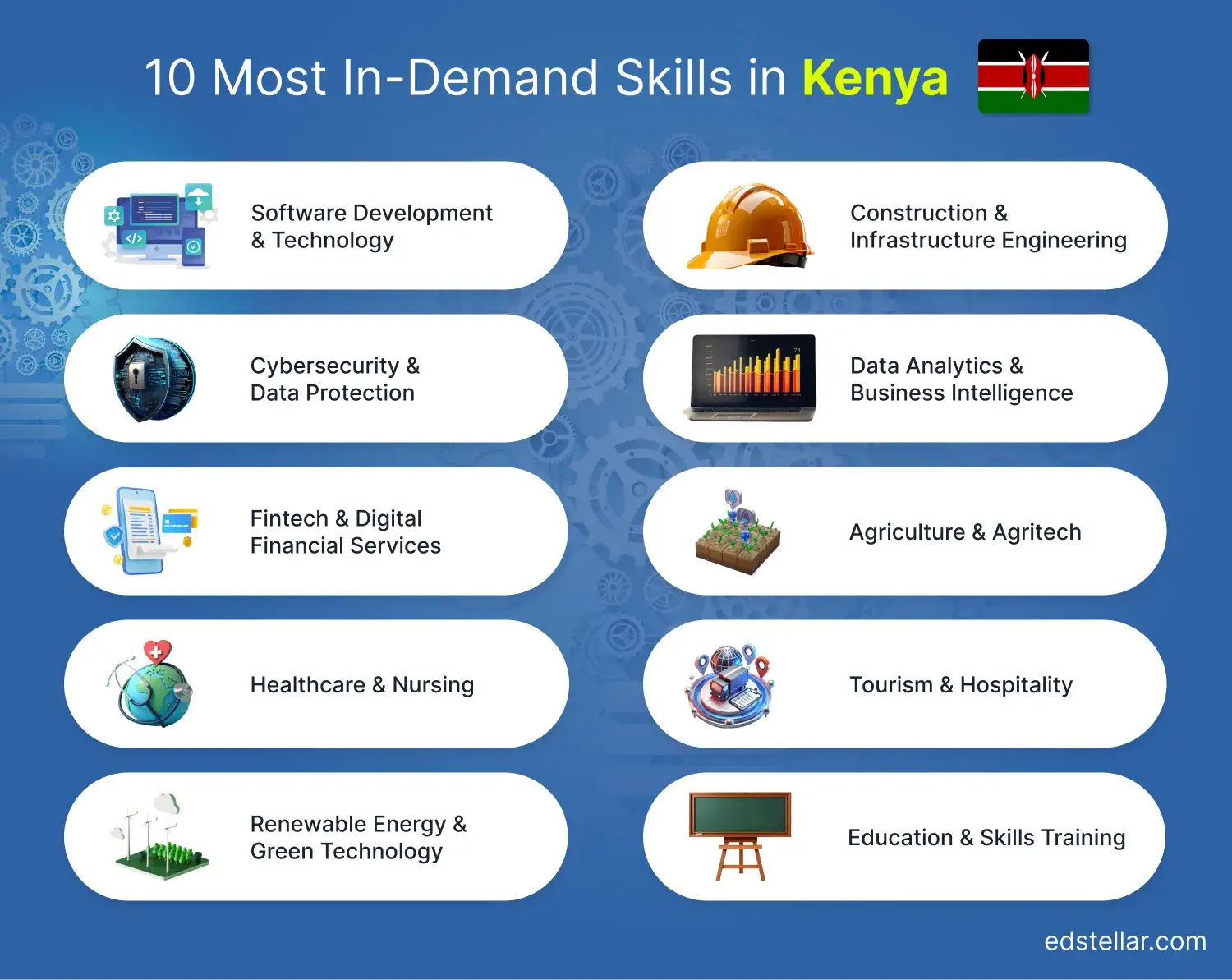
Kenya's skills landscape in 2026 reflects the collision of Africa's most vibrant technology ecosystem with structural challenges: mass youth unemployment, healthcare brain drain, a construction sector constrained by skills shortages, and an agricultural economy that employs millions but generates low productivity. The 10 skills below span technology, cybersecurity, fintech, healthcare, energy, and construction, mirroring the sectors where investment, employer demand, and growth potential are highest.

Nairobi's Silicon Savannah has transformed Kenya into Africa's leading technology hub, with skilled software engineers earning an average of KSh 721,000 annually, while remote roles soar to $51,000+ USD per year, often 5–10 times local pay. Multinationals like Microsoft and Google pay KSh 300,000+ monthly from their Nairobi Africa Development Centres, Safaricom engineers command KSh 140,000–250,000, and the premium for AI specialisation runs 12–20% above general software engineering. The BPO sector has created over 40,000 jobs and is projected to exceed $1 billion by 2030, while the broader IT outsourcing market generates $272 million in 2025.
Kenya's competitive advantage lies in its English-speaking, technically educated workforce operating at cost levels significantly below European and American markets. From Silicon Savannah startups to multinational tech giants, software engineering has become one of the most accessible high-paying career paths for young Kenyans. DevOps engineers with cloud-native skills and MLOps specialists who can bridge machine learning development with production deployment are in particularly short supply, with firms often searching for weeks to fill these roles.
Major employers include Microsoft Africa Development Centre, Google Kenya, Safaricom, Andela, Cellulant, Twiga Foods, and dozens of startups across iHub, Nairobi Garage, and the growing tech ecosystem. For young Kenyans, technology offers the most direct pathway from education to high-value employment, with Moringa School, AkiraChix, and university computer science programmes feeding a pipeline that still falls short of market demand. Python, JavaScript, Java, Go, and cloud-native frameworks are the most requested technologies.
Technology & Startups, BPO & IT Outsourcing, Financial Services (Safaricom, Banks), E-Commerce & Logistics
Explore Related Training:
Python Programming MERN Full Stack Development All Software Development Programs
Kenya recorded 3.3 billion cyber threat events between January and March 2026, with attacks targeting government agencies, banks, universities, and internet service providers. The Cyber Shujaa Industry Report 2025 documents 45,000+ unfilled cybersecurity roles, a 10.5% annual market growth rate, and the need for 10,000 new cybersecurity experts by end-2026. The average cybersecurity salary is KES 200,000 per month, with entry-level professionals earning KES 80,000–150,000 and mid-level roles paying KES 180,000–350,000.
Kenya's Data Protection Act, enforced by the Office of the Data Protection Commissioner, has created compliance demand that extends across financial services, healthcare, telecommunications, and government. Microsoft Africa Development Centre and Google Kenya hire for cloud and AI security, Safaricom needs M-PESA fraud prevention specialists, and banks including Equity Bank, KCB, and Co-operative Bank invest in threat detection and compliance infrastructure. Chief information security officers who can manage both technical defence and regulatory compliance are among the most difficult leadership positions to fill in Nairobi's corporate market.
Senior ML engineers at tier-1 tech firms in Nairobi now earn up to KES 12 million annually, approaching global compensation standards, and the intersection of AI with cybersecurity is creating hybrid roles in AI-native threat detection that carry significant salary premiums. For IT professionals already working in networking, systems administration, or software development, cybersecurity represents one of the highest-return career transitions available in the Kenyan market.
Financial Services (Safaricom, Banks), Government & Public Sector, Telecommunications, Technology & Startups

Kenya has consolidated its position as a world leader in digital financial services, achieving 91% mobile money market penetration by June 2025. M-Pesa processes over 61 million transactions daily, serves more than 50 million active users, and handles over USD 300 billion annually in transaction value, contributing an estimated 5% of GDP. Kenya hosts over 450 fintech companies, and the sector's growth is driving demand for developers, compliance officers, data analysts, and product managers who can build and scale financial technology platforms.
The evolution beyond basic mobile money into digital lending, insurance technology, wealth management, and cross-border payments is creating new skill categories that did not exist when M-Pesa launched in 2007. Equity Bank, KCB Group, NCBA, and Co-operative Bank are all investing in digital banking platforms, while fintechs like Pay Hero, Lipa Later, and Tala are scaling consumer financial products. The Central Bank of Kenya's regulatory framework for digital lenders is creating compliance demand alongside the Data Protection Act's privacy requirements.
For finance professionals in Kenya, the path to higher compensation runs through digital skills. Accountants who can implement digital financial reporting, risk managers who understand algorithmic lending, and compliance officers versed in mobile money regulation command premiums over peers with traditional-only expertise. Kenya's fintech ecosystem is also a major employer of international talent, with Nairobi's position as Africa's fintech capital attracting professionals from across the continent and beyond.
Mobile Money (Safaricom M-PESA), Banking (Equity, KCB, NCBA), Digital Lending & Insurance, Payment Technology
Explore Related Training:
AI for Financial Services Industry Financial Risk Management All Finance & Accounting Programs"Harnessing the transformative power of AI is now a tangible reality for organisations seeking to achieve exponential growth and optimisation. As AI continues to revolutionise industries, it is imperative that Kenya equips its workforce with the necessary skills to thrive in this new era."



Kenya's nursing exodus has reached what the Daily Nation describes as "catastrophic levels," with the country identified as the leading African nation in nurse migration to the United States. Skilled nurses are fleeing underfunded public hospitals for higher wages abroad, and the WHO reported in 2024 that nurse emigration continues to be a significant issue across Africa, with Kenya disproportionately affected. The total cost of educating a nurse from primary school through graduation is estimated at US$43,180, with an equivalent loss on migration investment of US$338,868 per nurse who leaves.
The root causes are systemic: inadequate working conditions, uncompetitive salaries, limited career progression, and a public healthcare system that cannot retain the professionals it trains. Kenya's county-level healthcare devolution adds complexity, as resource allocation varies dramatically across the 47 counties. The shortage extends beyond nursing to physicians, pharmacists, laboratory technicians, and community health workers across both urban and rural facilities.
For healthcare professionals who choose to stay, the domestic market offers growing opportunities. Private hospital groups including the Nairobi Hospital, Aga Khan University Hospital, MP Shah, and the expanding Avenue Healthcare network provide better compensation than public facilities. The medical tourism sector, serving patients from across East Africa, requires international-standard clinical care. The intersection of healthcare with technology through digital health platforms, telemedicine, and AI-assisted diagnostics is creating hybrid roles that command premiums over traditional clinical-only positions.
County Government Hospitals, Private Hospital Groups (Nairobi, Aga Khan), Community Health Programmes, NGOs & Development Partners

Kenya generates over 90% of its electricity from renewable sources, making it a model for clean energy across Africa. The renewable energy sector employs approximately 70,000 people with projections to reach 200,000 by 2030, and Kenya's green economy could create up to 240,000 jobs in the same timeframe. The 105 MW Menengai geothermal project will power half a million households, the Lake Turkana Wind Power Project's 365 turbines supply 17% of national grid capacity, and KenGen continues to develop the Olkaria geothermal complex as one of the world's largest single-site geothermal installations.
60% of green economy employment over the coming six years will be skilled or white-collar, with 30% requiring certification or vocational training. Geothermal engineers, solar PV technicians, wind turbine maintenance specialists, energy auditors, and grid integration engineers are the most sought-after roles. By 2025, TVETA plans to introduce green skills frameworks covering renewable energy, climate-smart agriculture, and environmental technology. Strathmore Energy Research Centre (SERC) is training solar technicians and energy auditors, and KenGen is developing geothermal training modules aligned with global standards.
For Kenyan professionals in engineering, construction, or environmental science, renewable energy represents one of the continent's most promising career pathways. Kenya's geothermal expertise, in particular, is globally significant, and KenGen's training programmes are producing professionals whose skills are valued by geothermal developers across East Africa, the Pacific, and Latin America. The off-grid solar sector (M-KOPA, Sun King, d.light) adds distributed energy employment across rural Kenya.
Geothermal (KenGen, GDC), Solar (M-KOPA, Sun King), Wind Energy, Utilities (Kenya Power)
Explore Related Training:
Renewable Energy and Sustainability All Environmental Sustainability Programs
Two-thirds of Kenyan developers report that skilled worker shortages are the major factor limiting construction activity, and a PMI report warns of a 57% construction talent gap across Africa, with demand for construction project professionals projected to rise from 260,000 to over 410,000 by 2035. President Ruto's KES 4.6 trillion ($31 billion) infrastructure investment plan over the next decade will intensify this demand across roads, railways, energy, and housing projects. Daily wages for certified artisans have tripled to KSh 2,500–3,000 from KSh 500–1,000 in 2012, reflecting the scarcity premium.
Kenya's construction sector employed 223,400 workers in 2024, but the industry faces challenges: no construction firms in a Central Bank survey planned to hire new workers in 2025. This paradox reflects the mismatch between available unskilled labour and the skilled tradespeople, engineers, and project managers that major infrastructure projects require. The Nairobi Expressway, Standard Gauge Railway extensions, Konza Technopolis, and affordable housing programmes all compete for the same limited pool of qualified construction professionals.
For young Kenyans, TVET-certified construction skills offer strong employment prospects. The National Construction Authority's registration requirements are raising quality standards, and international construction firms operating in Kenya (China Wu Yi, Strabag, Vinci) recruit locally for site-level positions while importing senior expertise. The growing demand for green building, smart infrastructure, and BIM-enabled project delivery is adding technology requirements to traditionally manual construction roles.
Road & Transport Infrastructure, Housing & Real Estate, Energy Infrastructure, Commercial & Industrial Construction

43% of Kenyan companies reported a significant increase in demand for AI-related abilities according to BrighterMonday, and the convergence of M-PESA transaction data, banking analytics, and enterprise digitisation is creating one of Africa's most data-rich economies. Financial services firms need data analysts for credit scoring, fraud detection, and customer segmentation, while FMCG companies, telecommunications firms, and government agencies all require professionals who can turn operational data into strategic decisions.
The National AI Strategy 2025–2030 is accelerating demand across agriculture (crop yield prediction, pest detection), healthcare (diagnostic analytics, patient flow optimisation), and logistics (route optimisation, demand forecasting). With 2.5 million Kenyan jobs flagged as at risk from AI by ODI analysis, the ability to work alongside AI systems rather than be replaced by them is becoming a critical differentiator for professionals across every sector.
Python, SQL, R, Tableau, Power BI, and cloud-based analytics platforms are the core technical requirements. Nairobi's data science community, anchored by iHub, Nairobi AI, and university research programmes, provides networking and training pathways. For mid-career professionals transitioning from business or finance roles, data analytics represents one of the strongest reskilling pathways in the Kenyan market, with the combination of domain expertise and technical analytics capability commanding significant salary premiums.
Financial Services & Banking, Telecommunications, Agriculture & FMCG, Government & Development
Explore Related Training:
Data Visualization with Tableau Data Science with Python All Data Science Programs"Many developing countries struggle with inadequate education systems, resulting in a workforce that lacks the skills for higher productivity and innovation. Investment in education and training is essential for empowering individuals and driving economic growth."

Agriculture remains Kenya's largest employer, engaging approximately 40% of the total workforce and over 70% of rural populations, yet productivity challenges, climate variability, and limited mechanisation constrain the sector's contribution to GDP. Kenya's National AI Strategy explicitly targets agriculture as a priority adoption sector, with AI applications in crop yield prediction, pest and disease detection, precision irrigation, and market price forecasting creating demand for professionals who can bridge traditional farming knowledge with digital technology.
The agritech startup ecosystem in Nairobi is one of Africa's most active, with companies like Twiga Foods (B2B fresh produce), Apollo Agriculture (smallholder farmer support), FarmDrive (agricultural credit scoring), and iProcure (agro-dealer supply chain) applying technology to solve food system challenges. Kenya's horticulture export sector (flowers, tea, coffee, vegetables) requires cold chain logistics, quality management, and international trade compliance professionals to maintain access to European and Middle Eastern markets.
For young rural Kenyans, agritech offers a pathway to modernise family farming enterprises, while agricultural extension officers, agronomists, and food technologists find growing employment across both public and private sectors. The intersection of agriculture with mobile money (farm payments, crop insurance via M-PESA), IoT (soil sensors, drone monitoring), and AI creates uniquely Kenyan career opportunities at the frontier of African agricultural transformation.
Horticulture & Tea/Coffee Export, Agritech Startups, Agricultural Finance, Government Extension Services

Kenya's tourism sector is a critical foreign exchange earner and employer, with the country's world-renowned wildlife reserves (Masai Mara, Amboseli, Tsavo), Indian Ocean coastline (Mombasa, Diani, Lamu), and Mount Kenya attracting visitors from across the globe. The sector employs hundreds of thousands directly and indirectly across hotels, safari lodges, tour operators, airlines, and supporting services. Kenya is positioning itself for higher-value tourism, with luxury safari lodges commanding premium rates and sustainable tourism gaining traction among international travellers.
Hotel managers, safari guides, guest experience specialists, chefs, event coordinators, and digital marketing professionals are in demand across the industry. The Kenya Utalii College, established specifically to train hospitality professionals, provides structured pathways into the sector, but graduate output remains below market needs, particularly for senior management roles that require both hospitality expertise and business acumen. The growing conferencing and MICE segment adds urban hospitality demand alongside traditional leisure tourism.
For young Kenyans, tourism offers employment that connects to the country's natural heritage and cultural identity. Conservation-based tourism creates roles for wildlife rangers, community liaison officers, and environmental educators alongside traditional hospitality positions. The combination of Kenya's global brand recognition, English-speaking workforce, and diverse tourism offerings makes it one of Africa's most promising hospitality career destinations.
Safari & Wildlife Tourism, Coastal Resort Hotels, Urban Hospitality & MICE, Airlines (Kenya Airways)

Over one million young Kenyans enter the labour market annually without marketable skills, and the Federation of Kenya Employers identifies the disconnect between education output and employer requirements as one of the country's most pressing workforce challenges. The 67% youth unemployment rate for 15–34 year olds is not primarily a jobs problem but a skills problem: employers across technology, healthcare, and trades report vacancies they cannot fill while millions of young people cannot find work.
TVET institutions, Competency-Based Education and Training (CBET) programmes, and digital skills initiatives are expanding, but the scale of the challenge requires corporate training investment alongside public education reform. Coding bootcamps (Moringa School, AkiraChix), digital literacy programmes, and sector-specific training initiatives are building alternative pathways from education to employment. Corporate trainers, instructional designers, and L&D specialists who can deliver industry-relevant programmes are in growing demand across Nairobi's corporate sector.
The National Industrial Training Authority (NITA) accredits training providers and administers the industrial training levy that funds employer-sponsored skills development. For organisations operating in Kenya, investing in structured training programmes is both an operational necessity and a contribution to the country's most critical economic challenge. The combination of a young, English-speaking population with growing technology adoption makes Kenya a market where workforce development investment yields disproportionate returns.
TVET Institutions & Universities, Corporate Training (NITA-Accredited), Coding Bootcamps & EdTech, NGOs & Development Partners
Explore Related Training:
Advanced Leadership Communication Strategies All Leadership Communication Programs"The skills gap is no longer just a youth-employment issue, it's a business-survival issue."


CBS 60 Minutes report on how Kenya became the "Silicon Savannah," exploring Nairobi's rise as East Africa's technology hub and its impact on jobs and innovation.
Kenya's skills demand is concentrated in a few economic hubs but extends across the country's diverse economic geography. Understanding these regional patterns helps corporate L&D teams and HR managers target training investments where they will have the greatest impact.
Nairobi dominates technology, financial services, and corporate employment, hosting Microsoft, Google, Safaricom, and the vast majority of Kenya's startup ecosystem. Mombasa's port and coastal tourism create a distinct demand profile centred on logistics, hospitality, and blue economy skills. The Rift Valley's geothermal resources and horticultural export farms generate specialised engineering and agricultural demand. Konza Technopolis, Kenya's planned smart city 60 km southeast of Nairobi, represents the future of technology employment if development continues as planned. For organisations planning multi-site operations, aligning training programmes with these regional demand patterns ensures that upskilling investments match actual hiring needs.
#On-site #Virtual #GroupTraining #Customized
Explore 2000+ industry ready instructor-led training programs.

Create dynamic leaders and cohesive teams. Learn more now!


Do a quick Skill gap analysis with Edstellar’s Free Skill Matrix tool

Unlock premium resources, tools, and frameworks designed for HR and learning professionals. Our L&D Hub gives you everything needed to elevate your organization's training approach.
Access L&D Hub Resources.svg)
.svg)
.svg)
.svg)

.svg)


.svg "Click Here to Follow on Medium")
.svg)


