A detailed list of the top in-demand skills in Portugal, curated by a trilingual corporate trainer with 30+ years of international experience in operational leadership, team performance, and multicultural communication.
Portugal's unfilled job vacancies surged 58.1% year-over-year to 18,768 open positions in October 2025, while the OECD Economic Survey for Portugal 2026 identified growing labour shortages across IT, construction, healthcare, and seasonal sectors. Unemployment dropped to 6.0%, the lowest since 2011, yet 71% of Portuguese companies say the lack of skilled staff impacts their business and only 19% find it easy to recruit workers with the right digital skills.
The tech sector grew 15% in 2025 with a 25% increase in tech jobs, 75% of construction firms cite skilled staff shortage as their main obstacle, and 1.56 million residents lack a family doctor. For corporate L&D leaders and HR managers operating in southwestern Europe's fastest-growing economy, these numbers define the most urgent training priorities.
Several structural forces are converging to reshape Portugal's labour market simultaneously. The PRR (Recovery and Resilience Plan) is deploying EUR 16.6 billion in reforms by 2026, including EUR 650 million for Companies 4.0 digitalisation and EUR 1,324 million for workforce qualifications. Portugal is racing toward 80% renewable power generation by 2026 (four years ahead of its original schedule), the EUR 2.8 billion MadoquaPower2X green hydrogen facility at Sines is beginning operations, and a EUR 50 billion Lisbon infrastructure programme spanning a new airport, high-speed rail, and third Tagus crossing is creating massive construction demand.
The NIS 2 Directive was transposed into Portuguese law in October 2024, DORA financial regulation took effect in January 2025, and the Industria 4.0 programme has already covered 24,000+ companies. With 5.27 million employed, 7 unicorns valued at EUR 34 billion+, and 32.5 million tourists generating record revenue, Portugal's economy is expanding faster than its workforce can adapt.
So which skills are truly driving Portugal's economy, and where should organisations invest their training budgets? This guide breaks down the top 10 skills in demand in Portugal, spanning software development, cybersecurity, data science, renewable energy, healthcare, construction, fintech, and tourism technology. Drawing on INE labour statistics, IEFP employment data, OECD economic analysis, and hiring platform benchmarks, it provides an evidence-based picture of what jobs are in demand in Portugal, whether you are planning corporate upskilling programmes, building talent pipelines, or advising teams on high demand skills in Portugal for 2026 and beyond.
Sources Behind This Research
Every ranking in this guide is backed by data from Portuguese government bodies, industry associations, and local recruitment platforms.
Government
INE (Instituto Nacional de Estatistica)
Labour Market Flow Statistics & Employment Data 2025
Reported 5,275,300 employed (up 3.2% YoY), unemployment at 6.0% (lowest since 2011), average gross monthly salary at EUR 1,741, and sector-level employment breakdowns. Confirmed 337,100 unemployed, down 4.0% year-over-year.
IEFP (Instituto do Emprego e Formacao Profissional)
Employment Services & Shortage Occupations Data 2025
Documented 297,722 registered unemployed (down 4.7% YoY) and 18,768 unfilled job vacancies (up 58.1% YoY). Identified health professionals, metal and machinery trades workers, and ICT professionals as the highest shortage occupations.
Recovery and Resilience Plan: Companies 4.0 & Qualifications
Published Portugal's EUR 16.6 billion recovery plan including EUR 650 million for Companies 4.0 digitalisation (Component 16) and EUR 1,324 million for workforce qualifications and skills development (Component 6). Documented Industria 4.0 progress covering 24,000+ companies.
Reported 75% of construction firms and 25% of manufacturing businesses citing skilled staff shortage as main obstacle. Recommended improving adult education, vocational training, and establishing national quality standards for lifelong learning.
Documented Portugal's tech sector growing 15% with a 25% increase in tech jobs and tech unemployment at just 2.3%. Reported 40% of new tech roles filled by foreign professionals due to domestic talent shortage, and tech industry revenue reaching EUR 11 billion.
BFSI Technology Workforce & Fintech Investment Data
Reported BFSI technology workforce at 18,500 professionals projected to reach 26,800 by 2030 (7.7% CAGR). Documented talent shortfall of 2,800–4,200 professionals with 4–7 month vacancy durations for senior roles, and EUR 1.2 billion in fintech funding since early 2025.
Surveyed 900+ employers providing sector-level salary benchmarks, recruitment dynamics, and hiring outlook data. Reported CTO roles at EUR 80,000–140,000, cybersecurity architects up to EUR 130,000, and growing demand for hybrid technical-business skill profiles.
Published role-based salary data showing DevOps and SRE roles averaging EUR 71,000 with AWS expertise commanding the highest premiums. Documented contractors earning 28% more than full-time employees and frontend, DevOps, and AI/ML salaries rising fastest.
"The skills shaping Portugal's workforce today demand professionals who can lead across cultures, communicate with clarity, and apply practical knowledge on the ground from day one. Organizations that develop operational leadership, trade literacy, and strong team dynamics across their people build a workforce that performs consistently in an increasingly international and competitive market.
"
Marcelo Hernandez
✓ 30+ years of international business experience across five continents, with hands on training expertise in operational leadership, multicultural communication, and international trade.
10 Key Skills in Demand Across Portugal's Job Market
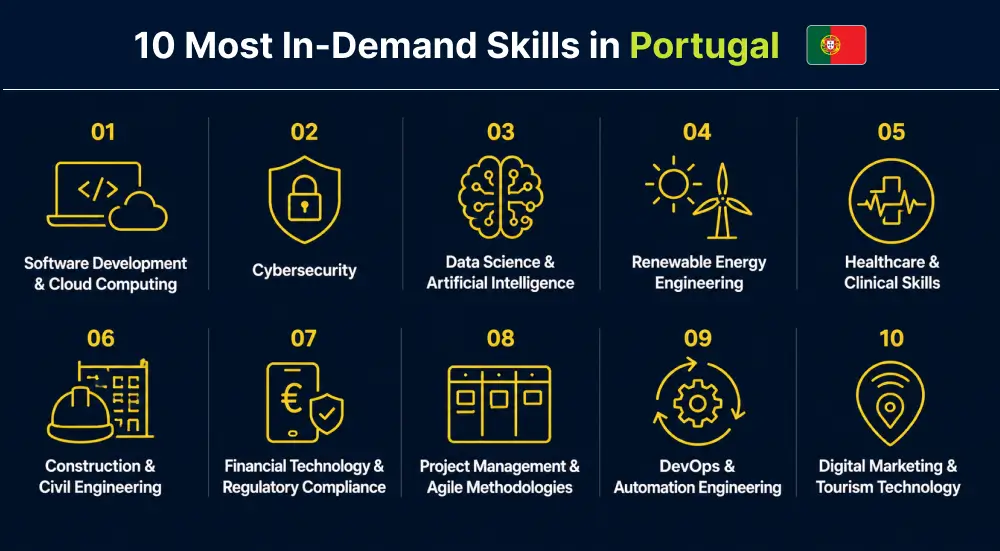
Portugal's skills landscape in 2026 reflects the convergence of a EUR 16.6 billion recovery plan driving digital transformation, a tech sector growing at 15% annually with just 2.3% unemployment, a renewable energy transition targeting 80% clean electricity by 2026, and critical workforce shortages across healthcare, construction, and financial services. The 10 skills below span software development, cybersecurity, data science, renewable energy, healthcare, construction, fintech, project management, DevOps, and tourism technology, mirroring the sectors where government investment, employer demand, and growth potential are highest.
1
Software Development & Cloud Computing
Research Score: 8.75/10
Portugal's tech sector grew 15% in 2025 with a 25% increase in tech jobs, tech unemployment at just 2.3%, and 40% of new tech roles filled by foreign professionals because domestic talent cannot keep pace with demand, according to Landing.jobs. Tech industry revenue reached EUR 11 billion, Portuguese startups raised EUR 780 million in venture funding, and Lisbon hosts 2,500+ registered startups including 7 unicorns valued at EUR 34 billion+ collectively. The PRR's Companies 4.0 programme (EUR 650 million) and INCoDe.2030's Specialisation axis are driving enterprise cloud adoption across every sector.
Portugal has established itself as a European IT nearshoring hub, with cloud engineers in particularly high demand. Financial institutions are migrating core systems to hybrid cloud environments, healthcare providers are deploying telemedicine platforms, and manufacturing companies are implementing Industry 4.0 solutions backed by the Industria 4.0 programme that has already covered 24,000+ companies. Full-stack development (Python, JavaScript, TypeScript) dominates job requirements, followed by cloud architecture (AWS, Azure) and API development for the growing fintech ecosystem. Porto's tech scene is expanding rapidly alongside Lisbon, with nearshoring firms establishing engineering centres to serve Western European clients.
Software engineers in Portugal earn EUR 35,000 to 65,000 annually, while cloud engineers command EUR 34,994 to 62,337 and cloud architects exceed EUR 65,000 according to Damia Group benchmarks. Non-Portuguese IT professionals now represent 15.7% of the workforce (up 5.1%), confirming that demand significantly exceeds domestic supply. The IT sector's net employment outlook of +22% is the highest of any sector in Portugal. For organisations operating in Portugal's tech ecosystem, software and cloud skills represent both the hardest positions to fill and the highest-return training investments.
Key Sub-skills
Full-Stack Development (Python, JavaScript, TypeScript)Cloud Architecture (AWS/Azure/GCP)API Development and IntegrationMicroservices and ContainerisationCI/CD Pipeline Management
Portugal transposed the NIS 2 Directive into national law in October 2024, DORA (Digital Operational Resilience Act) took effect in January 2025 for all financial entities, and the AI Act is being implemented throughout 2025, creating a regulatory triple wave that demands cybersecurity professionals across every regulated sector. The CNCS (Centro Nacional de Ciberseguranca) is actively recruiting across eight cybersecurity specialisations, and its C-Academy programme offers 44 PRR-funded cybersecurity training courses targeting 9,800 trainees by Q1 2026. Cybersecurity and regulatory compliance roles experience the longest vacancy durations (4 to 7 months) in the financial services sector according to the Portugal Fintech Report 2025.
The banking sector is the largest employer of cybersecurity professionals in Portugal, followed by government and telecommunications. NIS 2 compliance applies across all critical infrastructure operators, DORA mandates digital resilience testing for banks, insurers, and payment providers, and the AI Act introduces new risk assessment requirements for AI systems processing personal data. Portugal's 2,500+ startups handling sensitive customer data, Autoeuropa's connected manufacturing systems, and the healthcare sector's digitisation through the SNS all create cybersecurity demand that extends well beyond the traditional technology industry.
Cybersecurity professionals in Portugal earn EUR 40,000 to 80,000 annually, with senior security architects and CISOs reaching EUR 130,000 according to Hays Portugal. Cloud security and incident response specialists command the highest premiums due to scarcity. The C-Academy's 44-course programme signals government recognition that the domestic cybersecurity pipeline is insufficient, and organisations that invest in training existing IT staff toward cybersecurity specialisation will address their compliance obligations faster than those competing for a limited pool of external candidates.
Key Sub-skills
Security Operations and Incident ResponseRisk Management and Compliance (NIS 2/DORA)Penetration Testing and Vulnerability AssessmentCloud Security ArchitectureThreat Intelligence and Forensic Analysis
AI skills demand in Portugal is growing at 20%+ annually until 2026, with 1,307 open data science positions and 17,700 annual data analyst openings according to Landing.jobs and IEFP data. The government targets retraining 1.3 million workers by 2030 under the INCoDe.2030 Specialisation axis, APDC launched the IMPULSO AI initiative training 1,000 professionals in partnership with Google, and the AI Act implementation during 2025 is creating dedicated demand for professionals who understand AI and machine learning engineering alongside ethics and governance frameworks. Portuguese companies invested over EUR 100 million in AI in 2024 alone.
The financial services sector drives the largest share of data science hiring, with fintech firms deploying fraud detection, credit scoring, and algorithmic trading models. Healthcare institutions are adopting AI-powered diagnostic tools, manufacturing companies use predictive maintenance to reduce downtime at plants like Autoeuropa, and the tourism sector applies demand forecasting to manage 32.5 million annual visitors. Portugal's 66% AI adoption rate, while comparable to European peers, masks a significant gap in implementation capability: only 19% of companies find it easy to recruit workers with the right digital skills according to EU benchmarking data, and only 30% of graduates possess the necessary data and AI competencies.
Data analysts in Portugal earn EUR 31,109 to 54,801 annually, data scientists earn EUR 25,000 to 80,000, and AI/ML specialists reach up to EUR 98,280 at the senior level according to Damia Group and Hays Portugal. The Lisbon startup ecosystem and Porto's growing tech hub are the primary employers, but financial institutions, healthcare organisations, and manufacturing companies are all competing for the same talent pool. For organisations in Portugal, the data science talent gap is structural: universities are not scaling programmes fast enough, and internal upskilling of existing analytical staff (finance, operations, marketing) into data-capable professionals offers a faster path to capability than external recruitment.
Key Sub-skills
Machine Learning and Deep LearningNatural Language ProcessingStatistical Analysis and ModellingData Engineering and Pipeline DevelopmentAI Ethics and Governance (AI Act Compliance)
"The lack of qualified talent, especially in AI, data analysis, cybersecurity, and software development, is one of the main barriers to the sector's growth in Portugal."
Gabriel Coimbra
Co-Founder, GrowthOS · Lisbon, Portugal
4
Renewable Energy Engineering
Research Score: 8.10/10
Portugal is targeting 80% renewable power generation by 2026, four years ahead of its original schedule, and 100% by 2030. Renewables supplied 68% of electricity (37 TWh) in 2025, 67,000 people work in the renewable energy sector, and the government plans to bring an additional 3+ GW of renewable capacity online by end of 2026 including 5.7 GW of new solar. The National Hydrogen Strategy targets 2 GW of electrolysis capacity, 100,000 tonnes of green hydrogen per year, and EUR 3.5 billion+ in total investment by 2030. The EUR 2.8 billion MadoquaPower2X facility at Sines is beginning operations in 2026, producing 15,000 tonnes of green hydrogen annually.
One in three solar installation firms in Portugal turned down projects in 2025 because they could not find enough certified installers, according to industry surveys. EU grants currently cover 90% of upskilling costs for clean-tech training through April 2026, creating a time-limited opportunity for organisations to retrain workers at minimal cost. Clean-tech installers earn up to EUR 1,800 per month, 25% above the national average, confirming that the market is pricing the scarcity. Beyond installation, Portugal needs grid modernisation engineers, energy storage specialists, and green hydrogen production technicians as the Sines industrial cluster scales up.
Renewable energy engineers in Portugal earn EUR 35,000 to 60,000 annually, with hydrogen specialists and grid modernisation professionals at the upper range due to extreme scarcity. Solar PV system design and installation is the highest-volume skill need, followed by wind energy maintenance and battery storage technology. The combination of ambitious government targets, massive capital deployment (EUR 3.5 billion in hydrogen alone), and documented installer shortages makes renewable energy one of the most time-sensitive training investments for Portuguese organisations. Companies that build internal clean-tech capabilities now will capture EU co-financing that expires in 2026.
Key Sub-skills
Solar PV System Design and InstallationWind Energy TechnologyGreen Hydrogen Production and ElectrolysisGrid Modernisation and Smart GridsEnergy Storage Systems (Battery Technology)
Portugal's healthcare system faces a structural crisis: 1.56 million residents lack a family doctor, one-third of NHS specialists and one-fifth of nurses are aged 55 or over, and 2,700+ physicians requested documents to work abroad over a three-year period, according to the OECD Country Health Profile 2025. The government launched a EUR 300 million plan to add 12,000 full-time doctors to the SNS (Servico Nacional de Saude), and the Green Lane (Via Verde) immigration channel introduced in April 2025 offers 20-day fast-track work permits for healthcare shortage occupations, with 28,400 permits issued in the first ten months.
The SNS 24 health helpline received 1.457 million unanswered calls in the first nine months of 2025, a 941% jump year-over-year, reflecting a system under extreme pressure. CEDEFOP identifies health professionals as Portugal's top shortage occupation category, and 12% of active doctors are over 65, meaning the retirement wave will intensify before new graduates can fill the gap. Emergency medicine, geriatric care (Portugal has one of Europe's oldest populations), and mental health services face the most acute shortages, while health informatics and telemedicine skills are emerging as critical capabilities for a system trying to extend access through digital channels.
Nurses in Portugal earn EUR 1,200 to 2,000 per month, general practitioners earn EUR 2,500 to 4,000, and specialists earn EUR 4,000 to 7,000+ depending on the field. The pay differential with Northern European countries is the primary driver of healthcare emigration, and the EUR 300 million investment plan acknowledges that compensation reform is necessary alongside training capacity expansion. For healthcare organisations in Portugal, the workforce challenge requires both recruitment of international professionals through the Green Lane and internal development of existing clinical staff into high-shortage specialisations including geriatric care, emergency medicine, and telemedicine capability.
Key Sub-skills
General Practice and Family MedicineGeriatric Care and GerontologyEmergency MedicineHealth Informatics and TelemedicineMental Health and Psychiatric Nursing
Top Industries
Public Healthcare (SNS), Private Healthcare, Pharmaceuticals, Elder Care/Social Services
Get a custom training plan from Edstellar's 5,000+ expert trainers. Virtual or onsite delivery across Lisbon, Porto, Braga, Coimbra, and beyond.
Request a Free Consultation →
6
Construction & Civil Engineering
Research Score: 7.70/10
Portugal faces a construction workforce deficit of 50,000 to 100,000 skilled workers, and 75% of construction firms cite skilled staff shortage as their main business obstacle according to the OECD Economic Survey 2026. Construction remuneration rose 9.2% year-over-year and building costs in Lisbon increased 12%, reflecting the labour scarcity premium. A EUR 50 billion infrastructure programme including Lisbon's new airport, a high-speed rail link to Porto, and the third Tagus river crossing is at risk of delays unless the workforce gap is closed.
The Green Lane immigration fast-track issued 28,400 work permits in its first ten months, with construction among the designated shortage occupations. PRR infrastructure investments, renewable energy installation projects (Portugal plans 5.7 GW of additional solar capacity), and a housing construction push driven by record tourism demand are competing for the same limited pool of skilled tradespeople and engineers. BIM (Building Information Modelling) capability is increasingly required for public procurement projects, and sustainable construction practices are mandated for PRR-funded developments, adding technical requirements beyond traditional trade skills.
Construction workers in Portugal earn EUR 1,200 to 1,800 per month (with the 9.2% annual increase continuing), civil engineers earn EUR 30,000 to 55,000, and project engineers reach EUR 40,000 to 60,000. The sector competes directly with Northern European construction markets that offer higher wages, making retention as challenging as recruitment. For organisations in Portugal's construction industry, the workforce challenge is both a volume problem (tens of thousands of positions) and a skills problem (BIM, sustainable construction, and infrastructure engineering represent capabilities that most existing workers lack). Vocational training through IEFP and partnerships with the Green Lane programme represent the most practical paths to scaling the workforce.
Key Sub-skills
Structural Engineering and DesignBIM (Building Information Modelling)Sustainable and Green ConstructionInfrastructure Project PlanningGeotechnical Engineering
Top Industries
Infrastructure/Public Works, Residential Construction, Commercial Real Estate, Renewable Energy
Portugal's BFSI technology workforce stands at 18,500 professionals and is projected to reach 26,800 by 2030, growing at a 7.7% compound annual rate according to the Portugal Fintech Report 2025. The sector faces a talent shortfall of 2,800 to 4,200 professionals across critical technology functions, with average vacancy durations of 4 to 7 months for senior positions. Portuguese fintechs raised EUR 1.2 billion since the start of 2025, and DORA (Digital Operational Resilience Act), which took effect in January 2025, mandates digital resilience testing for every bank, insurer, and payment provider operating in Portugal.
The regulatory environment is driving a distinct fintech skill demand. DORA requires penetration testing, incident reporting systems, and third-party risk management capabilities. The AI Act implementation introduces risk assessment frameworks for AI systems used in financial decision-making. MiCA (Markets in Crypto-Assets Regulation) creates compliance requirements for crypto service providers. These overlapping regulatory mandates mean that fintech professionals in Portugal need both technical development capability and deep regulatory knowledge. Anti-money laundering technology, open banking API development, and automated compliance (RegTech) are the primary hiring areas.
Compliance officers in Portugal earn EUR 35,000 to 55,000 annually, fintech developers earn EUR 40,000 to 70,000, and CTOs at fintech companies reach EUR 80,000 to 140,000 according to Hays Portugal. The combination of Lisbon's startup ecosystem (2,500+ companies), EU regulatory mandates, and EUR 1.2 billion in fresh fintech capital creates a hiring environment where demand significantly exceeds supply. For financial services organisations in Portugal, the regulatory timeline is fixed: DORA compliance is already mandatory, AI Act obligations are phasing in, and organisations that cannot staff their compliance and technology teams face both operational risk and regulatory penalties.
Key Sub-skills
Regulatory Compliance (DORA, MiCA, AI Act)Anti-Money Laundering and KYC TechnologyRisk Modelling and Quantitative AnalysisPayment Systems and Open Banking APIsRegTech and Automated Compliance
Portugal's EUR 16.6 billion PRR must be fully executed by 2026, the EUR 50 billion Lisbon infrastructure programme requires programme-level delivery capability, and 71% of Portuguese employers prioritise hybrid skillsets combining technical expertise, emotional intelligence, and digital fluency according to Michael Page Portugal. Project managers who can bridge digital transformation initiatives with infrastructure delivery are in highest demand, particularly those with Agile certification and experience managing cross-functional teams in regulated environments.
The project management skills gap spans both traditional and Agile methodologies. Construction and infrastructure projects require PRINCE2 and PMP-certified managers capable of handling multi-stakeholder government contracts, while technology companies and fintechs need Scrum Masters and Agile Coaches to accelerate product delivery. The PRR execution deadline creates particular urgency: EUR 16.6 billion in reforms must be completed on time or Portugal risks returning unspent EU funds. This combination of infrastructure mega-projects and technology transformation programmes means that demand for certified project managers crosses every sector of the Portuguese economy.
Project managers in Portugal earn EUR 35,000 to 55,000 annually, Scrum Masters earn EUR 50,000 to 65,000, and Agile Coaches reach EUR 60,000 to 75,000 according to Michael Page Portugal and Hays salary guides. Programme directors overseeing PRR implementation and infrastructure delivery command EUR 70,000 to 100,000. The salary differential between traditional project management and Agile-certified roles reflects the market premium for professionals who can manage iterative delivery in complex, multi-stakeholder environments. For organisations managing digital transformation or infrastructure projects in Portugal, certified project management capability is the difference between on-time delivery and costly delays.
Key Sub-skills
Agile and Scrum FrameworksStakeholder Management and CommunicationRisk Assessment and MitigationDigital Transformation Programme DeliveryCross-Functional Team Leadership
DevOps and SRE roles in Portugal average EUR 71,000 annually with AWS expertise commanding the highest pay premiums according to the Damia Group 2025 Tech Salaries Benchmark. Contractors earn 28% more than full-time employees in DevOps positions, and frontend, DevOps, and AI/ML salaries are rising fastest across Portugal's tech sector. The Industria 4.0 programme, which has already covered 24,000+ companies, targets training 200,000 additional workers and financing 350+ transformational projects, with DevOps and automation skills central to manufacturing modernisation.
Autoeuropa's EUR 600 million investment to prepare for hybrid T-Roc replacement production and the upcoming ID.Every1 electric vehicle line from 2027 exemplifies the manufacturing demand for automation engineers. The plant's 4,842 workers and EUR 3.8 billion annual turnover (1.6% of national GDP) depend on continuously improving production automation. Beyond manufacturing, Portugal's nearshoring firms require DevOps engineers to manage cloud-native deployment for international clients, financial institutions need CI/CD capabilities for rapid compliance updates under DORA, and the growing startup ecosystem demands infrastructure automation to scale products efficiently.
DevOps engineers in Portugal earn EUR 35,340 to 71,000 annually, with SRE roles in a similar range. AWS certification carries the strongest salary premium, followed by Kubernetes and Terraform expertise. The nearshoring premium is significant: Portuguese DevOps engineers serving Western European clients through nearshoring arrangements earn substantially more than those in domestic-only roles. For organisations in Portugal, DevOps capability is the operational backbone that enables faster software delivery, more reliable infrastructure, and the automation required to compete in a labour-constrained market.
Key Sub-skills
CI/CD Pipeline Design and ManagementInfrastructure as Code (Terraform, Ansible)Container Orchestration (Kubernetes, Docker)Site Reliability EngineeringMonitoring and Observability
Portugal welcomed a record 32.5 million tourists in 2025, the tourism sector is on track for EUR 27 billion in revenue, and the industry added 18% more jobs between 2023 and 2024, bringing the total to nearly 500,000 direct and indirect positions according to Turismo de Portugal and INE data. The OECD specifically recommends preparing Portugal's tourism workforce for the digital future, and multilingual digital marketing candidates (particularly those with German, Dutch, French, or Nordic language skills) are in high demand for both tourism marketing and the broader nearshoring BPO sector.
The gap between Portugal's tourism scale and its digital marketing capability represents an untapped opportunity. Hotels, tour operators, and regional tourism boards increasingly compete on online visibility, and performance marketing (SEO, SEM, social media advertising) directly affects booking volumes and revenue per visitor. The Web Summit's permanent relocation to Lisbon has created a technology-marketing crossover ecosystem where tourism companies can access digital tools and talent. E-commerce specialists, CRM managers, and data-driven customer experience designers are emerging as distinct hiring categories within the hospitality sector as properties shift from OTA-dependent to direct-booking models.
Digital marketing managers in Portugal earn EUR 30,000 to 50,000 annually, e-commerce specialists earn EUR 25,000 to 40,000, and tourism technology roles sit in the EUR 25,000 to 40,000 range. While these salaries are lower than pure technology roles, the volume of positions (nearly 500,000 in the tourism sector alone) and the sector's growth trajectory create substantial aggregate demand. For tourism and hospitality organisations in Portugal, digital marketing capability directly correlates with revenue performance in a market where 32.5 million annual visitors are making booking decisions online.
Key Sub-skills
SEO/SEM and Performance MarketingCRM and Marketing AutomationSocial Media Strategy and AnalyticsE-Commerce Platform ManagementData-Driven Customer Experience Design
"Portugal is a country full of talent, but we must find ways to make better use of it. We started this journey with very clear objectives: to guarantee access to digital technologies for the entire population, promoting basic digital skills; for those who already have these skills, to improve them through upskilling."
Luísa Ribeiro Lopes
Chair Of The Board Of Directors, DNS.PT Association · Lisbon, Portugal
Why Portugal's Economy is Outperforming Europe: TLDR News EU examines the economic forces driving Portugal's growth in tourism, green energy, and technology.
Skills Demand Across Portugal's Regional Tech and Industry Hubs
Portugal's skills demand is shaped by the geographic concentration of its technology hubs, industrial clusters, and tourism infrastructure. Understanding these regional patterns helps corporate L&D teams and HR managers target training investments where they will have the greatest impact.
Region
Key Industries
Top Shortage Skills
Lisbon Metro
Tech Startups, Fintech, Tourism, Government
Software Development, Data Science, Cybersecurity
Porto Metro
Engineering, Manufacturing, IT Nearshoring
DevOps, Cloud Computing, Industrial Automation
Setubal (Palmela)
Automotive (Autoeuropa/VW), Logistics
Manufacturing Engineering, Supply Chain, Robotics
Alentejo (Sines)
Green Hydrogen, Port Logistics, Renewables
Energy Engineering, Electrolysis, Logistics
Algarve
Tourism, Hospitality, Construction
Digital Marketing, Hospitality Management, Construction
Lisbon dominates technology, fintech, and government services, hosting 2,500+ startups, 7 unicorns, and the Web Summit ecosystem. Porto has emerged as Portugal's second technology hub and primary IT nearshoring destination, with engineering firms and cloud service providers serving Western European clients. Setubal anchors automotive manufacturing through Autoeuropa's EUR 3.8 billion operation, while the Sines industrial cluster in Alentejo is positioning itself as Europe's green hydrogen gateway with EUR 2.8 billion in investment.
The Algarve drives Portugal's tourism economy (32.5 million visitors nationally) with acute demand for hospitality and construction workers, and the Centro region around Coimbra and Aveiro combines university-led R&D with advanced manufacturing. For organisations planning multi-site operations, aligning training programmes with these regional demand patterns ensures that upskilling investments match actual hiring needs.
How to Develop These Skills in Demand in Portugal
Portugal's skills challenge sits at the intersection of rapid economic growth and structural workforce gaps. Unemployment has fallen to 6.0% (the lowest since 2011), yet unfilled vacancies surged 58.1%, 75% of construction firms cannot find workers, 1.56 million residents lack a family doctor, and 40% of new tech roles must be filled by foreign professionals because domestic talent supply is insufficient. With EUR 16.6 billion in PRR funds to deploy by 2026, a EUR 50 billion infrastructure programme, and a renewable energy transition targeting 80% clean electricity, organisations need a systematic approach to close these gaps.
Start with a skills audit. Use a structured training needs analysis to map your current team capabilities against the skills your business needs over the next 12 to 24 months. Focus on the gaps that directly affect service delivery, compliance, and digital transformation. Portugal's Labour Code requires a minimum of 40 hours of annual training per employee, so a structured audit ensures those mandatory hours target your organisation's actual capability gaps rather than ticking a compliance box, particularly given that 71% of Portuguese companies report skills shortages affecting their business.
Build individual development plans. Generic training programmes produce generic results. Use individual development plan templates to tailor learning pathways to each employee's current skills and career trajectory. A DevOps engineer at a Porto nearshoring firm has different development needs than a fintech compliance analyst preparing for DORA in Lisbon, even though both operate within Portugal's fastest-growing technology ecosystem.
Combine certifications with applied learning. International certifications (AWS, Azure, CISSP, CEH, PMP, PRINCE2) carry significant weight in the Portuguese market and command salary premiums across cloud, cybersecurity, and infrastructure roles. However, applied projects and instructor-led workshops build the practical capability that certifications alone cannot provide. The most effective programmes pair certification preparation with hands-on exercises drawn from Portugal-specific industry scenarios, particularly in fintech, construction, and renewable energy where DORA compliance, PRR contract requirements, and Sines green hydrogen protocols add local context that global training materials rarely cover.
Address performance gaps systematically. A guide to understanding performance gaps can help managers distinguish between skill deficits, motivation issues, and systemic barriers before investing in training. A healthcare team struggling with patient throughput may need telemedicine platform training, while a construction crew missing PRR-funded project deadlines may need BIM upskilling rather than management development.
Leverage Portugal's PRR-funded training ecosystem. The EUR 1,324 million workforce qualifications component of the Recovery and Resilience Plan is actively co-funding upskilling programmes across priority sectors. The CNCS C-Academy offers 44 PRR-funded cybersecurity courses targeting 9,800 trainees by Q1 2026, EU grants currently cover 90% of clean-tech upskilling costs through April 2026, and IEFP vocational programmes provide structured pathways for construction and healthcare workforce development. Organisations that actively connect employees with these public-sector resources can extend their L&D investment significantly without proportionally increasing internal training budgets.
Portugal's economic trajectory, driven by a EUR 16.6 billion recovery plan, a tech sector growing at 15%, a renewable energy transition backed by EUR 3.5 billion in hydrogen investment, and a EUR 50 billion infrastructure programme, signals that demand for skilled professionals will only intensify. Organisations that build their training strategies around these national priorities, supported by a catalogue of over 2,000 instructor-led courses, will be better positioned to attract talent and maintain competitive advantage in one of Europe's most dynamic and rapidly growing economies.
Frequently Asked Questions
What skills are in high demand in Portugal?
The most in-demand skills in Portugal for 2026 include software development and cloud computing, cybersecurity, data science and artificial intelligence, renewable energy engineering, healthcare and clinical skills, construction and civil engineering, financial technology and regulatory compliance, project management and Agile methodologies, DevOps and automation engineering, and digital marketing and tourism technology. Software development and cloud computing lead the list, driven by 15% tech sector growth, 2.3% tech unemployment, and 40% of new tech roles requiring foreign professionals.
What jobs are in demand in Portugal in 2026?
The highest-demand jobs in Portugal for 2026 include software engineers, cloud architects, cybersecurity analysts, data scientists, renewable energy installers, doctors and nurses, civil engineers, construction tradespeople, fintech developers, Scrum Masters, DevOps engineers, and digital marketing specialists. IEFP identifies health professionals, metal and machinery trades workers, and ICT professionals as the top shortage occupation categories, with unfilled vacancies up 58.1% year-over-year.
What is the average salary for technology professionals in Portugal?
Technology salaries in Portugal vary by role and experience. Software engineers earn EUR 35,000 to 65,000, cloud engineers earn EUR 34,994 to 62,337, DevOps/SRE roles average EUR 71,000, data scientists earn EUR 25,000 to 80,000, and AI/ML specialists reach up to EUR 98,280. Cybersecurity professionals earn EUR 40,000 to 80,000 with senior architects reaching EUR 130,000. CTOs at fintech companies command EUR 80,000 to 140,000. Contractors earn approximately 28% more than full-time employees in equivalent roles.
How do I get a job in Portugal as a foreigner?
Foreign professionals access Portugal's job market through several pathways. The Green Lane (Via Verde) immigration channel, launched in April 2025, offers 20-day fast-track work permits for designated shortage occupations including healthcare, construction, and ICT, with 28,400 permits issued in its first ten months. EU citizens have free labour mobility. Non-EU professionals typically require an employer-sponsored work permit. Technology roles are the most accessible for international candidates, with 40% of new tech positions filled by foreign professionals. Portuguese language proficiency is not always required in tech, nearshoring, and tourism roles, though it significantly improves career prospects.
Why does Portugal have labour shortages despite unemployment?
Portugal's 6.0% unemployment coexists with a 58.1% surge in unfilled vacancies due to a structural skills mismatch. The economy is creating technology, healthcare, construction, and renewable energy positions faster than the education system can produce qualified workers. Only 19% of companies find it easy to recruit workers with the right digital skills, 75% of construction firms lack skilled staff, and 1.56 million residents are without a family doctor. Wage differentials with Northern Europe also drive emigration: 2,700+ doctors sought to work abroad in three years, and construction and nursing professionals face the same pull effect. The labour underutilisation rate of 10.2% confirms that many available workers lack the skills employers need.
What is Portugal's tech industry like?
Portugal's tech sector is one of Europe's fastest-growing, with 15% growth in 2025, EUR 11 billion in revenue, and tech unemployment at just 2.3%. Lisbon hosts 2,500+ startups, 7 unicorns collectively valued at EUR 34 billion+, and the Web Summit conference. Portuguese startups raised EUR 780 million in venture capital in 2025. Porto has emerged as a secondary tech hub and IT nearshoring centre. The sector employs a workforce of 700,000+ professionals, with non-Portuguese IT professionals representing 15.7% of the workforce. Key segments include fintech (EUR 1.2 billion raised), software development, cybersecurity, and data science.
What kind of jobs are available in Portugal for young people?
Young people in Portugal have growing opportunities across the economy's fastest-expanding sectors. Technology offers the highest salaries and lowest unemployment (2.3%), with entry-level software development, data analysis, and digital marketing roles accessible through bootcamps and university programmes. Renewable energy installation provides above-average wages (EUR 1,800/month, 25% above national average) with 12-week certification courses and EU-subsidised training. Tourism and hospitality employ nearly 500,000 people with seasonal and permanent positions. Construction trades face acute shortages and offer rising wages (9.2% annual increase). The PRR and INCoDe.2030 programmes provide subsidised training pathways, and the CNCS C-Academy offers free cybersecurity courses for career changers.
What jobs does Portugal need most?
Portugal's most critical workforce needs are in healthcare, construction, and technology. The healthcare system needs 12,000 full-time doctors to serve the 1.56 million residents without a family doctor. Construction requires 50,000 to 100,000 skilled workers for the EUR 50 billion infrastructure programme. Technology faces the lowest unemployment (2.3%) but highest growth (25% more jobs annually), requiring software engineers, cloud architects, and cybersecurity professionals. Renewable energy needs certified installers (1 in 3 solar firms turning down projects for lack of staff). Financial technology faces a talent shortfall of 2,800 to 4,200 professionals as DORA and AI Act compliance deadlines arrive.
Conclusion
Portugal's skills landscape in 2026 is defined by a country whose economy has outperformed most of Europe, with unemployment at its lowest since 2011, tech sector growth at 15%, 32.5 million tourists generating record revenue, and EUR 16.6 billion in PRR recovery funds being deployed. Yet 71% of companies say skills gaps impact their business, unfilled vacancies surged 58.1%, 75% of construction firms cannot find workers, 1.56 million residents lack a family doctor, and 40% of new tech roles must be filled from abroad. The gap between what Portugal's rapidly growing economy demands and what its education and training systems deliver remains the central barrier to converting ambition into inclusive prosperity.
The ten skills in demand in Portugal covered in this guide represent the intersection of EU-funded national strategy and acute workforce need. From software development backed by a EUR 650 million Companies 4.0 programme, through cybersecurity driven by NIS 2 and DORA compliance mandates, renewable energy engineering targeting 80% clean electricity by 2026, and healthcare confronting a system where 1.56 million people lack a GP, each skill area offers clear returns on training investment. The organisations that close their skills gaps fastest will be the ones that attract talent, meet regulatory deadlines, and lead their industries as Portugal executes one of Europe's most ambitious economic transformation programmes.
Organisations looking to upskill their Portuguese workforce across these in-demand skills can also explore our detailed comparison of corporate training companies in Portugal to find the right training partner based on industry focus, delivery format, and programme coverage.
Ready to Upskill Your Portugal Team?
Join 500+ organisations that trust Edstellar's Training Needs Analysis to find the gaps, pick the right skills, and build a training plan that works.
Marcelo Hernandez is a senior logistics executive and corporate trainer with over 30 years of international businesses experience across Brazil, Europe, Latin America, Africa, and Asia. Trilingual in Portuguese, English, and Spanish, he combines three decades of commercial leadership in international freight forwarding with hands on facilitation in operational leadership, team performance, and multicultural communication, including recent programs delivered in Portugal and Angola.
Explore High-impact instructor-led training for your teams.
Unlock premium resources, tools, and frameworks designed for HR and learning professionals. Our L&D Hub gives you everything needed to elevate your organization's training approach.
.svg "edstellar")


















.svg "Click Here to Follow on Medium")
.svg)




.svg)


.svg)
.svg)
.svg)

.svg)