A comprehensive list of the most in-demand skills in Vietnam, evaluated by an L&D professional with 21 years of experience including 12+ years running training inside Google and Apple.
Vietnam's GDP grew 8% in 2025, the fastest pace in the region, yet 80% of employers report major challenges finding suitable candidates and only 29.2% of the 53.3 million workforce holds a recognised diploma or certificate. Samsung manufactures half its smartphones here, Apple produces 65% of AirPods and 20% of iPads in Vietnamese factories, and FDI disbursements hit a record $25.35 billion in 2024, yet the country faces a shortage of 700,000 tech professionals, 50,000 nurses by 2030, and its semiconductor workforce totals just 15,000 against a target of 50,000 engineers by 2030.
For corporate L&D leaders and HR managers operating in Asia's fastest-growing manufacturing hub, these numbers translate directly into urgent training priorities that will determine whether Vietnam captures or misses the largest industrial investment cycle in its history.
Several structural forces are intensifying this demand simultaneously. The digital economy is projected to reach $43 billion, with an estimated 700,000 tech positions needing to be filled and over 58% of enterprises integrating AI into at least one core business process. Vietnam recorded $27.6 billion in disbursed FDI in 2025 (the highest in five years), with manufacturing accounting for 56.5% of newly registered capital.
Nvidia signed an AI cooperation agreement to establish R&D and data centres, FPT Corporation exported its first batch of commercial semiconductor chips in December 2025, and the government approved its first $500 million wafer fabrication plant. The IT services market reached $2.37 billion and is forecast to grow to $4 billion by 2030, the fintech market is valued at $4.33 billion with 15%+ CAGR, and 45% of companies plan to expand their workforce by 5–10% in 2026.
So which skills are truly driving Vietnam's economy, and where should organisations invest their training budgets? This guide breaks down the top 10 skills in demand in Vietnam, spanning manufacturing, software development, semiconductors, cybersecurity, and healthcare. Drawing on MOLISA labour data, Vietnam Briefing market analysis, ITviec salary reports, and Reeracoen hiring trends, it provides an evidence-based picture of what jobs are in demand in Vietnam, whether you are planning corporate upskilling programmes, building internal talent pipelines, or advising teams on high demand skills in Vietnam for 2026 and beyond.
Sources Behind This Research
Every ranking in this guide is backed by data from Vietnamese government bodies, industry associations, and established hiring platforms.
Government
General Statistics Office (GSO) / MOLISA
Labour Force Survey & Economic Data 2025
Reported 53.3 million workforce, 52.3 million employed, 8% GDP growth, 29.2% trained worker share, and sector-level employment data. Manufacturing engaged 17.4 million workers and grew 9.97%, the highest rate in the 2019–2025 period.
National Semiconductor Strategy & Digital Economy Data
Set the target of 50,000 semiconductor engineers by 2030, documented 170+ FDI semiconductor projects worth $11.6 billion, and tracked ICT sector revenue growth from $60.9 billion (2016) to $154 billion (2023) across 70,000+ tech firms.
Confirmed 8% GDP growth in 2025, projected 6.8% for 2026, and highlighted investing in high-tech talent as Vietnam's next step to a high-income future. Analysed the gap between FDI-driven growth and domestic skills development.
Detailed hiring hotspots and talent shifts, sector-level salary trends, FDI distribution by province, and the 80% employer hiring difficulty rate. Provided analysis of manufacturing, technology, and financial services hiring patterns.
Projected semiconductor market reaching $31.28 billion by 2027 (11.6% CAGR), documented the shift from assembly to chip design, and tracked investment flows from Intel ($4.1B), Amkor ($1.6B), and Samsung across manufacturing clusters.
Vietnam Energy Transition Workforce & Green Transformation Reports
Projected electricity sector growth from 300,000 to 500,000 FTEs by 2035, documented 64% of HR leaders prioritising green skills training, and the National Green Skills Framework development by 2026.
"The skills gap in Vietnam is not technical. It's behavioral. I've trained over 12,000 professionals, and the pattern is consistent: careers stall not from a lack of hard skills, but from the struggle to negotiate, prioritize, and say the difficult thing clearly. With AI on the rise, interpersonal skills are the qualities that matter most. The companies pulling ahead treat communication, time management, and the ability to focus as core business skills, not soft skills."
Thijs Van Loon
✓ 21 years in L&D with 12+ years running training inside Google and Apple, training 12,000+ professionals from 70+ nationalities.
10 Key Skills in Demand Across Vietnam's Job Market
Vietnam's skills landscape in 2026 reflects the collision of record FDI inflows from Samsung, Intel, Apple, and Nvidia with a workforce where nearly 38 million workers remain untrained. The 10 skills below span manufacturing, technology, semiconductors, healthcare, and green energy, mirroring the sectors where foreign investment, employer demand, and salary premiums are highest. Each ranking draws on the policy signals, job market data, and industry investments outlined in the sources above.
1
Software Development & IT Services
Research Score: 9.35/10
Vietnam's IT services market reached $2.37 billion in 2025 and is forecast to grow to $4 billion by 2030, with the country facing a shortage of 150,000–200,000 tech workers annually. The ICT sector revenue surged from $60.9 billion in 2016 to $154 billion in 2023, supported by over 70,000 tech firms. Backend developers earn $900 at entry level, rising to $2,200–$3,500 for senior roles, while full-stack developers command $2,200–$5,000 monthly and tech leads in global firms exceed $4,000. Despite rising wages, Vietnam offers savings of approximately 30% compared to Singapore, 50% versus Western Europe, and 70% versus the United States.
FPT Software, VNG, Viettel, and dozens of international firms with Vietnam R&D centres are competing for ML engineers, cloud architects, and senior developers. IT outsourcing has overtaken other segments, and Vietnam is increasingly positioned as a nearshore destination for Japanese, Korean, and European clients. The shift from simple outsourcing to product development and R&D is creating demand for higher-value skills: system architects, DevOps engineers, and AI-augmented development capabilities that go beyond traditional coding.
Ho Chi Minh City and Hanoi are the primary tech hubs, with Da Nang emerging as a third centre. Saigon Hi-Tech Park, Quang Trung Software Park, and Hoa Lac Hi-Tech Park host the largest concentrations of technology companies. For international tech firms, Vietnam offers a cost-effective English-speaking workforce with strong STEM education foundations. The government targets training 1.4 million new skilled workers, and companies like FPT and Viettel operate their own training academies to supplement the university pipeline.
Key Sub-skills
Full-Stack Development (React, Node.js, Python)Cloud Computing (AWS, Azure, GCP)DevOps & CI/CD AutomationMobile App Development (Flutter, React Native)Embedded Systems & Firmware
Vietnam hosts 170+ FDI semiconductor projects worth $11.6 billion, including Intel ($4.1 billion), Amkor ($1.6 billion), and Hana Micron ($673 million), yet the total semiconductor workforce stands at just 15,000 against a government target of 50,000 engineers by 2030. FPT Corporation exported its first batch of commercial semiconductor chips in December 2025, and the government approved a $500 million wafer fabrication plant in March 2025, marking Vietnam's entry into chip manufacturing. More than 237,000 students were admitted to STEM programmes in the 2025 admissions cycle, including 137,000+ in semiconductor-related fields.
Electronics is Vietnam's largest export segment, contributing over 30% of total exports ($72.6 billion in 2024), with FDI firms accounting for 98% of electronics exports. Samsung manufactures half its smartphones in Vietnam and is adding $1.8 billion in OLED capacity. The semiconductor market is projected to reach $31.28 billion by 2027. Vietnam's strategy targets three phases: foundation-building (2024–2030) with 100 design enterprises and 10 packaging plants, scaling (2030–2040), and global leadership (2040–2050).
IC design engineers, test engineers, packaging specialists, process engineers, and equipment technicians are the most sought-after roles. The National Innovation Center (NIC) and three hi-tech zones in Hanoi, HCMC, and Da Nang anchor the ecosystem. Nvidia's AI R&D centre and cooperation agreement add AI chip design to the skills pipeline requirements. For engineering graduates, Vietnam's semiconductor sector offers career pathways in the world's fastest-growing chip ecosystem.
Key Sub-skills
IC Design & VerificationSemiconductor Packaging & TestingElectronics Assembly & SMTFPGA & Embedded Systems DesignQuality Assurance & Reliability Testing
Vietnam's AI market is forecast to reach $932 million in 2025 and surge to $6.91 billion by 2031 at 38.97% CAGR, with over 58% of enterprises integrating AI into at least one core process. Professional positions in AI, data, and fintech can expect salary increases of 15–25%, and roles in data governance and intelligent systems have seen recruitment demand grow 22% year-over-year. Nvidia signed an AI cooperation agreement in December 2024 to establish an R&D centre and data centre in Vietnam, signalling major international investment in the country's AI ecosystem.
Data Engineers, AI Engineers, and Developers are the three roles leading hiring demand. The intersection of AI with Vietnam's manufacturing strength means that AI and ML engineers who can apply computer vision for quality inspection or predictive maintenance for factory equipment are earning substantial premiums over general software developers. Companies like VNG, FPT, and international firms with Vietnam R&D centres are competing intensively for ML engineers and data scientists. Vietnam ranks among the fastest AI-adopting countries in Southeast Asia, and the National AI Strategy positions the country to leverage AI across manufacturing (predictive maintenance, quality inspection), financial services (credit scoring, fraud detection), healthcare (diagnostics), and agriculture (precision farming).
The intersection of AI with Vietnam's manufacturing strength is particularly significant. Samsung's Vietnamese factories use AI for quality control and production optimisation, creating demand for AI engineers who understand both machine learning and industrial processes. For professionals in traditional engineering or IT roles, upskilling into AI and data science represents the highest-return career investment in Vietnam's rapidly evolving technology market.
Key Sub-skills
Machine Learning Engineering & MLOpsData Engineering & AnalyticsGenerative AI & Large Language ModelsComputer Vision (Manufacturing QC)Natural Language Processing
"The growing attention from businesses toward upskilling and career development is a positive sign for the market. On one hand, this approach helps companies proactively address the shortage of skilled talent; on the other, it meets candidates' rising expectations for career growth, making it an effective way to attract and retain top talent."
Nguyen Thu Trang
Head of Manpower Brand, ManpowerGroup Vietnam · Hanoi, Vietnam
4
Cybersecurity
Research Score: 8.60/10
Vietnam faces a projected shortage of 700,000 skilled cybersecurity professionals through 2028 and needs over 500,000 experts to protect its growing digital infrastructure. The cybersecurity job market is growing 20–30% annually, and 75% of Vietnamese companies plan to strengthen digital security by 2026. The government has committed a $100 million investment to bolster national cybersecurity, reflecting the critical nature of the shortage as the digital economy scales toward $43 billion.
The concentration of sensitive manufacturing data at Samsung, Intel, LG, and dozens of electronics factories makes industrial cybersecurity particularly critical. Financial services institutions (Vietcombank, VPBank, Techcombank), telecoms (Viettel, VNPT, Mobifone), and government agencies are all actively hiring security professionals. Vietnam's Cybersecurity Law and the Data Protection Decree create regulatory compliance demand that supplements the operational security requirements. With Samsung, Intel, and LG factories processing proprietary manufacturing data, cybersecurity engineers who can secure both OT systems on the factory floor and IT infrastructure supporting the digital economy are in critically short supply.
Entry-level cybersecurity positions offer competitive salaries significantly above the national average, with experienced professionals earning multiples of standard IT compensation. CISSP, CEH, and CompTIA Security+ certifications carry salary premiums. Viettel Cyber Security, BKAV, and CMC Cyber Security are the leading domestic cybersecurity firms, while international players including Kaspersky, Palo Alto Networks, and Fortinet maintain Vietnam operations. For IT professionals, cybersecurity represents one of the highest-paying career transitions in the Vietnamese market.
Key Sub-skills
Cloud Security ArchitectureOT/ICS Security for ManufacturingPenetration Testing & Vulnerability AssessmentIncident Response & Digital ForensicsData Protection & Compliance
Top Industries
Financial Services & Banking, Electronics Manufacturing, Telecommunications, Government & Defence
Manufacturing engaged 17.4 million workers in 2024 and value-added grew 9.97% in 2025, the highest rate in the 2019–2025 period. Manufacturing accounted for 56.5% of newly registered FDI capital, and Vietnam's GDP officially surpassed $500 billion in 2025. The sector encompasses everything from smartphone assembly (Samsung, Foxconn, Pegatron) to automotive components, garments, footwear, and food processing. Manufacturing personnel demand jumped 10% year-over-year, and construction labor shortages have already impacted 40% of ongoing projects.
The evolution from simple assembly to higher-value manufacturing is creating new skill demands. Apple's first smart home hub is being assembled entirely in Vietnam, BYD and VinFast are expanding electric vehicle production, and Gotion committed $6.4 billion for an EV battery plant. Industrial engineers, quality managers, production planners, maintenance technicians, and supply chain coordinators are consistently among the hardest roles to fill. The Construction Skills Certification Scheme (CSCS) launched in 2021 is improving vocational training standards, but the pipeline remains insufficient for the scale of industrial expansion.
Northern Vietnam (Bac Ninh, Hai Phong, Thai Nguyen) hosts the largest electronics manufacturing cluster, while the south (HCMC, Binh Duong, Dong Nai) concentrates more diverse manufacturing. Labour costs average approximately $2.99 per hour, compared to China's $6.50, maintaining Vietnam's competitiveness. For workers in traditional manufacturing, upskilling into automation, quality management, and lean manufacturing represents a pathway to higher compensation and career advancement.
Want Your Vietnam Training Investments to Deliver Results?
Edstellar's L&D consulting services help organisations move from ad-hoc training to structured capability development aligned with business priorities.
Vietnam has approximately 140,000–150,000 nurses, equivalent to 11.4 nurses per 10,000 people, less than half the global average. By 2025, the country should reach 25 nurses per 10,000 people, and by 2030, 33 per 10,000, but current projections indicate a shortage of 40,000–50,000 nursing staff by 2030 without increased investment. The healthcare workforce crisis is compounded by brain drain, resignations due to poor pay and long hours, and COVID-19 related departures that depleted clinical staffing.
Vietnam's Ministry of Health has attributed staggering resignation rates to workplace pressure, inadequate compensation, and poorly equipped hospitals. The dual challenge is retention and recruitment: competitive salaries, professional development, and improved working conditions are needed domestically, while international demand for Vietnamese nurses (particularly from Japan, Germany, and the Middle East through bilateral agreements) continues to draw talent abroad. The country's 100 million population and aging demographics are driving demand for both acute care and preventive health services.
Public hospitals, provincial health centres, and private healthcare groups including Vinmec (part of Vingroup), FV Hospital, and Hoan My Medical Corporation are the largest employers. Vietnam's medical tourism sector is growing, serving patients from Cambodia, Laos, and other neighbouring countries. For healthcare professionals, the combination of domestic retention incentives and international placement opportunities creates a dynamic career market where additional qualifications and language skills significantly increase earning potential.
Key Sub-skills
Critical Care & Emergency NursingPublic Health & Community MedicineGeriatric & Chronic Disease ManagementHealthcare Informatics & Digital HealthOccupational Health (Factory Workers)
Top Industries
Public Hospitals & Provincial Health Centres, Private Healthcare Groups (Vinmec, Hoan My), Industrial Zone Health Services, Pharmaceutical & Medical Devices
Vietnam's fintech market is valued at $4.33 billion in 2026 and projected to reach $8.85 billion by 2031 at 15%+ CAGR, driven by digital payments, mobile banking, and financial inclusion. A State Bank of Vietnam survey indicates 50% of credit institutions plan aggressive recruitment from Q1 2026, reversing a 2025 trend where 15 of 27 listed banks cut 7,500 jobs. Hiring demand in banking, fintech, compliance, and corporate finance is projected to grow 8–12% year-on-year, with AI/data/fintech roles seeing 15–25% salary premiums.
Risk management, compliance, fintech product, corporate finance, bilingual manufacturing leadership, and governance roles are among the strongest growth areas according to Reeracoen. VPBank, Techcombank, VIB, and MB Bank are building internal technology teams, while international fintech entrants and digital wallet operators (MoMo, ZaloPay, VNPay) are scaling rapidly. Vietnam's large unbanked population (approximately 30% of adults) represents a massive financial inclusion opportunity that fintech is uniquely positioned to address.
The IFC (International Finance Corporation) reported that digital finance will drive Vietnam's economic growth, job creation, and access to finance for all, positioning the sector as both a commercial opportunity and a national development priority. For finance professionals, adding digital skills, data analytics, and fintech product management expertise represents a high-return career investment in a market where traditional banking is rapidly digitising.
Key Sub-skills
Digital Payments & Mobile BankingFinancial Data AnalyticsRisk Management & ComplianceCredit Scoring & Lending TechnologyAccounting & Auditing (VAS/IFRS)
"More than before, we saw a marked growth in hybrid or cross-functional roles. The AI boom has revolutionised Vietnam's Tech & Transformation hiring market, increasing uptake of generative AI and creating new streams of demand in 2025."
Phuc Pham
Country Manager, Robert Walters Vietnam · Ho Chi Minh City, Vietnam
8
Renewable Energy & Green Skills
Research Score: 7.60/10
Vietnam's electricity sector is projected to grow from 300,000 to 500,000 full-time employees by 2035, with solar PV and wind energy driving the largest surge in labour demand. Power Development Plan 8 targets 47 GW of solar and wind capacity, and 64% of HR leaders now prioritise green skills training according to Reeracoen data. By 2030, the green economy could contribute over 10% to GDP, creating hundreds of thousands of new jobs, yet only 3–5% of the workforce currently holds green jobs.
Government partnerships with UNDP and the Ministry of Industry and Trade aim to build a National Green Skills Framework by 2026, and the Carbon Credit Trading Pilot Scheme is scheduled for 2025–2026 launch. Energy, finance, and manufacturing are the primary sectors driving green skills demand, led by renewable projects, green financing, and export-linked ESG mandates from European and Japanese buyers. Solar engineers, wind turbine technicians, energy efficiency specialists, and ESG compliance professionals are among the most sought-after green roles.
Vietnam's massive solar installation base (over 16 GW installed) requires ongoing operations and maintenance expertise, while offshore wind development in the south creates new job categories. For professionals in engineering, manufacturing, or environmental science, adding green skills and sustainability credentials represents one of the strongest career investments in Vietnam's evolving economy.
Key Sub-skills
Solar PV System Design & InstallationWind Energy EngineeringESG Reporting & Carbon AccountingEnergy Efficiency & Building PerformanceGreen Manufacturing & Circular Economy
Vietnam's construction industry is expected to expand 8.7% annually through 2026, driven by urbanisation, infrastructure projects, and industrial zone development, yet labour shortages have already impacted 40% of ongoing projects, causing delays and threatening completion timelines. The deficit of skilled engineers, project managers, operators, electricians, welders, and other tradespeople limits productivity and extends delivery schedules across the sector.
Many companies face shortages in specialised positions, and the problem extends beyond technical skills: despite a workforce of over 53 million, more than half of job seekers lack advanced training, meaning employers must budget for longer hiring timelines and onboarding investment. The government targets training 1.4 million new skilled workers, and the Construction Skills Certification Scheme (CSCS) is improving vocational standards, but the pipeline remains insufficient for the scale of infrastructure expansion needed to support FDI-driven industrial growth.
Factory construction for Samsung, Intel, Foxconn, and other FDI manufacturers creates specialised demand for industrial construction professionals who can build cleanrooms, high-tech facilities, and data centres to international standards. The rapid expansion of industrial zones across Bac Ninh, Hai Phong, Binh Duong, and Long An drives construction employment in parallel with manufacturing hiring. For young Vietnamese without university degrees, TVET-certified construction trades offer strong domestic employment and international work opportunities through labour export programmes.
Key Sub-skills
Civil & Structural EngineeringElectrical Installation & Industrial WiringWelding & Metal FabricationProject Management & Site SupervisionCleanroom & Hi-Tech Facility Construction
Top Industries
Industrial Zone Construction, Infrastructure & Transport, Real Estate & Urban Development, Data Centre & Factory Construction
Vietnam's position as a global manufacturing hub processing $72.6 billion in electronics exports alone creates massive demand for supply chain and logistics professionals. The country's geography, with over 3,200 km of coastline, major deep-water ports (Hai Phong, Da Nang, Vung Tau), and growing road and rail infrastructure, provides the physical backbone for trade, but the human capital to manage increasingly complex global supply chains remains in short supply.
The shift of supply chains from China to Vietnam, accelerated by U.S.-China trade tensions, requires professionals who can manage just-in-time delivery to Samsung and Apple factories, coordinate international freight across dozens of suppliers, and implement warehouse automation in a market that is still transitioning from manual to digital logistics. E-commerce growth (Shopee, Lazada, TikTok Shop Vietnam) is driving last-mile delivery innovation and cold chain development for Vietnam's agricultural exports.
Maersk, DHL, Kuehne+Nagel, and Vietnamese logistics firms including Gemadept and ITL Corporation are expanding operations. The development of new industrial zones requires supply chain professionals who can establish supplier networks, manage raw material flows, and coordinate finished goods distribution to global markets. For professionals in operations, procurement, or warehousing, adding digital supply chain capabilities and international trade compliance expertise represents a strong career investment as Vietnam's logistics sector matures.
Vietnam work permit process in 2025 explained in five steps covering everything professionals need to know about working in the country.
Skills Demand Across Vietnam's Key Economic Regions
Vietnam's skills demand is shaped by the geographic concentration of FDI, industrial zones, and technology hubs. Understanding these regional patterns helps corporate L&D teams and HR managers target training investments where they will have the greatest impact.
Region
Key Industries
Top Shortage Skills
Ho Chi Minh City & South
IT Services, Fintech, Manufacturing (Intel, Samsung), Logistics
Ho Chi Minh City and its surrounding provinces dominate technology, financial services, and diversified manufacturing, hosting Intel, Samsung's southern operations, and the largest concentration of IT firms. The Bac Ninh and Hai Phong corridor in the north is Vietnam's electronics manufacturing heartland, where Samsung and Foxconn have created one of Asia's most productive factory clusters. Da Nang is emerging as Vietnam's third technology hub, with its Hi-Tech Park attracting semiconductor design and IT outsourcing firms. For organisations planning multi-site operations, aligning training programmes with these regional demand patterns ensures that upskilling investments match actual hiring needs.
How to Develop These Skills in Demand in Vietnam
Vietnam's skills challenge is defined by a paradox of growth and qualification: the economy grew 8% with record FDI of $27.6 billion, yet only 29.2% of the 53.3 million workforce holds a recognised diploma or certificate and 80% of employers report hiring difficulties. With 700,000 tech positions unfilled, the semiconductor workforce at 15,000 against a 50,000 target, and 40% of construction projects delayed by labour shortages, organisations need a systematic approach to close these gaps. Here is how to approach it.
Start with a skills audit. Use a structured training needs analysis to map your current team capabilities against the skills your business needs over the next 12 to 24 months. Focus on the gaps that directly affect production capacity, client requirements, or project delivery. With 150,000–200,000 tech workers needed annually and cybersecurity requiring 700,000 professionals, identifying your organisation's specific mismatches is essential before committing training budgets.
Build individual development plans. Generic training programmes produce generic results. Use individual development plan templates to tailor learning pathways to each employee's current skills and career trajectory. A factory operator transitioning into semiconductor test engineering has different development needs than a BPO agent upskilling into AI-augmented services, even though both benefit from digital literacy fundamentals.
Combine certifications with applied learning. International certifications (AWS, CISSP, PMP, CompTIA, ISTQB) carry significant weight in Vietnam's job market, with AI-skilled professionals earning 15–25% premiums and cybersecurity specialists commanding multiples of standard IT compensation. However, applied projects and instructor-led workshops build the practical capability that certifications alone cannot provide. The most effective programmes pair certification preparation with hands-on exercises drawn from Vietnamese industry scenarios, particularly in electronics manufacturing, fintech development, and semiconductor operations where local context matters.
Address performance gaps systematically. A guide to understanding performance gaps can help managers distinguish between skill deficits, technology limitations, and systemic barriers before investing in training. A manufacturing team underperforming on quality metrics may need statistical process control and lean manufacturing workshops, while an IT team struggling with cloud migration may need AWS or Azure architecture training rather than more general programming courses.
Leverage Vietnam's workforce development ecosystem. MOLISA's TVET system provides vocational training across hundreds of programmes. The National Innovation Center (NIC) supports semiconductor and high-tech training. FPT University, VinUniversity, and RMIT Vietnam offer industry-aligned technology programmes. Samsung, Intel, and Nvidia all operate training partnerships with Vietnamese universities. Companies can partner with these government and industry programmes to supplement internal training budgets while accessing the pipeline of 237,000+ annual STEM graduates.
Vietnam's economic trajectory, driven by record FDI in semiconductors and electronics, a $43 billion digital economy, the world's fastest-growing AI market at 38.97% CAGR, and a manufacturing sector producing $500 billion in GDP, signals that demand for skilled professionals will only intensify. Organisations that build their training strategies around these national priorities, supported by a catalogue of over 2,000 instructor-led courses, will be better positioned to attract talent and maintain competitive advantage in Asia's most dynamic manufacturing and technology economy.
Frequently Asked Questions
What skills are in high demand in Vietnam?
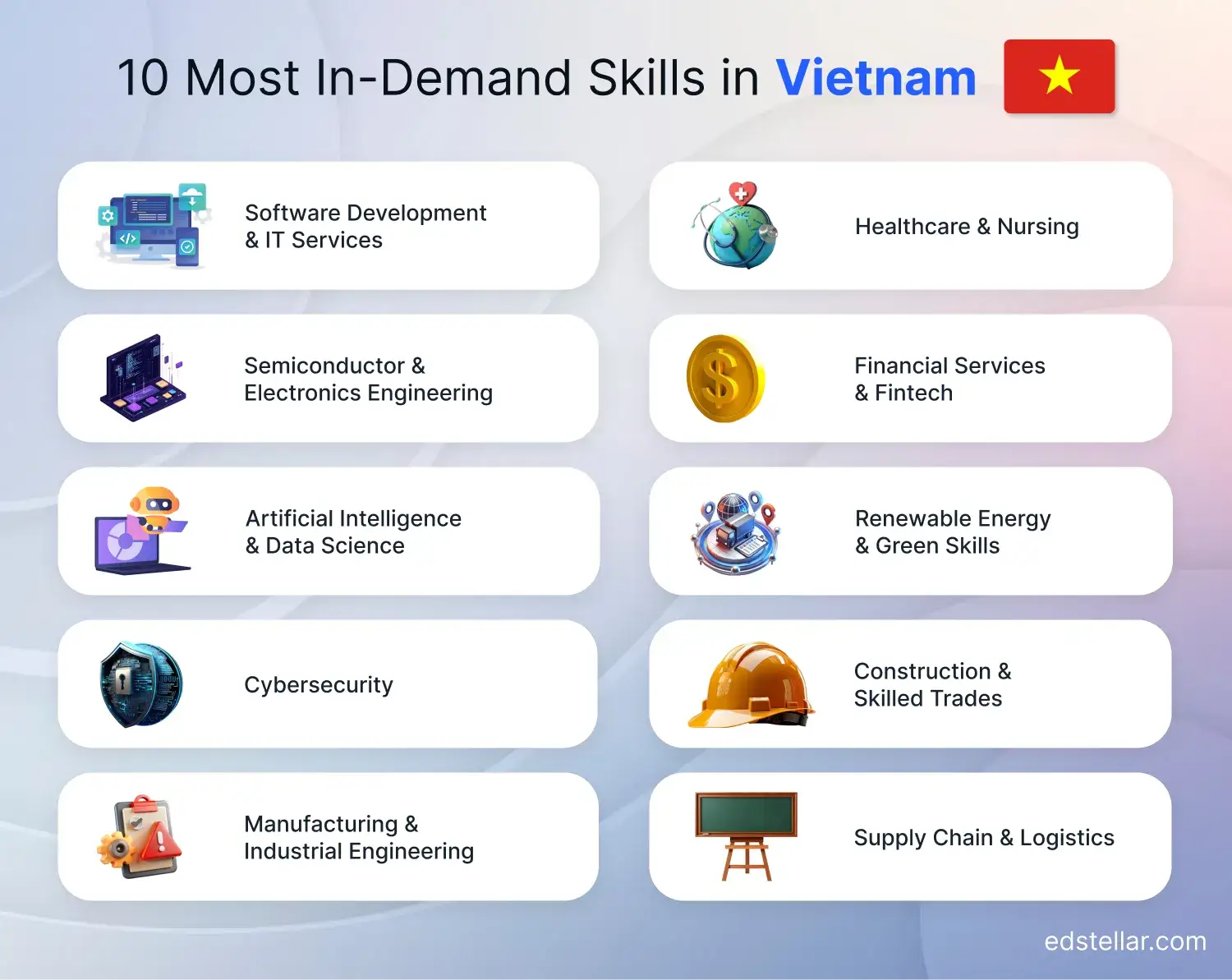
The most in-demand skills in Vietnam for 2026 include software development and IT services, semiconductor and electronics engineering, artificial intelligence and data science, cybersecurity, manufacturing and industrial engineering, healthcare and nursing, financial services and fintech, renewable energy and green skills, construction and skilled trades, and supply chain and logistics. Software development leads due to the 150,000–200,000 tech worker shortage, while semiconductor engineering is driven by 170+ FDI projects worth $11.6 billion and a 50,000-engineer national target.
What jobs are in demand in Vietnam in 2026?
The highest-demand jobs in Vietnam for 2026 include software developers, AI/ML engineers, IC design engineers, cybersecurity analysts, production managers, quality engineers, registered nurses, fintech developers, solar energy technicians, welders, electricians, and supply chain coordinators. Vietnam recorded $27.6 billion in FDI disbursements with manufacturing accounting for 56.5%, and 45% of companies plan to expand headcount by 5–10%. Electronics manufacturing, IT outsourcing, and financial services are the most active hiring sectors.
What are the highest paying jobs in Vietnam?
Senior full-stack developers earn $2,200–$5,000 monthly, tech leads at global firms exceed $4,000 monthly, and AI-skilled professionals earn 15–25% premiums. Senior software engineers at FPT can earn $107,000–$155,000 annually. Cybersecurity specialists command multiples of standard IT compensation. Semiconductor IC design engineers are among the highest paid in manufacturing. Financial services roles in AI/data/fintech are seeing 15–25% salary increases. Despite rising wages, Vietnam still offers 30–70% savings compared to Singapore, Western Europe, and the United States.
How do I get a job in Vietnam as a foreigner?
Foreign professionals access Vietnam's job market through employer-sponsored work permits, which require a valid employment contract, health certification, and police clearance. Technology, manufacturing management, healthcare, and education are the sectors most commonly employing foreigners. English teaching remains accessible, while senior engineering and management roles at FDI manufacturers (Samsung, Intel, Foxconn) actively recruit international talent. Ho Chi Minh City and Hanoi offer the most opportunities. Vietnam's cost of living is significantly lower than most Asian tech hubs, making real purchasing power attractive even at modest nominal salaries.
Why does Vietnam have a skills shortage despite a large workforce?
Vietnam's 53.3 million workforce is large but underqualified: only 29.2% hold recognised diplomas or certificates, and nearly 38 million workers remain untrained. The education system produces graduates in general fields while employers need semiconductor engineers, AI specialists, cybersecurity professionals, and quality engineers. The TVET system is expanding but cannot match the pace of FDI-driven demand. Brain drain to higher-paying markets compounds the shortage in healthcare and specialised technology roles. The government targets training 1.4 million skilled workers and 50,000 semiconductor engineers by 2030.
Is Vietnam good for a technology career?
Vietnam is one of Southeast Asia's fastest-growing technology markets. The IT services sector reached $2.37 billion with 70,000+ tech firms, ICT revenue grew from $60.9 billion to $154 billion in seven years, and the AI market is forecast to reach $6.91 billion by 2031 at 38.97% CAGR. Nvidia, Samsung, Intel, Google, and Apple all maintain significant operations. Despite lower nominal salaries than Singapore or Japan, Vietnam offers a low cost of living, a vibrant startup ecosystem, and growing remote work opportunities paying international rates. FPT exported its first commercial semiconductor chips in 2025, marking a new milestone.
What is Vietnam's semiconductor strategy?
Vietnam's National Semiconductor Strategy targets 50,000 skilled engineers by 2030 through three phases: foundation (2024–2030) with 100 design enterprises, one wafer fab, and 10 packaging plants; scaling (2030–2040); and global leadership (2040–2050). Currently, 170+ FDI projects worth $11.6 billion are active, including Intel ($4.1 billion), Amkor ($1.6 billion), and Hana Micron. The semiconductor workforce totals 15,000, and 237,000+ students enrolled in STEM programmes in 2025 admissions. FPT exported commercial chips in December 2025, and a $500 million wafer fab was approved in March 2025.
What kind of jobs are available in Vietnam for foreigners?
Foreign professionals in Vietnam most commonly work in technology management (at Samsung, Intel, Foxconn, and IT outsourcing firms), manufacturing leadership (at FDI factories across industrial zones), English teaching (at language centres and international schools), financial services (at international banks and fintech firms), and development work (at international NGOs and multilateral organisations). The growing startup ecosystem in HCMC and Hanoi absorbs foreign tech talent, and multinational companies actively recruit international engineers and managers for their Vietnam operations. Vietnamese language proficiency is an advantage but not required for most corporate roles, where English is the working language.
Conclusion
Vietnam's skills landscape in 2026 is defined by the collision of the world's most intense FDI surge in electronics and semiconductors with a workforce where 70% lack formal qualifications. The economy grew 8% and crossed $500 billion in GDP, Samsung manufactures half its smartphones here, Apple assembles 65% of AirPods in Vietnamese factories, and Nvidia is building AI infrastructure, yet 80% of employers cannot find suitable candidates, the semiconductor workforce is 15,000 against a 50,000 target, and 700,000 cybersecurity professionals are needed to protect the digital economy. The gap between what the world's fastest-growing manufacturing hub demands and what the talent pipeline delivers is the defining challenge for every HR leader operating in Vietnam.
The ten skills in demand in Vietnam covered in this guide represent the intersection of massive FDI-driven industrial demand and acute domestic workforce gaps. From software development and semiconductors powering the electronics export machine, through AI and cybersecurity driving the digital economy, to healthcare serving 100 million people, manufacturing building the factory of the future, and green energy supporting the sustainability transition, each skill area offers clear returns on training investment. The organisations that close their skills gaps fastest will be the ones that attract talent, win contracts, and lead their industries as Vietnam pursues its ambition to become a high-income economy by 2045.
Looking for a Corporate Training Partner?
Get a custom training plan from Edstellar's 5,000+ expert trainers. Virtual or onsite delivery across North America, Europe, Asia-Pacific, and beyond.
Unlock premium resources, tools, and frameworks designed for HR and learning professionals. Our L&D Hub gives you everything needed to elevate your organization's training approach.
.svg "edstellar")



.svg "Semiconductor and Electronics Engineering")














.svg "Click Here to Follow on Medium")
.svg)




.svg)


.svg)
.svg)
.svg)

.svg)