BLOG
10 Most In-Demand Skills in Greece for 2026
""
In-Demand Skills

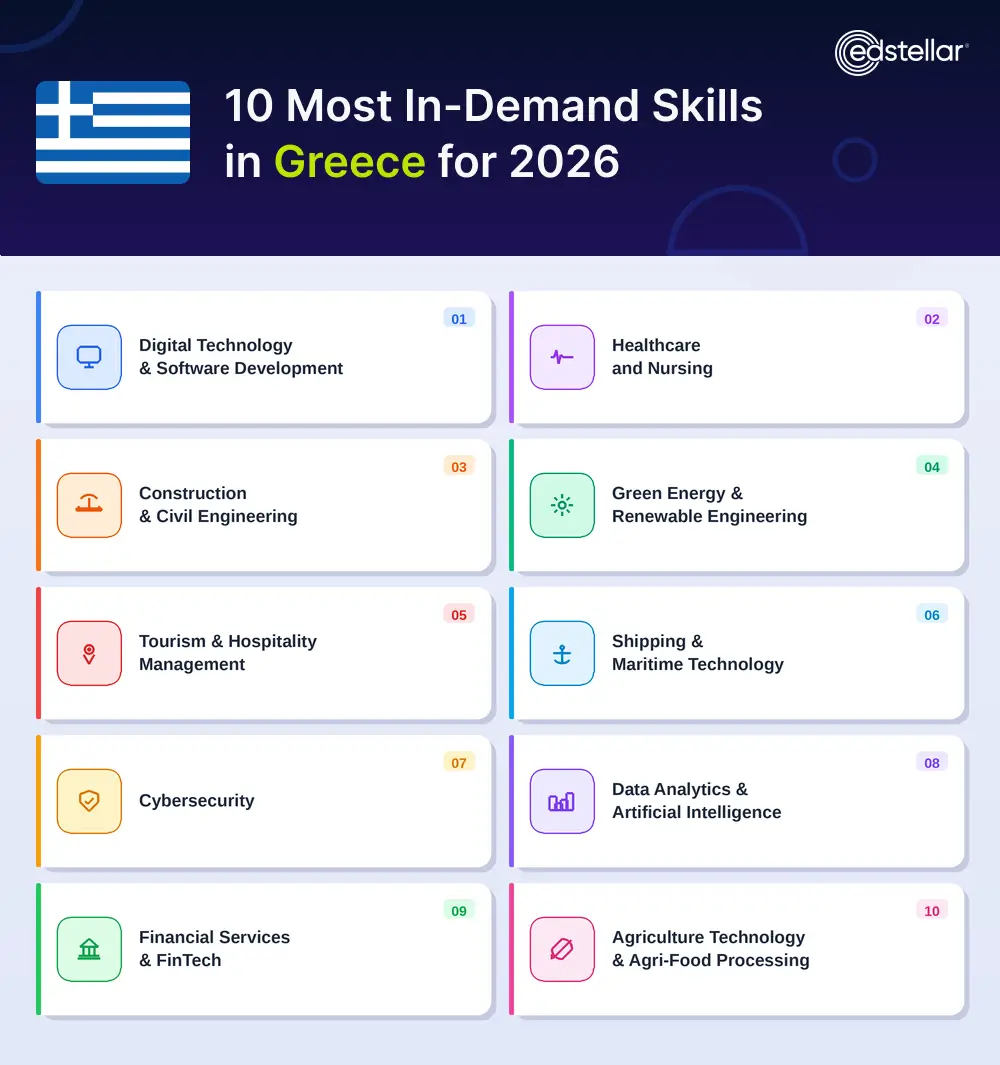
10 Most In-Demand Skills in Greece for 2026

A comprehensive list of the most in-demand skills in Greece, evaluated by a Certified Corporate Trainer with 17+ years of supply chain leadership and a decade of experience in learning and development program design.

10 Most In-Demand Skills in Greece for 2026

Updated On May 05, 2026

Corporate Training Consultant - Greece

✓ Edstellar Verified SME

8 mins read

Content
Table of Content

Greece's labour market is in a period of transformation unlike anything the country has experienced in decades. The EUR 36 billion "Greece 2.0" National Recovery and Resilience Plan, backed by EU funds, is the largest single injection of investment in modern Greek history, simultaneously building digital infrastructure, renewable energy capacity, transport networks, healthcare facilities, and agricultural technology. The result is a skills market under pressure from every direction at once. SEV, the Hellenic Federation of Enterprises, reports 30,000+ unfilled technology positions. The Ministry of Health estimates 25,000+ vacant healthcare roles, a direct consequence of the 60,000+ doctors and nurses who emigrated during the 2010-2018 debt crisis. The Technical Chamber of Greece documents 20,000+ engineering and construction vacancies, and the Greek Tourism Confederation found that over 70% of tourism businesses faced staffing shortages severe enough to affect service delivery during the record 2024 season of 33 million arrivals.

What distinguishes Greece from most European economies is the brain drain legacy compounding the current demand surge. Half a million educated Greeks left the country between 2010 and 2020, and the skills gaps they left behind are now colliding with Greece 2.0's investment ambitions, a renewable energy build-out targeting 70% clean electricity by 2030, and a shipping sector that must decarbonise the world's largest privately owned fleet. Whether you are asking what jobs are in demand in Greece in technology, healthcare, energy, or construction, the answer is shaped by both the urgency of recovery and the scale of transformation underway.

This guide ranks the 10 most in-demand skills in Greece for 2025 and 2026, using a weighted methodology that prioritises local government data, Greek industry body reports, and employer surveys. For each skill, you will find the policy evidence behind the demand, the industries driving it, and practical paths to closing the gap. Understanding the common skills gap examples shaping Greek workforce planning is the right place to start.

Sources Behind This Research

Every ranking in this guide is backed by data from Greek government bodies, local industry authorities, and established hiring platforms. We weighted Greece-specific sources more heavily than global reports, because local data reflects what is actually happening on the ground. Here is where the numbers come from.

Industry Body

SEV: Hellenic Federation of Enterprises

Digital Economy and Skills Report 2025

Reported 30,000+ unfilled technology positions and identified data science and analytics among the three fastest-growing professional categories. Estimated the brain drain costs Greece EUR 3.5 billion per year in lost productivity. Primary source for the technology skills ranking.

View source →
Government

Ministry of Digital Governance (Ypourgeio Psifiakis Diakyvernisis)

Greece 2.0 Digital Transformation Progress Report 2025

Confirmed EUR 6.4 billion Greece 2.0 digital transition investment and the Digital Greece strategy targeting a fully digitised public sector by 2027. Informed technology, cybersecurity, and AI skill rankings.

View source →
Government

Ministry of Health (Ypourgeio Ygeias)

Healthcare Workforce Gap Assessment 2025

Estimated 25,000+ unfilled healthcare positions across public hospitals and primary care. Documented 60,000+ doctors and nurses who emigrated during 2010-2018. Greece 2.0 allocates EUR 1.8 billion to health system modernisation. Primary source for the healthcare ranking.

View source →
Government

TEE: Technical Chamber of Greece

Engineering and Construction Skills Shortage Assessment 2025

Documented 20,000+ engineering and construction vacancies with Athens Metro Line 4, Ellinikon (EUR 8 billion), and Thessaloniki Metro simultaneously exhausting the available engineering workforce. Primary source for the construction ranking.

View source →
Industry Body

SETE: Greek Tourism Confederation

Tourism Workforce Survey 2025

Found over 70% of tourism businesses experienced staffing shortages during the record 2024 season of 33+ million arrivals. Tourism directly employs 900,000+ people. Primary source for the tourism and hospitality management ranking.

View source →
Industry Body

UGS: Union of Greek Shipowners

Annual Skills and Workforce Report 2025

Greece controls 21% of world shipping tonnage. IMO decarbonisation targets are creating demand for alternative fuel propulsion expertise not yet available in domestic supply. Informed the shipping and maritime technology ranking.

View source →
Government

ADAE: Hellenic Authority for Communication Security and Privacy

Annual Report 2024

Recorded a 35% increase in significant cyber incidents affecting Greek organisations. NIS2 transposition and DORA compliance are driving mandatory cybersecurity hiring. Informed the cybersecurity skill ranking.

View source →
Industry Body

Hellenic Bank Association (HBA)

Digital Transformation and Skills Report 2025

All four systemic banks in digital transformation phase requiring technology and compliance hybrid professionals. DORA January 2025 compliance deadlines driving urgent hiring. Informed the financial services and fintech ranking.

View source →
Author Insight

""The most critical skills in Greece's evolving market require professionals who can blend operational knowledge with strategic capability. Organizations that build diverse skill sets across their workforce create lasting value and position themselves for growth in an increasingly competitive landscape.

Maria Basina

✓ Certified Corporate Trainer with 17+ years of supply chain leadership experience and 10+ years designing high impact training programs aligned with organizational goals and talent development." "

1

Digital Technology and Software Development

Research Score: 9.50/10
Digital Technology and Software Development

Software development and digital technology sit at the top of Greece's skills demand list because of a collision between the country's largest-ever investment programme and its most damaging workforce loss. The Greece 2.0 National Recovery Plan allocates EUR 6.4 billion to digital transition, the largest single component of the EUR 36 billion plan, and the Ministry of Digital Governance's "Digital Greece" strategy is digitising every ministry, municipality, and public service simultaneously. At the same time, an estimated 500,000 educated Greeks emigrated between 2010 and 2020, and the technology sector was among the hardest hit. SEV estimates 30,000+ unfilled technology positions across Greece in 2025.

Athens' technology cluster, nicknamed "Silicon Acropolis", has produced globally recognised companies: Workable (HR software used by 27,000+ companies), Viva Wallet (acquired by JP Morgan for EUR 900 million in 2023), and Beat (merged into FREE NOW). Over 700 active tech startups are operating in Athens, and the government is offering multi-year income tax breaks for diaspora professionals who return to Greece, creating a "brain gain" dynamic that is beginning to reverse the decade of brain drain. Senior software engineers now command EUR 45,000 to EUR 75,000 in Athens, with AI-adjacent roles reaching EUR 65,000 to EUR 90,000, salary levels that are attracting international attention and beginning to close the gap with Western European markets.

Priority sub-skills include full-stack development, Python and Java engineering, cloud-native development, APIs and microservices, and DevOps and CI/CD.

Key Sub-skills

Full-Stack Development Python and Java Engineering Cloud-Native Development APIs and Microservices DevOps and CI/CD

Top Industries

Technology startups, financial services and fintech, shipping and maritime, government digital services, and tourism technology organisations across Greece are all competing for software development talent.

2

Healthcare and Nursing

Research Score: 9.30/10
Healthcare and Nursing

Greece's healthcare workforce crisis is the most severe of any EU member state and has its roots in the decade of austerity that followed the 2010 debt crisis. An estimated 60,000 Greek doctors and nurses emigrated between 2010 and 2018, primarily to Germany, the UK, Sweden, and Australia, stripping the National Health System (ESY) of a generation of trained professionals. The Ministry of Health estimates 25,000+ unfilled healthcare positions across public hospitals, primary care health centres, and EOPYY (the National Health Insurance Organisation) facilities in 2025. Rural areas and the Greek islands face the worst conditions, with some islands relying on rotating medical volunteers and helicopter transfers for emergency care.

Greece 2.0 allocates EUR 1.8 billion to health system modernisation, funding new hospitals, upgraded equipment, and telemedicine infrastructure. But infrastructure without staff resolves nothing, and the workforce rebuilding challenge is generational. The medical education pipeline takes a minimum of eight years from first-year entry to qualified doctor, and nursing programmes are struggling to attract candidates in an economy where healthcare salaries in the public sector remain compressed. The ageing population, with 22% of Greeks already over 65, guarantees that demand will continue rising regardless of the pace of supply recovery. Return migration incentives and emergency recruitment from non-EU countries are the only short-to-medium-term levers available.

Key sub-skills in demand include general and specialist medicine, general nursing, emergency and ICU nursing, mental health and psychiatric care, and allied health professions including physiotherapy, radiology, and pharmacy.

Key Sub-skills

General and Specialist Medicine General Nursing (Nosileutes) Emergency and ICU Nursing Mental Health and Psychiatric Care Allied Health Professions

Top Industries

ESY public hospitals, primary care health centres, mental health services, private healthcare groups (Hygeia, Metropolitan, Iaso), and EOPYY primary care all face critical staffing shortfalls across Greece.

Expert Insight

"We are investing significantly in digital skills for workers. Particularly in Artificial Intelligence and cybersecurity, we are filling a critical gap where as a country we were lagging behind, ensuring that businesses and employees have access to the skills the modern economy demands."

Dimitris Papastergiou
Dimitris Papastergiou LinkedIn

Minister of Digital Governance of Greece · Thessalia, Greece

3

Construction and Civil Engineering

Research Score: 9.10/10
Construction and Civil Engineering

Greece's construction and civil engineering sector is absorbing the largest pipeline of simultaneous major projects in its modern history. Athens Metro Line 4 (EUR 1.5 billion, with 15 new stations), the Thessaloniki Metro Phase 2 extension, the Ellinikon mixed-use development on the former Athens airport site (EUR 8 billion, Europe's largest urban regeneration project), national motorway upgrades, and a private construction boom driven by tourism resort development and housing recovery are all competing for the same engineering and trades workforce. The Technical Chamber of Greece reported a shortage of over 20,000 civil, structural, and mechanical engineers and construction professionals in 2025.

The compounding factor is geography. Greece's tourism infrastructure investment is concentrated on islands where logistics for both materials and skilled workers are inherently more complex and expensive. A shortage of civil engineers in Athens creates a manageable problem; a shortage on Mykonos or Santorini, where hotel and resort development is at historic highs, creates a crisis that no standard recruitment response can easily address. TEE has called for urgent expansion of engineering school places at Greek universities and for the recognition of engineering qualifications from non-EU countries to accelerate the pipeline. The EU Cohesion Fund investment cycle adds further project commitments through 2027, sustaining construction demand well beyond the immediate surge.

Key sub-skills include civil structural engineering, site management and project engineering, electrical and mechanical engineering (MEP), Building Information Modelling (BIM), and geotechnical engineering.

Key Sub-skills

Civil Structural Engineering Site Management and Project Engineering Electrical and Mechanical Engineering (MEP) Building Information Modelling (BIM) Geotechnical Engineering

Top Industries

Infrastructure and civil works (metros, motorways, bridges), private residential construction, hotel and resort development, industrial construction, and public buildings programmes all face acute engineering and construction skills shortages across Greece.

4

Green Energy and Renewable Engineering

Research Score: 8.90/10
Green Energy and Renewable Engineering

Greece's National Energy and Climate Plan targets 70% renewable electricity by 2030, up from approximately 40% in 2024. This is not an aspirational target: the government has approved offshore wind licences for over 20 GW in the Aegean and Ionian seas, has become the EU's fastest-growing solar market thanks to the highest solar irradiation on the continent, and is deploying Greece 2.0's EUR 6.2 billion green transition pillar to fund grid modernisation, battery storage, and green hydrogen pilots. RAE (the Regulatory Authority for Energy) and the Ministry of Environment and Energy estimate that 15,000+ additional green energy professionals are needed immediately to deliver the pipeline of approved projects.

The scale of the challenge is amplified by the timeline. Greece needs to roughly double its renewable capacity in under six years, requiring solar PV engineers, offshore wind turbine technicians, electrical grid engineers, and energy storage specialists in numbers that Greek universities are not equipped to produce fast enough. TERNA Energy, Mytilineos, PPC (Public Power Corporation), and Ellaktor are all running major hiring cycles and, in several cases, have announced international recruitment programmes in Portugal, Spain, and Germany for experienced renewables engineers. The REPowerEU acceleration has added additional EU funding that is now unlocking projects that were previously awaiting investment, further intensifying near-term demand.

Priority sub-skills include solar PV engineering and system design, wind turbine engineering and maintenance, electrical grid engineering and smart grid technology, battery storage systems engineering, and energy auditing and building efficiency with KENAK certification.

Key Sub-skills

Solar PV Engineering and System Design Wind Turbine Engineering and Maintenance Electrical Grid and Smart Grid Engineering Battery Storage Systems Engineering Energy Auditing and Building Efficiency (KENAK)

Top Industries

Solar PV development and operation, offshore and onshore wind, battery storage and grid modernisation, green hydrogen pilot programmes, and energy management and efficiency across buildings and industry are all competing for renewable engineering talent in Greece.

5

Tourism and Hospitality Management

Research Score: 8.70/10
Tourism and Hospitality Management

Tourism is Greece's largest economic sector, accounting for over 25% of GDP and employing approximately 900,000 people directly. The record 33 million visitor arrivals in 2024 represented a new national high, and SETE (the Greek Tourism Confederation) reported that over 70% of tourism businesses experienced staffing shortages severe enough to affect service quality during the 2024 season. Hotel management, luxury hospitality operations, revenue management, and sustainable tourism development are the most critically short professional profiles, but the shortage extends into almost every hospitality function.

What makes Greece's tourism skills challenge distinctive is the quality shift underway in the sector. Greece is actively moving away from budget mass tourism toward premium experiential travel, driven by the Attica Riviera luxury corridor development, the expansion of ultra-luxury resorts in Mykonos, Santorini, and Crete, and the growth of cruise tourism at Piraeus Port. This strategic shift requires hospitality managers who understand luxury service standards, revenue management systems, and sustainable tourism certification, not the entry-level seasonal staff that traditional Greek hospitality relied on for decades. The National Tourism Strategy 2030 explicitly identifies this workforce quality gap as the primary risk to the sector's premium repositioning.

Key sub-skills include hotel and resort operations management, revenue management and pricing strategy, sustainable tourism development, luxury guest experience management, and digital tourism marketing and OTA management.

Key Sub-skills

Hotel and Resort Operations Management Revenue Management and Pricing Strategy Sustainable Tourism Development Luxury Guest Experience Management Digital Tourism Marketing and OTA Management

Top Industries

Luxury hotels and resorts, tour operations and destination management, cruise tourism at Piraeus, agritourism, and food and beverage operations across Greece all face persistent and intensifying staffing shortages.

Need a Training Plan for Your Greece Team?

Edstellar's Training Needs Analysis consultants identify your priority skill gaps and build a customised training roadmap. Get matched with the right programmes in 48 hours.

Request a Free Consultation →
6

Shipping and Maritime Technology

Research Score: 8.50/10
Shipping and Maritime Technology

Greece controls approximately 21% of the world's total shipping tonnage, making it the world's largest shipping nation by fleet capacity. The Piraeus Port complex is Europe's largest cruise port and one of its busiest cargo hubs. The Union of Greek Shipowners represents companies (Costamare, Danaos, Navios, Star Bulk, and dozens more) that collectively own and manage a fleet responsible for a disproportionate share of global trade. This extraordinary concentration of maritime economic power creates equally extraordinary skills demand, and the pressure is intensifying because the entire global fleet must now decarbonise under IMO 2050 net zero targets.

The decarbonisation challenge is the defining professional shift in Greek maritime. Ships running on LNG, methanol, ammonia, or hydrogen require marine engineers who understand alternative fuel systems, containment technology, and the entirely new maintenance protocols these fuels require. Naval architects designing the next generation of vessels need to factor in fuel cell technology, onboard carbon capture, and wind-assisted propulsion. None of these skills existed in any maritime curriculum five years ago, and Greece must develop them domestically while simultaneously managing the digital transformation of fleet operations (remote vessel monitoring, predictive maintenance, port automation). UGS's 2025 report confirms that the skills gap in maritime decarbonisation is the most urgent professional challenge facing the Greek shipping industry.

Key sub-skills include naval architecture and marine engineering, maritime decarbonisation (LNG, methanol, and ammonia propulsion), digital shipping and vessel management systems, maritime data analytics and fleet optimisation, and port operations and terminal management.

Key Sub-skills

Naval Architecture and Marine Engineering Maritime Decarbonisation (LNG, Methanol, Ammonia) Digital Shipping and Vessel Management Systems Maritime Data Analytics and Fleet Optimisation Port Operations and Terminal Management

Top Industries

Ocean shipping and fleet management, naval architecture and ship design, Piraeus Port operations, shipbuilding and ship repair, and maritime insurance and finance all require professionals with skills that combine traditional maritime expertise with new technology competencies.

7

Cybersecurity

Research Score: 8.20/10
Cybersecurity

ENISA, the EU Agency for Cybersecurity, is headquartered in Athens (with a second office in Heraklion, Crete), giving Greece a unique institutional relationship with European cyber policy and positioning Athens as a natural hub for EU-level cybersecurity expertise. At the national level, ADAE (the Hellenic Authority for Communication Security and Privacy) recorded a 35% increase in significant cyber incidents affecting Greek organisations in 2024, targeting public sector ministries, the four systemic banks, and shipping company operational technology systems. The transposition of the NIS2 Directive into Greek law and the entry into force of DORA in January 2025 have created immediate and mandatory compliance hiring requirements across a wide range of organisations.

Greek cybersecurity faces a particular challenge in the maritime sector. As Greek-owned vessels become increasingly connected through satellite communications, remote monitoring systems, and automated navigation, they become increasingly vulnerable to cyberattacks on both IT (information technology) and OT (operational technology) systems. The IMO's maritime cybersecurity guidelines, now incorporated into the ISM Code, require every shipping company to implement cyber risk management, creating a new category of maritime cybersecurity demand that intersects with Greece's core economic strength. The Ministry of Digital Governance's National Cybersecurity Strategy 2025-2028 targets a significant expansion of Greece's certified cybersecurity workforce to address these converging demands.

Key sub-skills include network and infrastructure security, cloud security architecture, threat intelligence and SIEM, penetration testing and vulnerability assessment, and maritime cybersecurity for OT systems.

Key Sub-skills

Network and Infrastructure Security Cloud Security Architecture Threat Intelligence and SIEM Penetration Testing and Vulnerability Assessment Maritime Cybersecurity (OT Systems)

Top Industries

Government and public administration, banking and financial services, shipping and maritime, healthcare, and telecommunications organisations (OTE Group, Vodafone Greece, Wind) are all scaling cybersecurity functions in response to regulatory requirements and rising incident rates.

Expert Insight

"In order to achieve optimal results, it is necessary to combine artificial intelligence with the human factor. The pressing issue is how the human factor will be combined with this very major technological revolution."


Niki Kerameus
Niki Kerameus LinkedIn

Minister of Labour and Social Security · Greece

8

Data Analytics and Artificial Intelligence

Research Score: 8.00/10
Data Analytics and Artificial Intelligence

Greece is building genuine momentum in AI and data science, driven by strong university research programmes, growing commercial demand from the Athens tech cluster, and targeted Greece 2.0 investment. The Ministry of Digital Governance has published a National AI Strategy covering public sector AI adoption, AI ethics governance, and AI skills development. GRNET (Greek Research and Technology Network) operates one of Europe's most powerful academic supercomputing infrastructures, and the Universities of Athens, Thessaloniki, and Crete have active AI research groups publishing internationally competitive work. SEV reports data science and analytics among the three fastest-growing professional categories in Greece.

Commercial AI demand is being driven by a distinctive mix of sectors. Hellas Direct, one of Europe's most AI-native insurtech companies, has built its entire underwriting model on machine learning. Augmenta is applying precision agriculture AI to Greek farming. Innaas is developing AI applications for shipping fleet optimisation. The four systemic banks are deploying AI for fraud detection, credit scoring, and customer analytics, and EOPYY is exploring healthcare AI for population health management. The combination of EU AI Act compliance requirements, genuine commercial traction, and Greece 2.0 investment is building a data and AI ecosystem that is growing faster than the domestic talent supply. Diaspora return and international recruitment are filling some of the gap, but structured upskilling of existing professionals is the more sustainable long-term solution.

Key sub-skills include machine learning engineering, data science and statistical modelling, business intelligence and data visualisation, natural language processing (including Modern Greek NLP), and AI product development.

Key Sub-skills

Machine Learning Engineering Data Science and Statistical Modelling Business Intelligence and Data Visualisation Natural Language Processing AI Product Development

Top Industries

Financial services and fintech, shipping and fleet analytics, tourism and hospitality technology, healthcare analytics, and agriculture technology organisations are the primary employers of data and AI professionals across Greece.

9

Financial Services and FinTech

Research Score: 7.80/10
Financial Services and FinTech

Greece's four systemic banks (National Bank of Greece, Piraeus Bank, Alpha Bank, and Eurobank) have completed their post-crisis non-performing loan restructuring and entered a sustained digital transformation and growth phase. Each bank is investing in digital banking platforms, AI-powered credit scoring, ESG reporting infrastructure, and regulatory compliance capabilities under DORA, MiFID II, and Basel IV. The Hellenic Bank Association's 2025 Digital Transformation Report confirms that technology and compliance hybrid professionals are the scarcest profile across the entire financial sector.

The fintech validation provided by Viva Wallet's EUR 900 million JP Morgan acquisition in 2023 has attracted further venture capital and talent to the Athens fintech ecosystem. Hellas Direct (insurtech), Plum (savings AI), and a growing cluster of B2B financial technology companies are all scaling engineering and product teams. The Piraeus-based shipping finance cluster, one of the world's most significant concentrations of maritime financial expertise, adds further demand for structured finance, maritime risk, and project finance professionals with sector-specific knowledge. The Capital Market Commission (Epitropi Kefalaiagoris) has expanded its supervisory scope under EU regulatory alignment, creating compliance and regulatory affairs demand that mirrors the pattern seen in larger financial centres.

Key sub-skills include DORA and regulatory compliance (MiFID II, Basel IV, AML), fintech product and payments development, financial data analytics, ESG and sustainable finance, and shipping finance and structured credit.

Key Sub-skills

DORA and Regulatory Compliance FinTech Product and Payments Development Financial Data Analytics ESG and Sustainable Finance Shipping Finance and Structured Credit

Top Industries

Systemic banking (NBG, Piraeus, Alpha, Eurobank), fintech and payments (Viva Wallet, Hellas Direct, Plum), shipping finance at Piraeus, investment management, and insurance all face growing demand for technology and compliance-capable financial professionals.

10

Agriculture Technology and Agri-Food Processing

Research Score: 7.60/10
Agriculture Technology and Agri-Food Processing

Greece is one of Europe's most important agricultural producers, exporting olive oil, feta cheese, wine, fresh fruit, and vegetables worth over EUR 6 billion annually. The EU's Common Agricultural Policy (CAP) reform for 2023-2027 has made precision agriculture adoption a requirement for full subsidy access and sustainability compliance, creating mandatory upskilling demand that reaches every farming operation receiving EU support. ELGO-DIMITRA (the Hellenic Agricultural Organisation) has identified a critical shortage of agri-tech professionals who can operate drone technology, IoT soil and climate sensors, precision irrigation systems, and farm data management platforms.

Greece 2.0 allocates EUR 2.8 billion to agriculture modernisation and rural development, targeting the transformation of Greece's predominantly smallholder farming structure toward technology-enabled, export-oriented production. Agri-food processing, where Greece exports significant volumes of olives, olive oil, dairy products, wine, and aquaculture products (sea bass and sea bream from Greek fish farms are among Europe's top aquaculture exports), is simultaneously automating facilities and requiring food technology engineers and quality assurance specialists who understand HACCP, ISO 22000, and EU food safety regulation. The intersection of EU funding, export ambition, and CAP compliance requirements makes this one of Greece's most structurally significant skills gaps, even if it receives less attention than the digital and energy sectors.

Key sub-skills include precision agriculture and drone technology, agricultural IoT and sensor management, food processing technology and automation, agri-data analytics and farm management software, and food safety and quality assurance (HACCP, ISO 22000).

Key Sub-skills

Precision Agriculture and Drone Technology Agricultural IoT and Sensor Management Food Processing Technology and Automation Agri-Data Analytics and Farm Management Software Food Safety and Quality Assurance (HACCP, ISO 22000)

Top Industries

Olive oil and table olive production, viticulture and winemaking, dairy and cheese (Feta PDO), aquaculture (sea bass and sea bream), and fresh fruit and vegetable export operations across Greece all require agri-tech and food processing professionals.

Expert Insight

"The need to broaden the knowledge of employees on issues such as leadership ability, strategic thinking, digital technologies, change management and corporate social responsibility is now imperative. Upgrading the skills of human capital is a precondition for sustainable, inclusive growth."


George Xirogiannis
George Xirogiannis LinkedIn

Director General, SEV association of businesses and industries · Attiki, Greece

How to Develop These Skills in Demand in Greece

Closing these skills gaps requires structured, targeted training rather than ad hoc learning. The most effective approach combines a clear training needs analysis, practical instructor-led courses aligned to real job requirements, and an individual development plan that tracks progress over time.

Greece's DYPA (Public Employment Service) operates nationally funded upskilling voucher programmes for employed and unemployed workers, and Greece 2.0 includes dedicated digital skills training budgets accessible through accredited providers. The government's diaspora return incentive (a flat 50% income tax reduction for returning Greek professionals for seven years) is also beginning to rebuild the human capital that left during the debt crisis years. For organisations that cannot wait for public pipelines, Edstellar's instructor-led corporate training covers all 10 skills featured in this guide, from Artificial Intelligence and Cybersecurity to Project Management and Data Analytics.

Understanding performance gaps is always the first step. Greece's combination of recovery investment ambition, brain drain legacy, energy transition urgency, and maritime decarbonisation imperative means that L&D leaders face a skills landscape where doing nothing carries a higher cost than investing in training. The organisations that build capability systematically now will be better positioned than those waiting for the external talent market to correct itself.

Frequently Asked Questions

What skills are in demand in Greece?

The most in-demand skills in Greece for 2025 and 2026 span technology, healthcare, construction, energy, and tourism. Digital Technology and Software Development leads the list with 30,000+ unfilled positions, followed by Healthcare and Nursing, Construction and Civil Engineering, Green Energy and Renewable Engineering, Tourism and Hospitality Management, Shipping and Maritime Technology, Cybersecurity, Data Analytics and AI, Financial Services and FinTech, and Agriculture Technology. Greece's EUR 36 billion Greece 2.0 Recovery Plan is simultaneously driving demand across all of these sectors.

What are the most in-demand jobs in Greece?

The most in-demand jobs in Greece in 2025 include software engineers and developers, doctors and specialist physicians, registered nurses, civil and structural engineers, renewable energy engineers (solar PV, wind, grid), hotel managers and luxury hospitality professionals, naval architects and maritime decarbonisation engineers, cybersecurity analysts, data scientists and ML engineers, and financial compliance and DORA specialists. DYPA vacancy data and TEE, SETE, and SEV surveys consistently identify these as the hardest-to-fill professional categories across Greece.

Which skills are in demand in Greece for foreigners?

Greece has a shortage occupation list for work permit purposes administered by DYPA and the Ministry of Migration and Asylum. Healthcare (doctors, specialist physicians, nurses), technology (software engineers, cybersecurity, AI), construction (civil engineers, site managers), renewable energy (solar and wind engineers), and maritime technology (naval architects, alternative fuel propulsion engineers) offer the clearest pathways for international professionals. EU nationals have freedom of movement. Non-EU professionals in shortage occupations can apply for fast-track work authorisation, and Greece's diaspora return incentive (50% income tax reduction for seven years) is specifically designed to attract Greek professionals back from abroad.

Is Greece good for tech jobs?

Greece is becoming an increasingly attractive destination for technology professionals, particularly in Athens. The "Silicon Acropolis" tech cluster houses over 700 active startups and globally recognised companies including Workable, Viva Wallet (acquired by JP Morgan for EUR 900 million), and Beat. Senior software engineers earn EUR 45,000 to EUR 75,000 in Athens, with AI roles reaching EUR 65,000 to EUR 90,000. Greece 2.0's EUR 6.4 billion digital investment is sustaining strong hiring momentum, and the diaspora return tax incentive is making Greece competitive with Western European technology markets for the first time.

What is the biggest skills shortage in Greece?

By volume, digital technology is Greece's largest shortage with 30,000+ unfilled positions (SEV). Healthcare follows with 25,000+ vacancies including a severe shortage of doctors and nurses in rural areas and the islands, a legacy of 60,000+ healthcare professionals emigrating during the 2010-2018 debt crisis. Construction and civil engineering faces a 20,000+ vacancy gap as Greece 2.0 infrastructure projects run simultaneously. Green energy requires 15,000+ professionals immediately to deliver the National Energy and Climate Plan's 70% renewables target by 2030.

Are maritime skills in demand in Greece?

Yes, maritime and shipping technology skills are among the most distinctive and high-demand professional categories in Greece. With Greek-owned companies controlling 21% of world shipping tonnage, the demand for naval architects, marine engineers, digital shipping specialists, and maritime decarbonisation engineers is structurally embedded in the economy. The IMO's 2050 net zero target for shipping is creating urgent demand for professionals with alternative fuel propulsion expertise (LNG, methanol, ammonia) that did not exist in any maritime curriculum five years ago. The Union of Greek Shipowners identifies this as the most critical professional gap facing the sector.

What are the highest paying jobs in Greece?

The highest-paying jobs in Greece are concentrated in technology, shipping, and financial services. Senior software engineers earn EUR 45,000 to EUR 75,000 and AI and ML engineers reach EUR 65,000 to EUR 90,000 in Athens. Specialist physicians in private healthcare command EUR 80,000 to EUR 150,000. Senior naval architects and maritime decarbonisation engineers earn EUR 55,000 to EUR 90,000. Financial services professionals in DORA compliance and structured shipping finance at Piraeus earn EUR 60,000 to EUR 110,000 at senior levels. These salary ranges have grown significantly since 2022 as demand has outpaced supply.

Which field is in demand in Greece?

Digital technology, healthcare, renewable energy, and construction are the four fields with the most urgent and broad-based skills demand in Greece. Shipping and maritime technology is a uniquely Greek addition to the standard European skills shortage pattern. Tourism and hospitality, while more seasonal, employs the largest share of the population and faces the most visible annual service impact from its staffing gaps. Greece 2.0's EUR 36 billion investment programme is sustaining demand across all of these sectors simultaneously through 2027 and beyond.

Conclusion

Greece's skills landscape is shaped by two forces pulling in opposite directions: a decade of brain drain that emptied the talent pipeline and a EUR 36 billion recovery programme that needs that pipeline to be full immediately. The Greece 2.0 plan is the most ambitious domestic investment programme in modern Greek history, simultaneously building digital infrastructure, renewable energy capacity, transport networks, and healthcare facilities. Each of these pillars needs skilled professionals to deliver it, and the brain drain legacy means Greece starts from a position of structural deficit in almost every technical and professional category.

The 10 skills profiled in this guide are grounded in data from SEV, the Ministry of Digital Governance, the Ministry of Health, TEE, RAE, SETE, UGS, ADAE, the Hellenic Bank Association, and ELGO-DIMITRA, the authoritative Greek sources tracking what employers actually need. Whether you are an L&D leader conducting a training needs analysis, a hiring manager trying to fill critical roles, a diaspora professional weighing a return, or an international professional considering Greece, the direction is clear: invest in these skills now.

Explore Edstellar's full catalogue of instructor-led corporate training programmes to build the capabilities your organisation needs most.

Need Consistent Training Quality Across Greece?

Edstellar's managed services cover trainer coordination, compliance, scheduling, and quality assurance across every Greece location.

Talk to Our Team →

Maria Basina is a well rounded professional with over 17 years of progressive leadership experience across supply chain functions, combined with a strong background in learning and development.

Explore High-impact instructor-led training for your teams.

#On-site  #Virtual #GroupTraining #Customized

Edstellar Training Catalog

Explore 2000+ industry ready instructor-led training programs.

Download Now

Coaching that Unlocks Potential

Create dynamic leaders and cohesive teams. Learn more now!

Explore 50+ Coaching Programs

Want to evaluate your team’s skill gaps?

Do a quick Skill gap analysis with Edstellar’s Free Skill Matrix tool

Get Started

Tell us about your corporate training requirements

Valid number