10 Most In-Demand Skills in Russia for 2026
.webp)

.svg "edstellar")

Russia's unemployment fell to a record 2.1% in early 2026 while the economy simultaneously faces a structural shortage of 2.4 to 4.8 million workers, 70% of enterprises report staffing shortfalls, and the Central Bank Governor has stated that Russia has "never, until now, in the history of modern Russia, lived with such a deficit of labour force."
The Ministry of Digital Development estimates a shortage of 500,000 to 700,000 IT specialists, manufacturing is short nearly 2 million workers, the defence-industrial complex reports a 160,000-person deficit, and 26,500 doctors plus 60,000 nursing staff are missing from the healthcare system. For corporate L&D leaders and HR managers operating in the world's largest country by land area, these numbers define a labour market where demand has structurally outpaced supply across every sector.
Several converging forces have created what economists describe as a "perfect storm." The 1990s birth-rate collapse means the cohort now aged 23 to 32 is structurally smaller, workers aged 20 to 40 will shrink by one-third (approximately 13 million) through 2032, and the total fertility rate sits at 1.40, well below the 2.1 replacement level.
An estimated 80,000 to 100,000 IT professionals emigrated between 2022 and 2024 (contracting the tech talent pool by 15 to 20%), military mobilisation has drawn approximately 700,000 workers from the civilian economy, and registered CIS migrant workers fell from 8.5 million to 6.2 million.
Nominal wages grew 19.3% in 2024 (average monthly wage 87,952 rubles), defence sector wages surged 30 to 60%, and manufacturing wages rose 23% as employers compete for a shrinking labour pool. With the Data Economy National Project allocating 2.3 trillion rubles for digital transformation and import substitution mandating domestic software across government and critical infrastructure, Russia's skills challenge is both a demographic crisis and a technology sovereignty imperative.
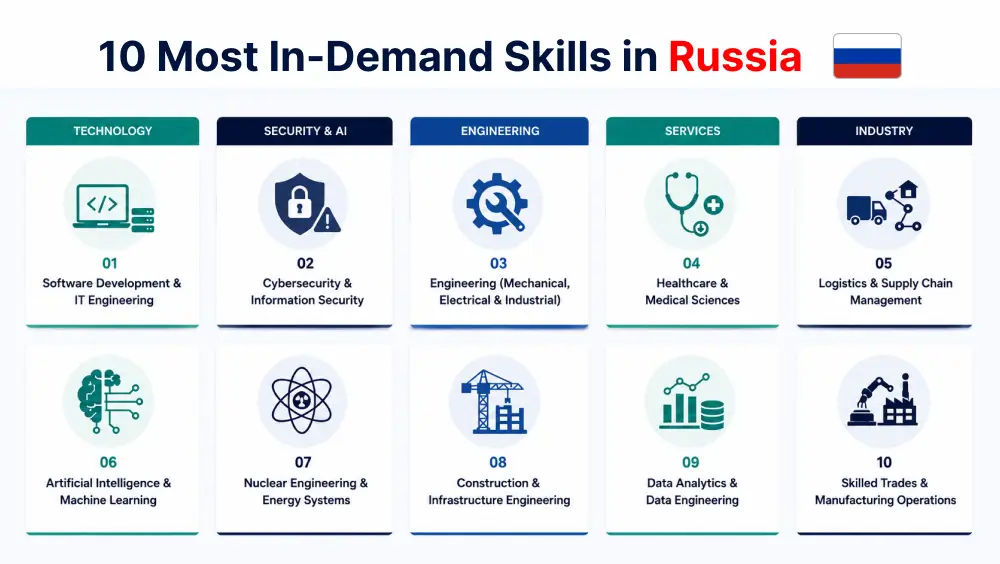
So which skills are truly driving Russia's economy, and where should organisations invest their training budgets? This guide breaks down the top 10 skills in demand in Russia, spanning software development, cybersecurity, AI, engineering, healthcare, logistics, construction, nuclear energy, and manufacturing.
Drawing on Rosstat labour data, HeadHunter vacancy statistics, Ministry of Digital Development workforce assessments, and industry salary benchmarks, it provides an evidence-based picture of what jobs are in demand in Russia, whether you are planning corporate upskilling programmes, building talent pipelines, or advising teams on high demand skills in Russia for 2026 and beyond.
Every ranking in this guide is backed by data from Russian government bodies, international research organisations, industry associations, and established recruitment platforms.
Russia's skills landscape in 2026 reflects an economy operating under unprecedented labour scarcity. A demographic hole from the 1990s birth-rate collapse, emigration of 80,000 to 100,000 IT professionals since 2022, military mobilisation drawing workers from the civilian economy, and declining migrant inflows have combined to create the tightest labour market in modern Russian history. The 10 skills below span software development, cybersecurity, AI, engineering, healthcare, logistics, construction, nuclear energy, manufacturing, and agriculture, mirroring the sectors where government policy, employer demand, and structural shortages are most acute.

Russia has approximately 1.12 million IT specialists (up 13% year-on-year in 2024), yet the Ministry of Digital Development estimates a shortage of 500,000 to 700,000 professionals. Universities produce approximately 120,000 IT graduates annually, but demand exceeds supply by at least 200,000 vacancies. The tech talent pool contracted 15 to 20% since 2022 due to emigration, with the departed workers tending to be more senior and more productive: the 11.1% of confirmed leavers from Russia's open-source developer community accounted for 14% of total code contributions in 2019 to 2020.
Import substitution mandates have created enormous demand for domestically built software. Government bodies were required to abandon foreign software on critical infrastructure by end-2024, state companies must transition to Russian database management systems by January 2026, and 837 identified software categories still lack adequate domestic alternatives. Sberbank plans to invest 450 billion rubles in IT between 2024 and 2026, Moscow's IT sector generated 2.3 trillion rubles in revenue (40% of Russia's total IT output), and the Data Economy National Project allocated 2.3 trillion rubles for digital transformation through 2030. Yet only 20% of organisations with critical IT infrastructure had fully replaced foreign solutions by mid-2024.
Software developers earn approximately RUB 93,800 to 145,000 monthly (median to average), with web developers seeing 26% wage growth in 2024. Senior and leadership roles in AI and cybersecurity command RUB 200,000 to 400,000+ monthly. For organisations operating in Russia, the combination of import substitution deadlines, a shrinking developer pool, and cross-sector digital transformation requirements means that training existing employees in domestic technology stacks (1C, Astra Linux, PostgreSQL-based systems, domestic cloud platforms) is often the only viable path to compliance and operational continuity.
Government/Public Sector, Banking (Sber, VTB), Telecoms (MTS, Rostelecom), Technology (Yandex, VK)

Cybersecurity architect unemployment in Russia sits below 1.2%, DevSecOps engineers rank among the most in-demand IT roles, and the import substitution mandate has dramatically increased demand for domestically built security platforms as organisations replace Western cybersecurity tools with Russian alternatives. The Data Economy National Project includes a dedicated "Personnel Cybersecurity for the Data Economy" federal initiative, and the government plans a centralised platform to halve the time for blocking phishing and fraudulent resources from eight to four hours by 2030.
The departure of Western security vendors (CrowdStrike, Palo Alto, Fortinet) from the Russian market forced organisations to migrate to domestic platforms from Kaspersky, Positive Technologies, and other Russian providers, creating a surge in demand for cybersecurity engineers who can implement, configure, and manage these systems. Critical infrastructure protection requirements extend across energy (Rosatom, Gazprom, Rosneft), banking (Sber, VTB, Gazprombank), transport (Russian Railways, Northern Sea Route operations), and government digitisation, each requiring professionals with both domestic platform expertise and threat intelligence capabilities.
AI/ML engineers and cybersecurity architects saw 35 to 45% salary growth in 2024 while aggregate IT salaries grew only 7%, reflecting the premium the market places on security talent. Cybersecurity architects earn RUB 5.0 to 8.0 million annually in Moscow. For organisations in Russia, the convergence of import substitution compliance deadlines, expanding digital infrastructure, and an elevated threat environment means that cybersecurity capability is both a regulatory necessity and an operational survival requirement in one of the world's most contested cyber environments.
Government, Banking/Finance, Energy, Defence, Telecoms

Russia's updated National AI Strategy targets generating more than 11 trillion rubles in AI-driven GDP impact by 2030 and training 15,500 AI specialists. Federal AI project funding since 2021 totals 32.1 billion rubles, with 7.7 billion allocated in 2025 for research, regional IT systems, and public-sector AI integration. Putin directed the creation of a centralised AI headquarters under the Government and Presidential Administration in November 2025, and Sber's AI systems are expected to drive 60% of corporate loan decisions by end-2024.
The departure of OpenAI, Google, and other Western AI providers from the Russian market created a vacuum that domestic players are filling. Yandex GPT-5 and Sber's GigaChat 2.0 MAX are the leading domestic large language models, and the government's "full-stack sovereignty" trajectory requires localising data, expanding domestic compute infrastructure, and anchoring AI deployment on Russian cloud platforms. Per HeadHunter's 2024 AI Talent report, only 8% of qualified AI/ML candidates are actively job-seeking, and vacancy rates for AI/ML engineers exceed 40% in Moscow.
AI/ML engineers earn RUB 4.5 to 7.2 million annually, and AI Lab Directors command RUB 12 to 22 million, making AI leadership among the highest-compensated roles in the Russian economy. The Energy Strategy to 2050 (approved April 2025) incorporates AI for grid optimisation, and Rosatom is deploying AI across its 420,000-person workforce for nuclear operations. For organisations in Russia, AI capability is no longer a competitive advantage but a strategic necessity as government mandates and market expectations converge around domestic AI deployment across banking, energy, manufacturing, and public services.
Banking (Sber), Technology (Yandex, VK), Government, Energy (Rosatom), Defence
"While maintaining current trends, the shortage of specialists can reach 1 million people. A particularly acute shortage is observed among information security professionals, where by 2035 only 45% of the needs will be met."



Russia faces a shortage of approximately 600,000 engineering specialists according to Meduza's analysis of government data. Between January and October 2024, employers posted 636,000 engineering positions (13% more than 2023's 565,000), and one in five companies was actively recruiting engineering talent. The defence-industrial complex, which employs approximately 2 million workers across 1,355 entities, reports a deficit of 160,000 workers including 50,000 highly skilled positions, projected to rise to 240,000 by 2026 with 80,000 engineers needed.
The structural challenge extends beyond headcount. The median age of defence-industrial workers was 45 in 2021, only 16% were under 29, and 41% were over 50. The number of school physics teachers has halved over 20 years (from 61 per school in 2002 to 31 in 2023), degrading the pipeline of students prepared for engineering degrees. Import substitution requires domestic production of components previously sourced from Western suppliers, and the National Projects target increasing manufacturing output by at least 40% versus 2022, both of which demand engineers the education system is not producing at scale.
Manufacturing sector wages grew 23% nominally in 2024, and defence factories offer 30 to 60% salary premiums to attract engineers competing against civilian technology employers. Rostec (producing 40% of Russian arms output) grew its workforce from 590,000 to 660,000 during 2023, but most new hires replaced retirees rather than adding net capacity. For organisations in Russian manufacturing and engineering, the demographic reality (workers aged 20 to 40 shrinking by one-third through 2032) means that upskilling existing workers and retaining older engineers through knowledge transfer programmes are more practical strategies than recruitment in a market where qualified candidates are structurally unavailable.
Defence/OPK, Automotive, Machinery, Electronics, Aerospace

Rosatom employs over 420,000 people, controls approximately 90% of the global market for nuclear power plant construction, and holds a foreign order portfolio exceeding USD 200 billion across 22 power units under construction at 40 international sites. The government approved an Energy Strategy to 2050 targeting 25% nuclear share by 2045 with the construction of 38 new nuclear power units domestically. Rosatom's foreign exchange earnings reached approximately USD 18 billion in 2024, and the organisation is simultaneously building a 4 GWh lithium-ion battery plant in Kaliningrad and constructing small modular reactors in Uzbekistan.
The workforce challenge is scale: Rosatom needs to hire 350,000 new employees by 2030 to replace retirees and staff new projects, but currently recruits only approximately 3,000 graduates annually and needs to scale to 8,000 to 9,000. Seventy percent of hires between 2023 and 2024 were under 40, indicating success in attracting younger talent, but the gap between current hiring pace and the 350,000 target remains substantial. Russia provides approximately 20% of the country's total electricity from nuclear, and 60,000 Russian nuclear specialists are currently deployed on foreign projects.
For organisations in Russia's nuclear and broader energy sector, the combination of domestic expansion (38 new units), international project commitments (USD 200+ billion portfolio), and the renewable energy target (6.7 GW additional capacity by 2035 with 360 billion rubles in subsidies) creates a sustained multi-decade demand for nuclear engineers, reactor physicists, radiation safety specialists, and energy systems professionals that the current education pipeline cannot satisfy. The sector represents one of Russia's most globally competitive industries, and workforce development is the primary constraint on growth.
Rosatom, Nuclear Construction, Energy Grid Operations, International Nuclear Projects

Russia lacks approximately 26,500 doctors and 63,600 nursing staff and mid-level practitioners as of early 2025, and doctors declined by approximately 7,500 over the prior 15 months. Twenty-two regions face significant doctor shortages with seven more experiencing acute deficits. Chukotka clinics are staffed at only 44% of needs with just three cardiologists for the entire region and no gastroenterologists. Kostroma operates at 56% staffing, Tver at 57%, and Kamchatka has no oncologists while Kalmykia has no nephrologists. The average district general practitioner serves 2,800 patients, 65% above the recommended load of 1,700.
The compensation structure compounds the shortage: 75% of healthcare employee salaries fell below targets set in presidential decrees in 2023, approximately 60% of physicians report salaries insufficient to meet basic needs, and approximately 80% work two or more jobs. Monthly salaries range from approximately 100,000 rubles nationally to 170,000 in Moscow and 210,000 to 220,000 in remote Arctic regions like Chukotka and Yamalo-Nenets. The education sector lost 193,500 teachers in 2023 (up from 141,800 in 2017), creating a parallel public service crisis that affects training capacity for future healthcare professionals.
For healthcare organisations and regional administrations in Russia, the staffing crisis is most severe in rural and remote areas where salary levels, working conditions, and career advancement opportunities cannot compete with Moscow, St. Petersburg, or international opportunities. Training programmes that focus on telemedicine deployment, AI-assisted diagnostics, community health worker development, and specialist clinical skills for underserved regions offer the most practical path to improving coverage in a system where the demographic pipeline of new graduates cannot close the gap at current salary and working condition levels.
Public Healthcare, Regional Hospitals, Private Clinics, Telemedicine
Explore Related Training:
Healthcare Data Analysis with Machine Learning All Health and Well-Being Programs
Russia's transportation, warehousing, and supply chain management sectors are missing approximately 1 million qualified employees, with 89% of transport and logistics companies reporting staffing shortfalls (second only to manufacturing at 90%). Median logistics salaries reached 112,000 rubles monthly in January 2025 (20% year-on-year growth), and labour cost increases of 8% are directly attributable to the skilled worker shortage. Russian Railways is operating with some divisions at up to 60% fewer staff than required.
The fundamental restructuring of Russia's trade corridors since 2022, pivoting from European markets to Asian partners, has created demand for professionals who can manage entirely new supply chains. The Northern Sea Route recorded a historic 38 million tonnes of cargo in 2024 with a planned RUB 2 trillion (USD 26.5 billion) infrastructure investment through 2035 and 25 new water transport facilities planned. The International North-South Transport Corridor (Russia to India via Iran) and Trans-Caspian routes are gaining importance, and the SGR expansion continues to increase domestic rail capacity.
Logistics and supply chain roles are projected to expand 26% over the next decade, driven by e-commerce growth, infrastructure investment, and the ongoing trade reorientation. For organisations in Russia's transport sector, the combination of route restructuring, port expansion (including 17 new seaports through 2036), and the Northern Sea Route buildout creates a sustained need for transport operations managers, freight coordinators, warehouse efficiency specialists, and cold chain logistics professionals that will persist through the decade regardless of geopolitical developments.
Russian Railways, Shipping/Ports, E-Commerce (Wildberries, Ozon), Freight/Trucking
Explore Related Training:
Supply Chain Operations Warehouse Management All Operations Management Programs
Russia's construction sector employs 6.8 million workers (second only to trade), generated USD 184.43 billion in 2025, and commissioned 107.7 million square metres of housing in 2024. However, new housing project starts fell 24% in Q1 2025 versus Q1 2024, apartment sales dropped 26% to 569,000 units, and a third of developers face pre-bankruptcy conditions due to the Central Bank's 21% key interest rate. A housing shortage could emerge as early as 2027, particularly in Moscow, as the supply pipeline contracts while demand remains structurally supported by urbanisation.
The sector is heavily dependent on CIS migrant workers, but registered migrant inflows fell 23% since 2022 (from 8.5 million to 6.2 million), and the government simultaneously reduced foreign worker quotas in construction from 80% to 50% of workforce. An USD 11.1 billion annual rebuilding programme in conflict-affected territories provides counter-cyclical demand, and firms are adopting prefabrication, automation, and BIM workflows to offset the labour gap. Road construction companies report approximately 50% facing pre-bankruptcy conditions alongside persistent wage payment delays.
For construction organisations in Russia, the labour shortage is compounded by regulatory contradictions (cutting migrant quotas while the sector cannot fill positions domestically) and financial stress (21% interest rates affecting project viability). Training in BIM technology, modular construction techniques, prefabrication processes, and construction project management offers the most direct path to improving productivity per worker, which is the sector's only realistic response to a shrinking workforce that cannot be replaced through recruitment alone.
Residential Development, Infrastructure/Roads, Industrial Construction, Government Projects

Ninety percent of manufacturing companies in Russia report staffing shortfalls, the highest rate of any sector according to SuperJob surveys. Russian factories hired nearly 50,000 foreign workers in 2024, defence plants offer triple standard pay for shift workers, and the National Projects target increasing manufacturing output by at least 40% versus 2022. The pharmaceutical sector grew 18% in production in 2024 with 33.1% growth projected by 2027, yet dependence on imported active pharmaceutical ingredients and specialised equipment remains a critical vulnerability requiring trained operators and quality specialists.
Secondary vocational education (SVE) is experiencing a renaissance: total SVE enrolment reached 3.9 million students (a 50-year record), over 60% of ninth-graders now choose vocational paths, and 506 industry clusters across 24 industries and 86 regions have been established under the "Professionalism" federal project with 850,800 budget-funded places approved for 2025. The programme structure emphasises practical training (up to 80% of content), employer-designed curricula, and job guarantees for graduates. The Barrick Academy model of employer-funded training is being replicated domestically with companies like Rostec investing in captive training facilities.
For manufacturing organisations in Russia, the demographic pipeline (fewer workers entering the 20 to 40 age bracket each year) means that vocational training, apprenticeship programmes, and re-skilling of older workers are not optional but existential. The national "Professionalism" project provides a framework for employer-education partnerships, and companies that invest in CNC programming, welding certification, tooling, electrical installation, and quality management training will have access to the graduates these industry clusters produce while competitors rely on an open labour market where qualified tradespeople are structurally unavailable.
Defence/OPK, Pharmaceuticals, Automotive, Food Processing, Electronics Assembly

The Data Economy National Project (2.3 trillion rubles, 2025 to 2030) positions data infrastructure and analytics as a strategic national priority. The project includes federal initiatives for digital platforms in social sectors, domestic data solutions (replacing Western analytics tools), and applied research. Sber's AI-driven analytics already influence 60% of corporate loan decisions, Yandex processes billions of search and e-commerce data points daily, and Rosstat and government agencies require data engineering capacity to support policy monitoring across the world's largest country by land area.
The import substitution mandate extends to analytics tools: organisations are migrating from Tableau, Power BI, and SAP analytics to domestic alternatives, creating demand for data analysts and engineers who can implement, maintain, and optimise Russian-built data platforms. The energy sector requires production analytics across Gazprom's pipeline network and Rosneft's oil fields, the retail sector (Wildberries, Ozon, X5) needs demand forecasting and logistics optimisation, and the healthcare system requires population health analytics that 22+ understaffed regions cannot currently produce.
Data analysis roles are growing at 25% annually, and the cross-sector nature of demand (banking, energy, e-commerce, government, healthcare) means that every industry competes for the same limited pool of analysts and data engineers. For organisations in Russia, training existing professionals in SQL, Python for data analysis, domestic BI platforms, and statistical modelling offers a faster path to capability than competing for graduates in a market where qualified data professionals are among the scarcest technical workers after AI/ML engineers and cybersecurity architects.
Banking (Sber, VTB), E-Commerce (Wildberries, Ozon), Energy (Gazprom, Rosneft), Government
"The shortage of workers remains one of the key problems in the labour market. Acute personnel deficits are observed in retail, healthcare, and pharmaceuticals."


Russia Faces Its Most Explosive Economic Crisis Yet: Analysis of Russia's labour shortage, war spending, and the structural workforce challenges reshaping the economy.
Russia's skills shortages are not evenly distributed across the economy. Some sectors face 90%+ shortage rates while others are experiencing relative stability. Understanding these sector-level patterns helps corporate L&D teams and HR managers target training investments where the return will be greatest.
Manufacturing and transport/logistics face the most acute shortages at 90% and 89% of companies respectively, driven by the demographic decline and competition from defence sector wages. IT shortages are reported by 64% of employers, but the pain is concentrated in senior and specialised roles (AI, cybersecurity, DevOps) where vacancy rates exceed 40% and unemployment sits below 1.2%. Healthcare shortages are most severe in remote regions where staffing levels can fall below 50% of requirements.
Construction depends on migrant labour that is declining, and Rosatom's nuclear sector needs to hire 350,000 workers by 2030 to sustain its domestic and international portfolio. For organisations planning workforce strategies across sectors, the common thread is that Russia's labour shortage is structural and demographic rather than cyclical, and no sector can expect relief from the broader labour market in the foreseeable future.
#On-site #Virtual #GroupTraining #Customized
Explore 2000+ industry ready instructor-led training programs.

Create dynamic leaders and cohesive teams. Learn more now!


Do a quick Skill gap analysis with Edstellar’s Free Skill Matrix tool

Unlock premium resources, tools, and frameworks designed for HR and learning professionals. Our L&D Hub gives you everything needed to elevate your organization's training approach.
Access L&D Hub Resources.svg)
.svg)
.svg)
.svg)

.svg)
.svg)


.svg "Click Here to Follow on Medium")
.svg)


