.svg "edstellar")

Blockchain for Business Professionals Corporate Training Program for Employees
This training equips business professionals with practical blockchain knowledge covering distributed ledgers, smart contracts, tokenization, use cases, and strategic frameworks for enterprise adoption.
(Virtual / On-site / Off-site)
.svg)
Drive Team Excellence with Blockchain for Business Professionals Corporate Training
Blockchain technology is reshaping industries from supply chain and finance to healthcare and legal services, yet most business leaders lack the practical knowledge to evaluate, sponsor, or govern blockchain initiatives effectively. This training bridges that gap, delivering a business-focused understanding of how blockchain works, where it creates value, and how to lead enterprise adoption with confidence and strategic clarity.
Edstellar's Blockchain for Business Professionals Instructor-led course offers virtual/onsite training options so teams can learn in the format that suits them best. The curriculum combines conceptual foundations with real-world case studies and strategic frameworks, enabling business leaders to evaluate blockchain opportunities, engage technical teams effectively, and make informed investment decisions.
.svg)

Skills Your Employees Will Gain
These are the core, hands-on capabilities your team builds during the program.
- Blockchain Use Case Identification
- Smart Contract Fundamentals
- Tokenization Strategy
- Enterprise Blockchain Evaluation
- Distributed Ledger Technology Understanding
- Blockchain ROI Assessment
- Regulatory and Compliance Awareness
What Your Team Will Achieve After This Training
- Master core blockchain concepts including distributed ledgers, consensus mechanisms, and smart contracts for business.
- Gain skills to identify and evaluate blockchain use cases relevant to your industry and organizational context.
- Develop strategic frameworks for assessing blockchain ROI, platform selection, and enterprise adoption roadmaps.
- Learn tokenization models, digital asset fundamentals, and their applications in corporate finance and operations.
- Build awareness of global blockchain regulations, compliance requirements, and governance frameworks.
- Apply blockchain strategy tools to evaluate vendor proposals and guide informed business investment decisions.
Topics & Program Outline
The curriculum is organized into focused modules built by industry experts and delivered virtually or on-premise. Interactive sessions reflect the evolving demands of the workplace, keeping the learning both relevant and practical.
- What is Blockchain and Why it Matters
- Definition of blockchain as a distributed, immutable ledger technology
- How blockchain differs from traditional databases and centralized record systems
- Key properties: decentralization, transparency, immutability, and programmability
- Why organizations across industries are investing in blockchain capabilities
- How Blockchain Works
- Blocks, chains, and how transactions are recorded and verified on a network
- Cryptographic hashing and digital signatures explained for non-technical audiences
- The role of nodes in validating and maintaining a distributed blockchain network
- How new blocks are added and why the chain is resistant to tampering
- Consensus Mechanisms Explained
- What consensus is and why it is the core innovation of blockchain technology
- Proof of Work vs Proof of Stake: business-level trade-offs in energy and speed
- Permissioned consensus models used in enterprise blockchain platforms
- How consensus choice affects transaction speed, cost, and network security
- Public vs Private vs Consortium Blockchains
- Characteristics and use cases of public blockchains: Bitcoin and Ethereum examples
- Private blockchain networks: controlled access for enterprise applications
- Consortium blockchains: industry collaboration models and governance structures
- Selecting the right blockchain type based on business requirements and trust needs
- Key Blockchain Terminology for Business Leaders
- Wallets, addresses, and keys explained without technical complexity
- Transactions, gas fees, and network costs relevant to business budgeting
- Nodes, validators, and miners: their roles in maintaining the network
- Forks, upgrades, and protocol governance for non-technical stakeholders
- Blockchain Technology Stack Overview
- Layers of a blockchain system: protocol, network, application, and user interface
- How decentralized applications (dApps) are built on top of blockchain networks
- APIs, SDKs, and integration points between blockchain and existing enterprise systems
- What business professionals need to know when reviewing a blockchain architecture proposal
- Hyperledger Fabric for Business
- What Hyperledger Fabric is and why it is the leading enterprise blockchain platform
- Key components: channels, peers, orderers, and chaincode explained simply
- Industries and use cases where Hyperledger Fabric is most widely deployed
- Business benefits of Fabric's permissioned, modular, and privacy-preserving design
- Ethereum and EVM-Compatible Platforms
- Ethereum's role as the leading public blockchain for smart contract applications
- Enterprise Ethereum (Besu) for permissioned deployments in regulated industries
- EVM compatibility and its importance for developer ecosystem and tooling access
- Business trade-offs of building on public Ethereum vs a private EVM chain
- Corda and Financial Services Blockchain
- What Corda is and why it was designed specifically for financial services use cases
- Key Corda concepts: states, contracts, flows, and notaries for business stakeholders
- Corda Network and its role in financial institution interoperability
- Use cases where Corda outperforms general-purpose enterprise blockchain platforms
- Other Notable Platforms
- Quorum (ConsenSys): privacy extensions for Ethereum in enterprise settings
- Polygon and Layer 2 chains for scalable enterprise and consumer applications
- Hedera Hashgraph: directed acyclic graph (DAG) alternative to blockchain for enterprises
- IBM Blockchain Platform and other managed blockchain services from major cloud providers
- Platform Evaluation Criteria for Business Teams
- Technical fit: throughput, latency, and privacy requirements for the business use case
- Ecosystem maturity: developer community, tooling, and vendor support availability
- Total cost of deployment and ongoing platform operations and maintenance
- Regulatory alignment and compliance certifications relevant to your industry sector
- Build vs Buy vs Partner Decisions
- When to build a custom blockchain solution vs use an existing platform or network
- Joining an industry blockchain consortium vs operating a proprietary network
- Evaluating system integrator and vendor proposals for enterprise blockchain projects
- Proof of concept vs pilot vs production deployment decision criteria for leadership
- What Smart Contracts Are
- Definition and purpose of smart contracts in business process automation
- How smart contracts self-execute when predefined conditions are met on-chain
- The difference between legal contracts and blockchain-based smart contracts
- Real-world examples of smart contracts replacing manual business processes
- Smart Contract Business Use Cases
- Trade finance: automating letter of credit issuance and settlement workflows
- Insurance: parametric payouts triggered automatically by verified data events
- Supply chain: automatic payment release upon verified delivery confirmation
- Real estate: streamlining property transfer, escrow, and title recording processes
- Smart Contract Limitations and Risks
- Immutability challenges: what happens when smart contract code has errors
- Oracle problem: the challenge of feeding real-world data into on-chain contracts
- Legal enforceability of smart contracts across different jurisdictions
- Security vulnerabilities and the importance of smart contract auditing
- Smart Contract Governance
- How organizations govern and update smart contracts after initial deployment
- Upgradeable contract patterns and their governance implications for business
- Multi-signature approval requirements for high-value smart contract transactions
- Dispute resolution frameworks when smart contract outcomes are contested
- Evaluating Smart Contract Proposals
- Key questions business leaders should ask when reviewing a smart contract proposal
- Understanding audit reports and their significance for risk management decisions
- Assessing the complexity and maintenance burden of proposed smart contract systems
- When smart contracts add clear value vs when simpler automation is more appropriate
- Legal Smart Contract Frameworks
- Hybrid models combining traditional legal agreements with on-chain smart contracts
- Ricardian contracts: linking human-readable legal text to machine-executable code
- Jurisdiction-specific legal recognition frameworks for smart contract enforceability
- Working with legal counsel to design compliant smart contract business workflows
- What Tokenization Means for Business
- Definition of tokenization and how it converts real-world assets to digital form
- Business benefits: fractional ownership, liquidity, and programmable asset management
- Types of tokens: utility, security, governance, and non-fungible tokens explained
- Industries where tokenization is creating new business models and revenue streams
- Real-World Asset Tokenization
- Tokenizing real estate for fractional investment and streamlined property transfers
- Tokenized bonds, equities, and financial instruments in regulated capital markets
- Commodity tokenization for gold, carbon credits, and natural resource assets
- Legal and regulatory requirements for launching a compliant tokenized asset offering
- Cryptocurrency and Stablecoin Fundamentals
- Bitcoin and Ethereum as foundational cryptocurrency assets for business context
- Stablecoins: fiat-backed, crypto-backed, and algorithmic models compared
- Business use cases for stablecoins in cross-border payments and treasury management
- Corporate treasury considerations when holding or transacting in cryptocurrency
- Central Bank Digital Currencies (CBDCs)
- What CBDCs are and how they differ from cryptocurrency and commercial stablecoins
- Retail vs wholesale CBDC models and their implications for business payments
- Global CBDC developments and their projected timeline for enterprise adoption
- How CBDCs may affect corporate treasury, cross-border payments, and banking relationships
- NFTs and Digital Ownership in Business
- What NFTs are and their business applications beyond digital art and collectibles
- NFTs for product authentication, loyalty programs, and digital credentials
- Intellectual property protection and provenance tracking using NFT technology
- Evaluating NFT-based business initiatives: value proposition, risks, and market fit
- Digital Asset Strategy for Organizations
- Building an organizational digital asset policy covering custody, accounting, and risk
- Custodial vs non-custodial asset management approaches for corporate holdings
- Tax and accounting treatment of digital assets under current reporting frameworks
- Board-level considerations for approving digital asset initiatives and investments
- Supply Chain and Trade
- End-to-end supply chain visibility using blockchain for provenance and authenticity
- Reducing counterfeit goods through product tracking from manufacture to consumer
- Streamlining trade finance: letters of credit and bill of lading automation
- Case studies: Walmart food safety, Maersk TradeLens, and pharmaceutical traceability
- Financial Services
- Cross-border payments using blockchain to reduce cost, time, and intermediary fees
- Securities settlement on blockchain: reducing T+2 to near-real-time clearing
- Trade finance digitization: automating documentary credit and guarantee workflows
- Syndicated lending and loan servicing efficiency gains from blockchain platforms
- Healthcare and Life Sciences
- Securing and sharing patient health records with patient-controlled access permissions
- Pharmaceutical supply chain integrity: tracking drugs from manufacturer to patient
- Clinical trial data integrity and regulatory submission verification on blockchain
- Medical device tracking and post-market surveillance using distributed ledger records
- Government and Public Sector
- Digital identity systems using blockchain for secure citizen credential management
- Land registry and property title recording on immutable blockchain ledgers
- Voting systems using blockchain for transparent and tamper-resistant election records
- Public procurement transparency and anti-corruption applications in government spending
- Energy and Sustainability
- Peer-to-peer renewable energy trading platforms enabled by blockchain and smart contracts
- Carbon credit tokenization and trading for corporate sustainability programs
- Supply chain ESG verification and reporting using blockchain provenance tracking
- Renewable energy certificate (REC) issuance and retirement on distributed ledgers
- Emerging Cross-Industry Applications
- Decentralized digital identity: self-sovereign identity frameworks for consumers
- Intellectual property registration and royalty distribution automation on blockchain
- Insurance claims automation using blockchain-verified data and smart contracts
- Education credential verification: tamper-proof academic record and certification systems
- Is Blockchain Right for Your Use Case?
- Decision framework for determining when blockchain adds genuine business value
- When blockchain is not the right solution: database or API alternatives
- The trust problem test: identifying where blockchain solves a real trust challenge
- Common blockchain hype traps and how to avoid them in strategic planning
- Building a Blockchain Business Case
- Quantifying efficiency gains, cost savings, and new revenue from blockchain adoption
- Identifying and valuing intangible benefits: transparency, trust, and compliance
- Cost estimation for blockchain development, integration, and ongoing operations
- Structuring a blockchain business case presentation for executive approval
- Blockchain ROI Measurement
- ROI frameworks adapted for blockchain's long-term and network-effect value drivers
- Key performance indicators for measuring blockchain pilot and production success
- Baseline measurement methodology before blockchain implementation for comparison
- Reporting blockchain ROI to stakeholders in accessible business language
- Consortium and Ecosystem Strategy
- Why many blockchain use cases require multi-party ecosystems and shared governance
- Identifying and engaging potential consortium partners for blockchain initiatives
- Governance models for multi-party blockchain networks: voting, membership, and rules
- Competitive dynamics in consortium blockchains: balancing openness and advantage
- Blockchain Vendor and Partner Evaluation
- Evaluating blockchain technology vendors on capability, stability, and ecosystem fit
- System integrator selection for blockchain implementation and integration projects
- Request for proposal (RFP) structure for blockchain technology and services sourcing
- Pilot design and success criteria for blockchain proof of concept projects
- Blockchain Roadmap Planning
- Phased blockchain adoption from pilot to scale: planning and milestone design
- Change management considerations for blockchain-driven process transformation
- Internal capability building vs external partnership for blockchain execution
- Integrating blockchain initiatives into the organization's broader digital strategy
- Global Blockchain Regulatory Landscape
- Overview of blockchain and cryptocurrency regulatory approaches by major jurisdiction
- EU MiCA regulation: key requirements for digital asset issuers and service providers
- US regulatory framework: SEC, CFTC, and FinCEN roles in digital asset oversight
- Asia-Pacific regulatory approaches in Singapore, Japan, Hong Kong, and the UAE
- Financial Regulation and Digital Assets
- When digital tokens are classified as securities and what that means for issuers
- Anti-money laundering (AML) and know-your-customer (KYC) requirements for blockchain
- Travel rule compliance for digital asset transactions between financial institutions
- Licensing requirements for crypto exchanges, custodians, and wallet providers
- Data Privacy and Blockchain
- GDPR and blockchain immutability: the right to erasure challenge for enterprises
- Privacy-preserving blockchain techniques: zero-knowledge proofs and off-chain storage
- Data minimization principles applied to blockchain application design
- Cross-border data transfer considerations for international blockchain networks
- Smart Contract Legal Compliance
- Jurisdictions recognizing smart contracts as legally binding agreements
- Embedding compliance rules into smart contract logic for automated enforcement
- Smart contract audit requirements for regulated financial applications
- Consumer protection and dispute resolution for smart contract-based services
- Tax Treatment of Digital Assets
- Capital gains, income, and VAT treatment of digital asset transactions by jurisdiction
- Corporate accounting standards for digital assets: IFRS and GAAP approaches
- Stablecoin and tokenized asset tax treatment for enterprise treasury operations
- Record-keeping requirements for digital asset transactions and on-chain audit trails
- Building a Blockchain Compliance Program
- Assessing regulatory exposure before launching a blockchain product or service
- Engaging legal counsel and regulators early in blockchain project development
- Compliance by design: embedding regulatory requirements into blockchain architecture
- Monitoring regulatory developments and adapting the compliance program over time
- Blockchain Technology Risks
- 51% attack risk and its relevance for public vs permissioned blockchain networks
- Smart contract vulnerability risks and the business cost of on-chain exploits
- Oracle manipulation risk when external data feeds influence smart contract outcomes
- Protocol fork risk and its implications for business continuity and asset security
- Operational and Custody Risks
- Private key management: the risks of loss, theft, and unauthorized access
- Custodial vs self-custody trade-offs for enterprise digital asset management
- Third-party custody provider risk assessment and due diligence criteria
- Business continuity planning for blockchain-dependent processes and services
- Counterparty and Network Risks
- Consortium member default or exit risk in multi-party blockchain networks
- Vendor and platform concentration risk when depending on a single blockchain provider
- Network outage and performance degradation risks for blockchain-based services
- Governance failure risk in decentralized or consortium blockchain networks
- Regulatory and Legal Risks
- Regulatory change risk: how shifting rules can affect blockchain business models
- Jurisdictional conflict when blockchain networks span multiple legal frameworks
- Enforcement risk for early-stage blockchain products operating in regulatory grey areas
- Legal uncertainty around smart contract validity and dispute resolution mechanisms
- Reputational and ESG Risks
- Energy consumption concerns associated with proof-of-work blockchain networks
- Reputational risks from cryptocurrency market volatility affecting blockchain projects
- Association risks when joining industry blockchain consortiums with diverse members
- Communicating blockchain risk posture to investors, regulators, and the public
- Blockchain Risk Assessment Framework
- Risk identification matrix for evaluating a proposed blockchain business initiative
- Likelihood and impact scoring for blockchain-specific risk categories
- Risk mitigation strategies and control design for enterprise blockchain deployments
- Board and audit committee reporting on blockchain risk exposure and controls
- Blockchain Project Lifecycle
- Phases of a blockchain project: discovery, design, build, pilot, and production
- Key milestones and decision gates throughout the blockchain implementation journey
- Typical timeline expectations for blockchain projects from concept to deployment
- Common causes of blockchain project delays and how to mitigate them proactively
- Proof of Concept Design
- Defining clear objectives and success criteria for a blockchain proof of concept
- Scoping a blockchain PoC to test the core value hypothesis efficiently
- Participant selection and data requirements for a meaningful blockchain pilot
- Evaluating PoC results and making the go/no-go decision to proceed to production
- Blockchain Team and Governance
- Key roles in a blockchain project: sponsor, architect, developer, and legal counsel
- Business leadership responsibilities in blockchain project governance and steering
- Cross-functional collaboration between IT, legal, finance, and operations in blockchain projects
- Vendor and partner governance for externally delivered blockchain implementations
- Integration with Existing Systems
- Common integration patterns for connecting blockchain with ERP, CRM, and core systems
- API gateway design for exposing blockchain data to existing business applications
- Data synchronization challenges between blockchain and off-chain enterprise systems
- Legacy system constraints that affect blockchain integration scope and timeline
- Change Management for Blockchain Adoption
- Communicating the business rationale for blockchain to affected stakeholders
- Training frontline staff on new blockchain-enabled processes and workflows
- Managing resistance from teams whose roles change with blockchain automation
- Measuring employee adoption and satisfaction with blockchain-based process changes
- Scaling from Pilot to Production
- Technical and organizational readiness criteria for moving blockchain from pilot to scale
- Onboarding additional consortium or network participants in a phased approach
- Performance testing and capacity planning for production blockchain deployments
- Continuous improvement and governance evolution as the blockchain network grows
- Web3 and the Decentralized Internet
- What Web3 means and how it relates to blockchain, tokens, and decentralization
- Decentralized autonomous organizations (DAOs) and their emerging business models
- Opportunities and risks for established businesses engaging with Web3 ecosystems
- How to evaluate Web3 opportunities without being misled by speculative hype
- Blockchain and Artificial Intelligence Convergence
- Using blockchain to create auditable, tamper-proof records for AI model outputs
- Decentralized AI marketplaces for model access, data sharing, and compute trading
- AI-powered smart contract monitoring and anomaly detection for fraud prevention
- Data provenance and lineage tracking for AI training datasets using blockchain
- Blockchain Interoperability
- Why interoperability between blockchain networks is critical for enterprise adoption
- Cross-chain communication protocols: Polkadot, Cosmos, and IBC framework overview
- Business implications of blockchain fragmentation and emerging interoperability solutions
- Industry standards bodies working on blockchain interoperability for enterprise use
- Tokenization of the Global Economy
- Projections for tokenized real-world assets in capital markets over the next decade
- How tokenization may reshape institutional investment, lending, and asset management
- Business model innovation opportunities created by programmable, tokenized assets
- Regulatory evolution that will enable or constrain widespread asset tokenization
- Quantum Computing and Blockchain Security
- How quantum computing threatens current blockchain cryptographic security models
- Post-quantum cryptography standards and their planned adoption in blockchain protocols
- Timeline for quantum risk to blockchain and what organizations should monitor now
- Business continuity planning considerations for quantum-resilient blockchain migration
- Building a Blockchain-Ready Organization
- Skills and capabilities organizations need to participate in blockchain ecosystems
- Staying informed on blockchain developments without overinvesting in hype cycles
- Embedding blockchain awareness into strategy, procurement, and partnership functions
- Positioning your organization as a leader in industry blockchain adoption and standards
Who Should Attend?
This program suits professionals at many levels across the organization, including:
- Business Analysts
- Strategy Managers
- Finance Executives
- Operations Leaders
- Product Managers
- IT Project Managers
What are the Prerequisites?
Professionals should have a basic understanding of business processes and familiarity with digital technology concepts to take the Blockchain for Business Professionals training course.
Choose the Format That Fits Your Team
We design training your teams actually engage with, and deliver it the way that suits you best. Through a vetted global trainer network, Edstellar runs sessions in 10+ languages with consistent quality anywhere.


.webp "Virtual Blockchain for Business Professionals Training")
Virtual / online: expert-led live sessions delivered anywhere, with consistency and easy scheduling.
.webp "On-site Blockchain for Business Professionals Training")
On-site (in-house): immersive, instructor-led learning at your office.
.webp "Off-site Blockchain for Business Professionals Training")
Off-site: focused, instructor-led group learning away from everyday workplace distractions.
Get a Proposal Shaped to Your Needs
Need pricing for onsite, offsite, or virtual delivery? Get a proposal tailored to your team's needs.
64 hours of group training (includes VILT/In-person On-site)
Tailored for SMBs
Tailor-Made Trainee Licenses with Our Exclusive Training Packages!
160 hours of group training (includes VILT/In-person On-site)
Ideal for growing SMBs
Tailor-Made Trainee Licenses with Our Exclusive Training Packages!
400 hours of group training (includes VILT/In-person On-site)
Designed for large corporations
Tailor-Made Trainee Licenses with Our Exclusive Training Packages!
Unlimited duration
Designed for large corporations
What Sets Edstellar Apart
Experienced Trainers
Our trainers are drawn from a vetted global network and bring years of industry expertise, keeping every session practical and impactful.
Proven Quality
With a strong global track record, Edstellar is known for quality and engaging delivery.
Industry-Relevant Curriculum
Our programs are built by experts to match the demands of today's industry.
Fully Customizable
Every program can be tailored to your organization's goals.
Comprehensive Support
We provide pre- and post-session support for a complete learning experience.
Global Multi-Location & Multilingual Training Delivery
We deliver in multiple languages to support diverse global teams.
Recognition That Motivates Your Team
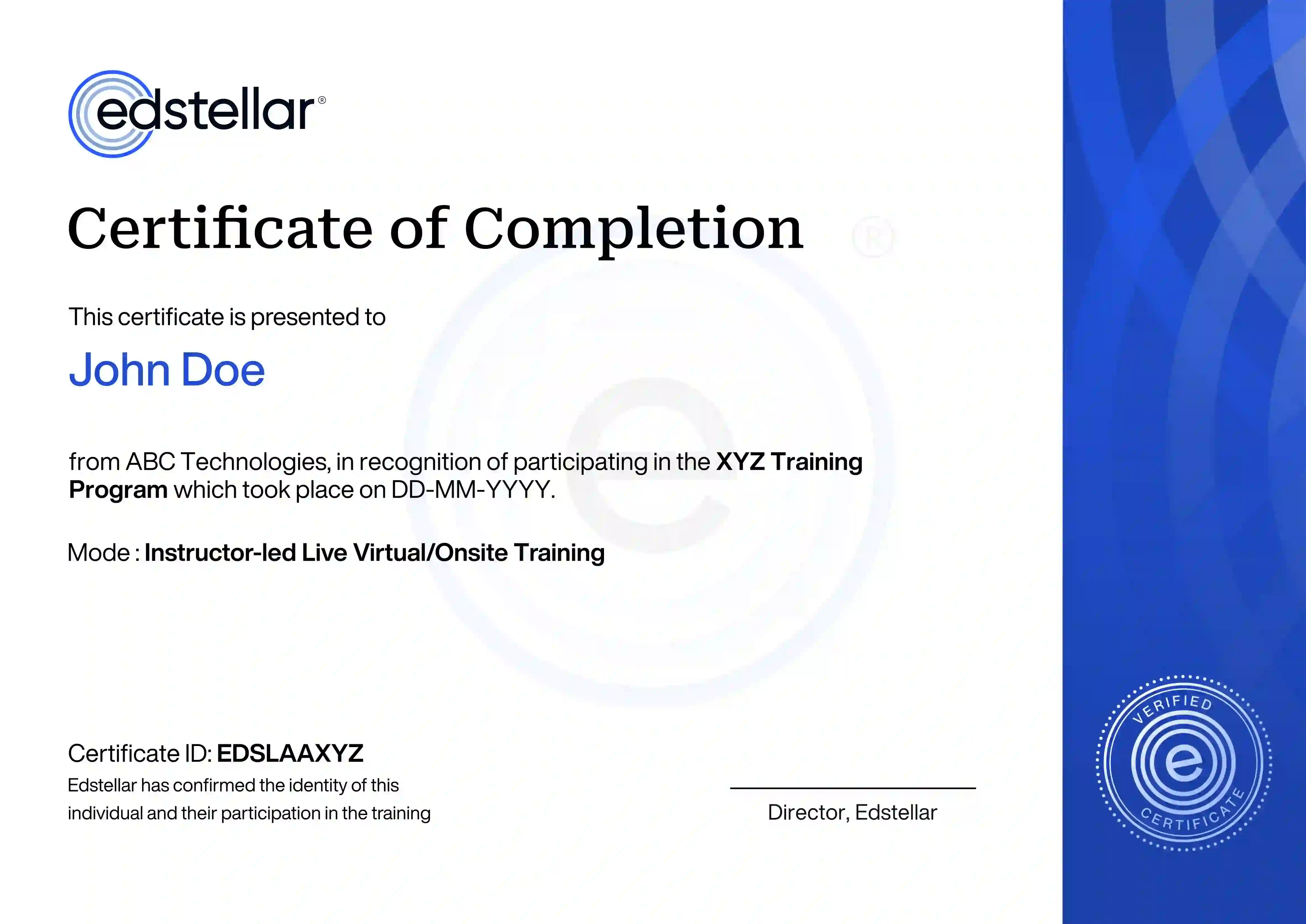
Upon successful completion of the Blockchain for Business Professionals training course offered by Edstellar, employees receive a course completion certificate, symbolizing their dedication to ongoing learning and professional development.
This certificate validates the employee's acquired skills and is a powerful motivator, inspiring them to enhance their expertise further and contribute effectively to organizational success.

Explore More Courses


Edstellar is a one-stop instructor-led corporate training and coaching solution that addresses organizational upskilling and talent transformation needs globally.
.svg)
.svg)
.svg)

.svg)
Learning Technology
Learning Content Design and Development
Learning Governance, Analytics & ROI
Digital Learning Ecosystem
Training Simulations, AR/VR & Case Studies
Employee Performance Support
Leadership Pipeline & Succession PlanningStrategic Workforce Planning for EnterprisesTransformation & Risk Advisory for EnterprisesDEI Consulting for EnterprisesEmployee Engagement Consulting for Enterprises
Cultural Transformation