.svg "edstellar")

Cloud FinOps Corporate Training Program for Employees
This training equips participants with cloud financial management skills covering FinOps frameworks, cost allocation, budgeting, chargeback models, and optimization strategies to maximize cloud ROI.
(Virtual / On-site / Off-site)
.svg)
Drive Team Excellence with Cloud FinOps Corporate Training
Cloud FinOps is a financial management discipline that enables organizations to get maximum business value from cloud investments by bringing financial accountability to the variable spend model of cloud. This training covers the full FinOps lifecycle - from cloud cost visibility and allocation to optimization and continuous improvement - equipping teams with the skills to manage cloud spending strategically and efficiently.
Edstellar's Cloud FinOps Instructor-led course offers virtual/onsite training options so teams can learn in the format that suits them best. The curriculum blends FinOps framework theory with practical cost engineering exercises, enabling learners to apply cloud financial management skills directly to their organization's cloud environments and drive measurable savings.
.svg)

Skills Your Employees Will Gain
These are the core, hands-on capabilities your team builds during the program.
- Cloud Cost Allocation
- Budget Forecasting
- Chargeback and Showback Modeling
- Reserved Instance Optimization
- FinOps Framework Application
- Cloud Spend Visibility
- Multi-Cloud Cost Governance
What Your Team Will Achieve After This Training
- Master the FinOps framework principles and apply cloud financial management practices across multi-cloud environments.
- Gain hands-on skills to build cost allocation models, tagging strategies, and chargeback reports for cloud spending.
- Develop accurate cloud budget forecasts and variance analysis workflows to control and reduce infrastructure costs.
- Learn to evaluate and implement reserved instances, savings plans, and spot strategies to maximize cloud ROI.
- Build proficiency in using cloud-native and third-party FinOps tools for spend visibility and cost optimization.
- Apply unit economics and cost-per-unit metrics to align cloud investments with measurable business outcomes.
Topics & Program Outline
The curriculum is organized into focused modules built by industry experts and delivered virtually or on-premise. Interactive sessions reflect the evolving demands of the workplace, keeping the learning both relevant and practical.
- What is Cloud FinOps
- Definition and origins of the FinOps discipline and its core value proposition
- The variable cost model of cloud and why it requires a new financial approach
- Key differences between FinOps and traditional IT cost management practices
- Overview of the FinOps Foundation framework and its guiding principles
- The FinOps Lifecycle
- Three phases: Inform, Optimize, and Operate explained with practical examples
- How organizations progress through the FinOps maturity model stages
- Stakeholder alignment across engineering, finance, and leadership functions
- Establishing a FinOps team structure and defining cross-functional responsibilities
- Cloud Economics Fundamentals
- Pay-as-you-go pricing vs traditional CapEx IT spending models compared
- How cloud providers bill for compute, storage, networking, and managed services
- Understanding cloud pricing pages, calculators, and cost estimator tools
- Total cost of ownership (TCO) analysis for cloud migration and operations
- FinOps Maturity Model
- Crawl, Walk, Run maturity stages and what each looks like in practice
- Key indicators for each maturity stage across people, process, and tooling
- Assessing your organization's current FinOps maturity baseline
- Roadmap planning to advance FinOps maturity incrementally over time
- Key FinOps Metrics and KPIs
- Unit economics: cost per transaction, user, feature, and API request
- Cloud spend as a percentage of revenue with industry benchmark comparisons
- Cost avoidance vs cost savings and how to measure and report each accurately
- Reporting cadence and dashboard design for FinOps stakeholder communication
- FinOps Organizational Culture
- Shifting from cost center to value center mindset in engineering and finance teams
- Embedding cost awareness into engineering culture and daily operational practices
- Incentive structures that encourage cost-efficient cloud usage across teams
- Change management strategies for FinOps adoption across business departments
- Cloud Billing and Invoicing
- Reading and interpreting cloud provider invoices and billing dashboards
- Understanding line items: compute, storage, network, support, and licensing
- Consolidated billing for multi-account and multi-subscription cloud environments
- Identifying billing anomalies and unexpected cost spikes through regular review
- Resource Tagging Strategy
- Why tagging is the foundation of cloud cost visibility and accountability
- Tag taxonomy design: environment, team, project, cost center, and application
- Mandatory vs optional tag policies and enforcement mechanisms across teams
- Tag inheritance and auto-tagging patterns for consistent resource coverage
- Tag Governance and Compliance
- Auditing tag completeness and accuracy across all cloud resources regularly
- Tag policy enforcement using AWS Tag Policies, Azure Policy, and GCP labels
- Reporting on untagged resources and driving structured remediation workflows
- Maintaining tag taxonomy consistency as organizations scale and evolve
- Cost Explorer and Native Visibility Tools
- AWS Cost Explorer for trend analysis and service-level cost breakdowns
- Azure Cost Management and Billing for subscription-level spending insights
- Google Cloud Billing reports and cost breakdown by project and resource label
- Setting up cost alerts and budget notifications in native cloud management tools
- Cost Anomaly Detection
- What constitutes a cost anomaly and how to detect it early in billing data
- Setting anomaly detection thresholds and configuring alert policies in cloud tools
- Root cause analysis workflow for investigating unexpected cloud cost increases
- Automating anomaly response with runbooks and escalation policies for teams
- Showback vs Chargeback Visibility Models
- Differences between showback (informational) and chargeback (financial allocation)
- How to implement showback reports to raise cost awareness across engineering teams
- Designing chargeback models that distribute cloud costs to owning business units
- Selecting the right visibility model based on organizational culture and maturity
- Cost Allocation Fundamentals
- What cost allocation is and why it drives cloud financial accountability
- Shared vs dedicated resource cost allocation approaches compared
- Direct vs indirect cost assignment methods for cloud resources
- Establishing cost allocation policies consistently across business units
- Account and Subscription Structures
- Using multi-account or multi-subscription structures for clean cost boundaries
- Landing zone and account factory patterns for cost boundary definition
- Mapping cloud accounts to teams, products, and organizational cost centers
- Managing cross-account shared services and their cost attribution methods
- Shared Service Cost Distribution
- Identifying shared services: networking, security, logging, and platform tooling
- Proportional allocation methods for distributing shared service costs fairly
- Fixed vs usage-based allocation for shared infrastructure components
- Documenting allocation decisions and communicating methodology to stakeholders
- Chargeback Model Design
- Chargeback vs cost allocation: understanding the key distinctions clearly
- Designing a chargeback model that is fair, transparent, and actionable
- Building chargeback reports from cloud billing data and resource tagging
- Integrating chargeback outputs with internal finance and ERP systems
- Custom Cost Allocation with FinOps Tools
- Using third-party platforms to handle complex shared cost allocation scenarios
- Virtual tagging and cost re-mapping for resources that cannot be directly tagged
- Automating monthly allocation reports with consistent and auditable methodology
- Handling edge cases: reserved capacity, committed use, and marketplace charges
- Communicating Costs to Engineering Teams
- Designing cost dashboards that resonate with engineering and product stakeholders
- Cost-per-service and cost-per-feature reporting for product and platform teams
- Embedding cost metrics in CI/CD pipelines and engineering sprint reviews
- Running cost review meetings that drive ownership, accountability, and action
- Cloud Budget Planning Fundamentals
- Differences between cloud budgeting and traditional IT budget planning cycles
- Bottom-up vs top-down budgeting approaches for cloud infrastructure spend
- Involving engineering and product teams in the cloud budget creation process
- Aligning cloud budgets to product roadmaps and infrastructure capacity plans
- Forecasting Cloud Spend
- Trend-based forecasting using historical cloud billing and usage data
- Workload-based forecasting tied to business growth metrics and usage drivers
- Adjusting forecasts for seasonality, marketing campaigns, and planned migrations
- Accuracy measurement and continuous forecast refinement over reporting cycles
- Budget Governance and Controls
- Setting cloud budgets at account, team, project, and service granularity levels
- Configuring budget alerts and enforcement actions in cloud management platforms
- Escalation policies when spending approaches or exceeds defined budget limits
- Budget revision processes aligned to business changes and quarterly reforecasting
- Variance Analysis
- Defining budget variance and understanding its primary root causes in cloud
- Separating price variance from volume variance in cloud cost fluctuations
- Building a variance analysis report suitable for finance and leadership review
- Using variance data to improve future budget accuracy and planning confidence
- FinOps and Finance Collaboration
- How FinOps teams partner with corporate finance for cloud budget alignment
- Translating cloud metrics into financial language for CFO-level reporting
- Accrual accounting for cloud costs and month-end close processes
- Aligning cloud spend with procurement contracts and commitment planning cycles
- Cloud Financial Planning Tools
- AWS Budgets, Azure Cost Management budgets, and GCP budget alert configuration
- Third-party FinOps platforms for enterprise budget planning and spend tracking
- Integrating cloud cost data with financial planning and analysis (FP&A) tools
- Automating budget reports and spend summaries for regular stakeholder review
- Introduction to Commitment-Based Discounts
- What commitment-based discounts are and how they reduce cloud costs
- Trade-off between flexibility and discount depth in cloud commitment options
- Organizational readiness requirements for effective commitment purchasing
- Overview of commitment discount types available across AWS, Azure, and GCP
- AWS Reserved Instances
- Standard vs convertible reserved instance types and their respective use cases
- Payment options: all upfront, partial upfront, and no upfront cost structures
- Term lengths and their impact on effective hourly discount rates
- Reserved instance marketplace and flexibility for selling unused capacity
- AWS Savings Plans
- Compute Savings Plans vs EC2 Instance Savings Plans compared in detail
- How Savings Plans apply across instance families, sizes, and AWS regions
- Analyzing Savings Plans coverage and utilization metrics with AWS native tools
- Combining Savings Plans with spot and on-demand for full workload cost coverage
- Azure Reserved Instances and Savings Plans
- Azure reserved VM instances: scope, flexibility, and cancellation policy rules
- Azure Savings Plans for compute: coverage scope and configuration options
- Hybrid benefit for Windows Server and SQL Server software license cost reduction
- Managing reservations across subscriptions and Azure management group hierarchies
- Google Cloud Committed Use Discounts
- Resource-based vs flexible committed use discount types available in GCP
- Calculating expected savings from GCP committed use discount commitments
- Scope of committed use discounts across GCP regions and machine type families
- Combining committed use with sustained use discounts for maximum cost savings
- Reservation Management and Optimization
- Building a reservation purchase cadence and governance review process
- Measuring reservation utilization, coverage, and effective discount rate metrics
- Rightsizing and modifying reservations as workload requirements change over time
- Automating reservation recommendation analysis and approval workflows at scale
- Introduction to Cloud Rightsizing
- What rightsizing is and why over-provisioning is a widespread cloud cost driver
- Metrics for identifying under-utilized compute, memory, and storage resources
- Rightsizing vs auto-scaling: choosing the right optimization approach per workload
- Building a rightsizing program with clear ownership and accountability structures
- Compute Rightsizing Techniques
- Analyzing CPU and memory utilization patterns over extended time periods
- Instance family selection for optimal cost-to-performance ratios in workloads
- Graviton and Ampere processor options for lower-cost compute alternatives
- Tools for generating and prioritizing rightsizing recommendations at scale
- Storage Cost Optimization
- Storage tier selection: hot, cool, cold, and archive storage classes compared
- Lifecycle policies to automatically move data to lower-cost storage tiers
- Identifying and removing orphaned volumes, snapshots, and redundant backups
- Object storage optimization with compression, deduplication, and tiering
- Network Cost Optimization
- Understanding egress charges and their impact on total cloud infrastructure costs
- Reducing inter-region and inter-AZ data transfer costs through architecture design
- CDN usage for reducing origin egress costs and improving content delivery efficiency
- Traffic routing optimization to minimize unnecessary data transfer fee accumulation
- Spot and Preemptible Instance Strategies
- How spot and preemptible instances work and when to use them for cost savings
- Designing fault-tolerant architectures suitable for interruptible workload patterns
- Spot instance pool diversification strategies to reduce interruption frequency
- Managed spot fleets and automation tools for optimized spot capacity management
- Auto-Scaling and Scheduling
- Horizontal and vertical auto-scaling for matching compute capacity to real demand
- Scheduling non-production environments to run only during defined business hours
- Event-driven scaling patterns for handling variable and unpredictable workloads
- Measuring cost savings achieved through auto-scaling and resource scheduling
- Multi-Cloud Cost Management Challenges
- Why multi-cloud environments create significant cost visibility and governance gaps
- Differences in billing models, pricing units, and discount structures across providers
- Common anti-patterns in multi-cloud cost management and how to avoid them
- Building a unified cost framework across heterogeneous cloud provider environments
- Unified Cost Visibility Across Clouds
- Normalizing billing data from AWS, Azure, and GCP into a common reporting format
- Multi-cloud tagging standards and cross-cloud taxonomy alignment strategies
- Centralized cost dashboards aggregating spend data from multiple cloud providers
- Handling currency and regional pricing differences in multi-cloud cost reporting
- Cross-Cloud Allocation and Chargeback
- Extending cost allocation models consistently to cover all cloud provider environments
- Managing shared services and platform costs that span multiple cloud providers
- Unified chargeback reporting across AWS, Azure, and GCP for finance and leadership
- Reconciling multi-cloud charges with vendor invoices and internal finance systems
- Cloud Vendor Negotiation and Contracts
- Enterprise discount programs (EDP, MACC, CUD) across major cloud providers
- Negotiating committed spend agreements and securing cloud pricing protections
- Understanding marketplace and private pricing arrangement structures
- Contract renewal planning and discount leverage strategies for cost reduction
- FinOps Policy and Guardrails
- Defining and enforcing cloud usage policies across teams and cloud providers
- Infrastructure-as-code guardrails for enforcing cost-efficient resource provisioning
- Automated remediation workflows for policy violations and non-compliant resources
- Cloud governance frameworks integrating cost, security, and compliance requirements
- Multi-Cloud Optimization Strategies
- Workload placement decisions based on cost, performance, and compliance requirements
- Cross-cloud cost arbitrage opportunities for reducing overall infrastructure spend
- Evaluating total cost of ownership for cloud-to-cloud workload migration decisions
- Continuous optimization cadence for sustaining multi-cloud cost management gains
- Native Cloud Cost Management Tools
- AWS Cost Explorer, Cost and Usage Report, and Trusted Advisor for cost insights
- Azure Cost Management and Billing, Advisor, and pricing calculator features
- Google Cloud Billing, Recommender, and Active Assist for cost optimization
- Setting up cost dashboards and spending alerts in native cloud management consoles
- Third-Party FinOps Platforms
- Overview of leading FinOps platforms and their key feature differentiators
- FOCUS (FinOps Open Cost and Usage Specification) data standard and its adoption
- Evaluating third-party tools on coverage, integrations, and total cost of ownership
- Selection criteria for choosing a FinOps platform that fits organizational needs
- FinOps Data and Analytics Stack
- Ingesting cloud billing data into data warehouses for custom cost analysis
- Building cost dashboards in BI tools: Power BI, Tableau, and Looker
- Automating cost report generation and distribution to relevant stakeholder groups
- Data quality and pipeline reliability requirements for FinOps reporting systems
- Cost Optimization Automation
- Automated rightsizing and instance scheduling with cloud-native automation tools
- Terraform and IaC policies for enforcing cost guardrails at provisioning time
- Event-driven cost optimization triggers using cloud-native automation services
- Building and maintaining a cost optimization automation runbook library
- Tagging and Policy Automation Tools
- Automated tagging using cloud-native tag policies and serverless functions
- Third-party tagging tools for retroactive and prospective tag compliance enforcement
- Policy-as-code for enforcing cost allocation standards at infrastructure deployment
- Reporting and alerting on tagging compliance across multi-cloud environments
- FinOps Reporting and Communication
- Designing executive cost dashboards for CFO and CTO level audiences
- Engineering team cost scorecards and accountability dashboards for sprint reviews
- Automating monthly FinOps summary reports with key metrics and spending trends
- Building a FinOps knowledge base and documentation for ongoing team reference
- Introduction to Cloud Unit Economics
- What unit economics means in the context of cloud cost management and FinOps
- Defining the right unit of measure for different business and product models
- Calculating cost per unit: transaction, user, API call, and product feature
- Why unit economics is the most actionable FinOps metric for engineering teams
- Measuring Cloud ROI
- Frameworks for calculating return on cloud investment for leadership reporting
- Comparing cloud cost to revenue generated and business value delivered
- Cost efficiency ratios for cloud-native product and technology service teams
- Communicating cloud ROI to business stakeholders in accessible, non-technical terms
- Business Value Attribution
- Mapping cloud infrastructure costs to specific products, services, and features
- Attribution challenges for shared platforms and internal platform engineering teams
- Using observability data to connect infrastructure cost to business events
- Building a cost attribution model aligned to product team ownership boundaries
- Cloud Spend vs Revenue Benchmarking
- Industry benchmarks for cloud spend as a percentage of total company revenue
- How to contextualize cloud costs relative to business growth and scale
- Identifying when cloud spend efficiency is improving or degrading over time
- Peer benchmarking using FinOps Foundation data and industry analyst reports
- Cost Efficiency in Product Development
- Embedding cost considerations into product design and architecture review processes
- Cost estimation workflows for new features and infrastructure change proposals
- Cost impact assessment integrated into pull request and deployment pipelines
- Tracking cost efficiency as a product health metric alongside performance and reliability
- Executive Reporting and Leadership Communication
- Translating technical cloud cost data into business value narratives for executives
- Designing board-level cloud efficiency dashboards and KPI summary reports
- Linking cloud investment decisions to strategic business outcomes and growth targets
- Presenting FinOps program ROI and maturity progression to senior leadership
- FinOps Team Structure and Roles
- Core FinOps team roles: FinOps practitioner, cloud economist, and billing analyst
- Cross-functional FinOps working group structure and governance charter design
- Embedding FinOps champions within engineering and product team structures
- Career paths and FinOps Foundation certification options for practitioners
- FinOps Program Launch and Roadmap
- Assessing organizational readiness for launching a formal FinOps program
- Quick wins to demonstrate FinOps value within the first 90 days of the program
- Building a 12-month FinOps program roadmap with measurable milestones
- Securing executive sponsorship and cross-functional stakeholder buy-in early
- FinOps Governance Frameworks
- Defining FinOps policies, standards, and decision-making authority structures
- Establishing a FinOps Center of Excellence for ongoing governance and enablement
- Integrating FinOps governance with existing cloud governance and security frameworks
- Measuring FinOps program effectiveness with leading and lagging performance indicators
- Engineering and Finance Collaboration
- Bridging the gap between engineering autonomy and financial accountability goals
- Joint cost review cadences that bring engineering and finance teams together
- Shared ownership models for cloud cost reduction initiatives across functions
- Building trust between finance and engineering through transparent cost data sharing
- Continuous Improvement and Optimization Culture
- Running monthly FinOps retrospectives to identify cost improvement opportunities
- Cost gamification and team challenges to drive cloud optimization engagement
- Recognizing and celebrating cloud cost optimization wins across the organization
- Scaling FinOps culture from a single pilot team to the entire enterprise organization
- FinOps Trends and Future Directions
- AI-driven cloud cost optimization and the rise of autonomous FinOps capabilities
- Sustainability and carbon cost integration with cloud FinOps management practices
- FinOps for containers and Kubernetes cost visibility and optimization techniques
- The evolving FinOps practitioner role in cloud-native and platform engineering teams
Who Should Attend?
This program suits professionals at many levels across the organization, including:
- Cloud Architects
- Finance Analysts
- DevOps Engineers
- IT Budget Managers
- Operations Managers
- Product Managers
What are the Prerequisites?
Professionals should have a basic understanding of cloud computing concepts and familiarity with cloud service providers to take the Cloud FinOps training course.
Choose the Format That Fits Your Team
We design training your teams actually engage with, and deliver it the way that suits you best. Through a vetted global trainer network, Edstellar runs sessions in 10+ languages with consistent quality anywhere.


.webp "Virtual Cloud FinOps Training")
Virtual / online: expert-led live sessions delivered anywhere, with consistency and easy scheduling.
.webp "On-site Cloud FinOps Training")
On-site (in-house): immersive, instructor-led learning at your office.
.webp "Off-site Cloud FinOps Training")
Off-site: focused, instructor-led group learning away from everyday workplace distractions.
Get a Proposal Shaped to Your Needs
Need pricing for onsite, offsite, or virtual delivery? Get a proposal tailored to your team's needs.
64 hours of group training (includes VILT/In-person On-site)
Tailored for SMBs
Tailor-Made Trainee Licenses with Our Exclusive Training Packages!
160 hours of group training (includes VILT/In-person On-site)
Ideal for growing SMBs
Tailor-Made Trainee Licenses with Our Exclusive Training Packages!
400 hours of group training (includes VILT/In-person On-site)
Designed for large corporations
Tailor-Made Trainee Licenses with Our Exclusive Training Packages!
Unlimited duration
Designed for large corporations
What Sets Edstellar Apart
Experienced Trainers
Our trainers are drawn from a vetted global network and bring years of industry expertise, keeping every session practical and impactful.
Proven Quality
With a strong global track record, Edstellar is known for quality and engaging delivery.
Industry-Relevant Curriculum
Our programs are built by experts to match the demands of today's industry.
Fully Customizable
Every program can be tailored to your organization's goals.
Comprehensive Support
We provide pre- and post-session support for a complete learning experience.
Global Multi-Location & Multilingual Training Delivery
We deliver in multiple languages to support diverse global teams.
Recognition That Motivates Your Team
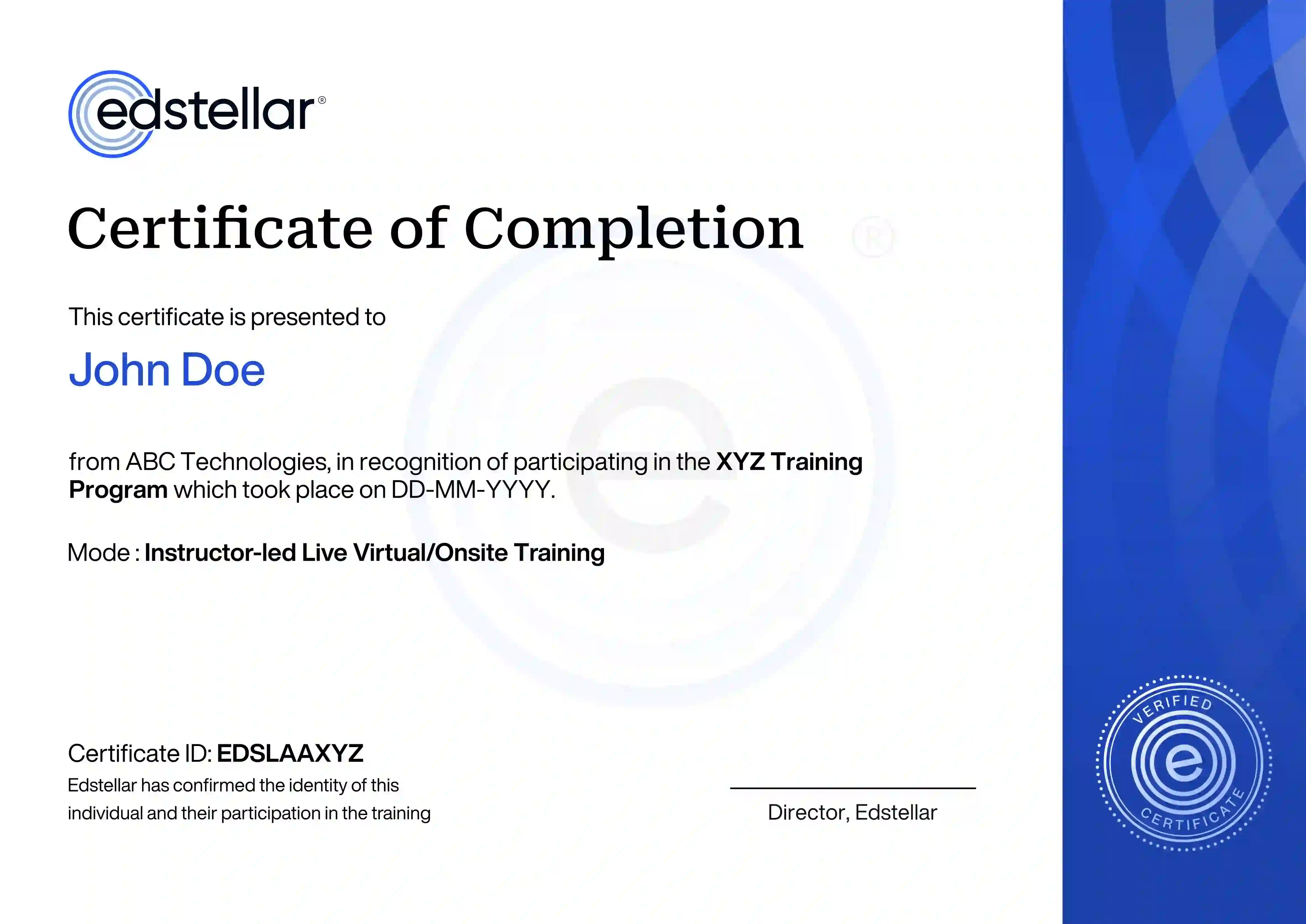
Upon successful completion of the Cloud FinOps training course offered by Edstellar, employees receive a course completion certificate, symbolizing their dedication to ongoing learning and professional development.
This certificate validates the employee's acquired skills and is a powerful motivator, inspiring them to enhance their expertise further and contribute effectively to organizational success.

Other Related Corporate Training Courses


Explore More Courses


Edstellar is a one-stop instructor-led corporate training and coaching solution that addresses organizational upskilling and talent transformation needs globally.
.svg)
.svg)
.svg)

.svg)
Learning Technology
Learning Content Design and Development
Learning Governance, Analytics & ROI
Digital Learning Ecosystem
Training Simulations, AR/VR & Case Studies
Employee Performance Support
Leadership Pipeline & Succession PlanningStrategic Workforce Planning for EnterprisesTransformation & Risk Advisory for EnterprisesDEI Consulting for EnterprisesEmployee Engagement Consulting for Enterprises
Cultural Transformation