Join 25 Global CEOs (Exclusive CEO Retreat) - Leading the Change - Mallorca, Spain · 20th–24th May 2026
Know More
X

Drive Team Excellence with Retrieval Augmented Generation (RAG) Corporate Training

Empower your teams with expert-led on-site, off-site, and virtual Retrieval Augmented Generation (RAG) Training through Edstellar, a premier corporate training provider for organizations globally. Designed to meet your specific training needs, this group training program ensures your team is primed to drive your business goals. Help your employees build lasting capabilities that translate into real performance gains.

Retrieval Augmented Generation (RAG) is an advanced AI framework that enhances large language models (LLMs) by connecting them with external, authoritative knowledge bases to retrieve relevant information at query time. It combines the generative capabilities of LLMs with real-time data retrieval from vector databases, enabling AI systems to produce accurate, contextually grounded, and up-to-date responses without model retraining. The training provides comprehensive knowledge of RAG architecture, vector embeddings, semantic search techniques, and production deployment strategies to build enterprise-grade AI applications.

Edstellar’s RAG Instructor-led course offers virtual/onsite training options to meet professionals’ diverse needs. This flexibility ensures that professionals and teams can engage in learning experiences that best suit their logistical and learning preferences. What sets the Edstellar course apart is its emphasis on practical experience, with hands-on projects and real-world scenarios that bring RAG concepts to life. Edstellar equips professionals with the skills and confidence to apply RAG technologies effectively in their AI development projects.

Get Customized Expert-led Training for Your Teams
Customized Training Delivery
Scale Your Training: Small to Large Teams
In-person Onsite, Live Virtual or Hybrid Training Modes
Plan from 2000+ Industry-ready Training Programs
Experience Hands-On Learning from Industry Experts
Delivery Capability Across 100+ Countries & 10+ Languages
""""

Key Skills Employees Gain from instructor-led Retrieval Augmented Generation (RAG) Training

Retrieval Augmented Generation (RAG) skills corporate training will enable teams to effectively apply their learnings at work.

  • RAG Architecture Design
  • Vector Database Management
  • Embedding Model Implementation
  • Semantic Search Optimization
  • Prompt Engineering for RAG
  • RAG Pipeline Orchestration
  • RAG Performance Evaluation

Key Learning Outcomes of Retrieval Augmented Generation (RAG) Training Workshop for Employees

Upon completing Edstellar’s Retrieval Augmented Generation (RAG) workshop, employees will gain valuable, job-relevant insights and develop the confidence to apply their learning effectively in the professional environment.

  • Master the fundamental principles and architectural patterns of RAG systems, focusing on how retrieval mechanisms enhance LLM capabilities and implementing embedding models, vector stores, and generation layers to deliver accurate, contextual, and knowledge-grounded responses.
  • Gain expertise in vector database technologies, including Pinecone, Milvus, Weaviate, and Chroma, emphasizing configuration, indexing strategies, optimization techniques, and efficient vector similarity algorithms for high-performance, enterprise-scale RAG deployments.
  • Develop proficiency in advanced retrieval techniques, including hybrid search, reranking, query transformation, and context enrichment, to maximize precision and recall and ensure RAG systems consistently surface the most relevant information.
  • Learn comprehensive prompt engineering strategies for RAG applications, emphasizing effective use of retrieved context, few-shot learning, and chain-of-thought reasoning to minimize hallucinations and improve response quality.
  • Build practical skills in RAG pipeline orchestration using LangChain, LlamaIndex, and Haystack, focusing on modular architecture, error handling, and end-to-end workflows from ingestion to response generation.
  • Master RAG evaluation and performance optimization techniques, emphasizing retrieval accuracy, generation faithfulness, answer relevancy, and system latency with continuous monitoring and improvement.

Key Benefits of the Retrieval Augmented Generation (RAG) Group Training with Instructor-led Face to Face and Virtual Options

Attending our Retrieval Augmented Generation (RAG) group training classes provides your team with a powerful opportunity to build skills, boost confidence, and develop a deeper understanding of the concepts that matter most. The collaborative learning environment fosters knowledge sharing and enables employees to translate insights into actionable work outcomes.

  • Understand RAG architecture by learning how LLMs integrate with external knowledge sources and real-time retrieval mechanisms to deliver accurate, context-grounded responses.
  • Configure and deploy vector databases such as Pinecone, Milvus, Weaviate, and Qdrant using efficient indexing and similarity search for production-ready semantic search.
  • Develop and fine-tune embedding models using transformer architectures and domain-specific datasets, while applying dimensionality reduction to improve storage and computational efficiency.
  • Design advanced retrieval strategies using hybrid search (dense + BM25) and reranking models to achieve high precision and recall across query types.
  • Build modular RAG pipelines with LangChain and LlamaIndex covering document loading, chunking, embeddings, retrieval, and prompt construction.
  • Optimize document preprocessing and chunking using semantic chunking, metadata enrichment, and hierarchical document structures to improve retrieval and generation quality.
  • Apply RAG-specific prompt engineering, including context-aware prompts and few-shot patterns, to reduce hallucinations and improve factual accuracy.
  • Evaluate RAG systems using retrieval metrics, relevancy, faithfulness, latency, automated evaluation pipelines, and A/B testing.
  • Deploy production-scale RAG applications on AWS, Azure, and Google Cloud using containerized microservices, autoscaling, and monitoring.
  • Apply advanced RAG techniques, such as query rewriting, context distillation, and adaptive and agentic workflows, for multi-hop reasoning and multi-turn conversations.

Topics and Outline of Retrieval Augmented Generation (RAG) Training

Our virtual and on-premise Retrieval Augmented Generation (RAG) training curriculum is structured into focused modules developed by industry experts. This training for organizations provides an interactive learning experience that addresses the evolving demands of the workplace, making it both relevant and practical.

  1. Understanding Large Language Models
    • Transformer architecture basics
    • Pre-training and fine-tuning concepts
    • LLM capabilities and limitations
    • Token-based processing mechanisms
  2. RAG Conceptual Framework
    • Definition and core principles
    • Difference between RAG and traditional LLMs
    • RAG vs fine-tuning comparison
    • Use cases and business applications
  3. RAG Architecture Overview
    • Retrieval component fundamentals
    • Generation component fundamentals
    • Integration patterns and workflows
    • System design considerations
  4. Knowledge Base Concepts
    • External knowledge sources
    • Structured vs unstructured data
    • Document repositories and databases
    • Data freshness and updates
  5. RAG Ecosystem and Tools
    • Popular RAG frameworks overview
    • Cloud platforms for RAG deployment
    • Development environments setup
    • Community resources and libraries
  6. Ethical Considerations
    • Data privacy in RAG systems
    • Bias in retrieval and generation
    • Responsible AI practices
    • Compliance and governance
  1. Text Embedding Fundamentals
    • Embedding concept and purpose
    • Vector space representations
    • Semantic similarity principles
    • Dimensionality and vector properties
  2. Embedding Model Types
    • Word2Vec and GloVe overview
    • BERT and transformer-based embeddings
    • Sentence transformers
    • Domain-specific embedding models
  3. Creating and Managing Embeddings
    • Generating embeddings from text
    • Embedding model selection criteria
    • Fine-tuning embedding models
    • Batch embedding generation strategies
  4. Semantic Similarity Metrics
    • Cosine similarity calculations
    • Euclidean distance metrics
    • Dot product similarity
    • Distance threshold tuning
  5. Embedding Quality Evaluation
    • Intrinsic evaluation methods
    • Extrinsic evaluation approaches
    • Benchmark datasets and metrics
    • Continuous evaluation strategies
  6. Optimization Techniques
    • Dimension reduction methods
    • Quantization for efficiency
    • Caching strategies
    • Computational cost optimization
  1. Vector Database Fundamentals
    • Purpose and architecture of vector databases
    • Comparison with traditional databases
    • Index structures and algorithms
    • Scalability considerations
  2. Popular Vector Database Platforms
    • Pinecone architecture and features
    • Milvus deployment and capabilities
    • Weaviate configuration and usage
    • Chroma and Qdrant overview
  3. Database Configuration and Setup
    • Installation and initialization
    • Collection and index creation
    • Schema design best practices
    • Connection management
  4. Indexing Strategies
    • HNSW algorithm implementation
    • IVF (Inverted File) indexing
    • Product quantization techniques
    • Trade-offs between speed and accuracy
  5. Query Operations
    • Vector similarity search queries
    • Filtering and metadata queries
    • Batch query optimization
    • Query performance tuning
  6. Production Deployment
    • High availability configurations
    • Backup and recovery strategies
    • Monitoring and observability
    • Cost optimization techniques
  1. Document Ingestion Pipeline
    • Multi-format document loading
    • Text extraction techniques
    • Preprocessing and cleaning
    • Handling various file formats
  2. Chunking Strategies
    • Fixed-size chunking methods
    • Semantic chunking approaches
    • Recursive character splitting
    • Context-preserving techniques
  3. Metadata Extraction
    • Document metadata importance
    • Automatic metadata generation
    • Custom metadata fields
    • Hierarchical metadata structures
  4. Text Preprocessing
    • Normalization techniques
    • Stopword handling
    • Special character management
    • Language-specific considerations
  5. Chunking Optimization
    • Chunk size determination
    • Overlap strategies
    • Performance vs accuracy trade-offs
    • Context window considerations
  6. Advanced Processing Techniques
    • Table and structured data extraction
    • Image and multimedia handling
    • Multi-modal document processing
    • Cross-reference management
  1. Basic Retrieval Methods
    • Dense retrieval with embeddings
    • Sparse retrieval with keywords
    • Top-k selection strategies
    • Similarity threshold setting
  2. Hybrid Search Techniques
    • Combining dense and sparse retrieval
    • BM25 algorithm integration
    • Score normalization methods
    • Weighted fusion strategies
  3. Reranking Models
    • Cross-encoder architectures
    • Bi-encoder vs cross-encoder comparison
    • Reranking model training
    • Computational cost considerations
  4. Query Transformation
    • Query expansion techniques
    • Query rewriting strategies
    • Multi-query generation
    • Hypothetical document embeddings (HyDE)
  5. Advanced Retrieval Patterns
    • Multi-hop retrieval workflows
    • Hierarchical retrieval strategies
    • Contextual compression techniques
    • Adaptive retrieval methods
  6. Retrieval Performance Metrics
    • Precision and recall evaluation
    • Mean reciprocal rank (MRR)
    • Normalized discounted cumulative gain (NDCG)
    • Latency and throughput measurement
  1. LangChain Framework
    • LangChain architecture overview
    • Document loaders and text splitters
    • Vector store integrations
    • Chain and agent patterns
  2. LlamaIndex Framework
    • Index structures in LlamaIndex
    • Query engines and retrievers
    • Response synthesizers
    • Custom component development
  3. Haystack Framework
    • Pipeline-based architecture
    • Node and pipeline design
    • Document stores and retrievers
    • Evaluation components
  4. Building Custom RAG Pipelines
    • Modular component design
    • Error handling and retry logic
    • Logging and debugging strategies
    • Performance profiling
  5. Integration Patterns
    • API integration approaches
    • Streaming response handling
    • Asynchronous processing
    • Batch processing capabilities
  6. Framework Selection Criteria
    • Use case alignment analysis
    • Performance requirements
    • Community support and documentation
    • Extensibility and customization options
  1. RAG-Specific Prompt Design
    • Context integration techniques
    • Instruction clarity principles
    • Retrieved document formatting
    • Token budget management
  2. Context Window Management
    • Context length limitations
    • Prioritizing retrieved content
    • Truncation strategies
    • Sliding window approaches
  3. Few-Shot Learning in RAG
    • Example selection strategies
    • Example formatting best practices
    • Dynamic example retrieval
    • Few-shot prompt optimization
  4. Chain-of-Thought Prompting
    • Reasoning chain construction
    • Step-by-step decomposition
    • Intermediate reasoning steps
    • Verification and validation prompts
  5. Prompt Templates and Variables
    • Template design patterns
    • Dynamic variable injection
    • Conditional prompt logic
    • Reusable prompt libraries
  6. Reducing Hallucinations
    • Grounding techniques
    • Citation enforcement strategies
    • Confidence calibration
    • Fact verification mechanisms
  1. Evaluation Framework Design
    • Metric selection methodology
    • Automated evaluation pipelines
    • Manual evaluation protocols
    • Continuous evaluation strategies
  2. Retrieval Quality Metrics
    • Precision and recall calculation
    • Mean average precision (MAP)
    • Hit rate measurement
    • Retrieval latency tracking
  3. Generation Quality Metrics
    • Faithfulness scoring
    • Answer relevancy evaluation
    • Contextual precision metrics
    • Factual consistency measurement
  4. End-to-End System Testing
    • Integration testing approaches
    • Regression testing strategies
    • Load and stress testing
    • User acceptance testing
  5. A/B Testing Strategies
    • Experimental design principles
    • Statistical significance testing
    • Multi-armed bandit approaches
    • Champion-challenger frameworks
  6. Debugging and Error Analysis
    • Common failure patterns
    • Root cause analysis techniques
    • Performance bottleneck identification
    • Error tracking and logging
  1. Deployment Architecture
    • Microservices design patterns
    • Containerization with Docker
    • Kubernetes orchestration
    • Serverless deployment options
  2. Scalability and Performance
    • Horizontal and vertical scaling
    • Load balancing strategies
    • Caching mechanisms
    • Rate limiting and throttling
  3. Monitoring and Observability
    • Metrics collection and visualization
    • Distributed tracing implementation
    • Log aggregation systems
    • Alerting and incident response
  4. CI/CD for RAG Systems
    • Automated testing pipelines
    • Model versioning strategies
    • Configuration management
    • Deployment rollback procedures
  5. Cost Optimization
    • Resource utilization analysis
    • API call optimization
    • Model selection trade-offs
    • Infrastructure right-sizing
  6. Security Best Practices
    • Authentication and authorization
    • Data encryption strategies
    • API security measures
    • Compliance requirements
  1. Agentic RAG Systems
    • Agent-based architecture patterns
    • Tool-using capabilities
    • Multi-agent coordination
    • Self-correction mechanisms
  2. Corrective RAG (CRAG)
    • Retrieval quality assessment
    • Self-reflection and correction
    • Alternative retrieval strategies
    • Dynamic fallback mechanisms
  3. Adaptive RAG
    • Query complexity analysis
    • Dynamic retrieval depth adjustment
    • Conditional retrieval triggers
    • Resource allocation optimization
  4. Multi-Modal RAG
    • Image and text integration
    • Audio and video processing
    • Cross-modal retrieval techniques
    • Multi-modal embedding strategies
  5. Graph RAG Approaches
    • Knowledge graph integration
    • Graph-based retrieval methods
    • Relationship-aware generation
    • Entity-centric RAG systems
  6. Fine-Tuning for RAG
    • Retriever fine-tuning techniques
    • Generator fine-tuning strategies
    • End-to-end fine-tuning approaches
    • Domain adaptation methods

Who Can Take the Retrieval Augmented Generation (RAG) Training Course

The Retrieval Augmented Generation (RAG) training program can also be taken by professionals at various levels in the organization.

  • AI Engineer
  • Machine Learning Engineer
  • Data Scientist
  • NLP Engineer
  • Software Developer
  • Solutions Architect

Prerequisites for Retrieval Augmented Generation (RAG) Training

Professionals should have a basic understanding of Python programming and machine learning fundamentals, including familiarity with neural networks and natural language processing, as well as general knowledge of APIs, cloud computing platforms, and software development practices, to take the Retrieval Augmented Generation (RAG) training course.

Request a Quote for your Corporate Training Requirements

Valid number

Delivering Training for Organizations across 100 Countries and 10+ Languages

Corporate Group Training Delivery Modes
for Retrieval Augmented Generation (RAG) Training

At Edstellar, we understand the importance of impactful and engaging training for employees. As a leading Retrieval Augmented Generation (RAG) training provider, we ensure the training is more interactive by offering Face-to-Face onsite/in-house or virtual/online sessions for companies. This approach has proven to be effective, outcome-oriented, and produces a well-rounded training experience for your teams.

Virtual Retrieval Augmented Generation (RAG) Training

Edstellar's Retrieval Augmented Generation (RAG) virtual/online training sessions bring expert-led, high-quality training to your teams anywhere, ensuring consistency and seamless integration into their schedules.

With global reach, your employees can get trained from various locations
The consistent training quality ensures uniform learning outcomes
Participants can attend training in their own space without the need for traveling
Organizations can scale learning by accommodating large groups of participants
Interactive tools can be used to enhance learning engagement
On-site Retrieval Augmented Generation (RAG) Training

Edstellar's Retrieval Augmented Generation (RAG) inhouse face to face instructor-led training delivers immersive and insightful learning experiences right in the comfort of your office.

Higher engagement and better learning experience through face-to-face interaction
Workplace environment can be tailored to learning requirements
Team collaboration and knowledge sharing improves training effectiveness
Demonstration of processes for hands-on learning and better understanding
Participants can get their doubts clarified and gain valuable insights through direct interaction
Off-site Retrieval Augmented Generation (RAG) Training

Edstellar's Retrieval Augmented Generation (RAG) offsite face-to-face instructor-led group training offer a unique opportunity for teams to immerse themselves in focused and dynamic learning environments away from their usual workplace distractions.

Distraction-free environment improves learning engagement
Team bonding can be improved through activities
Dedicated schedule for training away from office set up can improve learning effectiveness
Boosts employee morale and reflects organization's commitment to employee development

Explore Our Customized Pricing Package
for
Retrieval Augmented Generation (RAG) Corporate Training

Looking for pricing details for onsite, offsite, or virtual instructor-led Retrieval Augmented Generation (RAG) training? Get a customized proposal tailored to your team’s specific needs.

Request a Group Training Quote
""
How Many Team Members Need Training?
Please select an option or fill in the custom field.
"'

Is Your Corporate Training Requirement Only for Retrieval Augmented Generation (RAG)?

Please select at least one course.
""
Add the List of Training Workshops
search icon

      Please select the course

      No. of Courses selected: 0

      Clear

      Upload a CSV

      Send us your Training Requirements in 3 Easy steps

      1. 1
      2. 2
        Add the required training workshops
      3. 3
        Upload to get a quick quote or email it to contact@edstellar.com

      ""

      Looking for a Complete Package?

      Looking for a one-time pricing option for all your annual training requirements?

      View Corporate Training Packages
      ""
      Select the Option that Best Describes Your Corporate Training Requirement

      Please select an option or choose from the recurring options.
      ""
      Verify and Submit Your Request

      Review Your Corporate Training Selection Summary

      Training Program: Retrieval Augmented Generation (RAG) Training

      1. No of Team Members

      2. Selected Training Preference

      3. Selected Recurring Sessions

      1

      Review your Requirements

      Training Workshops Selected :


        Excel
        File has been
        successfully uploaded.
        Fill the form to submit
 your details
        Submit Your Professional Contact Information
        Valid number
        We've received your enquiry. Our team will be in touch soon.
        Oops! Something went wrong while submitting the form.
        Starter
        120 licences

        Tailor-Made Trainee Licenses with Our Exclusive Training Packages!

        View Package

        64 hours of group training (includes VILT/In-person On-site)

        Tailored for SMBs

        Growth
        320 licences

        Tailor-Made Trainee Licenses with Our Exclusive Training Packages!

        View Package

        160 hours of group training (includes VILT/In-person On-site)

        Ideal for growing SMBs

        Enterprise
        800 licences

        Tailor-Made Trainee Licenses with Our Exclusive Training Packages!

        View Package

        400 hours of group training (includes VILT/In-person On-site)

        Designed for large corporations

        Custom
        Unlimited licenses

        Tailor-Made Trainee Licenses with Our Exclusive Training Packages!

        View Package

        Unlimited duration

        Designed for large corporations

        Edstellar: Your Go-to Retrieval Augmented Generation (RAG) Training Company

        Experienced Trainers

        Our trainers bring years of industry expertise to ensure the training is practical and impactful.

        Quality Training

        With a strong track record of delivering training worldwide, Edstellar maintains its reputation for its quality and training engagement.

        Industry-Relevant Curriculum

        Our course is designed by experts and is tailored to meet the demands of the current industry.

        Customizable Training

        Our course can be customized to meet the unique needs and goals of your organization.

        Comprehensive Support

        We provide pre and post training support to your organization to ensure a complete learning experience.

        Multilingual Training Capabilities

        We offer training in multiple languages to cater to diverse and global teams.

        Testimonials

        What Our Clients Say

        We pride ourselves on delivering exceptional training solutions. Here's what our clients have to say about their experiences with Edstellar.

        "Partnering with Edstellar for virtual RAG training exceeded our expectations. Our AI engineers, ML architects, and data scientists completed the program in three weeks, strengthening our ability to build production-ready search and Q&A systems. We deployed two RAG solutions, reducing customer support response time by 40%. Edstellar's practical approach and expert trainers made complex concepts easy to apply."

        David Chen

        Director of AI Engineering,

        Enterprise Technology Solutions Provider

        "The onsite RAG training from Edstellar had a strong impact on our AI team. Fifteen engineers and architects completed a four-day hands-on workshop using real datasets. We strengthened skills in vector databases, semantic search, and prompt engineering, deployed RAG for our document intelligence platform, and improved retrieval accuracy by 65%, enabling scalable, context-aware AI applications for thousands of users."

        Priya Sharma

        Engineering Manager,

        Cloud-Based SaaS Company

        "Edstellar’s off-site RAG training advanced our AI initiatives through a five-day intensive program for ML engineers, research scientists, and product managers. The training covered RAG fundamentals, agentic architectures, and production deployment. Our team launched three enterprise RAG applications, including a knowledge system and chatbot. The practical focus on vector database optimization, retrieval strategies, and evaluation frameworks enabled confident RAG adoption at scale."

        Michael Rodriguez

        VP of Machine Learning,

        Financial Services Technology Firm

        “Edstellar’s IT & Technical training programs have been instrumental in strengthening our engineering teams and building future-ready capabilities. The hands-on approach, practical cloud scenarios, and expert guidance helped our teams improve technical depth, problem-solving skills, and execution across multiple projects. We’re excited to extend more of these impactful programs to other business units.”

        Aditi Rao

        L&D Head,

        A Global Technology Company

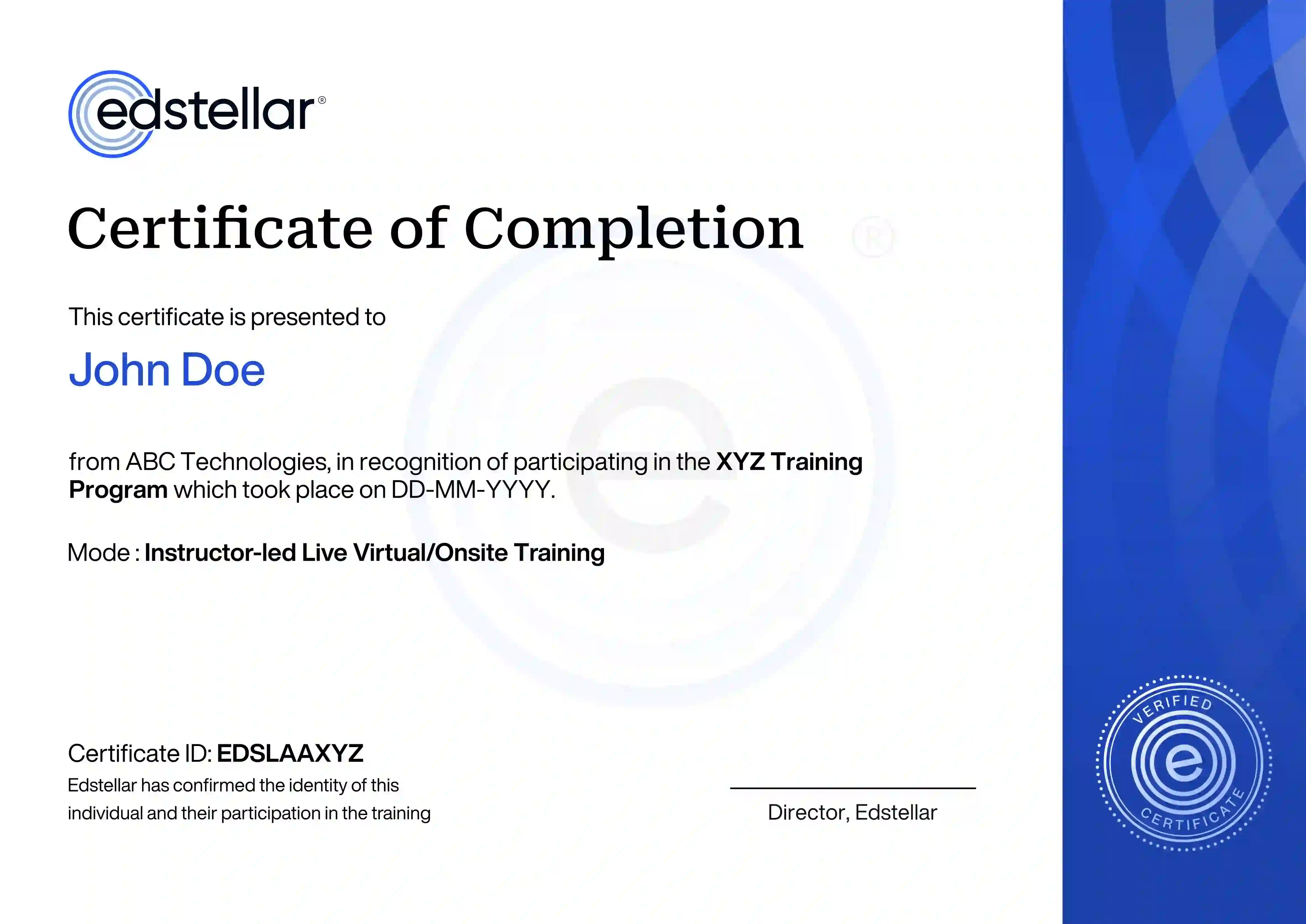
        Get Your Team Members Recognized with Edstellar’s Course Certificate

        Upon successful completion of the training course offered by Edstellar, employees receive a course completion certificate, symbolizing their dedication to ongoing learning and professional development.

        This certificate validates the employee's acquired skills and is a powerful motivator, inspiring them to enhance their expertise further and contribute effectively to organizational success.

        Certificate of Excellence

        We have Expert Trainers to Meet Your Retrieval Augmented Generation (RAG) Training Needs

        The instructor-led training is conducted by certified trainers with extensive expertise in the field. Participants will benefit from the instructor's vast knowledge, gaining valuable insights and practical skills essential for success in Access practices.

        Other Related Corporate Training Courses

        Explore More Courses