Corporate Oracle Enterprise Manager Cloud Control Training Course
Edstellar's instructor-led Oracle Enterprise Manager Cloud Control training course empowers teams with advanced OEM expertise and automation skills to monitor and optimize IT infrastructure, enhancing the organization's operational efficiency. Enhance your team's proficiency in IT management with our training course today!
(Virtual / On-site / Off-site)
Available Languages
English, Español, 普通话, Deutsch, العربية, Português, हिंदी, Français, 日本語 and Italiano
Drive Team Excellence with Oracle Enterprise Manager Cloud Control Corporate Training
Oracle Enterprise Manager Cloud Control is a comprehensive management solution that streamlines IT operations like database management and enhances efficiency. The Oracle Enterprise Manager Cloud Control training course enables organizations to optimize resource utilization, automate routine tasks, monitor performance, and ensure compliance with regulatory standards. The indispensable tool is utilized across various organizational departments to streamline operations, improve productivity, and mitigate risks.
Edstellar's instructor-led Oracle Enterprise Manager Cloud Control training course offers a customizable curriculum tailored to meet the specific needs of organizations through virtual/online delivery modes. Edstellar equips teams with hands-on experience and practical insights from industry experts with extensive domain knowledge. Professionals learn to effectively utilize Oracle Enterprise Manager Cloud Control to optimize IT operations, enhance performance, and ensure the reliability and security of their IT infrastructure.

Skills Your Employees Will Gain
These are the core, hands-on capabilities your team builds during the program.
- Resource OptimizationResource Optimization is the strategic allocation and management of resources to maximize efficiency and minimize waste. This skill is important for roles in project management, operations, and supply chain, as it enhances productivity and reduces costs.
- Proactive MonitoringProactive Monitoring involves actively tracking systems and processes to identify issues before they escalate. This skill is important for IT roles, ensuring system reliability and performance.
- Automation ScriptingAutomation Scripting involves writing code to automate repetitive tasks, enhancing efficiency and accuracy. This skill is important for IT roles, as it streamlines processes and reduces errors.
- Performance AnalysisPerformance Analysis involves assessing and interpreting data to evaluate efficiency and effectiveness. This skill is important for roles in management, sports, and finance, as it drives informed decision-making and enhances productivity.
- Management TechniquesManagement Techniques involve strategies and methods for effectively leading teams and projects. This skill is important for roles in leadership, ensuring productivity, collaboration, and goal achievement.
- System Reliability EnhancementSystem Reliability Enhancement involves optimizing systems for consistent performance and minimal downtime. This skill is important for IT roles, ensuring seamless operations and user satisfaction.
What Your Team Will Achieve After This Training
- Optimize resource allocation based on insights improving efficiency and cost-effectiveness in IT operations
- Implement proactive monitoring strategies to ensure system reliability and minimize downtime in critical environments
- Develop automation scripts to automate routine tasks, reducing manual effort and increasing productivity in day-to-day operations
- Analyze performance metrics to optimize resource utilization and enhance system performance within organizational IT infrastructure
- Apply advanced management techniques learned in Oracle Enterprise Manager Cloud Control to streamline IT operations and improve efficiency
Topics & Program Outline
The curriculum is organized into focused modules built by industry experts and delivered virtually or on-premise. Interactive sessions reflect the evolving demands of the workplace, keeping the learning both relevant and practical.
- Components overview
- Introduction to components and their functionalities
- Role of each component in the system
- Compatibility and differences between versions
- Version compatibility matrix and its implications
- Highlighting notable differences between different versions
- Strategies for managing version upgrades and compatibility issues
- Agent push installation
- Preparing for agent push installation and prerequisites
- Step-by-step guide to agent push installation process
- Deployment topologies
- Exploring different deployment scenarios and their advantages
- Understanding the impact of deployment topology on system performance
- Single server installation process
- Detailed installation steps for setting up a single server deployment
- Configuration options and customization during single server installation
- Post-installation tasks and verification steps for single server deployment
- Review Oracle enterprise manager architecture
- Detailed overview of the architecture
- Understanding the architecture components and their interactions
- Exploring the architecture's scalability and flexibility
- Agent installation and target discovery
- Requirements and procedures for agent installation
- Methods for discovering and adding targets to Enterprise Manager
- Describing different target types
- Classification and characteristics of various target types
- Exploring databases, applications, middleware, and other target types
- Management and monitoring requirements for each target type
- Monitoring cloud control
- Effective monitoring techniques for cloud control operations
- Utilizing monitoring dashboards and key performance metrics
- Managing securely with credentials
- Credential management and implementation of security measures
- Monitor the host OS
- Configuring performance metrics and thresholds for host OS monitoring
- Implementing proactive measures for host OS health checks
- Monitor and manage all hosts
- Techniques for centralized monitoring and management of all hosts
- Implementing host groupings and templates for efficient management
- Automating routine tasks for host monitoring and management
- Monitor an individual host
- Tailoring monitoring configurations for individual hosts
- Analyzing host-specific performance metrics and trends
- Viewing log files and trace files
- Accessing and interpreting log files and trace files
- Analyzing log data for troubleshooting and performance optimization
- Implementing log file rotation and archival strategies
- Controlling cloud control components
- Managing enterprise manager components for optimal performance
- Configuring component monitoring and alerting
- Configuring alerts and notifications
- Setting up alert rules and thresholds for proactive monitoring
- Customizing alert notifications based on severity and impact
- Integrating alert notifications with external monitoring systems
- Backup and Recovery: Repository, OMS and OMA
- Developing backup and recovery strategies for the enterprise manager repository
- Implementing disaster recovery plans for Oracle Management Service (OMS)
- Ensuring high availability for Oracle Management Agents (OMA) through backup and recovery measures
- System monitoring
- Implementing system-level monitoring for critical metrics such as CPU, memory, and disk usage
- Configuring alerts and thresholds for system performance anomalies
- Oracle-provided monitoring
- Leveraging built-in monitoring features provided by Oracle for various targets
- Understanding the capabilities and limitations of Oracle-provided monitoring
- Customizing monitoring settings to suit specific organizational needs
- Metric thresholds and settings
- Defining and fine-tuning metric thresholds for different targets
- Incorporating dynamic threshold adjustments for fluctuating workloads
- Administering network components
- Configuring and managing network components for target communication
- Implementing network segmentation and firewall rules for secure communication
- Troubleshooting network connectivity issues between targets and Enterprise Manager
- Manage targets with groups
- Creating and managing target groups to organize and streamline monitoring
- Utilizing group membership for applying common configurations and policies
- Define and distinguish enterprise manager groups
- Understanding the different types of groups in Enterprise Manager
- Differentiating between static and dynamic groups
- Applying group-based access control for simplified administration
- Workflow for systems and services
- Defining end-to-end workflows for system provisioning and service deployment
- Automating routine tasks and processes for system and service management
- Implementing change management processes to ensure system integrity and compliance
- Define and administer systems
- Creating and configuring system entities within enterprise manager
- Assigning resources and defining dependencies
- Viewing the system topology
- Visualizing system topology for better understanding and analysis
- Navigating and exploring system relationships and dependencies
- Utilizing topology views for troubleshooting and performance optimization
- Define and create services
- Defining service entities and their associated components within Enterprise Manager
- Configuring service attributes and dependencies for accurate monitoring
- Utilizing service models for service-oriented management and analysis
- Define and monitor the availability of a service
- Setting up availability monitoring for critical services
- Monitoring service availability in real-time and generating reports for analysis
- What Is a job?
- Understanding the concept of a job
- Differentiating between different types of jobs and their purposes
- Exploring the role of jobs in automating routine tasks and workflows
- Core concepts and tasks
- Exploring core concepts related to job management, such as job schedules and dependencies
- Performing common job management tasks, such as job creation, editing, and deletion
- Distinguish predefined jobs from user-defined ones
- Identifying predefined jobs available in enterprise manager
- Creating and managing user-defined jobs tailored to specific requirements
- Utilizing predefined job templates and customizing them for specific needs
- Create and manage jobs of different types
- Creating and scheduling various types of jobs, such as database backups, software deployments, and health checks
- Configuring job parameters and options to meet specific requirements
- Creating a multi-task job
- Combining multiple tasks into a single job for streamlined execution
- Configuring dependencies and sequencing between individual tasks within a multi-task job
- Managing and monitoring multi-task jobs for efficient workflow automation
- Use the job library
- Exploring the job library to discover predefined job templates and reusable job components
- Leveraging job library resources to expedite job creation and deployment
- Customizing job library contents to align with organizational requirements
- Enable job notifications
- Configuring notifications for job events and status changes
- Setting up notification channels and recipients for timely communication
- Responding to job notifications and taking appropriate actions as needed
- View job activity
- Monitoring job activity and performance metrics
- Analyzing job execution logs and reports for troubleshooting and optimization
- Utilizing job activity data for performance analysis and process improvement
Who Should Attend?
This program suits professionals at many levels across the organization, including:
- IT Administrators
- Systems Administrators
- Oracle Administrators
- IT Managers
- Cloud Administrators
- Database Administrators
- IT Operations Specialists
- Infrastructure Managers
- Systems Engineers
- Application Managers
- Network Engineers
- IT Analysts
What are the Prerequisites?
Professionals with a basic understanding of IT infrastructure management can take the Oracle Enterprise Manager Cloud Control training course.
Choose the Format That Fits Your Team
We design training your teams actually engage with, and deliver it the way that suits you best. Through a vetted global trainer network, Edstellar runs sessions in 10+ languages with consistent quality anywhere.


.webp)
Virtual / online: expert-led live sessions delivered anywhere, with consistency and easy scheduling.
.webp)
On-site (in-house): immersive, instructor-led learning at your office.
.webp)
Off-site: focused, instructor-led group learning away from everyday workplace distractions.
Get a Proposal Shaped to Your Needs
Need pricing for onsite, offsite, or virtual delivery? Get a proposal tailored to your team's needs.
64 hours of group training (includes VILT/In-person On-site)
Tailored for SMBs
Tailor-Made Trainee Licenses with Our Exclusive Training Packages!
160 hours of group training (includes VILT/In-person On-site)
Ideal for growing SMBs
Tailor-Made Trainee Licenses with Our Exclusive Training Packages!
400 hours of group training (includes VILT/In-person On-site)
Designed for large corporations
Tailor-Made Trainee Licenses with Our Exclusive Training Packages!
Unlimited duration
Designed for large corporations
What Sets Edstellar Apart
Experienced Trainers
Our trainers are drawn from a vetted global network and bring years of industry expertise, keeping every session practical and impactful.
Proven Quality
With a strong global track record, Edstellar is known for quality and engaging delivery.
Industry-Relevant Curriculum
Our programs are built by experts to match the demands of today's industry.
Fully Customizable
Every program can be tailored to your organization's goals.
Comprehensive Support
We provide pre- and post-session support for a complete learning experience.
Global Multi-Location & Multilingual Training Delivery
We deliver in multiple languages to support diverse global teams.
Hear from Organizations We've Trained
"The Oracle Enterprise Manager Cloud Control training exceeded my expectations in every way. As a IT Operations Manager, I gained comprehensive knowledge of strategic frameworks that transformed my approach to incredibly practical and immediately applicable. I now handle complex technical scenarios with enhanced confidence and systematic efficiency. The instructor's expertise in interactive labs made complex concepts crystal clear and actionable.”
Agustin Chandler
IT Operations Manager,
Enterprise Database Solutions Provider
"This Oracle Enterprise Manager Cloud Control course was precisely what I needed to design robust operational excellence architectures. The hands-on approach to hands-on exercises and seamless integration with expert-led using advanced techniques from this training. Our solution delivery efficiency and quality have increased substantially across the board. The comprehensive curriculum has elevated my solution delivery capabilities significantly.”
Lu Ming
Infrastructure Engineer,
Enterprise Data Platform Provider
"As a Technical Consultant leading operational excellence operations, the Oracle Enterprise Manager Cloud Control training provided our team with essential industry best practices expertise at scale. The comprehensive our complete operational footprint. Our department achieved a remarkable 50% improvement in operational efficiency metrics. This course has proven invaluable for driving our organizational transformation and sustained excellence.”
Shakir Faruq
Technical Consultant,
Database Management Platform
“Edstellar’s IT & Technical training programs have been instrumental in strengthening our engineering teams and building future-ready capabilities. The hands-on approach, practical cloud scenarios, and expert guidance helped our teams improve technical depth, problem-solving skills, and execution across multiple projects. We’re excited to extend more of these impactful programs to other business units.”
Aditi Rao
L&D Head,
A Global Technology Company
Recognition That Motivates Your Team
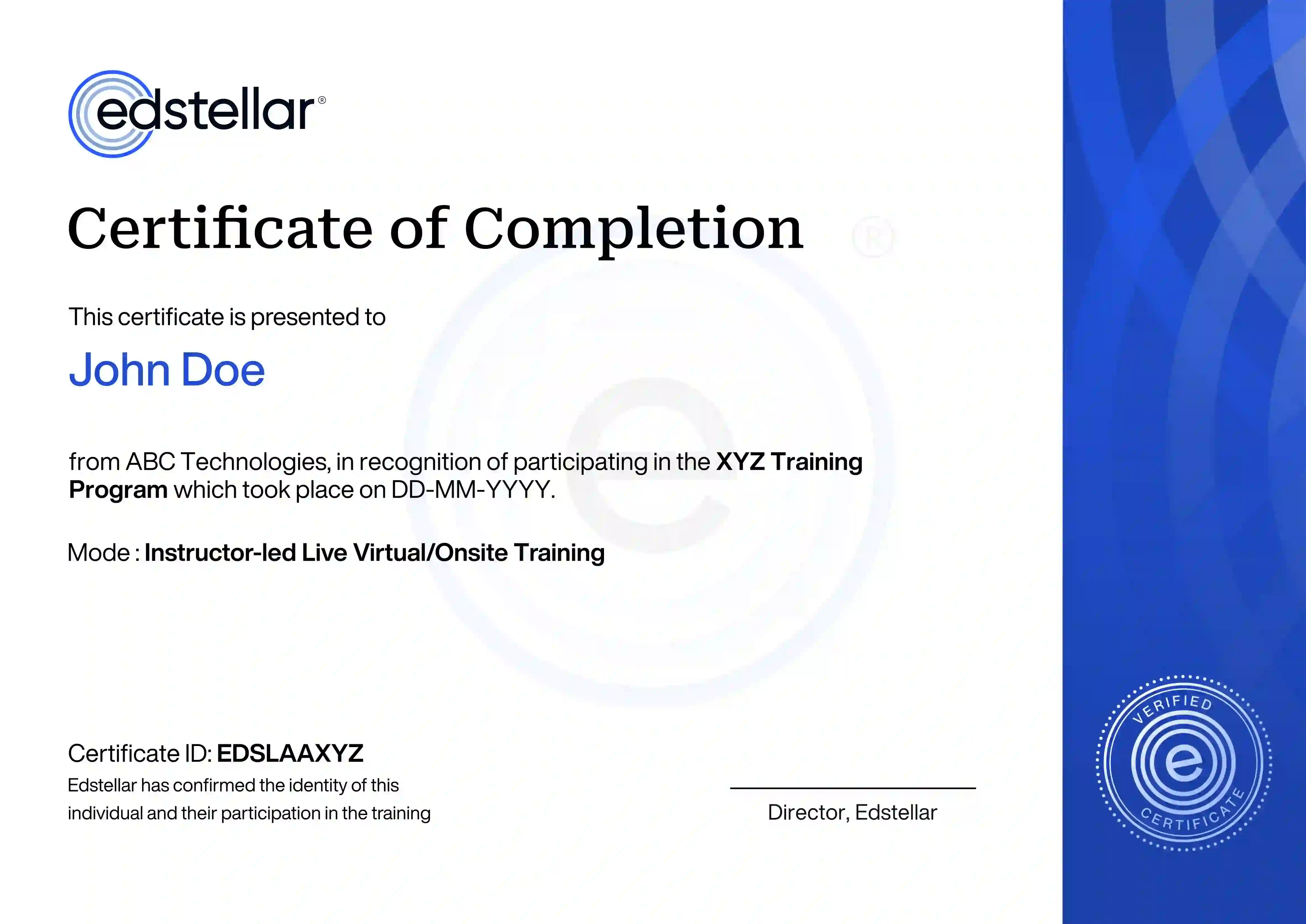
Upon successful completion of the training course offered by Edstellar, employees receive a course completion certificate, symbolizing their dedication to ongoing learning and professional development.
This certificate validates the employee's acquired skills and is a powerful motivator, inspiring them to enhance their expertise further and contribute effectively to organizational success.


Other Related Corporate Training Courses
Explore More Courses
Edstellar is a one-stop instructor-led corporate training and coaching solution that addresses organizational upskilling and talent transformation needs globally.
Marketing Excellence
Operational Excellence
Finance Excellence
HR Excellence
IT Excellence
Customer Service
Leadership Excellence
Quality Management
Software
How it WorksFAQ'sCorporate Training
CatalogStellar AI
Skill MatrixHRMS Integration
Who we ServeCEO RetreatsPricingTraining DeliveryPartner with Edstellar
CareersContact us