.svg "edstellar")

AI for Data Scientists Corporate Training Program for Employees
Equip your data science teams to apply generative AI across modeling, analysis, and automation with Edstellar's instructor-led, fully customized AI for Data Scientists training, delivered onsite or online worldwide.

(Virtual / On-site / Off-site)
.svg)
AI for Data Scientists is the application of artificial intelligence, especially generative AI techniques such as large language models, diffusion models, and autoencoders, within data science workflows to generate insights, automate data-related tasks, create synthetic data, and accelerate model development. It helps organizations such as fintech firms, healthcare institutions, and analytics-driven enterprises speed up innovation, reduce manual workload, and strengthen data-driven decision-making. AI for Data Scientists training gives your team the practical skills to integrate AI across the data science lifecycle, from data preparation and experimentation to model building, evaluation, and deployment at scale.
As organizations push generative AI into how they model, forecast, and build products, this program helps your data scientists apply AI confidently and responsibly inside real analytical pipelines. Empower your people with expert-led on-site, off-site, and virtual sessions delivered by Edstellar, a premier corporate training provider serving organizations worldwide in-person and virtually across popular languages. Built around your goals, the program turns AI for Data Scientists skills into lasting capabilities that lift performance across your data science, machine learning, analytics, and engineering teams.
By the end of the program, your team can integrate generative AI into data science workflows, build and fine-tune models, generate synthetic data, and deploy AI solutions that keep improving in production. The result is faster experimentation, less time lost to manual data work, and a data science function that turns AI from a buzzword into measurable business value across the organization.
.svg)

- Build, evaluate, and deploy generative AI models such as LLMs and diffusion models on real datasets.
- Integrate AI into data science pipelines to automate data preparation, experimentation, and reporting.
- Detect and correct bias in AI-generated content to keep outputs accurate and trustworthy.
- Translate business challenges into effective prompts and AI-ready problem statements.
- Track, log, and govern AI contributions to meet compliance and reproducibility standards.
- Troubleshoot unexpected model behavior and optimize models for performance at scale.
- AI foundations for data science
- Define generative AI and its role in modern data science
- Differentiate AI, machine learning, and deep learning
- Explore key model families: LLMs, diffusion models, autoencoders
- Business value of AI in data teams
- Map AI use cases across the data science lifecycle
- Identify business drivers for AI adoption in data teams
- Assess the value of AI for experimentation and decision-making
- Embedding AI in pipelines
- Embed generative AI into existing analytical pipelines
- Automate data preparation, cleaning, and feature engineering
- Generate synthetic data for training and testing
- Accelerating experimentation
- Accelerate exploratory analysis with AI assistants
- Use AI to speed up code, queries, and documentation
- Establish reproducible, version-controlled AI experiments
- Working with language models
- Apply large language models to text-based data
- Build sentiment analysis and text classification solutions
- Extract entities and key information from documents
- Generating and evaluating text
- Summarize and generate narrative reports with NLP
- Fine-tune language models on domain-specific data
- Evaluate the quality and accuracy of generated text
- Generative vision techniques
- Generate and enhance images with diffusion models
- Apply computer vision techniques to business data
- Use AI for image classification and object detection
- Multimodal and synthetic visuals
- Create synthetic visual data for model training
- Combine vision and language models for multimodal tasks
- Assess visual outputs for quality and relevance
- Responsible and fair AI
- Identify bias in models, data, and generated outputs
- Apply responsible AI and data privacy principles
- Track and log AI contributions for transparency
- Governance and compliance
- Align AI practices with organizational and regulatory policies
- Manage intellectual property and synthetic data risks
- Build governance for safe, compliant AI use
- Applying AI to real problems
- Translate business challenges into AI-compatible prompts
- Boost hypothesis generation and experiment design with AI
- Build AI copilots for analysis and reporting tasks
- Collaboration and impact
- Apply AI to forecasting, segmentation, and anomaly detection
- Collaborate on AI experiments using shared workspaces
- Measure the impact of AI on data science productivity
- From models to recommendations
- Turn model outputs into clear business recommendations
- Generate automated, stakeholder-ready insight narratives
- Integrate AI insights into business scenarios and planning
- Driving strategy with AI
- Support strategy with predictive and prescriptive analytics
- Communicate AI-driven findings to non-technical leaders
- Quantify the business value of AI initiatives
- Deploying AI to production
- Deploy generative AI models into production environments
- Monitor model performance, drift, and reliability
- Optimize and fine-tune models for scale and cost
- Continuous improvement
- Build feedback loops for continuous model improvement
- Collaborate with engineering and MLOps teams on deployment
- Plan long-term AI integration across data science teams
- Data Scientists
- Machine Learning Engineers
- AI Engineers
- AI Researchers
- Data Architects
- Business Intelligence Analysts
- Data Analysts
- Technical Program Managers
- AI Product Managers
- AI Ethicists
Participants need a working understanding of data science fundamentals and general comfort with Python, statistics, and machine learning concepts; deep prior experience with generative AI is not required. The program suits data scientists, machine learning engineers, AI engineers, data analysts, and business intelligence professionals who want to apply generative AI in their day-to-day work. Edstellar tailors the depth, tools, and datasets to your team's roles, your industry, and the data and systems your organization uses.


.webp "Virtual AI for Data Scientists Training")
.webp "On-site AI for Data Scientists Training")
.webp "Off-site AI for Data Scientists Training")
64 hours of group training (includes VILT/In-person On-site)
Tailored for SMBs
160 hours of group training (includes VILT/In-person On-site)
Ideal for growing SMBs
Tailor-Made Trainee Licenses with Our Exclusive Training Packages!
400 hours of group training (includes VILT/In-person On-site)
Designed for large corporations
Tailor-Made Trainee Licenses with Our Exclusive Training Packages!
Unlimited duration
Designed for large corporations
Experienced Trainers
Our trainers are drawn from a vetted global network and bring years of industry expertise, keeping every session practical and impactful.
Proven Quality
With a strong global track record, Edstellar is known for quality and engaging delivery.
Industry-Relevant Curriculum
Our programs are built by experts to match the demands of today's industry.
Fully Customizable
Every program can be tailored to your organization's goals.
Comprehensive Support
We provide pre- and post-session support for a complete learning experience.
Global Multi-Location & Multilingual Training Delivery
We deliver in multiple languages to support diverse global teams.
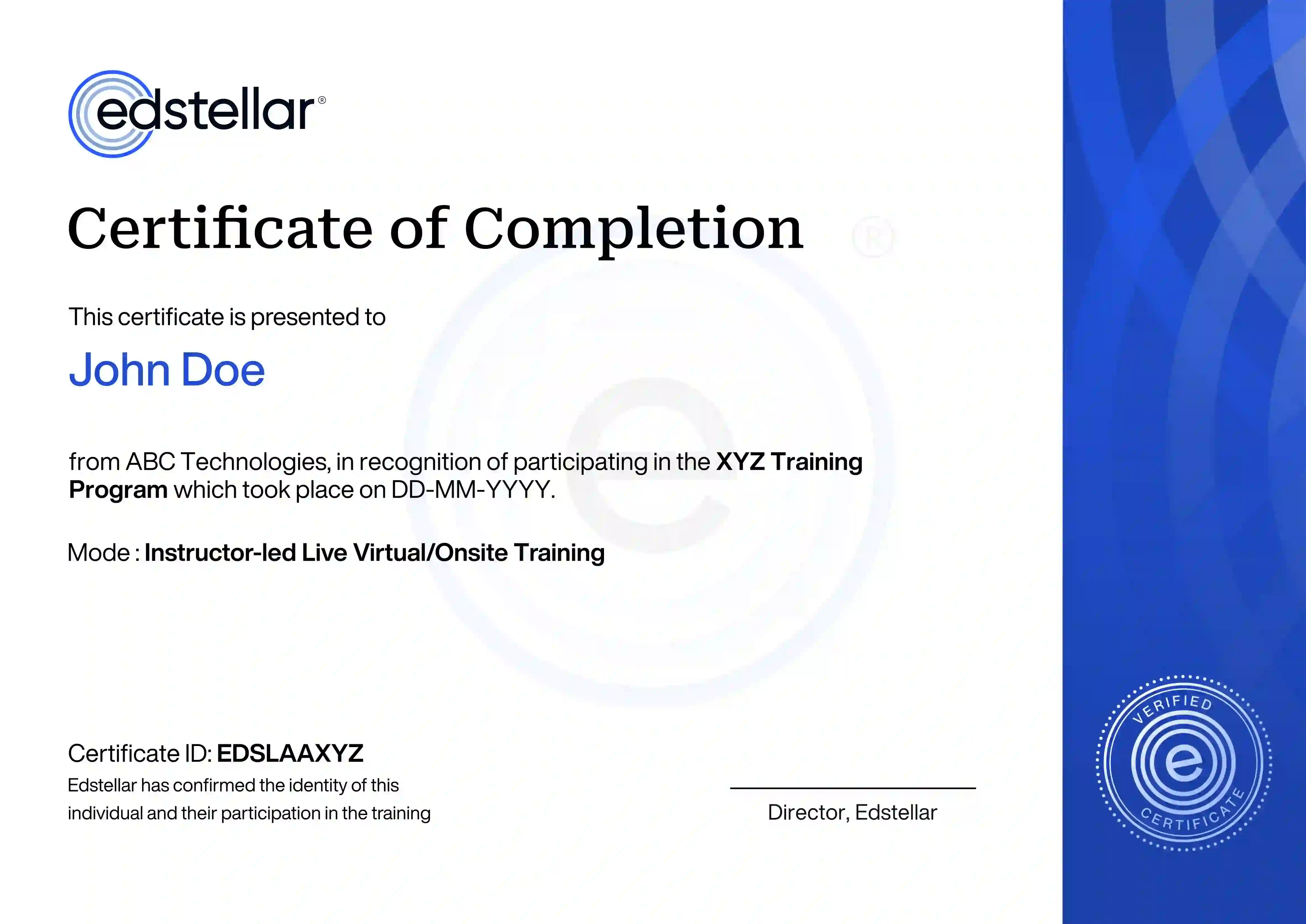
Recognition That Motivates Your Team

Frequently Asked Questions
Explore More Courses


.svg)
.svg)
.svg)

.svg)