

Prompt and Context Engineering for Enterprise Teams Corporate Training
Teach your teams to get reliable, high-quality output from AI, every day.
Give your enterprise teams the prompt and context skills that turn generic AI answers into reliable output. Edstellar's program teaches your operations, sales, HR, and IT teams to write precise prompts, supply the right context, and review AI output before it ships. We deliver this hybrid training with hands-on labs, each session tailored to your workflows, with assessments that track capability across your employees.
Instructor-led group trainingVirtual / on-site / hybrid10 languagesDelivered in English, Spanish, Mandarin, German, Arabic, Portuguese, Hindi, French, Japanese, Italian100+ countriesWe have delivered in United States, United Kingdom, India, Canada, Germany, France, Netherlands, UAE, Saudi Arabia, Singapore, Australia, Japan, Brazil, South Africa and 90+ more countries
How we build a prompt-ready team
THE EDSTELLAR PROMPT ENGINEERING CAPABILITY MODEL
Map current AI use
Skill checks reveal how your teams use AI prompts today, before module one begins.
One prompting standard
Align everyone on one approach: write prompts, add context, review output, reuse patterns.
Practice in hands-on labs
Rewrite real work prompts in guided labs, with instructor coaching on your use cases.
Prove the lift
Re-run skill checks and capstone reviews so leadership sees prompting capability rise.
Scale across teams
Roll out one prompt standard across operations, sales, HR, and IT everywhere.

Need more than one program?Get a group quote
Trusted as a Leading Corporate Training Provider by
















Program Overview: What is Prompt and Context Engineering for Enterprise Teams Corporate Training?
Prompt & Context Engineering for Enterprise Teams is Edstellar's instructor-led program for product, engineering, and operations teams putting AI to work in real workflows. Participants master prompt foundations, prompting techniques, context engineering, real-world enterprise use cases, and responsible use and quality. The program runs from first principles of prompting to a team prompt playbook.
Training is hands-on from the first module. Your team drafts prompts for their actual workflows, engineers context and grounding for enterprise data, and stress-tests outputs for quality in guided labs. Instructors coach participants through iteration, failure modes, and guardrails, reviewing every exercise with direct feedback on what the model got right and where the prompt failed. The program closes with a capstone where the team builds a prompt playbook for their real use cases.
Most enterprise AI efforts stall at clever demos: prompts that work once, context that leaks, and outputs nobody can trust in production. This program teaches your teams to engineer prompts and context systematically, ground AI in enterprise data, and enforce quality before anything ships. Your organization stops demoing AI and starts deploying it.
The capstone is a team prompt playbook build: each team takes its real enterprise use cases and produces production-ready prompt patterns, context templates, and quality checks, tested against edge cases and documented for reuse. The deliverable is a playbook the team can hand to the next hire and get consistent results. The review tests prompts on adversarial inputs, because an enterprise prompt that breaks under pressure was never production-ready.
Vague prompts waste time. Teams re-run AI answers that miss the mark, rewrite weak drafts, and skip grounding so outputs hallucinate. Participants learn to frame tasks clearly, attach the right context, and review output with a checklist, then practice on their own work with instructor feedback.
The result: teams that get reliable, usable AI output on the first attempt, with shared patterns that keep quality consistent across the organization.
What's Included in this Workshop for Your Enterprise Teams
- 1
Prompt foundations
Core prompt skills your team uses daily.
- 2
Context engineering labs
Ground AI answers in your documents and data.
- 3
Quality review routines
Check AI output before it ships.
- 4
Reusable prompt patterns
Ready patterns for drafting and summaries.
- 5
Team prompt playbook
Ship a shared playbook for your team.
- Training delivered at any of your offices globally
- 10+ languages
- Schedule around your calendar
- Group size set along with you
- Run as one cohort or split into batches
- Instructor-led (virtual/onsite/hybrid)
- Recurring and annual options
- Trainer sourcing, matching and logistics
Build your team's skills. Anywhere in the world.
Real-world use cases
from day one
Instructor-led training
for your teams
Delivered globally
in 100+ countries


Enterprise Training Solutions Customized for Your Company
One partner for instructor-led corporate training, delivered the way your teams work.
Request a Training Quote- Customized Training Delivery
- Scale Your Training: Small to Large Teams
- In-person Onsite, Live Virtual or Hybrid Training Modes
- Plan from 2000+ Industry-ready Training Programs
- Prompt Writing and Review Exercises, Led by Industry Experts
Prompt and Context Engineering Topics and Program Outline
A six-module program covering prompt design, context engineering, real-world use cases, and responsible use. Teams practice in hands-on labs and finish with a team prompt playbook for daily work.
Built by Edstellar's AI trainers
Built by practitioners in AI enablement, with lab feedback on every exercise your team completes.
Baseline each participant's prompt engineering readiness before module 01 begins
Build strong prompt engineering foundations in instructor-led sessions for your team
Reinforce skills through guided hands-on labs on prompts, context, and workflows
Apply prompt engineering skills to real-world scenarios and a capstone prompt playbook project
A short pre-training assessment sets each participant's entry level, so the program starts where your team actually is. The rest is weighted toward hands-on practice: prompt labs, context engineering exercises, and realistic scenarios drawn from your team's work, not slides.
Delivered as
Entry level set by the assessment. Depth and schedule customized to your team.

Rewrite a weak prompt into one with clear intent, format, and constraints.
learnHow AI assistants interpret prompts
Anatomy of an effective prompt
Framing tasks with clear intent
Baseline skills check
Apply few-shot, role, and step-by-step techniques to improve output on a work task.
learnFew-shot examples that work
Roles, formats, and constraints
Step-by-step reasoning prompts
Iterating toward better output
Ground AI answers in your documents and check citations and sources.
practiceWhat counts as good context
Grounding answers in documents
Retrieval basics for teams
Checking citations and sources
Draft emails, reports, and meeting summaries with AI for real use cases.
practiceDrafting emails, reports, and plans
Summarizing meetings and documents
Analyzing data with AI assistance
Brainstorming and structuring ideas
Review AI output for hallucinations and privacy risks and start a shared prompt library.
practiceSpotting hallucinations fast
Data privacy and safe inputs
Review checklists before shipping
Building shared prompt libraries
Capstone lab: build and present your team's prompt playbook.
applyAuditing your team's current prompts
Rewriting prompts with context
Writing the playbook with standards
Presenting the rollout plan
Customize This Program Tailored to Your Team?
Tell us your training needs: what your team already works with, the level they’re at, and the topics you want them to focus on. We’ll adjust the modules, duration and hands-on labs, and send you a customized outline for your group.
Key Skills and Outcomes Your Team Will Gain
By the end of this program, your team will write sharper prompts, supply better context, and review AI output with confidence. Each competency is practiced in guided labs with instructor feedback.
Write effective prompts
Frame tasks with clear intent, context, and format so AI assistants return usable output.
Use examples in prompts
Add few-shot examples that steer tone, structure, and quality toward the standard you want.
Engineer good context
Attach the right documents, data, and background so answers are grounded in your work.
Summarize long content
Turn meetings, reports, and threads into concise summaries with verified key points.
Review AI output quality
Check answers against sources, catch hallucinations, and apply fixes before anything ships.
Build prompt libraries
Collect tested prompts and patterns so your team reuses what works across projects.
Prompt responsibly
Keep sensitive data out of prompts and follow review rules your team trusts.
Teams that Benefit from this Prompt Engineering Group Training
This program is built for operations, sales, marketing, HR, and IT teams who use AI assistants in daily work. No technical background is needed: content adapts to role and experience, so each cohort improves the prompts they actually use.
Reliable output from every prompt.
Operations teams learn to write precise prompts for reports, summaries, and coordination. They practice grounding AI answers in their own documents and data.
Workflow friction
- Rewrites eat up the week
- Answers miss the context
- Output quality varies daily
How the program helps
- Write sharper prompts
- Ground answers in documents
- Standardize quality checks
Practice use cases
- Report drafting
- Meeting summaries
- SOP reviews
Faster drafts, sharper messaging.
Sales and marketing teams learn to prompt for proposals, campaigns, and customer messages. They practice few-shot examples that keep tone and quality consistent.
Workflow friction
- Drafts start from scratch
- Tone shifts between reps
- Research takes too long
How the program helps
- Draft faster with prompts
- Keep messaging consistent
- Summarize research quickly
Practice use cases
- Proposal drafts
- Campaign copy
- Call summaries
Consistent, careful AI assistance.
HR and people teams learn to prompt for job posts, policies, and employee communications. They practice review checklists that keep sensitive work accurate and safe.
Workflow friction
- Policies take long to draft
- Messages lack consistency
- Data privacy is a worry
How the program helps
- Draft policies faster
- Keep comms consistent
- Use AI safely at work
Practice use cases
- Job descriptions
- Policy drafts
- Internal comms
Better answers, fewer tickets.
IT and support teams learn to prompt for troubleshooting, documentation, and knowledge articles. They practice context engineering that grounds answers in internal guides.
Workflow friction
- Knowledge articles lag behind
- Troubleshooting takes long
- Answers vary by agent
How the program helps
- Draft articles faster
- Ground answers in guides
- Standardize troubleshooting
Practice use cases
- KB articles
- Ticket summaries
- Runbook drafting
Every cohort practices on its own work, so labs stay relevant to the prompts each team writes daily.
Prerequisites: This program benefits engineers, product teams, and analysts who design prompts and context for enterprise AI applications. Familiarity with large language models or scripting helps but is not required, and no prior prompt engineering experience is needed. Content adapts to each cohort's use cases, tools, and experience level.
From basic prompts to a team prompt playbook
The learn modules build prompt foundations and a toolkit of prompting techniques, so every team member writes sharper prompts immediately. Practice modules scale the craft: engineering context from internal documents, applying prompting to real-world use cases, and holding output to responsible-use quality standards. The capstone compiles everything into a team prompt playbook that keeps tone and quality consistent after training ends.
Teams move from writing one-off prompts to grounding answers in enterprise documents and standardizing quality across the whole team.
Different Teams, Locations, Time Zones, or Languages? We've Got You Covered.
Whether your teams are spread across countries, time zones, languages, or experience levels, we deliver tailored training programs that ensure a consistent learning experience across your global workforce.
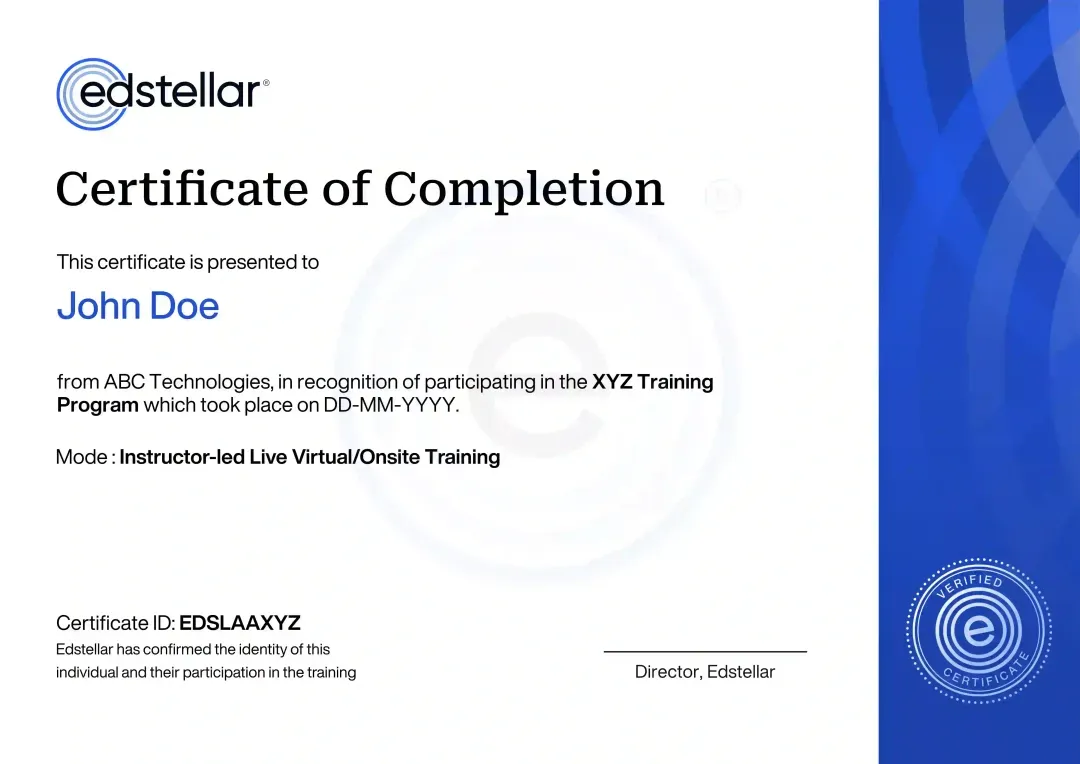
Certificate of Training Completion.
On successful completion, employees receive an Edstellar course completion certificate, recognizing their commitment to ongoing learning and professional development. It validates the skills they have built and motivates them to keep growing and contribute to organizational success.
Earned, not attended. Awarded on completion of all hands-on labs and the capstone project.
Training Delivery Modes: Onsite, Virtual and Hybrid
Every mode is instructor-led and tailored to your work before delivery. The curriculum, hands-on labs, assessments, and capstone stay the same across onsite, live virtual, and hybrid formats, so capability is consistent however you run it.
Onsite Training
Your instructor delivers at your facility with labs set up for your team. Every participant rewrites prompts around your work, with same-room coaching on context and quality checks.
- Instructor delivers at your facility
- Labs built around your workflows
- Practice prompts together with coaching
- Best for co-located teams wanting maximum interaction

Live Virtual Training
Live virtual sessions run instructor-led on your preferred platform. Your team joins guided prompt labs and breakout exercises, sharing screens for real-time coaching on prompts and context.
- Live instructor-led sessions on your platform
- Guided labs with breakout troubleshooting
- Screen-shared prompt reviews in real time
- Ideal for distributed teams across locations

Hybrid Training
Live instruction plus supervised hands-on labs, across onsite and virtual sessions. Your team rewrites real prompts with instructor coaching, mixing in-person depth with the flexibility of live virtual.
- Live instruction across onsite and virtual sessions
- Guided prompt labs with coaching on your use cases
- Practice prompting in real time
- Best for flexible schedules with real hands-on practice

Need a Customized Training Format That Works for Your Team?
Our training delivery is customized to your team's schedule, full days, half days, sessions spread across weeks, or modular formats. Share your preferred timeline, and we'll plan the training around it.
Frequently Asked Questions
Share your team size, use cases, and preferred format, and we will send a tailored proposal with transparent pricing. A short discovery call helps us scope the right mix of labs and customization for your group.
Yes. Start with a discovery call so we can review your roles, AI use, and goals, then recommend the right modules and delivery format for your team.
Yes. Live virtual sessions run instructor-led on your preferred platform, with the same hands-on labs, breakout exercises, and capstone as other formats.
Yes. Your instructor delivers at your facility with labs set up for your team, and we handle scheduling, materials, and logistics around your calendar.
The full program is 20 hours across six modules, usually delivered as short daily sessions over one to two weeks. We can also compress it into intensive days or spread it out to fit your calendar.
Question Not Answered Here?
Put it in the request. A training specialist answers it directly, within one business day.
Where this Training Fits in Your Team's learning path.
Prompt and context engineering follows AI fluency and everyday tool use, once your team has seen where simple prompts fall short. This course makes outputs reliable and repeatable, which is exactly what agentic AI needs in the next step.

AI FLUENCY FIRST
AI Fluency for Every Employee (AI Literacy Programme) Corporate Training
Build a shared understanding of AI and how language models produce answers.

USE AI TOOLS
AI Productivity Tools for Knowledge Workers Training
Use AI assistants in daily work and see where basic prompts give weak results.

ENGINEER PROMPTS AND CONTEXT
Prompt & Context Engineering for Enterprise Teams Training
Design structured prompts, examples, system instructions and context sources for consistent, testable outputs across teams.

MOVE TO AGENTS
Agentic AI Corporate Training
Apply prompt and context skills to agents that plan, use tools and take actions.
Why Choose Edstellar as Your Prompt and Context Engineering for Enterprise Teams Corporate Training Provider
As your training partner, we make comparing providers simple: share your training needs and we shape a prompt engineering program around your workflows, timelines, and team size. Our trainers bring deep AI expertise, and every trainer profile is shared before your program is booked.

EXPERT TRAINERS
YEARS DELIVERING
ORGANIZATIONS TRAINED
CERTIFIED
Tailored
Content shaped around your prompting and context-engineering use cases, so every session maps to your real enterprise AI needs.
Proven Methodology
Concise instruction followed by guided labs and reviews, a repeatable method that turns Prompt and Context Engineering for Enterprise Teams into confident daily practice.
Practice-Based Learning
5 hands-on labs across 6 modules. Your team builds team prompt playbooks and shared context guidelines with instructor guidance.
Expert Trainers
5,000+ certified trainers matched to your prompt engineering domain, with a full trainer profile shared before your program is booked.
Global Scale
One prompt and context engineering program across your offices worldwide, in hybrid, onsite, or live virtual.
Measurable Outcomes
Baseline-to-capstone measurement and Skills Matrix reporting keep your prompt engineering capability lift visible.
Improve Enterprise AI Prompts Through Better Context and Disciplined Output Review
Edstellar helps teams turn loosely defined AI requests into clear, reviewable workflows. Participants refine task instructions, select grounding material, and test prompts across drafting, summarization, and analysis examples. A shared playbook consolidates prompt standards and review checks, assessed for source use, output quality, privacy awareness, and practical team adoption.
- Step 01
Consult
We explore AI-assistant familiarity, recurring document tasks, and output-quality concerns to identify gaps in task framing, context selection, source checking, or safe input practices.
- Step 02
Plan
We connect prompt foundations and example-based techniques with context selection and grounding, then apply them to workplace tasks before developing responsible-use checks and a playbook.
- Step 03
Align
We align prompt and context-engineering facilitation with participants' workflows, confirming appropriate AI tools and boundaries for handling confidential documents during practice.
- Step 04
Customize
We adapt non-sensitive emails, reports, and meeting notes to familiar tasks, varying audience, output constraints, and supporting context so participants can compare prompt behavior.
- Step 05
Execute
Participants rewrite prompts, test supplied context, and inspect citations or unsupported claims, receiving feedback on task clarity, evidence use, and the adequacy of review checks.
- Step 06
Evaluate
We assess the team playbook for usable prompt patterns, clear context standards, source-verification checks, and explicit human-review responsibilities before outputs enter workplace use.
Also from Edstellar
Talent assessments
Psychometric, behavioral, leadership and 360-degree assessment.
→Training needs analysis
Needs analysis, gap identification, and a training roadmap.
→L&D consulting
Learning strategy, content, technology and ROI measurement.
→OD consulting
Org design, succession planning and cultural change.
→Managed training services
Training outsourcing, vendor management, logistics and administration.
→Coaching solutions
Executive and manager coaching that keeps skills in use.
Start an RFP shaped to your needs.
Answer three quick questions about team size, scope, and how often you need the program run, then send the request from the last step. Everything you choose travels with it, so you only fill this in once.
How many team members need training?
Prompt & Context Engineering for Enterprise Teams Training Packages & Pricing
Where L&D holds an annual budget, license packages price the whole year at once instead of raising a purchase order per workshop. Hours and licenses are pooled across teams, programs and locations, so unused capacity is not stranded in one department.
Starter
120
trainee licenses64 hours of group training
Tailored for SMBs
Growth
320
trainee licenses160 hours of group training
Ideal for growing SMBs
Enterprise
800
trainee licenses400 hours of group training
Designed for large corporations
Custom
Unlimited
trainee licensesDuration set by the rollout
Multi-region and multi-year
Training Packages & Pricing
Choose the training format that works for your team. Pricing is customized based on your requirements, cohort size, and delivery needs.
Request a Quote for Prompt Engineering Training for Your Team
Tell us your team size, roles, and preferred delivery mode. We will confirm availability and respond with a tailored training plan covering scope, schedule, and pricing.