.svg "edstellar")

Architecting with Google Compute Engine Corporate Training Program for Employees
Give your teams the skills to design, deploy, scale, and secure production infrastructure on Google Compute Engine, guided by certified instructors and tailored to your cloud environment.

(Virtual / On-site / Off-site)
.svg)
Architecting with Google Compute Engine is an instructor-led program that teaches teams how to deploy and manage solutions using Google Cloud infrastructure, with Compute Engine at the core. Your engineers learn to provision virtual machines, design VPC networks, control access with Cloud IAM, choose the right storage and database services, automate infrastructure, and build systems that scale and stay reliable in production. It maps to Google's official Architecting with Google Compute Engine curriculum.
As organizations move business-critical workloads onto Google Cloud, this program helps your teams build infrastructure that stays scalable, secure, and cost-efficient under real production load. Empower your people with expert-led on-site, off-site, and virtual sessions delivered by Edstellar, a premier corporate training provider serving organizations worldwide. Built around your goals, the program turns Google Compute Engine skills into lasting capabilities that lift performance across your engineering, platform, and operations teams.
The payoff is measurable: fewer outages from better reliability and autoscaling design, lower cloud spend from right-sized machine types and managed services, and faster delivery from automated, repeatable infrastructure. Teams leave able to defend infrastructure decisions to stakeholders and to prepare for the Google Cloud Associate Cloud Engineer and Professional Cloud Architect credentials, giving your organization in-house cloud authority instead of recurring consulting bills.
.svg)

- Provision and manage Compute Engine virtual machines sized and priced for the workload.
- Design secure VPC networks with subnets, firewalls, and hybrid connectivity.
- Apply Cloud IAM roles and least-privilege access across the organization.
- Select the right storage and database services and balance cost, latency, and durability.
- Automate infrastructure with templates, images, and managed instance groups for repeatable deployments.
- Build reliability and scale through load balancing, autoscaling, monitoring, and logging.
- Google Cloud and Compute Engine Foundations
- Google Cloud resource hierarchy: organizations, folders, and projects
- Interacting with Google Cloud: Console, Cloud Shell, and gcloud CLI
- Regions, zones, and the Compute Engine service model
- Billing, quotas, and cost-control basics
- Virtual Networks with VPC
- Designing VPC networks, subnets, and IP address planning
- Firewall rules, routes, and network tags
- Internal and external load balancing options
- DNS, Cloud NAT, and private Google access
- Compute Engine Virtual Machines
- Choosing machine types, families, and custom configurations
- Disks, images, snapshots, and persistent storage
- Metadata, startup scripts, and instance customization
- Preemptible and spot VMs for cost optimization
- Cloud IAM and Security
- IAM roles, policies, and least-privilege design
- Service accounts and workload identity
- Resource-level access control and audit logging
- Encryption, key management, and network security controls
- Storage and Database Services
- Matching data to Cloud Storage, Filestore, and persistent disks
- Selecting databases: Cloud SQL, Spanner, Firestore, and Bigtable
- Balancing cost, consistency, latency, and durability
- Data lifecycle, backup, and retention design
- Resource Management and Monitoring
- Resource hierarchy, labels, and quotas at scale
- Cloud Monitoring, Logging, and observability design
- Alerting, dashboards, and incident response
- Cost monitoring and ongoing optimization
- Interconnecting Networks
- Cloud VPN, Cloud Interconnect, and peering options
- Shared VPC and VPC Network Peering patterns
- Hybrid and multi-environment connectivity design
- Network performance and security trade-offs
- Load Balancing and Autoscaling
- Managed instance groups and instance templates
- Global and regional load balancing strategies
- Autoscaling policies and capacity planning
- Designing for high availability across zones and regions
- Infrastructure Automation and Managed Services
- Infrastructure as code with templates and Terraform
- Automated, repeatable environment provisioning
- Managed services: GKE, App Engine, Cloud Run, and Cloud Functions
- When to choose managed services over self-managed VMs
- Cloud Engineers
- Solution Architects
- System Architects
- Infrastructure Engineers
- DevOps Engineers
- Software Engineers
- Network Engineers
- IT Administrators
- System Administrators
- Security Engineers
- Back-end Developers
- Managers
Participants should be comfortable with basic Google Cloud concepts and have some hands-on experience deploying applications or managing infrastructure, equivalent to completing Google Cloud Fundamentals. Familiarity with networking basics, the command line, and at least one programming or scripting language helps teams get the most from the hands-on labs, though Edstellar tailors depth and pace to your group's starting level.


.webp "Virtual Architecting with Google Compute Engine Training")
.webp "On-site Architecting with Google Compute Engine Training")
.webp "Off-site Architecting with Google Compute Engine Training")
64 hours of group training (includes VILT/In-person On-site)
Tailored for SMBs
160 hours of group training (includes VILT/In-person On-site)
Ideal for growing SMBs
Tailor-Made Trainee Licenses with Our Exclusive Training Packages!
400 hours of group training (includes VILT/In-person On-site)
Designed for large corporations
Tailor-Made Trainee Licenses with Our Exclusive Training Packages!
Unlimited duration
Designed for large corporations
Experienced Trainers
Our trainers are drawn from a vetted global network and bring years of industry expertise, keeping every session practical and impactful.
Proven Quality
With a strong global track record, Edstellar is known for quality and engaging delivery.
Industry-Relevant Curriculum
Our programs are built by experts to match the demands of today's industry.
Fully Customizable
Every program can be tailored to your organization's goals.
Comprehensive Support
We provide pre- and post-session support for a complete learning experience.
Global Multi-Location & Multilingual Training Delivery
We deliver in multiple languages to support diverse global teams.
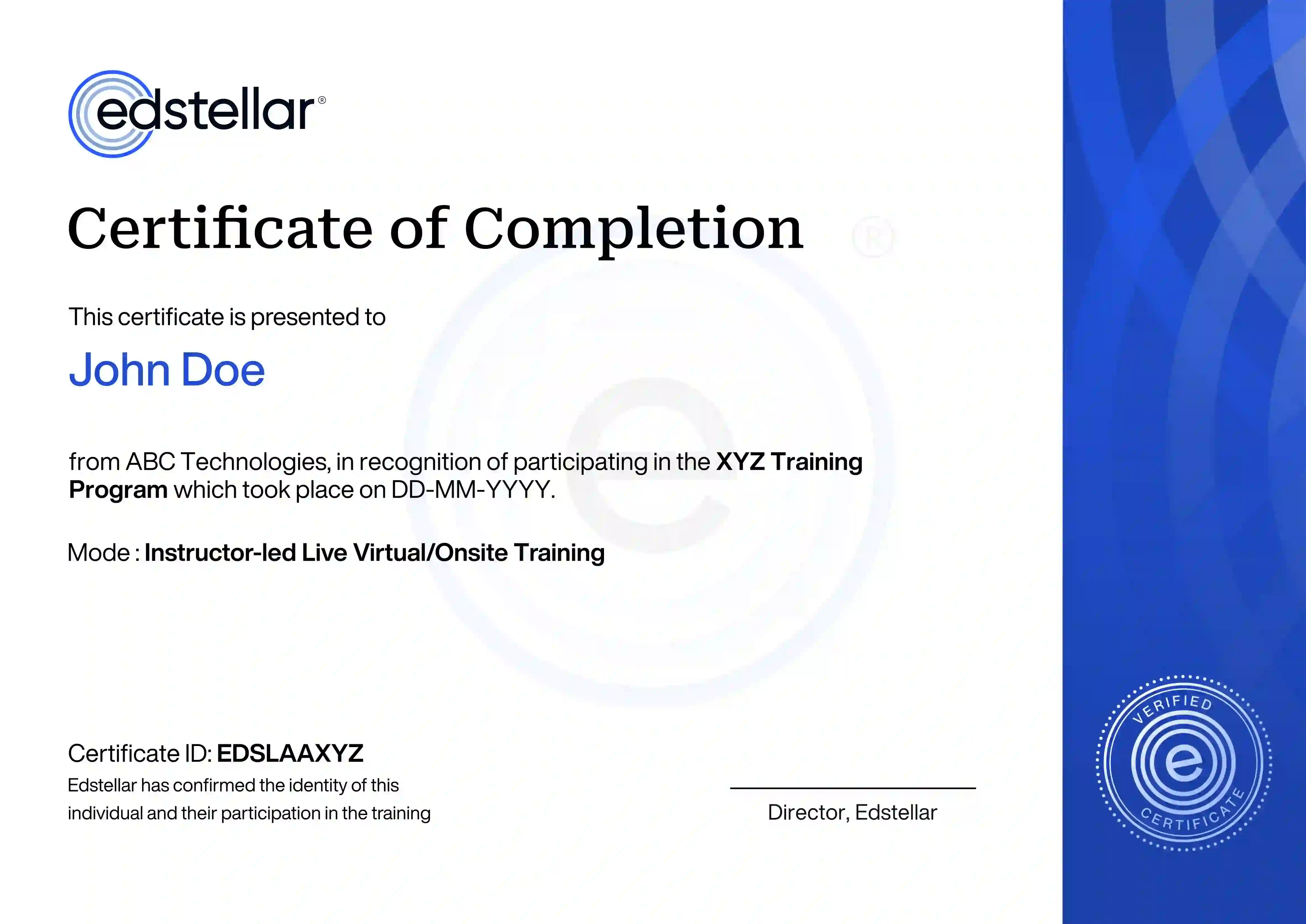
Recognition That Motivates Your Team

Frequently Asked Questions
Other Related Corporate Training Courses


Explore More Courses


.svg)
.svg)
.svg)

.svg)