.webp)
Corporate Strategic Marketing Training Course
Edstellar's Strategic Marketing instructor-led training course enhances your team's marketing skills and strategic thinking. The course empowers professionals to analyze market trends, understand consumer behavior, and create comprehensive marketing plans. Upskill teams to develop ethical marketing practices.
(Virtual / On-site / Off-site)
Available Languages
English, Español, 普通话, Deutsch, العربية, Português, हिंदी, Français, 日本語 and Italiano
Drive Team Excellence with Strategic Marketing Corporate Training
Implementing strategic marketing involves developing a mix of activities that work cohesively to reach and influence the target audience. Strategic marketing also places a strong emphasis on measuring and analyzing the effectiveness of marketing activities.Organizations attain overall business objectives through strategic marketing training, which enables them to formulate a distinct course of action for their marketing endeavors.
The Strategic Marketing instructor-led training course emphasizes the importance of data-driven decision-making and enables professionals to measure and analyze the impact of their marketing strategies. Edstellar customizes the virtual/onsite Strategic Marketing training course to align with the specific needs and challenges of each organization. This training ensures that it is directly applicable to the professionals' real-world marketing challenges.

Skills Your Employees Will Gain
These are the core, hands-on capabilities your team builds during the program.
- Applied Marketing ConceptsApplied Marketing Concepts is the process of optimizing software structures for performance and scalability. This skill is important for software architects and developers to ensure efficient, maintainable systems that meet user needs.
- Market AnalysisMarket Analysis is the process of assessing market trends, competition, and consumer behavior. This skill is important for roles in marketing, sales, and product development, as it informs strategic decisions and drives business growth.
- Targeted MarketingTargeted Marketing is the practice of directing marketing efforts to specific segments of consumers. This skill is important for roles in marketing and sales, as it enhances campaign effectiveness, boosts customer engagement, and maximizes ROI.
- Information SynthesisInformation Synthesis is the ability to combine diverse data sources into coherent insights. This skill is important for roles like analysts and researchers, enabling informed decision-making.
- Digital Marketing ImplementationDigital Marketing Implementation involves executing strategies across online platforms to enhance brand visibility and engagement. This skill is important for roles in marketing, as it drives customer acquisition and retention.
- Data-Driven Campaign EvaluationData-Driven Campaign Evaluation involves analyzing campaign performance using data analytics to inform decisions. This skill is important for marketers and analysts to optimize strategies, enhance ROI, and ensure targeted messaging.
What Your Team Will Achieve After This Training
- Apply theoretical marketing concepts to real-world business scenarios
- Analyze complex market dynamics to develop insightful marketing strategies
- Evaluate the effectiveness of marketing campaigns using data-driven metrics
- Implement digital marketing tools and techniques for enhanced online presence
- Design targeted marketing initiatives that resonate with diverse consumer segments
- Synthesize information from various sources to form a cohesive marketing approach
- Create innovative and effective marketing plans tailored to specific organizational goals
- Demonstrate leadership in collaborative projects, driving team success in marketing endeavors
Topics & Program Outline
The curriculum is organized into focused modules built by industry experts and delivered virtually or on-premise. Interactive sessions reflect the evolving demands of the workplace, keeping the learning both relevant and practical.
- Understanding marketing strategy
- Definition and scope of marketing strategy
- Evolution of marketing strategy over time
- Key components of a successful marketing strategy
- Role of marketing in business
- Marketing's impact on business growth and sustainability
- Integration of marketing with other business functions
- The strategic role of marketing in business planning
- Market research and analysis
- Techniques for effective market research
- Analyzing market research data
- Utilizing market research in strategic planning
- Consumer behavior insights
- Factors influencing consumer behavior
- Methods to analyze and predict consumer behavior
- Applying consumer behavior insights in marketing strategies
- Competitive analysis
- Identifying and analyzing competitors
- Competitive benchmarking techniques
- Leveraging competitive analysis for strategic advantage
- Setting SMART marketing objectives
- Defining SMART objectives
- Aligning marketing objectives with business goals
- Measuring and tracking marketing objectives
- Segmenting consumer markets
- Criteria for segmenting consumer markets
- Techniques for market segmentation
- Evaluating and selecting market segments
- B2B market segmentation
- Differences between B2B and B2C segmentation
- Approaches to segmenting business markets
- Applying B2B segmentation in marketing strategies
- Selecting target markets
- Criteria for target market selection
- Assessing market attractiveness and company fit
- Strategies for targeting multiple market segments
- Positioning your brand
- Developing a brand positioning strategy
- Techniques for effective brand positioning
- Positioning in relation to competitors
- Unique Selling Proposition (USP)
- Identifying and defining a USP
- Integrating USP into marketing communications
- Evaluating the effectiveness of a USP
- Effective market targeting strategies
- Developing targeting strategies
- Tailoring marketing mix to target markets
- Monitoring and adapting targeting strategies
- Product development and innovation
- Stages of product development
- Fostering innovation in product design
- Incorporating customer feedback in product development
- Product life cycle management
- Understanding the product life cycle stages
- Strategies for each stage of the product life cycle
- Managing products through their life cycle
- Pricing strategies
- Different pricing models and strategies
- Factors influencing pricing decisions
- Implementing and adjusting pricing strategies
- Branding and brand management
- Elements of strong brand management
- Building and maintaining brand equity
- Strategies for brand revitalization and rebranding
- Creating a brand identity
- Components of a brand identity
- Designing and implementing a brand identity
- Consistency and coherence in brand identity across platforms
- Product and service positioning
- Techniques for effective product/service positioning
- Differentiating products/services in the market
- Aligning product positioning with brand strategy
- Types of distribution channels
- Overview of various distribution channels
- Pros and cons of different channel types
- Selecting appropriate channels for product/service
- Channel selection and management
- Criteria for channel selection
- Managing and optimizing distribution channels
- Building relationships with channel partners
- Retail Vs online distribution
- Comparing retail and online distribution models
- Blending retail and online for omnichannel distribution
- Strategies for effective online distribution
- Channel conflict resolution
- Identifying sources of channel conflict
- Strategies to manage and resolve channel conflicts
- Maintaining channel harmony
- Supply chain management
- Role of supply chain in distribution
- Optimizing supply chain for efficient distribution
- Integration of supply chain with marketing strategy
- Distribution metrics and KPIs
- Key metrics for measuring distribution effectiveness
- Setting and tracking distribution KPIs
- Using metrics to improve distribution strategy
- Components of IMC
- Understanding the various components of IMC
- Developing an integrated approach to marketing communications
- Ensuring consistency across all IMC components
- Advertising strategies
- Designing effective advertising campaigns
- Choosing the right media for advertising
- Measuring the impact of advertising
- Public relations and media relations
- Building and maintaining public relations
- Strategies for effective media relations
- Crisis management in PR
- Digital marketing
- Key elements of digital marketing
- Developing a digital marketing strategy
- Leveraging digital channels for maximum impact
- Social media marketing
- Utilizing different social media platforms
- Creating engaging social media content
- Measuring social media marketing success
- Content marketing
- Developing a content marketing strategy
- Creating and distributing valuable content
- Measuring the effectiveness of content marketing
- Promotions and sales
- Planning and executing promotional campaigns
- Aligning promotions with sales objectives
- Measuring the success of promotional activities
- Importance of marketing analytics
- Role of analytics in marketing decision-making
- Benefits of a data-driven approach in marketing
- Challenges and opportunities in marketing analytics
- Data collection and analysis
- Techniques for collecting marketing data
- Tools for analyzing marketing data
- Interpreting data for strategic decisions
- Customer Relationship Management (CRM)
- Implementing CRM systems
- Leveraging CRM for marketing insights
- Integrating CRM with marketing strategy
- Key metrics and KPIs
- Identifying key marketing metrics and KPIs
- Setting and tracking marketing KPIs
- Using KPIs to drive marketing performance
- ROI measurement
- Calculating marketing ROI
- Factors affecting marketing ROI
- Strategies for improving ROI
- A/B testing and optimisation
- Basics of A/B testing
- Implementing A/B tests in marketing campaigns
- Using A/B testing results for optimization
- Building a marketing plan
- Steps in creating a marketing plan
- Components of an effective marketing plan
- Customizing marketing plans for different contexts
- SWOT analysis
- Conducting a SWOT analysis for marketing
- Utilizing SWOT analysis in strategic planning
- Integrating SWOT findings into marketing strategies
- Marketing budgeting and resource allocation
- Planning and allocating marketing budgets
- Optimizing resource allocation for maximum impact
- Balancing budget constraints with marketing goals
- Implementation and execution
- Strategies for effective implementation of marketing plans
- Overcoming challenges in plan execution
- Ensuring alignment of execution with strategy
- Monitoring and adjusting the Plan
- Techniques for monitoring marketing plan performance
- Adjusting marketing plans based on performance data
- Flexibility and responsiveness in marketing planning
- Marketing plan presentation
- Preparing and presenting a marketing plan
- Communicating marketing strategies to stakeholders
- Persuasive techniques in marketing presentations
- Expanding to international markets
- Identifying opportunities in international markets
- Strategies for entering and expanding in global markets
- Overcoming challenges in international expansion
- Global marketing strategies
- Developing marketing strategies for global markets
- Adapting marketing mix for international audiences
- Global vs. local marketing approaches
- Cultural considerations
- Understanding cultural differences in global marketing
- Customizing marketing strategies to fit cultural norms
- Building culturally sensitive marketing campaigns
- Legal and ethical issues
- Navigating legal and regulatory environments in global marketing
- Ethical considerations in international marketing
- Compliance with international marketing laws and standards
- Global branding
- Strategies for building a global brand
- Managing brand reputation across different markets
- Balancing global and local brand elements
- Challenges and opportunities in global marketing
- Identifying and addressing global marketing challenges
- Leveraging opportunities in international markets
- Adapting to changing global marketing landscapes
Who Should Attend?
This program suits professionals at many levels across the organization, including:
- Marketing Directors
- Market Development Coordinators
- Corporate Communications Specialists
- Marketing Executives
- Sales Directors
- Digital Marketing Managers
- Campaign Managers
- Market Research Analysts
- Advertising Managers
- Content Strategists
- Marketing Analysts
- Marketing Coordinators
What are the Prerequisites?
The Strategic Marketing training can be taken by professionals with a basic understanding of marketing principles.
Choose the Format That Fits Your Team
We design training your teams actually engage with, and deliver it the way that suits you best. Through a vetted global trainer network, Edstellar runs sessions in 10+ languages with consistent quality anywhere.


.webp)
Virtual / online: expert-led live sessions delivered anywhere, with consistency and easy scheduling.
.webp)
On-site (in-house): immersive, instructor-led learning at your office.
.webp)
Off-site: focused, instructor-led group learning away from everyday workplace distractions.
Get a Proposal Shaped to Your Needs
Need pricing for onsite, offsite, or virtual delivery? Get a proposal tailored to your team's needs.
64 hours of group training (includes VILT/In-person On-site)
Tailored for SMBs
Tailor-Made Trainee Licenses with Our Exclusive Training Packages!
160 hours of group training (includes VILT/In-person On-site)
Ideal for growing SMBs
Tailor-Made Trainee Licenses with Our Exclusive Training Packages!
400 hours of group training (includes VILT/In-person On-site)
Designed for large corporations
Tailor-Made Trainee Licenses with Our Exclusive Training Packages!
Unlimited duration
Designed for large corporations
What Sets Edstellar Apart
Experienced Trainers
Our trainers are drawn from a vetted global network and bring years of industry expertise, keeping every session practical and impactful.
Proven Quality
With a strong global track record, Edstellar is known for quality and engaging delivery.
Industry-Relevant Curriculum
Our programs are built by experts to match the demands of today's industry.
Fully Customizable
Every program can be tailored to your organization's goals.
Comprehensive Support
We provide pre- and post-session support for a complete learning experience.
Global Multi-Location & Multilingual Training Delivery
We deliver in multiple languages to support diverse global teams.
Hear from Organizations We've Trained
"This Strategic Marketing course was exactly what I needed to advance my career. As a Principal Brand Manager, mastering practical applications has become crucial for my success. The in-depth coverage of interactive labs frameworks I use daily. I've been able to drive meaningful innovation and improvement within my department. The real-world examples and deep dive into real-world case studies were particularly valuable for my professional growth.”
Dusty Palmer
Principal Brand Manager,
Marketing Analytics Platform
"This Strategic Marketing course equipped me with comprehensive advanced methodologies expertise that I've seamlessly integrated into our professional services practice. The hands-on modules covering expert-led workshops and hands-on design solutions that consistently deliver measurable business results. Our project success rate and profitability increased dramatically within the quarter, validating the immediate impact of this training program.”
Jiang Ying
Principal Client Services Director,
MarTech Platform Company
"The Strategic Marketing training gave our team advanced industry best practices expertise that revolutionized our operational excellence approach. As a Lead Growth Marketing Manager, understanding interactive labs and real-world case our entire portfolio. Our team has automated eighteen critical business processes, reducing manual effort by 70%. This training has become foundational to our team's strategic capabilities and continued growth.”
Mukesh Roy
Lead Growth Marketing Manager,
Digital Marketing Solutions Firm
“Edstellar’s Management training programs have greatly improved our teams’ ability to lead with clarity, confidence, and operational efficiency. The sessions combine practical leadership frameworks, real-world case studies, and hands-on exercises that strengthen decision-making, cross-functional collaboration, and execution excellence across departments, driving measurable improvements in overall business performance.”
Meera Rao
HR & L&D Head,
A Global Services Company
Recognition That Motivates Your Team
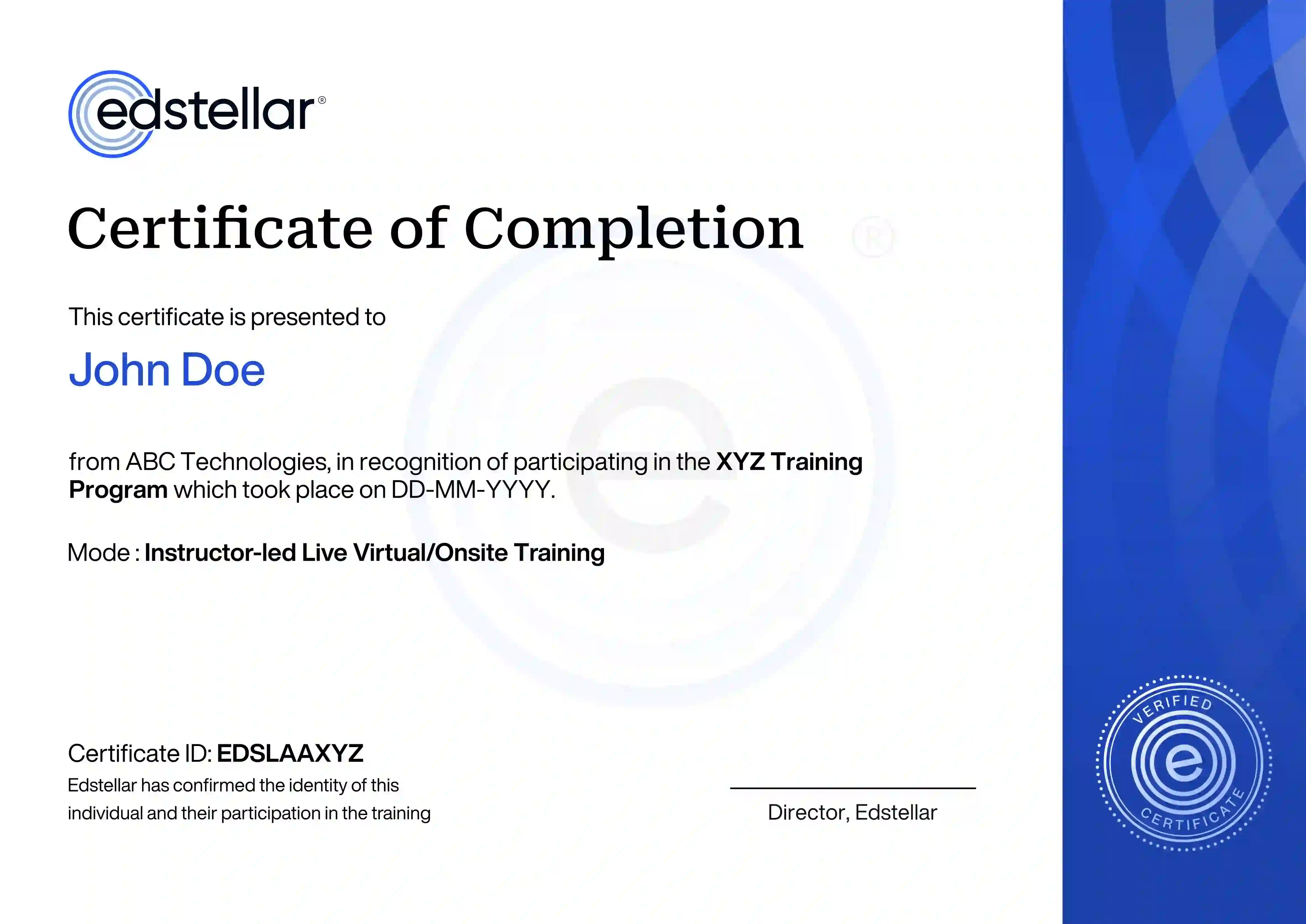
Upon successful completion of the training course offered by Edstellar, employees receive a course completion certificate, symbolizing their dedication to ongoing learning and professional development.
This certificate validates the employee's acquired skills and is a powerful motivator, inspiring them to enhance their expertise further and contribute effectively to organizational success.


Explore More Courses
Edstellar is a one-stop instructor-led corporate training and coaching solution that addresses organizational upskilling and talent transformation needs globally.
Marketing Excellence
Operational Excellence
Finance Excellence
HR Excellence
IT Excellence
Customer Service
Leadership Excellence
Quality Management
Software
How it WorksFAQ'sCorporate Training
CatalogStellar AI
Skill MatrixHRMS Integration
Who we ServeCEO RetreatsPricingTraining DeliveryPartner with Edstellar
CareersContact us