.webp)
Corporate SWIFT Training Course
Edstellar's instructor-led Swift training course empowers teams with Swift programming skills to enhance iOS app development efficiency and innovation for the organization. The course equips employees to write clean, secure Swift code, develop scalable and high-performance apps, and integrate Swift with APIs and third-party libraries.
(Virtual / On-site / Off-site)
Available Languages
English, Español, 普通话, Deutsch, العربية, Português, हिंदी, Français, 日本語 and Italiano
Drive Team Excellence with SWIFT Corporate Training
Swift is a modern, powerful programming language developed by Apple for building applications across iOS, macOS, watchOS, and tvOS platforms. It is required for organizations looking to create high-performance, secure, and scalable applications that provide an excellent user experience. Using Swift, companies can streamline their app development process, reduce maintenance time, and stay competitive in the fast-evolving mobile and software development industry. Swift training course equips teams with the skills and expertise needed to develop and maintain robust applications efficiently, ensuring the organization remains at the forefront of innovation.
Edstellar's instructor-led Swift training course offers virtual/onsite training options from industry experts with years of experience in mobile app development. The training provides a hands-on learning experience with practical exercises, customized curriculums to fit the organization's needs, and up-to-date knowledge of Swift's features. The course equips employees with the skills to write efficient, secure, and maintainable code, enabling them to contribute effectively to project success.

Skills Your Employees Will Gain
These are the core, hands-on capabilities your team builds during the program.
- Syntax MasterySyntax Mastery is the ability to understand and apply grammatical structures effectively. this skill is important for roles in writing, editing, and programming, ensuring clarity and precision.
- Memory ManagementMemory Management is the process of efficiently allocating, using, and freeing memory in computing. This skill is important for software developers to optimize performance and prevent leaks.
- Error HandlingError Handling is the process of anticipating, detecting, and resolving errors in software or systems. This skill is important for developers and IT professionals to ensure reliability, enhance user experience, and maintain system integrity.
- API IntegrationApi Integration is the process of connecting different software applications via apis to enable data exchange. this skill is important for developers and system architects to streamline workflows, enhance functionality, and improve user experiences.
- User Interface DesignUser Interface Design is the process of creating intuitive and visually appealing interfaces for software and applications. This skill is important for UX/UI designers as it enhances user experience, ensuring usability and satisfaction.
- iOS App DevelopmentiOS App Development is the process of creating applications for Apple's iOS platform. This skill is important for developers to build innovative, user-friendly apps that enhance user experience and drive business growth.
What Your Team Will Achieve After This Training
- Develop and implement secure and scalable solutions using Swift in real-world projects
- Analyze and optimize app performance to meet industry standards and organizational goals
- Design and create cross-platform applications by leveraging Swift’s advanced functionalities
- Apply Swift syntax to build high-performance mobile applications for iOS and macOS platforms
- Utilize debugging and troubleshooting techniques to resolve Swift-related issues during app development
Topics & Program Outline
The curriculum is organized into focused modules built by industry experts and delivered virtually or on-premise. Interactive sessions reflect the evolving demands of the workplace, keeping the learning both relevant and practical.
- Introduction to Swift
- A brief history and evolution of Swift
- The differences between Swift and Objective-C
- Exploring the key features of Swift
- Setting up the Swift development environment
- Introduction to playground
- Creating a playground in Xcode
- Writing and running Swift code in a playground
- Exploring Swift’s REPL (read-eval-print loop)
- Testing and debugging code snippets in playground
- Variables and constants
- Understanding the difference between variables and constants
- Declaring and using variables in Swift
- Working with constants and immutability in Swift
- Using type inference with variables and constants
- Optional & forced unwrapping
- Understanding optionals in Swift
- Using optional binding and optional chaining
- Forced unwrapping of optionals
- Avoiding crashes with optional unwrapping techniques
- Class and objects
- Understanding object-oriented programming in Swift
- Creating classes and objects in Swift
- Initializers and deinitializers in Swift
- Inheritance and polymorphism in Swift
- Playing with methods
- Defining and calling methods in Swift
- Understanding method parameters and return types
- Working with class and instance methods
- Using access control in methods
- Introduction to iOS
- Overview of iOS as a mobile operating system
- The iOS app lifecycle and architecture
- Key components of iOS app development
- What’s different about coding for iOS
- Differences between iOS and other mobile platforms
- Design and user experience guidelines for iOS apps
- Introduction to Apple’s Human Interface Guidelines
- A top-down tour of the layers
- Overview of iOS application layers
- Interaction between layers and application architecture
- Understanding the role of Core OS, Core Services, Media, and Cocoa Touch
- About UIKIT, Cocoa Touch
- Introduction to UIKIT for building iOS user interfaces
- Understanding the Cocoa Touch framework
- Key elements of the iOS user interface (views, view controllers)
- The Xcode workspace window
- Exploring the components of the Xcode workspace
- Customizing the workspace for development needs
- The toolbar
- Understanding the toolbar’s functions for building and running apps
- Managing breakpoints and debugging tools from the toolbar
- The navigator view
- Using the symbol navigator for accessing project files
- Searching and navigating within the project files
- Utilizing the debug navigator and managing breakpoints
- The jump bar
- Efficiently navigating through code using the jump bar
- Understanding the structure of files and methods
- The utility pane
- Working with inspectors in the utility pane
- Managing project attributes and resources
- View controller
- Introduction to MVC (Model-View-Controller) design pattern in iOS
- Working with view controllers to manage views
- Outlets and actions
- Connecting UI components with code using outlets and actions
- Handling user interaction through actions
- Button and action methods
- Creating buttons and assigning action methods
- Managing touch events and interactions
- Image view and text fields
- Adding and configuring image views in the interface
- Handling user input through text fields
- Closing keypad
- Implementing gestures to close the keyboard
- Handling form validation and interaction
- Slider and label
- Using sliders to control values dynamically
- Connecting sliders with labels to display selected values
- Tags
- Using tags to identify and manage multiple UI elements
- Checkbox and radio
- Implementing checkboxes and radio buttons in the UI
- Alert controller
- Creating alerts to notify users of events
- Adding actions to alert controllers for user interaction
- Switches and segment controls
- Using switches to toggle states
- Working with segmented controls for navigation and selection
- Web view
- Embedding web views in your iOS app
- Displaying web content within your application
- More UI components
- Exploring additional components like progress bars, steppers, and more
- Mechanics of autorotation
- Understanding how iOS handles autorotation
- Configuring auto-rotation in different view controllers
- Points, pixels, and retina display
- Understanding how points, pixels, and resolution affect UI design
- Designing for retina and non-retina displays
- Autorotation approaches
- Using Auto Layout and constraints for handling rotation
- Programmatically handling autorotation changes
- View orientation
- Managing different view orientations (portrait, landscape)
- Auto-sizing with different Apple devices
- Using Auto Layout for adaptive UI across multiple Apple devices
- Architecture of the multi-view application
- Understanding the architecture of multi-view applications in iOS
- Managing transitions between multiple views
- Root controller
- Working with root view controllers for navigation
- Setting up initial view controllers
- Navigation controller
- Managing hierarchical navigation using a navigation controller
- Customizing the navigation bar
- Tab bar controller
- Using tab bar controllers for multi-view applications
- Adding multiple view controllers to a tab bar
- Segues
- Using segues to transition between views
- Programmatic vs. storyboard segues
- Date picker
- Configuring date pickers for selecting dates and times
- Single component picker
- Implementing single component pickers for selecting a single value
- Multi-component picker
- Using multi-component pickers for selecting multiple values
- Custom picker with images
- Creating custom pickers with image components
- Delegates and data sources
- Managing picker delegates and data sources for custom behavior
- Working with table view
- Setting up and customizing table views
- Managing table view cells and sections
- Working with table view controller
- Implementing table view controllers for dynamic content
- Handling user interactions in table views
- Grouped and indexed section
- Grouping and indexing sections in table views
- Customizing section headers and footers
- Header and footer
- Adding custom headers and footers to table views
- Custom table view
- Creating and configuring custom table view cells
- Connecting view controller with table view controller
- Connecting view controllers with table view controllers for data management
- Store data in a file
- Writing and reading data from files on iOS
- Core data
- Introduction to Core Data for managing data persistence
- Creating and managing Core Data models
- SQLite databases
- Using SQLite for database storage in iOS
- Accessing remote database (Web services)
- Accessing and managing data from remote databases using web services
- Overview of Grand Central Dispatch
- Understanding concurrency in iOS with GCD
- Slow worker
- Identifying and handling slow tasks in background threads
- GCD: Playing with queues
- Working with queues for background processing
- Background processing
- Implementing background tasks for long-running operations
- Taps gesture
- Detecting and handling tap gestures in iOS
- Pinch gesture
- Implementing pinch-to-zoom functionality
- Rotation gesture
- Using rotation gestures for interactive UI components
- Swipe gesture
- Detecting swipe gestures for navigation and actions
- Pan gesture
- Managing pan gestures for dragging and sliding
- Screen edges pan gesture
- Implementing screen-edge gestures for side menus and navigation
- Long press gesture
- Detecting long-press gestures for contextual actions
- iOS core location framework
- Using Core Location to access device location
- iOS map kit framework
- Displaying maps and map data using MapKit
- The location manager
- Managing location updates with the location manager
- Getting location updates
- Handling real-time location updates
- Visualizing your movement on a map
- Displaying real-time location tracking on maps
- Annotation
- Adding and managing annotations on maps
- Latitude & longitude
- Working with latitude and longitude for positioning
- Image picker controllers
- Implementing image picker controllers for photo selection
- Camera and library
- Accessing the camera and photo library for capturing and selecting images
- UI collection
- Displaying a collection of images using collection views
- Playing video using a URL
- Streaming and playing video using remote URLs
- Playing videos using resource
- Playing locally stored videos in the app
- Working with audio
- Implementing audio playback and recording features
- Localization architecture
- Structuring your app for localization and internationalization
- Localize application
- Implementing multi-language support in your app
- Overview of deployment of application
- The process of preparing and deploying iOS apps
- Generating certificate request
- Creating and managing certificates for app deployment
- Provision profile
- Setting up provisioning profiles for app distribution
- App ID creation
- Managing app IDs in the Apple Developer portal
- Deploy application
- Submitting the app to the App Store and managing distribution
Who Should Attend?
This program suits professionals at many levels across the organization, including:
- Financial Analysts
- Payment Processing Specialists
- Banking Operations Managers
- Treasury Managers
- Risk Managers
- Compliance Officers
- Transaction Monitoring Analysts
- SWIFT System Administrators
- IT Security Analysts
- Settlement Officers
- Payment Services Managers
- Cash Management Specialists
What are the Prerequisites?
Employees with a basic understanding of object-oriented programming concepts can take the Swift course.
Choose the Format That Fits Your Team
We design training your teams actually engage with, and deliver it the way that suits you best. Through a vetted global trainer network, Edstellar runs sessions in 10+ languages with consistent quality anywhere.


.webp)
Virtual / online: expert-led live sessions delivered anywhere, with consistency and easy scheduling.
.webp)
On-site (in-house): immersive, instructor-led learning at your office.
.webp)
Off-site: focused, instructor-led group learning away from everyday workplace distractions.
Get a Proposal Shaped to Your Needs
Need pricing for onsite, offsite, or virtual delivery? Get a proposal tailored to your team's needs.
64 hours of group training (includes VILT/In-person On-site)
Tailored for SMBs
Tailor-Made Trainee Licenses with Our Exclusive Training Packages!
160 hours of group training (includes VILT/In-person On-site)
Ideal for growing SMBs
Tailor-Made Trainee Licenses with Our Exclusive Training Packages!
400 hours of group training (includes VILT/In-person On-site)
Designed for large corporations
Tailor-Made Trainee Licenses with Our Exclusive Training Packages!
Unlimited duration
Designed for large corporations
What Sets Edstellar Apart
Experienced Trainers
Our trainers are drawn from a vetted global network and bring years of industry expertise, keeping every session practical and impactful.
Proven Quality
With a strong global track record, Edstellar is known for quality and engaging delivery.
Industry-Relevant Curriculum
Our programs are built by experts to match the demands of today's industry.
Fully Customizable
Every program can be tailored to your organization's goals.
Comprehensive Support
We provide pre- and post-session support for a complete learning experience.
Global Multi-Location & Multilingual Training Delivery
We deliver in multiple languages to support diverse global teams.
Hear from Organizations We've Trained
"The SWIFT course revolutionized how I approach my daily responsibilities. As a Senior Software Engineer, understanding practical applications was essential, and this training delivered beyond all expectations. The real-world experience. I've successfully implemented these advanced techniques in production environments with measurable impact. The instructor's insights on expert-led workshops have proven instrumental in my professional advancement.”
Fletcher Chandler
Senior Software Engineer,
Enterprise Software Development Firm
"This SWIFT course was precisely what I needed to design robust strategic implementation architectures. The hands-on approach to hands-on exercises and seamless integration with practical simulations was outstanding projects using advanced techniques from this training. Client engagement and retention metrics have improved significantly across our practice. The comprehensive curriculum has elevated my solution delivery capabilities significantly.”
Vlad Popescu
Senior Software Engineer,
Global Technology Solutions Provider
"The SWIFT training transformed our team's entire approach to strategic implementation management and execution. As a Senior Software Engineer, the extensive coverage of industry best practices, real-world case these proven concepts to enhanced capabilities. We've successfully deployed these methodologies across all regional operations centers. Our team's productivity and solution quality have improved measurably, validating this investment.”
Shankar Lawrence
Senior Software Engineer,
Technology Consulting Services Company
“Edstellar’s IT & Technical training programs have been instrumental in strengthening our engineering teams and building future-ready capabilities. The hands-on approach, practical cloud scenarios, and expert guidance helped our teams improve technical depth, problem-solving skills, and execution across multiple projects. We’re excited to extend more of these impactful programs to other business units.”
Aditi Rao
L&D Head,
A Global Technology Company
Recognition That Motivates Your Team
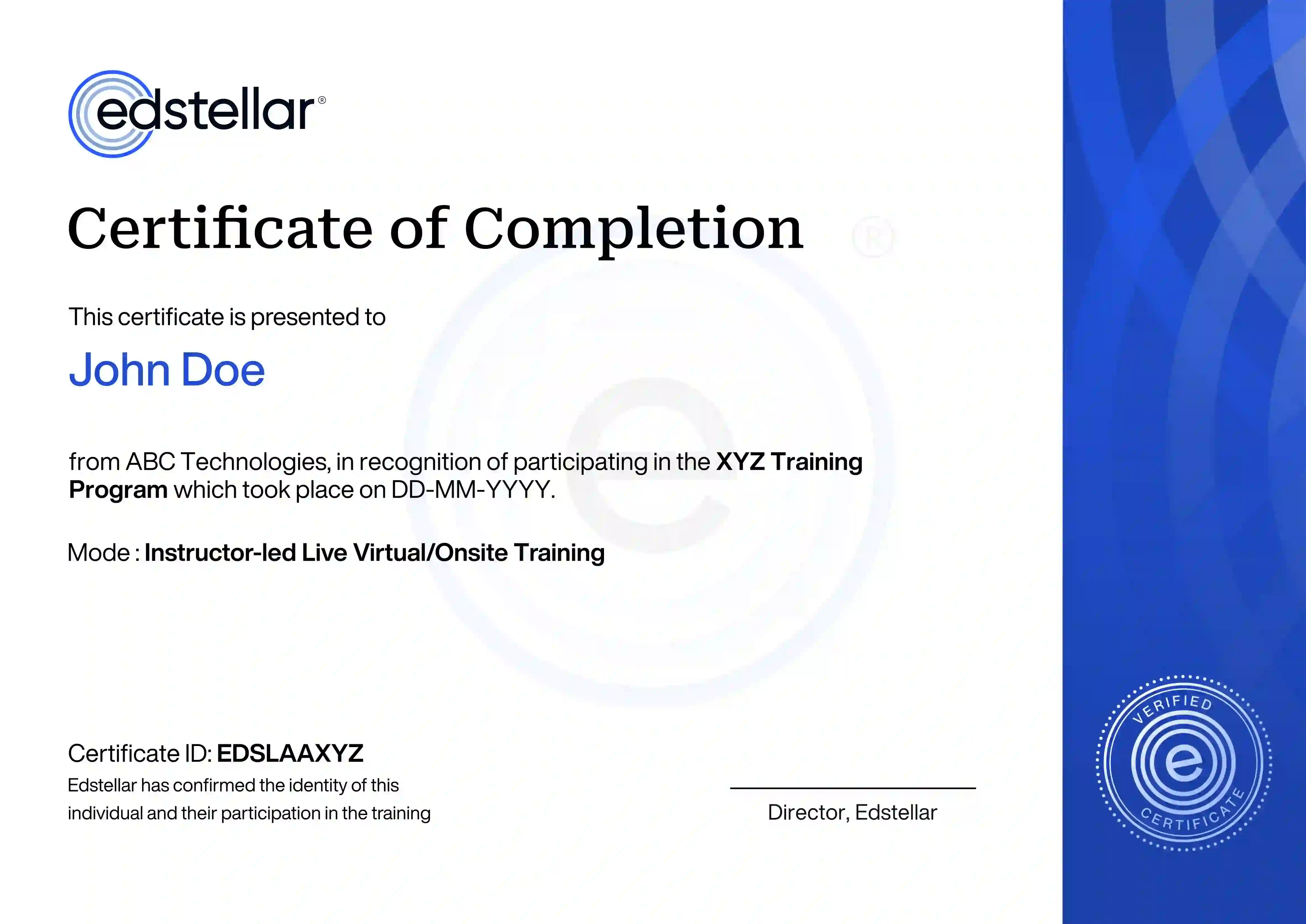
Upon successful completion of the training course offered by Edstellar, employees receive a course completion certificate, symbolizing their dedication to ongoing learning and professional development.
This certificate validates the employee's acquired skills and is a powerful motivator, inspiring them to enhance their expertise further and contribute effectively to organizational success.


We have Expert Trainers to Meet Your SWIFT Training Needs
The instructor-led training is conducted by certified trainers with extensive expertise in the field. Participants will benefit from the instructor's vast knowledge, gaining valuable insights and practical skills essential for success in Access practices.
Explore More Courses
Edstellar is a one-stop instructor-led corporate training and coaching solution that addresses organizational upskilling and talent transformation needs globally.
Marketing Excellence
Operational Excellence
Finance Excellence
HR Excellence
IT Excellence
Customer Service
Leadership Excellence
Quality Management
Software
How it WorksFAQ'sCorporate Training
CatalogStellar AI
Skill MatrixHRMS Integration
Who we ServeCEO RetreatsPricingTraining DeliveryPartner with Edstellar
CareersContact us


.webp)